e-Literate

Present is Prologue

Tag: online learning

  • Christensen Scorecard: Data visualization of US postsecondary institution closures and mergers

    Christensen Scorecard: Data visualization of US postsecondary institution closures and mergers

    In 2013, Harvard Business professor Clayton Christensen made a bold prediction based on his ubiquitous innovation theory that maybe half of all postsecondary institutions could close within 10-15 years.

    (source: https://youtu.be/KYVdf5xyD8I, starting at 6:25)

    The scary thing is that 15 years from now, maybe half of the universities will be in bankruptcy, including the state schools. But in the end, I’m excited to see that happen.

    Christensen then doubled down on his predictions in 2017, humorously saying it might take nine years instead of ten.

    (source: https://youtu.be/4ljlUOV-Uj4, starting at 1:04:42)

    Q. Do you still believe, as you’ve said before, that as many as half of colleges and universities will be bankrupt or closed within a decade?

    A. Um, yes. [snip] Whether the providers get disrupted within a decade — I might bet that it takes nine years rather than 10. Maybe I’m too scared about the Harvard Business School to be rational about it. But we should worry.

    There have been plenty of articles written about these claims, but it has been frustrating that very few back up their analysis with data. One exception is Derek Newton’s article critiquing the claims in Forbes, titled “No, Half Of All Colleges Will Not Go Bankrupt”.

    Look at the numbers. In the 2013-14 year, there were 3,122 four-year colleges according to the Department of Education. In 2017-18, the most recent data, there were 2,902 – a drop of about 7% over four years. That could be disruptive. But numerically, all of school closures since Christensen made his 2013 forecast were four-year, for-profit schools, which fell from 769 in 2013 to 499 in 2017 – a drop of 270. Of all the colleges, at all levels, that have closed since 2013, 95.5% of them were for-profit institutions.

    Another exception is Michael Horn’s explanation of the predictions (he co-authored the New York Times op-ed from 2013, titled “Innovation Imperative: Change Everything”, that included the initial prediction). This 2018 post “Will half of all colleges really close in the next decade?” also sought to go back to original, more nuanced claims of 25% closures and mergers at the Christensen Institute.

    Translation? Our predictions may be off, but they are directionally correct.

    To that I emphasize one more piece of nuance. Ultimately we are really predicting a failure rate, made up of a combination of closures, mergers or acquisitions, and bankruptcies in which a college or university has the opportunity to restructure itself. Not all universities that “fail” will disappear. [snip]

    From 2004–2014, “Closures among four-year public and private not-for-profit colleges averaged five per year from 2004-14, while mergers averaged two to three,” according to Moody’s. Moody’s predicted in 2015 that that closure rate—out of 2,300 institutions—would triple by 2017, and the merger rate would double.

    Assuming that were true, and say that the rate held steady for 15 years, that would take out roughly 13% of existing higher education institutions right there.

    Thanks to our partners with our LMS Market Analysis service, LISTedTECH, we can now provide data visualizations to better evaluate the validity or likelihood of these claims. For the first time that I’m aware of, we have visualizations showing combined closures and mergers over time, broken down by sector and degree-type, and showing data 2-3 years in advance of IPEDS publications.

    The LISTedTECH data shown below tracks known closures and mergers, which have then been checked against both IPEDS and Federal Student Aid data sets. There are translation issues in all three data sets, so the data will not match 100% – probably more at the 80 – 90% confidence level. The first view shows combined closures and mergers per year, broken out by control and whether they are classified as 2-year or 4-year degree-granting institutions.
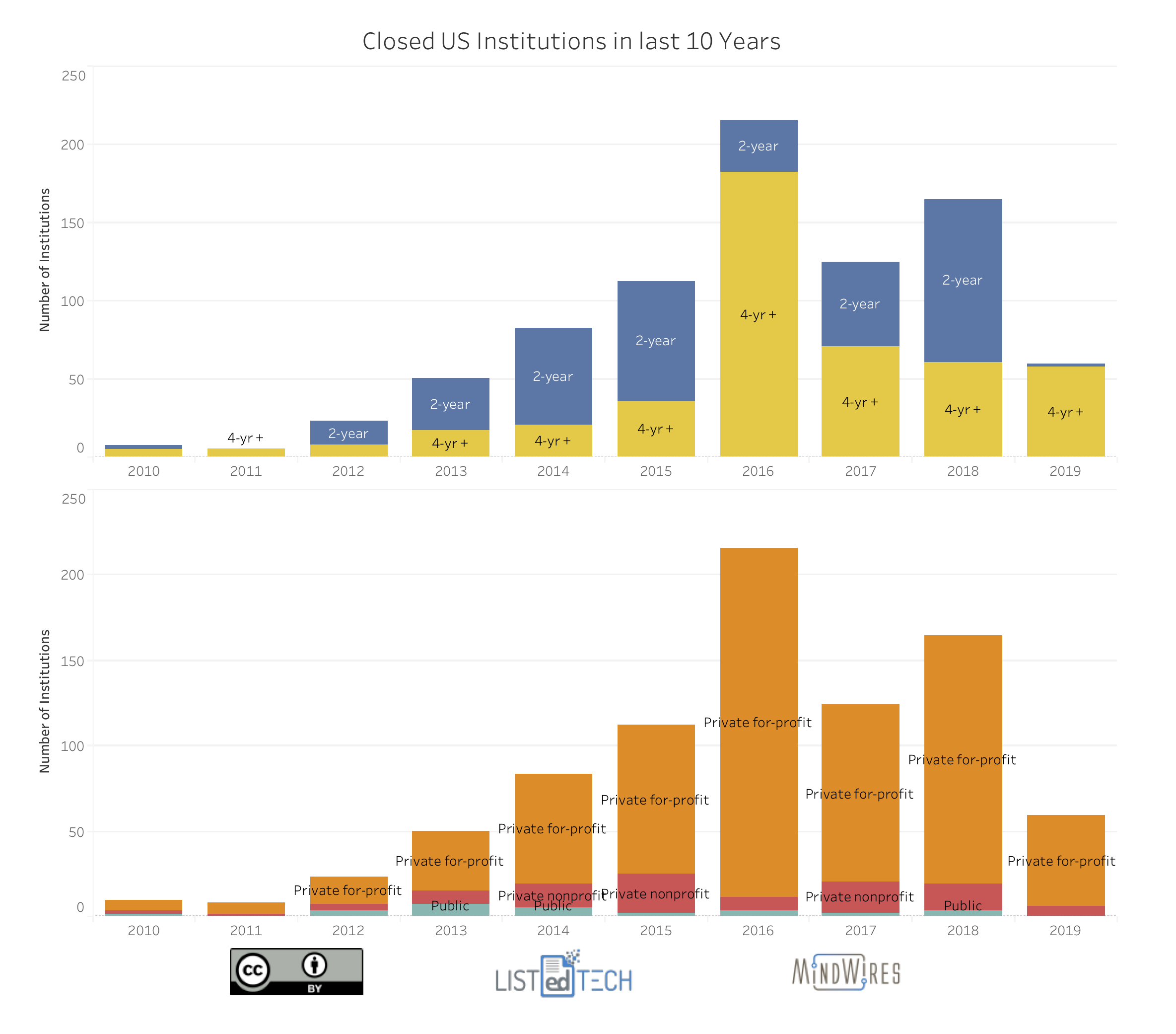
    Closed US higher ed schools over past decade

    As Derek Newton and Michael Horn pointed out, the vast majority of closures were from the for-profit sectors. Part of the dynamic at play is that when a large for-profit chain meets its demise (e.g. Corinthian Colleges, ITT, Westwood Colleges) or has a massive downturn (e.g. University of Phoenix) literally dozens of individual institutions close, whereas when a small private nonprofit college in New England closes, it is one school. Add to the that the massive drop in for-profit enrollments since 2012.

    The public sector data in 2013 and 2014 is largely driven by reorganizations in the University System of Georgia.

    Also note that the 2019 data only includes the first quarter.

    If we want to track the Christensen (and Horn) predictions, however, we need to view this data as a running total.
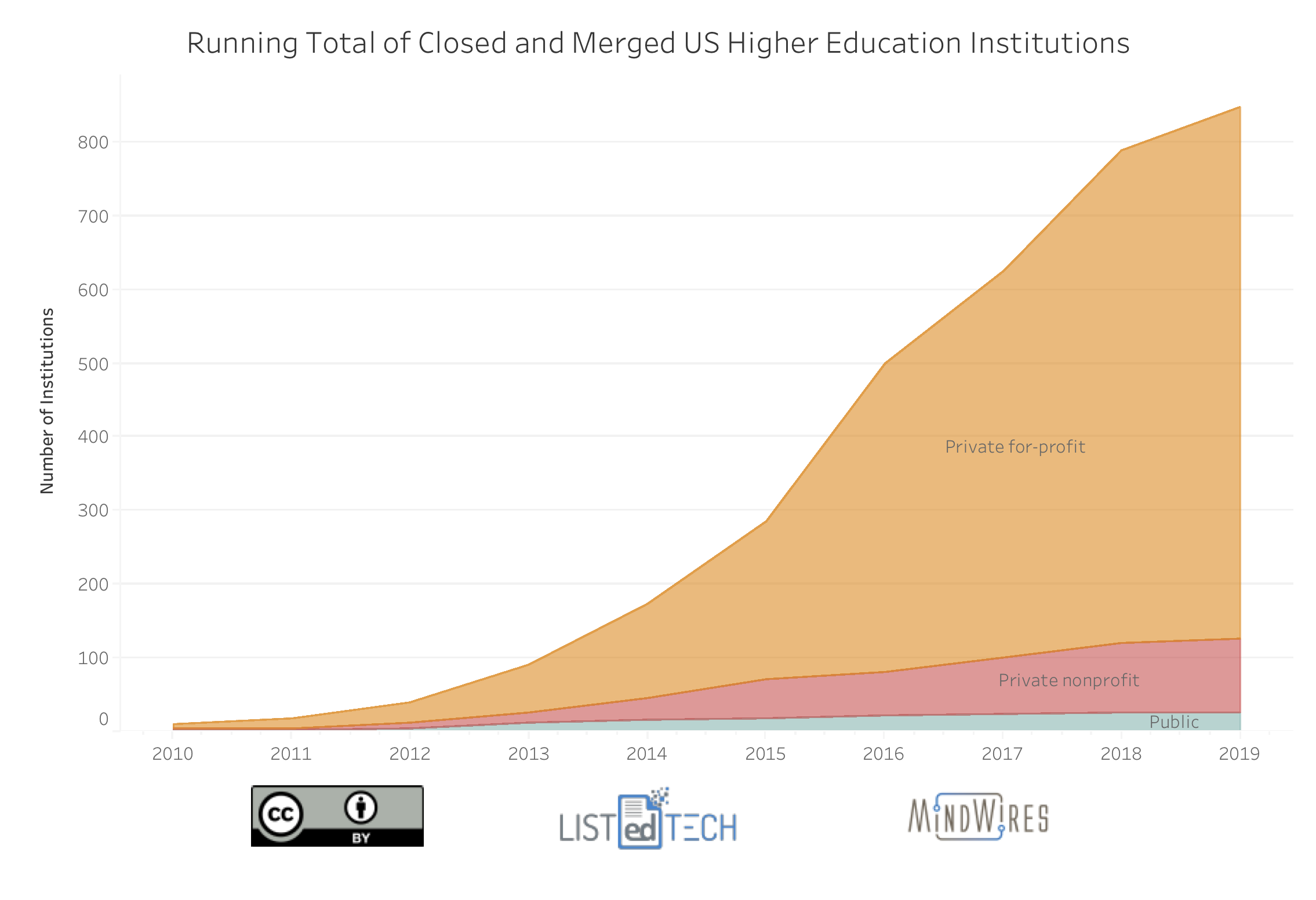
    Running total of closed and merged US higher ed institutions

    Let’s zoom out to capture the timeline of the most recent predictions of a decade from 2017, and let’s add the rough levels indicated (using bold row from this IPEDS table to define number of institutions).

    Running total of closed US institutions with trend lines

    If you include all degree-granting institutions (i.e. for-profits as well as private nonprofits and publics), then the current trends lines show that the 50% closure prediction by 2027 certainly seems feasible. Note, however, is that there are less than 1,000 for-profit institutions remaining as of Fall 2017 IPEDS data, and the rate of for-profit closures cannot continue more than another 8-10 years (best case / worst case, take your pick).

    There are quite a few stories recently about private nonprofit small-school closures, but the data thus far don’t show a rapid acceleration of closures. Some perspective is useful here.

    If you ignore the for-profit sectors, then the trend line for private nonprofit and public institution closures + mergers remains far below that needed to hit the 25% level described by Horn or the 50% level described by Christensen. None of this is to say that the trends moving forward will be linear, however. The rate of private nonprofit and public closures and mergers would need to at least triple to hit the more conservative level of 25% within a decade, a possibility that I would not reject out of hand. And it turns out that Moody’s was wrong – the rate of closures and mergers in this group did not triple from 2015 – 2017. Nevertheless, the data could get worse.

    We’ll share more information on this new data, but hopefully these visualizations provide a better sense of the trends on college closures and mergers.

  • Lost in Translation: Why it’s important to consult the original research

    Lost in Translation: Why it’s important to consult the original research

    Last week the Brookings Institute published an article in its Economic Studies: Evidence Speaks series titled “Promises and pitfalls in online learning,” by Eric Bettinger and Susanna Loeb of Stanford University. The article is a condensed summary of a lengthier draft research paper, “Changing Distributions: How Online College Classes Alter Student and Professor Performance” that was supported by the Stanford Center for Education and Policy Analysis (CEPA) and includes two additional authors, Lindsay Fox (Stanford) and Eric Taylor (Harvard). The Brookings’ article was first reported by Inside Higher Ed earlier this week in a piece called “Is Online Ed Missing the Mark?”

    I note the cascading levels of publication to draw attention to the occasional pitfalls of relying on reporting and journal summaries and the benefits of reading the original research. It reminds me a little bit of the time I spent working for a school board member in the L.A. Unified School District. An article would sometimes appear in a local paper, and what was reported would have little to do with the reality of what was actually being covered, or at least miss a lot of the complexity (that said, there was excellent reporting as well).

    (more…)

  • Recommended Reading: What Do Faculty Really Think of Online Learning?

    …As it turns out, it depends.

    Inside Higher Ed recently published its fifth annual  Survey of Faculty Attitudes Toward Technology, conducted in collaboration with researchers from Gallup. These reports cover a range of attitudinal questions on ed tech, online education, and new models of delivering course content. One of the key findings of this year’s report, as described in a Gallup blog,  is that there is still a high level of disagreement among faculty of the relative merits of online courses versus traditional face to face courses, but there are some important nuances to the results. The survey finds that a majority of faculty (55%) “disagree or strongly disagree” with the idea that online courses can deliver the same student outcomes that in-person courses produce. Among faculty who have actually taught online, however, there is a much more positive view of the ability for online education to match in-person courses. (more…)

  • Babson Study of Online Learning Released

    Babson Survey Research Group (BSRG) just released its annual survey of online learning in US higher education (press release here). This year they have moved from use of survey methodology for the online enrollment section to use of IPEDS distance education data. Russ Poulin from WCET and I provided commentary on the two data sources as an appendix to the study.

    The report highlights the significant drop in growth of online education in the US (which I covered previously in this e-Literate post). Some of the key findings:

    • Previous reports in this series noted the proportion of institutions that believe that online education is a critical component of their long-term strategy has shown small but steady increases for a decade, followed by a retreat in 2013.
    • After years of a consistently growing majority of chief academic officers rating the learning outcomes for online education “as good as or better” than those for face-to-face instruction, the pattern reversed itself last year.
    • This report series has used its own data to chronicle the continued increases in the number of students taking at least one online course. Online enrollments have increased at rates far in excess of those of overall higher education. The pattern, however, has been one of decreasing growth rates over time. This year marks the first use of IPEDS data to examine this trend.
    • While the number of students taking distance courses has grown by the millions over the past decade, it has not come without considerable concerns. Faculty acceptance has lagged, concerns about student retention linger, and leaders continue to worry that online courses require more faculty effort than face-to-face instruction.

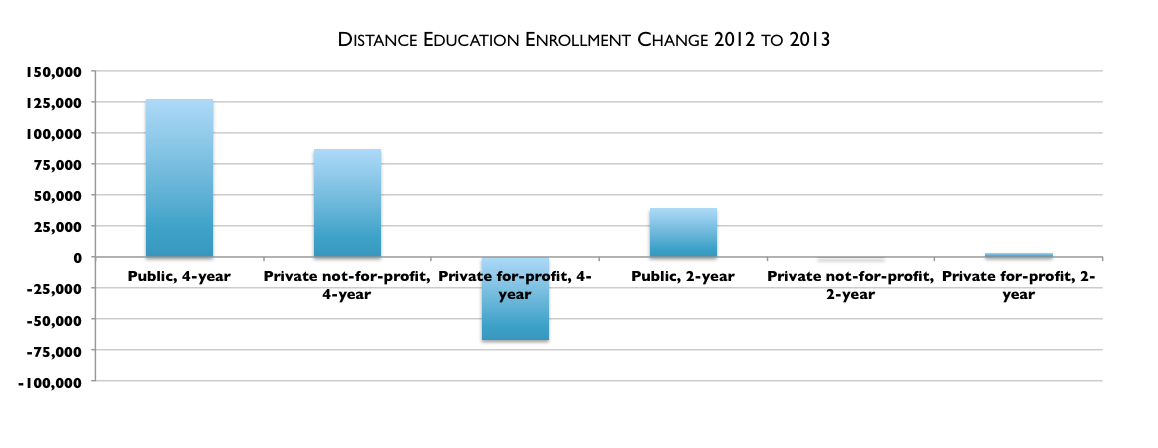
    BSRG looked at the low growth (which I characterized as ‘no discernible’ growth’ due to noise in the data) and broke down trends by sector.

    Growth by sector

    (more…)

  • A response to New Yorker article on ‘A MOOC Mystery’

    The New Yorker published an article yesterday titled “A MOOC Mystery: Where Do Online Students Go?” which tried to explain low MOOC completion rates by comparing the situation to the General Educational Development (GED) exam. Right off the bat, the article conflates MOOCs with “online students”. MOOCs are but one form of online education, and a very recent one at that. Worse, however, is that the entire basis for the article is quite flawed – GED results do not give much insight into MOOC students patters, and it turns out there is not much of a mystery in the first place.

    The hook in this article seems to be the coincidence of two numbers [emphasis added]:

    (more…)

  • The Emerging Landscape of Educational Delivery Models

    Part 2 in this series, on a key difference in educational delivery methods, can be found here.

    Traditional education or online education. In the past decade it seems that the dominant conversation has been around the potential for online learning, both from for-profit and non-profit options, to disrupt education as an industry.

    What I believe we are seeing in 2011 and 2012 is a transition to an educational system no longer dominated by traditional education and one or two alternative models. As my colleague Molly Langstaff has described, educational technology and new educational courses and programs are interacting to create new language and models for education. What does this emerging landscape of educational delivery models look like?

    While I do not claim to be able to solve this problem, I would like to offer a more descriptive view than the dichotomy of traditional and online education describes.

    (more…)