e-Literate

Present is Prologue

Tag: Open Educational Resources

  • OER Survey and Adoption Growth: It pays to check source material

    OER Survey and Adoption Growth: It pays to check source material

    I had a trip to the UK this month and only had time to read media coverage of the recent Babson Survey Research Group (BSRG) survey on open educational resources (OER). What a mistake. The Chronicle of Higher Education had a flawed description of a key question – actual and planned adoption of OER material by faculty – that misinformed readers like me who didn’t read the actual survey report, at least initially.

    The open-educational-resources movement, commonly known as OER, is an effort to encourage academics to use open-licensed materials in their classrooms as a way to lower costs. Some nonprofits, like OpenStax, have produced textbooks based on this material. The survey shows that OER has made inroads: 22 percent of people who teach introductory courses, subjects in which free textbooks are most commonly available, use it as required material, up from 15 percent last year.

    Yet the percentage of faculty members who say they will use, or consider using, open materials in the next three years actually dropped slightly, with the numbers now at 6 percent and 32 percent respectively.

    On the surface, this description indicates that OER adoption increased for faculty teaching introductory courses, but the second paragraph shows a potential drop in adoption over the next three years for all faculty. That would be major news showing that the OER movement hit an inflection point and is likely to drop soon, even though faculty have a natural affinity for the same issues that OER offers – lower cost and the ability to remix / reuse.

    It turns out this interpretation is wrong. The actual BSRG survey report states the following [emphasis added]:

    Each year, this survey asks faculty members who are not current users of open educational resources whether they expect to be using OER in the next three years.

    This question is only for non OER-adopting faculty. In other words, it measures growth potential, not total adoption potential. In fact, the percentage of faculty who used required OER material in any of their courses more than doubled this year, and based on the question above should continue to grow. BSRG further described the numbers for non OER-adopting faculty.

    There have been minimal changes in the proportion of faculty who report that they will use OER in the next three years, dropping slightly from 7% in 2015-16 and 2016-17, to the 6% reported this year. The number who report that they “Will consider” OER grew from 31% in 2015-16 to 37% for 2016-17, before dropping to 32% for 2017-18.

    This description is poorly worded and misses the context provided earlier, which I assume was part of the problem with Chronicle coverage.

    As for actual adoption, the category of “all faculty” grew significantly over the past year.

    Nearly one-quarter of faculty that teach large enrollment introductory courses report that they are using OER in some fashion, with more of these faculty responding that use OER as supplemental rather than as required materials. The rates are lower across all faculty, with 13% reporting using OER as required course material in at least one of their courses.

    These numbers represent a large increase over those in previous years, with the overall faculty rate of required OER use climbing from 5% two years ago to 6% in 2016-17, and then making a large jump to 13% this year. Given the sometimes vague understanding of the OER and its licensing, care must be taken in interpreting these results. Are faculty lumping any free resource into the OER category, even those that are not licensed as OER? Based on previous results we have to assume that there is some level of over-reporting in these figures of OER use; we just don’t know how much of an impact this is having.
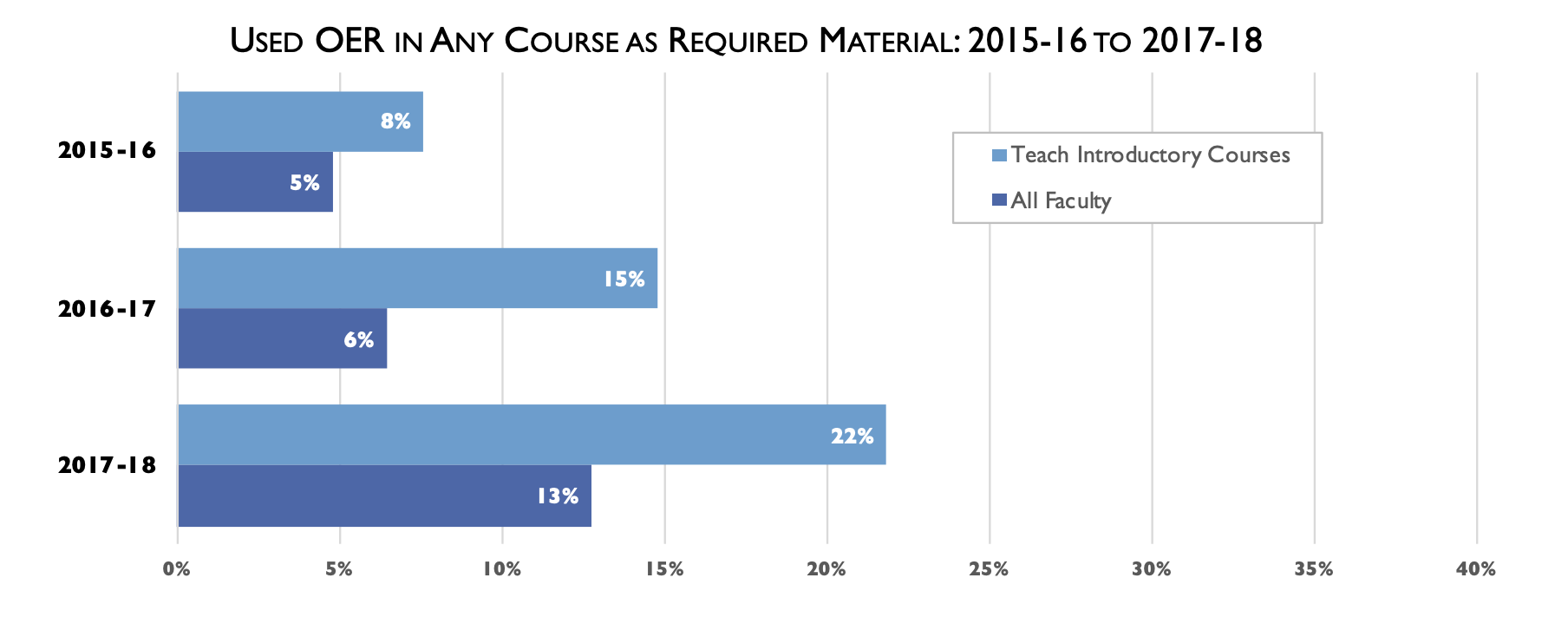
    Chart showing growth of OER adoption

    What is interesting is that this adoption growth aligns with an independent source, the Cengage OER survey from Fall 2016.

    Open Educational Resources (OER) in higher education have the potential to triple in use as primary courseware over the next five years, from 4 percent to 12 percent, according to a survey of more than 500 faculty by Cengage Learning.
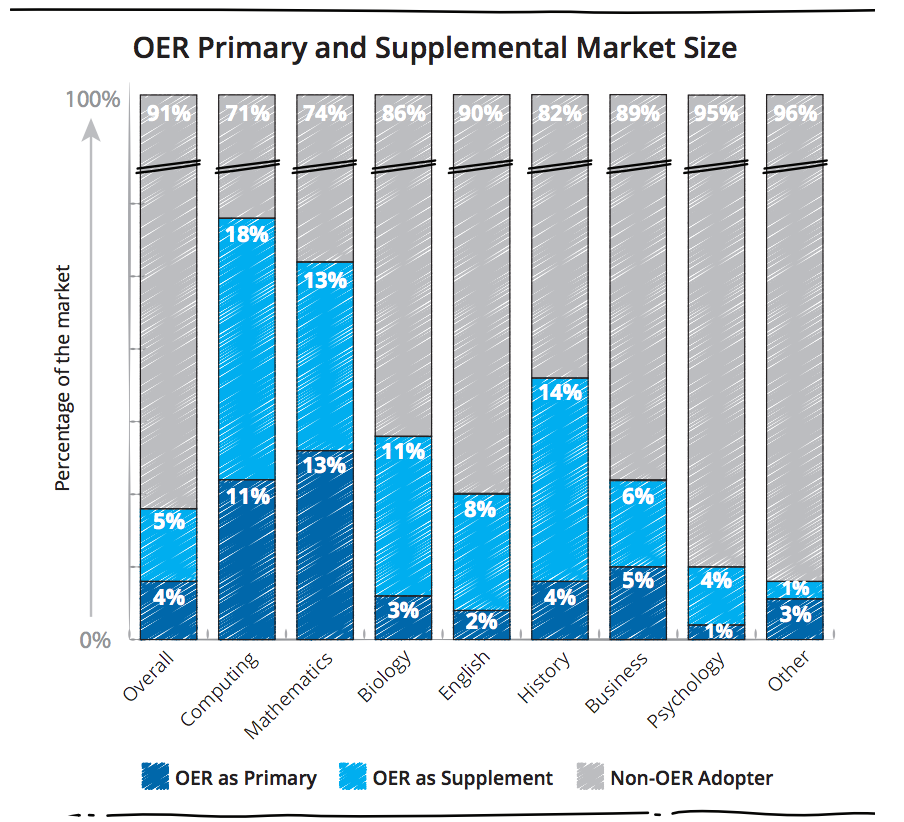
    What the data appear to show is significant growth in OER adoption for all faculty as well as for the subset teaching introductory courses. Adoption should continue, although it could be at a slower rate than was seen over the past year.

    It pays to read source material when the data describes important trends, especially when the results are surprising. I wish I had done this earlier.

  • Hawai’i Senate OER Bill Update: Amended language saves the day

    Hawai’i Senate OER Bill Update: Amended language saves the day

    On Friday I reported about SB2328, a bill that passed (with amendments) the Hawai’i Senate Committee on Higher Education and would have mandated open educational resources (OER) for all courses at all 10 University of Hawai’i campuses. And if there were no adequate OER materials for a course? “. . . the faculty member or lecturer responsible with providing instruction for the course shall create the instructional materials and offer those materials free of charge to students through open educational resources.”

    This bill was a disaster in the making. Not only would it have been unworkable in terms of funding and intellectual property ownership, it would also have set back the OER movement by associating OER with unfunded faculty mandates and reduction of academic freedom. All this from good intentions but apparently shallow understanding.

    As mentioned in an update to Friday’s posts, the amendments that resulted from committee hearings removed the mandates. We now have the amended language, and it is a completely different bill.

    Updated language:

    The purpose of this Act is to:

    (1) Establish the University of Hawai‘i open educational resources task force to conduct a comprehensive analysis and evaluation on all general education courses and high attendance courses taught at the University of Hawai‘i system to identify open educational resources for those courses;

    (2) Establish and appropriate funds for an open educational resources pilot project grant program to incentivize faculty that adopt, develop, and implement open educational resources; and

    (3) Require the University of Hawai‘i open educational resources task force to report its findings and recommendation initiatives for supporting and expanding the use of open educational resources at the University of Hawai‘i to the Legislature prior to the Regular Session of 2019.

    During the hearings there were several dozen testimonies shared, and all but two opposed the bill (and one of those two changed positions to oppose). Leading the opposition was the University of Hawai’i Professional Assembly, the local faculty union.

    In short, the bill amendments removed mandates, creates a task force charged with a one-year evaluation of high-enrollment and general ed courses, and creates a $50,000 grant fund to incentivize faculty adoption.

    It is not clear whether the bill will make it through remaining hurdles to become state law, but if it does, we will have a fairly significant move in the state dealing with the costs of curricular materials and OER adoption.

    Billy Meinke, OER Technologist and UH Manoa and a key player within the system (let’s call him Kane OER), was unaware of SB2328 before it came out. This gets to the heart of the problem – the original bill appears to have been written without any input from the people already working on OER adoption within the University of Hawai’i.

    I still have a problem with the preamble of the bill that uses the misleading claim that the “average cost for books and supplies for the same academic year at public colleges averaged $1,250.” Students actually pay about half this amount, and this false setup will lead to erroneous estimates of how much any such bill could save for its students. But for now, crisis averted.

  • Hawai’i Senate Bill: Would mandate OER material for all U Hawai’i system courses

    Hawai’i Senate Bill: Would mandate OER material for all U Hawai’i system courses

    Thanks for update from Brent Auernheimer, I found out that the Hawai’i Senate Committee on Higher Education recently debated a bill regarding Open Educational Resources (OER) usage at the University of Hawai’i system of 10 campuses. Introduced on January 19th, SB2328 states:

    Beginning with the 2020-2021 school year, all courses at all campuses within the University of Hawai‘i system that require the use of instructional materials, including textbooks, shall use instructional materials from the open educational resources at the University of Hawai‘i; provided that the use of instructional materials, including textbooks, that requires a student to purchase or pay a subscription for the materials shall be prohibited; provided further that if open educational resources does not have relevant instructional materials available for a course, the faculty member or lecturer responsible with providing instruction for the course shall create the instructional materials and offer those materials free of charge to students through open educational resources.

    Read that carefully – OER for all courses, no commercial services around OER allowed, and if appropriate OER does not exist, the faculty member must create the material themselves, all mandated from the state legislature.

    When I first saw this news, I assumed it was a either a misguided effort that would quietly be killed in committee or a political statement. Predictably, and appropriately, the University of Hawai’i Professional Assembly actively opposed this bill, calling it “legislative overreach” and “infringement on academic judgement”, while also calling out the costs and support needed for faculty to create such materials.

    On January 30 hearings, the vast majority of testimony – much of it from faculty members – opposed the measure with only two statements supporting. Yet on February 6, the Senate Committee unanimously passed the bill on to the full Senate.

    The committee(s) on HRE recommend(s) that the measure be PASSED, WITH AMENDMENTS. The votes in HRE were as follows: 5 Aye(s): Senator(s) K. Kahele, Kim, S. Chang, Keith-Agaran, Kidani; Aye(s) with reservations: none ; 0 No(es): none; and 0 Excused: none.

    I have not been able to determine what the amendments are for the bill (or if that refers to future amendments coming from floor debate), and I also do not know how likely it is to pass the full senate or to become state law. I’ll keep looking for more information.

    Unless I’m missing something, this could be a jump-the-shark moment for portions of the OER movement. Comments appreciated.

    Update: From Twitter stream (sounds like some good changes):

    https://twitter.com/billymeinke/status/962127447171907584

  • Cengage OpenNow: Big news on the OER front hiding in plain sight

    Cengage OpenNow: Big news on the OER front hiding in plain sight

    In the week prior to the OpenEd conference, Cengage Learning made a fairly big announcement with OpenNow, a “suite of digital products for general education courses with open educational resources (OER) content”. In an article from Inside Higher Education, I noted that this news was not out of the blue.

    Phil Hill, the co-publisher of the blog e-Literate and a partner at MindWires Consulting, said he was not surprised by Cengage’s OER announcement. “If you’ve been paying attention, you’ll know that Cengage has been saying for at least a year that they wanted to get into this space,” he said. Hill says he was surprised, however, at how aggressively Cengage seemed to be promoting OER with this announcement. “We’ve seen other publishers dipping their toes in, but this seems as if it is central to Cengage’s strategy.” He noted that the announcement could cause other publishers to accelerate their OER strategies. “The movement is not going away,” he said.

    Rather than looking at this specific news in isolation, it would be helpful to put this in some historical context showing the interplay of the OER movement and changing strategies from the big textbook publishers. We advise a number of large and small publishers in our role as consultants, and they occasionally ask us to help them to better understand some of the points we’ve been making about OER in our posts over the years. Put another way, here comes a thread of historical e-Literate quotes.

    In response to a 2011 article in the Chronicle titled “Publishers Criticize Federal Investment in Open Educational Resources”, Michael (then an employee of Cengage) chastised his fellow textbook industry professsionals, writing:

    Many different open source-related business models have been tried with varying degrees of success. Some open source projects have become sustainable as pure volunteer efforts while others have needed commercial support.

    I see no reason to believe that open educational resources will be any different. Right now, we’re in the early days. It’s very hard to predict which sustainability models will work or who the winners and losers will be. But I think it’s reasonable to predict that, five years from now (a) there will still be for-profit textbook publishers (though their all-digital products probably won’t be called textbooks by then) and (b) most or all for-profit textbook publishers will be involved with the production, support, and/or distribution of OERs in some way or other. There will likely be some OER projects that will have achieved long-term sustainability without commercial support and others that will have achieved long-term sustainability because of commercial support.

    It’s more than six years later, but (a) note the burgeoning category of courseware, and (b) see Pearson, McGraw-Hill Education, and Cengage initiatives, among others. Put simply, it was apparent that publishers needed OER strategies at least as far back as 2011.

    Fast forward to 2014 when Michael had departed Cengage to enter the joyous world of market analysis and consulting, he offered the observation that many publishers actually like OER:

    For the most part, OER was just not something publishers thought a lot about.

    That has changed in US higher education as it has become clear that textbook profits are collapsing as student find more ways to avoid buying the new books. The traditional textbook business is clearly not viable in the long term, at least in that market, at least at the scale and margins that the bigger publishers are used to making. So these companies want to get out of the textbook business. A few of them will say that publicly, but many of them say it among themselves. They don’t want to be out of business. They just want to be out of the textbook business. They want to sell software and services that are related to educational content, like homework platforms or course redesign consulting services. But they know that somebody has to make the core curricular content in order to for them to “add value” around that content. As David Wiley puts it, content is infrastructure. Increasingly, textbook publishers are starting to think that maybe OER can be their infrastructure. This is why, for example, it makes sense for Wiley (the publisher, not the dude) to strike a licensing deal with OpenStax. They’re OK about not making a lot of money on the books as long as they can sell their WileyPlus software. Which, in turn, is why I think that Wiley (the dude, not the publisher) is not crazy at all when he predicts that “80% of all US general education courses will be using OER instead of publisher materials by 2018.” I won’t be as bold as he is to pick a number, but I think he could very well be directionally correct. I think many of the larger publishers hope to be winding down their traditional textbook businesses by 2018.

    This point is crucial, as OER is not just an opportunity to co-opt a movement but a potential strategy for publishers to solve an existential problem.

    In 2016 Cengage released a survey on OER adoption and attitudes, which to me signaled that they were getting quite serious about figuring out their strategy.

    According to [VP of Content Strategy] Costantini, the reason Cengage did this study is that in their view OER is another type of content, and there are high-level conversations at schools about adoption. Costantini described Cengage as making a move for a while to not be as proprietary, with the MindTap platform as an example where multiple content types – proprietary and OER – can be combined or used individually. Cengage views themselves as excellent curators, and OER content fits into this view. They want to accelerate this shift, and internally they need to better understand the dynamics of OER usage.

    By spring of 2017, Cengage put further meat on the OER bone with the release of a podcast series, where I noted:

    And this new podcast fits in the same mold. Cengage does not fully understand OER, but they seem to like it and see it as a way to help them out of a hole, and while they learn more, the company is sharing their learnings through surveys, resource pages, and podcasts.

    Given some mistakes in how the podcast was released, I suggested that Cengage learn and use David Wiley’s description of the 5 Rs of open (Retain, Reuse, Revise, Remix, Redistribute) in their material. ((Disclosure: David Wiley’s company Lumen Learning is a client of MindWires.)) With this historical context in mind, let’s turn back to the OpenNow announcement and the next stage of Cengage’s move into OER strategy.

    In an interview with Cheryl Constantini, she described how Cengage released MindTap ACE last year and learned some key lessons about OER. While many people want affordable solutions, the market feedback according to Cengage was that if you’re going to go OER, go all in with OER – mixing with proprietary doesn’t resonate. This led to OpenNow as a pure OER play, unlike MindTap ACE.

    Constantini also described the market feedback on the need for simplicity and that MindTap ACE had too many features. This led to the choice of using Learning Objects, a platform Cengage acquired in 2016, to be the base for OpenNow. The approach is to take OER standard textbooks, realign them as outcomes-based design along with associated assessments and added videos, and release everything with an open license. Nine of the 12 initial courses are from OpenStax, and three are re-licensed courses from Cengage now with CC-BY licenses. The videos use YouTube open licenses.

    For each course Constantini estimates that the modifications take $50k – $100k of internal work, including verifying of licenses for embedded elements. I would note a certain irony here in that OpenStax produces more-or-less traditional digital textbooks requiring publishers or OER services companies like Lumen to break apart and realign to competencies or outcomes.

    Cengage charges $25 per student per course for OpenNow.

    The assessments and instructor manuals raise a “burning issue” about whether they should be accessible by students or not. Initially Cengage is adopting the OpenStax pattern of licensing openly but controlling by passwords; however, this is a subject they need to think through and figure out over time.

    At the OpenEd conference last month, there was significant interest in the OpenNow presentation with people spilling over into the hallway. The movement of publishers into the OER space is real, and this release from Cengage should be viewed as part of a long-term shift in strategy. And one that attempts to fully embrace OER as seen by this interesting description:

    • High-quality, 100% OER narrative and assessment content from Cengage, OpenStax and other third-party sources.
    • CC-BY-licensed (5Rs), so instructors and institutions can adapt and reuse all narrative and assessment content as needed.

    Update: Added description of pricing model.

  • Some Notes On Lumen Learning’s $3.75 million Funding Round Led By Follett

    Some Notes On Lumen Learning’s $3.75 million Funding Round Led By Follett

    Today’s biggest ed tech news was Lumen Learning – co-founded by David Wiley and Kim Thanos and focused on getting deeper adoption of OER in higher education – and their new round of funding. And this news goes beyond pure investment, as Follett, the large campus retailer that “serve[s] over half of the students in the United States, and work with 80,000 schools as a leading provider of education technology, services and print and digital content”, led the funding round.

    First up a disclosure: Lumen Learning is a client of MindWires (the consulting side of e-Literate, or our capitalistic alter ego), and we have had a consulting relationship with Lumen for almost 18 months. We mostly don’t blog about our consulting work, and I do not plan to describe our advice to them, but we are not neutral observers on this one.

    As described in the press release:

    Follett will offer Lumen Learning’s OER solutions to more than 1,200 colleges and universities where Follett manages course materials delivery. Given Follett’s ongoing mission to improve access and affordability for students, the company has invested in Lumen Learning to help fund future growth and expansion of OER courseware.

    (more…)

  • Cengage and OER Podcast Series: Two steps forward and one step back

    Cengage and OER Podcast Series: Two steps forward and one step back

    Last fall I wrote about Cengage, one of the big three publishers for higher education, sponsoring and releasing a survey on Open Education Resources (OER). The survey headline:

    Open Educational Resources (OER) in higher education have the potential to triple in use as primary courseware over the next five years, from 4 percent to 12 percent, according to a survey of more than 500 faculty by Cengage Learning. In addition, the use of OER for supplemental learning materials may nearly quadruple in size, from 5 percent to 19 percent.

    But the hidden headline could have been viewed by skeptics as “a publisher fully interested in OER – what’s the catch?”. As time goes on, it is looking more and more like there is no catch other than Cengage promoting OER and trying to understand the nature of OER internally while sharing those lessons. Today’s news is that on the company’s OER resource page they have launched a new podcast series titled “Journey to OER”.

    (more…)

  • About That Cengage OER Survey

    Last month Cengage Learning released a white paper titled “Open Educational Resources (OER) and the Evolving Higher Education Landscape” where the headline called out expected increases in OER adoption:

    Open Educational Resources (OER) in higher education have the potential to triple in use as primary courseware over the next five years, from 4 percent to 12 percent, according to a survey of more than 500 faculty by Cengage Learning. In addition, the use of OER for supplemental learning materials may nearly quadruple in size, from 5 percent to 19 percent.

    The 4 percent adoption of OER as primary courseware aligns with the Babson Survey Research Group (BSRG) finding of 5.3% using open textbooks (yes, we’re assuming the terms are interchangeable at least for the survey results). But the expectation that OER adoption may triple for primary usage and quadruple for supplemental is new. The BSRG did not estimate market growth – they just identified perceptions and barriers.

    There were enough causes for skepticism, however, that prevented me from taking the report at face value. A traditional textbook publisher touting OER growth while offering little data or methodology to back up their claims. The tendency for  some OER advocates to run with half-baked numbers. The question of open-washing and associated risk of redefining OER.

    I contacted Cengage and spoke to Cheryl Costantini, VP of Content Strategy to learn more about the study. Unfortunately, the deeper I dug the more credence I give to the results (unfortunate in terms of attention-grabbing blog post headlines). Long and short – the report seems like solid information despite a few flaws and need for broader sample size. (more…)