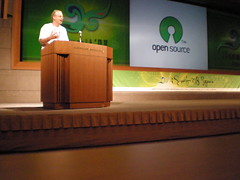
My fellow SUNY escapees Patrick Masson and Ken Udas are up to some good stuff now. They’ve started an EDUCAUSE constituent group on Openness–open source, open standards, open educational resources, open content, open management practices, etc. Their hope is that the disparate groups that tend to care about each of these strands will identify the common strands of philosophy and practice that will help universities develop more coherent policies and ways of doing business that are both practically beneficial and consistent with the values that universities ought to support. It’s an ambitious project, to be sure, but very important.
In concert with the new constituent group, the EDUCAUSE board has released a value statement on Openness. Here’s an excerpt:
A central pillar of the academic community is its commitment to the free flow of information and ideas. This commitment to sharing is essential to scholarly discovery and innovation. It is also central to helping learners engage, absorb, and apply knowledge in order to advance personally and academically. Finally, this commitment to openness provides the foundation for leveraging resources, both within and among institutions, to strengthen the creation, transmission, and preservation of knowledge.
The academic—and, by extension, social—value of unfettered intellectual exchange finds expression in technologies, applications, and approaches that foster sharing, collaboration, and open access to knowledge and resources. By actively encouraging collaboration, customization, and experimentation, open environments—whether social, cultural, or technological—best facilitate the free flow of information and ideas on which discovery, innovation, and high-quality higher education depend. In an IT context, examples include:
- Open standards and interoperability
- Open and community source software development
- Open access to research data
- Open scholarly communications
- Open access to, and open derivative use of, content
The constituent group meets at the conference this afternoon at 4:55 PM in Room W340D. I’ll see you there. And if you’re not at EDUCAUSE, you can find out more information about the effort here.

 Since I have made a commitment to take the umbrella concept of open education more seriously, this will be the first post in an occasional series in which I express my concerns about open education as a way of working through the issues. It is also part of an occasional series of posts about or inspired by the book . In this case, I would say “inspired by” is the correct phrase, because although the concern I want to talk about was triggered by the chapter “A Harvest Too Large? A Framework for Educational Abundance”, the authors are clearly aware of the concern I raise here (as are a number of the other chapter authors in the book). My issue is more with the naive formulations of open education that I often see floating around in the blogosphere.