Amy Collier was kind enough to post the video and notes from a recent keynote she gave. (For those of you who don’t know Amy, she is the Associate Provost for Digital Learning at Middlebury College and well worth following. She doesn’t blog that often, but when she does, she has interesting things to say.) A central element of her talk was on the “learnification” of education; that is, how the teacher disappears from the conversation about “good” education and the whole thing gets reduced to learners gobbling up little learning objects to get their competency level-up, like a human game of Pac-Man. This is one reason why Phil and I felt it was important to reframe “personalized learning” as a set of teaching practices that we called “undepersonalized teaching” in our recent EDUCAUSE Review article. When we visited actual classes (including Middlebury’s) and saw what actual teachers were doing as part of our e-Literate TV case study series, it was clear that there were thoughtful teachers using these tools in interesting ways that enabled them to spend more time on the high-value aspects of their teaching craft. But the student-as-Pac-Man story is the one that gets heard.
I would like to bring out one additional point about the learnification of education that Amy briefly hints at in her keynote but that you will miss if you only read her notes is that “learnification” is not something that only comes from the “neo-liberal” ((Honestly, I still don’t really know what that word means, other than “bad” and “vaguely associated with people who have money.”)) emphasis on measurement of learning outcomes, career readiness, scale, and student as consumer. The Gert Biesta paper that she references actually pins some of the blame on constructivism, which very often gets flattened into some version of “Hey, teacher, leave them kids alone!” In its historical context, constructivism is a useful antidote to Pac-Man reductivism of the prevailing educational theory of the time, but like the modern, mechanized variant that it is most frequently deployed to counter today, it tends to de-emphasize the role of the teacher to the point where that role all but disappears.
The picture that I have in my own head for the role of the teacher involves a kind of a bell curve for formal education. At the left-hand tail is the basic stuff that people need to know in order to start reasoning and learning for themselves—facts, basic concepts, habits of mind and of study, and so on. The specifics of what goes into that category are somewhat up for grabs and depend a lot on the student’s long-term goals. But whatever they are, many of them lend themselves to the sort of learning objectification/adaptive learning approach just fine. On the far end of the bell curve of formal education (but hopefully in the fat part of bell curve of normal adult life) is the complex reasoning that students apply on their own to synthesize what they are seeing into their own individual perspectives on the world. It’s the sort of thing that one hopes goes on in an undergraduate’s capstone or senior thesis project (and often sooner for different students in different classes). At that point, the training wheels of formal education come off.
The fat middle part of the curve is where good teachers should be spending most of their time. It’s the work of getting the students ready to ride their bikes without the training wheels. The “not yetness” that Amy talks about in her keynote (and elsewhere) is basically about taking your hand off the kid’s shoulder to give her a few seconds to ride on her own. It’s the moment when she realizes that she is free to steer, to ride a head, and yes, maybe to fall. You catch her if you see her in danger of falling badly enough to hurt herself, but not before. It’s the important how part of Vygotsky’s zone of proximal development.
The shape of the curve changes somewhat depending on the student population, but a classic bell curve image fits well both with the typical student progression in a four-year college as well as within the work to be done in a typical 100- or 200-level course. Most of the work of college should be about coaching students on how to think for themselves. Unfortunately, teachers face some practical problems in getting to what is supposed to be the fat part of the curve. The first one is that some students get stuck on the foundational stuff—different students in different places—and the standard lecture-format class doesn’t give teachers much opportunity to see where they are stuck and help them to get unstuck. As a result, teachers either have to deal with the “slowest car on the freeway” problem in their class or else decide to let more students fail rather than taking the time to help them get unstuck. (Or both. If you slow down too much, the students who understand most of the basics tune out and can miss the few critical pieces that they still need to learn.) Second, we have trained students through that very same lecture format that the basics are not something that they should even try to master for themselves. Basics are transmitted during class time as lectures.
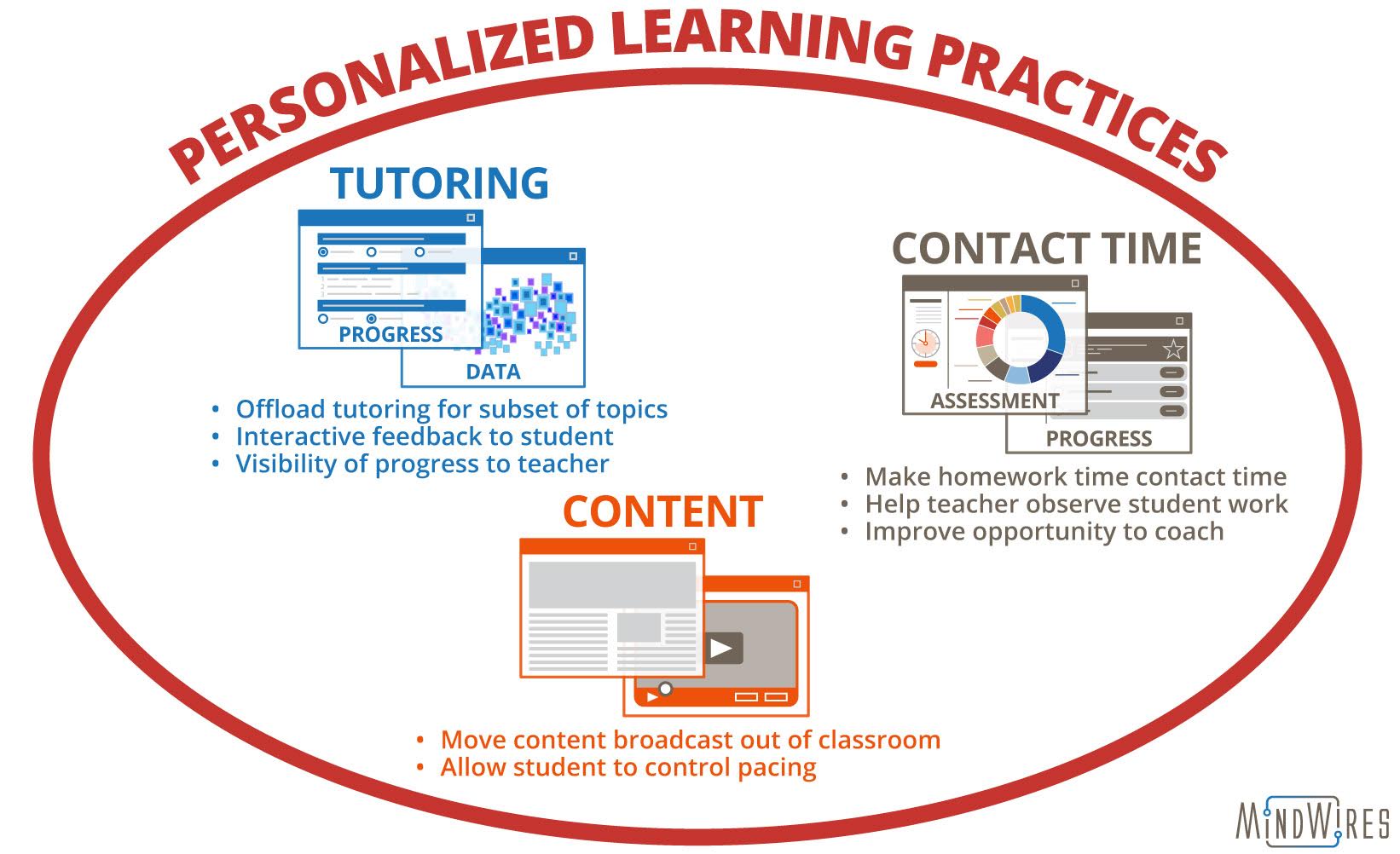
Personalized learning can be seen as a set of techniques designed to fix those two problems through the use of supporting technology. Proper use of adaptive “skill and drill” platforms, student retention early warning systems, and the like can actually free up the teacher to create that environment of “not-yetness” in the classroom. It’s not either/or but both/and.