e-Literate

Present is Prologue

Tag: personalized learning

  • Undepersonalized Teaching vs. Learnification

    Amy Collier was kind enough to post the video and notes from a recent keynote she gave. (For those of you who don’t know Amy, she is the Associate Provost for Digital Learning at Middlebury College and well worth following. She doesn’t blog that often, but when she does, she has interesting things to say.) A central element of her talk was on the “learnification” of education; that is, how the teacher disappears from the conversation about “good” education and the whole thing gets reduced to learners gobbling up little learning objects to get their competency level-up, like a human game of Pac-Man. This is one reason why Phil and I felt it was important to reframe “personalized learning” as a set of teaching practices that we called “undepersonalized teaching” in our recent EDUCAUSE Review article. When we visited actual classes (including Middlebury’s) and saw what actual teachers were doing as part of our e-Literate TV case study series, it was clear that there were thoughtful teachers using these tools in interesting ways that enabled them to spend more time on the high-value aspects of their teaching craft. But the student-as-Pac-Man story is the one that gets heard.

    I would like to bring out one additional point about the learnification of education that Amy briefly hints at in her keynote but that you will miss if you only read her notes is that “learnification” is not something that only comes from the “neo-liberal” ((Honestly, I still don’t really know what that word means, other than “bad” and “vaguely associated with people who have money.”)) emphasis on measurement of learning outcomes, career readiness, scale, and student as consumer. The Gert Biesta paper that she references actually pins some of the blame on constructivism, which very often gets flattened into some version of “Hey, teacher, leave them kids alone!” In its historical context, constructivism is a useful antidote to Pac-Man reductivism of the prevailing educational theory of the time, but like the modern, mechanized variant that it is most frequently deployed to counter today, it tends to de-emphasize the role of the teacher to the point where that role all but disappears.

    The picture that I have in my own head for the role of the teacher involves a kind of a bell curve for formal education. At the left-hand tail is the basic stuff that people need to know in order to start reasoning and learning for themselves—facts, basic concepts, habits of mind and of study, and so on. The specifics of what goes into that category are somewhat up for grabs and depend a lot on the student’s long-term goals. But whatever they are, many of them lend themselves to the sort of learning objectification/adaptive learning approach just fine. On the far end of the bell curve of formal education (but hopefully in the fat part of bell curve of normal adult life) is the complex reasoning that students apply on their own to synthesize what they are seeing into their own individual perspectives on the world. It’s the sort of thing that one hopes goes on in an undergraduate’s capstone or senior thesis project (and often sooner for different students in different classes). At that point, the training wheels of formal education come off.

    The fat middle part of the curve is where good teachers should be spending most of their time. It’s the work of getting the students ready to ride their bikes without the training wheels. The “not yetness” that Amy talks about in her keynote (and elsewhere) is basically about taking your hand off the kid’s shoulder to give her a few seconds to ride on her own. It’s the moment when she realizes that she is free to steer, to ride a head, and yes, maybe to fall. You catch her if you see her in danger of falling badly enough to hurt herself, but not before. It’s the important how part of Vygotsky’s zone of proximal development.

    The shape of the curve changes somewhat depending on the student population, but a classic bell curve image fits well both with the typical student progression in a four-year college as well as within the work to be done in a typical 100- or 200-level course. Most of the work of college should be about coaching students on how to think for themselves. Unfortunately, teachers face some practical problems in getting to what is supposed to be the fat part of the curve. The first one is that some students get stuck on the foundational stuff—different students in different places—and the standard lecture-format class doesn’t give teachers much opportunity to see where they are stuck and help them to get unstuck. As a result, teachers either have to deal with the “slowest car on the freeway” problem in their class or else decide to let more students fail rather than taking the time to help them get unstuck. (Or both. If you slow down too much, the students who understand most of the basics tune out and can miss the few critical pieces that they still need to learn.) Second, we have trained students through that very same lecture format that the basics are not something that they should even try to master for themselves. Basics are transmitted during class time as lectures.

    Personalized learning can be seen as a set of techniques designed to fix those two problems through the use of supporting technology. Proper use of adaptive “skill and drill” platforms, student retention early warning systems, and the like can actually free up the teacher to create that environment of “not-yetness” in the classroom. It’s not either/or but both/and.
    ERO Graphic 1

  • Personalized Learning vs. Adaptive Learning

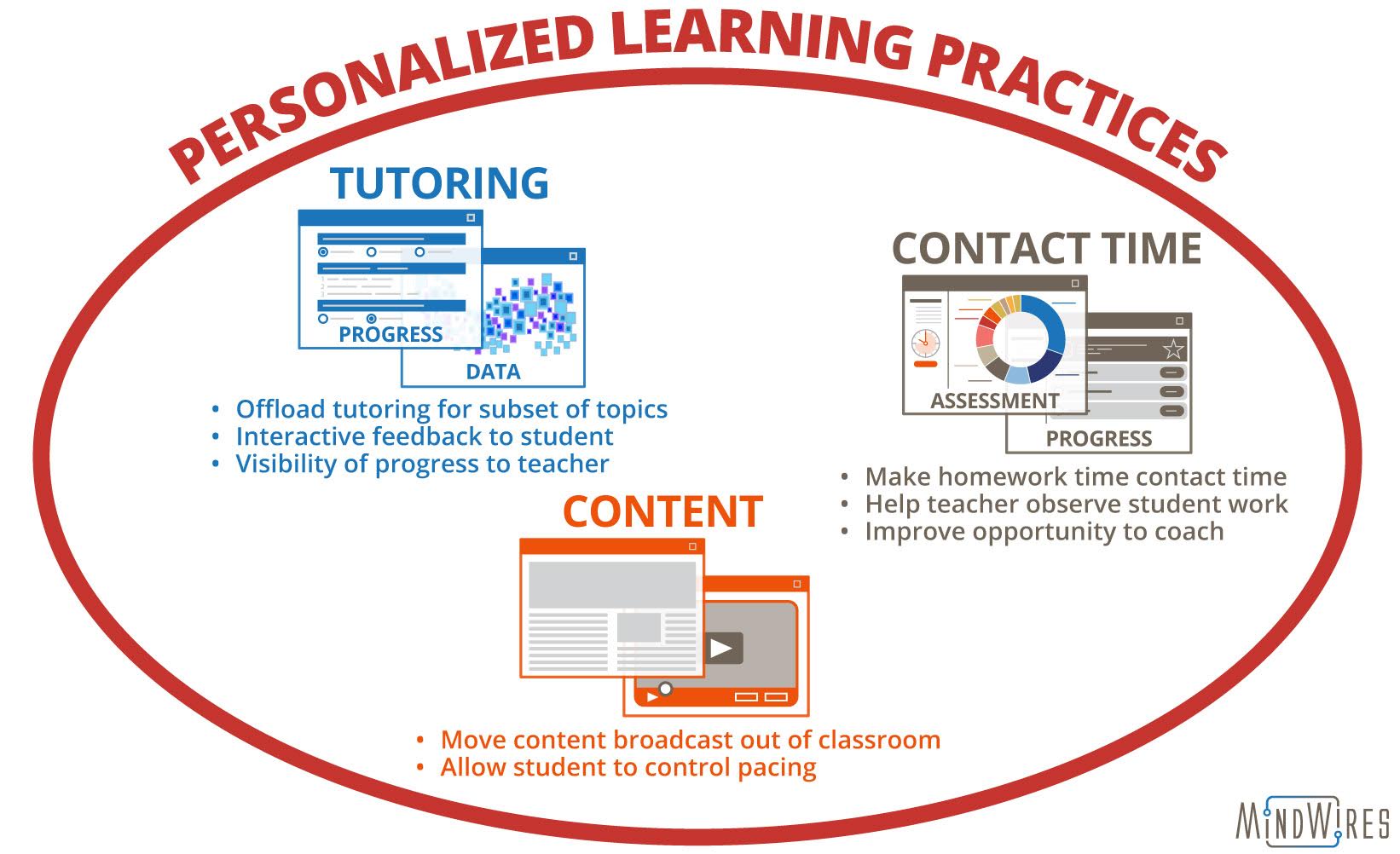
    In our recent EDUCAUSE Review article, Phil and I defined personalized learning as a set of technology-supported practices that help undepersonalize teaching. The three general practices that we identified are as follows:

    1. Moving content broadcast out of the classroom: Even in relatively small classes, a lot of class time can be taken up with content broadcast such as lectures and announcements. Personalized learning strategies often try to move as much broadcast out of class time as possible in order to make room for more conversation. This strategy is sometimes called “flipping” because it is commonly accomplished by having the teacher record the lectures they would normally give in class and assign the lecture videos as homework, but it can be accomplished in other ways as well, for example with reading-based or problem-based course designs.
    2. Turning homework time into contact time: In a traditional class, much of the work that the students do is invisible to the teacher. For some aspects, such as homework problems, teachers can observe the results but are often severely limited by time constraints. In other cases, such as comprehension of assigned readings, the students’ work is invisible to the teacher and can be observed only indirectly and with significant effort. Personalized learning approaches often allow the teacher to observe the students’ work in digital products, so that there is more opportunity to coach students. Further, personalized learning often identifies meaningful trends in a student’s work and calls the attention of both teacher and student to those trends through analytics.
    3. Providing tutoring: Sometimes students get stuck in problem areas that don’t require help from a skilled human instructor. Although software isn’t good at teaching everything, it can be good at teaching some things. Personalized learning approaches can offload the tutoring for those topics to adaptive learning software that gives students interactive feedback while also turning the students’ work into contact time by making it observable to the teacher at a glance through analytics.

    ERO Graphic 1

    Personalized learning is a set of things that you do, not a set of things that you buy. Products can support or enable personalized learning practices, but they are not “personalized learning products.” And in fact, once you have products that support personalized learning practices, that’s actually when the hard work begins. OK, so you moved content broadcast out of the classroom. Now what are you going to do with class time? Students get some benefit from having course content that they can review multiple times at home, but most of the big gains typically come from the teacher reclaiming class time for more high-value direct and interactive work with the students.

    On the other hand, adaptive learning is a label that applies to products. Further, adaptive learning products can support all of the practice areas of personalized learning. They enable teachers to move content broadcast outside of class time, they make homework time into contact time through analytics, and they provide some tutoring function. “Adaptive” tends to provoke a lot of discussion around the latter of the three practice areas. See the piece I wrote for the American Federation of Teachers if you want a primer on the strengths and limitations of adaptive learning products as tutors. But as often as not the first two capabilities, neither of which is dependent on adaptive algorithms, are the ones that enable the biggest gains in personalized learning teaching practices. “Courseware” is a set of products that, when designed well and used properly, can enable faculty to move content broadcast out of the classroom and make homework time content time. Adaptive courseware adds the tutoring element while also, if done well, increasing the value of that homework contact time by providing better feedback through more targeted analytics.

  • Defining Personalized Learning

    As many of you know, Phil and I have been exploring the topic of “personalized learning” for the past year, trying to figure out what the heck it means and what it’s really good for, separate from the hype. We’ve boiled down the idea into the beginnings of a framework, which we’ve just had published in EDUCAUSE Review. The central focus is to think of “personalized learning” as a set of technology-supported teaching practices that un depersonalize teaching. While we’re exploring that, we also dive into the question of why hype happens, why the hype cycle exists, and how we can try to kill it.

    You can read it here

  • Making Lab Sections Interactive: More evidence on potential of course redesign

    Two weeks ago Michael and I posted an third article on EdSurge that described an encouraging course redesign for STEM gateway courses.

    In our e-Literate TV series on personalized learning, we heard several first-hand stories about the power of simple and timely feedback. As described in the New York Times, administrators at the University of California, Davis, became interested in redesigning introductory biology and chemistry courses, because most of the 45 percent of students who dropped out of STEM programs did so by the middle of their second year. These students are the ones who typically take large lecture courses.

    The team involved in the course-redesign projects wanted students to both receive more individual attention and to take more responsibility for their learning. To accomplish these goals, the team employed personalized learning practices as a way of making room for more active learning in the classroom. Students used software-based homework to experience much of the content that had previously been delivered in lectures. Faculty redesigned their lecture periods to become interactive discussions.

    (more…)

  • McGraw Hill’s New Personalized Learning Authoring Product

    In what has to be the softest launch ever, McGraw Hill has been quietly talking about their new personalized learning authoring system. If you ask them when it will be available to all customers, they will tell you “right now.” But since it doesn’t even have a name yet, I’m not sure how customers would ask for it. They occasionally refer to it as their “learning science platform,” but that’s not really its name.

    Here’s a dirty little secret: The “new” authoring platform is essentially a publishing front end for their SmartBooks platform. Not only is it interesting in and of itself; it also gives us some indication of one direction that the textbook publishing industry could go. (By the way, they don’t like to be called “textbook publishers” anymore. I guess the industry needs to come up with a new name for that too.)

    I was able to get a quick overview of the platform from McGraw Hill’s Chief Digital Officer Stephen Laster and SVP Zach Posner.

    (more…)

  • Personalized Learning and the Teacher

    A few weeks ago, Jonathan Rees wrote a post calling out that, no matter what potential of so-called “personalized learning” for improving student outcomes, there is a potential—and a temptation—for it to be abused as a method of lowering (labor) costs in a way that also lowers educational quality and effectiveness. This is a serious and realistic concern, particularly as long as personalized learning is framed as a product rather than a set of teaching strategies.

    Phil and I have addressed this concern head-on in our latest piece on EdSurge. I suppose a battle over the meaning of the term was inevitable; why should this one be any different from all the others? There is an enormous disconnect between the way the term is used in product marketing and ed tech circles and the way it is actually applied in the real world in cases places it actually works. I have seen a number of cases in which personalized learning, as an educational strategy, produces good results for students. But every single one of those cases has had one or more good educators leading the charge, thinking hard about how to better serve the students. At its best, personalized learning is an effort to identify those classroom and institutional practices that are depersonalizing, and use technology as an aid to teaching strategies and support processes that can replace those practices with something more humane. Perhaps we should call it “undepersonalized learning.”

    As such, true personalized learning should be labor-friendly in important ways. It should put a premium on skilled educators and make a strong case for increased investment in professional development and teaching-friendly tenure and promotion practices. That doesn’t mean it will always be job-preserving. The focus should be on students and agnostic with respect to student/teacher ratios. It is possible to achieve a more humane and personal education at scale. Sometimes. With a lot of thought and iteration. But I have seen no evidence to suggest that personalized learning technologies improve outcomes significantly without good teachers at the helm, and plenty of evidence suggesting that they don’t.

  • New Column At EdSurge

    Starting today, Michael and I are publishing a three-post series on personalized learning at EdSurge. Depending on how that goes, we could end up providing a regular column there.

    The first post today is titled “Why Personalized Learning Matters to a New Generation of College Students”.

    As we talk to the people on the front lines of these differentiated instructional approaches—students, faculty and staff with real-world experiences, both good and bad—the most significant theme that emerged was the challenge of helping students that come to class with wildly different starting knowledge and skill levels. Personalized learning should be seen as an effort for institutions to directly support students across the spectrum.

    EdSurge

    We’re excited to be working with EdSurge, helping them expand their coverage of higher education and helping us to share analysis and e-Literate TV content with a broader audience.

    You can read the whole article here.