
Timothy Harfield commented on Arizona State University’s approach to pilots and scaling innovation at ASU.
.@philonedtech excellent comment on the problem of scaling innovation in #HigherEd. This is a central concern for @UIAinnovation.
— Timothy Harfield (@timothyharfield) June 4, 2015
excellent comment on the problem of scaling innovation in #HigherEd. This is a central concern for @UIAinnovation.
The University Innovation Alliance is “a consortium of 11 large public research universities committed to making high-quality college degrees accessible to a diverse body of students”. I wrote about this “central concern” last summer in a post titled “Pilots: Too many ed tech innovations stuck in purgatory”, using the frame of Everett Rogers’ Diffusions of Innovations model. While the trigger for that post was on ed tech products, the same situation applies for the course design situation.
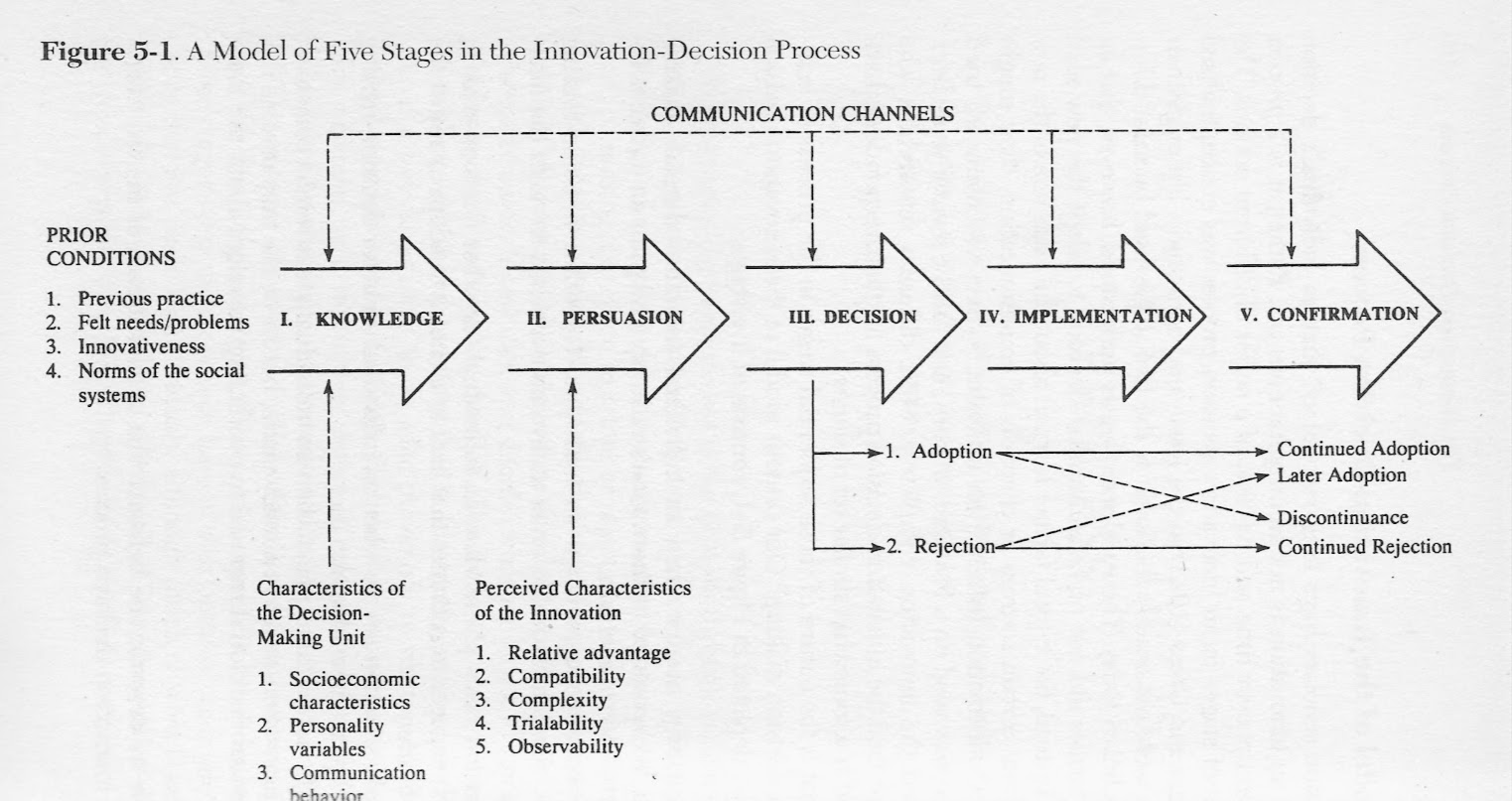
What we are seeing in ed tech in most cases, I would argue, is that for institutions the new ideas (applications, products, services) are stuck the Persuasion stage. There is knowledge and application amongst some early adopters in small-scale pilots, but majority of faculty members either have no knowledge of the pilot or are not persuaded that the idea is to their advantage, and there is little support or structure to get the organization at large (i.e. the majority of faculty for a traditional institution, or perhaps for central academic technology organization) to make a considered decision. It’s important to note that in many cases, the innovation should not be spread to the majority, either due to being a poor solution or even due to organizational dynamics based on how the innovation is introduced.
The Purgatory of Pilots
This stuck process ends up as an ed tech purgatory – with promises and potential of the heaven of full institutional adoption with meaningful results to follow, but also with the peril of either never getting out of purgatory or outright rejection over time.