This is a guest post by David Goodrum, a nominee in the 2010 Sakai Foundation Board of Directors election. His bio and platform are available here.
First off, I’d like to thank Michael Feldstein for his generous offer to the Sakai board candidates to present their perspectives in this forum as well as offer thanks to the many readers of e-Literate for their patience in wading through a discussion of board responsibilities, Sakai product directions, and open/community source approaches.
I won’t repeat my background and basic platform, which are available here; and will try my best to answer Michael’s call to articulate what I see as the Sakai community’s challenges and opportunities, where I see both Sakai products and community in three years, and what steps we must take to get there.
Challenges and Opportunities: that we face as a community and as part of the larger global education community over the next three years
The larger global education community is living in interesting times: communication is increasingly instantaneous; technological capabilities leapfrog each other daily; social, economic, marketplace, and political changes are constantly upon us. And so the need for individuals to learn, connect, and be contributing members of intellectual as well as social communities grows ever more important. And the ability of our institutions to create an environment to enhance the success of students and scholars alike becomes ever more critical.
The Sakai community is built upon the core values of
- Higher education meeting its own needs
- Our institutions maintaining control of their own destinies, and
- Sharing the burden among like-minded partners.
The opportunity for Sakai is to build on its current success of the Sakai 2 Collaboration and Learning Environment (CLE) and meet the future head-on, providing global vision and leadership for how technology can be integral to the success of the core academic mission.
In my view, the biggest challenges for the Sakai community are to:
- Continue to build and evolve a shared vision for the future and maintain core values
- Deliver on commitments to always provide high performing and scalable products friendly to both users and developers, and
- Accomplish this with a lightweight yet strong Sakai Foundation that champions the most valuable contributions and the most successful self-organizing behaviors in the community.
Sakai in Three Years: A vision for what Sakai (both products and community) should look like three years from now to respond to those challenges and opportunities
Sakai Products
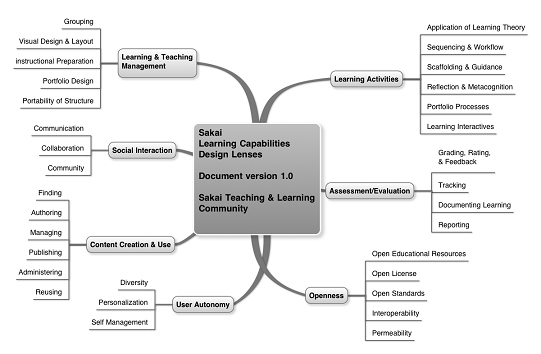
A version 1.0 of a comprehensive vision for Sakai products has been recently articulated, at least from a teaching and learning perspective, with the Sakai Learning Capabilities Design Lenses. Michael Feldstein has previously written a post about this work and invited me to write a post on the brainstorming and other community activities that led up to the version 1.0 document. It was very exciting to be a part of this highly collaborative work in the community and to continue to champion it in a variety of venues.
I think it’s accurate to say the document is presented as a comprehensive product vision for both the Sakai CLE as well as the newly announced project called the Sakai Open Academic Environment (OAE). Building on considerable advanced work on both the concepts and architecture for Sakai OAE, along with a hybrid approach to working together with Sakai CLE, the two projects are well positioned to deliver on the promise outlined by the Sakai Learning Capabilities.
LMS vendors are always marketing their latest or refreshed versions developed in secret and pursuing technologies and/or market share by acquiring other companies or suing in the courts. Even the open source Moodle is poised for major change as it is now beginning to strategize and brainstorm for a total rewriting/refactoring of its platform (e.g., see this).
The Sakai consortial values and governance affords us all a much deeper level of influence through a variety of tangible contributions to governance, direction, and products that uniquely meet the needs of higher education. In the next three years, Sakai is well positioned to provide an ecosystem of products, integrations, standards (e.g., LTI), and support that together can fulfill the Learning Capabilities vision.
Sakai Community
Simply put, my vision for the Sakai community is a house with all the lights turned on, occupied by multiple groups who are self-organized and board-recognized, and united broadly by common purpose and values. A lot of Sakai community accomplishments over time have occurred somewhat in isolation, pursued by a single institution, and difficult to find up-to-date information on.
This seems to be evolving already. Both the Sakai OAE managed project and the Sakai 2 Technical Coordination Committee (as well as the teaching and learning community efforts on the Learning Capabilities Design Lenses) have been prime examples of highly visible, self-organized efforts within the community, each with multiple participating institutions.
In three years, my vision is for a broader and more diverse Sakai community with a successful merger of Jasig and Sakai, more multiple-institution supported efforts, more higher ed institutions and commercial affiliates as members, and better outreach and communication of community initiatives overall.
Steps We Must Take: specific actions that must be undertaken to fulfill that vision
There are scores of actions and contributions the community would need to take to fulfill the vision I’ve outlined above. But let me focus on specific actions the Sakai Foundation Board needs to take.
For Community Vision
For the Foundation itself, I see several critical areas for thoughtful leadership by the directors through a dialogue with the whole of the Sakai community:
1) Partners. Make mergers and partnerships with other community source groups an opportunity for both organizational efficiency and technical and functional collaborations. The growing open source ecosystem in higher education supported by partner commercial affiliates affords us all a strategic approach to continue meeting our own needs while maintaining control of our own destinies and sharing the burden among like-minded partners.
2) Outreach. Implement an effective Sakai Foundation outreach strategy to a) institutions exploring learning management, portfolio, collaboration, and academic networking applications, b) potential commercial affiliates with services and application integrations that would benefit higher education, and c) other open and community source projects which together with us could create a rich platform for innovation.
3) New Voices. Increase engagement with the newest members of the community, many of which are struggling to find their way among the myriad of projects, sources of information, dense lists of email, and potential ways to contribute. There might be a variety of ways to help with this; one idea would be to create a ‘new members council’ for new institutions and commercial affiliates. A new member would have a representative on the council for twelve months; the council would meet regularly with the executive director and other community resources he brings to bear to an agenda built by the new council membership. New members, no matter their size, should feel they have an established and direct line of communication.
For Product Success
For the Sakai software, I also see several critical areas of importance for the Foundation working with the community:
1) Build and support a coherent product strategy. The Sakai CLE and the Sakai OAE (along with other community source projects) together provide the full range of capabilities needed in the demanding arena of higher ed online, hybrid and face-to-face teaching, learning, collaboration, and academic networking and community building.
2) Turn the lights on. Formally recognize self-organized efforts within the community where multiple institutions are co-sponsoring and co-supporting specific, well-documented initiatives.
3) Support and advocate standards. Adopting integration and interoperability standards would enable bringing together the best content, processes, and tools to support the academic mission of our institutions. As Feldstein has pointed out elsewhere, we need to integrate both the rest of the academic enterprise as well as the long tail of learning tools.
Final Note
As a board director, I believe I would bring a unique perspective:
- The experience of having supported large and small campuses through an early migration to Sakai from a legacy system;
- Substantial work with users as well as with development teams in continuing to move Sakai 2 CLE forward;
- Early championing and participation in the Learning Capabilities visioning;
- Involvement from the beginning in the Sakai OAE managed project;
- Being a frequent conversant with institutions considering Sakai — some already leaning, others rather skeptical;
- Understanding of how an institution can implement community source as a strategic direction; and
- Leadership experience with sizable responsibilities for both teams and budgets.
The opportunity to serve the Sakai community through a board position would indeed be a rare honor and privilege.