e-Literate

Present is Prologue

Tag: Schoology

  • Schoology Layoffs: Focusing on smaller higher ed opportunities

    Schoology Layoffs: Focusing on smaller higher ed opportunities

    We’ve noticed and had several people ask us about corporate changes at Schoology, the LMS vendor. More specifically, the questions have been based on whether they are laying off staff, and what that means for the higher ed LMS market. Short answers – yes to the layoffs, and the company will be more selective on which higher ed opportunities to pursue.

    Through phone and email interviews, I asked CEO Jeremy Friedman to respond to these questions.

    As you and I have talked about, operational efficiency is a strategic objective for Schoology in 2017. As we built our plan for the year we saw opportunities to focus our efforts and operate at a higher level. This meant that we decided to reduce our headcount by a little over 10%, primarily across sales and marketing. To be clear, we reduced how much we are going to spend in Sales and Marketing, and we increased how much we are going to spend in Research & Development and Customer Success. The net impact is a more efficient company that can invest more in product innovation and our customers.

    (more…)

  • Schoology: The strongest LMS you’ve never seen

    LMS evaluations are typically painful ordeals for not just committee members but also for the vendors. They have to provide multiple demos, have lots of Q&A, and write 100+ page proposals based on extensive feature requirements and perhaps even more painful terms and conditions. But there is one case that might be worse – not even getting to compete when your product appears to be an excellent fit. And that is the situation that Schoology finds it in for the majority of higher ed evaluations.

    Schoology’s original market was aimed US-based K-12 institutions, and for paying school or district LMS selections Schoology is probably one of the two strongest competitors, along with Canvas. Schoology does have an international presence and over the past year and a half have targeted an expansion into higher ed. Michael wrote a post after the company raised $32 million in new funding last fall, largely to fund this expansion. I described the institution-wide adoption by Wheaton College in Spring 2016, following the Colorado State University Global Campus adoption in early 2015. But what I don’t see is a real acceleration in the higher ed market yet. There are a few significant LMS active evaluations that include Schoology, but the majority of higher ed LMS evaluations over the past two years have not treated Schoology as a real competitor. Based on what I’ve seen, this lack of evaluation is not based on the product itself. (more…)

  • State of Higher Ed LMS Market for US and Canada: Spring 2016 Edition

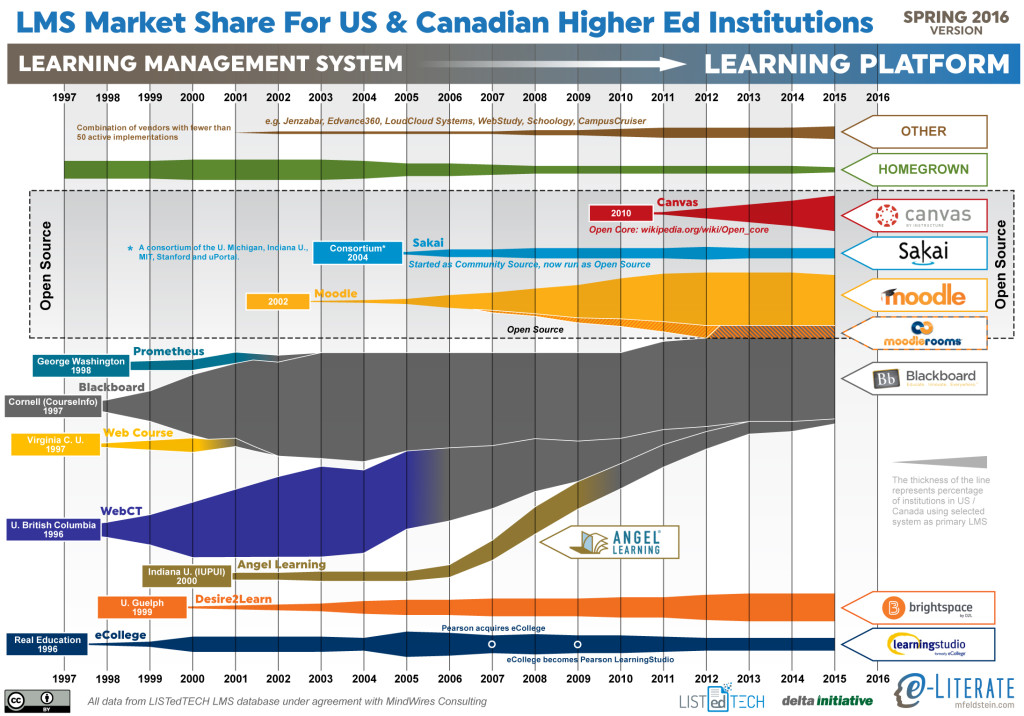
    This is the eighth year I have shared the LMS market share graphic, commonly known as the squid graphic, for (mostly) US higher education. The original idea remains – to give a picture of the LMS market in one page, highlighting the story of the market over time. The key to the graphic is that the width of each band represents the percentage of institutions using a particular LMS as its primary system.

    This year marks a significant change based on our upcoming LMS subscription service. We are working with LISTedTECH to provide market data and visualizations. This data source provides historical and current measures of institutional adoptions, allowing new insights into how the market has worked and current trends. This current graphic gets all of its data from LISTedTECH. Where previous versions of the graphic used an anchoring technique, combining data from different sources in different years, with interpolation where the data was unavailable. Now, every year’s data is based on this single data source.

    This graphic has been in the public domain for years, however, and we think it best to keep it that way. In this way we hope that the new service will provide valuable insight for subscribers but also improve what we continue to share here on the e-Literate blog.

    Since we have data over time now and not just snapshots, we have picked the end of each year for that data. For this reason, the data goes through the end of 2015. We have 2016 data but chose not to share partial-year results in an effort to avoid confusion.

    LMS_MarketShare_20160316

    A few items to note:

    • As noted in previous years, the fastest-growing LMS is Canvas. There is no other solution close in terms of matching the Canvas growth.
    • Blackboard continues to lose market share, although the vast majority of that reduction over the past two years has been from customers leaving ANGEL. Blackboard Learn lost only a handful of clients in the past year.
    • While the end-of-life occurs next year, Pearson’s has announced LearningStudio’s end-of-life for the end of 2017.
    • With the new data set, the rapid rise and market strength of WebCT becomes much more apparent than previous graphics.
    • There is a growing line for “Other”, capturing the growth of those systems with less than 50 active implementations as primary systems; systems like Jenzabar, Edvance360, LoudCloud Systems, WebStudy, Schoology, and CampusCruiser.
    • While we continue to show Canvas in the Open Source area, we have noted a more precise description as an Open Core model.

    For a better description of the upcoming LMS subscription service, read this post and / or sign up for more information here.

  • Wheaton College Selects Schoology As New LMS In Surprise Decision

    Schoology, a social cloud-based LMS known mostly used in the K-12 market, has set its sights on expanding into the higher education market using their recent $32 million funding round. Last January, Colorado State University’s Global Campus selected Schoology to replace Blackboard Learn, yet the market impact of this decision was limited, partially due to the non-traditional nature of the online-only campus. What Schoology has needed to gain more market credibility and awareness is a second set of higher ed institutions selecting Schoology in an open competition. Enter Wheaton College in Illinois, which recently selected Schoology as its new LMS. This is the most significant new selection that I have seen.

    I interviewed CIO Wendy Woodward from Wheaton to find out more on the nature of this decision. For context, Woodward became Wheaton’s CIO in January 2015, moving from her previous job at Northwestern University. Based on her listening tour to understand campus needs, the decision to replace the LMS was listed near the top of the list. Given Northwestern’s recent move to Canvas, Woodward related that there was a common assumption that Wheaton would do the same. The faculty committee fully went through the evaluation process, however, and ended up selecting Schoology after inviting responses from 10 different solutions. The campus has already begun pilots and plans to be fully migrated to the new system by Fall 2016. (more…)

  • What Schoology’s Venture Funding Means for the LMS Market

    LMS vendor Schoology just raised $32 million in Series D venture capital funding, bringing the total that they’ve raised to just over $57 million. If you’ve never heard of them, that’s because they have mostly been focused on K12, where they are doing very well. But they have turned their attention to US higher ed recently. They had a surprisingly big presence at EDUCAUSE, where CEO Jeremy Friedman told me that they are prepared to make an aggressive push. Their ability to get major funding was probably helped by Instructure going to market, and possibly by the leak that Blackboard is putting itself on the block as well. I don’t generally take money guys too seriously in their ability to predict ed tech, but they may be lucky on this one. I think there may be an opening the US higher ed LMS market for a new entrant.

    LMS selection for schools often works a little like the selection process that high school students typically go through when picking a college. Students looking at colleges usually have a favorite going in. Maybe their friends are going there. Or their big brother or sister. Or maybe they just heard that it’s cool. But they don’t apply to just one college, in case it doesn’t work out for one reason or another. So they have a second tier of schools that might be OK too. Generally, they don’t know much about your favorite school going in and they know even less about the “might be OK” schools. Depending on how cautious they are, they might throw in one or two “safety” schools that they really don’t want to go to but that they feel (or their parents feel) should be included for the sake of completeness.

    Likewise, colleges and universities frequently go into an LMS evaluation process with a favorite. Because the selection is generally done by a committee of stakeholders rather than just one person, there might be conflicting opinions on what the favorite is. But more often than not, there is a nascent majority or a consensus opinion about the likely winner, at least among the core selection committee. Back in the early to mid-aughts, the default favorite was usually Blackboard because it was considered to be the safe alternative that everybody was using. When Blackboard faltered, the favorite began to split between D2L and Moodle—and occasionally Sakai, particularly for larger public universities—with type of school and geography having a big influence on which one was likely to be the frontrunner. These days, the schools that Phil and I talk to report Instructure as the starting frontrunner at least four times out of five, across school types or geographies.

    But LMS selection processes still need their “might be OK” candidates. For one thing, most of them are mandated by policy or by law to do a real multi-vendor evaluation. And most evaluation committees genuinely do want to look at alternatives. Just because they have a sense going in of which alternative is most likely to be the best doesn’t mean that they are closed-minded. The trouble is that there aren’t many alternatives that selection committees feel hopeful about these days. Increasingly, Sakai and Moodle aren’t even making it to the serious evaluation stage in US higher ed evaluations; and even when they do, they are often treated like safety schools. Blackboard never fully recovered from reputational damage done under Michael Chasen and their failure to deliver on Ultra this year was a huge setback. At the moment, they are being treated like a safety school as often as not. If Ultra slips further—and maybe even if it doesn’t—they could start losing significant numbers of customers again. And we haven’t run into many schools that are particularly excited about D2L either. Probably the best I can say for them is that they are the least likely of the LMS companies that are not Instructure to be dismissed out-of-hand.

    I think there’s an opportunity for a new entrant to get a fair hearing from selection committees that want a real horse race but aren’t excited about any of the incumbents. Ironically, the rise and success of Instructure has probably reduced risk aversion among schools to go with a scrappy start-up. I don’t know if Schoology is going to be the one that gets a foothold in the market because of this opening, but their timing is definitely good.