
e-Literate

Present is Prologue

Tag: Stanford

  • Piazza Makes Three Significant Changes To Deal With Privacy Issues

    Piazza Makes Three Significant Changes To Deal With Privacy Issues

    For those following the Piazza privacy issues, we have a new update where the company has made three significant changes in their response to privacy concerns from several universities. They are now using true opt-in for their Careers product, they have stopped the practice of using university logos without permission, and they are now offering an easier process to enter into no-cost agreements. For those who have not followed, read here here and here for background. And remember that this case of Piazza’s usage of student data can be seen as a case study on third-party learning apps as we move closer to the Next Generation Digital Learning Environment / LMS as Hub concept.

    Opt-In vs Opt-Out

    In my original post, one of the key issues I called out was that Piazza did not offer with their Q&A platform a true opt-in method for students to choose to allow their personal data to be shared with recruiters through the Careers product.

    What does that opt-in look like in practice? Faculty assign usage of the platform, and during setup students see a pre-checked box labeled “Sign me up” for opting into the Careers service. (more…)
  • University Responses to Piazza: Some good, some bad, some web site changes

    After our reporting from Nov 10 on “Popular Discussion Platform Piazza Getting Pushback For Selling Student Data”, I was invited by Piazza CEO Pooja Sankar to visit the Piazza offices. During my visit, we had an open conversation where I got to meet pretty much the entire staff and have a direct conversation with Sankar and Sunthar Premakumar. After that meeting, Piazza provided a statement that we published in “Piazza Response To Blog Post On Student Privacy”. The statement primarily dealt with a mea culpa from Piazza about working directly with institutions to form agreements around privacy policies and terms of use, including this section:

    We are committed to fixing this. In fact we already have started. We have entered into agreements with Georgia Tech and Brown, and have ongoing engagement with Stanford, UBC and UC Davis[1]. In our conversations universities have been very happy with our policies, practice, and compliance. We are fully committed to entering into contracts with universities that protect students, professors, and the institutions including FERPA, accessibility, and more.

    I have subsequently had conversations with staff from several of the schools mentioned above to verify the information. Some of the responses were good (as in positive review for Piazza and their willingness to work with the school), some were bad, and in parallel I noticed several web site changes that appear to be related to this reporting and follow-up. (more…)

  • LMS Market Updates, Dec 2015

    There seems to be a series of news and analysis on the LMS higher education market worth summarizing.

    Major Adoption News

    I posted last weekend about University of Phoenix (UoP) and their LMS. UoP is well-known for being the biggest user of a homegrown LMS for well over a decade, but in the past several years they rolled out “Classroom”, an entirely new adaptive-learning based design. In a major strategic change, UoP is abandoning this effort and moving to a commercial provider.

    What we can now confirm at e-Literate is that the “learning platform” selected by the University of Phoenix is Blackboard Learn Ultra. This is the cloud-based redesign of Learn that Michael and I have described in several posts. Even with the University of Phoenix’s reduced enrollment, I consider this news to be the most important new client acquisition for Blackboard since at least 2011.

    Today Campus Technology reported that Stanford is moving to adopt Canvas as their campus-wide LMS. Previously Stanford was a founding member of Sakai, with its implementation called CourseWork.

    The university has been piloting Instructure Canvas since the 2014-2015 academic year. The vice provost for teaching & learning (VPTL) said in a statement that about 80 percent of faculty in the pilot reported being “very or somewhat satisfied” with the new platform; even more students (94 percent) found it “very or somewhat easy” to use.

    Alongside the pilot, two Stanford schools had already adopted the application independently. The Graduate School of Education moved to Canvas in 2013-2014, and the Graduate School of Business did so in 2014. Both adoptions were considered successes.

    During this school year, the migration was accelerated. Some 300 classes switched to Canvas. And the plan is to migrate the remaining 4,200 classes still using the legacy LMS software over the next academic year.

    (more…)

  • Student Course Evaluations and Impact on Active Learning

    The Chronicle has an article out today, “Can the Student Course Evaluation Be Redeemed?”, that rightly points out how student course evaluations are often counter-productive to improving teaching and learning. The article refers to a Stanford professor’s call for an instructor completed “inventory of the research-based teaching practices they use”, but most of the article centers on revised course evaluation tool from a Kansas State University spin-off (the IDEA Center). One of the key problems described is that “administrators often take their results as numerical gospel” as well as faculty misapplying the results.

    However they’re used, a lot of course evaluations simply aren’t very good, [IDEA president] Mr. Ryalls says.

    But as flawed as they are, faculty members still turn to them as some gauge of effectiveness in the classroom. About three-quarters of instructors use formal evaluations and informal feedback “quite a bit” or “very much” when altering their courses, according to the Faculty Survey of Student Engagement.

    One limitation of many tools is that they ask students things they don’t really know. A frequent example: Was your instructor knowledgeable about course content?

    There is one additional problem with most student course evaluations that is not explicitly covered in the Chronicle articles – students newly involved in active learning approaches often rate the course and instructor poorly even if they end up learning more effectively. We saw this in our e-Literate TV case study at UC Davis. In a previous post we highlighted how the routine hard work required of students in active learning courses can lead to poor evaluations, but later in the interview student course evaluations came up as a major barrier to improving teaching practices. (more…)

  • The Battle for Open and MOOC Completion Rates

    Yesterday I wrote a post on the 20 Million Minds blog about Martin Weller’s new book The Battle for Open: How openness won and why it doesn’t feel like victory. Exploring different aspects of open in higher education – open access, MOOCs, open education resources and open scholarship – Weller shows how far the concept of openness has come, to the point where “openness is now such a part of everyday life that it seems unworthy of comment”. If you’re interested in OER, open courses, open journals, or open research in higher education – get the book (it’s free and available in a variety of formats).

    Building on the 20MM post about the ability to reuse or repurpose the book itself, I would like to expand on a story from early 2013 where I happen to play a role. I’ll mix in Weller’s description (MW) from the book with Katy Jordan’s data (KJ) and my own description (PH) from this blog post.

    (MW) I will end with one small example, which pulls together many of the strands of openness. Katy Jordan is a PhD student at the OU focusing on academic networks on sites such as Academia. edu. She has studied a number of MOOCs on her own initiative to supplement the formal research training offered at the University. One of these was an infographics MOOC offered by the University of Texas. For her final visualisation project on this open course she decided to plot MOOC completion rates on an interactive graph, and blogged her results (Jordan 2013).

    (more…)

  • Combining MOOC Student Patterns Graphic with Stanford Analysis

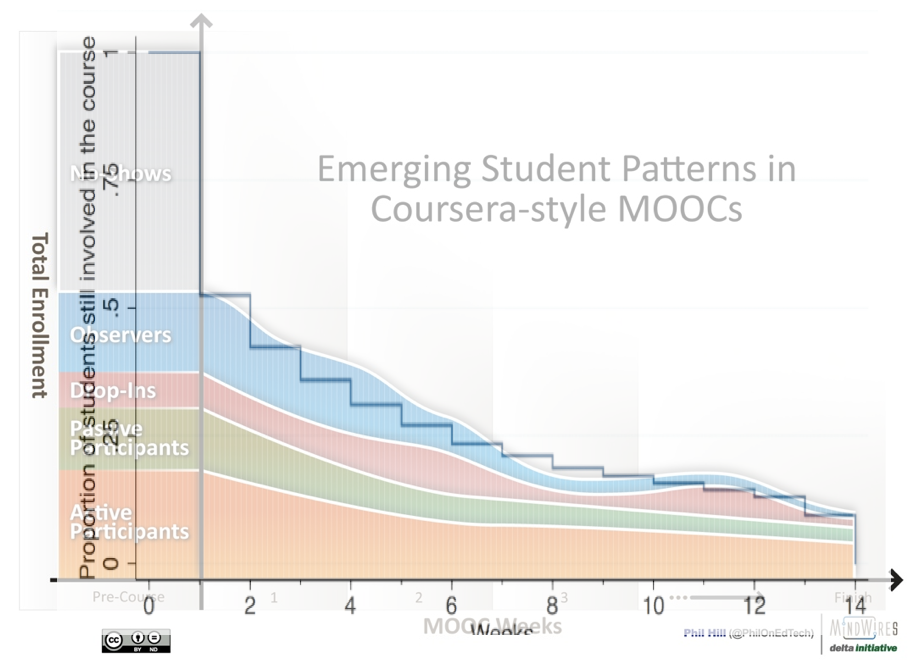
    In part 1part 2, and part 3 of this series of posts on MOOC student patterns, I shared a description of five student patterns emerging from open-enrollment MOOCs (excluding those with an associated student fee) based on anecdotal data.  In part 4 I compared the overall course completion pattern against an MIT study of the first edX MOOC, leading to some validation of the general shape of when participants drop out.

    Combined MOOC patterns

    The model and typology has gained traction recently, being referenced in both the Government of Ontario’s  environmental scan and literature review [pp 32-33, 40] as well as the British government’s The Maturing of the MOOC literature review [pp 26-28]. So that means it’s time to update and keep people on their toes.

    (more…)

  • MOOC Discussion Forums: barrier to engagement?

    Robert McGuire wrote an article for Campus Technology, Building a Sense of Community in MOOCs, that touches on an important topic – is the centralized discussion forum a barrier to student engagement?

    But more students can also mean more isolation within the crowd. “Online classes can be really lonely places for students if they don’t feel like there’s a community,” notes Maria Andersen, director of learning and research at Instructure, which runs Canvas Network, an open repository where participating schools can deliver their own MOOCs.

    Ironically, the biggest obstacle preventing MOOC students from forming relationships is the feature most relied on to encourage them. Discussion forums are the number one complaint by readers and contributors of MOOC News and Reviews, an online publication devoted to critiquing individual MOOC courses and the evolving MOOC landscape. Most MOOC discussion forums have dozens of indistinguishable threads and offer no way to link between related topics or to other discussions outside the platform. Often, they can’t easily be sorted by topic, keyword, or author. As a result, conversations have little chance of picking up steam, and community is more often stifled than encouraged.

    There are several studies that appear to show that MOOC discussion forums have few students participating and that the forums are dominated by a small number of students.

    (more…)