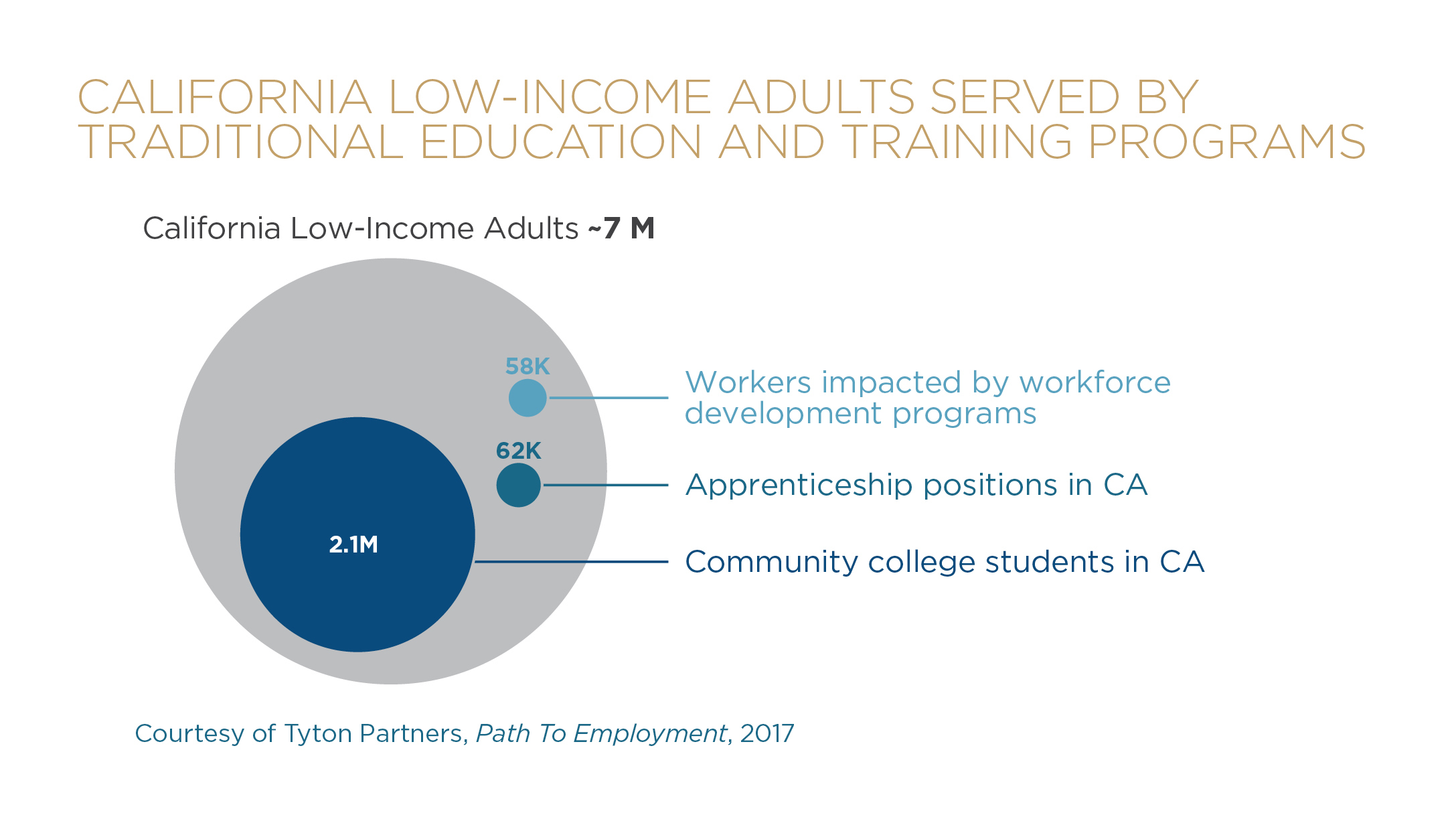
Tyton defines the common goal that programs under this broad umbrella could solve as creating “a path for improving the economic and employment opportunities and outcomes for low-income adults.” So these are focused, vocational education programs aimed at helping adults stuck at the bottom rung of the income latter achieve enough education to begin climbing to higher rungs. Obviously, this is not the only set of goals one could have for post-secondary education. One could be concerned about developing more informed citizens, enriching people’s intellectual lives, giving them access to career paths that they didn’t know existed, cultivating a common national culture, among others. It is both reasonable and important to talk about different educational goals that we should aspire to. But these sorts of conversations tend to take on a one-goal-fits-all tone. Take a look again at the grey space in that last graphic:
The people in that space are not currently being served by programs that address any of those goals. Tyton asks two basic questions. First, to what degree might APPs—many of which do not currently serve low-income adults—be recruited to fill in some of that grey space? And second, what are the characteristics of an APP that would make it most likely to achieve this goal? The first question can only be answered in a fairly general way, since we have no systematic tests of it yet. Tyton spends the bulk of their report on the second question by analyzing patterns across over 125 existing APPs.
I am not going to provide a detailed critique of Tyton’s analysis framework in this post. Rather, I’ll be examining the ways in which having such a framework enables more productive and nuanced discussions addressing big educational problems like helping low-income adults using tools ranging from policy to educational technologies.
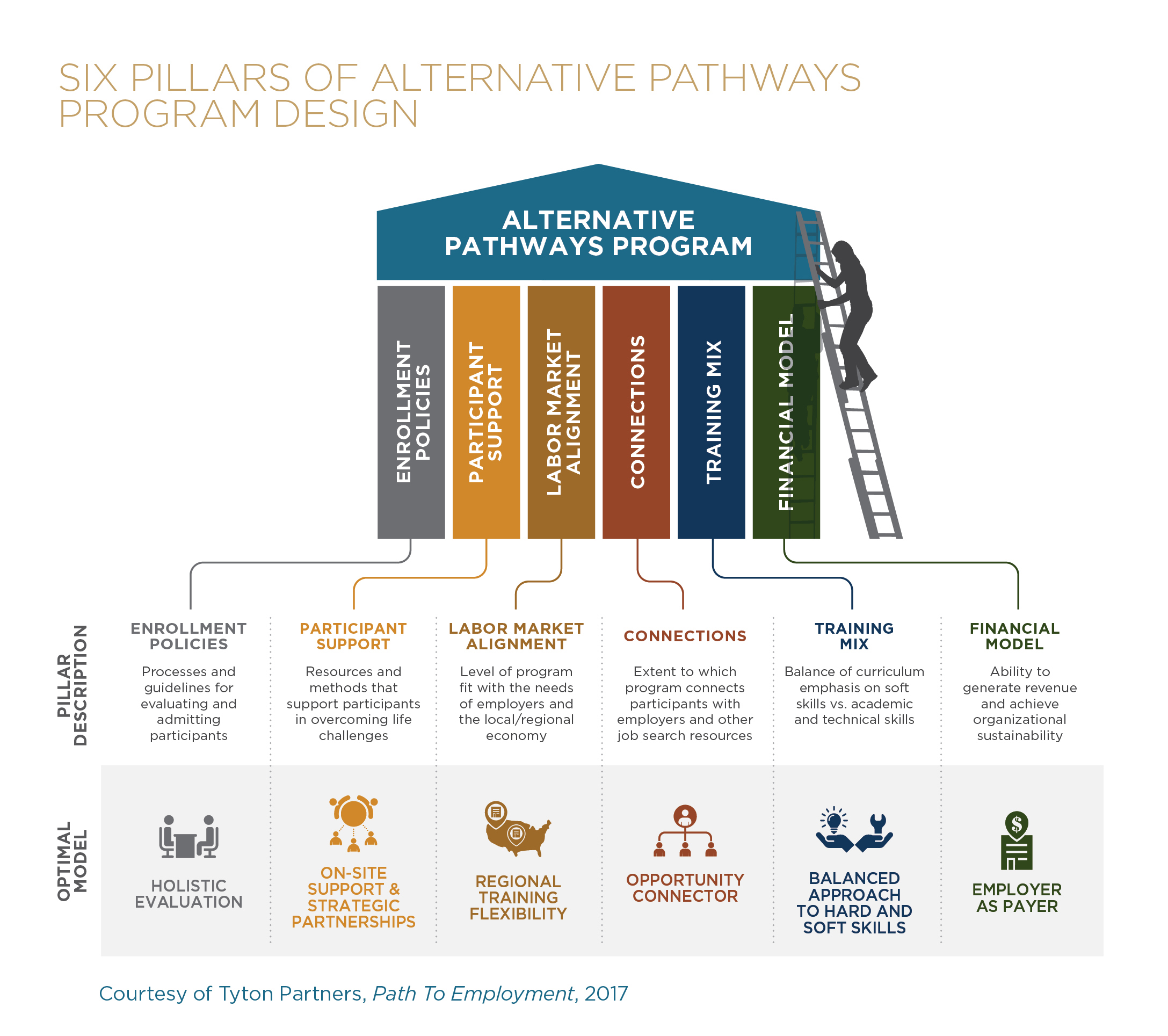
The Six Pillars
Much of Tyton’s analysis rests on what they call the “six pillars” of alternative pathways programs:
- Enrollment policies: Processes and guidelines for admitting participants
- Participant support: Resources and methods that support participants in overcoming life challenges
- Labor market alignment: Level of program fit with the needs of employers and the local/regional economy
- Connections: Extent to which program connects participants with employers and other job search resources
- Training mix: Balance of curriculum emphasis on soft skills vs. academic and technical skills
- Financial model: Ability to generate revenue and achieve organizational stability
In and of themselves, there’s nothing earth-shaking about these categories. But stating them explicitly as part of the analytic framework enables us to do all kinds of additional important work.
First, it enables us to ask, “Is this a complete and plausible list of critical success factors for a vocational program?” For example, the work of Vincent Tinto and others connects students’ sense of belonging in campus community to their likelihood of completing their degrees. Is that principle also operative in vocational programs for low-income adults? If so, how much of an effect does it have? And can it be subsumed under “participant support,” or is it distinct and important enough to merit its own pillar?
This line of questioning brings up a second advantage of having such a framework, which is that it points to a research agenda. What sorts of participant support are most effective for helping low-income adults to complete APPs? Does the answer to that question vary by context? If so, which sorts of contextual factors matter the most? Tyton has proposed a set of preliminary hypotheses for the optimal way to address each pillar based on the research that they conducted:
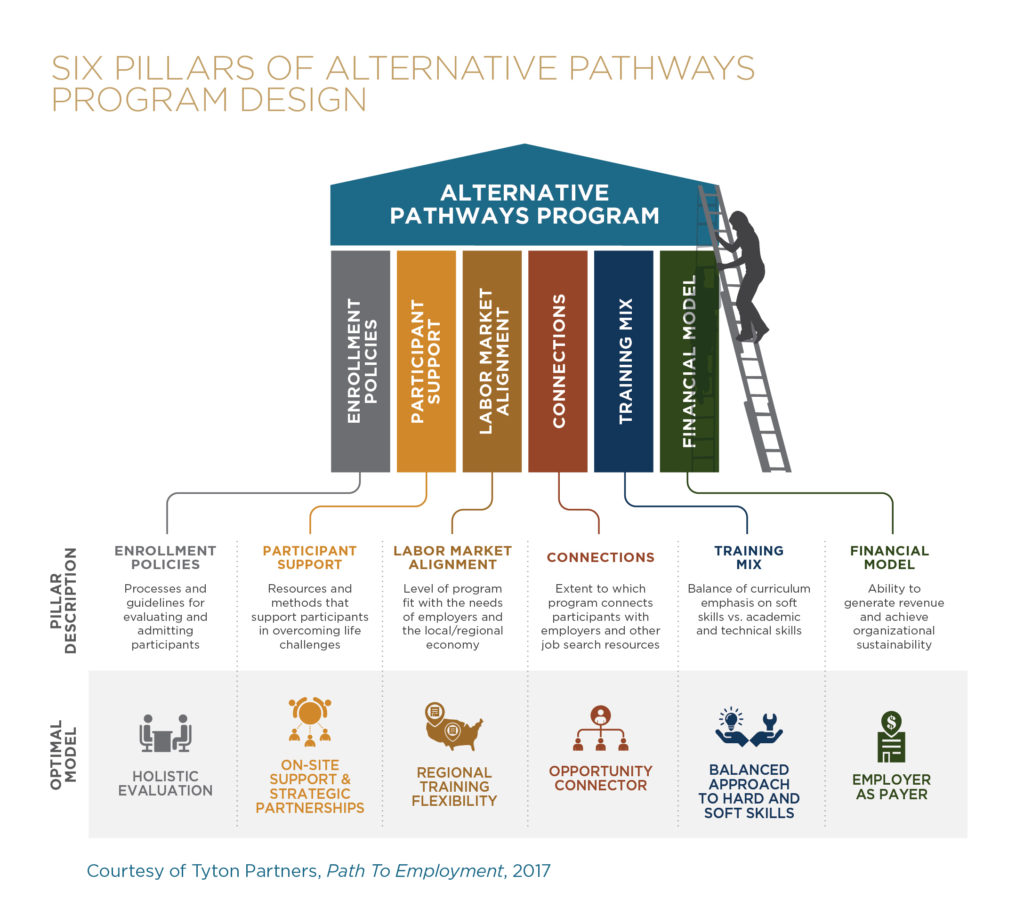
The point of the hypothesis is to have a truth proposition that can be tested. For example, Tyton has listed “employer as payer” as the “optimal model” for vocational programs. Going back to Governor Brown’s online campus proposition mentioned at the top of this post, California has funding mechanisms at its disposal that many of the start-up programs examined by Tyton do not. One might float an alternative hypothesis for that pillar and then test that hypothesis through various means.
The framework also enables program designers to think about trade-offs more clearly. A classic trade-off is between enrollment policies and participant support. Tyton articulates several alternative models for each pillar. Here’s the selection of models they examine for support: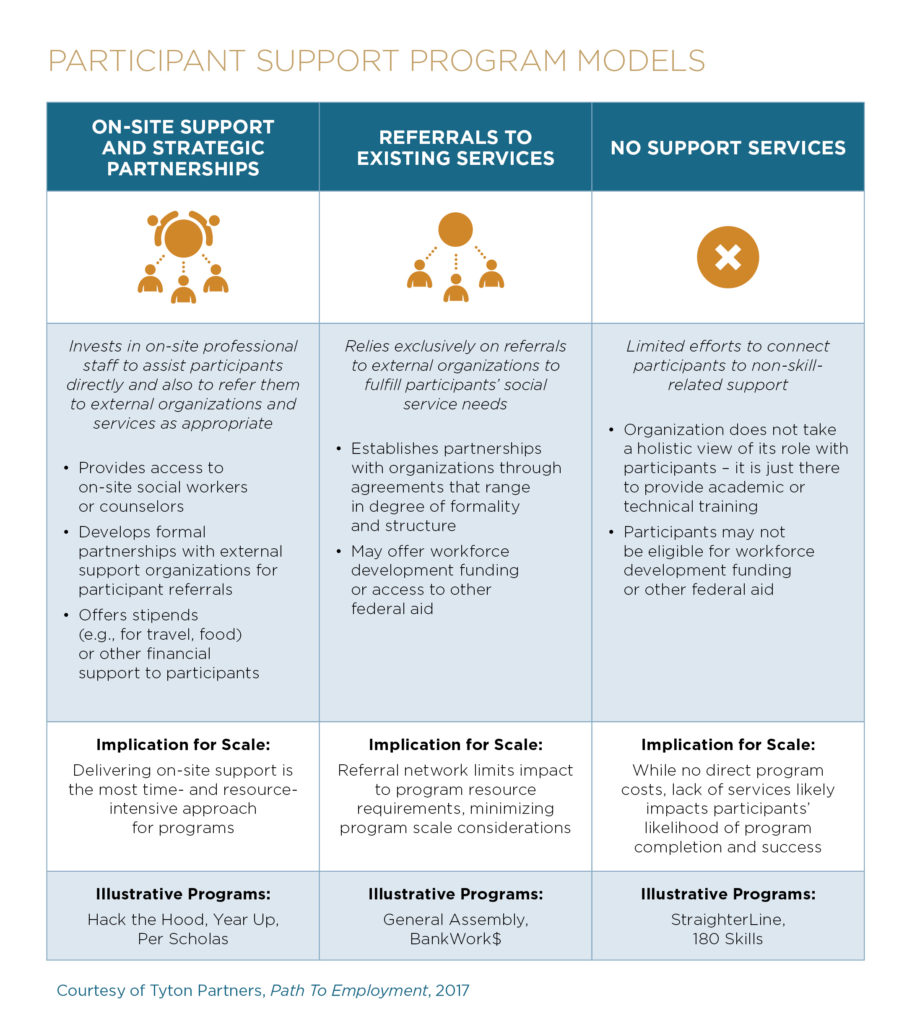
But these models don’t exist independently of the other pillars. If your program has an enrollment process that is extremely good at identifying students who come to the program already possessing many of the skills and life circumstances that would enable them to succeed if only they were given the opportunity, then you may need less investment in participant support. Conversely, if the program’s goal is to help those students who have to face the most daunting obstacles to their education, then investment in support becomes more important.
This example illustrates the point that we should interpret the word “optimal” loosely here. That large swath of grey in the earlier diagram representing all the low-income adults who are getting no education is not one homogenous blob of unmet need but rather a collection of millions of people with different strengths, needs, and circumstances. People in different situations will likely need different program designs in order to be successful. As a sector, we are thankfully past the peak of the idea that we can teach everything to everybody by posting video lectures online and calling them “MOOCs.” ((Not very far past, but still. Baby steps.))
This brings us to one of the most deeply divisive terms in education: scale.
The Tyton report examines two types of scale: inputs and outputs. Access and outcomes. Let’s imagine that California were somehow able to get 100% of low-income adults enrolled in community college degree programs. That would be good, right? Well, maybe. Let’s also suppose that, in doing so, California’s degree completion rate settles at the national average of 30% for community colleges. That would mean 70% of California’s low-income adults would end up still without a degree and still (likely) without improving their economic prospects. To the contrary, many of them would have increased levels of debt they would have to pay out of their unchanged salaries. So no, scaling access is not inherently good.
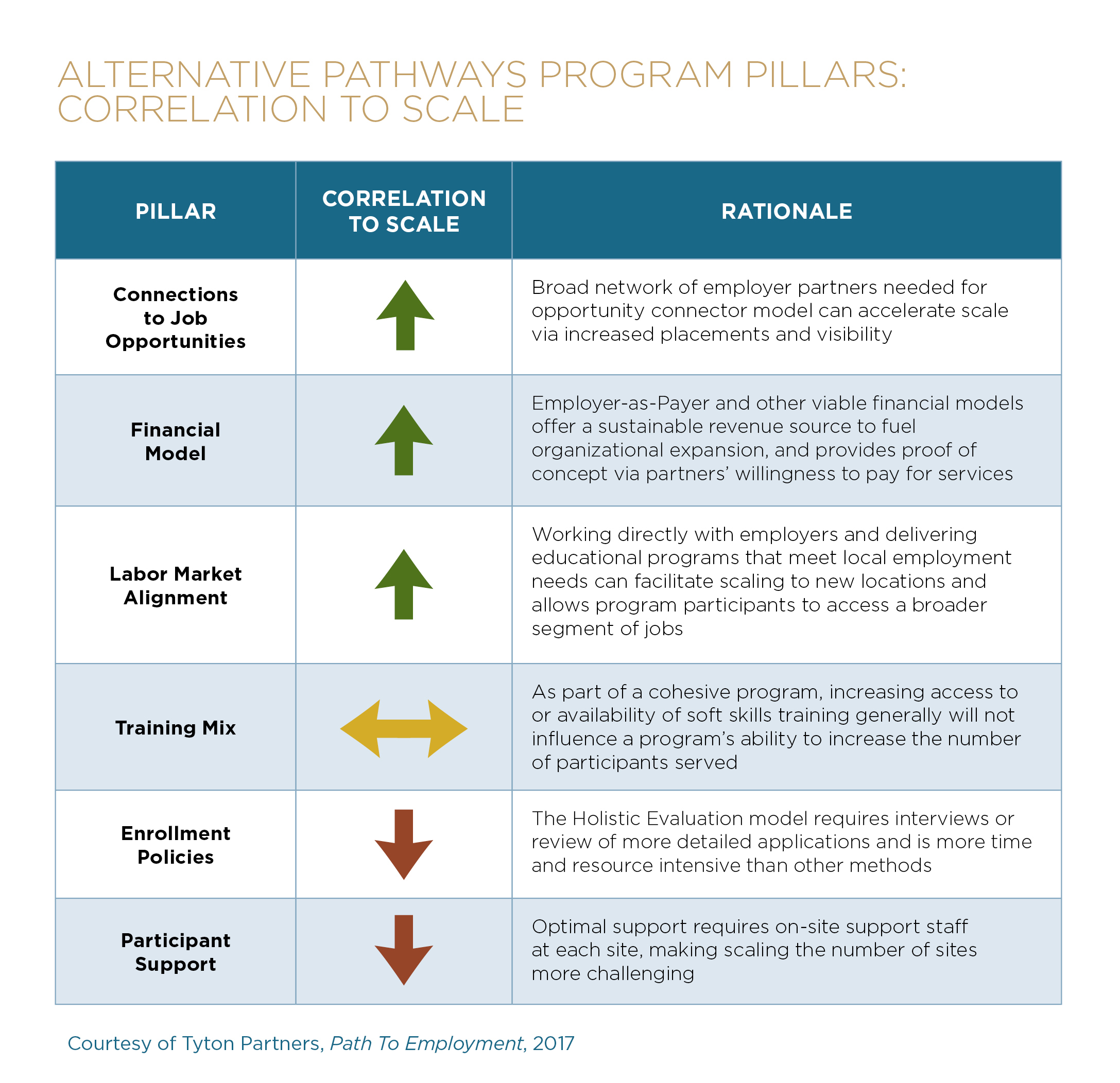
For each of Tyton’s hypothesized optimal strategies in each of their hypothesized pillars, they analyze the trade-off the strategy makes between scale of access and scale of outcomes:
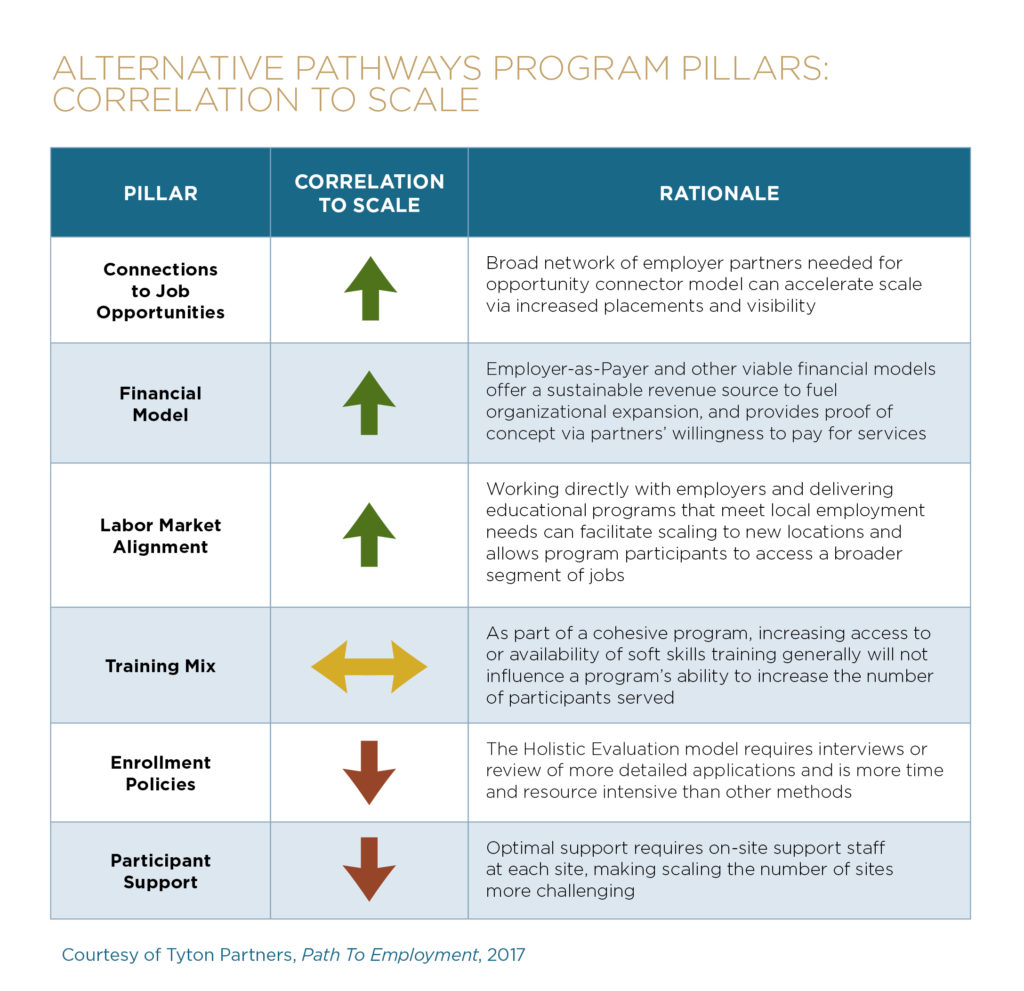
If a chosen strategy for a pillar has a downward-pointing red arrow, then it presents a challenge to scaling access. On-site support to students is harder to provide to many students than providing students with no support. It’s harder to scale enrollments—access—for a program that commits to high-touch student support. Then why do it? Hopefully because it improves the percentage of degree completions and other positive outcomes.
Taken together, the elements of Tyton’s framework give program designers and policy makers both a set of knobs they can turn in an effort to tune a particular program to the needs of a particular student population as well as a lens through which they can examine, test, and refine their assumptions in ways that will improve the effectiveness of those knobs and our knowledge of how the various settings interact with each other.
Of course, having knobs to twiddle is good, but being able to measure the impact of your knob twiddling is critical. As I mentioned earlier, the numbers Tyton cites for community college impact on low-income adults are less than perfect measures. While adequate for the purpose of assessing the order of magnitude of unmet need in a large state like California, the two proxies the report uses for scale or access and outcomes—number of students served and graduation rate—are not great for measuring impact at a more granular level. And it will be tough to develop better ones. Going back to the example of the person who takes a couple of accounting classes at a community college and gets a better job as a result, how would one capture that? And yet, that is precisely what we would need to do to get clearer sense of the degree to which community colleges are currently serving the needs of low-income adults and the degree to which tweaking community college programs in various ways might increase that impact. Other APP efforts will likely face similar data quality challenges. So application of the model in practice will likely require some innovation around measurement in these areas.
But here again, having a holistic model can help. Tyton highlights sustainability as the big reason to think about employer-pay business models. But if you happen to be thinking about the data problem while looking at the Tyton pillars graphic, it might occur to you that a direct relationship with employers can help with that problem. To start with, employers’ willingness to pay might be a good proxy for career progression benefits that students gain from their participation in the program. One would have to do the research, but it’s a plausible hypothesis. Second, the closer relationship with the employer makes outcomes data easier to get, perhaps in the form of anonymized aggregate data from the employers or by providing richer, longer term relationships with students that give them more incentive to provide the school with post-graduation follow-up data.
What About Ed Tech?
Nowhere does this framework explicitly address ed tech as such. And yet, ed tech decisions both large and small are often made by directly connecting a problem with a technological solution. A state wants to help reach more non-traditional students. Online learning can reach more students. So why not start an online learning program? A foundation or a college wants to help more first-generation college students make it through college. Adaptive learning programs seem to help some students in developmental math programs get past that stumbling block to their degree completion. So why not invest in adaptive learning programs?
Absent of a richer analytic framework, these efforts are more likely to fail and less likely to be reproducible because they don’t start with either a holistic understanding of the needs of the students the efforts are trying to help or a clear understanding of how various aspects of the support ecosystem interact with each other. Without a theoretical framework, you can’t construct a clear hypothesis. Without a clear hypothesis, you can’t construct a proper experiment. Without a proper experiment, you can’t learn what works and what doesn’t.
Very often, the best moment to think about ed tech is immediately after you have developed your program design and analyzed it for strengths and weaknesses. At this stage in the thinking, ed tech can potentially help by changing the laws of physics that underpin your model. OK, so low-income adult students need high-touch support which, when implemented in the traditional way, is resource intensive and therefore limits the number of students you can serve. Is there a way that technology can help provide that high-touch support at a lower resource cost? (By the way, the solution may not be to build robot advisors in the sky that can semi-read students’ minds. Instead, it might be saving advisors’ time spent doing other, non-student-facing work so that the same number of advisors have more time to serve students well.)
I have no strong opinions about the answers that the Tyton paper arrives at, but I do believe that they are asking roughly the right questions in roughly the right order. As a field, we need more of this type of program- and policy-level research and analysis to inform a wide range of strategic decisions, including but not limited to use of ed tech. It is an exemplar of a genre of educational research that we should be looking to grow, propagate, and use to inform practical decision-making.
This post is part of our Research in Translation series, which is funded in part by the Bill & Melinda Gates Foundation. The findings and conclusions (or views) contained within are those of the authors and do not necessarily reflect positions or policies of the Bill & Melinda Gates Foundation.