e-Literate

Present is Prologue

Tag: UC Davis

  • UC Davis LMS Back Online: Update on what we know about Scriba Sakai outage

    I’ve been told by two sources that the UC Davis LMS outage I described in this post may be over, and the SmartSite LMS is back online (SmartSite is UC Davis’ implementation of Sakai, hosted by Scriba). I would like to update what we know about the overall situation while we wait for additional confirmation. The following is based on my conversations with a Scriba inside source who asked to remain anonymous, a student at UC Davis, the LISTedTECH team whose database powers our new LMS subscription service, some commenters from the blog post, and a more thorough review of the UC Davis IT status site. And I should point out that UC Davis team has done an excellent job in communications – timely messages with no defensiveness, and full transparency.

    The Outage

    On Thursday, May 19, Scriba notified UC Davis and several other schools that it would perform emergency maintenance starting Friday, May 20 at 9pm PDT and ending Monday, May 23 at 11am PDT. The outage was not caused by software applications but data center issues. I’ve asked what this means, and I’ve been told that Scriba will describe the outage in the next week. (more…)

  • Scriba Disaster: Sakai-based LMS for UC Davis is down with no plans for recovery

    In what might shape up as one of the worst LMS outages in recent history, UC Davis has been working without an LMS for the past week and does not expect their vendor to fix the problems before the end of the term. UC Davis uses a version of Sakai hosted by the LMS remnants of rSmart. In 2013 rSmart sold it’s Sakai-supporting LMS business to Asahi Net International, and in 2015 a private equity firm – Vert Capital – bought ANI and renamed it Scriba. Scriba hosts the Sakai LMS for UC Davis which has branded it as SmartSite.

    UC Davis is on the quarter system, with the last week of class next week (May 31) and finals the week of June 6. A few months ago UC Davis announced their intention to migrate to Canvas as their LMS. SmartSite subsequently went down on May 19th, and all signs are pointed to a complete and final outage. Scriba will not answer the phones (you get a message that the mailbox is full), and UC Davis staff are making a heroic attempt to in-house recreate LMS tools and even to recover grades that had been entered on SmartSite.

    UC Davis staff have replaced the smartsite.ucdavis.edu portal with a page telling faculty some methods to replace the LMS or go to Canvas early.
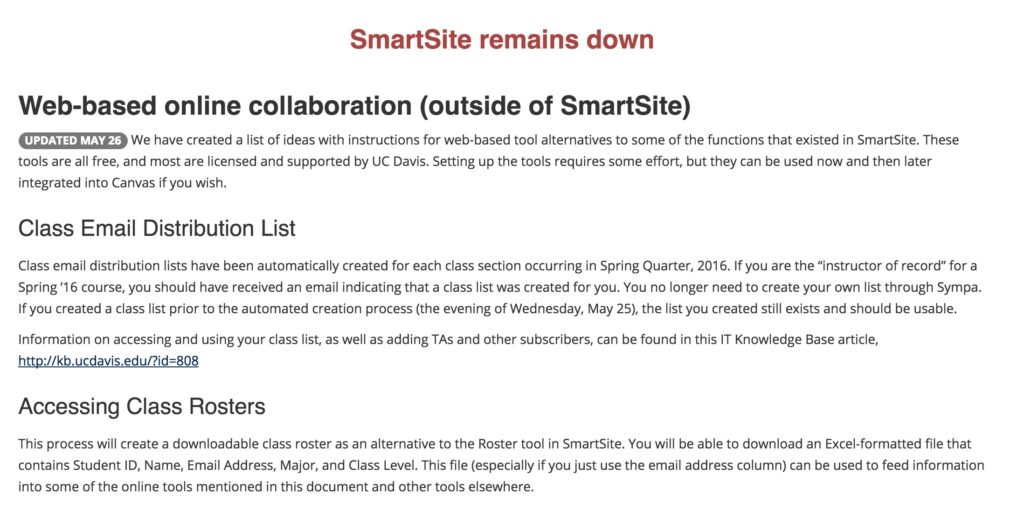
    UC_Davis_Smartsite

    There is no expectation for a repair by the vendor.

    On May 24th the UC Davis internal team sent this message to faculty and staff:

    We are working on extracting data from the SmartSite database. Our priority is to retrieve gradebook data for this quarter, and to make that information available to instructors as soon as possible. We are providing support for faculty to use alternatives to manage course materials for the rest of the quarter.

    This, folks, is a disaster. There is an interesting angle here in that Sakai is open source yet data is not easily recoverable. We will share more here at e-Literate as we find out new information.

    Update: Removed Buzzfeed post as unverified and not necessary for story.

    Update: Clarified that no expectation of repair by the vendor and that branding comes from UCD. Also adding the update from evening of May 26th.

    Progress continues on the Web interface to access grades. We expect that it will be available Friday (May 27).

    In addition, we have had a team working to build a local instance of SmartSite. This evening, the campus is completing internal testing on this limited version. A small group of selected faculty members will begin testing this version Friday morning. Depending on their results, we anticipate having this version available to spring 2016 instructors of record over the weekend. All of the content faculty have in SmartSite should be available to them.

    Please note that students will not have SmartSite access. While our goal remains to restore full access, this initial limited, local instance will only have capacity to support faculty access.

    Update: See this post for update on what happened and unconfirmed restoration of the system.

    I’ve been told by two sources that the UC Davis LMS outage I described in this post may be over, and the SmartSite LMS is back online (SmartSite is UC Davis’ implementation of Sakai, hosted by Scriba). I would like to update what we know about the overall situation while we wait for additional confirmation. The following is based on my conversations with a Scriba inside source who asked to remain anonymous, a student at UC Davis, the LISTedTECH team whose database powers our new LMS subscription service, some commenters from the blog post, and a more thorough review of the UC Davis IT status site. And I should point out that UC Davis team has done an excellent job in communications – timely messages with no defensiveness, and full transparency.

  • Making Lab Sections Interactive: More evidence on potential of course redesign

    Two weeks ago Michael and I posted an third article on EdSurge that described an encouraging course redesign for STEM gateway courses.

    In our e-Literate TV series on personalized learning, we heard several first-hand stories about the power of simple and timely feedback. As described in the New York Times, administrators at the University of California, Davis, became interested in redesigning introductory biology and chemistry courses, because most of the 45 percent of students who dropped out of STEM programs did so by the middle of their second year. These students are the ones who typically take large lecture courses.

    The team involved in the course-redesign projects wanted students to both receive more individual attention and to take more responsibility for their learning. To accomplish these goals, the team employed personalized learning practices as a way of making room for more active learning in the classroom. Students used software-based homework to experience much of the content that had previously been delivered in lectures. Faculty redesigned their lecture periods to become interactive discussions.

    (more…)

  • Student Course Evaluations and Impact on Active Learning

    The Chronicle has an article out today, “Can the Student Course Evaluation Be Redeemed?”, that rightly points out how student course evaluations are often counter-productive to improving teaching and learning. The article refers to a Stanford professor’s call for an instructor completed “inventory of the research-based teaching practices they use”, but most of the article centers on revised course evaluation tool from a Kansas State University spin-off (the IDEA Center). One of the key problems described is that “administrators often take their results as numerical gospel” as well as faculty misapplying the results.

    However they’re used, a lot of course evaluations simply aren’t very good, [IDEA president] Mr. Ryalls says.

    But as flawed as they are, faculty members still turn to them as some gauge of effectiveness in the classroom. About three-quarters of instructors use formal evaluations and informal feedback “quite a bit” or “very much” when altering their courses, according to the Faculty Survey of Student Engagement.

    One limitation of many tools is that they ask students things they don’t really know. A frequent example: Was your instructor knowledgeable about course content?

    There is one additional problem with most student course evaluations that is not explicitly covered in the Chronicle articles – students newly involved in active learning approaches often rate the course and instructor poorly even if they end up learning more effectively. We saw this in our e-Literate TV case study at UC Davis. In a previous post we highlighted how the routine hard work required of students in active learning courses can lead to poor evaluations, but later in the interview student course evaluations came up as a major barrier to improving teaching practices. (more…)

  • Challenge Of Student Transition Between Active And Passive Learning Models

    Last week the Hechinger Report profiled an innovative charter school in San Diego called High Tech High (insert surfer jokes here) that follows an active, project based learning (PBL) model. The school doesn’t use textbooks, and they don’t base the curriculum on testing. The question they ask is whether this approach prepares students for college.

    As a result, for [former HTH student Grace] Shefcik, college – with its large classes and lecture-based materials– came as a bit of a shock at first. At the University of California, Santa Cruz, she is one of more than 15,000 undergraduates, her assignments now usually consist of essays and exams. At High Tech High, Shefcik had just 127 students in her graduating class, allowing her to form close relationships with peers and teachers.

    The premise of the article is that PBL prepares students for life but maybe not for college. Grace described the big difference between high school, with constant feedback and encouragement, to college, where you rarely get feedback. Other students describe their frustration in not knowing how to study for tests once they get to college.

    After a recent screening of “Most Likely to Succeed” at the New Schools Summit in Burlingame, California, High Tech High CEO Larry Rosenstock told an audience, “We actually find that many of our students find themselves bored when they get to college.” (more…)

  • Universities As Innovators That Have Difficulty Adopting Their Own Changes

    George Siemens made an excellent point in his recent blog post after his White House meeting.

    I’m getting exceptionally irritated with the narrative of higher education is broken and universities haven’t changed. This is one of the most inaccurate pieces of @#%$ floating around in the “disrupt and transform” learning crowd. Universities are exceptional at innovating and changing.

    While I agree with his primary point about false narratives with simplistic no-change assumptions, I think there is a risk about going too far the other direction. Universities have certainly changed, and there are many innovations within universities, but universities are not very good about diffusing the innovations that they do make. I made this same argument here and here. ((The first article had more of a technology focus, but the same applies to the pedagogical side of change.)) Campus changes are apparent, but too often I see innovative course designs showing real results, but courses in the same department remain unchanged.

    In my opinion Universities are exceptional at innovating, but they are not exceptional at changing.
    (more…)

  • Using TAs As Key Component Of Active Learning Transformation at UC Davis

    Last week I described how UC Davis is making efforts to personalize one of the most impersonal of learning experiences – large lecture introductory science courses. It is telling that the first changes that they made were not to the lecture itself but to the associated discussion sections led by teaching assistants (TAs). It is well known that much of the instruction in lower division classes at large universities is led not by faculty but by TAs. This situation is often seen as a weakness of the business model of a research university, but it can also be leveraged as an opportunity to lead educational change. Consider this interview with staff from the iAMSTEM group at UC Davis from our e-Literate TV series on personalized learning:


    (more…)