e-Literate

Present is Prologue

Tag: University of Phoenix

  • Fate of EDU For-Profits: A look into recent enrollment changes and shut downs

    Fate of EDU For-Profits: A look into recent enrollment changes and shut downs

    One month ago the Education Corporation of America (ECA) was the latest for-profit system to shut down, as described by Inside Higher Ed:

    Education Corporation of America owns more than 75 campuses and enrolls at least 20,000 students in mostly certificate-granting professional disciplines such as cosmetology, culinary arts and medical and dental assistant programs. It operates chains including Virginia College and Brightwood College.

    A week later Adtalem Global Education completed their sale of for-profit systems:

    Adtalem Global Education (NYSE: ATGE), a leading global education provider, today announced the completion of the transfer of ownership of DeVry University (DVU) and its Keller Graduate School of Management to Cogswell Education LLC. Today’s announcement closely follows Adtalem’s disclosure of the transfer of ownership of Carrington College to San Joaquin Valley College, Inc. (SJVC Inc.) which was completed on Dec. 4, 2018. Post divestitures, Adtalem Global Education’s U.S. postsecondary degree-granting institutions serve the high-demand, rapidly growing medical and healthcare markets.

    The centerpiece of Adtalem’s remaining portfolio ((Disclosure: Adtalem is a former client of MindWires and past subscriber of our LMS Market Analysis service.)) is Chamberlain University, a growing system of nursing-based programs, and a look at the underlying data reveals that Chamberlain is one of only two large for-profit systems with significant growth.

    Given all the changes in for-profits, we tend to see either anecdotes about specific institutions or aggregate data on all for-profits combined. What is missing, though, is a view in between, showing enrollments and changes to a select group of for-profit schools, to help understand the different fates of different institutions.

    Why does this matter? For one, many for-profit chains are accredited as a number of different institutions, and they need to be combined to understand overall company strength. Second, following Tolstoy’s idea that “All happy families are alike; each unhappy family is unhappy in its own way”, the decline of for-profit institutions has a number of unhappy families with different lessons. In the case of ECA there is something unseen in other cases – ECA abruptly shut down despite growing enrollment by 32% year-over-year across Virginia College and Brightwood Colleges in the most recent IPEDS.

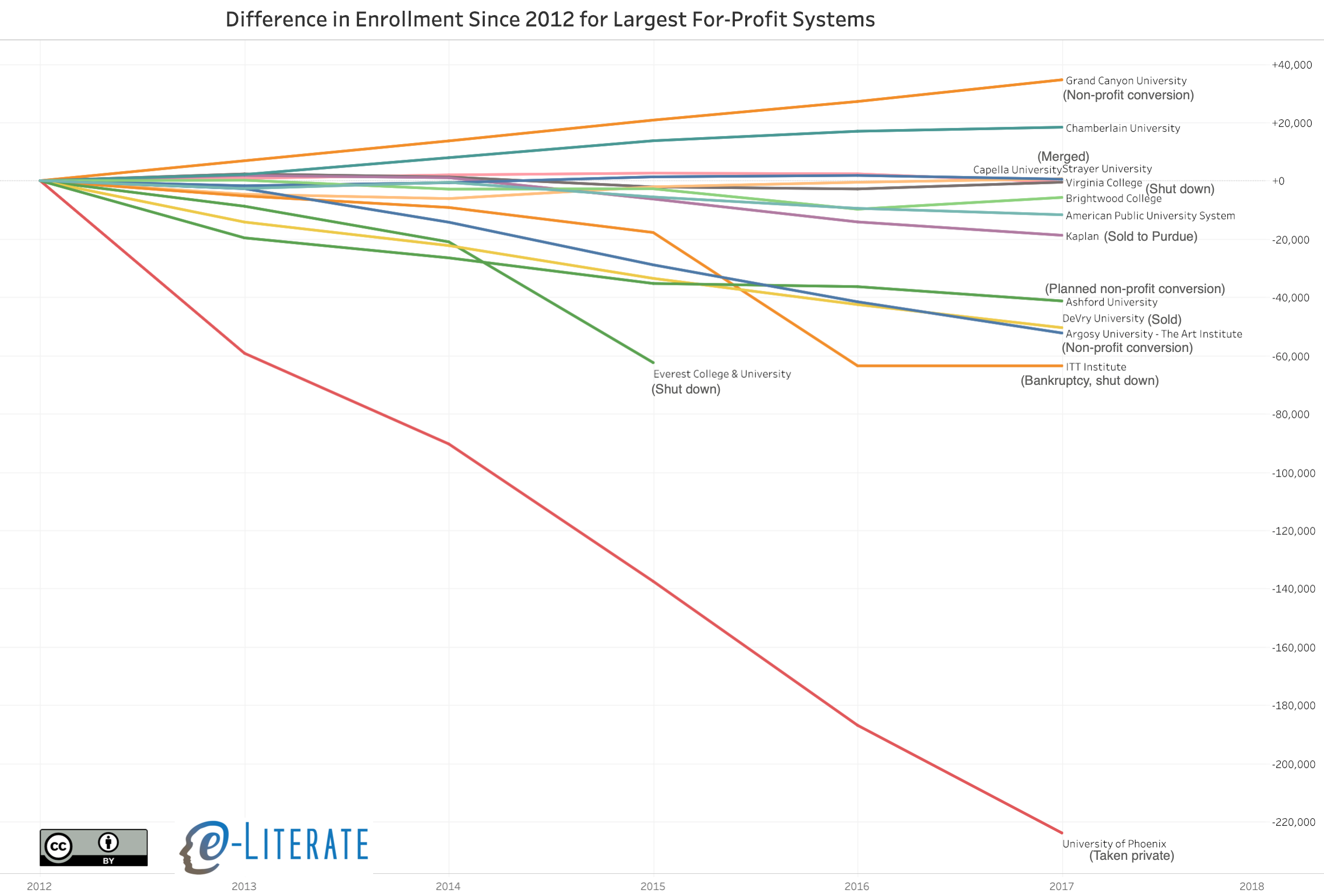
    The chart below shows differences from the Fall 2012 IPEDS enrollment report (grad + undergrad) for the 13 largest degree-granting systems as of that date, running through the Fall 2017 report (the most recent data available). I’ve added notes to show the various changes in ownership, control, and status for these systems – converting to non-profit status with a for-profit operating entity, merging of institutions, sale of institutions as with DeVry, going bankrupt withy full shut-down of systems, or taking the company private as with the U of Phoenix. Click on image for full size version.
    Largest for-profits - changes from 2012

    Some notes:

    • To read the chart properly, note that Chamberlain University had almost 20,000 more students in Fall 2017 than they had in Fall 2012, while DeVry University had roughly 50,000 fewer students in that same time period;
    • Seen together, it is startling the extent of changes in ownership, control and status among these former high-flying for-profit systems;
    • The only significant growth for these large systems came from Grand Canyon University and Chamberlain;
    • The changes to Virginia College and Brightwood College are not that significant; and
    • By far the largest decrease in enrollment has been the University of Phoenix.

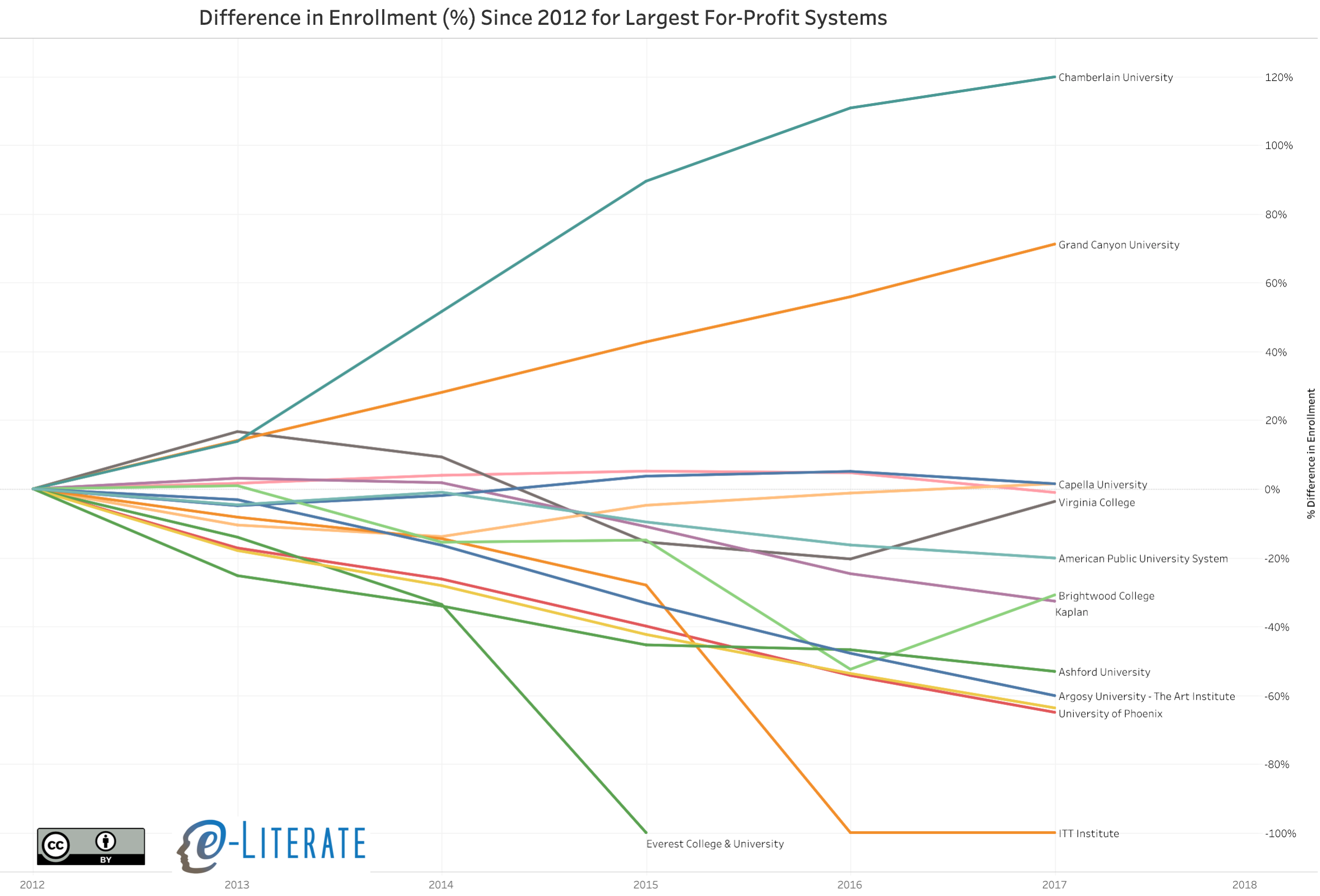
    While that view shows enrollment changes in total numbers, it is also useful to see relative changes for these same systems since 2012 to take into account the different enrollment sizes of the systems.
    Some notes:

    • To read the chart properly, note that Chamberlain University grew roughly 120% from Fall 2012 to Fall 2017, while DeVry University shrank more than 60% in that same time period;
    • In percentage terms, Chamberlain’s growth exceeds Grand Canyon University’s, which surprised me, but it seems to be leveling off;
    • Likewise, in percentage terms, DeVry University’s decline is roughly the same as the University of Phoenix’s;
    • Virginia College and Brightwood College actually grew from Fall 2016 – Fall 2017; and
    • We can see the shutdown of Corinthian Colleges (Everest) and ITT with 100% declines (ITT reported data in 2016 and 2017 even with no students).

    Let’s focus on just the four brands mentioned in last month’s stories – DeVry University & Chamberlain University for Adtalem, and Virginia College and Brightwood College for ECA.

    With this view, Adtalem’s strategy of selling DeVry while keeping Chamberlain makes a lot of sense, even if several years late and if they essentially gave away DeVry.

    ECA’s shut down, however, is not easily explained by the data. Unlike ITT and Everest, Virginia College and Brightwood College were not in enrollment free fall, and in fact there was instead recent enrollment gains getting them roughly back to 2012 levels. So why such an abrupt shutdown of ECA? The answer seems to lie with how the Department of Education and its accreditor handled recent troubles, based on IHE reporting.

    The shutdown follows years of declining enrollment for the chain. More recently, the privately held company scrambled to turn around its troubled finances by closing about a third of its campuses and pursuing a corporate overhaul through a court-approved receivership. But ECA continued to be dogged by creditors after falling behind on payments and rent for many campus locations. In October the company filed a lawsuit, which was later dismissed, against the U.S. Department of Education in an attempt to maintain its access to federal student aid.

    In an email to campus employees Wednesday morning, ECA CEO Stu Reed said that the Department of Education had added new restrictions on its access to Title IV student aid. And on Tuesday night, the Accrediting Council for Independent Colleges and Schools suspended the colleges’ accreditation. Those steps meant the company couldn’t secure the additional capital needed to operate its campuses, he said.

    I do not have enough knowledge to judge whether the ED should have shut off access to financial aid at the time that they did, but it does appear that students are paying the price despite signs that the schools were making significant enrollment gains. From the news coverage, there were significant outcomes issues beyond financial health of the parent company, but to my knowledge, this is a new situation among for-profit colleges in having a shut down despite very recent enrollment gains.

  • Fall 2017 Top 30 Largest Online Enrollments In US – With LMS Usage and Trends Since 2012

    Fall 2017 Top 30 Largest Online Enrollments In US – With LMS Usage and Trends Since 2012

    The National Center for Educational Statistics (NCES) and its Integrated Postsecondary Education Data System (IPEDS) provide the most official data on colleges and universities in the United States. This is the sixth year of data on distance education enrollments, and we have an opportunity to view trends over time.

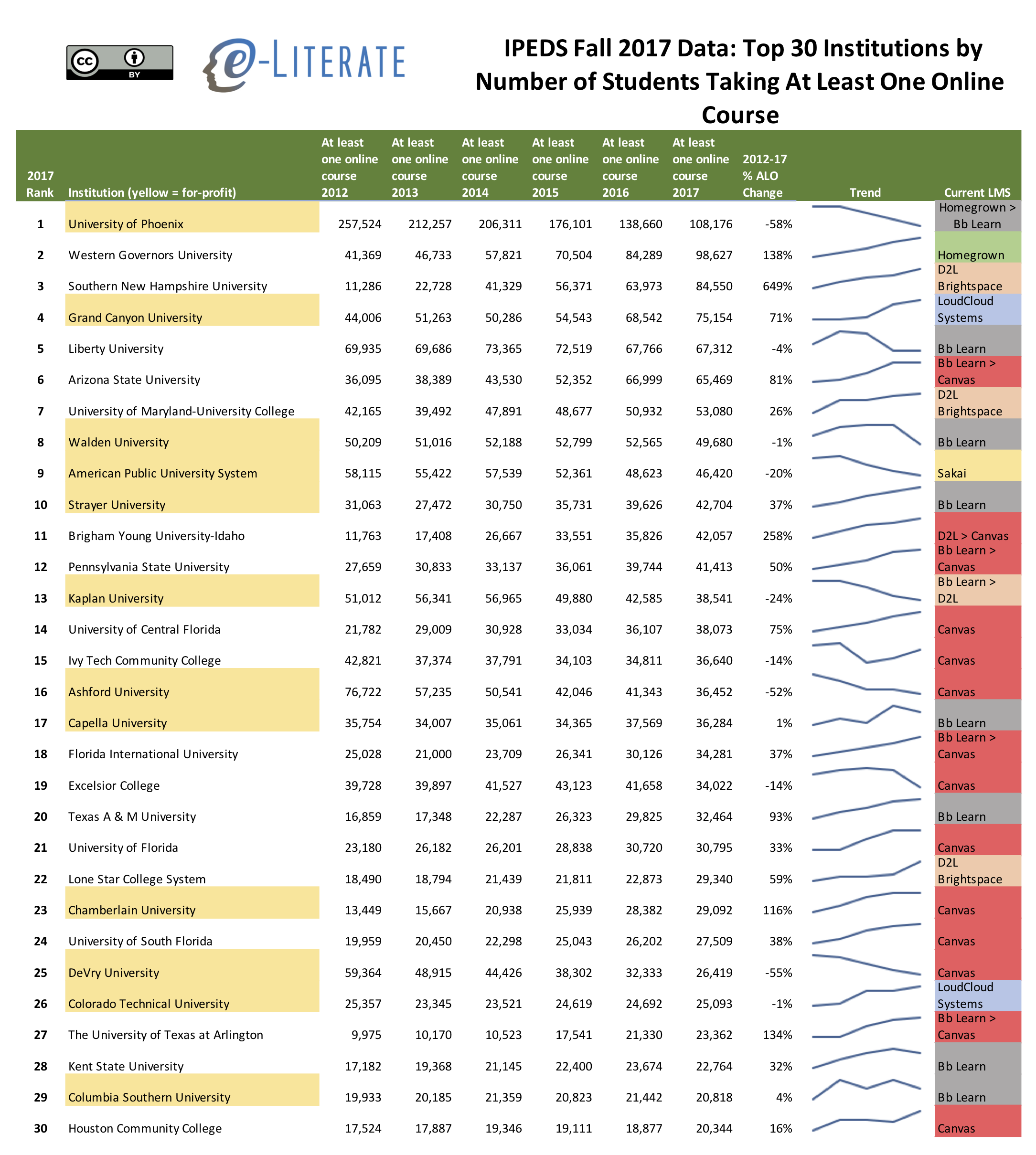
    Let’s look at the top 30 online programs for Fall 2017 (in terms of total number of students taking at least one online course for grad and undergrad levels combined) in the US. Some notes on the data:

    • The first view combines the categories ‘students exclusively taking distance education courses’ and ‘students taking some but not all distance education courses’ to obtain the ‘at least one online course’ category; the second view shows just the ‘students exclusively taking distance education courses’.
    • Note that IPEDS captures distance education enrollment data based on Fall 20xx reports using a census date of October 15; this approach does not fully capture programs with multiple start dates throughout the year.
    • IPEDS tracks data based on the accredited body, which can differ for systems – this data has combined most for-profit systems into one institution entity as well as Arizona State University and a handful of not-for-profit systems that operate as one entity.
    • There is a new column this year showing changes in enrollment in each case between Fall 2012 and Fall 2017 data.
    • Both views highlight for-profit institutions in yellow and added sparklines to help visualize trends. There has been a wave of for-profits converting in one form or another of not-for-profit institutions (e.g. Grand Canyon University, Kaplan / Purdue Global), but these conversions for the most part had not taken place as of the Fall 2017 reporting period.
    • There is another new column this year showing which LMS is currently in usage at each of the schools listed, and in cases where there is a transition in 2018, both systems are shown with a direction > sign.
    • See this post for Fall 2017 profile by sector and state.

    Largest 30 online enrollments in US

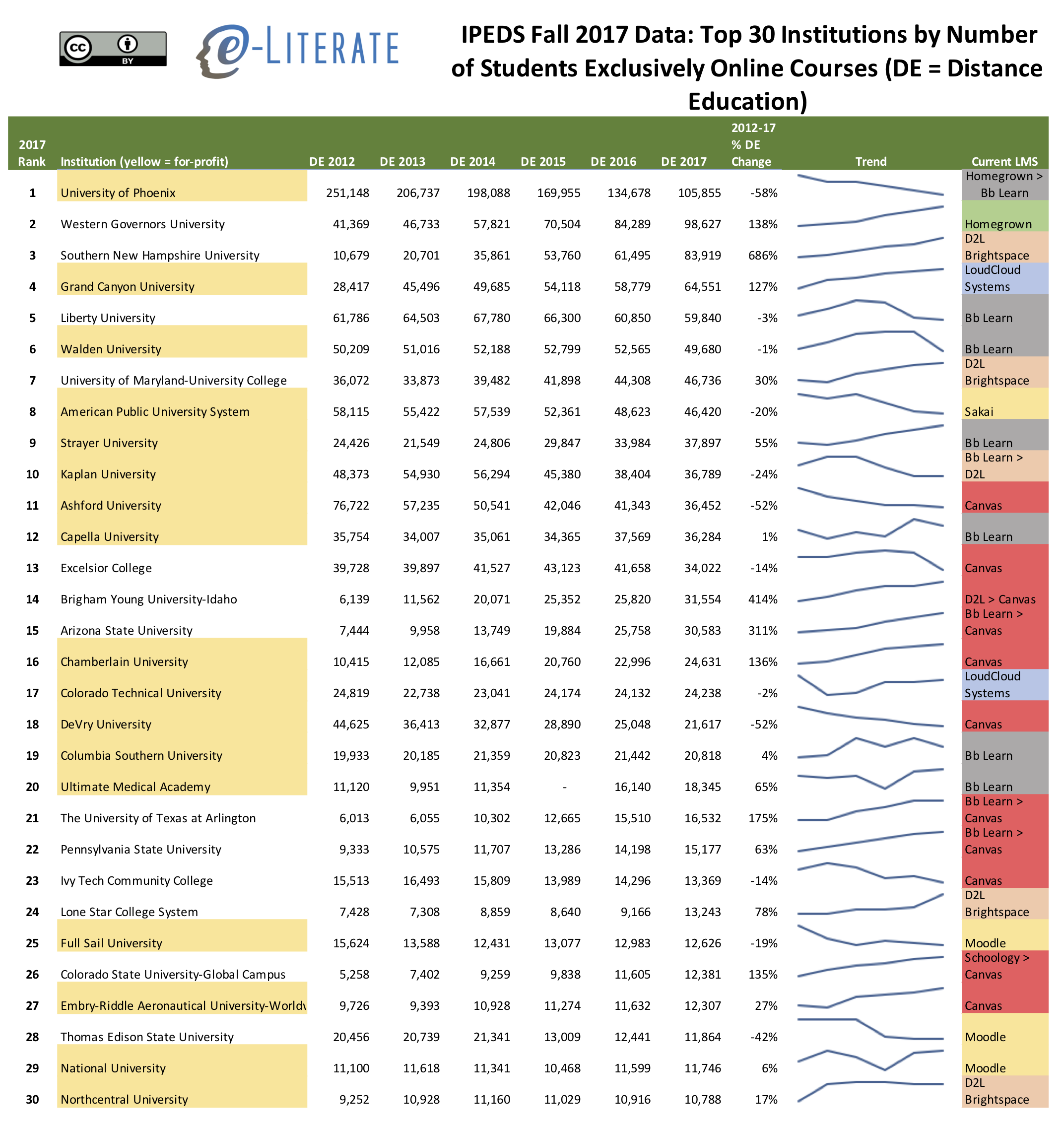
    Looking at the case where students exclusively take online courses in a distance education (DE) mode, we see some differences in the list with a greater concentration of for-profit schools.

    Top 30 distance ed institutions

    Finally, it’s worth looking at the top 30 trend over time. Obviously the University of Phoenix is no longer the 800 pound gorilla in distance education, with two not-for-profits – Western Governors University and Southern New Hampshire University – poised to overtake Phoenix in the next year or two. This view also shows the tendency for most institutions to top out at approximately 60,000 students, but this may be changing with the three counter-examples above as well as Grand Canyon University.

    IPEDS Top 30 trend 2012-17

    Based on a reader request, I have added a Google Sheet for the data used above. There are tabs for Top 200 and Top 30 listings for each category (ALO and DE), but the LMS data was added manually and only available in Top 30.

    Update 11/26: Fixed mistake in 2012-17% calculations, updated first two images. Added downloadable Google Sheet for data access.

  • The Massive Decline In Larger Education Company Market Caps

    After our coverage of Blackboard’s CEO change last week, we were both interviewed by the Washington Business Journal, with the following lede:

    Analysts and sources I spoke with Monday, both on and off the record, said the decision to bring on Bill Ballhaus as CEO was a combination of Bhatt failing to make progress building the company’s business and lacking the experience needed to successfully run a company of that scale. And that means at least several years before Providence Equity Partners, which owns a majority of the company after paying $1.64 billion for it in July 2011, begins actively marketing the company for sale, according to industry experts.

    Earlier this week I wrote about Apollo Education Group, parent of the University of Phoenix, putting itself up for sale due to its weakening financial position. I also noted that I doubt that McGraw-Hill Education is going to be able to go public in the near-term. Part of the reason for this latter observation is the dramatic fall of Pearson in the stock market, triggered by its warnings that it would miss earnings estimates. In Audrey’s excellent year-end post on the business of ed tech, she noted:

    Private equity firms sure love buying ed-tech companies. Perhaps because the stock market’s sorta “meh” about them.

    (more…)

  • Parent Company of University of Phoenix Could Be Sold to Owner of McGraw-Hill Education

    Apollo Education Group, parent company of the University of Phoenix as well as Apollo Global, is in “advanced talks” to be purchased by Apollo Global Management, owner of McGraw-Hill Education and of Cengage debt. Got that?

    To clarify, the Apollo Education Group is the parent company of the University of Phoenix, and they have a subsidiary called Apollo Global, which is a joint venture with the Carlyle Group, another private equity firm. While the confusion is understandable, Apollo Global Management previously shared nothing in common with the Apollo Education Group other than their admiration for the choir-directing sun-god.

    With that in mind, here is the news from the Wall Street Journal today:

    A deal between Phoenix-based Apollo Education and Apollo Global Management, a New York private-equity firm, could be worth about $1 billion, some of the people said, with one of them adding an agreement could be reached in the next few weeks. Apollo Education had been in discussions with a number of private-equity firms since late last year, but Apollo Global Management is the only one still in the running now, this person said.

    It is possible, as always, in such situations that there will be no deal, and another buyout firm could re-emerge.

    (more…)

  • LMS Market Updates, Dec 2015

    There seems to be a series of news and analysis on the LMS higher education market worth summarizing.

    Major Adoption News

    I posted last weekend about University of Phoenix (UoP) and their LMS. UoP is well-known for being the biggest user of a homegrown LMS for well over a decade, but in the past several years they rolled out “Classroom”, an entirely new adaptive-learning based design. In a major strategic change, UoP is abandoning this effort and moving to a commercial provider.

    What we can now confirm at e-Literate is that the “learning platform” selected by the University of Phoenix is Blackboard Learn Ultra. This is the cloud-based redesign of Learn that Michael and I have described in several posts. Even with the University of Phoenix’s reduced enrollment, I consider this news to be the most important new client acquisition for Blackboard since at least 2011.

    Today Campus Technology reported that Stanford is moving to adopt Canvas as their campus-wide LMS. Previously Stanford was a founding member of Sakai, with its implementation called CourseWork.

    The university has been piloting Instructure Canvas since the 2014-2015 academic year. The vice provost for teaching & learning (VPTL) said in a statement that about 80 percent of faculty in the pilot reported being “very or somewhat satisfied” with the new platform; even more students (94 percent) found it “very or somewhat easy” to use.

    Alongside the pilot, two Stanford schools had already adopted the application independently. The Graduate School of Education moved to Canvas in 2013-2014, and the Graduate School of Business did so in 2014. Both adoptions were considered successes.

    During this school year, the migration was accelerated. Some 300 classes switched to Canvas. And the plan is to migrate the remaining 4,200 classes still using the legacy LMS software over the next academic year.

    (more…)

  • Exclusive: University of Phoenix moving from homegrown platform to Blackboard Learn Ultra

    The University of Phoenix has a history of using its scale to develop and rely on homegrown platforms, including the  adaptive learning platform branded as “Classroom”. I wrote about this investment in 2013.

    The full significance of the University of Phoenix bet on adaptive learning platforms goes beyond pure dollars and became clear when the school announced the closure of 115 of its 240 locations. The stated usage of the savings from campus closures is primarily to further invest in the platform as described by the Phoenix Business Journal.

    In early 2015 the University of Phoenix experienced “significant disruption with respect to our new online classroom platform”. By summer, the university’s parent company The Apollo Group announced to investors that it planned “to move away from certain proprietary and legacy IT systems”. CEO Greg Cappelli further described these changes in broad terms in the most recent earnings call. (more…)

  • U of Phoenix: Losing hundreds of millions of dollars on adaptive-learning LMS bet

    It would be interesting to read (or write) a post mortem on this project some day.

    Two and a half years ago I wrote a post describing the University of Phoenix investment of a billion dollars on new IT infrastructure, including hundreds of millions of dollars spent on a new, adaptive-learning LMS. In another post I described a ridiculous patent awarded to Apollo Group, parent company of U of Phoenix, that claimed ownership of adaptive activity streams. Beyond the patent, Apollo Group also purchased Carnegie Learning for $75 million as part of this effort.

    And that’s all going away, as described by this morning’s Chronicle article on the company planning to go down to just 150,000 students (from a high of 460,000 several years ago). (more…)