Gang, don’t forget that this week’s Blursday Social guest is Phil Hill. Blursday Socials are conversational, so we’ll all talk about whatever the folks who show up want to talk about. But here are a few topics on my mind for a conversation with Phil:
Curricular materials trends: Phil recently updated his cost analysis of curricular materials. But there’s some weirdness in the numbers due to the convoluted way in which publishers bundle products. I’d like to tease out what we know about adoption rates and pricing of courseware and digital homework products.
Online education trends during COVID: Phil has been tracking the enrollment numbers that we have so far and sifting through them to find trends among types of institutions, types of programs, etc. I’d like to get his latest take on what we do and don’t know, as well as what numbers he’s watching for.
The resurrection of Blackboard…? While I care a lot less about LMS market share these days, I am interested in why different companies are doing better or worse and what that tells us about what campuses value in their LMS and LMS vendor these days. Phil recently wrote about a big win in the US for Blackboard. I want to know more.
But most of all, I want to catch up with my old friend in the company of other friends, probably with a beverage in-hand. You should come. It’s fun.
Remember, Blursday Socials are much more conversation and participation than broadcast. Think of it as being like trivia night at your favorite bar. There will be some organized activity, but a lot of it will be just connecting with friends. Some folks will be regulars, others will be semi-regulars, and still others will drop in occasionally. They start every Thursday at 4 PM Eastern Time. The bar closes at 5:30.
The dress code is casual; BYOB.
I recommend that you also subscribe to the iCal feed, which you can do by going to this page and clicking on the “iCal Feed” button on the bottom. I have events tentatively lined up for the handful of weeks, which I will populate to the calendar as they are finalized.
Phil Hill’s session is Thursday, November 12th at 4 PM ET. RSVP here.
In my last post, I argued that scaling the seminar is an equity issue:
[S]caling the seminar is essential for equity if we want to avoid a two-track system of education—one at expensive universities and another for the rest of us. This is already a serious problem that the current situation is likely to make worse.
I also argued that we are experiencing a failure of imagination about how to scale the seminar because EdTech has become obsessed with solving the wrong problem:
We’ve been pursuing the solutions that have helped improve student self-study by providing machine-generated feedback on formative assessments. While these solutions have proven beneficial in some disciplines and have been especially important in helping students through developmental math, they have hit a wall. Even in the subjects where they work well, these solutions usually have sharply limited value by themselves. They work best when the educators assigning these products use their feedback to reduce (and customize) their lectures while increasing class discussion and project work.
Despite the proliferation of these products, flipped classrooms and other active learning techniques are spreading slowly. And meanwhile, there is a whole swath of disciplines for which machine grading simply doesn’t work. This most broadly applies to any class in which the evaluation of what students say and write is a major part of the teaching process. EdTech has been trying for too long to slam its square peg into a round hole.
In this post, I will outline an approach for scaling social feedback and peer assessment as the means for scaling the seminar. I will use the example of an English composition course for two reasons. First, I recently had the pleasure of presenting at a virtual workshop on the topic hosted by the University System of Georgia and supported by the APLU. So I have already done some thinking about this particular topic. Second, English composition is one of the hardest seminar-style classes to scale. Students need frequent and intensive feedback. And particularly in access-oriented contexts, many of these first-year students do not come to college with the skill sets necessary to provide high-quality writing-oriented peer review. So it’s a good test case.
Setting the goalposts
Let’s be clear about the boundary between ambitions and fantasies. I do not believe it is currently possible to scale English composition courses with quality in even middle-of-the-road access-oriented colleges using any method that I can think of. We do not have a viable alternative to frequent feedback from an expert human to teach students that don’t have a good grasp of grammar, are weak at constructing arguments, don’t know how to cite evidence, and have not learned how to give and take feedback on writing.
I do believe that a technology-supported approach to social feedback and peer assessment can potentially accomplish the following goals:
Improve the outcomes in access-oriented composition courses by supporting effective pedagogical models and evidence-based practices
Make writing-across-the-curriculum programs more practically implementable.
Scale effective seminar-style classes in cases where students are better prepared for them (including second-year students at access-oriented institutions who have had a year of experience in a writing-across-the-curriculum program).
Provide scaffolding for faculty in all disciplines to “flip” their classes more easily and effectively
The basic rationale is that social feedback and peer assessment enable groups to learn and work more effectively regardless of the knowledge domain. These two functions are at the heart of seminar-style pedagogy. Anyone lucky enough to have taken a great seminar on any subject will likely remember the fantastic conversations among the whole class. There may or may not have been lectures. But whenever content is provided to the students—as an instructor presentation, a reading, or something else—the point is generally to catalyze peer-to-peer conversation and learning.
Equally importantly, these skills transfer to the workplace. With all the buzz over the years about preparing students for the future of work, we fail to recognize that the future of knowledge work—a future that has already arrived—is a workplace environment designed to facilitate social feedback and peer assessment in a project-based learning context. For example, in software development, Agile software development is all about improving software quality by baking social feedback and peer assessment into the day-to-day work of building software. The very first tenet of the Agile Manifesto—which only has four tenets in total—is “individuals and interactions over process and tools.” Building novel and complex software always requires a learning process. It’s a major reason why development timelines are notoriously unpredictable. Teams learn as they build. They discover unanticipated problems to which they have to invent solutions. Older software development methods perpetually led to disappointment because they failed to recognize that knowledge work entails learning and discovery. Waterfall development was optimized for predictable schedules. It failed at that goal. In contrast, Agile software optimizes for team learning and responsiveness in the face of unpredictability. It has a much better track record.
Today, Agile software development is used to create and improve many of the largest and most complex software applications in human history. These projects succeed by deploying—and continuously fine-tuning—social feedback and peer assessment at scale in a project learning-based context. The rule of thumb with Agile software development teams is that they are usually seven people on average. Larger projects are scaled by creating more teams, not larger ones. The various Agile methodologies all emphasize team roles, regular check-ins, and frequent constructive feedback from teammates. Agile development is organized in sprints, which are short periods of time—typically two weeks—in which teams attempt to meet very specific project goals that were defined at the beginning of the sprint. (You can think of them as project-based learning objectives.) At the end of each sprint, teams conduct “demos” to bring in important stakeholders and get peer review on what they accomplished. They also conduct “retrospectives,” in which the team discusses what went well and what went poorly in each sprint, with a goal of identifying ways to improve their craft in future sprints. They might conduct formal exercises like “the five whys” which are designed to improve the quality of social feedback.
Agile can teach us a lot about what it takes to improve both the quality and the scale of purposeful collaborative learning work. Experienced practitioners will tell you that Agile is easy to explain but hard to do well. Managers of development shops often need years of practice and regular coaching from experts to cultivate high-performing collaborative teams reliably. And importantly, many Agile teams do use specialized tools to support their collaborative learning journey. The Agile Manifesto may prioritize individuals and interactions over processes and tools, but most Agilistas are all for processes and tools designed to support and scaffold individuals and interactions.
You may even be familiar with one or two of these tools. Trello—a collaborative brainstorming and planning tool with a whole section of its website devoted to educators—was originally developed as an Agile software development tool to simulate sticky notes moved around on a whiteboard with swim lanes drawn on it. It is owned by Atlassian, which is probably the single best-known company for creating products designed to support Agile software development.
I’m not arguing that every class should ape Agile development methodologies. It’s the opposite, actually. Every Agile development methodology is an example of a project-based collaborative learning methodology. While we don’t need to fetishize software development, we certainly can learn from it. The first two lessons are (1) collaborative, active learning can be accomplished effectively at scale, and (2) doing so is hard, requiring lots of practice for everyone and good supporting tools.
Individuals and interactions over process and tools
That last bit—about the approach being hard and requiring lots of practice for everyone—is a buzzkill. The popular assumption is that that that neither professors nor students will work hard and persistently, especially if it requires them to change their habits. Rather than interrogating that assumption, the sector gets seduced into magical thinking. “Humans are too hard to teach. Why don’t we teach machines to do the work instead? That will be much easier!” Which, I must say, is not a terribly productive attitude for education in general. But it’s particularly bad for teaching difficult and uniquely human skills like good communication and critical thinking. Let’s take a moment to explore that dead end before moving on to the approach I’m proposing.
As part of my preparation for the aforementioned workshop on scaling English composition, I took a look at the notes the group had been taking from previous sessions. They (inevitably) included a tools section that (inevitably) included a list of programs that auto-assess writing. To be clear, I use tools like these in my own writing. But I am vehemently opposed to their use in education as unsupervised assessment tools. These programs all regularly provide mistaken diagnoses and poor advice. I am an experienced enough writer to know when to ignore them. Many students are not. The students who are in most dire need of frequent feedback on their writing are also least well equipped to know when to ignore the software’s advice. And the software is often poorly equipped to handle second language learners or neurodivergent students with unusual language or communication challenges.
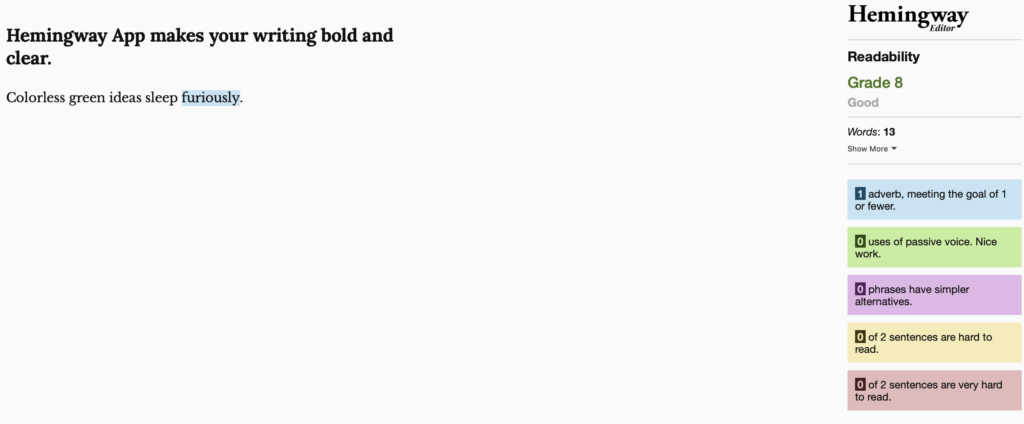
To illustrate this point, I tested a few text examples with Hemingway, one of the tools listed in the workshop notes. For my first test, I asked Hemingway what it thinks of a sentence that Noam Chomsky famously created to illustrate the difference between syntax and semantics.
Hemmingway likes grammatical but meaningless sentences.
This sentence is perfectly grammatical and perfectly meaningless. Hemingway likes it.
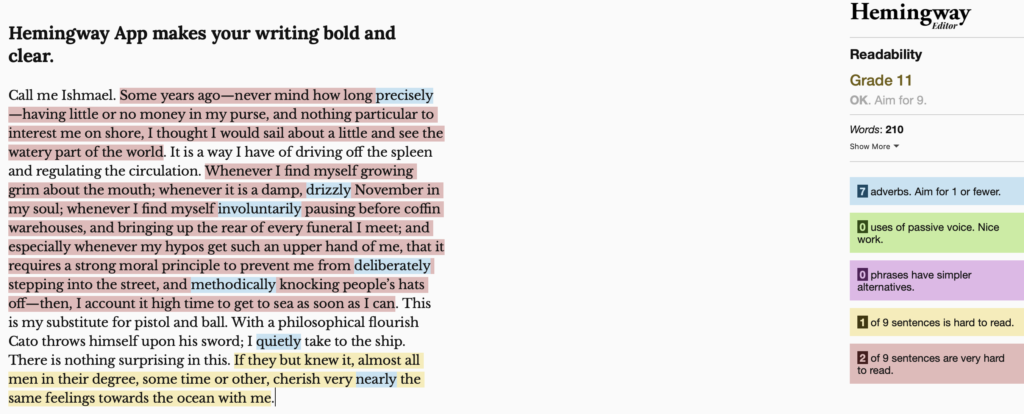
Maybe that’s an unfair test. Let’s try some text from Hemingway’s fellow giant of American literature and notorious macho man, Herman Melville:
Hemingway thinks Moby Dick is bull. And not in a good way.
Hemingway likes “Call me Ishmael.” After the first three words, though, things go downhill fast.
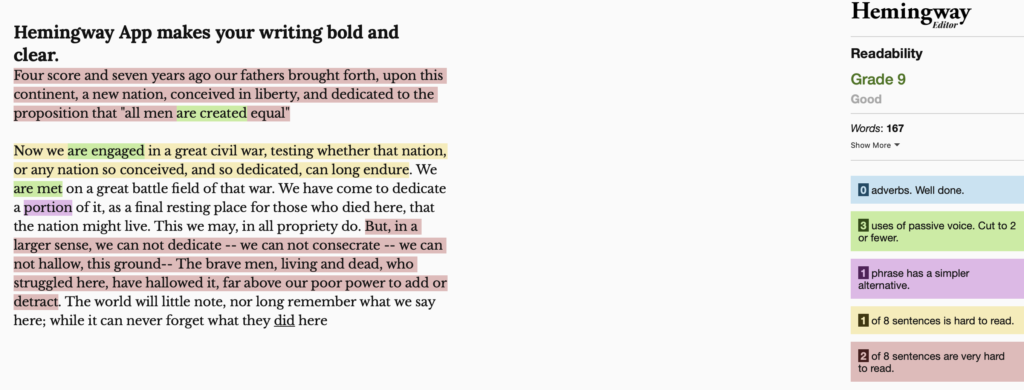
So, maybe that’s not fair either. Let’s try some non-fiction. How about a great speech?
Is Hemingway a hater?
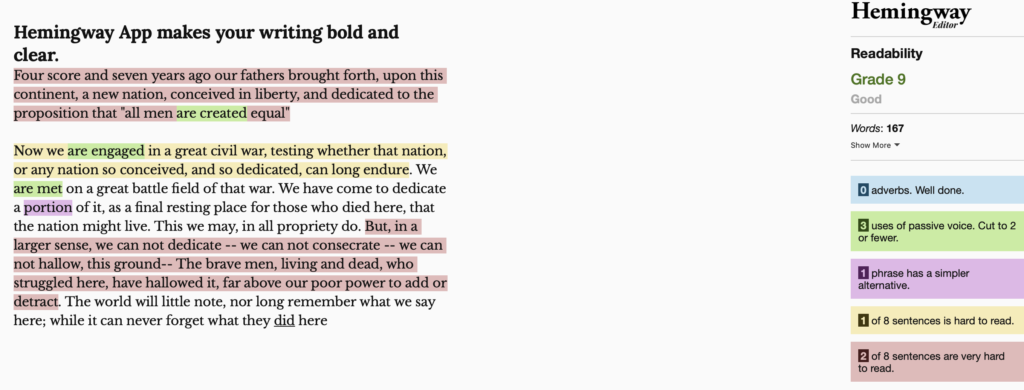
Hemingway is not a big fan of Abraham Lincoln either, as it turns out. It thinks the Gettysburg Address is “very hard to read.” And maybe that’s true. But I don’t think that Lincoln would have written a better speech had he followed Hemingway’s advice.
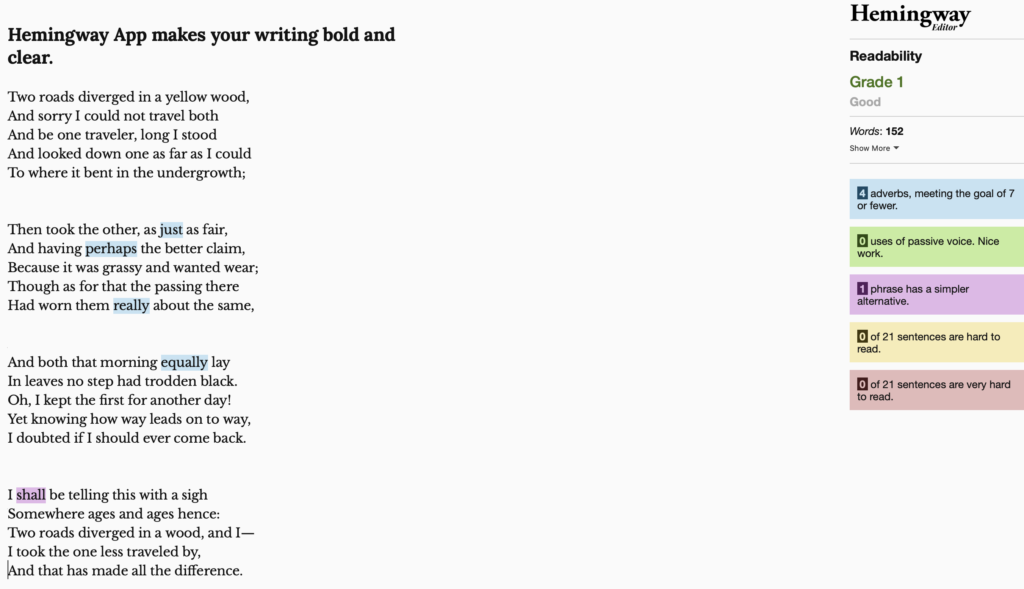
At this point in my experimentation, I had given up on finding another great American writer that Hemingway likes. So just for fun, I threw it a Robert Frost poem:
Hemingway likes poetry
Huh. Hemingway was not thrown off by the line breaks of the poetry. Does it “understand” them? Or does it fail to “see” them at all? I don’t know.
And this is the real problem with the machine assessment of writing. It’s not just that the software gets the analysis wrong a lot. That’s bad enough. But the bigger problem is that it gets its analysis inscrutably wrong a lot. How do you teach students when to trust an unreliable tool if you don’t know when it will be reliable yourself? The more advanced a textual analysis algorithm is, the greater the chances are that even the people who programmed it don’t always know why it makes the assessments that it does. This is because artificial intelligence software reprograms itself as it “learns” in ways that even AI experts can’t always follow.
Machines are unpredictably unreliable writing tutors. And keep in mind that Hemingway is only trying to evaluate writing style here. Software that tries to evaluate the accuracy or coherence of a written argument is even more problematic.
If your software cannot evaluate complex speech acts, it is probably useless at evaluating many types of complex thought. And isn’t complex thinking…um…what we’re supposed to be learning how to do in college? Might that be one reason that the seminar is considered the pinnacle of a high-quality college education?
Collaborative feedback
Throughout this post, I have been using the phrases “collaborative feedback” and “peer evaluations.” I consider them to be separate competencies, with collaborative feedback being a prerequisite of peer evaluation. These skills are building blocks for any kind of social learning pedagogy, including but not limited to the seminar.
Collaborative feedback is essentially class discussion that actively managed by an educator (or facilitator if the exercise is in the workplace). Participants both practice both giving and receiving constructive feedback. In contrast to other styles of class discussion, collaborative feedback sessions are student-centric. The goal of the instructor is to encourage peer-to-peer conversation and then intervene primarily to help keep the participants on track and constructive. The the group has achieved competence when the instructor either starts to function as just another peer in the group or fades out of the conversation altogether.
This is a common strategy for teaching English composition. By way of example, let’s revisit the Hemingway evaluation of the Gettysburg Address:
Students achieve competency at writing collaborative feedback when they can have a constructive conversation about the writing passage without a lot of help. This takes time and practice. The instructor might start by modeling commentary. What does that first sentence mean? What would be a simpler way of writing it? Why did Lincoln write it that way instead of putting it more simply?
Students are learning a whole cluster of skills in this exercise, including but not limited to the following:
How to ask good questions about writing quality (starting with, “Do I actually understand this sentence?”)
What intelligent answers to those questions look like
What constructive answers for the purposes of revision look like
Writing instructors do this all the time. Sometimes they use passages from readings, while other times they use student writing samples. They don’t need a tool like Hemingway to do this work. But notice how it can help. It scaffolds some of the questions and calls students’ attention to sentences that deserve attention. With an educator present to facilitate, Hemingway could be an excellent aid for fostering collaborative conversation around writing. (If I were facilitating such a conversation using this passage in Hemingway, I might point out that one of the uses of passive voice is contained in a quote from the Declaration of Independence. So there’s an opportunity to teach students the skill of knowing how to use tools like Hemingway and when to ignore them.)
In collaborative feedback sessions, participants are always learning and refining two sets of skills: one that is domain-specific and another that is general to collaborative work. It is not enough for participants’ answers to be insightful. They must also be constructive. Instructors are often scaffolding both of these skill sets. First, they model. Then, they facilitate. And finally, they step back and let the students lead.
Scaling an access-oriented English composition seminar is incredibly difficult because it often takes an entire term to get students proficient enough at collaborative feedback that they will be ready for peer evaluation, which is the point at which social teaching methods can scale. (In fact, access-oriented writing classes in challenging environments routinely fail to get all the students across this particular finish line. It’s too much to accomplish in one course.)
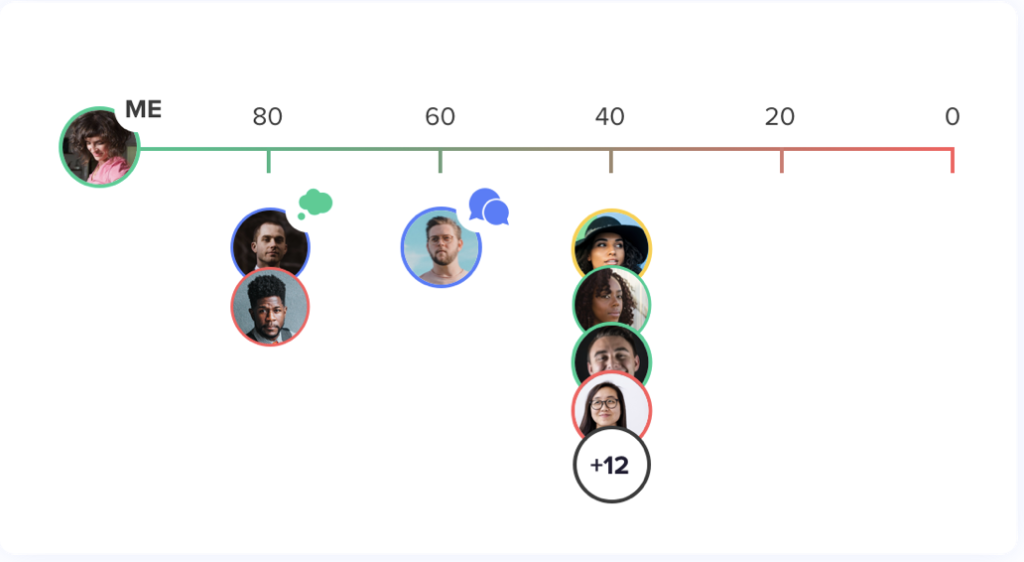
But I can easily see how both synchronous and asynchronous technologies could enable instructors to teach collaborative feedback skills more effectively. The Hemingway example I just gave is a good starting place. A good textual analysis tool could help the instructor rapidly scaffold many different examples for class discussion. The Riff Analytics tool that I wrote about in my Engageli first look post is another example. Riff may not be able to evaluate the quality of the student feedback, but it can provide feedback on the collaborative conversation quality. Some education-oriented discussion boards are starting to develop interesting affordances that also help students to cultivate this skillset. For example, Ment.io provides analysis of how close or far apart students are from each other in their opinions on a subject, based on textual analysis:
Thought distance
How accurate is this algorithm? I don’t know. But it’s fairly low-stakes. It simply encourages students to reflect on the dynamics of agreement and disagreement. Even if students ultimately decide that the algorithm is misreading a conversation, it still will have accomplished its purpose. These kinds of analytics can be used in a synchronous discussion, an asynchronous discussion forum, or a social text annotation tool.
In fact, one of the most promising aspects of collaborative feedback EdTech affordances is their potential to become ubiquitous. They can be embedded in many different educational tools to help teach many different subjects and disciplines. All technology-enabled classes could include affordances that make facilitating rich and productive class conversations easier. As a result, instructors could be more likely to incorporate such discussions into their course designs more frequently.
Peer assessment
Once students are proficient in participating in collaborative feedback, they are ready to start learning peer assessment skills. To restate my earlier point, this is the milestone at which social learning pedagogies can begin to scale effectively. Why has EdTech pushed so hard on machine assessment? Because providing students with frequent, high-quality feedback is the bottleneck to scaling classes while maintaining quality. Machines have proven excellent at providing frequent and timely feedback to students, but often at the expense of quality. If students can be taught how to provide high-quality feedback to each other, then they can solve the assessment bottleneck more effectively than the machines can. Even better, the students will be learning essential workplace and life skills in the process.
To be clear, the path that I’m proposing is hard. Every academic knows from direct experience that even people with PhDs are not reliably capable of providing good peer review (or receiving it, for that matter). Anyone who has tried to implement peer assessment in even a small classroom knows that it is a lot harder to pull off than giving a decent lecture. Going back to the Agile example, software development shops that transition to Agile methodologies usually need a couple of years and some active, persistent coaching from an expert to become proficient at it.
To deal with this problem, a substantial majority of the rituals and artifacts in Agile methodologies are designed to improve these skills in the group. To cite another example, Agile teams will often “play the cards” at the beginning of each development sprint. A key part of reliable software development is accurately estimating how much effort—and therefore time—will be required to develop a feature. So at the beginning of a sprint, all team members may be given a set of cards representing different estimates for the amount of effort they think each feature will require. For each feature, the team members literally lay their cards on the table, comparing how much effort each person thinks a given feature will require. The goal is remarkably similar to the “thought distance” graph above. The team is trying to figure out the level of agreement about how much work is required. Each team member then has to defend her estimate. The team debates the merits of the various opinions and strives to arrive at a consensus estimate.
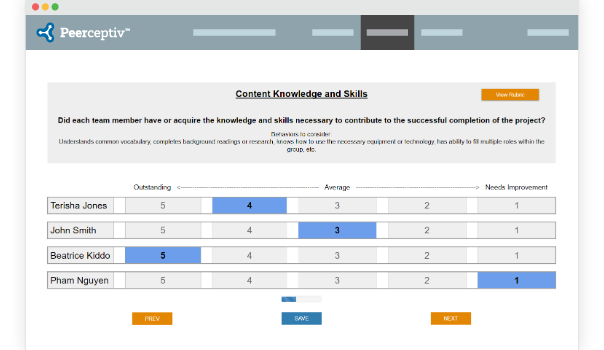
We do have EdTech tools that facilitate, scaffold, and scale peer assessment. There is some evidence that they can be effective, although I would like to see more research in this area. One of the (relatively) better-known products in this category is Peerceptiv. It can help organize students into groups, scaffold their peer evaluation work, and then scaffold peer evaluation of how supportive and effective their peers were during the exercise.
Putting your cards on the table
Peer assessment can be enhanced using a number of techniques. The simplest one is to assign a small but meaningful percentage of students’ grades based on the feedback quality scores that their peers give them. In other words, reward students for giving feedback that their peers find useful. Second, the instructor can selectively hop from group to group and act as a participant in some peer reviews (particularly if these reviews are asynchronous). She doesn’t have to do this with every group every time. But having an instructor present and modeling quality peer evaluation from time to time helps a lot. She’s essentially acting like a coach, moving from team to team. And finally, we can some of the same technological aids that I described in the previous section to continue acting as supplemental “guides on the side.”
One of the harder parts of this approach is designing good rubrics that students can be taught to apply consistently and effectively. The upside is that, if they are designed well, they can often be reused in various contexts. For example, I can imagine a shortlist of writing evaluation criteria that are included in every rubric template. To the degree that non-writing instructors adopt the peer evaluation tool and template, they will automatically implement a basic writing-across-the-curriculum program. Even if they are uncomfortable evaluating students’ writing, the students themselves will coach each other.
Making the transition
My proposal is ambitious. It likely will work best when applied consistently in different courses across different programs. Faculty would have to redesign their classes and think differently about their pedagogical approaches. Much of the technology required may exist but has yet to be stitched together into a coherent end-to-end experience that supports this approach. And we don’t have a lot of research on how well these strategies will work, especially in concert in a technology-enabled context.
But the raw materials exist. Research on the effectiveness of collaborative learning exists. Various technologies that could scaffold, support, and scale the pedagogy exist. And I reject the notion that instructors or students would not be willing to put in the work required en masse. The truth is that a discussion-based seminar in which ideas flow freely is almost the Platonic ideal of education for educators and students alike. A good seminar is a joy for everyone involved. We should not abandon the idea that we can provide this kind of opportunity for all students. Nor should we shirk our responsibility to teach students the skills required to participate in such learning experiences as an essential part of a college education.
Nothing I have written here should be read as a blanket repudiation of machine assessment or EdTech that focuses on helping students with self-study. Those approaches are necessary for scaling educational access with quality.
In my recent first look at Engageli, I wrote about the importance of scaling the humanities seminar. The short version is that budget pressures will force universities to make cuts to programs that are the most costly to run. Since STEM programs tend to generate more grant money and social sciences programs can often teach at least the lower-level courses in large numbers, the humanities are vulnerable. The pedagogy of the seminar constrains the size of even the 100-level composition classes that all students take (in contrast to the vast majority of other 100-level courses). We are not good at scaling seminar-style courses with quality yet. Consequently, programs that rely on seminar-style pedagogy are vulnerable during hard economic times. Faculty are more likely to be let go, and programs are more likely to be cut.
This action can create a vicious cycle because teaching these disciplines with quality currently depends on having sufficient faculty. The more faculty are cut, the weaker the program becomes. The weaker the program is, the fewer students it attracts. The fewer students there are in the program, the less financially healthy the program becomes. As a result, cutting into a program can easily lead to the program’s eventual elimination altogether. While specious rhetoric around humanities degrees not being career-relevant doesn’t help, the real pressure on humanities departments will come from the institution’s per-student cost.
These are good reasons to find ways to scale the seminar, but there are others. In fact, I’m going to argue that scaling the seminar is essential for equity if we want to avoid a two-track system of education—one at expensive universities and another for the rest of us. This is already a serious problem that the current situation is likely to make worse. I’m also going to argue that it is not an oxymoron to talk about large seminars. I think it’s possible to approximate—and even innovate on—the pedagogical affordances of a seminar with significantly more students in one class section.
Seminars shouldn’t only be for rich white dudes.
Finally, I will argue that one major reason we haven’t arrived at this solution before now is that EdTech is stuck in something of a cul-de-sac. We’ve been pursuing the solutions that have helped improve student self-study by providing machine-generated feedback on formative assessments. While these solutions have proven beneficial in some disciplines and have been especially important in helping students through developmental math, they have hit a wall. Even in the subjects where they work well, these solutions usually have sharply limited value by themselves. They work best when the educators assigning these products use their feedback to reduce (and customize) their lectures while increasing class discussion and project work.
Despite the proliferation of these products, flipped classrooms and other active learning techniques are spreading slowly. And meanwhile, there is a whole swath of disciplines for which machine grading simply doesn’t work. This most broadly applies to any class in which the evaluation of what students say and write is a major part of the teaching process. EdTech has been trying for too long to slam its square peg into a round hole.
I am calling for a new research agenda. One in which we focus on scaling educational conversation and human-to-human engagement with as much energy as we have been investing in machine assessment. I am far from the first person to call for a focus on this problem. For a variety of structural and historical reasons, it hasn’t gained traction. But the situation has changed. Now is the time for such a research agenda. Now is the time for us to figure out how to augment and scale educator-facilitated pedagogy. We can’t just keep trying to automate assessment and hoping the rest will work out. Scaling the seminar will not be easy. But I will argue that the challenges are less daunting than those we face by continuing down the current path while the results could produce higher quality and more equitable education.
This post is the first in a multi-part series.
The gold standard
If we’re being honest, the seminar is still considered the de facto gold standard for all disciplines. However much we may pretend that large lectures are acceptable in teaching some disciplines, the truth is that rich colleges and universities minimize them and market that lack of scale as one of the hallmarks of an elite institution.
On the undergraduate level, one way—perhaps the dominant way—in which top-tier colleges and universities measure and express the quality of the education they offer is through their student/faculty ratio. This is a proxy for the seminar/large-lecture ratio.
This pattern holds online as well. Take a look at the differences in the design of online graduate programs from top-branded universities versus those from older, more access-oriented programs. We can use 2U as a proxy for the former since they essentially built their company by persuading top-tier universities that they can build top-tier online graduate programs. 2U’s motto is “No back row,” and their course designs are heavily weighted toward synchronous classes of constrained size. 2U scales graduate seminars by offering many sections of the identically designed course with more junior (i.e., less expensive) instructors trained to teach the same course design. One way to express this strategy is that 2U is scaling the seminar “horizontally.” They are still offering normal-sized seminars but are pushing down the cost of incrementally adding more sections.
One of the reasons they have been able to sell this approach to faculty senates that would have rejected a larger and more asynchronous design is that 2U has preserved the seminar’s basic structure. Keep in mind, though, that this model tends to work best with one-year degree prices in the $40,000 or $50,000 range. It incrementally improves the scalability of seminars. That’s not a criticism of 2U. It’s simply an acknowledgment that this approach to scaling does not bend the cost curve radically enough to solve the problems that I am calling out.
The reality is that we have to substantially lower the cost of higher education in the United States while increasing the number of available seats in degree programs if we are going to meet equity goals. And we also have reasons to do so for institutional sustainability. If colleges can serve more students—with quality—at a lower cost per student, then we can achieve both equity and sustainability goals.
This shift cannot work if it begins and ends with a mantra to “do more with less.” Access-oriented institutions are already doing more than they can sustain with less than they need to be sustainable. Rather, we need to create tools that are “force multipliers.” We can think of that metaphor in the military sense, i.e., increasing the effectiveness of the human forces we have on the ground, or in the physics sense, i.e., increasing the force that one human can apply by using a pully or an inclined plane or an engine. Technology externalizes techniques into tools that enable us to apply those techniques more effectively with less effort. EdTech should externalize pedagogical techniques in ways that enable us to apply them to help students learn more effectively with less effort per student on the part of the educator.
I believe in the transformative potential of EdTech. I also believe that we have been thinking too narrowly about the kinds of tools we can create and how we can apply them.
The cul-de-sac
EdTech has generally approached scaling by trying to replicate the growth of large lecture classes, i.e., by scaling the machine scoring of assessments. On one level, this makes sense. We know that students do better when they get frequent and timely feedback, and we also know that providing that feedback is incredibly time-consuming. The feedback loop is the fundamental unit of teaching and learning. Students try something, see what happens, and adjust accordingly. Educators give students something to try, watch what happens, and adjust accordingly. The more rapidly and frequently students can get feedback, the more likely students are to learn, and the more rapidly they tend to progress. So scaling feedback loops—both the number that can be provided to each student and the number that can be supported for an entire class at one time—is an important problem to solve for both quality and cost reasons. Automating assessment is a straightforward way to scale feedback loops without burdening the instructor.
Keep in mind that this trend started long before “EdTech” was a word. Universities figured out that TAs are less expensive to use as graders than professors and that Scantrons are less expensive than TAs. Universities were using Scantrons and similar machine grading technologies to scale assessment when I was a student back in the 1980s, at a time when personal email addresses were still relatively uncommon.
Unfortunately, scaling via machine assessment is problematic. Some types of student output—like writing or comments in a discussion or projects—are difficult for machines to evaluate. To do even a passably reliable job, machine assessment inevitably flattens the very notion of feedback. This approach can work OK for helping students master foundational knowledge and skills that are low on Bloom’s Taxonomy but fall apart quickly when trying to provide feedback on the kinds of complex analysis and problem-solving skills that we associate with a college education. There are underutilized methods for pushing at the boundaries of machine assessment somewhat, such as educational games and inquiry-based courseware designs, but these approaches have their limits too.
Think about the feedback that students get in a seminar. Classroom conversation is rich with feedback. In addition to direct feedback from both the instructor and fellow students, there’s indirect feedback that results from multiple people engaged in purposeful conversation and collaborative problem-solving. This high-bandwidth environment for learning feedback doesn’t easily lend itself to simulation or replacement by software-assisted self-study. Likewise, when evaluating student expressions of sophisticated ideas, even the most enthusiastic proponents of writing assessment software have to grant that today’s algorithms are left in the dust on the subtleties compared to even a mediocre human reviewer. And again, while writing and humanities are the most obvious cases, I’ve had math and physics professors tell me that they can facilitate a deeper understanding of even foundational concepts in a small, discussion-based seminar than they can in any other way.
So while conventional machine assessment enables us to help more students achieve passable literacy levels in reasonably well-structured knowledge domains, it’s not consistently good at teaching critical thinking in these domains. And it’s virtually useless at teaching fluent expression or collaborative problem solving—two key skills for the modern workplace (not to mention the modern democracy, such as it is).
The fundamental limiter to scaling the class is the human instructor, who has only so many hours in the day. Augmenting instructor feedback with machines the approach that EdTech has emphasized so far. But what if we could scale the student peer-to-peer feedback with quality? While instructors do not scale as class sizes grow, peers scale as the class size grows by definition. Instead of putting all our eggs in the one basket of trying to make computers provide feedback that is as good as humans, what if we focused more energy on getting students to provide feedback that is as good as the instructor’s?
The new “blended” and the new “flipped”
COVID-19 is teaching us a lot in a hurry about the quality of that high-bandwidth educational feedback machine that we call the classroom. And we are already beginning to see products like Engageli begin to respond to those lessons learned. We can begin to see a world in which those rich synchronous educational conversations can take place fully online or even in some random and unpredictable mix of some participants being online and others being in a physical room together. We can aspire to a new type of “blended” classes that mix synchronous and asynchronous experiences rather than a mix of online and face-to-face.
As I wrote in my Engageli first look post, that would be great but not enough. In an environment where software mediates the face-to-face as well as the online synchronous class experience, the software could scaffold pedagogy in ways that a physical classroom cannot—for both the educator and the students. At the tail end of my Engageli review, I started to explore ways in which software can help improve the quality of human-to-human feedback. I used the example of Riff Analytics, which helps students to recognize whether they are speaking out, taking turns, and affirming statements made by their peers in group conversations. In other words, Riff helps students to become more effective at collaborative, purposeful, and equitable peer conversations.
We can take this idea much further, particularly if we blend synchronous and asynchronous tools. The ideal we should be trying to replicate and improve on is not just the blended classroom but the flipped classroom. One of the perennial challenges with flipping the classroom is that facilitating consistently productive group work among students is incredibly hard. It’s a lot of work that sometimes fails regardless of the instructor’s skill and best efforts. It’s hard even in a small class when conducted by an instructor who practices it regularly. It’s really hard in a large class when conducted by an instructor who is mostly trained and experienced in a conventional lecture model.
We shouldn’t be surprised at the stories of instructors who tried to flip their classes and had horrible experiences. We haven’t provided them with the tools that they need. With its competency-based analytics, courseware can help faculty prepare by giving them a sense of the foundational knowledge that students may be either mastering or struggling with. But by itself, that information is not sufficient for a successful flipped classroom. The hardest part about flipping a class is getting the groups to collaborate effectively and consistently. I can’t think of any widely adopted EdTech tools that are specifically designed to help with this part of the challenge.
I think it’s possible to scale the seminar and active learning across most disciplines. I think we should put more energy into improving the quality of peer feedback rather than single-mindedly focusing on improving machine feedback. There is research, and there are products that can help to achieve this goal. Both have been chronically undernourished because all the glory (and money) has gone to machine assessment. But this historic moment we are all living is creating an opportunity to rebalance our efforts. COVID-19 has forced EdTech—and many educational institutions—to think about the richness of human-to-human conversational experiences with more clarity and specificity.
In my next post in this series, I’ll describe how we might tackle this challenge using the hardest one of the courses to scale that I can think of—English Composition—as my example.
So, the bad news is that this week’s Blursday Social has been cancelled. The bar is closed for renovations.
The good news is that we have some great guests coming up in the next couple of Blursdays. First, Susan Baldridge will still be joining us next Blursday, November 5th. We will also be joined by the great Amy Collier, Associate Provost for Digital Learning from Middlebury College. We’ll be talking about getting everybody on campus working together (and supporting each other) during these times of difficult change. Amy and Susan worked together at Middlebury on engaging faculty in conversation on Middlebury’s digitally-enabled future. So they have some stories to tell about bringing people together.
Amy Collier
On the following Blursday, November 12th, we will be talking with Phil Hill about…um…I don’t actually know. It’s hard to predict with Phil. But you get a say. Point him in a direction and we’ll see what happens.
Phil Hill and some handsome guy
Remember, Blursday Socials are much more conversation and participation than broadcast. Think of it as being like trivia night at your favorite bar. There will be some organized activity, but a lot of it will be just connecting with friends. Some folks will be regulars, others will be semi-regulars, and still others will drop in occasionally. They start every Thursday at 4 PM Eastern Time. The bar closes at 5:30.
The dress code is casual; BYOB.
I recommend that you also subscribe to the iCal feed, which you can do by going to this page and clicking on the “iCal Feed” button on the bottom. I have events tentatively lined up for the handful of weeks, which I will populate to the calendar as they are finalized.
Susan Baldridge and Amy Collier will be joining us next Thursday, November 5th at 4 PM ET. RSVP here.
Phil Hill’s session is next Thursday, November 12th at 4 PM ET. RSVP here.
I usually don’t write product reviews anymore unless they give me a reason to write about a larger trend or issue. This is one of those cases. Engageli is a new product that, at this moment in time, is inevitably going to be talked about as a Zoom alternative for synchronous education. And it is that. But it also represents more than that. In a recent post, I wrote about the idea of digital residential education. Pre-COVID, most online education was designed specifically for people for whom residential education is not appropriate. People who couldn’t afford the time and money required to spend every day full-time on a physical campus, and in many cases actually live on it. COVID has forced us to broaden our perspective. We find ourselves finally beginning to truly examine the subtle and invisible magic that can be created simply by putting groups of humans in close physical proximity for extended periods of time. What is it about residential education that facilitates rich learning experiences and to what extent can we recapture that magic online?
Our exploration is starting with Zoom simply because many of us, as well as many of our children and students, are spending huge portions of our day on it. Zoom is a great product. It was designed to facilitate online business meetings. In many respects, it is the best web conferencing application I have ever used. Over time, it was adapted for use in large-audience webinars. For that purpose, it’s…fine. If your goal is to reproduce a typical conference session experience, with a speaker or a panel that do most of the talking and some limited audience interaction, it works quite well. But the more you try to use it to facilitate fluid and interactive sessions, the harder it becomes. For example, I generally don’t attempt breakout groups on a Zoom webinar unless I have a dedicated helper to manage the logistics.
Classroom interactions tend to be even more fluid than the most interactive webinar. Even in a lecture hall with hundreds of students, a decent instructor will foster levels of class participation that can be cumbersome to recreate in Zoom. If your goal is to create an active learning experience, with lots of group work, very high student participation, and fluid movement of students in and out of various sized groups that the instructor sometimes improvises in the moment, Zoom is a nightmare. Can some instructors use it this way? Yes. But it’s a high-wire act. Zoom simply wasn’t designed with that kind of organic social fluidity in mind.
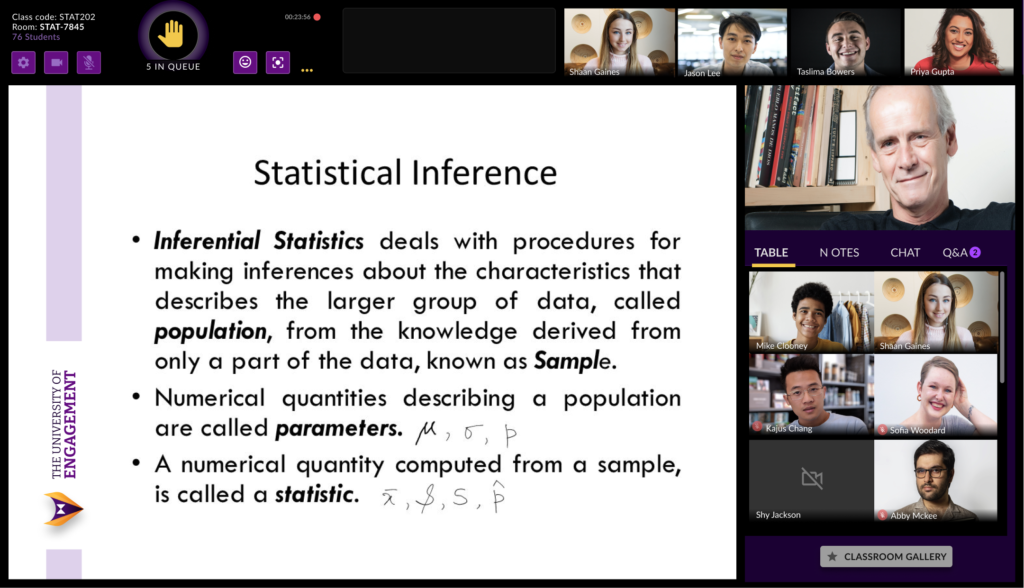
Enter Engageli, which is very specifically designed to support that kind of organic and ever-changing conversational structures in a well-facilitated class, while also accommodating the crazy mix of some students who are physically in the classroom and others who are remote. In my view, it represents a big step forward. And it also reflects the current boundaries of our thinking the digital residential experience.
Cutting-edge in-person active learning spaces
To get a sense of the kind classroom setting that Engageli is trying to create virtually, it might help to first look at a cutting-edge example that is firmly grounded in the physical world.
A few years ago, Phil Hill and I had the pleasure of visiting the Steelcase headquarters and design showcase in Grand Rapids, Michigan. While I can’t say that such a trip had previously been on my bucket list, the visit was fascinating. First, we saw an instrumented research room where the company studied an instructor teaching active learning classes. The room was relatively square, with one table sticking out length-wise from each corner toward the center. Six or seven students would work at each of the four tables. The instructor had a whiteboard but also had a stool with wheels on it. He would often sit in the center of the room, listening to the four groups. Sometimes he would scoot over on his stool to one table or another. Other times he would get the class’s attention and show them something on the whiteboard. With the tables at that angle, the instructor could see all of the students, and they could all see him. It led to highly flexible, social, and improvisational classes. Steelcase filmed these natural interactions and studied them in detail.
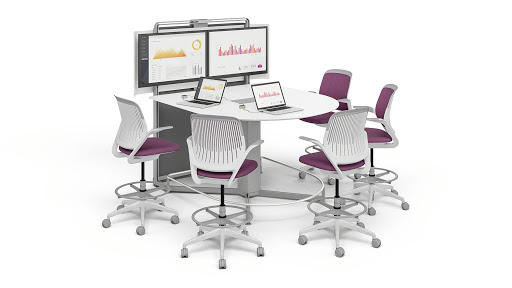
Then the company designed a product line to support this kind of educational interaction. It’s called media:scape. In the demonstration room they showed us, there were once again four tables—one in each corner of the room. But these tables had big video screens on the ends closest to the corners of the room.
A media:scape table
Each seat had a puck where a student could plug in a laptop.
Media puck
Notice the buttons on the puck above. Students could project their laptop screen onto the group video by pressing a button. The group could dynamically switch among their laptops as needed.
As in the research room, the teacher’s default position was in the center of the room. But in addition to a stool with wheels, she also had a pedestal with some controls on it. She could project her laptop onto wall or, alternatively, she could also project the screen from one of the groups onto a wall. There were also smart white boards that captured everything that was written or drawn on them.
When I saw the demonstration room my first thought was, “If I could teach in a room like this, it would completely change the way I teach. I could do everything that I tried and failed to do with group work in the past, plus a lot more.”
My second thought was, “Wow, I would be nervous about trying to teach in this room. I don’t think I could just transplant my existing teaching practices and evolve them over time. Not only would I want to teach completely differently; I would have to. And I’d have to learn all the technology. And teach my students. And hope that all the hardware and software worked. If it went well, it would be a dream. But if it went poorly, it would be a nightmare.”
And then my third thought was, “This system is hideously expensive and probably impractical for most colleges that aren’t building entire new buildings that could be designed to accommodate it. You’d need to have rooms that are the right shape and size. Those rooms would have to be wired for power and connectivity in the right ways and places. You’d have to buy a lot of expensive furniture and tech. And you could only teach a maximum of twenty students in that class.”
But what if you could offer that rich active learning environment without having to design whole buildings to accommodate it? What if you could make it work in any room that has tables? And scale it to as many groups as you need? And accommodate students who are online, in person, or both? What if a system could do all that while being easy to learn and allowing educators to use their existing pedagogical approach, adapting and improving their teaching practices over time as they grow more confident in the new system?
This, in essence, is what Engageli aspires to do.
Table talk
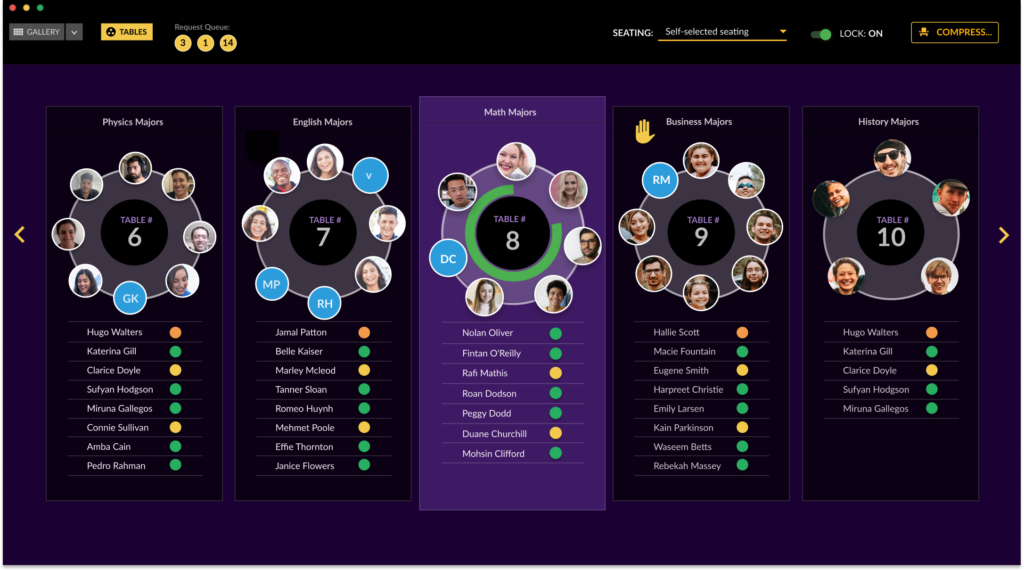
The fundamental metaphor of Engageli is a room of students working at small tables with up to eight students each.
Engageli tables
Just stop for a second. Look at the picture above. At first blush, do you get a rough sense of how your room is set up? Do the indicators and buttons seem clear and intuitive to you? One of the first emotions I experienced upon seeing Engageli was shock. I couldn’t believe how intuitive it looked.
Beyond the visuals, the functionality is also designed to closely mimic the flexibility of a live classroom with students sitting around tables. Students can talk to their table group, tuning out the conversations going on at the others. The instructor can “move” from table to table.
In theory, this works a lot like breakout rooms in traditional web conferencing software. For example, a table view can feel a lot like a breakout room.
Table talk
In practice, it feels simpler and more natural. For example, when the instructor addresses the whole class, students don’t leave their tables the way they would leave breakout rooms in a web conferencing product. They still have access to their group while they are listening.
At your table, in the class
In a refreshing improvement on real life, students can mute the sound from their table mates if they want to focus on what the instructor is saying.
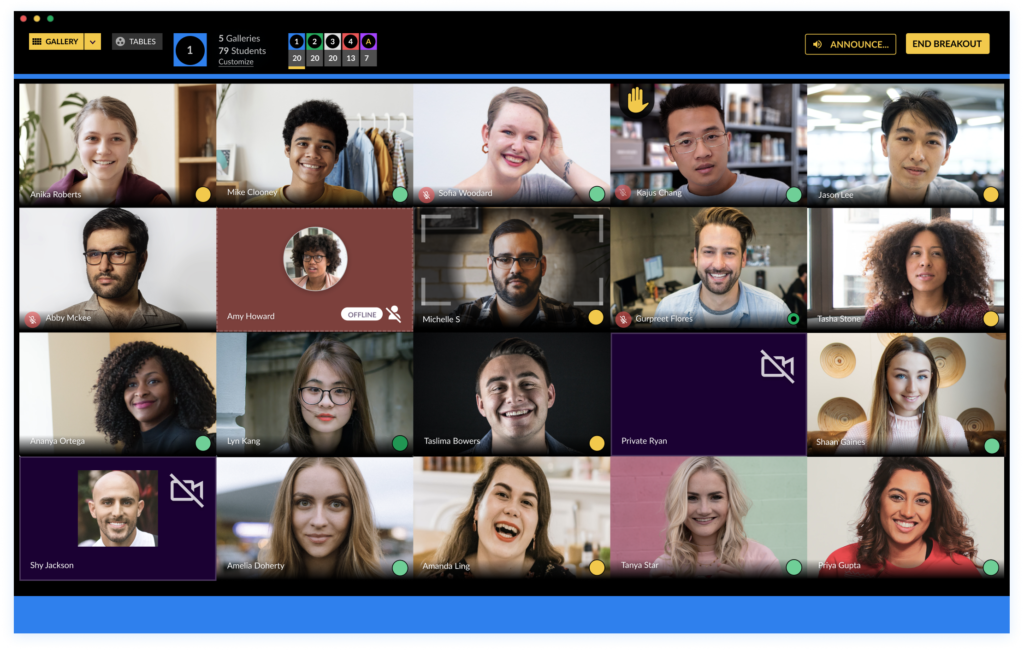
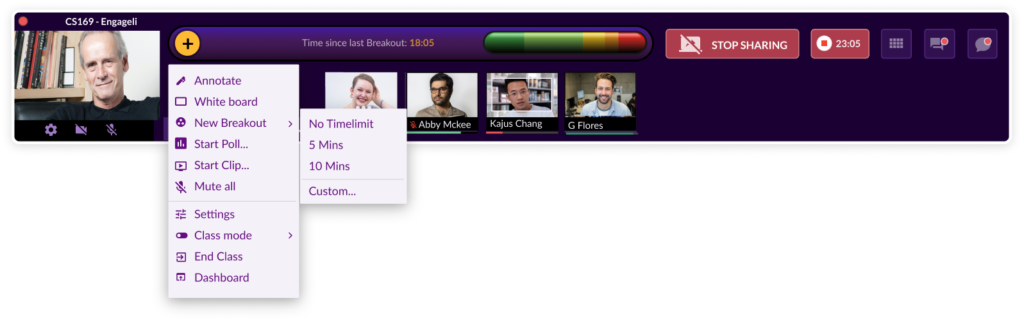
Starting and ending table group work sessions (which, in a holdover from web conferencing terminology, Engageli appears to call “breakouts”) is easy, as is accessing a range of tools that one would normally expect to have in a well-appointed classroom, like a projector, a white board, a polling tool, and so on.
A well-appointed classroom
Reading the room
One of the affordances of in-person classroom group work is that, in addition to visiting tables and listening in, an educator can scan the room to see which tables look like they might need some attention. If half the students at a table are looking down at their phones rather than talking to each other, the instructor can walk over to that table and bring everyone’s attention back to the work. Engageli attempts to replicate that experience with engagement analytics. Algorithms running on the student video can detect situations where students might be drifting.
This is tricky to get right. Many instructors who would be most enthusiastic about this kind of active learning environment also tend to be extremely wary of technology that they perceive as student surveillance. The COVID-driven growth in usage of proctoring software and its inevitable backlash is only increasing that concern in some quarters.
Engageli has tried to address this concern. For example, they do not store the video of student groups. The platform attempts to approximate those real-time attention signals that educators get in a physical class…and then go no further.
That said, I did not see this capability in action in my demo from Engageli CEO Dan Avida. While I think Engageli has the right general approach, this particular feature set will be tough to get right.
Glitches in the matrix, equity, and blind spots
Another nice feature about face-to-face experience that I personally would appreciate in a digital environment is that, in a real classroom, people don’t freeze for thirty seconds. Also, their lip movements are in sync with the sounds of their voices. Engageli makes a point of emphasizing how hard they’ve worked to minimize the bandwidth required for the product and to ensure it will run on old or underpowered machines. All the video streams are combined into one on the server side in order to reduce the bandwidth streaming down to the students’ laptops as much as possible. The product runs entirely in the Chrome browser, requiring no downloads (which, conveniently, also makes it well suited for the Chromebooks that are so popular in K12).
Dan Avida presented these features as equity-minded. He is right to do so. Access to computers and broadband internet are huge equity issues right now. Somewhat more problematic is their feature to have the software automatically place students in groups that maximize diversity. While I applaud the intention, there are a few problems with this idea. First, in order to pull it off, Engageli needs access to data inside the school or college’s Student Information System that some would consider to be sensitive personal information. Second and relatedly, doing so would require data integration with the Student Information System. In higher education, this IT system is often run by an entirely different group than the one that runs the LMS. They rarely make decisions to integrate with anything lightly or easily (or quickly). So just getting this integration approved by the appropriate administrators will be challenging in many cases. And finally, I think there will—and should—be some questions about how the Engageli algorithm defines diversity.
As Dan pointed out to me in an interview, institutions don’t have to provide the data necessary to enable this feature. They can skip it. I predict that most will indeed pass on it.
I’ll have more to say about the promise and perils of data analytics in these sorts of systems in the next section of this post. But before I do, I want to explore the data SIS integration challenge as diagnostic of the company’s potential blind spots. Another area where I saw a minor warning sign was in our discussion of single sign-on. Dan mentioned that students could use a consumer log-in like a Google account to get into their Engageli classroom or, if need be, Engageli would integrate with whatever enterprise single sign-on product the institution uses. He notably did not mention the IMS LTI standard. Most faculty will tend to create their front door to a virtual classroom product like Engageli through their LMS course site using LTI.
To be clear, this is not a complex standard to implement, particularly for a team that has solved the kind of difficult technical problems that Engageli has already solved. Rather, my point is that the current Engageli team doesn’t seem well versed in institutional EdTech—the standards, norms, and politics. A blind spot involving something like LTI is easily corrected. On the other hand, a blind spot regarding use of student data could be a bigger deal.
I am confident that the Engageli team is thoughtful and knowledgeable about security and privacy. I am less confident that they are well versed in the tricky education-specific sensitivities regarding the balance between supporting student privacy and supporting student success in the collection and use of data.
Engagement is not ambitious enough
I predict that many educators who have been frustrated with their synchronous teaching experiences will love the product. It has the feel of a virtual classroom designed by a parent and teacher trying to create the environment that they would want for their children (as opposed to ClassEdu, which has the feel of something designed by a parent and former CEO of an LMS company circa 2005 trying to create the environment that he would want for his children).
But I worry that Engageli’s aspirations may currently be limited to a goal of replicating face-to-face classroom affordances with modest improvements. This limitation may be driven by a lack of depth of experience in the company regarding both institutional challenges and current educational research on using data to improve collaborative learning. I think they can do more. I also think that we, as a sector, must aspire to do more.
For example, as I have learned from my friend and colleague Susan Baldridge (who, by the way, will be the featured guest in this week’s Blursday Social with e-Literate LIVE!) has helped me to understand that the health of some residential colleges could be substantially improved if they could manage to double the size of humanities seminars (starting with writing classes) without hurting their quality. As I have written before, the financial pressure on many universities, which COVID has massively accelerated and exacerbated, leads to a grim chain of financial logic:
Many US colleges and universities will need to trim their budgets somewhere between 20% and 40% in the next one to three years.
Salary and benefits typically account for between 60% and 80% of the average college or university budget. This means that without new revenue, institutions can’t balance their budgets without cutting some people.
Of the percentage of the budget that represents human costs, about 60% of those costs are for faculty. So it will be hard to meet budgetary constraints without cutting faculty.
So where will these cuts come from? Well, STEM programs tend to generate grant money, so they will be relatively safer in many institutions. Social sciences are financially efficient, by which I mean that they are often taught with larger class sizes. The disciplines that cost the most per student to run while bringing in the least amount of non-tuition money per student are often the humanities, where the pedagogy requires small class sizes in order to be taught with quality. Therefore, universities that could increase the average humanities class size from, say, 20 students to 40 or 50 without harming quality could preserve both faculty jobs and the integrity of the institution’s academic mission. It’s not a silver bullet, but it could make a big difference for some institutions.
Engageli is an example of a tool that could aspire to help meet that kind of challenge, but only if they raise their goals beyond classroom engagement. Anyone who has taught using lots of group work can tell you that it is easily possible to have groups of highly engaged students who are also completely unproductive. This is true in the workplace too; constructive collaboration is a critical 21st-Century skill.
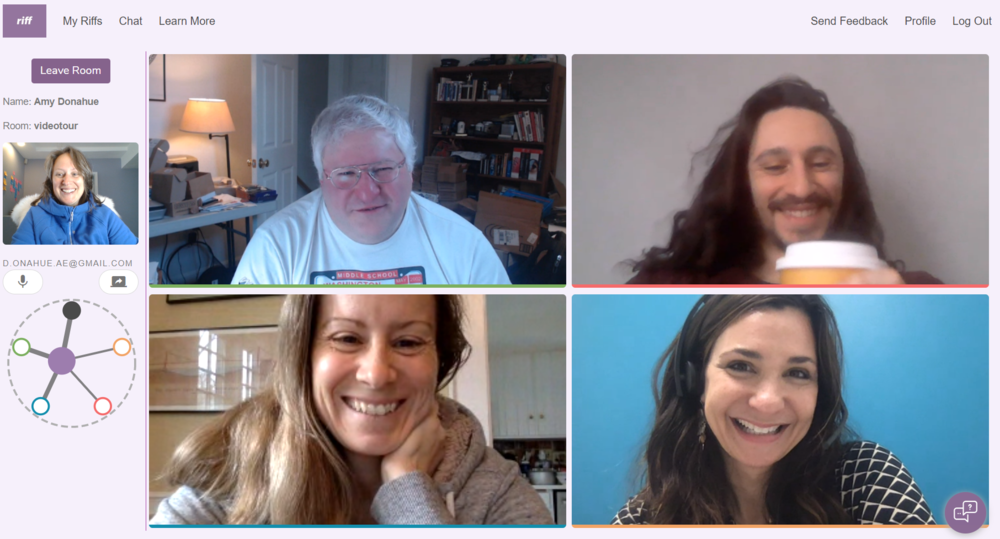
There is research, and there are tools, that help to facilitate better collaboration. Riff Analytics is a good example of a solid, research-based tool to improve synchronous collaboration. During meetings, it provides collaborators in group work with real-time feedback based on their interactions.
Riff video feedback.
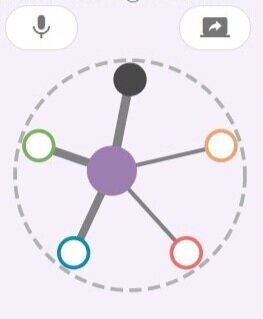
The ball in the bottom left is called a “meeting mediator.”
Riff meeting mediator
Here’s Riff’s description of that feedback tool:
The meeting mediator measures the most recent five minutes of a conversation. When the center ball is closer to a participant node, it indicates that the participant has spoken more than others in the group. The thickness of the line also indicates conversational dominance, and acts as a secondary measurement.
An additional metric of conversational energy (the amount of times participants take turns) is indicated by the color of the central node. Darker purple represents more turn taking, and a more dynamic exchange of ideas. A lighter shade represents fewer turns between participants.
In other words, it’s an easy-to-read, real-time indicator of whether people are listening to each other or just letting one or two people dominate the conversation.
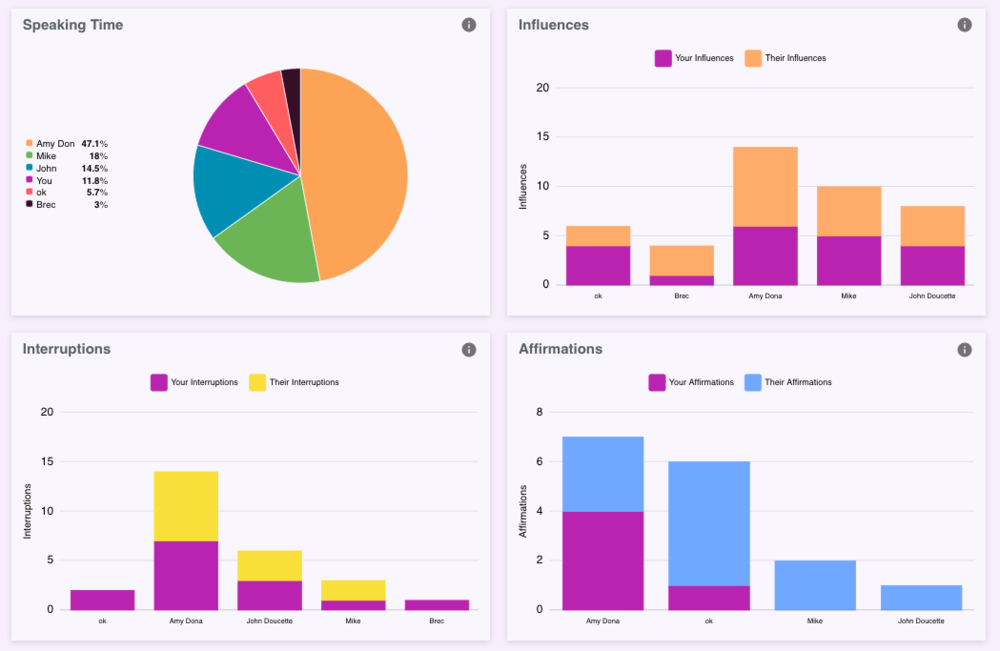
After the meeting, students get feedback on their productive (or unproductive) meeting behaviors.
Riff Dashboard
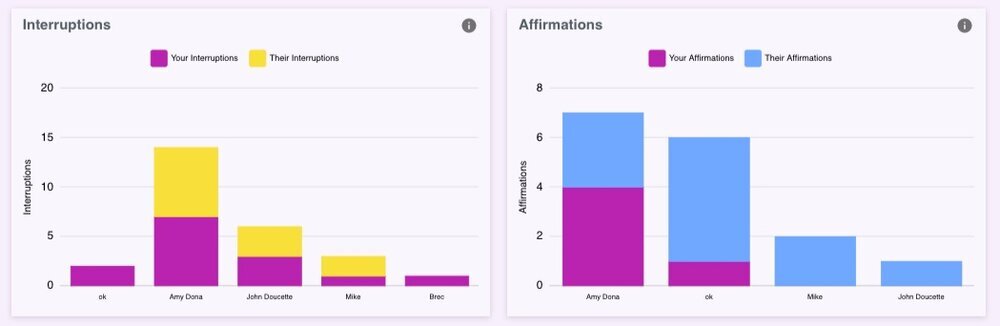
Students can drill into important speech acts that contribute to both productivity and equity, such as the number of affirmations they gave or the number of times they interrupted somebody in the group.
Affirmations and interruptions
I find Riff’s approach to be attractive in several ways. First, it goes beyond trying to replicate the best collaborative classroom environment and actually provides feedback on relevant collaborative behaviors. This is exactly the kind of feedback that is necessary to make collaborative learning more consistently effective and easily scalable to larger groups. Second, their feedback is student-facing rather than educator-facing. Uses of data that are for the students and that provide immediate feedback on their performance are generally both less sensitive from a privacy perspective and more educationally potent. And finally, they are researchers in the field. Their product is informed by learning science as well as data science.
Meanwhile, the concern about accuracy that usually comes up about automated feedback is somewhat mitigated in this case because the machine is not telling students whether they have given “right” or “wrong” answers. It’s just telling the students, “Hey, y’all seem to be talking over each other a lot” (for example). I’m not suggesting that this approach is danger-free, but it tends to be lower stakes than other kinds of algorithmically-driven student feedback.
I have no doubt that Engageli’s data science team is good and can do some really interesting work. But somebody has to point them in the right direction. The company will only be able to do that by broadening out the breadth of experience on its team as it grows. One of the common criticism of Coursera among educators already working in online learning is that the company gave the appearance of being relatively ignorant of the broad and deep body of existing research and experience in the field. I would hate to see Engageli repeat that mistake.
Summing it up
Based on the one working demo I saw, I’m impressed with Engageli. Particularly for a first version, it seems full-featured and intuitively, worked seamlessly, and showed sensitivity to the kind of fluid human interactions that are necessary in lively, student-centered class.
But these are super star founders. Dan Avida and his wife Daphne Koller both have stellar track records. My expectations are high.
As I would say to talented students in the kind of course I would love to teach in Engageli, “This is an excellent first draft, Group 2. I look forward to seeing how much you can improve it in the next draft.”
Last week on Blursday Socials with e-Literate LIVE!, we had the pleasure of chatting with Jeff Young, the creator of the Pandemic Campus Diaries podcast, which is still one of the best ways I know of to get a feel for the varied and changing impacts of COVID-19 on students and educators. (The latest episode dropped this week and I can’t wait to listen to it.) Over the next two weeks, we’ll be exploring topics of what’s coming and how to deal with it as campus communities.
As I’ve written about in a previous post, we’ll have Inside Higher Ed editor and co-founder Doug Lederman this Thursday, October 22nd at 4 PM ET. Just about every major developing story about higher education crosses Doug’s desk. That puts him in an excellent position to talk with us about what he sees coming next.
Susan is in a great position to talk about how campuses are managing change—and how they should manage change—during these difficult times. She has a mastery of the financial, mission, and human aspects of the challenge. She is fascinating to talk to. So come talk to her!
Remember, Blursday Socials are much more conversation and participation than broadcast. Think of it as being like trivia night at your favorite bar. There will be some organized activity, but a lot of it will be just connecting with friends. Some folks will be regulars, others will be semi-regulars, and still others will drop in occasionally. They start every Thursday at 4 PM Eastern Time. The bar closes at 5:30.
The dress code is casual; BYOB.
I recommend that you also subscribe to the iCal feed, which you can do by going to this page and clicking on the “iCal Feed” button on the bottom. I have events tentatively lined up for the handful of weeks, which I will populate to the calendar as they are finalized.
Doug Lederman’s session is this Thursday, October 22nd at 4 PM ET. RSVP here.
Susan Baldridge’s session is next Thursday, October 29th at 4 PM ET. RSVPhere.
In a recent blog post, I argued that structural changes—the lasting effects of COVID and the acceleration of ubiquitous broadband—would mean that some of the shift to online will be permanent. I also argued that the marginal value of a residential campus experience will be challenged as students and their families consider just what they are getting for in return for the extra money required for a residential college experience.
Today I want to add some more nuance to those claims. I don’t think that residential education is going to disappear except for elite universities. Nor do I think that we’re going to see the long-predicted Great Unbundling. Some residential colleges will fold or go online. There will be some unbundling. There will be some downward price pressure. But one of the most profound changes may be the re-imagining of what it means to have residential education experience in a digitally enabled world. There have already been some experiments in this direction, such as the Minerva Project. But I don’t think Minerva will be the dominant model. In fact, I’m not sure that there will be any one dominant model. Rather, I think we’re going to see a growth in various forms of blended and low-residency educational experiences, where colleges use various means to create that magic of connectedness which we tend to romanticize as coming-of-age experiences but which really are intimately related to the ways in which people learn, grow, and succeed.
As part of my preparation for this week’s Blursday Social, I’ve been binge-listening to Jeff Young’s fantastic Pandemic Campus Diaries podcast series. Rather than giving a top-down picture of what’s happening on campuses through surveys and aggregate data, or a one-off article of anecdata from a handful of individual interviews, Jeff views the rolling crisis from the middle distance. He has asked five professors and five students on different campuses to maintain audio diaries of their experiences as the semester unfolds. The group is diverse in just about every way that you would want them to be, from backgrounds to attitudes to campus contexts and COVID policies. He weaves snippets from these diaries into thematic episodes, peppered with occasional commentary by an expert or interview with a relevant vendor or campus administrator. The result is at once both intimate and textured. We get a glimpse of just how complex it is to make generalizations about the ground truths in education.
And given that the participants are living through a diverse mix of on-campus and online college experiences, it’s also a great laboratory for examining what residential education actually is, what value it offers, and how it is already beginning to evolve during this period of forced digitization.
Connections and serendipity
One of the most memorable visuals in Jeff’s audio story is a description of a dorm hallway in which students have posted their social media handles on their dorm room doors. When I was in college in the 1980s, the whiteboards on dorm room doors were a way of sending messages to people who were out. They were our text messaging tool. Today’s students have much richer and more organic means of socializing remotely. The idea of getting to know somebody who lives two doors down from you through communication on social media is not crazy. But it is weird. It’s not satisfying in quite the same ways. Humans have been socializing in physical groups for as long as there have been humans. We have a rich, subtle, and largely unconscious repertoire of tricks for adjusting the ways in which we socialize to meet the needs of the moment. And most of the time, we don’t even notice when we’re doing it.
One of the students that Jeff captures describes an app that he and his friends are building to fill in one of those gaps. They noticed that most people don’t go to parties or bars alone. They go with a small group of friends. I was the kind of kid who never would have gone to a social event alone in college unless I knew most or all of the people who would be there. If I was venturing out into unknown social territory, I would only ever go with a few friends. The student in the interview described an app where students can form small groups of friends and then search for other small groups of friends to text message with. It’s almost like Tinder for small-group meet-ups. This is a great example of a social pattern that takes advantage of serendipity in the physical world. In the digital world, that kind of opportunity needs to be consciously created.
This happens in classes too. Even an instructor who is a mediocre course designer can offer a decent experience to her students if she is available to them and a good communicator. If they need help, they will ask and she will provide it. And they can also find each other easily, get to know each other, and spontaneously form study groups. If those groups aren’t working for a student, she might ask around on her dorm floor to find somebody she knows who is good at the subject she’s struggling with and is willing to help her. Our capacity for improvisation as social beings occupying the same physical spaces can help people compensate for a multitude of shortcomings and challenges. And as a species, we’re wired to enjoy that kind of interaction. So one of the ways in which it helps is motivation (which is a topic that really starts to come through in the fourth episode of the podcast series).
Most college experiences aren’t really designed to maximize connectedness (to the degree that they are designed at all). They don’t have to be. If you put enough humans together in the same space for long enough, they will tend to socialize. Or, to put it another way, they will tend to become socialized. They will integrate into a social group that is flexible and highly functional. How did Neanderthals bring down a wooly mammoth? With friends.
In the new world we are entering, residential colleges that want to maintain their distinctive missions will have to re-imagine what a residential college experience means, blending the physical and the digital. That will require a lot of mindful observation and experimentation.
Why do we think learning is a solo sport?
The podcast episode that really drove the social home for me—believe it or not—was the one that tackled “cheating.” Jeff captured a number of experiences and perspectives on the problematic product categories of homework sites—particularly Chegg—and proctoring software. The instructors were worried about “academic integrity.” (I’m using scare quotes a lot here to indicate value-laden words or phrases that aren’t necessarily my own.) While they sympathized with students wanting help (in the case of the “cheating sites”) and feeling nervous about being surveilled by proctoring software, they felt a responsibility to make sure the students’ answers were their own. To his credit, Jeff interviewed (and pressed) representatives for both Chegg and Proctorio. The Proctorio representative had the good sense to express concern and sympathy for the student who said the proctoring software made her so nervous that it affected her performance on tests. The Chegg spokesperson (somewhat high-handedly) took the position that, if millions of students are using the platform all over the world, “then either cheating is a much bigger problem then we think, or that’s not what Chegg is designed to do.” The clear implication is that the spokesperson wants us to believe the latter explanation. But I’m more inclined to believe the former. I suspect that “cheating” is a much bigger problem than we think, in part because we have a very restrictive notion of acceptable social support for assignments.
During the same episode, a student described struggling with an economics problem, not being able to reach the professor, and not being able to find anyone at various campus help and tutoring centers who could answer her problem. Interestingly, this problem wasn’t obviously COVID-related. She was stuck. Students in her position see Chegg and its competitors as their only option. Once you’re in one of those sites—which you may have gone to as a student because you were feeling a little desperate and unsupported—it’s a slippery slope. One big reason these sites exist is because instructors and their institutions have defined much academic work—particularly evaluation exercises—as a solo sport and have failed to provide students with the social support that they need. Because humans in general are so good at improvising together to work around problems, this issue isn’t obvious as a campus-wide problem except at heavily access-oriented institutions. But that doesn’t mean the problem isn’t there.
In fact, I myself was (briefly) a human “cheating site” as an undergraduate. I went to Rutgers, which is strong state university with an academically diverse student population (though I suspect it may have been more academically diverse in the 1980s than it is now). A friend of mine asked me if I could help him take paper that had been previously written by one of his fraternity brothers for a film class and repurpose it for his philosophy of film class. I was torn. On one hand, I emphatically did not want to participate in the pre-internet essay mill economy. On the other hand, if I didn’t help my friend, he would either get somebody else to do it or submit the paper as is, with some tweaks around the edges. Either way, he would learn nothing.
I told him that I would help him but only if he agreed to do it my way. I would not write one single word for him. We looked at the assignment prompt and the raw material of the essay from his fraternity brother. It happened to be about Mel Brooks movies, most of which my friend could quote line-for-line. I asked him for his thoughts about the answer to the prompt. It turns out that he had some. I painstakingly drew his thesis statement from him. Then I asked him what lines or scenes in the movies made him think the way he did. He had ready answers. With some prodding from me, he wrote his second paragraph. I then told him that he needed to write about the rest of his supporting evidence without my help.
He said, “You mean, all I have to do is explain the parts of the movies that make me think this way?” He was absolutely incredulous. Essay writing wasn’t supposed to be that easy. It was supposed to be mysterious. Hard. Something he could never do. He was in a cul-de-sac that he couldn’t just study his way out of. Somebody had to help him get past a basic misconception. That somebody didn’t have to be his professor. It just had to be somebody who cared about his learning and had a modicum of skill at teaching writing. Somebody that he trusted to have his interest at heart. A capable peer.
By the time he was finished, my friend had a complete draft with his own thesis statement, his own line of argument, and his own supporting evidence. While the final draft still had a handful of phrases and sentences from the original paper that he was ostensibly plagiarizing, he mostly wrote that paper himself. But not by himself. He “cheated.” And I helped him “cheat.”
A couple of weeks later, he came to me, elated. He got a B. More importantly to him, he had earned a B. It belonged to him rather than to the fraternity brother whose paper he borrowed. And he knew it.
The web of social learning in residential education is vast and varied. It is also largely invisible to professors and administrators.
Solving for social
Today husband-and-wife Coursera pioneers Daphne Koller and Dan Avida announced their new company Engageli, a product that promises to create a more social synchronous learning experience than conventional web conferencing platforms. The news comes hot on the heels of Blackboard co-founder Michael Chasen launching ClassEdu, an education-specific extension of Zoom. When multiple EdTech veterans suddenly jump into the same product category, that’s usually a sign that something is up.
Remember my recent post about product/market fit: A good product is like a key in a lock, where the lock represents some unmet need of a coherent group of people who are willing to pay for a solution. If you don’t like an EdTech product category—homework sites or proctoring tools or LMSs or whatever—then ask yourself why it exists. Whose needs does it fill? What are those needs? And how does our current academic system fail to fulfill or even actively create those needs? Don’t be glib or lazy about seeking the answers to those questions, either. If you really want to understand, you have to get inside these people’s lives, as Jeff has done with his podcast series.
Likewise, when you see a lot of activity by successful EdTech entrepreneurs, ask yourself what need they are seeing. In this case, don’t think as narrowly as “Zoom sucks.” Because it doesn’t. Zoom is everywhere because it is a good product—for meeting different social needs than those of the classroom. We are at the very beginning of our collective examination of the instinctive human magic that truly makes residential education special. It’s social.
EdTech has mostly been moving in the opposite direction. It’s been about robot tutors in the sky working with solitary learners. Because we’ve somehow gotten the idea that a good college experience is getting together in one physical location…so that we can learn by ourselves. Anything else would be “cheating.”
Residential college?
Don’t get me wrong; we absolutely do need to get much better at helping learners become more effective in their self-study. But that’s not the whole answer. EdTech has been focused on how we can teach STEM classes to thousands of largely solitary learners in one shot. But the truth is that residential colleges will be more likely to save their missions and their finances if they can figure out how to transform humanities courses that can only be effectively taught to 20 students at a time and scale them with quality to 50 or 100 students at a time. We’re not going to get there in the near future solely—or even primarily—with adaptive learning and machines “reading” essays. We need to scale social learning. And if you extend that idea to the informal learning that happens on campus, which may or may not be course-related, and to building the purely social bonding that enables the purposeful social work to happen, we will be on the path to a digital residential college experience. How much of it will be online versus digitally-enhanced face-to-face is up for grabs. I doubt there is a single answer to that question.
There is much work to be done.
We’ll be chatting about this line of thinking with Jeff—and each other—at the Blursday social on October 15th at 4 PM ET. RSVP here.