

e-Literate

Present is Prologue

Author: Michael Feldstein

  • Curtiss Barnes Joins e-Literate and EEP

    Curtiss Barnes Joins e-Literate and EEP

    Curtiss Barnes

    I’m thrilled to announce that my long-time friend, colleague, and sometime mentor Curtiss Barnes is joining e-Literate and the Empirical Educator Project. We’re in a transitional phase right now, but the goal is for him to become a full partner in the business. For those of you who really know Curtiss, I don’t need to tell you why I’m so excited about this. But for those of you who don’t know him, or who only know him as that textbook publisher executive guy—seven years at Pearson and three at Cengage—an introduction is in order. I was planning on making this post brief. But has Curtiss and I chatted about his journey in education, I realized that his story contains interesting lessons about both the history of EdTech, the challenges of making it work for academia, the future of academic work, and also the future of e-Literate.

    Also, Curtiss has influenced me and embodies the core values and mission of e-Literate in some non-obvious ways. I don’t feel that rattling off the typical marketing blah-blah-blah about so-and-so joining the company would really get at why his decision to work here is meaningful to me and why I hope it will turn out to be meaningful to you. So I’m going to use this opportunity to tell a broader (and longer) story.

    A familiar origin story

    Curtiss was, in his words, a “military brat.” His father was an enlisted service member in the U.S. Air Force who was trained as a linguist. While it’s not quite accurate to say that Curtiss was a first-generation college student, neither of his parents and most of the adult relatives he knew growing up had college educations. But as we know, lack of education and lack of intellectual curiosity or capability are not the same thing. His father learned to speak several languages—Vietnamese during the Vietnam War and then Russian during the Cold War—as part of his work in the Air Force. Curtiss spent most of his childhood in West Berlin, Germany at the International school, where he became interested in the differences between the German and American educational systems.

    He went to Clark University for his undergraduate degree, in part because Clark gave him a good scholarship that made the price attractive relative to some state universities he was considering. That interested him too. How did this whole college finance thing work in America? He wrote his undergraduate thesis in Economics on philanthropy. (He also met his wife there.)

    And for a while, Curtiss’s professional path was one that will be familiar to many academic administrators. He got a job working in Clark’s advancement department (i.e., fundraising) immediately after college. From there, he moved to the University of Pennsylvania. At first, he was involved in fundraising again. But that got him working closely with admissions, alumni relations, and institutional research. For family reasons, he managed to convince Penn to let him move out to the West Coast, where Wharton in particular had an interest in cultivating a stronger presence. While there, he eventually got involved with the creation of a sustained West Coast operation including Wharton’s West Coast Executive Education and Executive MBA programs.

    So far, this may sound familiar to some of you (although the people who tend to follow this specific path often end up in different parts of the academic institution than the historic e-Literate readership). Most people who end up in academia are there because they are intensely curious about something. Often it’s an academic subject, but sometimes it’s some aspect of how the university works, like pedagogy or sustainability or policy. If your early stops on this train are a set of jobs working in a university as an undergraduate, there’s a good chance that you eventually end up going to graduate school. Which is what Curtiss did. He went to Wharton for his MBA.

    And then his career took an interesting turn.

    Product management

    While he was working on his MBA, he took some time off to work at a startup called Campus Pipeline, which wasn’t a very successful company but turned out to be a fantastic place to work if you were curious about how technology would begin to impact higher education over the course of the next decade. This was back in 1999, when a lot was happening. Peoplesoft had created what became Campus Solutions from a system built by a team at UCLA. In the early days, it was a green screen application. For you young ‘uns in the audience, this green screen isn’t the feature in Zoom that lets you look like you’re web conferencing from the beach. It means that the user interface of your software typically looked something like this:
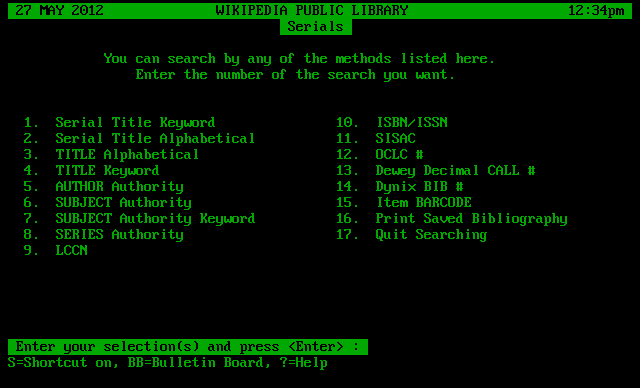
    Green screen software

    It was literally a screen that was all green, all text, and no mouse or pointer functionality. Peoplesoft and its competitors were very focused on getting the transactional registration and accounting details right so that people were registered for the right classes, got credit for them, got billed for them, and so on. And on making the interface less awful for the administrators who had to use the system. They weren’t terribly focused on the stakeholders beyond the back office folks like the registrar. People of a certain age will remember that students used to register for courses by standing in lines in the college gym and filling out paper forms. That was one problem to be solved, but the companies that made these Student Information Systems (SISs) were not really ready to take it on yet. They were busy working out the kinks in the core software.

    Correction: While many of these early SISs had green screen implementations, Peoplesoft did not.

    Another change of the time was the rise of the LMS. This was right at the time when LMSs were beginning to achieve widespread adoption. But they were pretty simple applications back then. They didn’t integrate well with these new SISs, and they hadn’t yet evolved good software for sharing information beyond the needs of individual classes.

    And then there was this thing called the World-Wide Web. The internet search giant that was taking over the world—I’m talking about Yahoo!—was changing the way everybody was thinking about information. This word “portal” was making its way into the popular lexicon, even if not everybody knew exactly what it meant.

    Campus Pipeline stood astride all of these trends. Or tried to. There were obviously some big new ways in which technology could help education, but it wasn’t yet obvious how they all would fit together usefully. The company never quite found its footing, in part because it was just too early to the party. It pivoted so often that perhaps “pirouette” would be a better term. Campus Pipeline survived the dotcom implosion in 2000 and was eventually managed to get acquired by the company that, several mergers later, would become part of Ellucian.

    But the important aspect for our story is that Curtiss got bitten by the product management bug. He understood some of the challenges and changes facing higher education from his experiences on the inside. Now he had a chance to see what it was like to design products that helped with these problems. What if students didn’t have to line up in the gym to register for classes, as they had from time immemorial? What if they didn’t have to work their way through a maze of campus departments to get basic information and could instead just look it up on the web? How could students be served better and institutions work more effectively if these new, expensive software products that the universities were buying could actually integrate with each other in some way?

    It’s intoxicating. I have teased Curtiss that there is a certain Forrest Gump aspect to his story of always stumbling into the right place at the right time, but the truth is that a lot of this was about him following his curiosity. This is partly a story of what it can look like when we stop defining ourselves by what we have done in the past and start imagining ourselves based on what we could do in the future—as individuals, organizations, and a sector writ large.

    Products serving people

    Curtiss followed Campus Pipeline into the bowels of the SIS world and soon found himself at Oracle. This was soon after Oracle had acquired Peoplesoft in a publicly acrimonious hostile takeover. And it wasn’t like Oracle otherwise had a sterling reputation before this. They were generally reviled as a company, even if their database product was highly regarded. Further, SISs were still relatively primitive but already very complicated. They are extremely hard products to build well because so little about the ways in which they were used was standard. Again, this is not exactly the description of an easy and fun job, but it was a great place to learn. (There is a pattern in Curtiss’ life choices that is developing at this point in our story.)

    Higher education is not known for its loving embrace of aggressive corporate empires. Needless to say, the acquisition was not welcome news for many Peoplesoft Campus Solutions customers. To say the least. Luckily, Oracle was smart enough to keep most of the really wonderful group of people in the Peoplesoft higher education team (including some who had come from the UCLA team that developed the original software on top of generic Peoplesoft). Curtiss started at Oracle with the word “strategy” in his title. Strategist is often a difficult role to have because at many companies, everyone thinks they’re a strategist and almost nobody is really any good at it. At Oracle, being a strategist meant that Curtiss and his fellow colleagues were the connective tissue—and sometimes the mediators—between the sales team, the product team, and the customers. Their job was to understand how both salespeople and product people listen to customers (and each other) and synthesize what they heard into, for lack of a better term, a strategy. He also represented Oracle on the IMS Board of Directors (while I was contemporaneously serving my tour of duty representing Oracle on an IMS standards development committee).

    At that time, Oracle had a couple of challenges that Curtiss worked on with his (truly excellent and often unsung) colleagues in Oracle’s higher education group at that time. First, they had to prove to the Campus Solutions customers that their voices would be heard and their needs met under the new ownership. This they did, at least to the degree that anyone can make people feel warm and fuzzy about an inherently crazy-making product category. (The number of people who have ever in human history said “I love my Student Information System so much!” is approximately zero. Almost as many as have said the same thing about their LMS grade book.) They really did win a lot of trust back, which is something you can only do by consistently listening to clients, making sure you are understanding their needs, and responding to them as quickly, empathetically, and effectively as possible over a long period of time. When Curtiss and I talked about what he considered to be the highlights of his time at Oracle, this work was the first thing he mentioned (along with his colleagues).

    The best reason to make a living working on products is that you love solving other people’s problems. This means that you have to learn to love—or at least empathize with—the people whose problems you are solving.

    The second challenge that Curtiss and his colleagues tackled was taking Campus Solutions to international markets. The good news (from a business perspective) was that large parts of the world were lagging the US in the adoption of this sort of product, so there was an early opportunity to get into those countries and serve those schools. The bad news was that universities function very differently in different countries. So there was a ton of product localization work to be done. Tech people tend to throw that word around as if it means “translate the labels into another language,” but really it means understanding how customers in a new area have different needs—typically influenced by different cultures, sustainability models, and regulatory requirements—and then redesigning your application to serve those needs (without breaking it for existing customers). This is really hard, especially for an application that gets deep into the quirkier and more arbitrary—and yet critical—aspects about how different universities and education systems work, like how credit is awarded and who pays how much for what aspects of the education at what times. So for a person with the word “strategy” (or “product”) in their title, growing into international markets should mean learning to empathize with different kinds of customers well enough to understand and help to address their needs and wants.

    The third challenge that Curtiss and the team wanted to take on was to better serve their customers’ core mission of teaching and learning. This is why I was recruited to Oracle. I was their first hire who was supposed to be an expert on the “education” part of higher education. Like Curtiss, I had started off working in an educational institution and got bitten by the product bug. I had done some consulting work that had periodically gotten me into product design, but Oracle was my first gig where product design was my full-time job. I had an unusually large number of colleagues that I liked, admired, learned from, and still consider friends to this day. Curtiss is one of them, but he also was a mentor for me in a way that has had a profound impact on e-Literate.

    Big companies like Oracle are weird in their own special way. If you’re an academic, you have probably had your moments when you’ve clenched your fists or pulled your own hair out in frustration that what should be a simple, rational process to accomplish something that obviously needs to be done is absurdly hard or even impossible. Corporations are no different in that regard. Their dysfunctions are often completely different—to the point of sometimes seeming incomprehensible to academics—but the end result feels striking similar from the inside. Understanding why organizations are dysfunctional in their own particular ways can be hugely helpful for both effectiveness and mental health. It helps you get more done while saving yourself some stress by avoiding battles that you can learn to recognize as unwinnable earlier on. Both of these are critical. We all want to spend as much of our time being effective at work and as little time as possible spinning our wheels. Curtiss had been a student of this dysfunction starting long before I had. He understood corporate dysfunction, academic dysfunction, and the codependencies between the two kinds of organizations. He taught me ways of thinking about these problems that animate some of my best writing and work in the sector to this day.

    Ultimately, the team was not successful in getting Oracle to make a major investment in the teaching and learning side of education. It felt like we got close a few times, getting multiple meetings with top executives who seemed receptive. For me, the final nail in the coffin was Oracle’s acquisition of Sun Microsystems. It became clear that, while the company was happy to have the higher education business, they were hunting for bigger game. We were not going to be a priority. This was the bleeding edge for a company like Oracle at that time—along with moving to the cloud—but the company wasn’t ready to bleed for education. It was time to either come to terms with that fact or move on.

    Products supporting teaching and learning

    Curtiss left for a job at Cengage Learning, where he could get closer to the education problem. I quickly let him know that I wanted to follow him both because I wanted to continue to work with him and because Cengage seemed like an interesting opportunity to attack a meaty problem.

    I’ll speak for myself here: I thought I was going to Cengage to start a methadone clinic for one of the major textbook publishers. The industry was addicted to high prices and frequent republishing of new additions to tamp down the used book market. As is often the case with addicts, it took a long time for the industry to admit that it had a problem. Curtiss was the right person to help them with this problem, and he was being hired at a high enough level that I had hopes he could help them do it (although he did have that pesky word “strategy” in his title). He also persuasively argued that the right team was in place to make the change. Cengage had hired Chris Vento, who was famous in EdTech circles for leading the creation of WebCT Vista, which was a cutting edge LMS in many ways in its day, and for driving some important standards work at IMS. Chris was the visionary behind their new digital courseware platform—though that term wasn’t in common parlance yet—called MindTap. Once I saw what he was working on, I was sold. Chris is one of the most brilliant EdTech product visionaries I’ve ever met. It would be a privilege to learn from him.

    I wanted to work with Curtiss, Chris, and other valued colleagues to help Cengage re-invent curricular materials products as something new and genuinely educationally useful while pushing the company toward a healthier business model in the process. This was a growing passion of mine—to make EdTech healthier and more responsive. Continuing to learn about how to do it by working with and learning from Curtiss felt right.

    It was a good hill to die on.

    While the first generation of MindTap was fairly successful, we ultimately failed to achieve our larger ambition—at least in the time frame that the three of us stuck around the company—in part because the patient hadn’t reached the first step in the 12-step program. It would take a number of more years for the publishers to come around to our way of seeing things, and it’s arguable whether they’ve come far enough or moved fast enough.

    During my personal trough of disillusionment with Cengage, Phil Hill approached me about starting a consulting business together. It seemed like an idiotic idea, which was one of the reasons that it appealed to me. If I was going to fail to make a difference, I wanted to at least do it my way.

    But Curtiss stuck to his guns. He moved on to Pearson, where he finally shook the “strategy” label and found a place where he could help shepherd truly large-scale change.

    Bringing the “Ed” and the “Tech” together

    I was worried about Curtiss at first, for two reasons. First, my opinion of the industry as a whole was at an all-time low. And y’all know where my baseline is. Second, Pearson had a reputation at the time of being an old boys’ club and a highly political place, which is the antithesis of how I think of Curtiss.

    But he steadily climbed the ladder there while still staying recognizably Curtiss. Before I knew it, he was essentially overseeing Pearson’s entire digital product portfolio. Textbook publishers’ organizational charts and accounting systems are even weirder and more Byzantine than many universities, so both describing what it means to “oversee” a portfolio at one of these companies and measuring the size of it in any definitive way are incredibly complex. Depending on how you count it, the products under Curtiss’ purview were worth anywhere between hundreds of millions and well north of a billion dollars in revenue. He certainly didn’t have absolute authority over that portfolio, but he had enormous influence.

    Curtiss took some of the ideas that had failed to get traction at Cengage and helped drive them deep into Pearson. Digital curricular materials would be, as he puts it, “more than just a book under glass.” There would be educational affordances designed not just for the convenience of the professor but to support more effective teaching and learning. This meant bringing learning designers and UX designers into the center of the design process. It meant battling the notion that every discipline—which in the world of textbook publisher politics really meant every major editor—was an island unto itself and therefore should have been allowed to build its own half-baked platform. Pearson CEO John Fallon, about whom I have decidedly mixed feelings, deserves immense credit for pushing the company to hold itself accountable for its role in impacting educational outcomes. But it fell to Curtiss’ team, as well as to Kate Edwards and her colleagues in Pearson’s research and efficacy group, to actually operationalize that commitment and make real progress toward it.

    One of the aspects of my professional perspective that I’m proud of is my ability to recognize important, hard-won progress without losing sight of how far we still have to go. That’s a trait that I share with Curtiss and may well have learned from him. The publishers are still a mess, and it’s very much an open question regarding where they go from here. That said, the sector has made substantial progress in figuring out what the potential of digital courseware can be. Some of the credit for that undeniably belongs to Pearson, and Curtiss played a significant part in that transformation.

    Remember, this is the same guy who started out his professional life as a fund-raiser for his alma mater. In the current environment, many of us are likely to face some strange and unexpected career choices. We are who we choose to be. Or as the great Yogi Berra once said, “When you see a fork in the road, take it.”

    Curtiss’s last role at Pearson shows him once again following his nose. He spent some time looking at the problem of life-long learning and career development in the 21st Century. The ongoing educational needs of today’s workers can no longer be met by the traditional corporate training and development department. (More accurately, the need can be met by T&D departments even less effectively than ever.) How can we build stronger, more agile partnerships between higher education, the corporate sector, and non-profit actors to address this challenge? As usual, Curtiss is onto the next frontier.

    Run, Forrest! Run!

    A really bad career decision?

    So now Curtiss is starting to work with me at e-Literate and EEP. A person with his experience has options. I’m humbled—and honestly a little perplexed—that he’s chosen this particular option, but then, he’s never been one to take the easiest or most obvious path.

    This post has been an introduction to my friend and colleague, but it’s more than that. And it’s also more than just a parable meant to encourage you about your own future career choices (though it is that too). Times are changing and we must change with them. e-Literate must change too. I’ve been signaling that in some of my recent posts. This is the first concrete sign of those changes. I want to help you make the world a better place, in this moment, in ways that matter. My skills are not equal to my ambition, and anyway, I’ve always enjoyed my job most when I’ve had the privilege of working with people that I admire. Curtiss is one of those people. You’ll be hearing his voice here on e-Literate soon enough. And you’ll hear about new initiatives that we’re cooking up. I can’t wait for you to see what’s coming.

    In the meantime, my next post in this series will cover Curtiss’ history with pets, including his formidable chicken coop-building skills.

    I kid! I kid!

    (Maybe.)

    They do come home to roost…
  • During #Covid19, Every Student is At-Risk

    One aspect of the current crisis that I’ve not seen a lot written about is retention. Oh, there’s plenty from a hand-wringing financial perspective. Will students take a gap year? If so, will they come back? Will they move to different institutions with better online learning offerings?

    What I haven’t seen a lot of yet is how to address the increased risk that traditionally successful students are more likely to drop out due to financial problems, the stress of working from home, other stresses in their lives, struggles to adapt to online education, and so on. If this list sounds familiar, it’s because students that we have thought of as “at risk” in the past—post-traditional students, including first-generation and older, working students—often face some or all of these challenges. But now, most or all students face them.

    Every student should be considered an at-risk student in the current environment.

    So we should be looking closely at the strategies that have been developed to address the needs of at-risk students and consider scaling them up to support every student. Particularly at higher end institutions whose populations have not been traditionally at-risk, it’s time to take a closer look at the supports you have in place for your non-traditional cohort and to learn from access-oriented colleges and universities that have been dealing with this problem at scale for a long time.

    I recently ran a Standard of Proof webinar with Tyton Partners, which recently released the latest iteration of their Driving Towards a Degree study of this strategy. There’s a lot that’s of interest in their work, including their methodology, which is quite clever. But today I want to highlight one of the major findings of the study, which is that colleges that collaborate across departmental lines on their retention initiatives achieve better retention. We all understand what the phrase “falling through the cracks” means, but Tyton has actually found a way to quantify how many more students fall through the cracks when college departments let those cracks form by not working together to create a seamless experience:

    Tyton’s findings on the impact of inter-departmental collaboration on retention

    [https://youtu.be/8At8Er_JXMY]

    Collaboration is particularly hard right now. Everybody is just trying to stay afloat. But that includes the students. Tyton was very careful not to generalize their pre-COVID study results to the current COVID situation—as they should be—but I would be money that next year’s results will be more dramatic than this year’s because the stresses on students are higher and there are more students under stress. Universities need to work harder than ever to knit their student support efforts into a coherent safety net for their students, and to anticipate many more students needing that support.

    Watch the whole webinar here.

  • #ResilienceNetwork Discussion Prompt Video

    As I mentioned in a previous post, I want to encourage conversation among groups about how we can build a #ResilienceNetwork together. The first such conversation will be next week at the Apereo Foundation virtual conference. I’ve created a discussion prompt video to kick off the conversation:

    #ResilienceNetwork Discussion Prompt

    [https://youtu.be/n8rY1PnH6o0]

    Here’s the lesson plan:

    • The foundation will be posting the video above on a discussion thread accessible to conference attendees. We will encourage folks to brainstorm asynchronously before we start.
    • I will facilitate a conversation with community leaders—in this case, Ben Maddox from NYU, Matthew Rascoff from Duke, and Aria Chernik from Duke OSPRI—about the input. We will also have synchronous breakout groups to discuss the prompt. These two pieces can be sequenced in either order, depending on the preference of the community.
    • We’ll wrap with a discussion with the leaders processing the input from the community and talking about the next steps to refine and prioritize the ideas and develop an action plan.

    The video and lesson plan are CC-BY licensed, as usual. You can use them without my prior permission. If you want to do this yourself with your group, feel free. If you produce interesting results, let me know. If you think that I can help, then ask me and I’ll help if I can.

  • ASU Launches Historic #ResilienceNetwork-relevant Virtual Conference

    So, the word is out in The Times of London that Arizona State University (ASU) is planning a massive, free virtual conference on July 13th and 14th to help faculty everywhere prepare for fall term under COVID. Speaking as a volunteer working on this effort, I can tell you with confidence that this event is going to be historic. There will be a large number of high-quality talks. The conference committee has—wisely—mostly eschewed the Big Think talks from Big Thinker speakers in favor of on-the-ground topics that will be immediately useful to faculty, delivered by people who have the hands-on experience. Faculty and other educators can dip in, find talks that speak to their aspirations or pain points, and dip out. The talks will be available afterward for people who can’t attend synchronously. I don’t think anybody can really predict what attendance will be like—ASU has wisely been setting modest expectations—but the venue has capacity for 100,000 attendees. I am asking you all to help fill this event to capacity.

    While the conference is not officially branded as a #resiliencenetwork event, it is very much in the spirit. The conference organizers are gathering up some of the best information and useful presentations from people who are responding to the crisis on the ground right now. Rather than linking out to a thousand sites on a web page, they are coordinating the production and distribution of the content so that it can reach the most faculty possible at the time when they are preparing to deal with the next wave. Notably, the conference is branded as “REMOTE: the connected faculty summit hosted by ASU.” Somebody at the university made the decision to downplay their brand in favor of highlighting the purpose of the event and the common cause across the sector.

    This is our first example of what a proportionate response could look like.

    Details on the web site are currently scant and there’s not a lot I can share yet because, frankly, the plane is being built while in flight. Speakers are still being confirmed. Connections with partner organizations are still being ironed out. Staff and volunteers are working frantically to stay on top of the work even as this the scale of the project has mushroomed. ASU will undoubtedly be releasing more details as they get finalized. I will keep you posted. For now, I’m telling you as somebody who has had the privilege of working with the folks who are making this happen: This is going to be a big, big deal.

    You can register here.

  • Surviving the Third Wave of COVID and Beyond

    We have now fully transitioned into the second wave of the COVID crisis for higher education. Educators and students, having survived the sudden and painful transition to remote education, are now turning to the fall and frantically searching for a less painful and more meaningful educational experience than the one they just endured. I’m beginning to see hopeful signs in the sector-wide collaboration in this phase. Within a week, there will be an announcement of the first initiative that will demonstrate what a proportionate response could look like. Stay tuned for the details.

    But the third wave is coming fast. It will be a financial crisis that tears at the social fabric of academia and threatens to unmake colleges and universities as we know them, not only because of the economic hardship itself but also because many academic institutions do not have the unity of vision and effective governance to navigate this next wave without a great deal of distracting and destructive infighting. As the early budget cuts are starting to roll in, so are the early skirmishes being fought in faculty senates and in the academic press.

    As I read one harbinger of the next wave of the crisis—”Bashing Administrators While the University Burns” by Gabriel Paquette in The Chronicle—I was struck by just how intimately related the coming challenges are to many of the themes covered here in e-Literate. If we want to weather the coming waves with as little permanent damage as possible, we would do well to revisit these lessons afresh and consider them as intimately connected to academia’s core challenges rather than as one niche of debatable importance.

    Ahistoricity

    It’s easy to read Paquette’s piece as the expected administrator’s response to a labor dispute with faculty brought on by budgetary pressures. But if we read the piece more closely, there is a lot here to unpack.

    Take this passage, for example:

    Myths provide comfort but offer little practical guidance. It is easy enough to conjure a vision of a lost academic paradise where philosopher-kings served as presidents, and departments were semiautonomous cantons. This paradise, the myth continues, was decimated by the irruption of centralized authority, the eclipse of academic [sic] by corporate values, and the corruption brought by private philanthropy and athletics. The only chance for redemption, according to this view, is a restoration of the prelapsarian idyll.

    If such an idyll ever existed, its heyday coincided with an age when universities were bastions of race-, gender-, and class-based privilege, with a minute fraction of the population enrolled in higher education. This scholastic arcadia could not withstand the pressures brought by the expansion of access to (and democratization of) higher education, the conversion of universities into vehicles of social mobility, the administration of enormous government contracts and grants, and universities’ newfound status as economic bulwarks of entire communities. The resulting transformation gradually made traditional modes of academic organization obsolete. What replaced this beloved anachronism was not necessarily superior to it. But it was a form of management better suited to the complex, large-scale multiversity.

    Bashing Administrators While the University Burns

    Back in 2017, when describing research on cultural differences in learning, I wrote,

    We are currently facing two civilizational educational challenges. By “civilizational,” I mean that they go beyond country- or region-specific challenges. They are unprecedented in the history of humanity. The challenges I’m talking about are universal access to quality education and universal lifelong learning, both of which are almost certainly ones that you’re well aware of. But we don’t talk enough about how unprecedented they are, what we need to learn to do differently to meet them, and how we could go about learning what we need to learn.

    Research in Translation: Cultural Limits of Self-Regulated Learning

    Notably, that post was about a study examining the differential impact of teaching techniques in MOOCs on students from different cultures. Yes indeed, the world has changed. As much as there has been good reason to decry the early hype and continuing shortcomings of the MOOC model, nobody was asking this kind of research question back in the good old days of the Great Depression. (The previous one.) We cannot commit ourselves to the ideal of equal access to quality education for a global population of 7.8 billion people and simultaneously remain committed to the ideal of small in-person seminars as the paragon of quality education. The two are simply incompatible. I am not suggesting that we lower our standards. Rather, I am suggesting—and I believe Paquette is suggesting—that we take a good hard look at how much our standards may be influenced by hidden assumptions of privilege. Why should a “quality education” for the 21st-Century masses look identical to the “quality education” of the 19th-Century elites? Where do these ideas of quality come from? Whose goals do they serve? And what trade-offs do they entail?

    Paquette continues,

    Among the drivers of the much-lamented “administrative bloat” are government regulation and student services. The former has added layers of compliance most university denizens applaud, including the creation of offices to uphold civil-rights laws and Title IX, unmistakable signs of social and political progress. Similarly, the advent of a vast support apparatus is not an affront to the university’s academic mission. The monochromatic student body of yesteryear has been replaced, felicitously and partially as a result of faculty advocacy, with a heterogeneous one more reflective of society’s diversity at large. Students from less privileged backgrounds often depend on support services to flourish, with staffs large enough to meet high demand.

    This faculty critique of the contemporary university is predicated, then, on a surprising ahistoricity. Such critiques obscure from view the rationale for current structures of governance.

    Bashing Administrators While the University Burns

    This part of Paquette’s argument is more complicated. On one hand, there are many reasons why administrative costs have grown dramatically, not all of which are as straightforwardly benign as Title IX compliance. On the other, the very complexity of these decisions is further justification for the careful and cool-headed accounting conversation that Paquette calls for.

    Consider robo-graded homework platforms. Why do they exist? Five or ten years ago, publishers would tell you it’s because faculty appreciate the labor-saving convenience. (They have better answers now, but those answers have nothing to do with why robo-graded homework platforms were created to begin with.) Faculty will often tell you it’s because they just can’t grade multiple homework assignments a week in a 400-person class, even with the help of TAs. Why do we have 400-person classes? Because as universities strive to teach more students without having access to proportionately more money, it turns out that large lecture classes are very cost-effective. In a different sector, they would be called “profitable.” They generate more revenue than they cost. Where does that extra revenue go? It’s hard to tell in many cases because a lot of colleges and universities are allergic to this kind of accounting. But one place that money often goes is to subsidize courses and programs that would be called “unprofitable” in a different world. Foreign language departments. Upper-division and graduate programs. Is this the right educational trade-off to make? I don’t know. I’m not sure there is one universally correct answer to that question.

    But I do know answers to two different questions that are highly relevant to the previous one. First, was this set of trade-offs made consciously by most institutions? No, it was not. The vast majority of the people involved in making the incredibly complex chain of decisions that are relevant here—down to how many graduate students academia should be producing in different disciplines—are almost completely ignorant of these economics. They certainly are not trained to have sophisticated conversations about them (even if their institutions were capable of performing the necessary accounting, which many are not).

    Second, could a different set of technology-assisted trade-offs have been made? For sure. Technology is good at reducing the cost of repetitive work that requires relatively little judgment. For example, when I was a product manager at Oracle in the mid-2000s, I was shocked to discover that most faculty were still copying students’ final course grades from their electronic LMS grade book and pasting them manually into their electronic registrar grade book. Every minute spent doing so was a minute less that a given instructor had to perform other, higher-value work. If you work at a college or university, think about how much of your day is spent performing such mind-numbing tasks, like manually entering data into a spreadsheet when that data exists somewhere else in electronic form. Academia could have relentlessly sought out such inefficiencies first. But they didn’t. They still haven’t.

    Here’s another example: Businesses understand that losing paying customers is bad. If they go away, not only do you lose the revenue, you also have to spend money to attract a new customer to replace that revenue. Many universities treat student retention as a mission issue. They’d rather not fail their students that way, all things considered. Not all universities even see it as that much of a problem. So-called “weeder” programs are still all too common. But in reality, in addition to being an issue of ethical responsibility, retention is also one place where universities leak money. This is an area where the institution can be more financially sustainable by serving its students better. Technology can definitely help with this problem in multiple ways. And yet, many segments of academia have been slow to prioritize retention, as well as the related challenges of degree completion and time-to-graduation.

    Hang together or hang separately

    Ultimately, Paquette is not as focused on taking sides in an adminstration/faculty budget war as he is on pointing out that war is not the answer:

    Denunciation, recrimination, and grandstanding are pit stops on the road to oblivion. This is not to say that faculty criticisms of university leadership are unfounded or invalid. But they are a dead end unless accompanied by the constructive aim of collective betterment. The allure of mounting the barricades is almost irresistible, but what’s the point if we all end up guillotined? What use is rehearsing old grievances if students balk at further indebtedness, and our revenue models collapse?

    I anticipate one of two scenarios in the coming years. In the first, the familiar feuds persist, and the university edifice crumbles, with old enmities slight consolation for those who remain amid the ruins. In the second, instinctive self-preservation and mutual interest incite faculty-administrative cooperation, institutional moribundity is reversed, and a new university is erected on the foundations of the old. Viva la revolución, indeed.

    Bashing Administrators While the University Burns

    In one of my earlier posts on COVID, I quoted Ben Franklin as saying, “We must, indeed, all hang together or, most assuredly, we shall all hang separately.” That is as true intra-institutionally as it is inter-institutionally. In recent months, e-Literate has proudly featured two guest posts by Susan Baldridge, co-author of The College Stress Test. Both posts were about having hard internal conversations about institutional change. They may have seemed tangential to e-Literate‘s core focus. They were not.

    What does it mean to be “e-literate”? When I came up with that name many years ago, it was meant to be self-deprecating. But it also contains a serious message I believe in passionately, now more than ever. Academics—educators—take literacy very seriously. It is a word with deep meaning and many nuances. A life-changing word. E-literacy is a kind of literacy. Today, as we all learn how a funeral or a wake over Zoom can be meaningful and resonant, as we learn how social media can be used simultaneously to bring us together and tear us apart, as we struggle to support friends and loved ones and colleagues and local businesses and total strangers from a distance, we are learning to be more e-literate. Just as literacy is about more than employing the technology of the printed word, e-literacy is about more than EdTech. It’s about culture. It’s about understanding how we change ourselves—consciously or not—when we choose to depend on certain tools in certain ways. And it’s about making mindful choices.

    We are entering the third wave of the crisis. If you want to understand what that means, then just turn on the TV news for five minutes. This is the moment when either we all come together or we all fall apart.

    We need to think harder, and we need to share what we are learning with each other so that we can learn faster together. That’s what the written word was invented for. That’s what literacy is about.

  • The Resilience Network Manifesto

    I have been writing here on e-Literate about the need for higher education to create a resilience network in response to COVID-19 and future continuity crises (like hurricanes, wars, and so on). In the course of evangelizing this idea with various parties, I have discovered two barriers. First, as with every other aspect of the COVID-19 crisis, people are at different stages of understanding with the first-, second-, and third-order effects. We are not yet all on the same page regarding how different this crisis is and how different our response needs to be. Second, even with people who are far along in that journey, many struggle to envision what an appropriately different response could look like. COVID-19 is revealing the reflexes and habits of mind that have made us vulnerable. But recognizing that our most reliable strategies are failing us is not the same as being able to envision new strategies. We are confronting a cascade of systemic failures, one of which is a failure of imagination.

    Time is running out. We are not moving quickly enough and I have apparently not been communicating clearly or urgently enough. This is a call to action.

    What’s at stake

    Let’s start with what we know.

    We know that, while online education can be as effective for students as face-to-face, it often isn’t. We know that delivering quality online education is hard, requiring specifically trained faculty, specifically designed courses, specifically optimized technology services, specifically designed guidance programs, and a whole host of other difficult operational skills. We know that, when colleges don’t get all of these hard operational details right, more students fail out or drop out. Sometimes dramatically more. We know that underserved and neurodivergent students are disproportionately hurt during these failures. We know that students who drop out are at higher risk of not returning.

    We know that the most effective online programs have taken years or even decades to hone. We know that the vast majority of colleges and universities do not have years or decades of experience and do not have sufficiently knowledgable staff in sufficient numbers to be able to build such programs quickly. We know that many of the people upon whose shoulders a transition will fall are not active participants in the associations that help people like them find the knowledge and resources that they need.

    We also know that even the tried-and-true formulas of the most experienced online programs may not fit the environment we will face several months from now. I am not aware of any university that designed entire degree programs to be adaptable on the fly to multiple possibilities of online and blended. I am not aware of any university that has trained all its faculty and prepared its physical plants for the kind of flexibility we may very well need for an unknown period of time. The vaccine is at least a year away, and that estimate is extremely optimistic.

    The other day I was on a call with an administrator I respect from one of the very best and most effective online programs that I know of. One that operates at significant scale. He said he is very worried that his own administration is overconfident in their ability to move the rest of the university online quickly and effectively. He said they think they are a lot better prepared than they actually are. I can’t name that university here, but if I did, you would be appropriately afraid. I certainly am.

    We are on the cusp of losing a generation of students. But that is not the worst of it. Because if we lose a generation of students, then many colleges and universities, including ones that we have thought of as safe and stable, will fail. The University of Michigan is forecasting a $1 billion budget shortfall. Every college that emphasizes the benefits of residential education is at particular risk. All of their previous investments in that idea are now costs that they have no obvious way of sustaining. Everything that was a mark of distinction is now a disadvantage.

    The Cal State system has announced that all campuses will be closed in the fall and all courses will be online. Their more prestigious sibling, University of California system, is having a harder time making that call. Here’s an excerpt from the article linked above:

    The state’s other four-year public university system, the 10-campus University of California, was not prepared on Tuesday to immediately follow CSU’s example, a spokeswoman said.

    “We are exploring a mixed approach with some material delivered in classroom and labs settings while other classes will continue to be online,” Claire Doan said in an email to EdSource. “Our campuses will reopen for on-site instruction when it is safe to do so — in coordination with federal, state and local health departments and authorities.”

    Classes across the UC system have been online since March. The UC Board of Regents is meeting next week and is expected to discuss plans for the fall. So far, UC San Diego has announced a massive coronavirus testing plan for students, faculty and staff. UC San Diego this week is starting testing for the 5,000 students currently on campus, with plans to expand that to all 65,000 students, faculty and staff in the fall. That campus is aided by having its own medical center.

    First in nation, California State University to close campuses for in-person instruction this fall

    Think about that billion-dollar shortfall that Michigan is facing. Now think about how the UC system is struggling with the idea of giving up the fees that pay for student dormitories, cafeterias, gyms, and so on. And struggling to imagine how they convert the kind of residential education that they have held up as an ideal into an online format that students will recognize as being of equal quality—and equal financial worth—in three months. Think about how many colleges and universities are in this situation.

    We are facing more than one pandemic.

    All of those crazy predictions of 25% or 50% of colleges going out of business are suddenly a lot more plausible. We will lose institutions. Some will be ones that you don’t expect. Many that do survive may have to make draconian cuts that, particularly if they are made out of a sense of panic, could fundamentally alter the missions of these institutions while putting them at greater risk of failure. This could happen very quickly.

    As with COVID-19 itself, every day counts. We will permanently lose students and universities. Careers will die. Institutions will die. The question is how many. The answer to that question depends on the adequacy of our response.

    Our current response is inadequate

    I have written before about how the POD Network has published a Google Sheet with 400+ links to university continuity web sites, and that it overlaps to an unknown degree with a separate Google Sheet organized by Bryan Alexander that also has several hundred entries. This is laudable work. And it is impressive, particularly given how much else the organizers have to deal with in the rest of their work and personal lives. Four hundred institutions is a non-trivial percentage of all colleges and universities in the United States. Almost a double-digit percentage. (Not all of the institutions on the spreadsheet are US colleges and universities, but that doesn’t take anything away from the accomplishment.) I have spoken with many educators who are involved in one sort of effort or another to create a database or a web site or a Google Sheet that lists resources. I thank you all. I admire you all.

    Please understand that I mean no disrespect when I say that all of these efforts amount to a drop in the bucket relative to the current need. Those people who found time in their busy days to add a link to their web site in the Google Sheet? Each of those people is in the middle of a separate institutional hurricane. It is chaos. OK, they have some content. Is it the right content? Is it everything they need? If not, will they have the time they need to click through each of the 400+ links in that Google Sheet in an effort to find what they need? Are they able to get the information effectively to all the institutional stakeholders who need it, when they need it?

    You already know the answers to these questions.

    Some of you have pointed out to me that there are years—decades, even—of high-quality resources that people have been creating to help faculty learn how to teach online. That’s true. Let’s imagine that everybody knows about this content. (They don’t.) Imagine that they know where to find it. (They don’t.) And that they know what to look for. (They don’t.) Ask yourself this question: As somebody who knows about all of this great existing content intimately, are you able to fill all of your campus’ informational needs simply by plugging in resources that already exist? Or are you finding yourself creating new documents, videos, and training interventions despite the fact that all these great resources exist, and that you know about them, and you know where many of them are, and you know what you need? As your institution goes through successive waves of the crisis—from online to blended, or blended to online, through the budget crisis, through the thrashing about for new kinds of programs that can keep you afloat, through teaching everybody just what the heck a stackable credential is, through the unknown series of twists and turns—as you go through all of the waves that are coming, what are the odds that you will continue to need to create new resources?

    So we’re all in #pivotonline now, and online is finally getting its due. Yay rah. Nobody expected us to pivot this way. Nobody prepared for this. Nobody can fully prepare for what comes next. Because we don’t know what comes next.

    We are not ready for this.

    Nobody will save us

    Will the state of Michigan fill the university’s billion-dollar budget hole? Could they do it even if they wanted to? I don’t know. Will universities that had what they thought were good cushions in their endowments be able to live off their rainy day funds now that the stock market has tanked and revenues are circling the drain? I have no idea. Will the Federal government ride to the rescue? I’m not even sure that the Federal government will continue to deliver my mail six months from now.

    No central agent will coordinate the production of COVID tests. Nobody is procuring and distributing PPE, balancing supply and demand across 50 states. Nobody has maintained the stockpile of ventilators and made sure that they are in good working order. There will be no grand rescue plan. Nobody is coming to save us. We must save ourselves.

    The corollary is that whatever we can do that is different and more effective than what we are doing now, it will not be beautifully architected and meticulously orchestrated. It will be messy. Inefficient. Chaotic. Redundant. Exhausting. In other words, similar to the current situation, but incrementally and iteratively better. It will not be an adequate response to the crisis either. We are beyond the point where adequacy can be achieved in the foreseeable future. We must now aspire to produce the least inadequate response possible and to make it less inadequate as quickly as possible. This is where we are. The sooner we come to terms with that, the more careers and institutions we will be able to save.

    What a resilience network could be, conceptually

    When I have spoken about a resilience network with various people, I have repeatedly gotten the sense—sometimes said explicitly, but often not—that people think it is something that I intend to own or control. Let me be clear: the Resilience Network is not trademarked. It is not proprietary to me. This is not about me. It’s about mustering a more effective group response to immense suffering.

    In terms of ownership and central coordination, I think of the resilience network as something like a hashtag and something like a potluck dinner. It’s like a hashtag in the sense that it is a way to crowdsource organization with intentionality. Creating lists of useful resources is good. Creating discoverable resources is better. Creating discoverable resources that are tagged with something that has semantic weight is better still. There is a difference between the way the #adorables hashtag works and the way the #MeToo hashtag works. Also, #pivotonline is different than #resiliencenetwork. There’s nothing wrong with either of them, but one focuses intentionality on the problem of the moment—getting courses online—while the other focuses on building a supply chain that can help us respond to the larger crisis as it evolves over time in a way that leaves us more capable rather than less. But the main point is that anybody can label their resource, their list, their workshop, or whatever as #resiliencenetwork.

    The resilience network something like a potluck dinner in the sense that the tagging with intentionality enables us to conduct some lightweight collaboration. If we know who is coming to the potluck dinner and what they are planning on bringing, we can begin to identify redundancies and holes. If we have four salads and no proteins, then maybe somebody should bring a protein. Note the level of specificity. Realistically, everybody is producing and sharing what they are capable of producing and sharing. No amount of intentionality will make me capable of cooking salmon without producing an inedible mess. But I can probably manage some burgers if I know that people need protein and already have plenty of greens. We can incrementally but meaningfully improve our coordinated production and sharing of resources.

    This description may give you a sense of what a resilience network could feel like, but it’s probably still too vague to give you a clear vision for what it actually does. We need to get more specific and operational.

    What a resilience network could do

    I have a few ideas about what we could realistically be doing to improve the effectiveness of our crowdsourced response at this moment of great chaos.

    Use technologies to help with curation

    Between the two aforementioned Google Sheets alone, there are hundreds of web sites that purportedly fulfill the same purpose. It would not be hard to have a web crawler index all of these sites and apply machine learning to begin classifying the documents it finds. It could make a list of all resources that look like instructions for creating effective lecture videos, all the ones that look like they are about facilitating online discussion, and so on. I suspect the level of effort for the first iteration of this is somewhere on the order of one engineer working for somewhere between a few days and a few weeks. Several iterations would likely be required to make the software as useful as it could be. For example, we might cross-reference URLs with IPEDS data so that somebody browsing the database could filter documents for ones being used by institutions that are like their own. We could also increase its value by having it crawl more data sources, like databases that are being maintained by various associations for different purposes. But even the first iteration could greatly increase the value of the resources that are being shared by increasing their discoverability and making their curation easier.

    Importantly, this application of technology would enable us to detect changes in the resources being produced over time. As we roll through successive phases of the crises, needs will change. The people on the ground who are managing their respective institutions’ sites will be the first ones to see the new needs as they arise. If we can watch their responses as they are evolving, then we can galvanize faster and more effective collective action.

    By itself, a crawler with some intelligence behind it would be a major improvement over what we have now. It doesn’t supplant the current efforts by human experts. Rather, it augments them. Even better would be to have a collaboration space where some of the people who are creating, curating, or looking for content can collaborate across organizational boundaries. The crawler’s classification algorithm will need to be tuned and retuned over time. To do this, we will need people to correct its mistakes and to enrich the results with information that only the human experts can apply—like, for example, if the resource is grounded in evidence-based practices—in order to make the resource lists maximally useful. So having a large-scale but porous collaboration space, like Slack or Yammer, could complement the machine classification by supporting better human curation across the organizational silos that normally confine this sort of work. At some point, we all need to talk about what we’re bringing to the potluck, what we have too many of, and what we need more of.

    Use technologies to help with dissemination

    The strategy above would help us develop better resource lists, but that’s only part of the problem. Another part is that most educators struggling to get through this crisis don’t have time to sort through even well-curated lists. Support staff at colleges and universities are doing heroic work organizing content into structures that help faculty walk through course design and delivery processes with step-by-step and just-in-time guides. But they are overwhelmed. Even if all faculty came for help (which they don’t), there simply aren’t enough staff to answer all the questions that aren’t on the generic guides.

    We have technology that can help with this too. Once we have the curated and evolving list created with the help of our crawler, we can feed it to a chatbot. Educators could ask natural language questions for exactly what they need and get targeted answers. As with the crawler, a first iteration of a chatbot could be built quickly and then refined iteratively over time. Rather than answering the same questions 100 times over, the human experts could identify the increasingly frequent questions, train the chatbot to recognize and answer them, and then focus their time on answering the tough or unusual questions. A cloud-based chatbot could be embedded anywhere and everywhere that people might have questions in the moment. It could be put in an LMS. Or in a courseware product. Or on a university web site. Or an association web site. It could be in all of those places at once. Since different points of use would likely have different audiences, we can use the information about where the chatbot is embedded to scope the answers and produce more reliably useful ones. If the chatbot is embedded in a chemistry text, then users are more likely to be asking questions about teaching or learning chemistry. If it’s on the site of an association for instructional designers, then we can expect different questions.

    With these technologies, we can assemble a supply chain. We can find resources wherever they are, track changes in production of those resources, organize and curate them so that the right resources are more likely to be routed to their point of need, and create a delivery system that is ubiquitous.

    When people talk about the Fourth Industrial Revolution—a phrase that I confess I am ambivalent about—this is what that term can mean in the best sense. Machines helping humans to be more fully human. Creating tools that let us apply our expertise and good intentions more effectively, wasting less time on work that could be automated so that we can invest more time in high-value work that requires human judgment. This is not the hard part. There is absolutely no reason I can think of why we can’t or shouldn’t do this.

    Facilitating collaboration

    But by itself, technology won’t save us. We need to do the work. And we need to do it together. Collaboration is hard in even the best of times, but the fact that it is hard does not make it any less necessary. We need to find lightweight yet effective ways to coordinate our potluck efforts.

    I am offering to run a traveling collaboration roadshow. The first organization to schedule such an event is the Apereo Foundation, although I am in conversations with a number of other organizations and expect to have more such announcements soon. In Apereo’s case, my roadshow will be part of their 2020 virtual conference next month. I’ll describe how we intend to structure the interaction, as I expect it to serve as the first iteration of a template for similar events.

    I will record a brief video talking about the concept of a resilience network as a hashtag and a potluck. The video will end with two discussion prompts. First, what does your community have to offer to such a network now that it wishes to share more effectively? Second, what could your community create, consistent with its strengths and own immediate needs, that it could contribute to a larger effort? This video will be embedded in a discussion thread before the event. Community members will be invited to comment.

    At the two-hour session itself, I will open the conversation with a brief expansion on the idea of a resilience network, including some of the ideas in this post. I will then have a conversation with a community leader, responding to the comments that we gathered in response to the discussion prompt. (In this case, my discussion partner will be Aria Chernik from the Open Source Pedagogy Research + Innovation network (OSPRI), a Red Hat-supported project housed at Duke University, about how institutions can process the lessons learned from the pivot to emergency remote instruction this spring.) The intention here to set the stage for the second round of brainstorming, this time in the synchronous session.

    From here, we will go to breakout groups. Participants will add to the original discussion thread as they develop ideas in their breakout groups. We will end the session with a final discussion led by Aria and me to process the ideas.

    I hope to conduct a number of these sessions with different organizations, and to encourage each organization to follow up on the brainstorming by identifying the best ideas that their group can follow through on. By the fall, I hope to have had enough of these conversations that representatives from these groups can gather for a potluck planning session. What is everybody cooking up? Are there ways in which we can adjust our plans to increase the complementarity and reduce redundancy in the work that each group is doing?

    I don’t know for certain what we should do after that. It will depend on what everyone wants to do and is able to do. The way we will figure out how to better collaborate going forward is by collaborating better now.

    It’s on us

    I am working to bring about all of the ideas listed above, as well as helping out with some other initiatives that I believe are important to the idea of a resilience network (whether or not they choose to label themselves as such). In many cases, I am doing this work for free. In some cases, I may actually end up contributing money as well as time. I’m doing this not because I believe that the resilience network is my project but because I believe that helping in this time of crisis is my responsibility. If you want to do something that you believe is relevant to #resiliencenetwork and think I can help, then ask me. I will help if I can. Whether or not you need my help, you definitely don’t need my permission. We need a resilience network. Please build one. Do your part. Take the name. Take the ideas. Take whatever you need. Just do it.

    I love the people who work in education. I don’t mean that in the casual sense. I love you. The work you do—particularly now—inspires me. It pains me greatly to tell you that what you are doing is not enough. We are not rising to the challenge, collectively, in the way that we need to be. Everybody is working incredibly hard. Everybody is working in good faith. Those are not enough. We also must work effectively. And we must work differently. Change and efficiency are not higher education’s strong suits.

    But we are good at learning. It’s time to learn quickly and act quickly.

    I know that we can do this. But I don’t know if we will.

    Are you with me?

  • Retention Webinar is Back On

    Driving Toward a Degree finding

    We now return to our regularly scheduled program.

    Sort of.

    Given the strains that COVID-19 is putting on both students and institutions, student retention is going to be more important than ever in this coming academic year. Our Standard of Proof webinar with Tyton Partners on their Driving Toward a Degree research, which was put on hold due to the crisis, is now scheduled for Thursday, May 21st at 2:00 PM. In addition to covering the report in general—including the recent update based on 2019 data—we’ll talk about the specific implications (that we know of) for the world we’re living in now.

    Sign up here.