e-Literate

Present is Prologue

Author: Michael Feldstein

  • Another Email Subscription Update

    Those of you subscribed to the site by email may have noticed that you didn’t get anything in the last 24 hours. (Or maybe you didn’t notice, since the email never came.) We are aware of the problem. The new system sends a message once a day and is next scheduled to send an email digest every morning at 4 AM Eastern Time. For whatever reason, it did not engage this morning, but we believe that it is working correctly now. You should get something in your inbox that includes this post tomorrow morning. Obviously, if you are reading this by email, then all is well.

    Thanks for your patience as we work out the kinks in the new system.

  • Mail Subscription Change

    For those of you who subscribe to e-Literate by email, be aware that we’re switching over to a new system for handling emails today. Among other things, we’ve had complaints that a few people had trouble unsubscribing.

    Which is bad.

    The new plugin, Mailchimp, will hopefully solve this problem while enabling us to do some new things we’ve been thinking about as well. (More on that soon.)

    We will switch over to the new plugin shortly after I post this message and will be publishing one or two new posts in the next 24 hours. So if you don’t receive any emails by this time tomorrow, or if you have any other email-related problems, then please let us know.

  • Undepersonalized Teaching vs. Learnification

    Amy Collier was kind enough to post the video and notes from a recent keynote she gave. (For those of you who don’t know Amy, she is the Associate Provost for Digital Learning at Middlebury College and well worth following. She doesn’t blog that often, but when she does, she has interesting things to say.) A central element of her talk was on the “learnification” of education; that is, how the teacher disappears from the conversation about “good” education and the whole thing gets reduced to learners gobbling up little learning objects to get their competency level-up, like a human game of Pac-Man. This is one reason why Phil and I felt it was important to reframe “personalized learning” as a set of teaching practices that we called “undepersonalized teaching” in our recent EDUCAUSE Review article. When we visited actual classes (including Middlebury’s) and saw what actual teachers were doing as part of our e-Literate TV case study series, it was clear that there were thoughtful teachers using these tools in interesting ways that enabled them to spend more time on the high-value aspects of their teaching craft. But the student-as-Pac-Man story is the one that gets heard.

    I would like to bring out one additional point about the learnification of education that Amy briefly hints at in her keynote but that you will miss if you only read her notes is that “learnification” is not something that only comes from the “neo-liberal” ((Honestly, I still don’t really know what that word means, other than “bad” and “vaguely associated with people who have money.”)) emphasis on measurement of learning outcomes, career readiness, scale, and student as consumer. The Gert Biesta paper that she references actually pins some of the blame on constructivism, which very often gets flattened into some version of “Hey, teacher, leave them kids alone!” In its historical context, constructivism is a useful antidote to Pac-Man reductivism of the prevailing educational theory of the time, but like the modern, mechanized variant that it is most frequently deployed to counter today, it tends to de-emphasize the role of the teacher to the point where that role all but disappears.

    The picture that I have in my own head for the role of the teacher involves a kind of a bell curve for formal education. At the left-hand tail is the basic stuff that people need to know in order to start reasoning and learning for themselves—facts, basic concepts, habits of mind and of study, and so on. The specifics of what goes into that category are somewhat up for grabs and depend a lot on the student’s long-term goals. But whatever they are, many of them lend themselves to the sort of learning objectification/adaptive learning approach just fine. On the far end of the bell curve of formal education (but hopefully in the fat part of bell curve of normal adult life) is the complex reasoning that students apply on their own to synthesize what they are seeing into their own individual perspectives on the world. It’s the sort of thing that one hopes goes on in an undergraduate’s capstone or senior thesis project (and often sooner for different students in different classes). At that point, the training wheels of formal education come off.

    The fat middle part of the curve is where good teachers should be spending most of their time. It’s the work of getting the students ready to ride their bikes without the training wheels. The “not yetness” that Amy talks about in her keynote (and elsewhere) is basically about taking your hand off the kid’s shoulder to give her a few seconds to ride on her own. It’s the moment when she realizes that she is free to steer, to ride a head, and yes, maybe to fall. You catch her if you see her in danger of falling badly enough to hurt herself, but not before. It’s the important how part of Vygotsky’s zone of proximal development.

    The shape of the curve changes somewhat depending on the student population, but a classic bell curve image fits well both with the typical student progression in a four-year college as well as within the work to be done in a typical 100- or 200-level course. Most of the work of college should be about coaching students on how to think for themselves. Unfortunately, teachers face some practical problems in getting to what is supposed to be the fat part of the curve. The first one is that some students get stuck on the foundational stuff—different students in different places—and the standard lecture-format class doesn’t give teachers much opportunity to see where they are stuck and help them to get unstuck. As a result, teachers either have to deal with the “slowest car on the freeway” problem in their class or else decide to let more students fail rather than taking the time to help them get unstuck. (Or both. If you slow down too much, the students who understand most of the basics tune out and can miss the few critical pieces that they still need to learn.) Second, we have trained students through that very same lecture format that the basics are not something that they should even try to master for themselves. Basics are transmitted during class time as lectures.

    Personalized learning can be seen as a set of techniques designed to fix those two problems through the use of supporting technology. Proper use of adaptive “skill and drill” platforms, student retention early warning systems, and the like can actually free up the teacher to create that environment of “not-yetness” in the classroom. It’s not either/or but both/and.
    ERO Graphic 1

  • Some Changes at e-Literate and MindWires

    Periodically, we write “full disclosure” posts describing our work and how it relates to our blogging, mostly so that readers can judge any conflict of interests we may have. They are usually not particularly fun or interesting posts, but we feel they are important nevertheless.

    This time is a little different. We have been thinking hard about the relationship between the blog and our paid work. After listening to a lot of readers and customers, we have some new ideas about how we can have the most impact—some of which we can talk about today, some of which we can talk about soon, and some of which we will talk about down the road.

    (more…)

  • Personalized Learning vs. Adaptive Learning

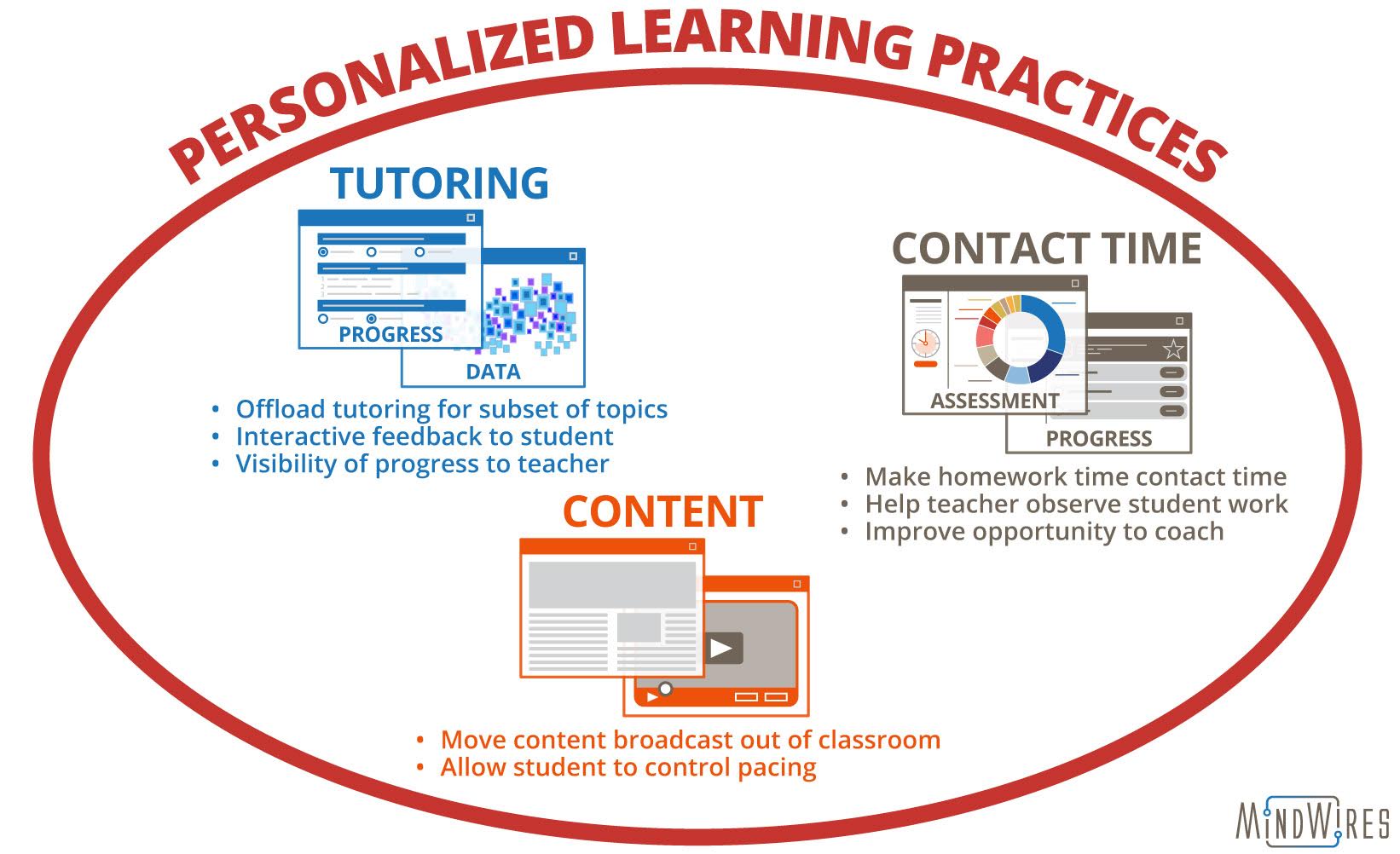
    In our recent EDUCAUSE Review article, Phil and I defined personalized learning as a set of technology-supported practices that help undepersonalize teaching. The three general practices that we identified are as follows:

    1. Moving content broadcast out of the classroom: Even in relatively small classes, a lot of class time can be taken up with content broadcast such as lectures and announcements. Personalized learning strategies often try to move as much broadcast out of class time as possible in order to make room for more conversation. This strategy is sometimes called “flipping” because it is commonly accomplished by having the teacher record the lectures they would normally give in class and assign the lecture videos as homework, but it can be accomplished in other ways as well, for example with reading-based or problem-based course designs.
    2. Turning homework time into contact time: In a traditional class, much of the work that the students do is invisible to the teacher. For some aspects, such as homework problems, teachers can observe the results but are often severely limited by time constraints. In other cases, such as comprehension of assigned readings, the students’ work is invisible to the teacher and can be observed only indirectly and with significant effort. Personalized learning approaches often allow the teacher to observe the students’ work in digital products, so that there is more opportunity to coach students. Further, personalized learning often identifies meaningful trends in a student’s work and calls the attention of both teacher and student to those trends through analytics.
    3. Providing tutoring: Sometimes students get stuck in problem areas that don’t require help from a skilled human instructor. Although software isn’t good at teaching everything, it can be good at teaching some things. Personalized learning approaches can offload the tutoring for those topics to adaptive learning software that gives students interactive feedback while also turning the students’ work into contact time by making it observable to the teacher at a glance through analytics.

    ERO Graphic 1

    Personalized learning is a set of things that you do, not a set of things that you buy. Products can support or enable personalized learning practices, but they are not “personalized learning products.” And in fact, once you have products that support personalized learning practices, that’s actually when the hard work begins. OK, so you moved content broadcast out of the classroom. Now what are you going to do with class time? Students get some benefit from having course content that they can review multiple times at home, but most of the big gains typically come from the teacher reclaiming class time for more high-value direct and interactive work with the students.

    On the other hand, adaptive learning is a label that applies to products. Further, adaptive learning products can support all of the practice areas of personalized learning. They enable teachers to move content broadcast outside of class time, they make homework time into contact time through analytics, and they provide some tutoring function. “Adaptive” tends to provoke a lot of discussion around the latter of the three practice areas. See the piece I wrote for the American Federation of Teachers if you want a primer on the strengths and limitations of adaptive learning products as tutors. But as often as not the first two capabilities, neither of which is dependent on adaptive algorithms, are the ones that enable the biggest gains in personalized learning teaching practices. “Courseware” is a set of products that, when designed well and used properly, can enable faculty to move content broadcast out of the classroom and make homework time content time. Adaptive courseware adds the tutoring element while also, if done well, increasing the value of that homework contact time by providing better feedback through more targeted analytics.

  • Blackboard and Moodle Now BFFs

    As we have been writing about here for some time, there has been an open question about the future of Blackboard’s partnership with Moodle. Through its acquisitions, Blackboard has become the world’s largest Moodle support company. This means that they also contribute a hefty percentage of the annual operating budget for Moodle Pty. Both sides have good reason to get along—Blackboard because Moodle has been key to their growth in international markets and Moodle because Blackboard contributes such a substantial portion of the money that keeps Moodle running every year. But there have been challenges in aligning the specific needs of both sides to make the relationship work. In my post about Blackboard’s new CEO, Bill Ballhaus, I wrote the following as one of the things the new leader will have to accomplish:

    • Resolve the tensions with Moodle HQ (one way or another): As Phil and I have written about before, Moodle is critical to Blackboard’s international growth, but there are growing signs of tension between Blackboard and Moodle HQ, the company that shepherds Moodle’s open source development. While this item is less of a “must do” than it is a “probably gonna happen,” I think it likely that Blackboard will either mend fences or go its separate ways in the next six months. Unresolved tensions are not good for either organization.

    Well, it looks like fences have been mended. Blackboard and Moodle Pty. have announced a renewal of the partnership. Based on both from the press release and comments made by both sides, Phil and I believe that both sides made and received concessions to restructure the relationship, and that both sides seemed to be happy about the result.

    If you’re a fan of Moodle, or just of diversity in the LMS market (including open source options), then you should be happy about this resolution. At the same time, it enables Blackboard to keep driving its successful international growth strategy, of which Moodle is an essential part.

  • Dammit, the LMS: The Play at Home Game

    A while back, I wrote a rant about why LMSs fail to evolve. It got some…notoriety. Since Phil and I are now writing a bi-weekly column for the Chronicle‘s new Re:Learning section, I thought I’d try trimming down the piece and rewriting it for a general audience. It was an interesting exercise. On e-Literate, we have the luxury of writing pieces that are as long as we want them to be and of assuming that our audience is pretty knowledgeable about a wide range of tech issues. We can also choose to target different subgroups of our audience with each post. Honestly, there have been times when I’ve written a post that was primarily intended to persuade one (influential) person, although I always try to make my posts interesting to a broader range of people. When we write for the Chronicle, we are always writing for a broad audience of non-techies, and we have to keep our ideas small and focused enough that we can adequately express them in 1500 words or less. But to the degree that we succeed, we have an opportunity to be ambassadors for ed tech issues to broader academia.

    Since many of you play that role of ambassador every day, I’d be grateful for your feedback. If you have a moment, please go read the article at the Chronicle and then come back here and comment on it. Did I pick the right aspects of the issue to focus on? Do you think this piece would resonate with your campus stakeholders? Would it be helpful to you in your conversations at work?
