
For a large portion of our readers who deal mostly with US higher education, it could be easy to dismiss Moodle as an LMS and an idea past its prime. Market data from Edutechnica shows that since 2013 the number of adopting US institutions has hit a plateau, but the total number of students served (number of institutions using Moodle as primary LMS scaled by enrollment) has actually decreased. Gone are the days of UCLA, LSU, Athabasca, North Carolina Community Colleges, UNC Charlotte and other high-profile Moodle selections from the late 2000s. ((Disclosure: I helped UCLA with their LMS selection.)) Pop quiz: name the last significant LMS decision process in US higher ed that selected Moodle as a replacement for another system.
. . .
And yet no other academic LMS solution comes close to Moodle in terms of worldwide deployments and learners enrolled. Even if you’re a US college or university, consider several reasons why Moodle matters.
Most Common LMS For Small Schools
Again using Edutechnica data (this time from early 2014), for US institutions with enrollments of 2,500 FTE or less Moodle is the market leader, surpassing Blackboard Learn.
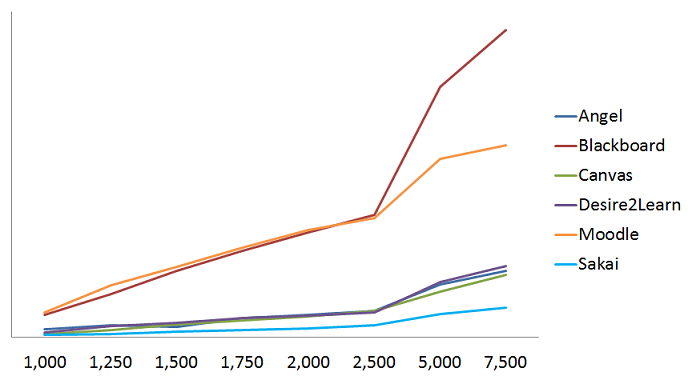
Most Prevalent LMS In The World Based On Self-Reported Data
This is a tricky measurement as different solutions report their data differently and there is a motivation to inflate numbers, but it is still a useful data source to consider. The commercial LMSs release their number of worldwide clients and total number of students / learners in press releases, blog posts, or article references – typically combining data across all markets (higher ed, K-12, corporate learning). Open source solutions like Moodle and Sakai tend to list or summarize their actual adopting institutions on public web pages.
- Blackboard: 19,000 clients and 90-100 million students (but this is for all product lines; assume far less than half the counts from Bb Learn)
- Canvas: 1,200 clients and 18 million students (all for LMS)
- D2L: 1,100 clients and 15 million students (all product lines but mostly LMS)
- Sakai lists their number of adopting institutions: 270.
- Moodle uses a software identification strategy and posts their current number of sites (active LMS instances), course, and students. This can be found in Moodle Statistics. What are the numbers? 60,600 installations and 77 million students.
This data, however, has a large margin for error.
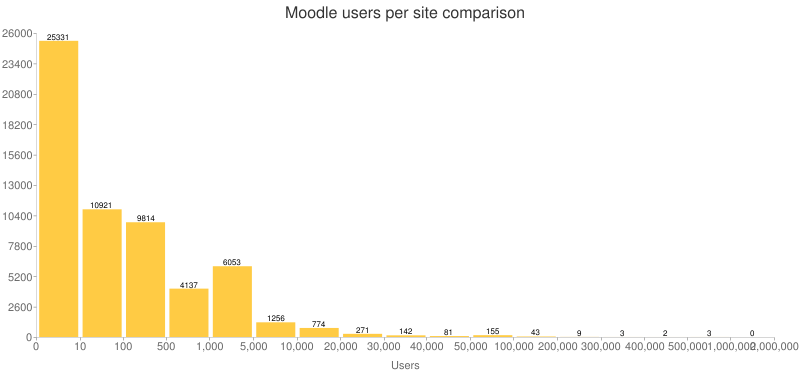
- On one hand, a large number of instances are for 500 students or less (as shown above), indicating personal or ad hoc non-institutional usage.
- On the other hand, system registration is voluntary and no one knows how many organizations just don’t report. For example, Blackboard’s Moodlerooms clients are not counted as the use a SaaS model without separate installations.
We can eliminate much of the personal or ad hoc reporting usage by eliminating the 46,000 sites and 3.6 million students where enrollment is less than 500 per site. This leaves a conservative estimate of 14,600 sites (> 500 enrollment) and 73 million students.
Even with these conservative estimates, Moodle numbers are greater than any other academic LMS and are comparable to the largest corporate LMS (Skillsoft after its acquisition of SumTotal for 10,000 clients and 60 million end users). It is likely that even with the noise in the system, Moodle is still the most prevalent academic LMS in the world and on the same rough level as Skillsoft and Edmodo ((I don’t consider Edmodo a full-fledged LMS, but it does claim to have 51 million end users.)) for overall LMS.
Institutional Reporting
It is not easy to get worldwide LMS market data that does not come directly from the provider. The best one that I know of for academic usage is ListEdTech, which uses a wiki along with staff data collection and cleanup for higher education. This chart from 2013 shows the most commonly deployed LMS in each country, and Moodle has the most countries, by far.
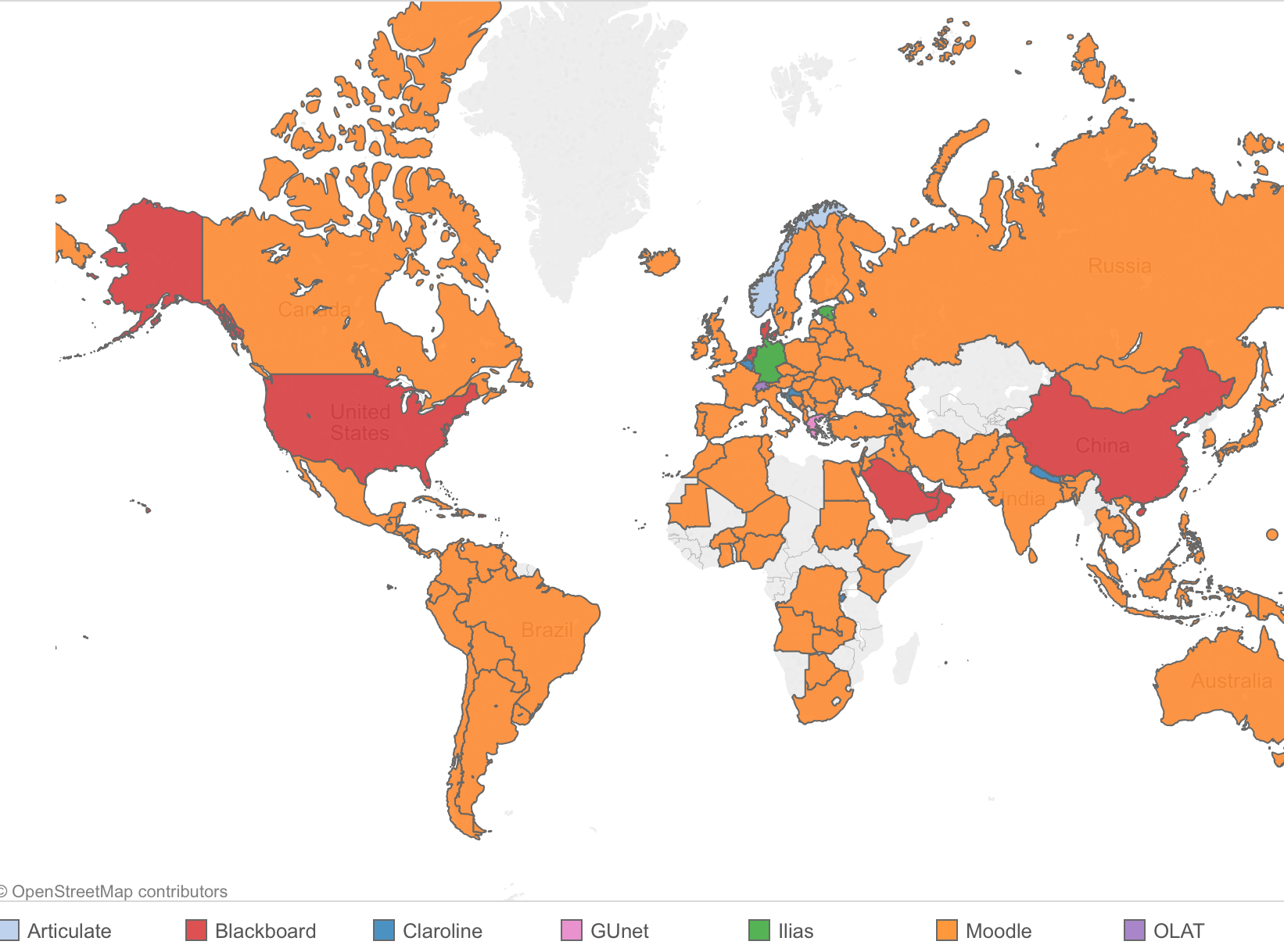
Anecdotally, every time I have spot checked per country, as was done in Colombia talking to institutional staff and vendor resellers whose business it is to know their local market, I get similar results showing Moodle as the most common system outside of the US.
Online Service Providers
Two years ago I wrote how Moodle had “quietly become the dominant LMS for online service providers“, noting:
It is this market where the Moodle LMS has seen its most impressive growth in the US in the past two years, as approximately half of these providers use Moodle as their core learning platform. Typically the companies customize the platform by extensions to Moodle and white labeling. This market is interesting, as the companies themselves are growing, leading to organic growth in LMS usage.
Series of Posts
What began as an idea for a standalone Moodle analysis post has now morphed into a series of posts that Michael and I will write over the next couple of weeks. The reason we are putting this much emphasis on Moodle is that it matters a great deal, even in the US higher education market. With this large worldwide presence, it is natural that Moodle has become big business – institutions and corporates rely on Moodle for their core learning platform. Perhaps because of this usage growth, there appears to be some significant changes that to me indicate an inflection point for the Moodle community and how it allocates resources.
What changes are going on? How sustainable is this particular open source model? How well is the system adapting to new LMS solutions and end user expectations? Stay tuned for more.
Comments
14 responses to “Why Moodle Matters”
Hi Phil
On Moodle having “the most countries”, I’m just going to hop on my soapbox and point out that country counting has a misleading tendency to flatten things out (George Kroner knows that I’m prone to this particular bit of pedantry!) So in your map, half of Australia’s thirty something public universities becomes equivalent to half of the US market when one is actually far more significant than the other. To me, this relates to the issue that you discuss with your chart: clients, sites or instals can represent many different scales in terms of users. So I’m imagining instead once of those world maps that adjusts for highered market size. Is that an option, using your data?
I’m also interested to know whether we’re starting to see institutional LMS procurement cycles changing now that so many more options available right down at the level of the individual to create hybrid learning environments — a bit of the institutional LMS, something in the open, whatever platform the student uses. This is the situation I’m in, and actively using right at this moment: inhouse student management package + Moodle grade book + WordPress + Twitter plus whatever the student adds. Calling this all “Moodle” is a simplification.
How do we start to account for this much more dispersed activity, in market terms? And how will institutions adapt in terms of the money they spend on an LMS once their students and instructors are working on free public tools instead?
Kate, you’re right that the country counting does not scale for enrollments or number of institutions. It’s just another ‘blind man feeling the leg of the elephant’ that we attempt to synthesize with the poor edtech data available.
While the flattening is an issue, there is still a scaling of interest in terms of the number of cultures and local conditions where Moodle has been adapted.
I think the ListEdTech data does include number of institutions and official enrollments – I’ll check with Justin Menard on possibility of different map scale views.
I’m seeing a slow change in LMS procurements to acknowledge the broad array of learning technologies available. Many schools now understand that the LMS is not the be-all end-all of learning apps and are attempting to evaluate as platforms. There is some success in these efforts:
– Calling out IMS standards such as LTI, etc, as a requirement; and
– Asking vendors to present their vision of integrating and using other applications.
But this progress is both slow and schools lack reference procurement models.
In fairness to Moodle, they (Martin, others) have been quite clear that they see themselves as platform that encourages use of other tools. There might be an argument in your case that Moodle enables such a hybrid approach.
But all good points.
[…] By Phil HillMore Posts (359) For a large portion of our readers who deal mostly with US higher education, it could be easy to dismiss Moodle as an LMS and an idea past its prime. Market data from Edutechnica shows … Continue reading → […]
[…] By Phil HillMore Posts (359) For a large portion of our readers who deal mostly with US higher education, it could be easy to dismiss Moodle as an LMS and an idea past its prime. Market data from Edutechnica shows … Continue reading → […]
[…] By Phil HillMore Posts (359) For a large portion of our readers who deal mostly with US higher education, it could be easy to dismiss Moodle as an LMS and an idea past its prime. Market data from Edutechnica shows … Continue reading → […]
[…] “ By Phil HillMore Posts (359) For a large portion of our readers who deal mostly with US higher education, it could be easy to dismiss Moodle as an LMS and an idea past its prime. Market data from Edutechnica shows … Continue reading →” […]
[…] “Why Moodle Matters,” according to MindWire Consulting’s Phil Hill. […]
Interesting statistics Phil. But as I’ve indicated in other places, my concern is the development of the core Moodle functionality. In the future, development and potential for a product may be better indicated by the available focused and productive coding hours. So, the resources available to the mother ship for Bb, D2L, Moodle and Canvas etc is also a critical number to consider, in addition to what user stats we can find.
I wonder if this sort of data is available?
I think I agree that Moodle is at an inflection point. At present (again in my opinion) the convergences of both positive factors and negative factors (and probably “interesting’ as well) is greatest for Moodle when compared to any other LMS or LMS wannabe.
I’ll be interested in your comments in your series of posts on Moodle.
-Derek
Derek, Thanks for notes. Michael and I are finally getting a break from that silly paying work and have more posts coming out on the topic, starting today.
[…] his recent post on why Moodle matters, Phil […]
[…] For a large portion of our readers who deal mostly with US higher education, it could be easy to dismiss Moodle as an LMS and an idea past its prime. Market data from Edutechnica shows that since 2013 the number of adopting US institutions has hit a plateau, but the total number of students served (number of institutions using Moodle as primary LMS scaled by enrollment) has actually decreased. Gone are the days of UCLA, LSU, Athabasca, North Carolina Community Colleges, UNC Charlotte and other high-profile Moodle selections from the late 2000s.[1] Pop quiz: name the last significant LMS decision process in US higher ed that selected Moodle as a replacement for another system. […]
[…] […]
[…] is a lot of volatility in the LMS market – Blackboard’s situation, Moodle’s inflection point, Instructure’s impending IPO, and new learning platforms from CBE, courseware and adaptive […]
[…] the tensions with Moodle HQ (one way or another): As Phil and I have written about before, Moodle is critical to Blackboard’s international growth, but there are growing […]