e-Literate

Present is Prologue

Author: Michael Feldstein

  • Live Stream for Wednesday’s OpenEd Keynote

    Phil and I will be giving a joint keynote to the OpenEd conference the day after tomorrow—Wednesday, 11/18—at 8:30 AM Pacific Standard Time. You can watch the live stream here. If you miss it live, don’t worry. The video will be available afterward at the same URL. For a modest license fee, all rights reserved.

    Kidding about that last part.

  • What Schoology’s Venture Funding Means for the LMS Market

    LMS vendor Schoology just raised $32 million in Series D venture capital funding, bringing the total that they’ve raised to just over $57 million. If you’ve never heard of them, that’s because they have mostly been focused on K12, where they are doing very well. But they have turned their attention to US higher ed recently. They had a surprisingly big presence at EDUCAUSE, where CEO Jeremy Friedman told me that they are prepared to make an aggressive push. Their ability to get major funding was probably helped by Instructure going to market, and possibly by the leak that Blackboard is putting itself on the block as well. I don’t generally take money guys too seriously in their ability to predict ed tech, but they may be lucky on this one. I think there may be an opening the US higher ed LMS market for a new entrant.

    LMS selection for schools often works a little like the selection process that high school students typically go through when picking a college. Students looking at colleges usually have a favorite going in. Maybe their friends are going there. Or their big brother or sister. Or maybe they just heard that it’s cool. But they don’t apply to just one college, in case it doesn’t work out for one reason or another. So they have a second tier of schools that might be OK too. Generally, they don’t know much about your favorite school going in and they know even less about the “might be OK” schools. Depending on how cautious they are, they might throw in one or two “safety” schools that they really don’t want to go to but that they feel (or their parents feel) should be included for the sake of completeness.

    Likewise, colleges and universities frequently go into an LMS evaluation process with a favorite. Because the selection is generally done by a committee of stakeholders rather than just one person, there might be conflicting opinions on what the favorite is. But more often than not, there is a nascent majority or a consensus opinion about the likely winner, at least among the core selection committee. Back in the early to mid-aughts, the default favorite was usually Blackboard because it was considered to be the safe alternative that everybody was using. When Blackboard faltered, the favorite began to split between D2L and Moodle—and occasionally Sakai, particularly for larger public universities—with type of school and geography having a big influence on which one was likely to be the frontrunner. These days, the schools that Phil and I talk to report Instructure as the starting frontrunner at least four times out of five, across school types or geographies.

    But LMS selection processes still need their “might be OK” candidates. For one thing, most of them are mandated by policy or by law to do a real multi-vendor evaluation. And most evaluation committees genuinely do want to look at alternatives. Just because they have a sense going in of which alternative is most likely to be the best doesn’t mean that they are closed-minded. The trouble is that there aren’t many alternatives that selection committees feel hopeful about these days. Increasingly, Sakai and Moodle aren’t even making it to the serious evaluation stage in US higher ed evaluations; and even when they do, they are often treated like safety schools. Blackboard never fully recovered from reputational damage done under Michael Chasen and their failure to deliver on Ultra this year was a huge setback. At the moment, they are being treated like a safety school as often as not. If Ultra slips further—and maybe even if it doesn’t—they could start losing significant numbers of customers again. And we haven’t run into many schools that are particularly excited about D2L either. Probably the best I can say for them is that they are the least likely of the LMS companies that are not Instructure to be dismissed out-of-hand.

    I think there’s an opportunity for a new entrant to get a fair hearing from selection committees that want a real horse race but aren’t excited about any of the incumbents. Ironically, the rise and success of Instructure has probably reduced risk aversion among schools to go with a scrappy start-up. I don’t know if Schoology is going to be the one that gets a foothold in the market because of this opening, but their timing is definitely good.

  • The Starling: Pre-K Ed Tech

    The product I am going to tell you about here was created by two of my former seventh and eighth grade students. I love these guys. So yes, I am biased. But that knowledge also presents an opportunity. I am 100% confident that they have only the best of intentions. With that in mind, I can look at the genesis of an idea for pre-K ed tech—a particularly fraught corner of a fraught field—knowing that there is no scam or hidden agenda here and see some of the challenges that arise when trying to go from best of intentions to implemented product.

    I think Starling is a great idea that has the potential to do a lot of good in the world. But I also think it will raise some eyebrows.

    (more…)

  • The Rise of Antisocial Deconstructivism

    Phil and I gave our first ever joint keynote at the OLC conference this week. We didn’t want to just do dueling PowerPoints, so instead we tried a format that I have been calling a social constructivist keynote. Each of us would present on a topic for a few minutes, and then the two of us would talk about it for a few minutes. We planned the arc of the topics we would cover in advance, but we didn’t rehearse the talks for each other or script the conversation. The discussions came pretty close to the kind of bull shooting conversations that we have all the time. We set a time limit of eight minutes for each segment so that we could get through our presentation with enough time to bring the audience into the conversation at the end. It seemed to work pretty well.

    In the course of the conversation, we spontaneously came up with a term that we both like and that seemed to resonate with the audience: antisocial deconstructivism. ((“Antisocial deconstructivism” should not be confused with “antisocial deconstructionism,” the latter of which is redundant. Anyone who writes like Derrida did clearly is actively hostile to the idea of shared meaning making as something that provides net positive value, or even the desire to communicate with other humans.)) It’s the approach of breaking learning down into teeny, tiny bits, tied to fine-grained competencies and micro-assessments, that students learn on their own by following a prescription that is created for them, possibly with the help of a robot. To be clear, the term isn’t entirely meant to mock. There are times when antisocial deconstructivism is an appropriate pedagogical technique. For example, it’s pretty good for helping nursing students memorize medical terminology or IT students learn the basic components of a network. It can be good for learning some math kinds of skills, depending on your philosophy of math education. Any situation in which you are working fairly low on Bloom’s Taxonomy might be OK for it as an approach. Procedural knowledge that either doesn’t require higher order problem solving skills or where problem solving skills are best built incrementally by slowing increasing problem complexity is a particularly appropriate type of candidate for antisocial deconstructivism.

    But we do mock it when it is presented not as a pedagogical technique but as a pedagogical ideology. It’s the idea that anything worth learning can be learned best, most cheaply, and “at scale” this way. It’s the fetishization of one tool in the teaching toolbox as the technological society’s Great Leap Forward. The worst, crudest examples of MOOCs, Competency-Based Education, and personalized learning software hype are all manifestations of this stunted (and self-interested) view of education. Antisocial deconstructivism is like botulism. A little bit injected in just the right spot by a trained expert can smooth out some wrinkles that bother you, treat a chronic headache, or refocus a lazy eye. A little more injected in the wrong places and you can quickly start to look like a parody of the thing that you are trying to be. Any more that, and what you have is not a tool but a toxin.

    You might be suffering from antisocial deconstructivist toxicity if you find yourself believing any of the following:

    • Short videos of lectures by Ivy League professors, coupled with little quizzes at the end, will almost always provide a better education than a class taught by a live, human, non-Ivy League professor.
    • Short vendor-produced articles or animations, coupled with little quizzes at the end, will almost always provide a better education than a class taught by a live, human, non-Ivy League professor.
    • We think of our product like a robot tutor in the sky that can semi-read your mind and figure out what your strengths and weaknesses are, down to the percentile.

    If you exhibit any of these symptoms, then get yourself to a great teacher immediately and have them demonstrate for you what it is that videos, quizzes and robots cannot do.

  • Yes, I did say that Knewton is “selling snake oil”

    My comments in today’s NPR article about Knewton are getting some attention on Twitter. One comment in particular, actually. The one where I accused Knewton CEO Jose Ferriera of selling snake oil. To understand the basis of the comment, you have only to look at the quote from Jose earlier in that selfsame article:

    We think of it like a robot tutor in the sky that can semi-read your mind and figure out what your strengths and weaknesses are, down to the percentile.

    Can it read what I’m thinking now?

    And then there’s this:

    We can take the combined data power of millions of students — all the people who are just like you — [who] had to learn a particular concept before, that you have to learn today — to find the best pieces of content, proven most effective for people just like you, and give that to you every single time.

    Really? Every single time?

    Objectively speaking, I don’t know much about Knewton’s platform or the value that it adds. The only efficacy studies I have seen are for Pearson products, and those studies do not differentiate between Knewton features and Pearson-native features in terms of impact. If you dig deep enough on their site, you can find some information on the techniques that they use. For example, this overview paper, while not perfect, is a credible attempt to explain the techniques that the platform employs and the benefits to the users in layperson’s terms. If Knewton were doing more of this, I wouldn’t be as critical. There are still questions about the value of the product, but they are on the same level with many other products in the adaptive learning category. A company like Knewton should be working hard to demystify what their product does and providing hard, reproducible evidence that they add value.

    But much of what Jose says, at least to the media, is the opposite. No responsible educator or parent should adopt a product—even if it is free—from a company whose CEO describes it as a “robot tutor in the sky that can semi-read your mind” and give you content “proven most effective for people like you every single time.” I’m sorry, but this sort of quasi-mystical garbage debases the very notion of education and harms Knewton’s brand in the process.

    If you want to sell me a product that helps students to learn, then don’t insult my intelligence. Explain what the damned thing does in clear, concrete, and straightforward language, with real-world examples when possible. I may not be a data scientist, but I’m not an idiot either. If you can translate the technical mumbo jumbo into sensible teaching insights for me, then you just might make a sale. But most people wouldn’t buy a used car from somebody who describes their product using language as hyperbolic as “robot tutors in the sky.” The same principle should hold for educational technology.

  • Instructure Files for IPO

    This doesn’t exactly come as a shock, but Instructure has filed for an IPO, and is expecting a post-IPO valuation of somewhere between $500 million and $800 million. Whenever a private company does this, they have to file a form called an S-1 with the SEC, which contains all kinds of financial and strategic information. You can find Instructure’s here.

    Also not a big surprise, but the numbers in the report show big growth. Subscription revenue rose 72% from 2013 to 2014. Coincidentally, Edutechinica just published its 3rd annual LMS Data Update. As you can see, Canvas went through the roof in US higher ed while the other major LMS players were either flat or close to it:
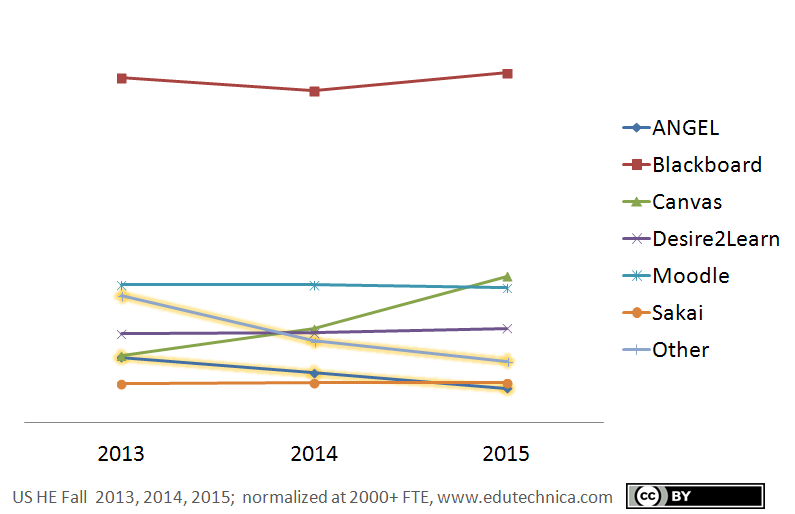
    But in order to achieve that growth, they have been running at a loss. The problem seems to be in high expenses rather than low revenues, which suggests that the losses are coming from the company bulking up rather than from them undercutting the competition on price. Also, most of those revenues still come from the US. Instructure has offices in London, Hong Kong, and Sydney. That’s not a huge international presence. And as it happens, Eductechnica has data for the UK and Australia:
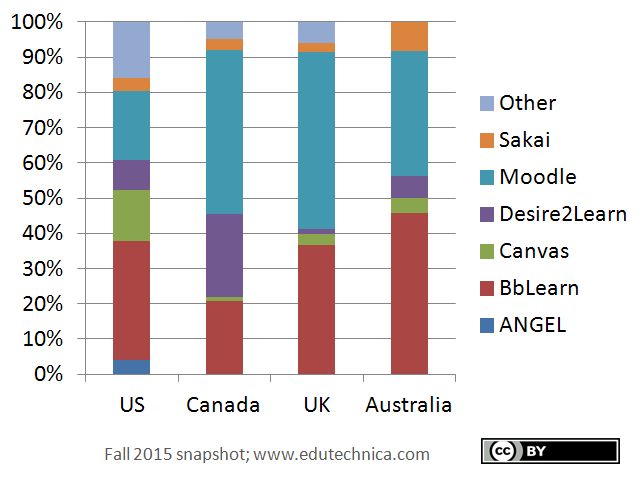
    You can see that Instructure has not made a major dent yet in either country. (You can also see that their biggest competitor by far in those two countries is Blackboard, particularly when you consider that Blackboard now owns major Moodle hosting operations in both countries.)

    One last bit that jumped out at me after a quick scan of the S-1 wasn’t financial. Their characterization of analytics was interesting. Throughout the document, they try to make the case that high user engagement and utilization lead to better learning analytics. For example,

    Strong User Engagement Leads to Robust Data Analytics

    Given today’s focus on accountability and performance, both academic institutions and companies are striving to improve learning outcomes. To do so, an organization must first understand the variables that impact results, such as attendance metrics, user engagement, and the efficacy of various learning content and technologies for individual learners. A learning management system has the potential to provide significant insight to educators and administrators on their students’ and employees’ progress toward meeting learning objectives and the factors impacting performance. In addition, such learning management systems can facilitate insightful benchmarking to allow organizations to explore other drivers of learning outcomes.

    Strong user engagement with learning management systems is critical to maximize the potential of data analytics. High utilization enables the learning management system to capture more data, and leads to more insightful analyses on user behavior, quality of individual courses and effectiveness of digital content. Better analytics enables instructors and administrators to make more informed decisions about instruction and materials that in turn drive improved learning outcomes and performance for individuals and companies. This virtuous cycle among user engagement, data analytics and learning outcomes represents the evolution of learning technology. We believe that the market increasingly is demanding learning management software that delivers both robust analytics and strong user engagement.

    They later go on to say,

    Over eight million instructors, students and employees have used our software over the 12 months ended June 30, 2015. According to self-reported data in an ECAR 2014 survey, 58% of faculty in higher education use a learning management system to share content with students, while our internal analysis of higher education institutions using Canvas shows that 71% of faculty use Canvas to share content with students.

    But their claim in terms of what they actually have for data analytics is fairly weak:

    Our platform provides users with open API access to data analytics. We deliver the analytics in an easy to understand and consumable way, that is optimized for independent analysis. This open visibility allows learners to view their own progress in real-time, educators to adjust programs and personalize curricula for maximum effectiveness and organizations to benchmark user data internally and respond to patterns observed.

    They are not arguing that they have good analytics, but rather that the high utilization of the software plus open APIs will enable customers to build good analytics themselves.

  • Is Moodle “Bigger than Martin”?

    In his recent post on why Moodle matters, Phil wrote,

    For a large portion of our readers who deal mostly with US higher education, it could be easy to dismiss Moodle as an LMS and an idea past its prime.[…]And yet no other academic LMS solution comes close to Moodle in terms of worldwide deployments and learners enrolled.

    Likewise, if you’re not embedded in the Moodle community, you may not know how central Moodle creator Martin Dougiamas is to that project, or even know who he is. And yet, he is huge. I can name maybe a handful of people who are relatively widely known and respected in educational technology. I can name only a few who are admired and even beloved. I can name very few indeed who are not working for universities (although that’s changing a little, now that Jim Groom and David Wiley have both joined commercial ventures). Within the circle that knows him, Martin’s many admirers have been fiercely loyal to and protective of him, trusting him absolutely to steer Moodle the product, Moodle the community, and Moodle the brand. When you add to that the size of Moodle’s adoption footprint, one can make the case that Martin Dougiamas is one of the most consequential figures in the history of educational technology.

    Which is why it is so remarkable that Phil and I are hearing, for the first time ever, from a number of different, independent sources, the phrase, “Moodle is bigger than Martin now.” It is another indicator that Moodle is reaching an inflection point.

    (more…)