e-Literate

Present is Prologue

Author: Michael Feldstein

  • Interview with Mitch Kapor

    I am delighted to share with you the rare treat of a conversation with famed entrepreneur, investor, and philanthropist Mitch Kapor. Probably best known as the founder of the Lotus Corporation and designer of Lotus 1-2-3, the man is consistently so far ahead of the curve it is not funny. He told me that the major he created for himself in “cybernetics” at Yale in the late 1960s was his attempt to create a cognitive science major before the field was invented. When I was an undergraduate in the late 1980s and wanted to create my own major in cognitive science, my advisor told me, “We don’t know enough about cognitive science yet to make an undergraduate major in it feasible.”

    The reason I wanted to talk with Mr. Kapor was to get his take on having educational impact as a guy who is both invested in ed tech startups like Inkling and Piazza as well as an active participant (and founder) of educational foundations. He was kind enough to carve an hour out of his schedule for a delightful, honest, and wide-ranging interview:

  • The Future of Sakai: My View

    As a member of the Sakai Foundation Board, I have at least the appearance of conflict of interest in any analysis I write about Sakai. That’s why I encouraged Phil to write his own, independent analysis of the recent developments around Sakai OAE. I was happy to support him as one source for the article but not as editor. In fact, in keeping with his previous coverage of the Sakai OAE woes, Phil did not show me his post draft before he published it. This is as it should be. We strive for objectivity and independence here at e-Literate.

    But now that Phil has done his work, I would like to offer up my own personal reflections on the current state of the Sakai software and community and where they could go from here. In the process, I will do my best to make my relationship to the project clear.

    (more…)

  • Desire2Learn Mobile Contest Winners

    I’ve been meaning to get to this post for a while. Way back in July, I had the privilege to be a judge in Desire2Learn’s Edge Challenge. Basically, they offered cash prizes for groups building compelling mobile applications for education. One of the nice aspects of the contest was that the apps didn’t have to have anything to do with D2L’s technologies (although use of those technologies was, of course, encouraged). Basically, if it was new and innovative and good for students and teachers, then it didn’t matter what technology was used. As a judge, I both evaluated the entrants and then—the fun part—got to participate in a coaching session with the winners.

    The two companies that made it to the coaching session were both really interesting. The first, mPrep, delivers lessons and quizzes to K12 students in Kenya via text messages on mobile phones (whether they are smartphones or not). There is also an analytics portal for teachers. The company has aspirations to expand its reach across Africa and, eventually, to the rest of the developing world. Here’s their video entry:

    The second was a company called Primal. They have a semantic search technology that helps you zero in on what you were actually looking for by understanding your interests. They built an app on top of their core technology called Learning Sherpa. Basically, the tool combines the class context of what is being taught (e.g., anatomy and physiology) with the student’s interests (e.g., baseball and statistics) to find articles that cover both areas. In other words, it helps students find their zone of proximal curiosity in the context of the class.  Here’s their video entry:

    Great stuff. Both of these start-ups impressed me a great deal. I think D2L’s contest was outstanding and I hope they do it again.


  • Open Secret: Pittsburgh’s Ed Tech Revolution

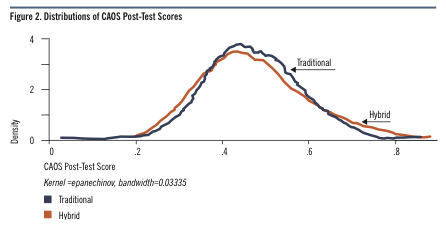
    Generally when we talk about goals for educational technology, we talk about one of two things: improving access or improving effectiveness. Rarely do we get an opportunity to talk credibly about an innovation that can move both of those needles at the same time. And yet, I saw just such innovation in Pittsburgh this week at the LearnLab Corporate Partners Meeting. LearnLab, jointly run by Carnegie Mellon University and the University of Pittsburgh, is not widely known in ed tech circles. However, it’s close cousin OLI is. For example, an independent study by ITHAKA S+R made a splash when it showed OLI could cut instructional time in half and still achieve the same level of effectiveness. Two groups of students across six different public universities took the same introductory statistics class. The first group took a traditional version of the class, with an average of 3 hours per week spent in the classroom. The second group took a hybrid version, where they spent one hour a week in the classroom and some time studying independently with the OLI cognitive tutoring software. So that second group spent one-third of the time in the classroom, which amounts to a very significant cost savings and an opportunity to teach more students for less money. Students themselves spent more time on homework in the second group than the first, but even so, they spent 25% less total time on the class than the ones in the traditional class. And yet, both groups achieved essentially the same competence at the end of the class:

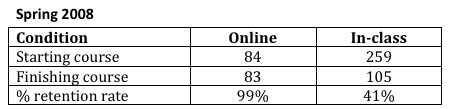
    To sum up, OLI was able to teach more students at lower cost and with less time on task from the students yet with the same effectiveness of a traditional class. Another, smaller study with similar traditional vs. cognitive-tutor-hybrid for an introduction to logic course found that while students in the hybrid condition saw a small (though not statistically significant) gap in learning effectiveness relative to their peers, they achieved more than double the completion rate:

    OLI is pretty well known in the broader ed tech community. They show up at conferences. The ITHAKA study got lots of play. I find it odd that we have not had a broader conversation about how they have achieved their results. Because the techniques developed by OLI, their colleagues at LearnLab, and their collaborators in other institutions have serious implications for OER, MOOCs, the textbook industry, and really, the future of education.

    (more…)

  • Blackboard’s New Platform Strategy

    A few weeks ago, I had the opportunity to attend the BbWorld conference and conduct a private interview with Chief Technology Officer and President of Academic Platforms Ray Henderson. ((As an aside, I did not know that Ray also holds the CTO title until I went to the Blackboard web site to check his title when sitting down to write this post. I don’t know how new that title is.)) What I learned is that the company is embarking on a fairly radical, high-risk/high-reward strategy of re-architecting both their platform and their business model. The implications of what they are attempting are much larger than you might infer from the press releases.

    (more…)

  • The Odometer Flips at e-Literate

    Phil Hill pointed out to me a while ago that we were approaching our 1,000th post here on e-Literate, and I am tardy responding to the occasion. This post is mainly to say thank you for sticking with us. I am continually amazed and humbled by your interest and participation.

    On related note, I still am thinking very seriously about a book based on the blog and am still interested in hearing your thoughts about what would be most interesting and useful, as well as which posts were most memorable and why.

  • Would You Buy an e-Literate Book?

    I have been having a fun time lately going back through the close to 900 posts that I have written on this blog since early 2004. It has been fascinating to remember what I was thinking, where I was on the right track, and where I was on the wrong one. As a personal reflective ePortfolio, it has been more useful, enjoyable, and fulfilling than I ever could have imagined when I started it.

    But I am even more amazed at the number of people who have found it worth reading. We’re up to about 3,500 non-robot page views a day. That’s just mind-boggling. It makes a little more sense to me now that I have been joined by great authors who regularly post interesting content to the site. But I am still continually astonished and gratified by the number of people who seem interested in what I have to say and who are so kind to me when I meet them at conferences and other professional gatherings.

    All of which brings me to an idea that I’ve been playing with lately. I’m thinking about putting together an eBook that is a retrospective of eight years of e-Literate content. I would create just a few categories, publish the posts for each category in chronological order, and add commentary (both for each post and for each chapter) about what I have learned and what I find interesting about it looking back. These would be my posts only, although if the experiment is successful I would consider working with my featured bloggers on a sequel (assuming they are willing).

    I would like to charge for the book, partly because it would be nice to have a non-icky way to defray some of the costs of maintaining e-Literate—I’m up to $99/month in web hosting fees now—but mostly as a way of learning more about how people value the work we do here. I know roughly how many people are interested in the content when it is free, but how many think it is interesting (and hopefully useful) enough to pay for it?

    So here are my questions to you:

    • Without thinking too hard or paging back through the site archives, are there any e-Literate posts that are particularly memorable to you? If so, which ones are they and why did they stand out in your mind?
    • If you would consider reading such a retrospective, what would you be looking to get out of it? Why would you find it interesting?
    • Would you be willing to pay a few bucks for an annotated anthology of blog posts that are freely available online?
    • Why, in general, do you read e-Literate? what do you get out of it?

    Thanks in advance for any perspective you can give me.