e-Literate

Present is Prologue

Author: Michael Feldstein

  • Please Be Patient While We Remodel…

    Due to ongoing consequences of getting hacked by a spammer, I have not had administrative access to WordPress for over a week. Despite the good faith efforts of the kind people at Fused, I have come to the conclusion that, given both the nature of my site as a target for attacks and my lack of skill at hardening it, I need to move to a web host that has dedicated WordPress security and support. So I’m moving over to WPEngine. It will take a few days to get the new site up and the DNS servers flipped to point to it. In the meantime, I’m shutting down posting and commenting so we don’t lose anything in the transition.

    Thanks for your patience.

  • We Interrupt This Program…

    e-Literate went down for few hours this afternoon due to somebody apparently hacking my account and using it for spam. It’s fixed now. Sorry.

  • The Blackboard Announcements, Part 2: Can Open Source Be Bought?

    I have gotten a lot of email from folks who moved to Moodle (often from Blackboard CE) because they wanted to get away from Blackboard and they thought that open source was “safe.” In my first post on the announcements, I noted there are reasons to believe that Moodlerooms customers may do just fine under the new corporate ownership. But still, what does the announcement mean? Did Blackboard buy Moodle? What about open source can be for sale? What protection does it afford from corporate acquisition, and what are the limits of those protections?

    I’ll try to outline some of the ins and outs in this post.

    (more…)

  • Khan Academy Contributes to the Google Art Project

    My friends Beth Harris and Steven Zucker, formerly of smARThistory, now of smARThistory at Khan Academy, have announced that they contributed 90 art history videos for the newly launched version 2 of the Google Art Project. This idea, of creating virtual versions of important museums around the globe, complete with high-resolution images of the art, is wonderful. Sadly, for me, the interface is a bit confusing and hard to navigate at times. (Frankly, I think Beth and Steven did a terrific job with the visual design of smARThistory; Google should be learning from them.) But still, this is an important effort that I hope Google continues to grow and improve.

    I also think it’s interesting to see this kind of partnership between Google and Khan to bring high-quality educational resources together. It may be an early example of what turns out to be a blossoming ecosystem of such partnerships. Let’s hope so.

  • My Blackboard Open Source Post: A Correction

    I screwed up.

    My recent post about Blackboard’s moves into open source was a particularly challenging one to organize coherently. While wrestling with that, I failed to give my usual attention to the tone. As a result of that oversight, I communicated a substantially different message than the one that I intended to communicate. I don’t believe in rewriting my posts after they are published (unless it’s on the level of a typo fix), because I believe in being accountable for what I have posted. So instead, I have inserted a short correction notice into the original post and will issue a longer one here.

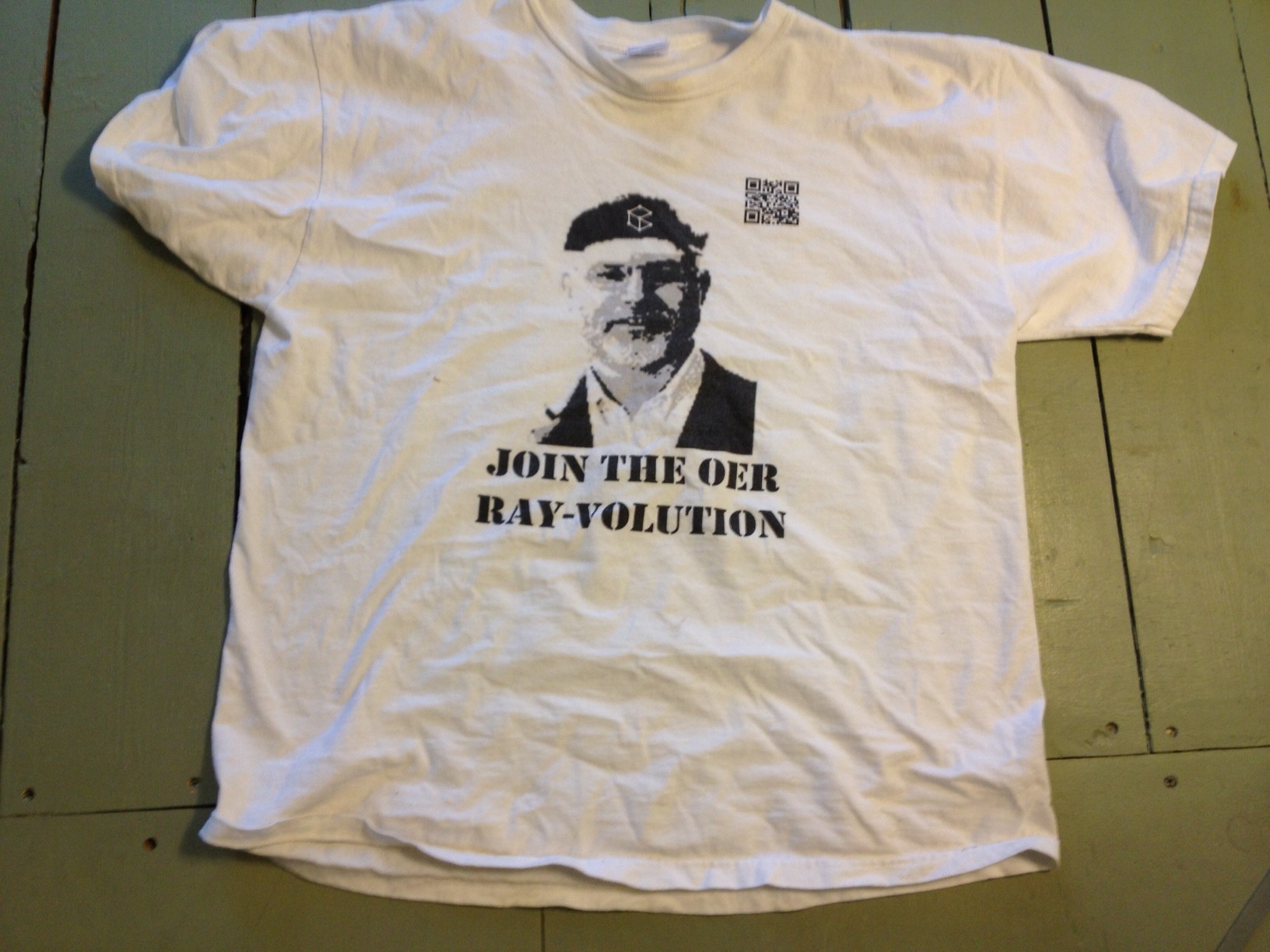
    The problem can be best illustrated with the T-shirt that I placed into the post:

    There is a story behind that shirt. It was a gift. While at the Open Ed conference, Blackboard employees George Kroner and Jarl Jonas generously offered to walk me through the details surrounding some recent announcements about Blackboard’s support for OER in CourseSites. As I wrote in a subsequent blog post based on the information I got from George and Jarl, my conclusion was that Blackboard had made a sincere and substantial contribution to the advancement of OERs. At the end of the conversation the two gentlemen, I mentioned that I have a T-shirt from every major LMS except Blackboard. The one pictured here was kindly sent to me by George in response. Even a casual glance at it shows that it is not an official Blackboard T-shirt. I interpreted it as something created by the employees as an expression of affection for Ray’s personal investment in their openness effort. That’s what it meant to me and that’s what made me think of posting it.

    Unfortunately, I didn’t provide that context in the post. Along with my text, it easily could have been interpreted as a suggestion that Ray is trying to hog the limelight. Anybody who knows him even a little bit would not find that credible. I did not mean to suggest that Ray was looking to take credit for the open source move. Rather, I meant to suggest that he is looking to claim responsibility for it. I interpret him as saying, roughly, “To the degree that I’ve earned your trust, please trust me on this. I am personally invested in it.” He wasn’t bragging, nor was he slamming other Blackboard executives. So, my bad for not writing clearly.

    Ray wrote me a respectful and entirely appropriate email calling my attention to the passage in question. He took particular pains to emphasize that the T-shirt was not a Blackboard PR effort intended for external audiences, but rather “a humorous element of our cocktail party.” I do get push-back about my posts by their subjects from time to time and only feel compelled to respond when the objection has merit. This one did.

  • The Blackboard Announcements, Part 1: What the Heck Happened?

    For those of you who have been living under a rock, you may have missed a cluster of announcements from Blackboard this week:

    There has been a lot of really good, thoughtful coverage on the web about these developments. I recommend starting with the e-Literate friends and family, including Phil Hill’s post right here on this blog, Audrey Watters’ passionate rant on Hack Education, Rob Reynolds’ commentary at his blog, The Learning Lot, and frequent and eloquent e-Literate commenter Kate Bowles’ ruminations on her highly worthwhile Music for Deck Chairs blog. Those posts, in turn, link to other really good posts. I am really impressed with the level of sophistication of the dialog that the educational community is having about these developments.

    That said, I do think that there is more to add before we have exhausted the topic. I’m going to provide my own thoughts on what Blackboard is up to in this post and an analysis of what this means for non-Blackboard customers—particularly users of open source platforms—in a follow-up post.

    (more…)

  • Instructure Steps Up for Open Education

    Friday evening, I wrote in a blog post:

    If you are a large for-profit education company—say, an LMS vendor or a textbook company—give $5,000 to the DS106 Kickstarter project. At that level of contribution, in addition to all the benefits of the lower levels, you’ll get a mention as doing a really swell thing on the fabulous e-Literate weblog.

    I’m thrilled to say that it took Instructure less than 24 hours to step up to the plate:
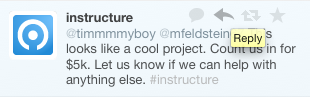
    That is just spectacular. We should all take note of a company that did not hesitate when presented with an opportunity to help out a great grassroots open education project. I very much hope that other education companies will step up to the plate.

    There are a couple of things that I think are particularly praiseworthy about DS106. First, it’s  a course that teaches digital literacy in a way that has proven effective and inspiring for a wide range of students. That’s huge and much needed in and of itself. But I also think that the course presents a replicable model for doing open education on a wide range of topics on a small budget, while teaching students some basic digital literacy through its very structure. Even if the course subject isn’t something like digital storytelling, the DS106 model has each student set up her own blog and participate in a distributed community. If you think that is an unreasonably high barrier, then you probably haven’t set up a blog recently. Having students set up their own web sites, understand how they work at a basic level, and learn what it is like to have a digital space of their own is a good and appropriate set of educational goals for an incredibly broad range of learners.

    You may wonder why making a contribution would be worthwhile, given that the project has already well exceeded its initial funding goal. If you’d like to get a sense of what the DS106 organizers may do with the extra cash, then read Jim’s post about it, including the comments. For me, a common theme jumps out that I find very exciting, and that theme is about making the DS106 model easier and more accessible to a wider range of students and teachers—developing WordPress plugins that make course setup simpler, developing a languages course using the same teaching model, and so on. I would very much like to see a community grow around helping to spread this model, test its limits, and make it more accessible to people who want to do open education across a wide range of subjects.

    That’s why I’m hoping that folks like Ray Henderson, John Baker, Adrian Sannier, and others with significant budgets will step up and add further funding to this project. And, of course, you don’t have to be a captain of industry to make a contribution. You can contribute whatever money you think you can spare as an individual. Remember, DS106 achieved its initial funding goal in less than 24 hours, before Instructure stepped up. Individuals making $5 and $25 contributions did that. Your contribution matters. In fact, one of the lessons of DS106 in general is that you don’t have to have deep pockets and an enterprise IT infrastructure to make a big impact in education. To the degree that large contributors like Instructure are stepping up, it is because they are following your lead. Before smARThistory was “acquired” by Khan Academy, it was funded by contributors like you in a Kickstarter project.