
e-Literate

Present is Prologue

Author: Michael Feldstein

  • Duke Moving from Blackboard Enterprise to Sakai

    As I wrote in an earlier post, defections of Blackboard Enterprise customers to other LMS platforms might be an indicator of a greater market share movement that we’ve seen in the past because, absent any forced migration, schools just don’t change LMSs very often. Well, Duke has announced that they are moving from Blackboard Enterprise to Sakai. Particularly interesting is their reasoning for undertaking an LMS evaluation in the first place:

    Since future versions of Blackboard are significantly different than the current Blackboard 8, any upgrade would necessitate a fair amount of change for users. [Emphasis added.] On top of that, Duke’s needs and priorities have shifted in the 10+ years since we first adopted Blackboard as the campus LMS. This plus the fact that our Blackboard license is up for renewal in July 2012 suggests that it is a good time to review the LMS “landscape” and determine if Blackboard is still the best system to meet Duke faculty, student and strategic needs.

    It sounds as though the Duke folks thought that the changes from Blackboard 8 to Blackboard 9 were large enough that they amounted to a forced migration. They passed the threshold of user retraining beyond which you might as well look at all options.

    This is always a tough dilemma for developers of software with a significant installed base. You need to evolve your software to keep up with the competition, but in doing so, you force your users to deal with change, when not requiring them to change has been one of your competitive advantages. The challenge for Blackboard is that they face this dilemma at a time when they are also putting their WebCT and ANGEL customers through a forced migration. So if the move to Blackboard 9  from Blackboard 8 is also perceived as, effectively, a forced migration, then that means an alarmingly high percentage of their LMS customers might be looking around at alternatives.

    I’m interested in hearing from people who have experience with both Blackboard 9.x and 8.x. In your opinion, is it really a big change? How much user retraining does it require?
  • How Do You Choose Your Textbook?

    This is a question for e-Literate readers who are teachers. I’m trying to understand how instructors in different disciplines choose their books for a class. My sense is that it varies widely by discipline. For example, my wife teaches a lot of English Composition, so the didactic manual isn’t as important as the anthology of short stories and/or essays. I would imagine that her selection criteria for a good anthology would be quite different than, say, a macroeconomics professor looking for a good textbook. And the macroeconomics professor, in turn, might have very different criteria than an art history professor.

    All of this matters because it will have a profound influence on how content is digitized, disaggregated, and made available under open licenses. The change is likely to be different discipline by discipline, depending on how well the decision process of the faculty works in the new digital world. Many composition teachers would probably like a world in which they could assemble their own anthologies. On the other hand, if you’re an economics professor who tends to use Greg Mankiw’s book because you like his overall take on economics, a disaggregated, digital world might offer you a different set of pros and cons.

    So I’m asking: How do you choose your texts for class? Do you go by publisher/brand? By author? Do you look for a particular theme? Do you think about cost for the students, or open licenses? Is convenience a factor? Please let me know in the comments thread, and please don’t forget to tell me what subject you teach as part of your answer.

  • A Big Vista to Blackboard 9.1 Win

    Following up on my two-part series on the changing LMS market, I am going to write short posts noting LMS evaluation decisions of Vista, Blackboard Enterprise, and select ANGEL customers (as well as any others that seem noteworthy) when I hear of them. Today, via Ray Henderson’s tweet, I note that the San Diego Community College District (131,403 students) has chosen to migrate from Vista to Blackboard 9.1.

  • The Evolving LMS Market, Part II

    I have gotten a lot of very nice compliments in the last 24 hours about the first post in this two-part series. I do want to emphasize that a huge portion of the value in that post comes from the great survey work that Casey Green does. All I did was tease out a few implications and make a few new graphs (which, I admit, were very pretty). If you want to see analysis like this continue in future years, then support the Campus Computing Project.

    In this next part, we’re going to go “off-road” a little and see what we can figure out in areas where we don’t have quantitative data that is as solid as Casey’s. As I wrote in the previous post in this series, there are roughly 875 WebCT and ANGEL customers who will have to migrate to a new LMS in the next few years, in an environment of strong budget pressures. This creates an atmosphere in which more and different schools may be in play than has typically been the case. But evaluating options and choosing to move are two different things. What happens in the next few years is likely to shape the LMS landscape for years to come, at least in North America.

    Let’s see if we can read the tea leaves.

    (more…)

  • The Evolving LMS Market, Part I

    As Casey Green said in my recent interview with him, the LMS space is a “market in transition.” In 2005, the year that Blackboard acquired WebCT, the two platforms had a combined total of 75.6% U.S. higher education market share, and the next closest competitor had barely cracked 2% market share. Today, the situation is substantially different and changing rapidly. But the narratives around exactly what’s happening tend to be off. Typically, I hear the frame as being a contest between Blackboard and “open source.” Has “open source” (by which we mean Moodle and Sakai, the two open source LMSs with significant market share in the United States) made inroads into the market?  If you read what the majority of sell-side financial analysts ((Sell-side analysts are financial analysts who work for major brokerage houses and provide stock analysis to retail investors. Comments by analysts that you read in business news articles are typically from sell-side analysts.)) are writing, you may see the claim that “open source” is not putting a major dent in Blackboard. If you talk to Moodle or Sakai advocates, you might hear that they are crushing the company in sales. Neither account is really capturing what’s happening in the market, so I’m going to try to explain what we know about what’s really going on in a two-part series. In this post, I’ll talk about what the data are telling us so far about the recent shifts in the market, describe how colleges and universities come to decide that they need to go to market for an LMS, and assess the degree to which we may see an uptick in the number of schools that decide to look around and evaluate their options. In the second post, I’ll describe how the next four years of market transition may be different than the previous four and what signs we should be watching for to see which way the market is going to break.

    (more…)

  • Jim Groom Unbound

    There is a lot of good buzz in the edublogosphere about Jim Groom’s newly open course called “Digital Storytelling.” I’m not going to have time to participate this time around, so I really hope that he offers it again. But it’s already off to such an interesting start that I can’t resist commenting on it. Jim has been careful to credit other experimenters with Massively Open Online Courses (MOOCs), which is fair and good, but without getting into a discussion about how much is original to him, I think the course is exemplary in a lot of ways, both as a relatively refined example of a new genre and as an educational experiment.

    (more…)

  • The CDW-G 2010 Annual Surveys: CIOs and Faculty Differ on Education Technology?

    This is a guest post by Jim Farmer. Jim is Chairman of instructional media + magic.

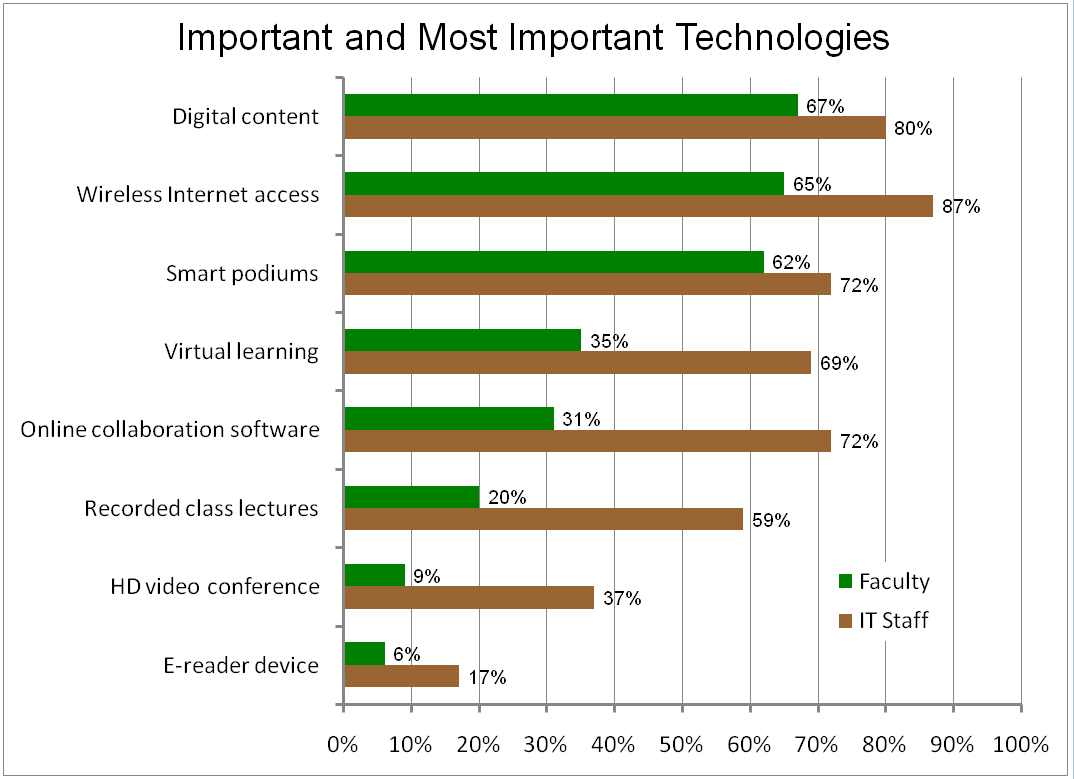
    Interpreting the CDW-G 2010 survey summary report, Campus Technology magazine concluded: “Faculty members and campus IT staff aren’t exactly in agreement on the necessity of some technologies in education.” The can be interpreted to show CIOs consistently rank the individual technologies higher than faculty. Summary data from the CDW presentation is shown in Figure 1.

    The real innovation in higher education it is not the technology itself. This may seem obvious now, but it wasn’t in the past. It’s a recent revelation that comes with changes in the roles of IT staff and faculty in innovation with technology for teaching and learning and in IT organizations and departments on campus.
    Trent Batson in Campus Technology, 2 June 2010

    In July the “2010 21st Century Campus Report: Campus 2.0” was released at the Campus Technology conference held in Boston. Sponsor CDW-G is “a leading source of Information Technology (IT) solutions for education, government and business.” Their report was a series of summary slides from the survey data.

    But the data may suggest a different interpretation.

    (more…)