e-Literate

Present is Prologue

Author: Michael Feldstein

  • Blackboard, Ray Henderson, and Progress

    When Blackboard acquired ANGEL back in May of 2009, there was a lot of noise about how the acquisition was going to change the company. I wrote a post then called Three Tests for the ‘New’ Blackboard, which outlined some indications I was going to be looking for to see whether there was substance behind the hype. The first sign I got that something was changing happened within days (hours?) of my publication of that post, when Ray Henderson publicly accepted my challenge on Twitter. How well have he and Blackboard done since then?

    Really well, actually:

    • Challenge 1, drop the patent suit: Done. To be honest, I did not expect this to be the first one ticked off the list. But it was. Blackboard and Desire2Learn settled in December of 2009.
    • Challenge 2, support IMS Common Cartridge, including export: Done. I wasn’t following this too closely, so I don’t know exactly when this was released, but some time this year Blackboard provided full support for IMS Common Cartridge, including export.
    • Challenge 3, support IMS Learning Information Services: In Progress. Yesterday, Ray Henderson declared in a blog post that Blackboard is “committed to supporting” LIS. To my knowledge, this is the first time that Blackboard has made an unequivocal, public commitment in writing to implement the standard. This declaration has been backed up by activity in the LIS working group that indicates Blackboard is actually taking steps to implement the specification.

    If Blackboard succeeds in implementing LIS by the 2011 IMS Learning Impact conference, then Ray will have met all three challenges within 24 months of coming to Blackboard. That’s pretty impressive.

    Update: I received an email response to this post from Ray (who is at an IMS meeting today), which I reprint in part here with his permission:

    1. Common Cartridge: we actually have NOT shipped this, just demo’d it. My public statement was to show progress at the 2 IMS meetings this year, and ship by end of year. We’re on target for that.
    2. IMS Basic LTI: this was another area I clarified earlier–that we’d ship LTI. We got conformance cert at this meeting. And so we’ll ship that too, by end of year.

    Related story: I mentioned in my blog a mega relationship between Bb and McGraw. We really are using basic LTI as a production technology — and one for a major strategic partner — in 2011. Adoption is key, and I’m delighted to see it brewing up.

  • Sakai Board Platform — Nate Angell

    This is a guest post by Nate Angell, a nominee in the 2010 Sakai Foundation Board of Directors election. His bio and platform are available here.

    Challenges & Opportunities

    The greatest challenge we face in the Sakai community is how our collaboration can stay healthy and relevant in a time when numerous forces are rearticulating not only educational technology, but education itself.

    Before Sakai first started—not even that long ago—centralized learning management systems (LMSs) were not necessarily considered crucial in higher education, as they still are not across K12 today. Since that time, most higher ed institutions have recognized that offering enterprise online learning platforms is crucial to their missions. In the interim, we formed Sakai to enable us to develop and support such central platforms on our own terms.

    Yet today, the now well-accepted idea that an educational institution should offer a single, centralized learning technology platform is under a variety pressures to evolve, including:

    • Nimble, specialized technologies with compelling academic capabilities appearing and disappearing nearly daily.
    • Large commercial technology companies offering seemingly costless platforms for collaboration, research, and thought work.
    • Students, faculty, and researchers finding more reasons to reach outside institutional and pedagogical boundaries.
    • More people customizing, hacking, and developing their technology tools.
    • Data generated by teaching, learning, and research calling out for and flowing in to a wide variety of new uses.
    • People increasingly accessing online technologies day and night from multiple devices in far-flung locations.
    • Educational institutions reinventing their activities to meet changing cultural and economic patterns.

    These same pressures—and more—challenge the Sakai community, our practices, and our technology to evolve as well. To meet this constellation of challenges, I believe we in Sakai need to understand them as opportunities for our continued engagement, not as threats against which to raise our defenses. This positive attitude is not unfamiliar to the Sakai community: we rose together out of just such engagement and apply it daily to our work with each other. Sakai exists not merely to support what we have now, but to bring our collective energy and effort to develop and own what we need tomorrow.

    Sakai in Three Years

    My vision of Sakai three years from now can be summed up in a single word: growth. Not just growth for growth’s own sake, but growth along many dimensions.

    Part of that growth should be new people and new institutions choosing Sakai and adding their ideas and resources to our collective endeavor. We set out to help educators take control of their own technology destinies. If we are not bringing that gift to more people, then we are not fulfilling our founding goal.

    Yet successful growth is not measured only by adding more names to the Sakai list. We also need to grow what Sakai can offer: our continuing work to open Sakai to other technologies via a variety pathways, to sustain multiple technology projects of our own, and to partner with complementary communities already demonstrates our progress down this path.

    We must also measure growth by how many ways we offer to engage in our vision. Sakai has come far beyond our deep, enterprise technology roots to include more players on our stage. We now count technologists of many stripes, instructors, designers, accessibility experts, vendors, policy-makers, and more among our ranks, all hailing from widely international locations and organizations of every shape and size. New efforts are underway to reach out to students, to professional organizations, and to new policy- and grant-making bodies to further expand our constituencies. By continuing to become more, to more people, we ensure our work does not atrophy, losing touch with what matters.

    Last, but not least, we must continue to enlarge what is possible with Sakai. While we have a commitment to support the activities we already have underway at our organizations, we also have the tradition and the mandate to support activities that go beyond. The continuing novelty of what our work so far makes possible should inspire us to further work that in turn generates possibilities we can’t yet imagine.

    Over the next three years, we should continue—and stretch—these trajectories, until we truly grow to become not just the community that supports a technology called Sakai, but a community called Sakai that supports technologies for education, and all that can mean.

    Steps We Must Take

    The Sakai community must focus on three, interrelated activities to meet these challenges, grasp our opportunities, and lead us to where we want to be three years from now.

    First, a very tangible, yet crucial activity: ensuring the continued health and effectiveness of the Sakai Foundation itself as a coordinating body. The unique governance structure of the Sakai community is one of our most valuable assets. The Foundation is key to our distinction. Imagine for one moment Sakai without a sustaining—and sustainable—nonprofit foundation at its center: any positive vision we have depends on the ongoing vitality of this entity, dedicated to nothing other than Sakai’s success.

    Second, a governor for our growth: building and maintaining mechanisms to ensure that growth generates continuing common resources. By establishing a viable core platform and spreading its adoption, Sakai has demonstrated that this center of gravity will generate innovation and extension. We need to make sure that our growth also returns sufficient resources to support the less sexy, yet essential activities at our core.

    Third, a guarantee of our promise: establishing and maintaining quality and coherence in our products and processes. As Sakai grows, we need to build on our promise that our work not only meets, but exceeds the quality and coherence of alternatives. To date, we have achieved these measures only inconsistently. We need to institutionalize processes to bring new rigor to our work and meet the expectations we set for ourselves to stand at the front.

    I welcome further conversation about these ideas and my candidacy for the Sakai Board of Directors. You can read more of my thinking about Sakai on my blog at http://xolotl.org.

  • Sakai Foundation Board Nominee Posts

    Spotty hotel wifi permitting, I will shortly be publishing blog posts from most of the nominees for the 2010 Sakai Foundation Board election. A couple of the nominees have not responded to my offer. Given the time constraints involved, I don’t read anything into that. People are busy.

    Here are the details that I provided to the nominees in the email:

    What I’m offering is an opportunity for you to write one blog post that describes your goals and ambitions for the three-year period of your proposed first term as a Board member. Each blog post would have the following three headings:

    • Challenges and Opportunities
    • Sakai in Three Years
    • Steps We Must Take

    The idea, if it isn’t clear, is to (1) outline the challenges and opportunities that we face as a community and as part of the larger global education community over the next three years, (2) present a vision for what Sakai (both products and community) should look like three years from now to respond to those challenges and opportunities, and (3) describe specific actions that must be undertaken to fulfill that vision.

  • The Future of Open Textbooks

    In general, I have been an OER skeptic—not because I think OER is unimportant, but because getting the sustainability model right is really hard. But there is one notable exception to my gloomy outlook; one bright spot that I believe really will transform education. That’s Washington State’s Open Course Library project, under the leadership of Cable Green.

    Some excerpts from a Seattle Times article about the program:

    Here’s an idea that would take a big bite out of the cost of a two-year college degree:

    Gather state community-college faculty members who teach “English Composition I.” Use state and federal grant money to pay them to assemble a top-notch textbook on the subject. Sell a digital version of the book for $30. Ditch the $100 textbook from commercial publishers….

    They could lower the cost of a two-year degree, with some studies showing students spend up to $1,000 a year on textbooks….

    The state’s community and technical colleges are leading the way with an ambitious new initiative: They’re assembling previously published “open-source” textbooks and course materials for the 81 most popular classes at state two-year colleges — including for such mainstays as “General Psychology” and “Introduction to Chemistry.”

    “The power of this is that we’re going to go from a couple hundred dollars per year [for each textbook] to $10 or $20,” said state Rep. Reuven Carlyle, D-Seattle, who sponsored legislation that set aside $750,000 for the initiative. It’s a robust level of funding, experts say.

    “The return on our investment is going to be extraordinary,” Carlyle said.

    The open-source textbook drive is part of a larger state effort, called the Open Course Library, to assemble all curriculum materials — including the course syllabus, videos, lecture notes and exams — for the 81 most popular courses, said Cable Green, director of elearning and open education for the State Board of Community and Technical Colleges (SBCTC).

    The board is working with a consortium of international colleges and universities to find and assemble the materials — for example, taking pieces from freely available textbooks to create a book suited for a Washington state course. In Washington, about 90 community- and technical-college faculty and staff are involved….

    The Bill & Melinda Gates Foundation has matched the Legislature’s contribution with $750,000 in foundation money….

    The textbooks and curriculum materials are being developed this fall and winter for the first 43 classes with the highest enrollment in the state’s two-year colleges, including English Composition I and II, General Psychology, Introduction to Sociology and Introduction to Chemistry. By fall 2012, textbooks and curriculum materials will be completed for all 81 of the most popular classes….

    This could be hugely transformative. With the number of institutions participating and the number of courses created, this should hit escape velocity for sustainability fairly easily. It could be picked up by community colleges throughout the country fairly rapidly. And that’s just the start.

  • Sakai Foundation Board Elections

    Elections are being held this week for two open seats on the Sakai Foundation Board of Directors. You can see the slate of candidates here. Votes are due in by a week from today. In the interest of transparency, I have invited all candidates to blog about their respective platforms here on e-Literate. Time is tight, so I may not get submissions from everybody, but I hope to get as many candidates as I can to post. I feel strongly that voting decisions should be based more on just, “Hey, I’ve seen that person’s name on list a lot; s/he must be good.”

    As a sitting Board member myself, I feel it would be inappropriate for me to comment on individual candidates or even advocate specific platform preferences. But I do think it’s worth talking more about how to pick a good Board member in general. I invite members of the Sakai community—particularly past and departing Board members—to respond here in comments with your own suggested criteria, but here are some possible angles to consider when you’re evaluating the candidates:

    (more…)

  • Moodle and Sakai: A Trainer’s Perspective

    Here’s an interesting presentation from Mark Drechsler of NetSpot Pty, an Australian company that is both a Moodle partner and a Sakai Commercial Affiliate (and the first company to be both, as far as I know):

  • Interview with Martin Dougiamas

    Here it is! All about the past, present, and future of Moodle:

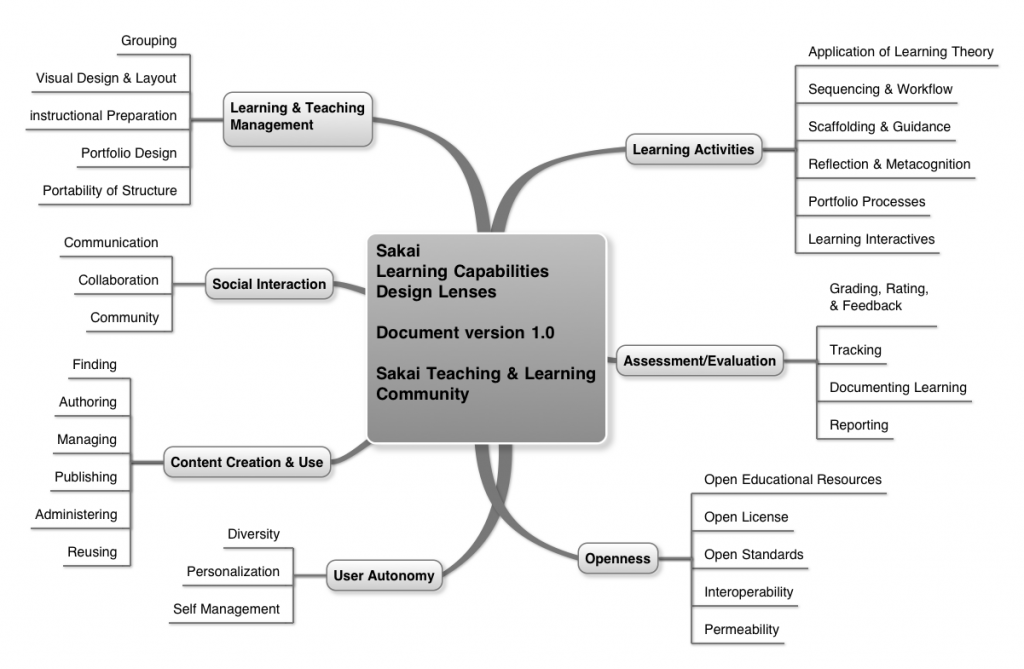
    It’s interesting to compare Moodle’s trajectory with Sakai’s. On the one hand, there’s evidence that the Moodle and Sakai communities are moving toward each other in terms of vision. The design principles that Martin describes as having guided Moodle development from the beginning are similar in approach and overlapping in content with the “lenses” that the Sakai community is adopting to guide Sakai 3 design:

    Sakai Learning Capabilities Design Lenses
    Sakai Learning Capabilities Design Lenses

    At the same time, the description that Martin gives of his early thinking about the design goals for Moodle 3, as well as its relationship to current-generation learning management, is quite similar to the path that the Sakai community has taken with Sakai 3, particularly vis-a-vis Sakai 2.

    On the other hand, the Moodle and Sakai sustainability and governance models are quite different from each other and show no signs of converging. Moodle’s model puts a company with a strong central manager in charge of most core development. Money flows from adopting schools, through Moodle support partners, and into Moodle Pty., under Martin’s direction, to pay for the core developers. Sakai, in contrast, works on a consortial model with a foundation at its center. Both approaches have pros and cons, but the point is that they are quite different and have different risks for adopting schools to manage. We tend to talk about the choice between private source and open source as if the latter were monolithic, but actually there’s huge variety in the ways that these projects work. You have to evaluate the strengths and risks associated with each open source support ecosystem individually, just as you would evaluate the strengths and risks associated with each private source vendor individually.

    Anyway, many thanks to Martin for an illuminating discussion.