
e-Literate

Present is Prologue

Author: Michael Feldstein

  • Social Software in an Academic Context is Hard

    People standing next to each other in a subway station, texting
    CC License: Josh Liba

    A couple of things have gotten me musing about social lately. The first was Dave Cormier’s thought-provoking blog post about how PLEs are supposed to disaggregate power, not people. The second was a private conversation with a friend who is thinking hard about how to add a social layer to an existing LMS. And the third was a blog post by Union Square Ventures VC Fred Wilson expressing skepticism about Google’s plan to add a social layer to its existing services. I have been struggling to articulate why I am ambivalent about both the attempts I have seen so far to create a Personal Learning Environment and attempts to layer on social capabilities to existing LMSs. Wilson says it better than I can:

    (more…)

  • The Future of the LMS

    Here’s the ninety-minute video and slides from a presentation I made to UMassOnline ((For other presentations in the UMassOnline speaker series, as well as a list of upcoming speakers, see https://confluence.umassonline.net/display/OBS/Speaker+Series.)) last month called W(h)ither the LMS?

    It’s a fairly institution- and enterprise-centric vision, but it has the potential to cohabitate rather nicely with more distributed, informal personal learning networks. Formal and informal educational paths should co-exist and cross each other in a seamless ecosystem, rather than being walled off from each other.

    It’s a shame that the video doesn’t capture the technology demo. I’ll try to get a screencast up at some point.

  • How to Sell a Migration to Moodle

    The folks at Wesleyan University have a blog up that is a stellar example of how to evangelize for an LMS platform to faculty when you’re facing the front end of a migration. ((Another great example is UNC’s Sakai pilot blog.)) For starters, their FAQ is rich with information, including analysis by peer schools.

    Here’s a sample:

    (more…)

  • Social Learning and the Re-bundling of the College Experience

    Just a couple of hours after I posted on social network analysis and the LMS, Scott Wilson tweeted about an article from Wired Magazine that he correctly identified as having serious implications for social learning. An economic sociologist from MIT used social network analysis to show that behaviors spread more quickly in social networks of clustered close connections.

    Clustered and diffuse network maps
    From Wired Magazine

    (more…)

  • Social Network Analysis and the LMS

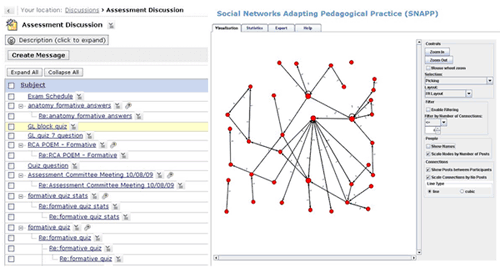
    Many thanks to George Siemens for pointing out SNAPP: Social Networks Adapting Pedagogical Practice. This is something I’ve been urging various LMS communities to  build for seven or eight years (since I was involved with dotLRN). SNAPP extracts information from the discussion boards in your LMS course and provides social graphs that help you to visualize interactivity.

    Example layout of discussion forum posts and replies in a learning management system, and the same discussion as a network diagram using SNAPP
    Example layout of discussion forum posts and replies in a learning management system, and the same discussion as a network diagram using SNAPP

    It works with Blackboard, ANGEL, Desire2Learn, and Moodle (but not Sakai). The mechanism by which it works isn’t entirely clear from the project site, but it looks like you use a bookmarklet to call a web service hosted elsewhere while browsing the discussion forum you want to analyze.

    There’s quite a bit that you can do with a tool like this. Here are some applications that the SNAPP site suggests:

    (more…)

  • …aaaand We’re Back

    CC License: tanakawho

    e-Literate had an outage of several days due to…irreconcilable differences with my now former web host. I have moved to Fused Network. Even in these early days, the difference in quality of service is night and day. I think I’m going to be happy here.

    You may have noticed that the site looks different. Again. I have had a hard time finding a theme that I’m happy with. My criteria aren’t actually that complicated:

    • Legibility of posts and comments has to be excellent.
    • Navigation must be configurable.
    • There must be flexible widget spaces, preferably including spaces in the footer.
    • The look must be clean and simple.

    I’m happy to say that the new default WordPress theme finally meets all of those characteristics, so that’s what I’m using and intend to keep using for the foreseeable future. I may change the banner at the top of the page, but that’s about it.

  • Xplana.com: Is This a PLE?

    The title of this post is slightly tongue-in-cheek because I have my doubts about whether there is such a thing as PLEs that are distinct from existing software product categories. If there were, then after years of people talking about them, one would think there would have been an example by now that everybody could point to and say, “Yes, we all agree that is a Personal Learning Environment and not a Learning Management System, a Virtual Learning Environment, an ePortfolio, an RSS reader, a personal portal, or whatever.” Then again, maybe the PLE is an idea whose time has finally come. I believe that learning environment developers are embracing many of the articulated values behind the PLE and experimenting with different ways to embody those values. Xplana.com, which launched this week, is one example.

    (more…)