e-Literate

Present is Prologue

Author: Michael Feldstein

  • The Course Hero/Lumen Deal

    The Course Hero/Lumen Deal

    EdSurge’s Daniel Mollencamp has published a piece called “What a Homework Help Site’s Move to Host Open Educational Resources Could Mean” about Lumen Learning’s deal with Course Hero to transfer hosting of those OER textbooks from Lumen’s site to Course Hero’s. The article contains a fair bit of speculation quotes from folks who I believe miss the mark on some basic facts and implications. I confess that I will engage in some informed speculation here in the sense that I have not engaged with on-the-ground reporting to confirm what I believe I know. Nevertheless, I believe I know some facts that contradict some of the speculation in the piece and put the transaction in a somewhat different light.

    For most of this piece, I’m going to stick with what I believe to be the facts. I will take a little time in the last section to provide my own point of view. That said, there are strong feelings in pockets of the educational community about both of these companies. I will be treading lightly. If you want to read vehement critiques of these companies, their business models, and their values, you can find them elsewhere on the web.

    The basic facts as I understand them

    Here’s what I believe to be true:

    • Lumen has had two branded lines of OER-based products:
      • Waymaker is their flagship product line. They invest in editorial work and research to improve the content and software development to improve the underlying platform on which it is hosted.
      • Candela are OER products that were contributed by the community but not actively maintained and improved by Lumen. They were hosted on a less capable platform. And, to my knowledge, they were free.
    • Lumen transferred Candela products, but not Waymaker products, to Course Hero.
    • Lumen received quite a bit of traffic to those free OER content. I seem to recall Kim telling me the number was in the millions of visits. That’s great for education but is also an expense for a small company. While I know some will dismiss the cost of hosting web pages on the internet, the cost of hosting content with that much traffic and keeping it accessible can add up over time.
    • The business value of Candela courses to Lumen was far from clear. It’s not like students using the content for free were likely to become paying customers or convert their faculty to adopting Waymaker products. Again, hosting the content is a good thing to do. But every company has a limit of how much they can afford to invest in public-good work. I don’t know how much Candela costs to host and maintain relative to Lumen’s total revenues. I speculate that it was non-trivial.
    • On the other hand, Course Hero’s primary clientele is students. Every user of Candela is a potential subscriber to Course Hero’s paid services. And Course Hero is a vastly bigger company. So the relative cost of hosting the content was smaller to them than to Lumen and the potential business benefit was larger.
    • As I alluded to in my introduction, both companies have vocal detractors.
      • In Lumen’s case, their primary critics tend to be within a subsection of the OER community and relate to which business models in relation to OER are considered “legitimate” or support the values of the OER community.
      • In the case of Course Hero, the controversy is more widespread. They are criticized as being a “cheat site.” Some universities are blocking access to Course Hero from school networks and I hear periodic rumors of plans for legal action against the company, although I am not aware of any actual litigation.
    • [Update] I have heard multiple complaints that Candela students were redirected from Lumen’s site to Course Hero’s site with no notification to instructors or universities, including paying customers. (See the correction below for more detail on “paying customers.”)
    • I do not believe the content was editable on either site. I’m certain it’s not currently editable on Course Hero’s site and I’m fairly confident that it was not editable in Candela on Lumen’s site.

    Corrections: A source informed me that I was mistaken on two fronts. First, Lumen did charge a low price for the version of Candela that integrated with LMSs. I do not believe it was a money maker for Lumen, and I’m confident that the free, non-integrated version got significant traffic. While this doesn’t change the overall business implications, I got the facts wrong. Unfortunately, this also means that some of those affected by the switch were paying customers.

    Second, Candela did support editing.

    Implications

    First, the business logic for both companies is clear. Hosting OER content for free is a public service that has non-zero cost, particularly if it is successful at attracting significant volume. Hosting a catalog of free online textbooks simply costs less and buys more for a company like Course Hero than it does for a company like Lumen. I make not value judgment here, one way or the other. These are simple economics.

    By I suspect—and this is pure speculation on my part—that Course Hero did pay Lumen, at least to cover the costs of supporting the content transfer. I don’t know the details of any potential transaction but I don’t see any ethical red flags with it, at least as a stand-alone issue. I’d have to see some sign of some other, ethically problematic quid pro quo which is not evident in the reporting.

    Second, these details (assuming their accuracy) tend to cut against some of the commentary in the article. For example, while I respect Bryan Alexander, I don’t think the facts support the speculation that “Lumen handing over the content to Course Hero seems like it could plausibly be them agreeing with those who think there’s no good business case for OER.”

    Likewise, Steel Wagstaff from Pressbooks, in my opinion, missed the mark on a couple of points. The first was when he suggested that “Although the content has an open license, it’s conceivable that it will be harder for technical reasons to edit and make copies of the content on Course Hero’s platform, depending on what Course Hero is doing to host the content.” My understanding is that it is neither easier nor harder. Neither platform supports native editing. To change the content, one would have to copy and paste the content in a platform that does support editing such as Google Docs or Pressbooks.

    Correction: Steel was correct. Candela, unlike Waymaker, did allow for editing. (I’m not sure if it was available in the free version of the product; see the correction above.)

    Wagstaff is also paraphrased in the article as saying, “If your main interest in OER is to adopt a book for free, then the hosting change isn’t such a big deal, except perhaps that people “feel scuzzy” about Course Hero being the ones hosting the content[.]”

    This is where things get messy. And sometimes nasty.

    Course Hero’s reputation and some circumscribed commentary

    “Scuzzy” vastly understates the breadth and depth of feeling currently swirling around Course Hero. And that concern is likely the reason this transfer of free content between two companies generated enough noise to get the attention of EdSurge.

    Before I get into further commentary, I want to state my priors here. I know the leadership of both companies. In Lumen’s case, I’ve known CEO Kim Thanos and her co-founder, David Wiley, for many years. I consider them to be friends. I trust their values even when I don’t agree with particular decisions. I know Course Hero CEO Andrew Grauer and his leadership team less well. But I have had a number of interactions with them, spent some time vetting them, and came away feeling good about the humans in charge. My best read on them, given the caveat that I don’t know them terribly well, is that they want to be constructive partners in supporting education. I have worked with both companies in the past (though not recently) and have no qualms or regrets about having done so. With that in mind, here’s my take on the story:

    Currently, Course Hero is widely and often vehemently viewed as a bad actor that helps students cheat within a significant slice of university educators and administrators. It’s not particularly easy to get your website blocked by a major public university and yet I personally know of a handful that have blocked Course Hero. EdSurge likewise states that “some campus networks have actually blocked Course Hero’s core service domains”.

    This state of affairs, combined with the companies’ mutual decision to roll out the change quietly, had two serious implications. First, universities that have encouraged students to use free OER hosted by Lumen suddenly started hearing from their students that they cannot access these resources. Second, students could not access those resources because the content has been quietly moved to a web site that important university stakeholders decided was harmful enough that they blocked it from university networks. They believe that Course Hero undermines their policies and contributes to students’ failure to learn. To add insult to injury, I heard from folks at several of these universities that they first heard about the switch from panicked students who couldn’t access their course materials after the term had started rather than from Lumen or Course Hero beforehand. These leaders feel blindsided.

    Both companies appear to have been taken by surprise at the level of backlash. In fact, Course Hero’s Vice President of Academics Sean Michael Morris is quoted in the EdSurge article as saying, “Part of this news cycle around this caught us off guard.”

    Morris’s reaction is shockingly tone-deaf from beginning to end. First of all, referring to this reaction as a “news cycle” reflects a fundamental misunderstanding of the seriousness of the brand problem Course Hero has. He actually jokes about universities unblocking their site as a solution to the problem. And he never once addresses the underlying issue of trust that caused the site to be blocked in the first place.

    This has been my deepest concern with Course Hero, which has only grown with time. Although I still believe they are not intentional bad actors, they have the instincts of a consumer company catering to students and show little understanding of universities. And while they have made earnest efforts to reach out to and understand their critics—I have participated in some of those conversations—they demonstrate at times like these that they remain dangerously naive about the stakeholders inside the institutions they want to work with.

    They have made good inroads with adjunct faculty. But incidents like this one, and their reaction to it, suggest that they have made little progress in understanding, much less winning over, the kinds of stakeholders who can block on-campus access to their site or even initiate legal action. And to be clear, I have heard more than one senior campus leader intimate that such actions were being contemplated.

    Lumen, while it has been quieter, also seems to have been caught flat-footed. I am hearing from multiple long-time customers who have been put in a very difficult position by their lack of advance communication. Lumen needs its advocates and can’t afford to burn these bridges.

    This was entirely avoidable

    The two companies missed a chance to turn a potential blow-back into a trust-winning opportunity. They could have done something like the following:

    • Announced in advance that the two companies are working on a sustainability strategy to keep the OER accessible for free to students
    • Selectively sought input from Candela-using educators and campuses about the best way to do this
    • Created a separate site with a separate URL, hosted by Course Hero, that would have bought them more goodwill at the cost of some easy customer conversion

    I don’t want to pretend that everything would have been rosy had they taken this path. The companies each have critics that would have come after them no matter what they did. So I understand the impulse to do this quietly.

    But it obviously didn’t save them from the slings and arrows. Instead, it alienated Lumen’s allies while reinforcing rather than softening Course Hero’s reputation of being an enemy of university folk.

    To sum up my own reading of the events in question, this story does not portend doom and gloom for OER. Nor does it provide convincing evidence of nefarious profiteering by Lumen. This is the story of two companies, each driven by enlightened self-interest, that screwed up a mutual effort to preserve access to free educational resources with a gob-smacking level of tone-deafness.

    This story also tells us something about how OER does and doesn’t work in supporting different sorts of business models (e.g., Lumen’s and Course Hero’s, which are starkly different).

    These companies obviously have some thinking to do and need to do a far better job of staunching the bleeding.

    In the meantime, the academic community needs to get far more sophisticated in their thinking about how sustainability works when OER gets used as infrastructure in a for-profit EdTech world. Keep in mind that another option Lumen had at its disposal was to simply turn Candela off. That would have benefitted nobody.

    I’m not going to pretend I have an answer or even pretend that I believe there is a one-size-fits-all answer. But we need better answers about sustainability at scale, balancing cost against quality, and harnessing the theoretical affordance of editability into something that actually serves students. I believe those answers will come, in part, from studying how different EdTech companies make their money and how the business mechanics interact with OER. After all, the foundation of OER is a copyright license. It may hack the private property system but it does not live outside of that system. We don’t have to look for evil motives to understand why Lumen and Course Hero thought moving stewardship of Candela might be good for everyone. It’s actually pretty straightforward.

    So how do we cultivate companies whose business interests benefit from promoting affordable, quality education? And where does OER fit into that equation?


  • More on Texas as a CBE Ecosystem Laboratory

    More on Texas as a CBE Ecosystem Laboratory

    In my last two posts, I wrote about the importance of ecosystem thinking when trying to change complex systems like higher education and followed it up with a specific exampthe the of core curriculum in Texas.

    Well, Texas is the gift that keeps on giving this week.

    The Texas Tribune just published a piece entitled “Texas Could Tie Community College Funding to Outcomes.” The outline of a proposal is on the table and the final report due to the legislature in November. While the article has many encouraging details across a range of topics, two jumped out at me related to the topic of CBE and ecosystems.

    The first is outcomes-based funding. This is not new in Texas. The current proposal involves refining the system to make it more equitable and effective. In researching the system, I discovered—as I had hoped and expected—that it takes transfers to four-year colleges into account. Community colleges earn the same number of points if students transfer to a four-year college after earning 15 or more credits as they do if the student graduates.

    This is another piece of the puzzle for creating positive evolutionary pressure. Community colleges get more funding for successful student transfers. How do they increase their odds? By following the core curriculum standards, competencies, and numbering system. That said, an ecosystem is neutral with respect to “good” outcomes. It only drives toward stability as a whole and creates evolutionary pressure on its inhabitants to evolve in a direction that increases their chances of survival. These mechanisms don’t optimize for a good education merely by existing. They do create pressure for systems that enable students to transfer and complete their educations at a lower cost. That much is good. The quality of education depends on how well crafted the competencies and assessments are. But if the pressure for natural selection exists, then evolutionary forces exist. Reform advocates can focus their efforts on cultivating that ecosystem by refining the competencies and outcomes, which will point the evolutionary pressures in the direction of the kind of evolution that produces the humane outcomes we want to see from the system.

    Such an effort will inevitably trigger reactions from academics inside these institutions, including some negative ones. That is good if handled with care and respect. Ultimately, the guardians of quality at each institution need to be won over for real change to take hold. If CBE (or any other curricular change) is really going to take hold, these guardians need to feel like their professional identity—which impacts their fit for the ecosystem they live in—is invested in the quality design and execution of key CBE components. In Richard Dawkins’ framework, we might think of these folks as the “selfish genes” (which I mean, as Dawkins did, in the evolutionary sense and not as an insult to the character or motivation of our educational quality champions).

    The second bit of relevant news is that there is at least some talk of “providing funding for non-credit programs will encourage schools to enroll more students in those areas where there is a large demand for jobs upon completion.” Since I don’t know the Texas policy participants and process well enough, I can’t gauge how likely this is to make it into legislation. But this is a good opportunity for experimentation with relaxing the seat-time requirement since, as far as I know, these programs are not governed by the laws that compel degree programs to abide by Carnegie requirements.

    There are a few colleges and universities that are already using direct assessment to deliver full CBE in for-credit programs. My cursory scan turned up Austin Community College, Lone Star College, South Texas College, TSTC-Harlingen, and WGU Texas. I’m sure there are others I missed. Texas has a beachhead for full CBE. If the state funds non-credit pathways—and particularly if the state provides incentives for performance in these pathways—that would create another ecosystem, another vernal pool, in which CBE could evolve.

    There’s enough here that somebody must have research that I’m not seeing on CBE in Texas. Please shoot it my way if you have it.

  • Case Study in a CBE Ecosystem: Core Curriculum

    Case Study in a CBE Ecosystem: Core Curriculum

    I realize that yesterday’s post about the role of ecosystems in realizing Paul LeBlanc’s vision for CBE is a bit abstract. Luckily, Providence provides. Today’s Inside Higher Ed brings us an article entitled “What Faculty Know (and Don’t Know) About Transfer—and Why It Matters” by Vita Rabinowitz, Yoshiko Oka, and Alexandra W. Logue of CUNY’s Transfer Opportunity Project (TOP). I mentioned transfer as a potential area where competencies could plausibly become the survival measure that drives evolution. I also made a point of calling out the role of faculty in traditional universities as critical actors in the ecosystem. This article brings these two points together.

    The invisibility of the transfer problem

    Let’s start with the very basics of understanding the problem with this beautifully written passage by the authors:

    “To the best of your knowledge, about what percentage of the graduates of your primary college every year are vertical transfer students?” bachelor’s program faculty answered “don’t know” 70 percent of the time, and they were twice as likely to give the wrong answer than the right one: that more than 50 percent of those graduates are vertical transfer students. If bachelor’s program faculty have no idea that many and often most of their students—including their majors—started their college careers elsewhere, then they may make faulty assumptions about vertical transfer students’ prior learning and level of preparedness. They may also be less likely to recognize the challenges that many of their transfer students face in getting good advice about course taking, securing the right academic supports and finding community and a sense of belonging.

    At bachelor’s-granting institutions at CUNY and across the nation, there has historically been a particular focus on first-time, full-time freshmen that has rendered transfer students nearly invisible. That makes it very difficult for anyone—faculty or even administrators—to have good information about transfer students. One of us was already provost of CUNY’s Hunter College for several months before realizing that fully two-thirds of the graduates she would celebrate at Hunter’s commencement were transfer students.

    What Faculty Know (and Don’t Know) About Transfer—and Why It Matters

    My own daughter transferred to Berkeley after getting an associate’s degree at a community college. I doubt most of her professors knew. She was older and more mature than a typical straight-from-high-school student. She got good grades and performed well. The point the authors are making is that students like her don’t always thrive. They have different needs and challenges than straight-from-high-school students. The challenges of these students are invisible because they themselves are invisible. They are not known as transfer students. Academics, by and large, do not know how prevalent these students are and therefore how differently the professionals need to think about supporting such a substantial percentage of the students in their care.

    Separately, the authors write,

    …[F]aculty were asked to agree or disagree with the statement “Students who transfer after having received an associate’s degree have more of their credits transferred to bachelor’s degree programs than students who transfer without an associate’s degree.” The correct answer is “disagree.” Only 6 percent of associate program faculty and 5 percent of bachelor’s program faculty answered this item correctly; 42 percent of the associate program faculty and 24 percent of the bachelor’s program faculty answered incorrectly. Fully 50 percent of associate program faculty and 70 percent of the bachelor’s program faculty answered “don’t know.” Moreover, only 7 percent of all faculty who reported ever having had formal roles gave the correct answer to this item, compared with 5 percent of faculty who reported never having had such roles. [Emphasis added.]

    What Faculty Know (and Don’t Know) About Transfer—and Why It Matters

    This point and the previous one are related. Faculty are largely ignorant both of how many transfer students they have and of how credit transfer problems impact them. Who decides what is transfer-worthy?

    Faculty (usually) decide

    In a separate Inside Higher Ed piece, “Who Decides on Transfer Credit?“, reporter David Moltz writes about the 2011 controversy at the CUNY system when the administration tried to establish rules about credits transferring from two-year to four-year CUNY schools. The proposal deeply divided the faculty. The opposition was clearly and vehemently articulated by the chair of the system-wide University Faculty Senate:

    Sandi E. Cooper, chair of the system-wide University Faculty Senate and a history professor at the College of Staten Island, said she believes the broad changes being proposed by CUNY’s central administration are a “transparent attempt to ensure faster graduation” and that while “citing student complaints about the problems of transfer,” it is “proposing a cure that threatens the entire validity of the four-year degree.”

    The administration has proposed a general education model in which all two- and four-year institutions would hold 36 credits — with courses distributed across disciplines — in common; then, each college would be able to designate up to six additional credits for the general education requirement that are specific to its institution. Cooper argues that asking colleges to trim their general education requirements, some of which currently consist of more than 42 credits, “dilutes quality” and the “rich range” of disciplines students may encounter in their higher education.

    “An administration which pays for ads on the sides of buses, for billboards and for all manner of commercials demonstrating its commitment to quality, is now asking its baccalaureate institutions to bend to the limited educational attainments of transfer students who may have barely touched the menu of course work,” Cooper wrote in an e-mail to Inside Higher Ed. “What should be eliminated? Languages? Lab science? History? Courses that are too tough — math?”

    Who Decides on Transfer Credit?

    At many universities, faculty decide what transfers. And those faculty—including the ones who have direct roles in deciding which credits transfer—are staggeringly ignorant of the concrete impact on students.

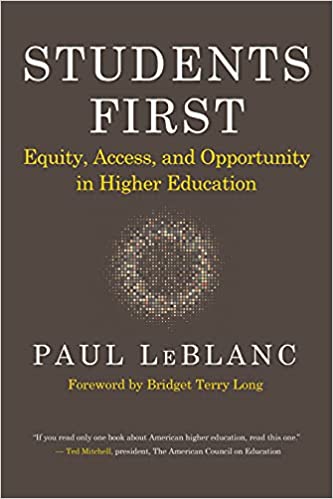
    In Students First, Paul LeBlanc writes,

    As Michael Horn and Richard Price wrote in a recent essay, transfer students typically lose 43 percent of the credits they bring with them. That is, the new institution refuses to accept those credits, and studnets lose ground while paying more for their degrees. Transfer students in California pay on average “an extra $36,000 for their bachelor’s degrees, if they can get them at all,” Horn and Price noted.

    Students First

    So faculty are making decisions that cost transfer students, which are often students of modest financial means, an average of an extra $36,000. Not because they don’t care. Sandi Cooper is clearly a passionate advocate for quality education. She cares about her students. But according to the CUNY TOP study, over 90% of CUNY faculty who are involved with making transfer decisions don’t know how dramatic an impact their decisions may have on college affordability for these students. Moreover, while they care, they are not responsible. Cooper clearly feels that it is her job, her personal responsibility, to ensure that students receive a quality education. While she likely cares about affordability, nothing in her statement indicates that she feels it is her personal responsibility to be a guardian of affordability.

    This is not a failure of Sandi Cooper. It is a failure of the ecosystem. Professors in general are overwhelmingly ignorant of transfer and its impact on affordability because it is not part of their professional identity to be guardians of affordability. It is not in their professional genome (or meme-ome, if you want to be cute). And it’s not there because nothing in their ecosystem encourages them to feel responsible or empowers them with knowledge, data, and tools to meet obligations to quality, affordability, and viable paths to student success.

    Competencies as an answer

    As Paul points out in Students First, competencies are a potential answer to this conundrum:

    Universities do not trust competencies[….] When students seek to transfer from one institution to another, they provide their new institution with a transcript. But because learning, teaching, and rigor are so variable; grades so untrustworthy; and perceived institutional quality so uneven, universities are often reluctant to grant full credit for learning the students have done at other institutions. For the 37 percent of students who transfer between colleges at least once, this failure to fully count credit hours adds considerable cost the compleition of a degree, often for those who can ill afford it.

    Students First

    He suggests that competencies are a better framework for establishing a trust framework. He reminds us,

    These are the two fundamental questions at the heart of a competency-based education:

    • What claims do you make for your students interms of what they will know and be able to do upon graduation?
    • How do you know?

    Students First

    If the answers to these questions are rigorously defined, which Paul takes great pains to explain are no easy tasks, then one of the many benefits is that transfer credits become simpler, more objective, and more predictable for students. If we agree on the competencies and assessments, then a student passing the agreed-upon assessment should receive credit. Little discussion or judgment should be required.

    Cultivating the ecosystem

    This approach is not entirely without precedent at scale. For example, the state of Texas has a patchwork of initiatives that move in this direction. They have a core curriculum, an accompanying set of competencies, and a common course numbering system. These pieces together seem to increase the likelihood of credit transfer. (If anybody knows of studies on the impact of these efforts on credit transfer, please point me to them.) Texas even has an “automated transfer equivalency system,” which is a step in the direction that Paul advocates for when he talks about interoperability standards in the context of an ecosystem.

    A step in the direction, but not all the way there. The “automated transfer equivalency system” is a database where students can look up which courses will transfer to which schools. In the world that Paul envisions, such a database would not be needed because competencies would be well-defined and would transfer automatically. The problem for students would largely go away.

    A provost in a two-year Texas college who happens to be a friend shared bits of information about how the system works in the course of a conversation on another topic. He gave the state credit for establishing these initiatives while pointing out that the competencies were “not great,” by which I believe he meant they were not rigorous in the sense that Paul is advocating for. They did seem to establish incentives for college administrators, department heads, and individual educators to feel personally responsible for weaving those competencies into course designs and assessments. And as Paul argues in the book, the faculty seemed to have room to be creative in how they fulfilled these competencies.

    It seems to me that credit transfer is an effective pressure point for establishing a working ecosystem. First, everybody can understand the impact of adding $36,000 to the cost of an education that comes from forcing students to retake courses they have already taken. Second, by tying transfer to the definition and assessment of student learning in specific courses, then the course designers—whether they are individual educators, department committees, or curriculum development teams—will feel personally responsible for thinking about quality in a way that directly impacts affordability. And in doing so, the natural imperative among these champions of educational quality will be to advocate for rigor in competency definition and testing. This drive will be balanced by the need to arrive at the consensus required to achieve the goal of easy and transparent credit transferability. So cultivating a productive ecosystem will require facilitating conversation and a decision-making process among the stakeholders that will enable them to arrive at an initial iteration and improve it over time.

    Once the drive that shapes natural selection and the pathways by which evolution can take place have been established, the ecosystem will grow. For example, the development of interoperability standards will be a natural outgrowth of a working system in which competency credits are being transferred at scale. Trying to create one in its absence will likely fail to achieve its goals. But putting one in place after the evolutionary imperatives have been established will both make the task of defining practical, working technical interoperability vastly easier and act as an accelerant for the evolutionary forces that are already in place.

    Credit: Nick Youngson CC BY-SA 3.0 Alpha Stock Images

    Evolution happens over time

    This change, as hard as it would be, would still only meet one of the two criteria for CBE. It doesn’t eliminate seat time. But once the ecosystem is driven by competencies, the blockers for eliminating seat time increasingly become about practical barriers rather than battles over principle. These challenges are still daunting. Outdated laws would have to be changed. Administrative systems and faculty professional responsibilities would have to be rethought and embraced.

    Nor are deeper considerations eliminated. For example, I worry about maintaining the evidence-supported practices of peer learning and broader network building in a self-paced environment. I also worry that, for a variety of reasons, the pace of evolution toward instructional quality does not seem as rapid as it has been in assessment and advising in some of the CBE-focused institutions I have observed. These may be solvable problems but there is still work to be done. We need time and space to experiment at scale, work out the kinks, and figure out the tradeoffs.

    The more important point in this post, though, is that if one wants to drive large-scale educational reform of any kind, the key will be ecosystem thinking.

  • “Students First”: Paul LeBlanc’s Book on Competency-Based Education

    “Students First”: Paul LeBlanc’s Book on Competency-Based Education

    I just finished reading Paul LeBlanc’s book Students First: Equity, Access, and Opportunity in Higher Education.

    To be clear, this post is neither a book review nor a comprehensive exploration of Competency-Based Education (CBE), although it contains some elements of both. Rather, I’m interested in exploring how to think about a well-drawn and incredibly ambitious proposal for change in education. How can we think about change in such a complex and—up until very recently—stable system? In particular, Paul refers briefly to the notion of an “ecosystem.” I’m going to take that analogy seriously. Nature has powerful mechanisms for both ensuring stability and driving change. They are amoral in the sense that the only outcomes they drive toward are the survival of species and resilience of ecosystems. There is no “good” or “bad.” Nevertheless, they offer powerful mechanisms that are echoed within our human systems, often without us fully realizing it.

    How to read this book

    Before you read this book, I recommend that you wait until September 27th when Paul’s new book, Broken: How Our Social Systems are Failing Us and How We Can Fix Them, will be available to buy and read that one first. I was privileged to receive an early copy. It is one of the most important and morally courageous books on education that I’ve read in years. (I’ll have more to say about it after its official publication date.) It will also make Students First more legible.

    This is a trick I learned from Paul himself. He was recently generous enough to make time for me to seek his advice on a matter of some importance to me. Before we started, he took the first 45 minutes of the conversation to coax my life story out of me. While he was genuine and warm, he was also practiced at it. I soon found out why. He proceeded to use everything he had learned about me—my values, my ambitions, my way of thinking, my emotional compass, and more—to help him understand what I was trying to do and why I was trying to do it. He was uncannily effective at it.

    CBE is a fraught topic for a lot of reasons. It’s hard not to bring some baggage to the conversation. Broken is a deeply personal, at times biographical, and occasionally confessional book. By reading it, you will understand Paul better. That, in turn, will help you understand Students First better. Paul is a broad thinker and, given the complexity of the topic of CBE, his style of taking on all arguments and covering all cases can easily be misread, particularly if you are already ambivalent about the subject (or actively opposed to it). If you read Broken first, you may still disagree with Students First, but you will read it more sympathetically because you will understand the values and the commitments to education of the person writing it.

    These two books are well worth your time. They’re short and well-written (though they reward more careful reading and thought than their easy-to-read prose might lead you to believe). I encourage you to read them both.

    The nub of CBE

    At any rate, on to the topic at hand. At a high level, CBE poses two questions:

    • Why should we design a system that prioritizes how long students spend in class over how well they learn? In other words, if one student comes in already knowing half the material in the class and another comes in needing a little extra time to master it, shouldn’t we design our education system around accommodating both of these students?
    • Why should we prioritize content coverage over skills learned? In other words, isn’t it more valuable for a student to be able to analyze an unfamiliar work—a work of literature, an economic argument, a biological experiment, a musical composition, etc.—than it is for them to be familiar with a list of such works that somebody compiled for them?

    Time versus mastery and knowledge versus skills. That’s how I understand the nub of CBE. I’m sure the CBE experts reading this will find flaws in this reductive formulation—please feel free to do so in the comments thread—but as a first approximation, these are the challenges that CBE poses to the traditional educational model. I find it hard to argue with these principles. The devil, as usual, is in the details. But those details are not the primary concern of this post.

    I’m going to explore the mechanics of CBE in a little more detail later in this piece. Just a little. First, though, I want to frame up the notion of an “ecosystem,” which is more central to my thinking as I write this. As a thought experiment, please accept for the sake of argument that CBE is a positive innovation and worth propagating.

    How would we do that? How do we even go about thinking about how to do that?

    Ecosystems

    Paul raises the topic of ecosystems early with an explicit shoutout to evolutionary biology:

    To borrow from E. O. Wilson, the renowned conservation biologist, “insular biogeography” is the idea that isolated ecological areas, being disconnected from each other, are inherently less robust and supportive of life than healthy ecosystems. Our institutions of higher education largely exist as islands and thus are not serving students who try to navigate their educational journey in a world that promises and rewards mobility.

    Students First: Equity, Access, and Opportunity in Higher Education

    When Paul refers to “islands,” think “Galapagos Islands.” Each university is its own precious, isolated ecosystem that is vulnerable to external shocks. In nature, it might be an invasive species coming to an island. In education, it might be a change in demographics or a pandemic that has long-term effects on student enrollment patterns and modality preferences.

    From here, Paul immediately launches directly into a discussion of data interoperability. How do we connect university ecosystems? Through common agreements about student achievements and technical interoperability standards that support sharing of data about student achievements.

    He’s not wrong. That said, ecosystems are generally not architected. They evolve. Sometimes they can be cultivated. And they always follow certain rules that are worth exploring because they explain both change and stability in complex contexts like education.

    For starters, ecosystems in nature are driven by one imperative: natural selection. Survival. Individual critters within the ecosystem strive to survive, reproduce, and have their offspring survive and reproduce. Sometimes they randomly mutate. The mutations may enhance their chances of survival, hurt them, or be neutral. In my backyard, many species of sparrow co-exist. Their variations provide them with neither an advantage nor a disadvantage. As such, natural selection doesn’t kick in. It doesn’t care. It only exerts its influence when competing variants become either more or less well suited to survive and reproduce within a particular ecosystem.

    Survival does not exist in a vacuum, thanks to predator/prey relationships, competition for resources, symbiotic relationships, and other interactions among species within an ecosystem. In fact, the sum of these interactions is the ecosystem. And it has within it feedback mechanisms. For example, when field mice thrive and multiply, so do predators who feed on them such as hawks and foxes. Conversely, when the mouse population drops, so does the predator population. For those of you familiar with systems thinking more generally, ecosystems function through reinforcing and balancing feedback loops. Some actions are amplified while others are balanced out.

    These feedback mechanisms give ecosystems resilience. Paleontologists Niles Eldredge and Stephen Jay Gould proposed that ecosystems exist in a state of punctuated equilibrium. Normally, the feedback mechanisms keep the ecosystem in a state of balance. Much like a thermostat, the balancing feedback loops help the system adjust to deviations. While the system does fluctuate, it stays within an acceptable range. But external shocks to the system like an invasive species, human impact on habitat or a keystone species, or climate change can cause sudden, dramatic, even violent shifts in what may have seemed like a permanently stable system. The changes driven by reinforcing feedback loops will continue until the ecosystem finds a new balance in which novel feedback loops among the surviving species achieve stability (or until the ecosystem dies completely). A virus will continue spreading, multiplying, and mutating until its hosts develop strong and broad enough immunity to keep it in check. We all have experienced the havok such a dramatic shift can wreak in a short period of time.

    In evolutionary biologist Richard Dawkins’ seminal work The Selfish Gene, he proposed the idea that the unit of life that is competing to survive is not the species but the gene. For example, the genes on the spike protein of the SARS CoV-2 Omicron variants outcompeted the genes of the original strain and thus became the dominant strain.

    When we use “ecosystem” as an analogy in education, it’s sometimes hard to figure out which entities are the ecosystems, which are the species, and which are the genes. In Paul’s usage, each institution is its own ecosystem. As humans, we tend to focus most naturally on the species level. We recognize different types of plants and animals. It’s hard for us to hold in our heads the level above—i.e., the feedback loops among multiple species and the physical environment that make up an an ecosystem—or the level below—i.e., genes that express themselves in complex and non-obvious ways to influence the species.

    This may seem like a lot of detail but it will come in handy when we think about a theory of change for a shift in punctuated equilibrium like CBE.

    Let’s put a pin in this idea and return to it shortly after a very brief detour.

    CBE, backward design, and natural selection

    Another touchpoint that Paul mentions briefly but is worth dwelling on is backward design. The basic notion is as follows:

    • When designing your curriculum, first think hard about meaningful and observable learning outcomes. What do you want to make sure your students achieve? What would it look like for them to achieve it?
    • Next, drill into that second question and design authentic assessments. How can we give students meaningful, real-world ways to demonstrate that they’ve learned what we’re trying to help them learn? How can we make sure our assessments are truly meaningful and reliable?
    • If you’ve nailed the first two parts, then you can be pretty wildly experimental with how you teach. You’re always measuring against results using the same yardstick.

    Paul returns to this last point repeatedly. Well-executed CBE is entirely agnostic about teaching methods. Whatever teaching method helps students achieve competency is good by definition.

    (By the way, my characterization of backward design may be as crude as my one of CBE. Corrections are welcome in the comments thread.)

    Notice the analogy to natural selection. In a balanced ecosystem, a course design mutation that results in poor student results against the competencies should not survive. A design that produces better results than others should outcompete the others. And ones that achieve similar outcomes should be able to coexist.

    Keep in mind, too, that we can have multiple ecosystems and even micro-ecosystems. A claim of “achieving similar results” begs the questions “for whom” and “under what conditions”. Even one ecosystem can have a stream, a meadow, a forest, a vernal pool, and so on. It’s not one-size-fits-all. Each micro-ecosystem within the larger whole has its own conditions for survival. Each is well-suited to certain kinds of species with certain genes moreso than others. Likewise, different students will thrive in different educational ecosystems.

    Paul’s rhetorical pivot from ecosystems to technical interoperability comes from E. O. Wilson’s point about interactions across ecosystem boundaries. A frog starts its life as an aquatic animal and later comes to live on land. You might think of it as a transfer student. It needs to bring everything it developed in the aquatic environment (like its legs, for example) into its next environment to thrive. Birds and other animals migrate, sometimes thousands of miles, to spend different parts of their lifecycles in very different environments.

    Both the ecosystems themselves and the creatures that pass from one to another are more resilient when this kind of transition works. Students moving from a two-year college to a four-year college are more likely to complete their degree if all their credits transfer. This makes for more successful students and more successful universities. Likewise, students who graduate from college to work effectively are more likely to succeed if the skills they learned at college transfer to the work world, to the mutual benefit of the graduates and their employer. Every time a person passes successfully from one ecosystem to the next, that person brings resilience and diversity of thought, skills, and lived experience that strengthens the new ecosystem. On the other hand, closed ecosystems where species never move to or through the boundaries tend to result in species—and the balance of feedback loops that constitutes the ecosystem—that are more vulnerable to external disruption. The less that colleges are enmeshed through transfer agreements and the less often they have students that are highly successful at crossing boundaries with adjacent ecosystems (like K12 and the workplace), the more fragile they will be. In our cultivated human ecosystems, technology can help (or hinder) the connections among and pathways between the environments we create.

    What’s missing

    Paul runs through a wide array of of successful CBE examples. He writes about a seminary school that uses CBE and argues—compellingly, in my view—that philosophy can be taught with depth and integrity via CBE. In fact, speaking as a philosophy major, if my program had focused more explicitly on how reading Plato and Aristotle, Locke and Hume would teach students how to read closely, think critically, write clearly, argue compellingly, and change their minds based on evidence and argument (i.e., learn), the department likely would have attracted more philosophy majors rather than fewer. I can say with great confidence that my training as a philosopher gave me competencies that have served me well in a variety of jobs that did not yet exist at the time that I was in college.

    I got lucky. Nothing in my college drove me toward philosophy or showed me how it could make me successful and resilient. I was not meaningfully tested in ways that made me more likely to gravitate toward skills that would be useful to me throughout my life. From an ecosystem standpoint, we are thin on single natural selection drivers. In the book, Paul does identify drivers toward competencies in certain critical disciplines, noting that one would not want to fly with a pilot who passed every test except landing or a surgeon who is competent in everything except identifying organs. A second area he talks about is credit transfer, where institutions are rightly under increasing pressure to fix a broken system that forces students to redo work, costing them time and money, because their courses from their old institution are not accepted by their new one. And a third area is stackable graduate micro-credentials, where working professionals want to build toward graduate degrees in small, manageable, and useful increments. These, along with the hypergrowth of pro-CBE institutions like SNHU and WGU, are areas where demonstration of competencies can serve as the driving measure of success that helps create a reward system for innovation. But in places where there isn’t a “competency or die” mechanism, there will be no evolution toward competencies and no variation and natural selection that will help us to discover what thriving CBE-driven ecosystems can achieve for the humans that inhabit them.

    This is the top-down part of evolution. The forces that shape survival and reproduction. Up until very recently, there haven’t been strong pressures on higher education to change in general. To adapt to its environment. To adapt, in particular, to the needs of its students. To the contrary, the modern university evolved to achieve stability against political pressures for change. The multiversity—the model for the modern university that was conceived of as part of California’s Master Plan—is a resilient ecosystem that maintains stability in part because it was designed to avoid certain kinds of competition within the ecosystem. Master Plan architect Clark Kerr did not have an economic problem when he created the University of California model that now dominates the world of university designs and rankings. The California state legislature was both able to and inclined to invest. No, Kerr’s problem was political. He faced factions, both within the university and within the state legislature, that felt in competition with each other. Even though there was money for everyone at the time, competition for status will always be a zero-sum game. So Kerr invented the multiversity to discourage comparisons that might lead to competition. Universities, he argued, could serve their research, teaching, and community mission goals. Just don’t look too closely at the accounting. If you examine who is getting how much or hold one group too visibly accountable for performance, that creates strife that threatens the coalition holding the modern university together. In a way, today’s universities are not institutions at all and are barely ecosystems. Each department and function is its own Galapagos Island. Which is why it can be maddenly difficult to try to get traditional universities to do anything at an institutional level. The “institutions” are barely more than fictions. They are not in a state of balance so much as they are in one of stasis, largely powerless to change in the face of either internal or external pressures.

    The multiversity and the status hierarchy it creates among universities is a strong environmental condition that has made the ecosystem of higher education as a sector incredibly stable. It, along with the Carnegie Unit and the Higher Education Act of 1965 cited in Students First, create incredibly strong balancing feedback loops to add stability while dampening reinforcing feedback loops that could drive change. The multiversity inspired a series of ranking systems and, more broadly, a status system that ensures more money and status flow to R1 universities. It creates a clear survival imperative along with rules for thriving in the ecosystem. Don’t want to starve? Then don’t neglect research. While I am no policy expert, I do not see any strong survival incentive in this ecosystem for measuring and improving student outcomes (which is likely why Paul, who is far more of a policy expert than I am, spends siginficant time on policy proposals in Students First). Some pressure has come increasingly in recent years in policies that focus on student graduation rates and time-to-completion, but those are not really measures of accountability for learning. In fact, time-to-degree is partly driven by state budget concerns in a public education system where every student’s tuition is subsidized by taxpayers.

    On a more micro level, the humans who want to survive and thrive in this system are driven by the imperatives they are given by the ecosystem. Unlike genes, they are conscious. Their changes are not random. They have agency and intelligence. But at the end of the day, the people living and working in a system cannot ignore needs for economic security, status and approval, a sense of professional identity that makes them feel good about themselves, and so on. If we want an ecosystem that drives toward improving student outcomes (whether through CBE or some other means), then we need to change the environmental conditions such that educational innovation and measurement of success at some clear measure of progress are rewarded. Currently within higher education, the humans working in the system often lack the natural incentives in their teaching that both rewards effective innovations and provides vectors for those innovations to propagate.

    Contrary to popular belief, research supports the position that even tenured, research-oriented professors tend to care deeply about the quality of their teaching. But they are have neither the motivation nor the tools to improve beyond certain bounds. From a motivation perspective, they fear “experimenting” on their students (which I extrapolate from the research to mean deviating from the teaching methods that they are comfortable with and believe have been effective for them). They also fear looking like idiots in front of their students. And if they wanted to experiment, how would they know that they are succeeding? What tools do they have to help them? What gauges can they use, other than their feelings and student feedback, that they are on the right track? In centrally driven programs, how do learning designers and their managers know what to refine and when to refine it?

    We know that implementing new teaching strategies often takes multiple attempts for practitioners to refine and we also know that students’ perception of learning and their actual measured learning can differ dramatically. Our existing tools—the LMS, the digital textbook, and the webconference—often don’t provide practitioners with clear measurements and increased confidence that what they are trying to improve is, in fact, improving. It’s not magic to do so from a technical perspective. If you have good backward design, then you theoretically have good measures of whether, where, and how dramatically your teaching approach is succeeding or failing at getting students to succeed at the assessments that measure specific competencies. But our mainstream systems are not designed to make that easy. There is neither measurement nor reward for teaching in the way that CBE or even backward design requires to propagate. Without those functions, there is no positive evolutionary pressure on teaching. Regardless of how much educators may want to become better at their craft, their ecosystem is not conducive to that evolution.

    And suppose an educator (or group of educators) does improve teaching of a particular topic. How does that spread? How does their Omicron become the dominant strain (to use a horrible analogy)? Right now, what happens in the classroom largely stays within the classroom.

    The aforementioned evolutionary biologist Richard Dawkins wrote a seminal cognitive science article called “Selfish Genes and Selfish Memes.” While the viral pictures with captions on the internet owe their name to this article, he meant something broader. He proposed that an idea is like a gene. It wants to propagate. Because Dawkins’ “selfish gene” concept is a subtle one, let’s make our story a little simpler by thinking about an idea as functioning like a virus. (We do often talk about videos “going viral” on the internet.) Ideas “want” to spread to other hosts, where they can continue to establish themselves. Each host can be thought of as an ecosystem. For a literal virus, the relevant environmental factors include pre-existing immune responses, genetics, other health conditions that weaken the host, and so on. For a meme—an idea—the environmental factors that influence its success include the “infected” person’s strong conflicting (or supporting) ideas and values, prior interest in related ideas, and so on.

    How do we enable better course designs, and better course design thinking, to propagate? How do we cultivate mindsets among educational professionals—the environmental conditions for the memes to take root—so that new designs are likely to spread? How do we cultivate continuous improvement and measurement as core values and part of educators’ sense of professional identity? How do we connect these ecosystems so that effective teaching approaches and course designs spread more easily?

    We are not yet thinking clearly about how our ecosystems work. We are not yet approaching education as an organic, complex adaptive system. An ecosystem. And yet the biological principles apply whether we harness them or not because they are based on more fundamental rules about how feedback loops create stabiity and change. We ignore the basic mechanisms of evolution at our peril.

    Reminder: This isn’t a book review or a position statement on CBE

    My point isn’t to advocate specifically for this focus on CBE. I don’t believe that CBE is a panacea. Spoiler alert: Neither does Paul. On page 163 of Students First, at the end of several chapters of extraordinarily ambitious policy proposals, he writes,

    Taken together, these recommendations for change are probably a bridge too far for the industry. Also, too much that is genuinely good about higher education might be placed at risk if we forced a sudden and dramatic shift to a completely competency-based education system.

    So, the ask here is for something more modest. It is to create a safe space for innovation and learning to take place, to create a Plan B for those institutions willing to raise their hands and design new outcomes-based programs for students who want and need them.

    Students First

    (The book would have benefitted from Paul making this point clearly and loudly right at the beginning. That framing would have invited a more open-minded reading from skeptics.)

    I have my own set of questions about CBE which I won’t recite here. I do agree wholeheartedly with Paul that we need a safe space for experiments, specifically for CBE and more generally for educational innovation. More than that, I think we should be creating conditions that reward bold experimentation, at scale, across a variety of learning contexts. And I think the only way we’re going to understand and mitigate the challenges of a change as dramatic as CBE while realizing its promise is to create an environment that encourages experimentation is by creating positive evolutionary pressure toward student success.

    The real point of this post is that we should take the time and care needed to think deeply about how change happens in complex adaptive systems like education. We may very well be at a moment of dramatic change as external forces drive higher education from its balance point of punctuated equilibrium. Much is up for grabs now. As I wrote at the top of this post, the forces that determine whether a system has reached a point of stability don’t entail a notion of whether that point of stability achieves outcomes that are humane for individuals and productive for society. We need to develop and operationalize more robust theories of change. For the times, they are a changin’.

  • Apologies to Aktiv Learning

    In my recent post on Cengage’s author moving over to OER, I included some references to a small company called Activ Learning which was mentioned in a joint press release. I received a complaint from the company’s CEO on Friday afternoon, asserting that the post contained inaccurate speculation about Cengage’s relationship with Aktiv—the companies have none—and an assumption that the interaction model in their current OpenStax integration in their current Chemistry product would also apply to the new Organic Chemistry product.

    After reviewing Aktiv’s complaints, I concluded they were reasonable. Consequently, I have removed all references to Aktiv from the original post. I apologize for any inadvertent confusion I may have caused.

  • Cengage Author Moves to OER: The Implications

    Cengage Author Moves to OER: The Implications

    Derek Newton called out in his Forbes column that a Cengage organic chemistry author is releasing the 10th edition of his book as OER via OpenStax. Newton is right to call this out as significant. That said, his column contains a lot of speculation about what this could mean or might mean. Fair enough. There’s a lot we don’t know.

    In this post, I’m going to tease out some of the implications that Newton doesn’t talk about.

    What we do and don’t know

    Before I do that, though, it’s worth reiterating some of the basic facts and unknowns covered in Newton’s column. An author for Cengage whose book sold well enough to go through nine editions decided to take his tenth edition to OpenStax and publish it as OER. The author, John McMurry, characterized it as a tribute to his son who passed away. Cengage is outwardly supporting McMurry’s decision and is promoting the added value of WebAssign, which Cengage owns.

    We don’t know the degree to which this decision was amicable and mutual. For reasons I’ll get into later in this post, it’s possible that both sides were comfortable with it. It’s also possible that McMurry’s contract came up for renewal and Cengage decided to make the best of his decision to bolt. We don’t know and probably never will. We also don’t know if other successful authors will follow suit. I mean no insult to McMurry when I observe that he profited from the first nine editions of his book before opening up the tenth. I don’t blame authors for wanting to be compensated for their hard work. That said, authors who have signed with a publisher more recently haven’t gotten anything like the kind of deal that McMurry likely had. So incentives are shifting.

    The platform theory

    Newton, following the cues from the press release, sees this as a movement of publishers selling their platforms as the underlying books commoditize. The problem with this theory is that publishers across the sector have been disinvesting in their platforms. WebAssign was built in 1997 and I don’t have reason to believe that it’s been significantly upgraded in quite some time. Cengage is far from alone in this. Pearson’s platforms are ancient too. I’m hearing and seeing that, by and large, all the publishers are backing off tech investment. Even McGraw-Hill and Wiley, which have been the most tech-forward of their cohort in recent years, appear to have slowed investment.

    This is not to say that Newton is wrong or that Cengage is disingenuous about promoting the package. Rather, it should be considered a holding action. Cengage, like several of its peers, is owned by private equity. While these companies can support investment and acquisition, they tend to marshall their resources very carefully. Especially for assets that show a consistent trendline of shrinking businesses, like textbook publishers. By and large, the publishers are milking their aging platforms for as much revenue as possible while investing as little in new tech as possible. It is not a new strategy.

    The economics

    It’s worth noting that the PDF of McMurry’s ninth edition costs $40.99 to rent for one term.

    A PDF. For one term.

    Yes, it’s true that prices have come down a great deal on textbooks in recent years. But $41 to rent a PDF?

    Of course, that’s not the option Cengage wants students to choose. The first option on that page is a subscription to Cengage Unlimited, which is $69.99 for a four-month all-you-can-eat subscription. They’re trying to move to a model where they don’t care if they lose pricing power on individual items because they can charge for the bundle.

    This is a challenging model for a publisher to make worthwhile for students. Either they have to ensure that the students’ professors are adopting several Cengage products every term, which is challenging due to academic freedom, or they have to provide more products that are direct-to-student, in which case they’ll be competing with the likes of Quizlet and, increasingly, Course Hero.

    The bottom line

    Cengage has a courseware platform called MindTap. They could have invested in creating a more seamless experience with more context by building on that platform. But they didn’t. That tells us something about their strategy. For them, this is all about the economics of Cengage Unlimited.

    Publishers are struggling. All of their moves right now are defensive. (By the way, I predict that Pearson will sell off its higher ed business—possibly including their OPM—to private equity within six months.) The problem is that, given the natural path that the industry is taking, the student experience is still terrible and the cost, while better than a few years ago, is still hard to justify given the quality of these tech-enabled products.

    And as far as I can tell, the sector is not moving toward replacing them with something better.

    Correction: An earlier version of this post included references to Aktiv Chemstry, which also is working with the McMurry book. Those references were removed due to inaccuracies.

  • Workplace Learning: A Follow-up

    Workplace Learning: A Follow-up

    I was surprised my previous post on workplace learning got some attention from folks in the field. Apparently, I struck a nerve with problems that are still difficult some twenty years since I worked in that subfield. And yet, there are ways to tackle these problems. New tools combined with new approaches can address reusability, quality, and rapid update challenges in novel and more effective ways.

    In this post, I will respond to a couple of comments on LinkedIn. I’d like to see if we can build a dialog.

    Training vs. Learning

    Brandon Carson, the Vice President of Learning and Leadership at Walmart (among other things), commented,

    What Michael Feldstein is saying gets to the heart of corporate learning and what I’m calling the “dark ages of training.” Its genesis begins with the simple fact that too many orgs won’t just say “training” anymore. Like somehow this became a bad word at some point. And for too long, people who aren’t training experts are involved in making decisions about what training interventions should be. The business has little to no clue about what, when, and where training should be. So, let’s get back to some fundamentals. We are chartered with helping to increase performance. We need to be selective in how we do that. And we need to say no when we know it won’t work. And we train employees. And hopefully, they learn how to perform better in their work. There’s nothing wrong with the word “training.” Now, don’t get me started on the whole skills movement.

    Brandon Carson’s post

    Given how long I’ve been out of L&D, I can only speculate regarding what’s on Brandon’s mind for parts of this comment. For example, I wish somebody would “get him started” on “the whole skills movement.” I suspect we have a complementary problem with the competency movement in higher education, particularly where it claims to intersect with job skills. But I can only guess.

    The distinction he draws between “training” talk and “learning” talk seems more legible to me. Higher ed underwent a roughly similar transformation when we stopped talking about “teaching” and switched our language to focus on “learning.” There was a lot behind this switch, some of which was good. For example, “teaching” focuses on the performative act—the intervention—while “learning” focuses on the outcome. “Learning” also encourages enlisting the learner as an active stakeholder with motivations, goals, and a need to participate for learning to occur.

    But the switch led to a lot of fuzzy-headedness too. On the vendor side, textbook publishers began to realize that students who hate their products can be very creative in finding ways to avoid buying and using them. So they focused more on features that students might care about (including, reluctantly, price). But in doing so, they missed the core complaint that students were buying products their instructors weren’t using in meaningful ways. In other words, the textbook contributed to breaking the social contract between teachers and students about the value of the work that teachers are assigning but not meaningfully incorporating into their teaching. The real problem is that the products fail to provide the educators with tools they can easily make an essential part of what they believe to be their core teaching work rather than an ancillary and a necessary evil. They therefore don’t use them much or well in their teaching. Students, in turn, seeing them as a waste of time and money, don’t use them either and increasingly don’t buy them. Educators, seeing that students are not using the products they are assigning, rely less on them, for example by replicating the reading in class lectures. Which perpetuates the vicious cycle.

    On the teaching side, the mess gets worse. Educators find themselves on a slippery slope from engaging with the students as active participants to catering to their needs. This is how I find myself on a stage at a major conference debating whether it is more critical for composition professors to teach students how to write well or to listen to their desires and teach them whatever they want to learn.

    That’s a real thing.

    I suspect the dynamics in corporate L&D have some differences. First, providing education as an HR benefit is back in fashion now after a few decades of corporate neglect. This is an important function but entirely different from training employees on essential and immediate skills they need to perform their jobs today. Second, mediocre, braindead approaches to Design Thinking seem significantly more prevalent in the corporate world than in higher ed. One lousy design thinking workshop seems capable of inflicting massive brain damage on virtually everyone exposed to it. Lost in a haze of corporate New Age-ism, the cultists seem to forget that the two key words in Design Thinking are “design” and “thinking.”

    There are also nuances by industry and even department. L&D for manufacturing line workers is very different than L&D for pharmaceutical chemists. While most folks who a computer or robot can’t replace are knowledge workers these days, the degrees of freedom and need for consistency still vary pretty dramatically.

    And finally, there is a legitimate and challenging trade-off between capturing the ever-changing workplace know-how and business processes that the frontline workers see most clearly and maintaining the effectiveness and quality control around knowledge and training interventions that professionals handle best. This is not entirely unlike the tension between the textbook publishers, who can only manage to update their editions every five years, and say, the biology professors whose knowledge of disease and the immune system has been evolving at an astonishing rate since the start of COVID. In the current higher ed system, either we accept the chaos of everybody teaching what they think is the latest understanding, or we drive the pace of updating education based on the ability of the centralized publisher to keep up, given their heavy processes.

    The barrier is not technology in either the corporate world or higher education. We have the raw technological building blocks we need to create a system in which innovation is captured at the edge, pulled into the core for collaborative review and refinement by professionals when that is called for, and then pushed back out to the edge for use and adaptation when needed. It’s possible to create easy authoring, scaffolded by UX and AI/ML, that lowers the barrier for subject-matter experts to develop first-iteration learning experiences with some educational validity.

    Imagine an authoring system that does something like the following:

    • A subject-matter expert (SME) creates some content.
    • The system says, “Hey, it looks like you’re trying to teach about X. Based on what you’ve written, here are some possible learning objectives. What do you think? Do you want to add them? Do you want to edit them?”
    • Then the system says, “OK, now that we know what you’re trying to teach, it would be good to assess the learners. Here are some suggested assessment questions. What do you think? Do you want to add them? Do you want to edit them?”
    • Finally, the system says, “OK, you have content, learning objectives, and assessments. Let’s look at them side-by-side. Do they look right together? Do you want to change anything? By the way, I have some additional content (or learning objectives, or assessments) that seem to fit with what you’re trying to do. Would you like to see some suggestions?”

    These sorts of algorithms are in use at scale today in the textbook industry. They work pretty well. But they’re not being used in this way to help SMEs in the field.

    Now imagine that the course draft could be shared with the L&D department. They could ignore it. Maybe it’s just fine as-is and doesn’t merit the attention of a professional learning designer. Maybe it can be improved. Maybe it’s OK to run for a while, but the learning designers (or learning engineers) want to look at data regarding how well the learners perform on the assessments over time to see if it needs fine-tuning. What if they could engage with the SMEs directly in the content, like comments on a Google Doc? Track changes? Make versions? Compare different versions? Do A/B testing for the effectiveness of the training? Only a subset of courses would need any of this, and a smaller subset would need most or all.

    Let’s go a step further. Suppose the libraries of premade content L&D departments license were designed to work with such a system. Suppose you could edit a course you licensed to make more sense in your context. Suppose you could fork it. Test it for continuous improvement. I’m not talking about just moving around blocks of locked-down content. And I’m also not talking about writing your course with the help of a licensed library of little tiny bits. I’m talking about taking the 80% of pre-created content and creating or editing the 20% you need to be different, whether at the word, sentence, lesson, or module level. For example, maybe a course is good, but the terminology differs from your organization-internal vocabulary. Why can’t you change just that? It could make a big difference.

    The existing tools seem to be designed to solve the wrong problems. A cursory scan of the leading corporate L&D authoring platforms and content libraries suggests to me that they still are designed for traditional training development workflows. Sure, they have easy authoring templates to lower the barrier to creating basic training. But what I’ve seen so far is skin-deep. I don’t see sophisticated workflows for creating real collaboration between the field and the learning professionals. I don’t see any serious effectiveness analytics or continuous improvement tools. The content might as well be SCORM packages or Authorware applications. As far as I can see—again, with the significant caveat that I haven’t seen much yet—neither the cloud nor AI/ML have changed the fundamental paradigm.

    But they could.

    Context

    Mirjam Neelen, Head of Global Learning Design and Learning Sciences at Novartis, wrote,

    One sentence that stood out for me: “the key missing ingredient is context.”

    Mirjam Neelen’s post

    Before the term “reusable learning objects” came into vogue, I remember reading an article in Performance Improvement Quarterly called “Instructional Design Paradigms: Is Object-Oriented Design Next?” The idea was to take the principles of (then still relatively new and hot) object-oriented programming (OOP) and apply them to content. Instead, we got a whole bunch of tiny bits of content with “metadata.” Tags. Labels. You know the tools you could (at least theoretically) use to organize your email inbox? Yeah, that’s roughly what we’re talking about.

    If you were writing a series of explanations (like a training manual, for example), you wouldn’t write one paragraph at a time, isolated from the others, and then decorate it with tags. That’s not how we craft explanations, never mind learning experiences.

    Rather than composing, we should be thinking about decomposing. Suppose you started with the training manual, course, or whatever, and you broke it down into chunks that made sense. That you might reuse. Suppose you applied both human judgment and AI/ML to update your tags based on new usage contexts continuously. And suppose you expressed these relationships not just in tags but in a language designed expressly to describe relationships—i.e., context—like, for example, xAPI?

    On the surface, we would have an authoring environment that feels…like an authoring environment; only it makes good recommendations about changes (like the ones I describe in the bulleted example in the previous section). Under the hood, it would have to be quite different. By tagging little bits in isolation, we’re losing 95% of the context that can help us understand where and how content is useful (or whether it is useful at all). Everything about the system would need to be designed to track context, relationships, and knowledge gained through using and reusing it in different learning contexts. I have yet to see much of that in the corporate market so far (and I’ve seen precious little of it in the higher education market, which I know much better). Where it does show up, it’s generally in highly specialized adaptive learning platforms that are more optimized for creating that magic “Netflix of education” than for reuse and continuous improvement. It’s hard to build these systems so they’re flexible and easy to author and edit in, even if that’s a primary goal (which it usually isn’t).

    How you know when you’ve got it right

    I don’t mean to slam the platforms in the market now. First, I don’t pretend to be current on today’s offerings. Second, when I do look at platforms, whether they’re mainstream authoring platforms like Articulate Rise, course delivery platforms like LinkedIn Learning, or more niche platforms, I see good work, and I see bits and pieces of what I’ve described above. Authoring and delivery have gotten easier in the past two decades. People are thinking about collaborative workflows and bringing SMEs into the creation process.

    What I don’t see is a change in the gestalt. I see tools designed to optimize the same fundamental workflows and approaches that L&D departments had 20 years ago. You might be able to build much more polished training courses much easier with Articulate Rise than you could have with Authorware. But I don’t see how it would fundamentally change what kinds of courses you would build, how you would build them, or how you would figure out what to improve or what to build next. And I certainly don’t see how it helps to do more than incrementally improve the scaling problem by making authoring faster and easier. I don’t see how it fundamentally changes the dynamic.

    That’s…odd. The old “If Hewlett Packard knew what Hewlett Packard knows” quote is more accurate than ever. We have the technology that can enable us to break out of this box now. We seem to have a failure of imagination. The same is true in higher education, of course. Different idiosyncracies drive it. But the higher education sector is caught in the same problem of being caught in a locked-down paradigm.

    But it’s a bit of a chicken-and-egg problem. We get the tools we ask for, and then the tools nudge us toward specific ways of working—which were probably the same ways we were working when we asked for the better tool. Henry Ford famously (and probably apocryphally) said, “If I asked people what they wanted, they would have said faster horses.”

    We’ll know we have it right when we see people work differently and ask for different kinds of improvements to their tools. The comments on the LinkedIn threads provide us with some clues in this regard. Let’s start with Ray Jimenez, Chief Architect and Founder of Vignettes Learning:

    Thanks Mirjam Neelen we know all along, something is broken with L&D practices. When we focus on the workers’ context, almost always our L&D solutions, content, tactics become obsolete. Context will guide us, our north.

    Ray Jimenez’s comment

    “Something is broken with L&D practices.” Yup. That’s one reason why I left. Twenty years ago. What is that something? It’s the ability to be responsive to context and real-world, ever-evolving needs of workers and teams. Bartlomiej Polakowski, Senior Learning Architect at Amazon, responded to Mirjam Neelen,

    Totally agree. Most companies concentrate on tools and content instead of context.

    I observe this trend with purchasing more and more ..and more of[f] the shelf training every 5 years. First there were content houses, then micro learning platforms, LXPs, recently I read about nano learning services (these are micro “microlearnings”). At the end employees go and ask a colleague for help or check Google.

    Bartlomiej Polakowski’s comment

    When is taking a course more helpful than looking something up on Google or YouTube or asking a colleague, particularly when you’re looking for knowledge and not just a credential? That’s the bar.

    So what options do L&D professionals have to respond to this need? Natalia Alvarez, a leadership and communication consultant, writes,

    This is something that I consistently see. Solutions are not relevant because they don’t talk to the changeable scenarios that people are facing.

    These days I tend to spend plenty of time trying to talk to the people who attend my workshops to truly understand their mindset, narratives and context. I’m becoming a student of the impact created by the learning experience that I’ve designed.

    I used to think that I could learn, reflect, teach and get feedback and now I need to expand the circle and study feedback and impact using narrative, context and mindset approaches. Listening has never been more relevant than today, or at least to me. Thanks for all the great content that you share here Mirjam!

    Natalia Alvarez’s comment

    First, notice that she’s talking about face-to-face training sessions. In human-facilitated L&D, you can respond to learner needs flexibly. But even there, you’re often walking in semi-blind. You do your best to conduct a needs assessment and prepare for your audience, but you are still creating training somewhat in a vacuum. Getting it right is always a crap shoot. That’s not Natalia Alvarez’s fault; it is simply the best one can do with the available tools.

    The fundamental problem is that L&D intervention development is treated as a separate, after-the-fact process divorced from actual business processes. With AI/ML tools like Microsoft Viva and SharePoint Syntex being incorporated into standard productivity tools, it is becoming increasingly practical to capture business pain points and important topics that identify continuous improvement opportunities and provide context for L&D needs assessment. Tools can then simplify the capturing and fleshing out of field knowledge into training modules by SMEs without demanding more time than they can give or more expertise than they can have. These first iterations can be worked on, curated, and improved, either in simultaneous collaboration or after the fact, by L&D professionals. This could be a continuous cycle.

    In other words, we’ll know we’re succeeding when L&D becomes integrated with and inseparable from the business processes and knowledge work it supports in near-real time.

    This long dreamed of vision among knowledge management and performance improvement geeks (of which I used to be one) is now finally practical, given the tools that exist today. It will not be easy. The design challenges of building the software and change management challenges within adopting organizations are both formidable. But they are, finally, surmountable.

    Isn’t it about time?