e-Literate

Present is Prologue

Author: Michael Feldstein

  • Workplace Learning: Still a Mess

    Workplace Learning: Still a Mess

    From the mid-’90’s through the mid-’00’s, I worked as what was then called an eLearning and knowledge management consultant for what was then called training and development departments. It was an interesting time in the sense that computer-based training was just making the transition to the web and systems to author and deliver that training at scale were starting to come onto the market. That work enabled me to transition from classroom teaching to EdTech. I learned a lot of craft. I experimented with designing interconnected systems of “reusable learning objects” back when that term first started gaining currency. I designed a learning content management system back before that term existed. It was interesting.

    For a while.

    The truth was that, while we were learning a lot about using new tools to scale up training, the output was relatively low-value to the organizations (as evidenced in part by the fact that training and development was always the first department to get hit when budget cuts came).

    There were several problems. First, we weren’t good at developing truly flexible and effective training, or at matching the training to the changing needs. Out-of-the-box content usually didn’t match the specific needs of a particular organization while reusable learning objects didn’t turn out to be terribly reusable in practice. In 2002—a couple of years before I started e-Literate—I published an article called “How to Design Recyclable Learning Objects.” It still holds up today. The whole approach of assembling content lego blocks is fatally flawed. While it’s not useless, it often fails to yield the value required to justify its investment.

    Second, very often providing somebody with training wasn’t the right solution. Maybe they’d learn the right thing but would forget it by the time they needed it. Maybe they were learning to work around a broken process or broken software when the real fix was to change the process or software. And the training content was not keeping up with the changing business processes and knowledge needs within the organization.

    So consultants like me invented various adjacent approaches. Knowledge Management. Electronic Performance Support. Performance Analysis. Business Process Analysis. These methodologies were often pretty labor-intensive and were not widely taken up by businesses.

    I left the corporate world partly because I felt it was not evolving and I couldn’t make an impact until it started to change. More recently, with all the buzz and investment in what is now often called “workplace learning,” I’ve been curious. What’s changed? Has this space gotten interesting again? Luckily for me, I subscribe to GSV N2K, which is one of very few daily link newsletters that I still follow. (My rule of thumb is that if I don’t click on an average of at least two links a day, then I unsubscribe.) So I’ve been taking a peek at how much this space has evolved in the last two decades.

    While I can’t claim to have a good grasp of the space at this point, my initial impression is that it sadly hasn’t evolved nearly as much as I had hoped.

    Industry needs to learn to listen to industry

    There’s a mantra these days that higher education needs to get better at listening to industry so they can better prepare students for work. And while there is definitely some truth to that, it assumes that “industry” knows what it needs its workers to know. Former HP CEO Lew Platt once famously said, “If only Hewlett Packard knew what Hewlett Packard knows, we’d be three times more productive.”
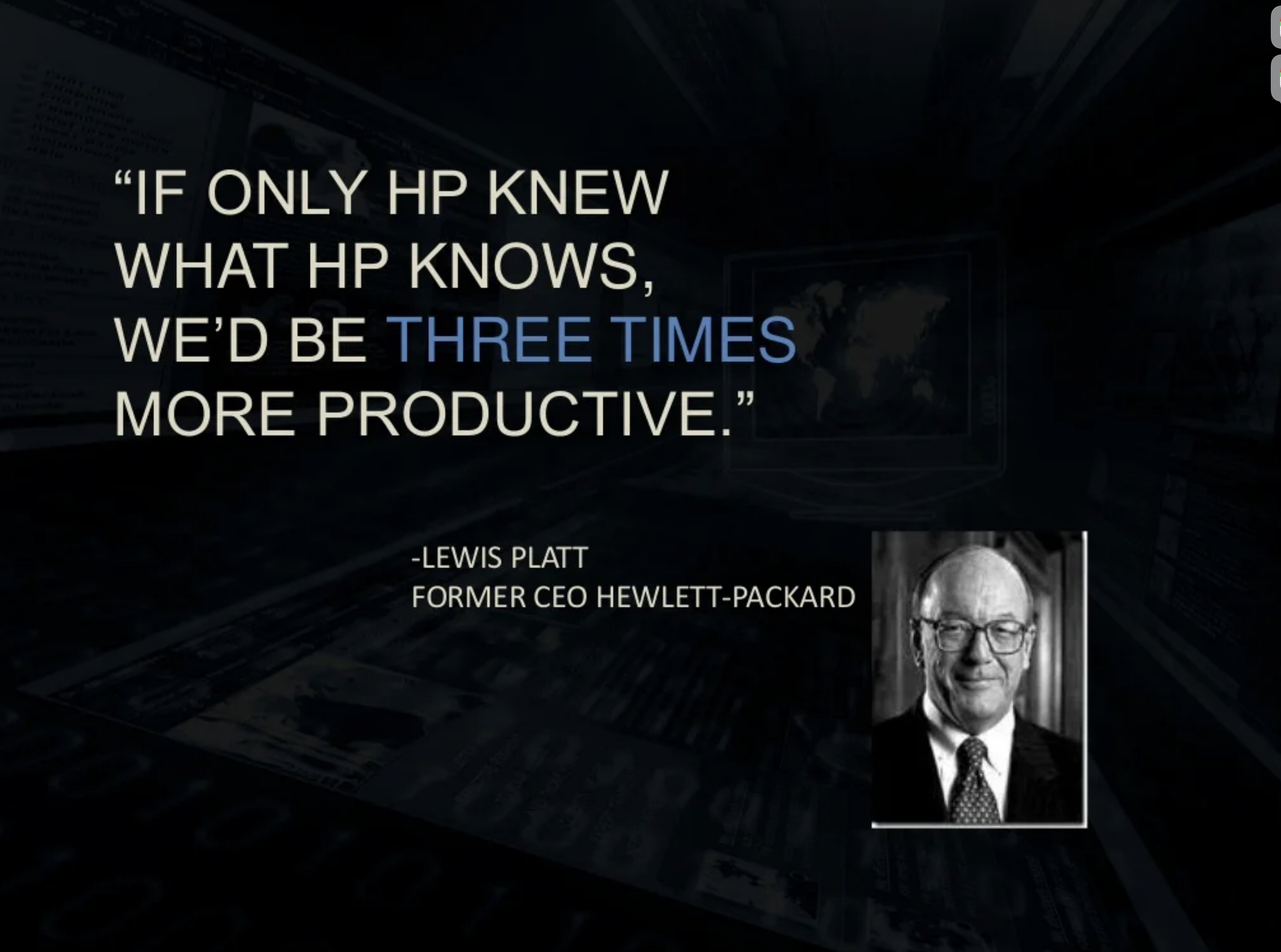
    In other words, a lot of vital know-how is locked up in pockets within the organization. It doesn’t reach either the training folks or the HR folks. So how are either universities or EdTech professional development companies supposed to serve an invisible need?

    A recent Forbes article entitled “Going From Learning Provision To Performance In L&D” suggests that “industry” isn’t much closer to solving this problem now that it was when I left.

    Here’s the first key passage:

    The problem is that many L&D leaders are choosing a slightly different approach to what’s always done. They’re looking to vendors with their silver-bullet solutions, and only now they’re searching for “smart” ways of matching generic content to the most commonly required skills across the entire workforce. On the surface, this might seem to make sense. With millions of items of learning content and only 50,000 employees, the algorithm will find something for everyone, right? That’s what we’ve bet the house on.

    Shouldn’t the same generic content sold to so many different organizations still work in your unique culture? I’m sorry to say it likely won’t since all organizational expectations are not the same. The lack of engagement from employees is a clue because they know it too. It’s not that they don’t know how to learn or they don’t like to learn online. It’s because their experience tells them that their valuable time spent “learning” might not equate to actual skills development.

    Going From Learning Provision To Performance In L&D

    This is the “Netflix of education” canard or, if you’re slightly older, the “smart playlist” fantasy.

    AI doesn’t make learning objects any more re-usable because, as I illustrated in that 2002 article, the key missing ingredient is context. One lesson on the same topic may not work in two different workplaces because the examples are wrong. Or because the content needs to be connected to the previous and subsequent bits of content in ways that help the learner make sense of what they’re being taught. As the Forbes article puts it,

    The crux of this is that L&D’s preoccupation with more and better “learning” is a dead end if it doesn’t fully incorporate the work context and what employees are trying to do. The development of a learning provision cannot predictably and reliably affect performance if it’s off-the-shelf or only loosely tailored to an organization’s culture. When put in the context of the skills gap, if solutions (programs or content) don’t reflect how the work is done in your organization then they can’t positively affect capability and performance.

    Going From Learning Provision To Performance In L&D

    So what’s the answer? Needs analysis? Nope:

    One of the stock-in-trade tools in L&D has been the learning needs analysis. This has helped L&D find out what training (or learning) is needed to further bolster the learning provision and determine how we spend our budgets. But it rarely relates to actual jobs: the very tasks, interactions, roles, expectations and outcomes employees are measured against. The learning needs analysis helps aggregate common needs so we can develop or purchase standardized programs and content that covers all bases without doing much analysis of the work context. The logic is: If we add more courses and buy big enough suites of generic content then there must be something for everybody, right? Surely? Except this doesn’t stand up to any level of scrutiny.

    Doing the course or completing the content does not mean reskilling. We know this, but we often ignore it. The big learning content vendors can give us the credits and produce certificates, but completion doesn’t mean competence. Not even close. It just means you were there.

    Going From Learning Provision To Performance In L&D

    This is essentially the same criticism leveled at higher education. The degree, the credential, the certification of completion doesn’t mean much even if the educational experience it represents is built to address a needs assessment conducted by trained professionals inside the company.

    A quick skim of this CLO Magazine article suggests that the Forbes author is right about the continuing blind spot. The author, who is the Senior Director of People Growth and Enterprise Skills Strategy at Warner Bros. Discovery, conducted a study of training interventions designed to take input from employees as well as how employees go about using the training resources at their disposal. The main conclusions, from my perspective, were (1) employees are more engaged in training if you ask them what they want, and (2) employees decide what training they need when they need it and will be as likely to go to YouTube as to that library of AI-curated content that the employer paid for.

    So what is the author’s answer? Performance analysis:

    Performance analysis means seeking the answers to questions that relate to what employees are expected to achieve and that they are not able to easily or effectively. What is actually being observed and what are the implications of things not working the way they should? Recognize those responsible for the work and the expected deliverables. Completely articulate how things should be working. L&D professionals have been too quick to interpret performance needs into learning needs and completely distort reality in order to develop courses. But an exploration of the way the work is done and the results expected will help us move from perpetual anxiety about our value and impact to actually affecting the way the work is done.

    Going From Learning Provision To Performance In L&D

    This is…the same idea we were advocating for (and failing to get traction on) twenty years ago. It’s hard. It’s labor-intensive. It requires specialized skills. And it constantly needs to be refreshed.

    Waiting for the next EdTech crash

    Right now, companies that sell libraries of training content are hot. I’m not saying these products are bad. I’m not saying they’re useless. I am saying that there is an element of faddishness contributing to their valuations and ability to raise capital. And I’m saying that the same tired solutions—either buying libraries of whole courses or buying libraries of lesson bits—are not going to become game changers just by sprinkling some AI fairy dust on them. You can’t fix a fundamentally limited approach to constructing effective learning experiences with a matching algorithm.

    There are ways to approach these difficult, thorny problems. We’re trying out several of them in my day job. But my main point for the purpose of this article is that there seems to be an assumption that building a workplace learning EdTech company is easier than in higher education. I will grant you that selling to corporations is less painful than selling to universities (though it is still very, very painful). But I think investors are going to discover the fads and crashes in the corporate space are not less dramatic than they have been in higher ed. Just because something is selling well now doesn’t mean that it is solving a real problem and will remain hot.

    If you want to develop lasting product/market fit with a learning product, regardless of the sector that it’s in, you’ll need to look deeper than the buying patterns of the moment. This is a complex space whose ongoing success cannot be predicted by purchases, initial usage, or even the first couple of years of repeat purchases. It takes a while to figure out if learning interventions are working, especially if you’re not studying their impact (which most organizations are not).

  • Zovio and Arizona Global: Is There a Less Obvious Trend Here?

    Zovio and Arizona Global: Is There a Less Obvious Trend Here?

    Inside Higher Ed’s Doug Lederman published an excellent early take on Arizona Global Campus acquiring Zovio. For those who have not been following along, this is an example of the kind of “pivoting”—more like “twisting in the wind”—that’s evolved out of the for-profit university space. Here’s the gist:

    • Way back in 2005, the non-profit University of the Prairies sold itself and its accreditation status to the for-profit company that eventually would be rebranded as “Zovio.”
    • That company got slammed for predatory recruitment practices and squeezed by the legislation that was triggered by such practices in the for-profit university sector.
    • In response, Zovio’s “Ashford University” converted back to a non-profit online college but used Zovio effectively as the OPM that provided the services.
    • That didn’t work either. So Zovio sold Ashford to the University of Arizona Global Campus while continuing to serve as the OPM.
    • The university came under heavy fire, both internally and externally, for depending so heavily on Zovio for critical services and the conflict of interest that relationship created.
    • So the University of Arizona Global Campus just bought Zovio, killed the company, and kept the people they needed.

    I have no idea whether the University of Arizona is making good decisions or not. I haven’t followed the details closely enough to have an informed opinion. But I do think there’s something interesting here about disintermediation and the potential reversal of the outsourcing trend.

    Finding a balance

    There’s been a bit of a pendulum swing in EdTech regarding university relationships with companies. On the one hand, there’s been a strong history of outsourcing. Universities let their professors publish textbooks with for-profit publishers, who turn around and sell those books to the university’s students. Pretty much every LMS on the market today started inside a university and got spun off as a private company. And the latest trend is universities outsourcing much of their machinery—from student recruitment to a big chunk of course and program design to student support to job placement—to OPMs.

    “Outsourcing” is often an oversimplistic or even a flat-out incorrect way of describing these relationships, but the basic gist is directionally correct. Universities decide that they are better off shifting critical functions of their business over to companies that they believe are better equipped to execute those functions efficiently and effectively. Sometimes these are great decisions, other times they are disastrous, and much of the time they are very mixed.

    Of course, for every action, there is an opposite (if not always equal) reaction. The dissatisfaction with the proprietary LMS companies led to a rash of open-source LMSs being developed (only one or two of which have sufficient adoption to have significant impact). There is the push for OER textbooks, which has slowly gained momentum but is still heavily dependent on grant funding for its survival and arguably has so far failed to live up to the promise of improving quality while having some impact on cost. OPMs have given rise to OPEs, which are fee-for-service shops that give more control and independence back to the universities (at the cost of financial support for launching new programs). And now we have this Zovio thing.

    Universities are not well designed to be agile. To the contrary, they evolved to resist change in many ways, both in their original Medieval form and in their modern multiversity incarnation. So it makes sense that they might need help from institutions that are designed to evolve more quickly in response to evolutionary pressures (like for-profit companies) in order to keep up with changing mission and sustainability demands. And it also makes sense that the evolutionary pressures that cause companies to change might create tension and misalignment with their university customers that grows over time.

    We’re at an odd moment in EdTech. When I look around, I see fewer companies than ever that are succeeding in making a beneficial impact, at least in higher ed. (Professional development is—finally—dynamic again, and K12 is…weird and hard for me to figure out given the amount of attention I’ve given to it.) And yet, I sense we’re on the verge of a change. Companies can be designed to facilitate the changes universities want and need to make. They can provide more efficient and effective services without losing alignment with the needs of their customers, including the need for control over their core mission. And universities, for their part, can become savvier at engaging in these sorts of public/private partnerships than they have generally shown so far. They can make good decisions that allow them to maintain control of their destiny and duty of care while getting the help they need to evolve and thrive as the needs of their students and our society evolve.

    I sensed the beginning of this change when I started the Empirical Educator Project and followed it when I co-founded Argos. It’s still pretty early in a process that will take decades. Maybe too early. There will be many failures. But I feel like something is in the air.

    I can’t say whether the Zovio acquisition will pan out or even whether it’s a good thing to try. But in the very broadest sense, I believe it is another harbinger of things to come. The pendulum has swung and what was non-profit has become non-profit once again. Will the journey return a more viable, more useful organization than the original failing non-profit college? I don’t know. But there’s a deeper, more interesting, and broader story here than a failing for-profit or a university groping for a way to achieve growth with integrity.

  • Coursera and 2U: MOOCs are Designed to Compete with Google AdWords.

    Coursera and 2U: MOOCs are Designed to Compete with Google AdWords.

    Coursera’s stock dropped by about 30% on Wednesday in after-hours trading after their earnings announcement. The reason for the drop and the company’s own analysis of its financial performance are both instructive. MOOCs are more or less explicitly considered to be useful primarily as marketing tools rather than educational experiences. There’s reason to believe this is a bad idea for their university partners even from a financial perspective, never mind from university brand value and mission perspectives.

    MOOCs are marketing tools

    Higher Education Dive’s analysis of the stock drop is fairly representative of the reason for the decline:

    Although Coursera reported overall revenue growth in 2022’s second quarter, revenue from the company’s degree segment declined 4% to $11.4 million, according to its latest earnings report.

    Coursera Reports Revenue Declines in its Degree Business

    This isn’t the whole story. The company missed analyst expectations for earnings growth and has guided lower on earnings growth going forward. But the conversation has focused on the degree program decline. Let’s look at what Coursera CEO Jeff Maggioncalda said about Coursera’s challenge in his own words during the company’s earnings call. Responding to an analyst question about problems in the “consumer” side of the business (which means degrees and certificates paid for by individuals rather than their employers), Maggioncalda said,

    On the Consumer side, it’s interesting because the professional surge are still performing really well, particularly in North America. In Europe, it’s kind of more of a conversion rate challenge. And so, like Ken said, maybe it’s the same kinds of effects. You asked about activity levels, I don’t think that we’re seeing any notable difference in activity levels. It seems to be an even a lot of top of the funnel seems to be similar between Europe and other regions. I will say that, generally speaking, search volume for online courses and online degrees.

    And this is not just on Coursera, which is general search volume is down. I think there’s sort of a bit of a the economy reopening and people doing things outside their house that we’re that we kind of see globally. And that probably is happening in Europe as well, but a lot of it sort of conversion rates on the Consumer segment in EMEA, and particularly Europe that we’re seeing.

    Coursera, Inc. (COUR) CEO Jeffrey Maggioncalda on Q2 2022 Results Earnings Call Transcript

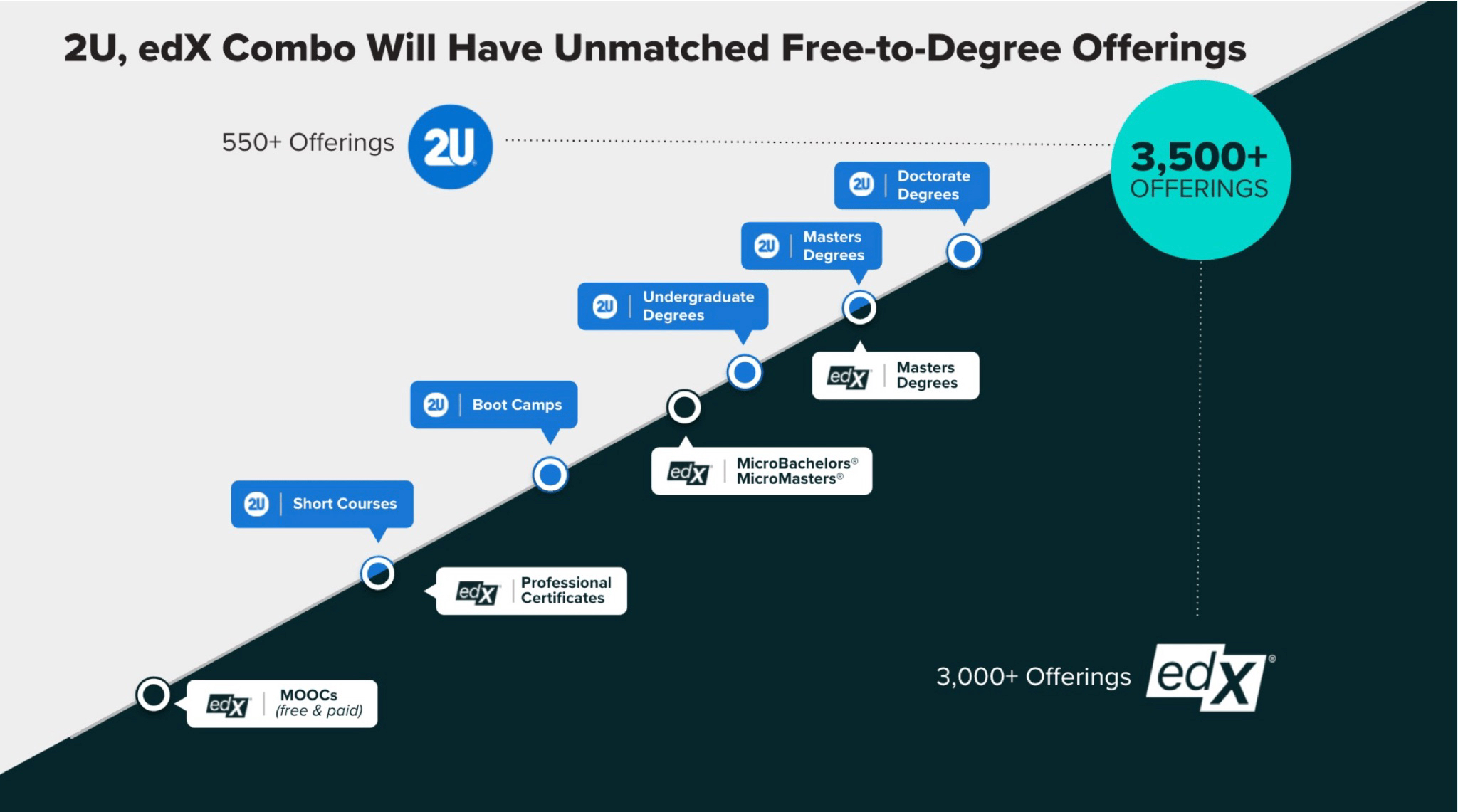
    The key phrases in this excerpt are “conversation rate,” “top of the funnel,” and “search volume.” These are marketing terms. Free MOOCs are at or near “top of the [sales] funnel.” They are designed to identify and attract paying degree candidates. Meanwhile, 2U CEO Chip Paucek said a month ago in his company’s earning call that “[m]arketing investment decisions will be made at the platform level, aggregated across business lines with the goal of increasing the lifetime value of each learner.” The “platform” he’s referring to is EdX. The “lifetime value of each learner” means 2U intends to use the EdX platform to get learners to pay for more courses.

    When 2U introduced its slogan “Free to Degree,” the company wasn’t describing their breadth of coverage. It was describing its sales funnel for getting students into paying degree programs.

    Free to Degree: Increasing the lifetime value of each learner.

    We can see this mindset at work on the micro-scale by looking at the MOOCs produced by Coursera co-founder Andrew Ng, who now has a company called DeepLearning.AI that sells certificate programs on Coursera. Try the AI for Everyone certificate program. Don’t worry; you won’t have to pay anything to try it.

    You’ll find it is a series of short, engaging, and mildly informative lecture videos by Andrew, each of which is followed by a quiz that anyone who was halfway paying attention could pass. This is absolutely terrible education. But that’s an unfair assessment. Because this “certificate program” isn’t really intended to be education.

    Andrew Ng is at least twice as smart as me and has all the money in the world to pay high-quality learning designers. If his certificate program is not worth paying for, then the most obvious explanation is that he doesn’t really expect you to pay for it. It’s not a certificate program. It’s an infomercial designed to convince you that you need to learn more about AI. It’s the “top of the funnel” designed to “convert” you into a paying customer so that DeepLearning.AI can increase the “lifetime value” of you as a (future) enrolled and paying student in the company’s more extensive (and expensive) programs.

    None of this is new but it’s oddly still news

    In 2019 Justin Reich, possibly the single most prolific and widely respected researcher on MOOCs, co-published an article called “The MOOC Pivot: From Teaching the World to Online Professional Degrees.” The article’s abstract states, “[A]fter promising a reordering of higher education, we see the field instead coalescing around a different, much older business model: helping universities outsource their online master’s degrees for professionals.” Reich’s book Failure to Disrupt is similarly blunt (and well worth reading). MOOCs have become advertising tools to attract students into more lucrative degree programs run by OPMs. As more degree programs have gone online (driven, in part, by the success of the OPMs themselves), the cost of advertising using relevant search keywords Google AdWords has gone up. Because demand for them has gone up.

    MOOCs are attempting to disrupt Google AdWords in education.

    University stakeholders know this. Sort of. If you search the internet for articles about the cost and revenues, you won’t find anything published more recently than about 2015. After the first few years, they just stopped talking about costs and revenues. That shift wasn’t random. And of course, everybody knows how bad MOOC completion rates are and how badly they’ve failed to demonstrate consistent educational effectiveness under rigorous testing.

    When I’ve asked folks I know who are directly or indirectly with MOOC programs at their universities why their institutions are still creating and maintaining these things, I typically get one of two answers. The first is that their bosses think it’s good marketing for the institutions despite the fact that they have data showing that YouTube videos work better. The second is that they frankly don’t know why they are still doing it.

    By extension, Coursera is now an OPM. If it weren’t, then its underperformance in its relatively new online degree unit wouldn’t cause such a precipitous plunge in its stock price.

    But it gets worse

    If MOOCs turned out to be infomercials and everybody understood that to be the case, that would be disappointing but not the end of the world. Some of us never expected them to be the magic bullet.

    The problem is that Coursera’s degree programs are also MOOC-based and 2U is making worrying (though admittedly cryptic) comments suggesting that they may be moving in that direction as well. I’ve seen no good data on MOOC-based degree completion rates. Or on MOOC-based degree efficacy. Or on the perceived value of MOOC-based degrees by employers. We do know how individual MOOCs perform on these measures: badly.

    The only difference I can see between a MOOC and a MOOC-based degree is that students will be paying significantly more for them. Will this make a difference? Eh, maybe a little. I once had a conversation with Andrew Ng and Daphne Koller about research indicating that students would more highly value and be more likely to complete a course that cost $1 than one that is free. Maybe cost will matter because students will be literally invested in their education.

    But that’s a thin reed on which to bet the future of billion-dollar companies, whose future is in turn paid for by students who are participating in an uncontrolled experiment that they are paying for. It seems more likely that if 2U joins Coursera on this path they may have to change their motto to “No Front Row.”

    I get that universities need to develop more sustainable business models. pumping up degree programs through MOOC marketing and then lowering the price of those degrees by delivering them as MOOCs strikes me as a particularly risky way to try to meet financial goals, even if they’re willing to play fast and loose with their mission goals and institutional brands.

  • Blursday with UCF’s Tom Cavanagh

    Blursday with UCF’s Tom Cavanagh

    Update: Due to summer vacations, we are in the process of rescheduling this (and other) Blursday sessions for August. Sorry, and stay tuned!

    We’re lucky this Blursday to be joined by Tom Cavanagh, University of Central Florida Vice President for Digital Learning. Tom has been building one of the great online and blended, evidence-based, faculty-friendly digital learning programs since before MIT and Stanford invented digital learning! He’s also the co-host of the TOPcast podcast.

    Tom has always straddled the worlds of pragmatism and innovation, always focusing on the practical while being unafraid to try something new. He’s a great person to chat with about the new abnormal.

    BYOB.

  • Web3: Still Don’t Know Why We’re Talking About It

    Web3: Still Don’t Know Why We’re Talking About It

    Bob Bodily was thoughtful enough to engage with me about my recent Web3 post, first on Twitter and then at more length on Medium.

    Bob is an internet friend. I don’t know him but I like him. I think he’s trying to do good work for a good cause. So one reason I’m responding to him in this post is to show my appreciation for his thoughtfulness and willingness to engage. Back in the early days of e-Literate, there used to be good dialogues about EdTech happening on the internet. I don’t see that anymore. So when somebody like Bob takes the time to have a real dialogue, I want to show respect for that.

    Unfortunately, I also have another motivator that conflicts with that collegial goal. For reasons that have absolutely nothing to do with Bob, I am fed up with the human obsession with easy answers to hard problems. More than usual, even. The amount of venture money pouring into EdTech for Web3, the Metaverse, and other silliness without any real understanding of it makes me retch. Just writing that last sentence made me throw up in my mouth a little.

    I’ve gotten a few questions about why I wrote my first post about Web3 in the first place. Is it an expansion of e-Literate‘s coverage? No, it isn’t. If I’m going to write about human failures it’s only fair that I acknowledge my own. Anger has always been a big driver for me on e-Literate. I have been often driven to write about a topic because something about it pisses me off.

    I tried to get control over that impulse. I really did. But it’s so satisfying. It’s my version of an easy answer. Turns out it’s a lot less effort and, honestly, a lot more remunerative to complain about the world than it is to change it. People like a good rant. It gives them something without asking for anything in return. My rants have gotten me praise. Heck, they’ve gotten me jobs. And they feel good.

    So I’m sorry, Bob Bodily. This is not going to be the response you deserve. I swear, it’s not you. It’s me.

    No use case

    On Twitter, I challenged Bob to give me a use case. What educational problem can I solve with Web3 that I can’t practically solve some other way? Bob never gave me one. A use case requires a specific class of user with a specific need. It keeps us honest by focusing on problems rather than solutions first.

    Unfortunately, the world is filled with solutions in search of problems. Take the Metaverse, for example. (Oops. Threw up in my mouth again.) I remember the craze around Second Life before it turned into a soft porn site for furries. Campuses spent large amounts of time and money building virtual classrooms, which were replicas of their actual classrooms so that students could put their virtual butts in virtual chairs and look around their classmates’ virtual heads at a virtual screen so that they could view actual PowerPoint slides. It was absurd. It deserved to die. And it did. Eventually. After enormous amounts of time and effort were poured into it.

    OK, so virtual reality technology has evolved quite a bit since then. What are universities doing now that we can all buy dorky headsets that make fake things seem so much more vivid? Why, they’re building digital twin campuses. Of course. That’s what we call “innovation.” I still don’t know how changing “VR” to “Metaverse” is going to help any particular set of educational users in any particular way.

    And why now? Because a rich jackass best known for undermining democracy in the United States decided that he could solve his reputational problem by rebranding his company to Meta and selling virtual clothing. All hail technological progress! Now those virtual heads you’ll have to look around will be wearing nice, expensive hats!

    Oops. The mouth again.

    (I did warn you.)

    If you’re going to tell me that some new technology has the potential to revolutionize education, please be specific. Because everything is bullshit until there are specifics.

    (I’m really, really sorry Bob. It’s not your fault. I swear.)

    Affordances

    OK, if we don’t have a use case, then what do we have? Affordances. Things that the tech supposedly offers that have some utility that could be applied to some use case. What affordances does Web3 have? Let’s run down Bob’s list:

    Security

    Blockchain, the heart of Web3, is supposed to be incredibly secure. You can’t hack it, and if you did, everybody would know immediately. It has an iron-clad audit trail.

    Except that Web3 projects have lost more than $2 billion to hacks this year. So far. Halfway through the year.

    It turns out that the biggest weakness in security is the humans. Stupid humans who forget to set a password, leading to the hacking of one billion identities. Or who click on links in texts like the one I got just the other day claiming to be from Amazon checking on a potential fraudulent purchase. Where the link, written in plain text, goes to a domain that is not Amazon.com.

    Until we have blockchain for monkey brains, I’m not buying the security argument.

    Decentralization

    Nobody likes for the fate of education to be in the hands of jackass billionaires who want to show everybody how big their rockets are and are going to save the climate by emitting massive amounts of methane in order to launch William Shatner into space. Honestly people, that’s where we are. So I’m sympathetic to the desire to get away from this state of affairs.

    Unfortunately, I see two reasons to be skeptical that Web3 will save us from this predicament. First, decentralization has been around for a long time. Tor and Napster were around in the 1990s. What were they most popularly used for? Sharing pirated music and porn. Peer-to-peer just means that the monkeys can talk to each other without a monkey in the middle. It doesn’t mean that they’ll be smarter monkeys. And second, people who know more about Web3 tech than I do worry that it is not, in fact, decentralized.

    I can think of legitimate and important uses of decentralization technology. We could give students control over their own data, for example. We can do that using Solid, which is not a Web3 technology. But the very idea gives universities the hives.

    The hardest problem preventing us from giving students control over their data is convincing the people who have control over it now that they should give it up. If you tell people that you can create a solution that convinces people to act differently, they won’t believe you. If you tell people you have a new magic technology that will solve “privacy,” they will.

    Simpler developer experience

    Meh.

    Being able to spend more time on features that matter and less time on essential but uninteresting infrastructure is valuable if and only if you know which features matter and why. If Web3 could solve that problem I’d be on board.

    Token economy

    We already have an economic token. It’s called “money.” Ever since we went off the gold standard, we have lived in a token economy.

    Beyond that, I need a use case. Explain to me, specifically, how a Web3 token economy changes things. Who is paying for what? Why are they doing that? Why are tokens easier than money? Why is this different and better than Kickstarter?

    I do not understand.

    Open Standards/Open APIs

    I have participated in standards committees. I have been a paid consultant on efforts to kick-start standards efforts. The problem is never the technology.

    It’s. The. Humans.

    I have attended multiple hours-long sessions on how to properly represent a person’s name in a standard. I am not kidding. To be fair, it’s a much harder problem than you would think. But not nearly as hard as the humans made it.

    Sorry, I’m not buying the interoperability thing yet. Give me specifics, please.

    Permanent data storage

    I have permanent data storage. It’s called AWS. It will last until our society collapses (which, to be fair, Jeff Bezos is speeding along a bit by putting massive amounts of methane into the atmosphere in order to launch William Shatner into space).

    The major reason links break is that humans stop maintaining them or paying for them to be hosted.

    I still don’t get it

    Maybe that should have been my entire post. One sentence. “I still don’t get it.”

    But I guess I don’t have to. While many of us are genuinely trying hard to solve human problems, our monkey brains keep gravitating toward technology-first solutions. Hacking human behavior at scale is too hard to think about, much less to actually try to accomplish.

    So I’m pivoting. My new startup is going to revolutionize education by using Web3 in the Metaverse. I’m going to build simulated solutions to educational problems. You have to wear a goofy headset to see them, but your avatar will look spiffy. I’ll free you from the tyranny of big corporations (except mine, of course) through the magic of Web3. And by magic, I mean sleight-of-hand. Pay no attention to the virtual man behind the virtual curtain.

    I’m taking investments now. Hard cash only, please. No cryptocurrency. That crap’s a pyramid scheme.

    (Also, I’m really, really sorry, Bob Bodily. You didn’t deserve this.)

  • New Argos Post on Optimizing for Educator Effectiveness

    New Argos Post on Optimizing for Educator Effectiveness

    The phrase “empowering educators” is a cliché that usually doesn’t mean much. We could use the language of business—as I have—to describe educators as knowledge workers and think about optimizing their workflows to reduce the amount of time they spend on low-value tasks and increase their opportunities to apply their expert judgment to high-value tasks. That formulation provides a more specific, testable, and potentially impactful description at the risk of turning off a lot of educators with the language. Having been both a classroom educator and a corporate knowledge worker myself, I believe these are two sides of the same coin. In my most recent post on the Argos blog (following my post that introduces what will be a four-post arc), I explore this topic with some concrete examples.

    If I weren’t co-founder of Argos, I would be publishing these posts here on e-Literate. Argos, for me, is an effort to actually bring into the world some of the ideas that I’ve advocated for here on this blog for the better part of two decades. It’s an attempt to apply everything that my co-founder and I have learned about the barriers to change to make a real and lasting impact on education. Which is all I’ve ever wanted, professionally. I never had any inherent desire to run—or even work in—a start-up. It just turned out to be the best vehicle we could find for accomplishing something as important as it is hard to pull off. That said, because I am the co-founder of Argos, a commercial venture, I will maintain some separation between e-Literate, EEP, and Argos even as I try to keep all the plates spinning and bring these efforts together when doing so will further the mission.

    Relatedly, I won’t be announcing Argos posts here on e-Literate for much longer. I want to get back to writing posts here while maintaining an appropriate level of separation. My current plan is to stop announcing my Argos posts here at the end of July. So if you like what you’re reading over there, please subscribe to that blog.

    Read “Engagement and Faculty Workflows.”

  • New Post About the Blended Future of College on the Argos Blog

    New Post About the Blended Future of College on the Argos Blog

    As we try to make sense of changing student enrollment numbers post-COVID and think about what “quality education” means in a pervasively blended education, part of that work requires us to think about “data” the way we would think about our senses and sense-making in a face-to-face class. My new post on the Argos website describes one way the platform enables our educator/publishers to do that and provides some eye-opening early data about how well that strategy is working.