
e-Literate

Present is Prologue

Author: O’Neal Spicer

  • Lost in Translation: Why it’s important to consult the original research

    Lost in Translation: Why it’s important to consult the original research

    Last week the Brookings Institute published an article in its Economic Studies: Evidence Speaks series titled “Promises and pitfalls in online learning,” by Eric Bettinger and Susanna Loeb of Stanford University. The article is a condensed summary of a lengthier draft research paper, “Changing Distributions: How Online College Classes Alter Student and Professor Performance” that was supported by the Stanford Center for Education and Policy Analysis (CEPA) and includes two additional authors, Lindsay Fox (Stanford) and Eric Taylor (Harvard). The Brookings’ article was first reported by Inside Higher Ed earlier this week in a piece called “Is Online Ed Missing the Mark?”

    I note the cascading levels of publication to draw attention to the occasional pitfalls of relying on reporting and journal summaries and the benefits of reading the original research. It reminds me a little bit of the time I spent working for a school board member in the L.A. Unified School District. An article would sometimes appear in a local paper, and what was reported would have little to do with the reality of what was actually being covered, or at least miss a lot of the complexity (that said, there was excellent reporting as well).

    (more…)

  • Recommended Reading: Ballmer group publishes “Annual Report” on government spending

    Recommended Reading: Ballmer group publishes “Annual Report” on government spending

    A few years ago Steve Ballmer, former Microsoft CEO and current president of the LA Clippers, formed a group called USAFacts. Their goal was to collect comprehensive data on how tax revenues (federal, state and local) are spent in the U.S. Their initial publication, structured like a company’s Annual Report is being released today.

    It should be required reading for anyone entering public office. It should also be consulted by anyone interested in how their tax dollars are being spent and more generally in how government works.

    That includes those of us who work in the education field. There is a detailed information in the “Annual Report” on financial aid disbursements (p. 28), educational attainment levels broken down by various cohorts (p. 39),  the size of the public education workforce – 10,979,260, or 47% of all government employees, of which 29% relate to higher education (p. 50), educational property assets (p. 57), fiscal year education spending comparisons (p. 80) and additional analysis of college enrollment and completion by income level and other attributes.

    (more…)

  • Recommended Reading: Signs of Restraint in the Analytics Hype Machine

    Recommended Reading: Signs of Restraint in the Analytics Hype Machine

    Mike Sharkey’s recent post on the Blackboard blog site, “Analytics isn’t a thing,” triggered by an epiphany he had while reading the latest NMC Horizon Report, suggests that we might finally be seeing a maturation in the much-hyped analytics space. Rather than viewing analytics as a product category in and of itself, Mike concludes that the market is finally embracing analytics as a tool that can help solve discrete problems in specific situations. He writes:

    “My point is that we shouldn’t be “selling analytics” and customers shouldn’t be looking to “buy analytics.” Analytics isn’t a thing. Analytics help solve problems like retention, student success, operational efficiency, or engagement.”

    (more…)

  • Recommended Reading: Realistic Hopes for a Genuine Science of Learning

    Recommended Reading: Realistic Hopes for a Genuine Science of Learning

    Keith Devlin is a professor of mathematics at Stanford who has taken a keen interest in mathematics education. He is particularly interested in how people learn and what constitutes effective teaching. As a side note, e-Literate interviewed Keith as part of the MOOC Research Initiative in 2013. ((Disclosure: Our e-Literate TV series of video case studies and explainer videos is funded by a grant from the Bill & Melinda Gates Foundation.)) In his response to a question posed by the Edge last year, “2016: What do you consider the most interesting (recent) scientific news? What makes it important?”, Devlin argues that learning researchers are in the early, but momentous, stages of establishing a genuine science of learning. What has made this possible now is the application new research techniques enabled by the internet and online learning technologies:

    “The problem that has traditionally beset learning research has been its essential dependence on the individual teacher, which makes it near impossible to run the kinds of large scale, control group, intervention studies that are par-for-the-course in medicine. Classroom studies invariably end up as studies of the teacher as much as of the students, and often measure the effect of the students’ home environment rather than what goes on in the classroom.”

    (more…)

  • Recommended Reading: A Digital Chief from Publishing Talks Anonymously

    Recommended Reading: A Digital Chief from Publishing Talks Anonymously

    A recently published article in Digiday provides an insider view of ongoing tensions that are still playing out in the world of publishing. The interviewee speaks to the challenges of running two parallel businesses, one that’s in decline but still generating cash, another that is growing but requiring significant investment, and the internal conflicts that are inherent to that dichotomy.

    “It creates a real clash because of how these competing business models play out on a daily basis. Everything from salary disparities to space or resource allocation. If you’re throwing resources at a problem to make it move faster — that generates huge resentment from people whose resources are being chopped to slow losses. It creates a “them and us” situation which isn’t helpful.”

    In the educational publishing sector, most publishers recognized the need to transition to digital several years ago. That recognition, however, doesn’t make it so overnight. It’s a difficult slog, fraught with strategic, operational and human challenges.

  • Recommended Reading: What Do Faculty Really Think of Online Learning?

    …As it turns out, it depends.

    Inside Higher Ed recently published its fifth annual  Survey of Faculty Attitudes Toward Technology, conducted in collaboration with researchers from Gallup. These reports cover a range of attitudinal questions on ed tech, online education, and new models of delivering course content. One of the key findings of this year’s report, as described in a Gallup blog,  is that there is still a high level of disagreement among faculty of the relative merits of online courses versus traditional face to face courses, but there are some important nuances to the results. The survey finds that a majority of faculty (55%) “disagree or strongly disagree” with the idea that online courses can deliver the same student outcomes that in-person courses produce. Among faculty who have actually taught online, however, there is a much more positive view of the ability for online education to match in-person courses. (more…)

  • Recommended Reading: Times Higher Education (THE) Reports on Student Views of Blended Learning

    Recommended Reading: Times Higher Education (THE) Reports on Student Views of Blended Learning

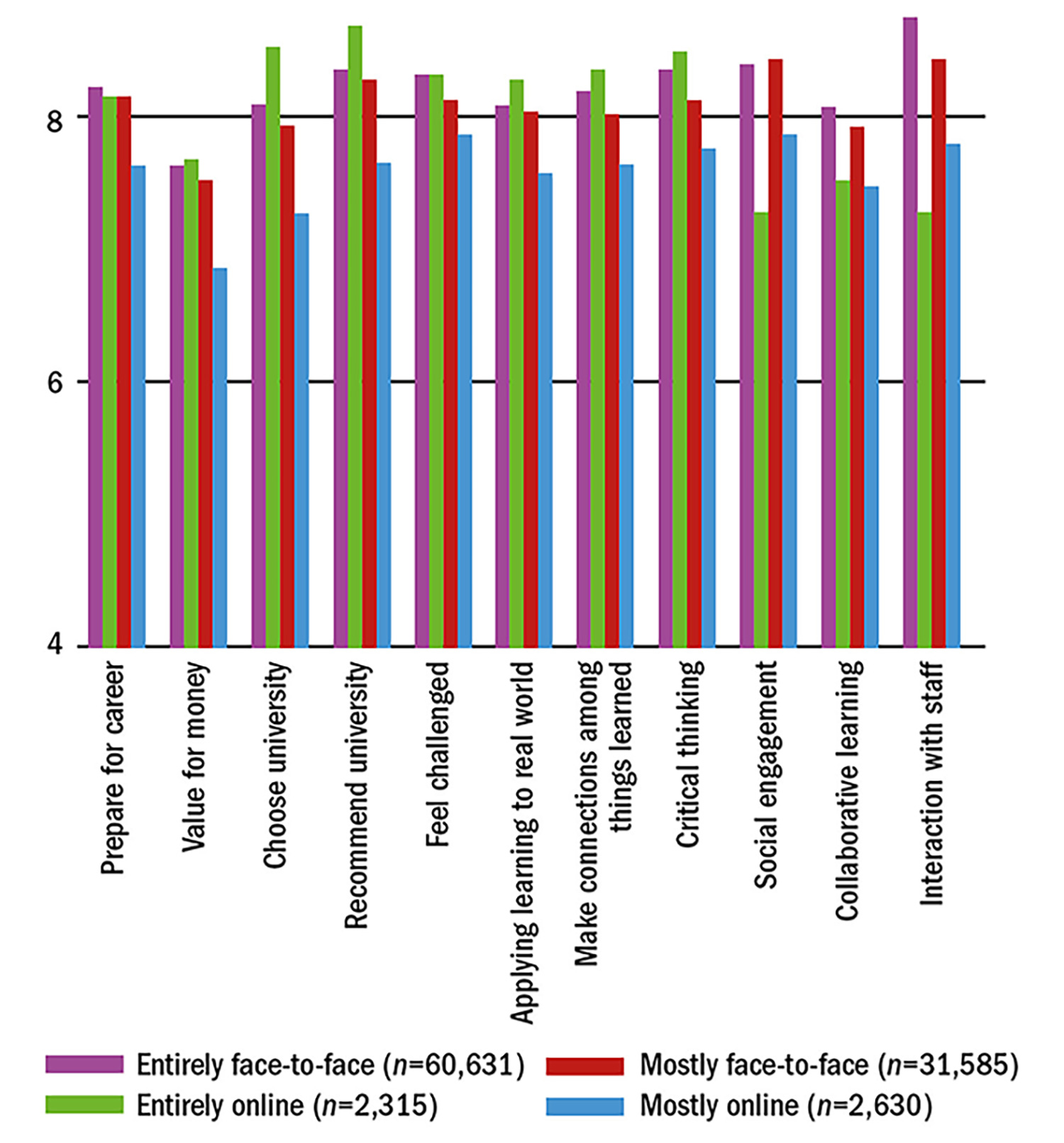
    Citing in-house research that surveyed over 100,000 students in the United States, THE reported late last week (see article) that students in exclusively face to face courses and students in exclusively online courses tended to give higher marks to their programs than those students taking blended courses that combine face to face learning with online learning. The report suggests that there is something about the design, implementation or execution of blended learning that is leading to lower overall satisfaction among students across several metrics that were tracked. For those universities pursuing some form of blended learning, and the list is growing every day, the THE report provides a launching point for new conversations around what is working and what isn’t working on their campuses.

    Blended learning is in its early stages and measurement and analysis are key factors that can drive improvement. As Mike Sharples, chair in educational technology at the UK’s Open University states in the article, “…the survey results do not show that ‘blended learning is a failure,’ but either that universities do not yet know ‘how to blend properly’ or that ‘there is a difference between what students say they like and what they do better at.” More data is needed, but this is an important conversation to be having.

    Snapshot of data from THE article.
    Snapshot of data from THE article.