
e-Literate

Present is Prologue

Author: Phil Hill

  • The Need for Alternative Educational Models in California Illustrated in One Chart

    An earlier version of this article appeared at the Delta Initiative website

    There is a full-court press in the media regarding the California budget crisis and its likely impact on higher education. The most recent entry is in the New York Times.

    Class sizes have increased, courses have been cut and tuition has been raised — repeatedly. Fewer colleges are offering summer classes. Administrators rely increasingly on higher tuition from out-of-staters. And there are signs it could get worse: If a tax increase proposed by Gov. Jerry Brown is not approved this year, officials say they will be forced to consider draconian cuts like eliminating entire schools or programs.

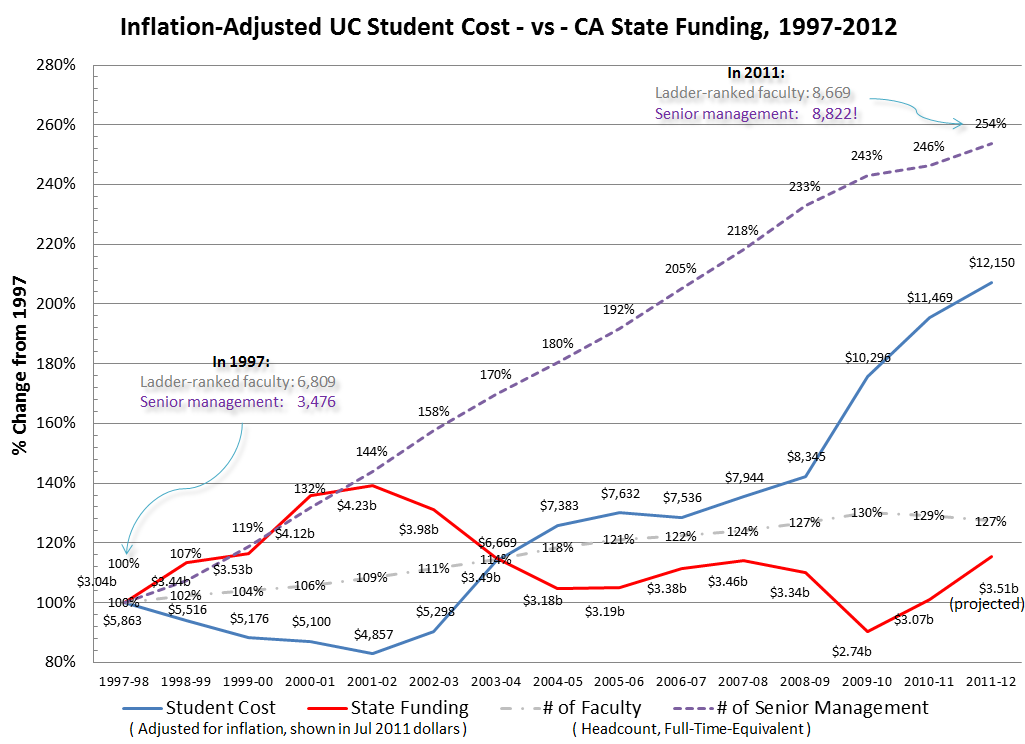
    While I’m not arguing the point that there is a crisis, I do think it is worth looking at historical trends to get perspective. Consider the following chart from the California Review (blog post here). It looks at inflation-adjusted budget numbers and faculty and senior management headcount from 1997 – 2011. [Click to expand]
    (more…)

  • Piazza – An Example of Free Learning Tool Targeted at Faculty / Student Adoption

    In my recent webcast with Patrick Masson for WCET, we described the growing usage of learning tools outside the official LMS solution. Patrick described survey results done by UMassOnline that captured the rich source of (often free) learning tools used in UMass courses. Much of educational technology is moving from an enterprise LMS market – with feature-rich LMS solutions expected to provide the majority of learning tools – to a learning platform market – with interoperable tools patched together with or without the official LMS by either campus staff or even directly by faculty. These tools are quite often free, and as such they are targeted at faculty and student adoption, rather than institutional adoption via a Request for Proposal process.

    One example of these tools is Piazza, which is a “a place where students can come together to ask, answer, and explore under the guidance of their instructor”. Think of the tool as an combination of discussion board, chat room, and wiki, with some design elements from Google Wave. While the description might be hard to understand, that is part of the issue – Piazza is not targeted to replace the LMS or to replicate specific LMS functionality.

    Jessica Wong at MakingUseOf has a very useful post running through the functionality of Piazza for those interested in the tool itself. My interest for this post is more on what Piazza represents in terms of ed tech trends with the availability of free platforms and tools that are targeted at student and faculty adoption.

    (more…)

  • The Search for Differentiated and Engaging Student Experience

    One of the trends I highlighted last summer was that the LMS or learning platform market was overlapping the educational content market.

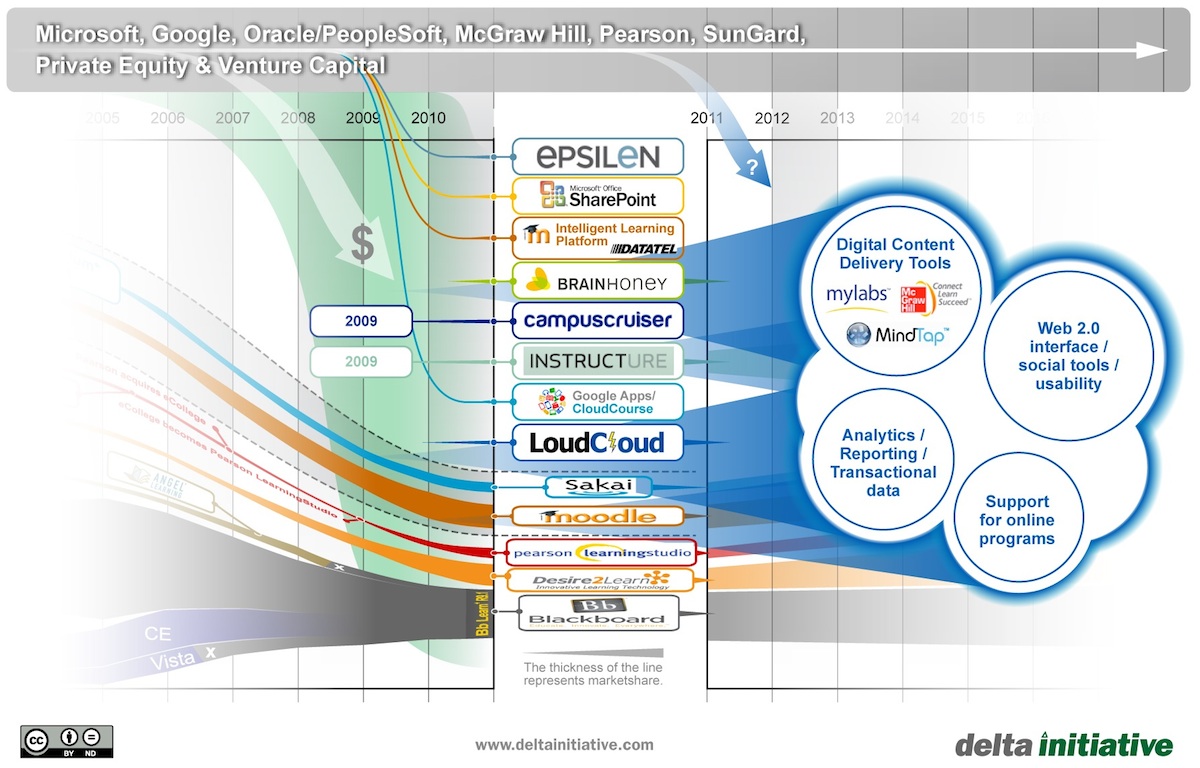
    The lines are blurring between content delivery systems (e.g. Cengage MindTap, Pearson MyLabs, etc) and LMS.  Content delivery and ability to keep students engaged within the content will drive much of the broader ed tech market.  This integration of markets is being seen as a strategically important issue for institutions, particularly for online programs.

    While I feel quite confident in having made that description, I did not have a model, or explanation, of what was driving the trend. Nine months later, I believe the trend has proven itself empirically, as more examples emerge: Apples iBooks2 / iTunesU App, Online Education Service Providers such as 2tor combining online programs with custom learning platforms, Pearson OpenClass, MOOC startups with custom platforms such Coursera, Udacity, etc.

    Last week Roger McNamee, co-founder and managing director with venture capital firm Elevation Partners, gave a presentation to the Mashable Connect conference titled “How to Revive the Web”. The presentation described how Apple won big by betting against the web and its prevailing culture (Mashable post here and Roger’s full presentation here). Roger’s theory is that Apple’s strategy was to move away from commoditized content, which most of the PC-based web (HTML4) assumed,  by delivering content in a differentiated, elegant manner – tightly combining content and the delivery mechanism. Furthermore, as HTML5 emerges, this move will accelerate.

    If this theory is correct, I think it helps explain the trend of the LMS market combining and blurring with the educational content market.

    (more…)

  • What is a Learning Platform?

    While I have written (along with others) about the shift we are seeing in the LMS market, where it is moving from an enterprise LMS market to a learning platform market, there has not really been a good definition of what a learning platform is. As Jeff Bohrer asked via Twitter, “What are the hallmarks of LMS as a “learning platform” (beyond SaaS)? Any posts you can point to?” Mike Zackrison offer some very helpful thoughts in his response of “A few I’ve observed: cloud, multi-tenant; open API; social, analytics, mobile baked in; apps/content discovery too”.

    Rather than reply within the limits of 140 characters, I’d like to offer a response here (I have trouble with being pithy).

    Platform Definitions

    First, let’s look at the metaphor. A platform is typically defined in the generic sense as a raised surface of some type that supports other interacting objects. Within computer and software terminology, a platform can be defined as “A platform is any base of technologies on which other technologies or processes are built”. The idea is that the platform is not intended to stand on its own, as its definition includes the support of other technologies or applications.

    Given this context, there is a rather extensive Wikipedia entry on learning platforms with some useful definitions included. I have excerpted several below.

    A learning platform is an integrated set of interactive online services that provide teachers, learners, parents and others involved in education with information, tools and resources to support and enhance educational delivery and management.

    (more…)

  • Upcoming WCET Webcast: “Why the RFP Process Doesn’t Work in Today’s LMS Market”

    I have written several articles (posted here at e-Literate, here at the Delta Initiative website, and as a guest post at WCET) about the significant changes that the LMS market is undergoing, moving from an enterprise-class, mini-ERP, system to a learning platform. The folks at WCET provide a great set of resources for the higher ed community, and the asked me to set up a webcast on the subject, to allow a more interactive discussion. As part of this webcast, I will be joined by Patrick Masson, Chief Technology Officer at UMassOnline. Patrick and his team have created a Needs Identification Framework for Technology Innovation (NIFTI) that is a much more robust approach to technology selection and innovation that the standard RFP process.

    The webcast is scheduled for May 22. You can go to the WCET site here for more information or to register.

    From the description:

    (more…)

  • MOOCs: Two Different Approaches to Scale, Access and Experimentation

    In part 1 of this series, I described a new landscape of educational delivery models. In part 2 I described the master course concept and how it presents a cultural barrier that most traditional institutions cannot cross, at least without a dedicated online organization or an outsourced partnership.

    Why does it matter that we describe these educational delivery models with finer granularity than just traditional and online? Because the aims of the models differ, as do the primary methods of how these models are created and delivered.

    With all of the recent interest in Massive Open Online Courses (MOOCs), it would be worth summarizing the two branches of MOOCs including recent posts or interviews by the founders of the concept.

    Scale and Access

    In most online programs, at least those with more than few thousand students, the delivery method of this scale is the duplication of course sections in the manner of tract housing (for a better description, see part 2). But are there other methods to achieve scale (and therefore access) without duplicating sections? MOOCs represent an alternate approach where the actual course itself provides scale, allowing essentially unlimited enrollment in the single course section in the manner of a large apartment building.

    (more…)

  • Summary of Statements by Key Players in Blackboard Announcement, Including Competitors

    Given all the news and discussion surrounding Blackboard’s strategy change last week, I thought that it would be useful to collect the public statements from Blackboard and their competitors in one place. No analysis, no interviews, just statements. I have a feeling that this might provide a rich source of analysis 6 – 12 months from now.

    Blackboard Official Announcements

    On March 26th, Blackboard made four simultaneous announcements through press release. They also released two additional press releases based on these four announcements.

    Blackboard / Moodlerooms / NetSpot / Moodle / Severance Key Blogs and Interviews

    Subsequently, several of the key players in the Blackboard announcements made statements through their own blogs or through media interviews. (more…)