
e-Literate

Present is Prologue

Author: Phil Hill

  • 3 Surprising LMS Market Observations

    This is a guest post by Phil Hill from Delta Initiative, follow on Twitter  @PhilOnEdTech or his blog

    In a recent post, I argued that Blackboard is most likely losing at least 150 clients per year in their LMS core business.  This is part of my larger argument that the LMS market is changing significantly.

    The reason for focusing on these subjects is that Blackboard’s prospects are having and will have a major impact on the overall LMS and educational technology market, affecting educational customers as well as technology vendors and their investors.  If you misread Blackboard’s strategic direction, you might misread the upcoming changes in the educational technology market.

    [snip] Looking at the 3 different sets of public data, the conclusion I have is that Blackboard is losing more than 150 total LMS clients per year, and probably closer to 250.  This decline in market share is significant enough to affect the overall LMS and educational technology market – it is driving many competitors into a land grab mentality to acquire as many of these ex-Blackboard clients as possible.  Furthermore, the decline of the Blackboard business model in terms of LMS market share is allowing new LMS models to emerge.  All of these conclusions hold even if Blackboard has been able to achieve stable or increasing profits from their LMS customers.

    Let’s look at some of the other LMS competitors.  Surely if the market is changing as much as I’m arguing, then there must be some real evidence in terms of companies picking up LMS clients.

    While doing additional LMS market research I discovered three surprising facts about the LMS market. (more…)
  • SunGard HE and Blackboard Acquisitions: Compare and Contrast

    UPDATE:  In the section on ‘Cash Cow vs. Growth Potential’, my choice of words could have caused misunderstanding.  I did not mean to equate Operating Income with Cash Flow, and my choice of the word ‘cash’ in this section should really have been ‘income’, as my analysis was obviously based on Operating Income.  I have made this correction below.  My apologies for any misunderstanding.

    Consider the recent news this summer that private equity firms have agreed to acquire both SunGard Higher Education (SGHE) and Blackboard in separate deals:

    • Two market leaders in technology solutions for education,
    • both generating revenues of several hundred million dollars per year,
    • both business strategies at risk due to eroding market share in their core business since 2007,
    • both facing challenges to integrate product lines and offer a clear road map for customers,
    • and both sold to private equity firms for more than $1.6B.

    SunGard Higher Education (SGHE) and Blackboard – brothers in arms.

    At first glance, there are some strong similarities between the acquisition perspectives of both market leaders, but if you look deeper, the differences provide a good insight into the future of technology markets for higher education.  These differences can explain why the ERP market seems to be consolidating with fewer choices while the LMS and educational technology market seems to be expanding with more choices.

    Cash Cow Income Machine vs. Growth Potential

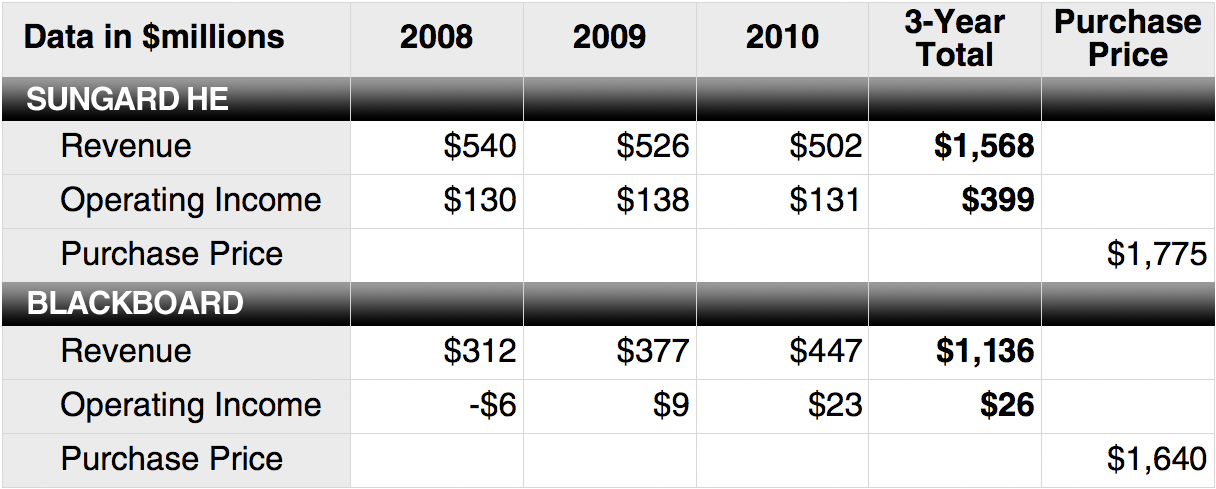
    During research for this post, I was surprised to find out how much cash income that SGHE generates and how close Blackboard has come to SGHE’s revenue numbers.  While Blackboard has seen its revenue increase due to corporate acquisitions of its own, it has only had a combined operating income of $26M over the past 3 years.  In that same time, SGHE has seen its revenue decrease by almost 10%, but it has had a combined operating income of $399M.

    It is somewhat difficult to compare the financials of the two companies, as they employ different accounting methods, so use the following table to see the big picture rather than the details.  I have attempted to show total revenue (numbers are fairly solid) and operating income (not as solid), while ignoring provisions for income taxes.  This data is based on SunGard’s annual report for 2010 (p. 36 as printed) and Blackboard’s annual report for 2010 (p. 26 as printed).

    (more…)

  • Emerging Trends in LMS / Ed Tech Market

    This is a guest post by Phil Hill.  Phil Hill is executive vice president of Delta Initiative and has been consulting in educational technology for over 8 years, with a strong focus on the LMS market.  He is also the founder of HBO Systems, which merged operations with Delta Initiative in 2008.  Phil is known to many in the educational technology community for some info graphics that help people see the broader trends and issues with the technology markets.  You can follow Phil on Twitter at @PhilOnEdTech or on his main blog at http://www.deltainitiative.com/index.php/phils-blog.

    I have argued in previous blog posts on the Blackboard acquisition that their position of being a safe bet is now gone, they are picking up only a handful of new LMS clients, while they are losing hundreds of LMS clients per year.  The theme behind these observations is that Blackboard’s future prospects “are having and will have a major impact on the overall LMS and educational technology market, affecting educational customers as well as technology vendors and their investors.  If you misread Blackboard’s strategic direction, you might misread the upcoming changes in the educational technology market.”

    Put another way, as Lou Pugliese commented in a post by Michael Feldstein on the LMS Market

    Typical disruptive markets (Clay Christiansen) are repeatable events exist where (a) over-served customers consume a product or service but don’t need all its features or functionality (b) there is broad based industry concern about the effective use of overly complex, expensive products and services (c) features that are not valued and therefore are not used and (d) decreasing price premiums for innovations that historically created value but in the current market are now irrelevant. The street will eventually see it this way no matter how you NPV a business’s customer base. . . . I would argue that there is an exact parallel here and the education market is not immune to the same disruption experienced in other markets.

    What I believe we are seeing in 2011 is a transition to a market no longer dominated by Blackboard and other players’ reactions to Blackboard.  This new market that is emerging will look quite different from the market we have seen for the past 6 – 8 years, and we should no longer view this as an evolving market, but instead view it as a market being disrupted, with new competitors and new dynamics.

    (more…)