e-Literate

Present is Prologue

Author: Phil Hill

  • Ambivalent on Ed Tech: The EDUCAUSE Re-write

    Now that I’ve had time to digest the implications of EDUCAUSE 2011 – which were significant, but not as mind-blowing as the Reading Market experience – I keep going back to a post I wrote earlier this year (although not on e-Literate).  In that post contrasting a Gartner report on IT spending with an Ambient Insight report on ed tech and online spending, I argued that ambivalence was the key to understanding both reports in context.  Likewise, based on the hype and reality of ed tech at EDUCAUSE, ambivalence can help us understand future implications for education.

    One of the benefits of blog posting is the ability to wholesale plagiarize yourself where needed (ed – I’ll see you in court, Mr. Hill).  Herewith is my rewrite of that post based on this year’s EDUCAUSE experience.

    (more…)

  • Pearson OpenClass: Judge It As Disruption, Not As Status Quo

    If the mantra of ‘any news is good news’ is accurate, then you’ve got to hand it to Pearson and their OpenClass announcement for dominating the public discussions leading into Educause – Inside Higher Ed, the Chronicle, Campus Technology, countless blog entries – and even NPR Marketplace – all since Thursday.  That’s quite a bit of press for a new, free LMS for higher ed.  I’ve been late to the game in posting on OpenClass, so I’ll dispense with any overview of the news.  I find it interesting to observe how the public discussions frame the issue.  It seems that quite a few discussions are trying to put OpenClass into the comfortable box of today’s LMS model, but some are starting to see the potential disruptive nature of the new service.

    There is some healthy skepticism out there, probably best described by Audrey Watters, Joshua Kim and Music for Deckchairs.  I agree that we should not be convinced of the value of the service before we see more content and description of the service, are allowed to test out a course, and understand whether Pearson’s long-term business interests will support a free and open platform.  We should especially watch for whether the service remains free without hidden catches and whether it truly is content neutral.  Healthy skepticism should be the default mode for any unproven ed tech announcement.

    OpenClass as Disruption

    What I think is important to watch, however, is not whether OpenClass ends up being a free version of today’s LMS, but instead whether OpenClass can change the rules of the LMS game and move the market to a new model of learning platform. (more…)

  • Analysis of Blackboard Response to Recent Disclosure of Security Vulnerabilities

    There’s been an interesting set of public relations based on the recent news of Blackboard security vulnerabilities.  SC Magazine’s Australian edition broke a story on September 16 about an investigation by two or more anonymous Australian universities working with a security firm, Securus Global.  In conjunction with the magazine, this investigation exposed a number of security vulnerabilities with Blackboard Learn 8.0, 9.0 and 9.1 (the mainline legacy LMS from Blackboard, but not the WebCT or ANGEL acquired LMS product lines).  Blackboard has confirmed the majority of the issues are valid and issued a security advisory on September 16, subsequently updated on September 22.

    That is where the agreements stop, however.  Blackboard took issue with the tone of the article in a blog post from September 23, subsequently updated on September 27.  Blackboard disputes the assertions that they were not responsive to customer requests, and further, they are trying to downplay the significance of the vulnerabilities. (more…)

  • Breaking Up the LMS: K-12 District Selects Part of LoudCloud Systems’ LMS

    This is a guest post by Phil Hill from Delta Initiative, follow on Twitter  @PhilOnEdTech or his blog

    It’s been a busy week for LMS announcements, and I expect more announcements leading up to EDUCAUSE.  First, the Hawaii Virtual Learning Network (for K-12) is moving from Moodle to Blackboard, which as Michael Feldstein points out, is a new development to watch.  Then Brown University announced they are moving from Blackboard to Instructure’s Canvas as their LMS.  This morning, Jefferson County school district, the largest district in Colorado, announced that they have chosen a module from  LoudCloud Systems’ LMS as the basis for their Instructional Improvement System.

    That’s right – they purchased a module from the overall LMS.  Normally I cover higher ed more than K-12, but this announcement is worth watching since it shows how the New Mentality in LMS Market is or will be changing our expectations on what an LMS can provide.

    (more…)

  • Brown University moving from Blackboard to Instructure’s Canvas LMS

    This is a guest post by Phil Hill from Delta Initiative, follow on Twitter  @PhilOnEdTech or his blog

    Brown University announced today that they will be moving from MyCourses, which is their branded version of Blackboard Campus Edition (formerly WebCT), to Instructure’s Canvas LMS.  They have already been piloting the Instructure system, and plan to fully move into the new system by Spring 2013.  The Computing and Information Services (CIS), aided by the Academic Technology Steering Committee, started the move to replace MyCourses after Blackboard announced it would end support for Campus Edition by October 2012.  Brown University had been on the WebCT / Blackboard system since 2002.

    (more…)

  • Role of Educational Technology in Enabling Higher Ed Change

    This is a guest post by Phil Hill from Delta Initiative, follow on Twitter  @PhilOnEdTech or his blog

    Over the weekend, and over the big pond, Music for Deckchairs had two interesting posts that called me out for perhaps being too optimistic on the transformation of LMS markets.  The two posts referenced my recent posts on New Mentality Entering LMS Market and 3 Surprising LMS Market Observations, although I suspect they might indirectly reference Michael Feldstein’s posts support the same proposition – namely that the LMS market specifically, and ed tech market generally, is changing in significant ways that are going to have a big impact on higher education.  Both posts from Music for Deckchairs are important reads. (more…)

  • New Mentality Entering LMS Market

    This is a guest post by Phil Hill from Delta Initiative, follow on Twitter  @PhilOnEdTech or his blog

    Since 2008 I have been sharing with clients the observation that the current generation of LMS solutions were conceived and designed circa 1996 – 2004. This timeframe was eons ago in terms of technology and business models. Furthermore, the major LMS solutions were designed as solutions for specific institutions and only later “commercialized” for broad market release.

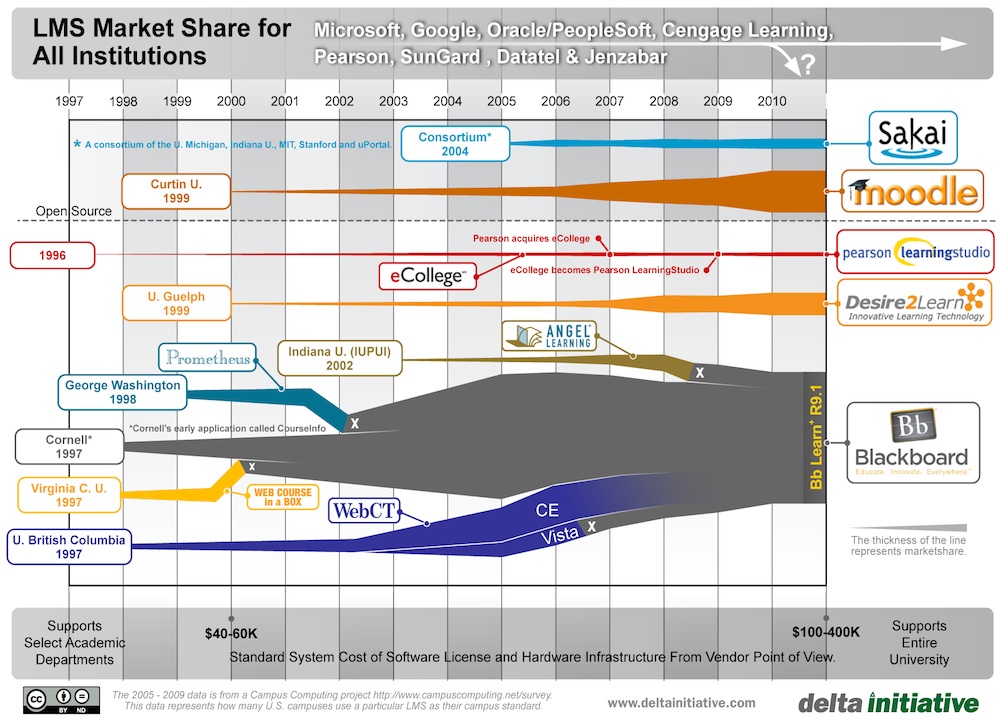
    In fact, this observation of LMS origins was a key reason behind the creation of the “squid chart” looking at the LMS market in one view. Notice the origins of each major LMS solution.

    Well, that situation has changed in a big way over the past year, and the LMS market will be the better for this change. The best two examples of this change are the entrances into the market by Instructure and by LoudCloud Systems. The change in the market will be more significant than just having two additional competitors. The real significance will be the entrance of a new mentality – one based on new investment (venture capital, private equity, strategic publisher moves), one based on startup companies willing to challenge the status quo with new approaches, and one that is almost naive in its assumptions about giving end users what they want.

    (more…)