e-Literate

Present is Prologue

Category: Academics & Academia

The “Academics and Academia” category covers topics related the ways in which colleges and universities function that are relevant to technology-supported education. One key aspect covered here is pedagogy—how people teach—and how technology impacts teaching and learning.

But this category also includes more institutional aspects that are relevant to technology-supported education, such as how campus leadership supports (or doesn’t support) new initiatives, politics and bureaucracy that impact these efforts, and so on.

Finally, “Academics and Academia” covers commercial and non-profit services that provide support for technology-supported education initiatives, such as Online Program Management (OPM) companies.


  • Is Open Education a Movement?

    Phil and I had a wonderful time co-keynoting the OpenEd 2015 conference. It was a hoot.

    Here is the spectacular graphic depiction of the keynote done by Tracy Kelly from BC Campus:

    And here is the post-keynote conversation that we had with the Virtually Connecting gang:

    There have also been some other interesting virtual conversations growing around the conference, first over Twitter and now in the blogosphere. Some of the ones worth reading that I have seen so far include those from Maha Bali, Clint Lalonde (parts one and two), Robert Farrow (who also captures some of the tweets), and Robin DeRosa.

    Phil and I approached our keynote as analysts because we figured that’s probably the main value that we have to offer. We wouldn’t presume to tell people what open education “should” be about, but given any particular “should,” we’re pretty good at thinking through how to achieve it. For my part of the talk I used the analogy of building the climate action movement because the open education community often speaks of itself in the language of a movement and because I happen to have some experience in that area. And if you read some of the posts I mentioned above, you will indeed see varying degrees of movement language.

    But there is an underlying question that really should be addressed explicitly: To what extent is it accurate or useful to think of open education as a movement?

    (more…)

  • New Column At EdSurge

    Starting today, Michael and I are publishing a three-post series on personalized learning at EdSurge. Depending on how that goes, we could end up providing a regular column there.

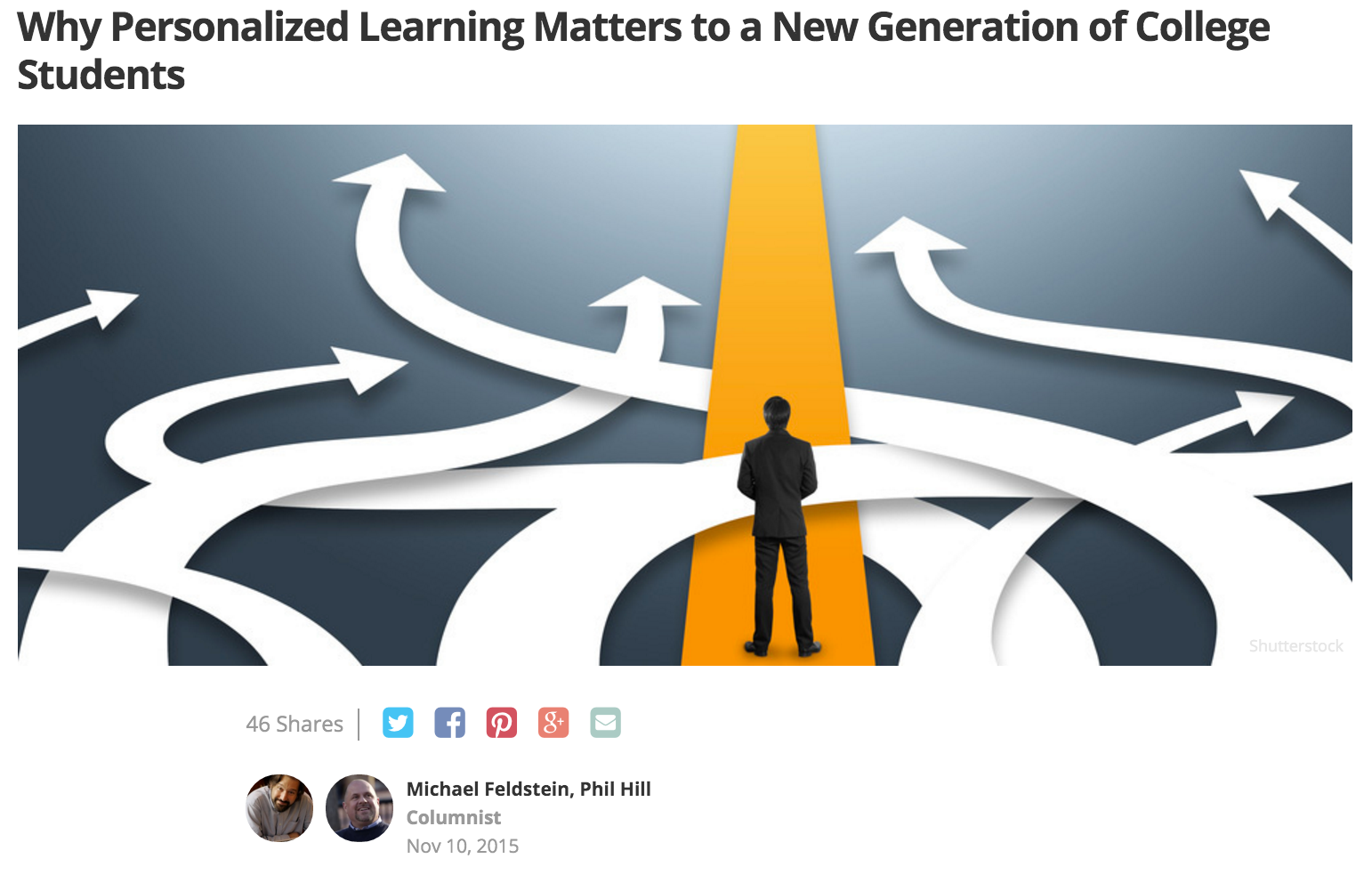
    The first post today is titled “Why Personalized Learning Matters to a New Generation of College Students”.

    As we talk to the people on the front lines of these differentiated instructional approaches—students, faculty and staff with real-world experiences, both good and bad—the most significant theme that emerged was the challenge of helping students that come to class with wildly different starting knowledge and skill levels. Personalized learning should be seen as an effort for institutions to directly support students across the spectrum.

    EdSurge

    We’re excited to be working with EdSurge, helping them expand their coverage of higher education and helping us to share analysis and e-Literate TV content with a broader audience.

    You can read the whole article here.

  • The Rise of Antisocial Deconstructivism

    Phil and I gave our first ever joint keynote at the OLC conference this week. We didn’t want to just do dueling PowerPoints, so instead we tried a format that I have been calling a social constructivist keynote. Each of us would present on a topic for a few minutes, and then the two of us would talk about it for a few minutes. We planned the arc of the topics we would cover in advance, but we didn’t rehearse the talks for each other or script the conversation. The discussions came pretty close to the kind of bull shooting conversations that we have all the time. We set a time limit of eight minutes for each segment so that we could get through our presentation with enough time to bring the audience into the conversation at the end. It seemed to work pretty well.

    In the course of the conversation, we spontaneously came up with a term that we both like and that seemed to resonate with the audience: antisocial deconstructivism. ((“Antisocial deconstructivism” should not be confused with “antisocial deconstructionism,” the latter of which is redundant. Anyone who writes like Derrida did clearly is actively hostile to the idea of shared meaning making as something that provides net positive value, or even the desire to communicate with other humans.)) It’s the approach of breaking learning down into teeny, tiny bits, tied to fine-grained competencies and micro-assessments, that students learn on their own by following a prescription that is created for them, possibly with the help of a robot. To be clear, the term isn’t entirely meant to mock. There are times when antisocial deconstructivism is an appropriate pedagogical technique. For example, it’s pretty good for helping nursing students memorize medical terminology or IT students learn the basic components of a network. It can be good for learning some math kinds of skills, depending on your philosophy of math education. Any situation in which you are working fairly low on Bloom’s Taxonomy might be OK for it as an approach. Procedural knowledge that either doesn’t require higher order problem solving skills or where problem solving skills are best built incrementally by slowing increasing problem complexity is a particularly appropriate type of candidate for antisocial deconstructivism.

    But we do mock it when it is presented not as a pedagogical technique but as a pedagogical ideology. It’s the idea that anything worth learning can be learned best, most cheaply, and “at scale” this way. It’s the fetishization of one tool in the teaching toolbox as the technological society’s Great Leap Forward. The worst, crudest examples of MOOCs, Competency-Based Education, and personalized learning software hype are all manifestations of this stunted (and self-interested) view of education. Antisocial deconstructivism is like botulism. A little bit injected in just the right spot by a trained expert can smooth out some wrinkles that bother you, treat a chronic headache, or refocus a lazy eye. A little more injected in the wrong places and you can quickly start to look like a parody of the thing that you are trying to be. Any more that, and what you have is not a tool but a toxin.

    You might be suffering from antisocial deconstructivist toxicity if you find yourself believing any of the following:

    • Short videos of lectures by Ivy League professors, coupled with little quizzes at the end, will almost always provide a better education than a class taught by a live, human, non-Ivy League professor.
    • Short vendor-produced articles or animations, coupled with little quizzes at the end, will almost always provide a better education than a class taught by a live, human, non-Ivy League professor.
    • We think of our product like a robot tutor in the sky that can semi-read your mind and figure out what your strengths and weaknesses are, down to the percentile.

    If you exhibit any of these symptoms, then get yourself to a great teacher immediately and have them demonstrate for you what it is that videos, quizzes and robots cannot do.

  • Response to Robert Talbert: Pedagogical change is difficult, many need support

    On Monday Robert Talbert, associate professor at Grand Valley State University and author of the Casting Out Nines blog, wrote a provocative and important post titled “Active learning as an ethical issue”. Robert noted:

    The recent Proceedings of the National Academy of Sciences study stands out among these recent studies. It is a meta-study of 225 prior studies on active learning, and the results are bracing: students in these studies who were in classes focused on lecture and direct instruction in the classroom were 55% more likely to fail their courses than their counterparts in active learning focused classes, and scored almost half a standard deviation lower than their active learning counterparts on exams.

    This sentence from the PNAS study stopped me in my tracks when I first read it:

    “If the experiments analyzed here had been conducted as randomized controlled trials of medical interventions, they may have been stopped for benefit—meaning that enrolling patients in the control condition might be discontinued because the treatment being tested was clearly more beneficial.”

    Robert’s central point is that active learning should be thought of as an ethical issue, where it could be considered unethical to withhold treatment. He then asks why faculty might withhold active learning and listed four reasons: self-preservation, laziness, a weird and irrational superiority complex, and legitimate external forces (such as overly controlling school structure).

    The argument is an interesting and compelling one based on the study, and it is worth reading the whole article and his follow-up post. I wish we treated teaching and learning more often as an ethical issue,but I would add one additional reason that the active learning treatment is not more prevalent. This one comes from our discussions with faculty and support staff as part of our e-Literate TV series on personalized learning, and Michael and I summarized the point in the introduction episode. (more…)

  • The University As Ed Tech Startup: UMUC, Global Campus, Texas, and SNHU roll their own

    Today the University of Maryland University Campus (UMUC) announced its plans to spin off their Office of Analytics into a separate for-profit ed tech company.

    The University System of Maryland Board of Regents today approved a University of Maryland University College (UMUC) plan to spin off its Office of Analytics into a new company, HelioCampus, that will provide business intelligence products and services to universities nationwide. [snip]

    The new company will provide a foundational analytics platform and data analysis services. This comprehensive offering will include all the tools needed to support or jumpstart an analytics program. HelioCampus will host a secure platform in the cloud that will include flexible data models and best-in-class visual analytics to accelerate analysis.

    The technology will be complemented by a team of higher-education and business-intelligence experts. Each institution will be assigned a dedicated analyst that will partner with key stakeholders to interpret the data and highlight key trends.

    The Chronicle quotes two UMUC execs – CIO Pete Young (staying at UMUC) and VP for Analytics Darren Catalano (leaving UMUC to become HelioCampus’ chief executive). It is worth noting, as Stephen deFilipo did on Twitter, that both Pete Young and Darren Catalano come from Rosetta Stone. (more…)

  • Release of Analysis Episode for e-Literate TV Series on Personalized Learning

    Today we are thrilled to release the the final episode in our new e-Literate TV series on “personalized learning”. In this series, we examine how that term, which is heavily marketed but poorly defined, is implemented on the ground at a variety of colleges and universities. While today’s episode is the final one released due to its analysis of what we learned in the five case studies, it was designed to be used as an introduction to the series.

    We have deliberately held back from providing a lot of analysis and commentary within each case study – letting faculty, students, administrators and staff speak for themselves – but in today’s episode we share some of the key lessons we learned. We had a variety schools profiled in the series, and our analysis addresses the commonalities and differences that we saw. You can see the analysis episode at this link or in the embed below.

    Controls

    Introduction: What Did We Learn In Our Personalized Learning Series?

    (more…)

  • In Defense of the Lecture

    Following the IHE piece on Essex County College’s struggles to get good outcomes from their personalized learning program in developmental math, and following my blog post on the topic, Phil and I had an interesting exchange about the topic in email with ECC’s Vice President for Planning, Research, and Assessment Doug Walercz. With his permission, I’d like to share some of his observations with you. One of the big takeaways from the conversation, for me, is that our cultural notion of the pedagogical work that happens in a good lecture is pretty impoverished relative to the reality. We don’t have a clear understanding of all the things that a good lecture accomplishes, and therefore we often lose valuable elements of student support when we try to replace it. This has pretty serious implications for MOOCs, flipped classrooms, personalized learning, and a wide array of pedagogical approaches that replace a traditional in-person lecture with something else.

    (more…)