e-Literate

Present is Prologue

Category: Academics & Academia

The “Academics and Academia” category covers topics related the ways in which colleges and universities function that are relevant to technology-supported education. One key aspect covered here is pedagogy—how people teach—and how technology impacts teaching and learning.

But this category also includes more institutional aspects that are relevant to technology-supported education, such as how campus leadership supports (or doesn’t support) new initiatives, politics and bureaucracy that impact these efforts, and so on.

Finally, “Academics and Academia” covers commercial and non-profit services that provide support for technology-supported education initiatives, such as Online Program Management (OPM) companies.


  • Coursera and 2U: MOOCs are Designed to Compete with Google AdWords.

    Coursera and 2U: MOOCs are Designed to Compete with Google AdWords.

    Coursera’s stock dropped by about 30% on Wednesday in after-hours trading after their earnings announcement. The reason for the drop and the company’s own analysis of its financial performance are both instructive. MOOCs are more or less explicitly considered to be useful primarily as marketing tools rather than educational experiences. There’s reason to believe this is a bad idea for their university partners even from a financial perspective, never mind from university brand value and mission perspectives.

    MOOCs are marketing tools

    Higher Education Dive’s analysis of the stock drop is fairly representative of the reason for the decline:

    Although Coursera reported overall revenue growth in 2022’s second quarter, revenue from the company’s degree segment declined 4% to $11.4 million, according to its latest earnings report.

    Coursera Reports Revenue Declines in its Degree Business

    This isn’t the whole story. The company missed analyst expectations for earnings growth and has guided lower on earnings growth going forward. But the conversation has focused on the degree program decline. Let’s look at what Coursera CEO Jeff Maggioncalda said about Coursera’s challenge in his own words during the company’s earnings call. Responding to an analyst question about problems in the “consumer” side of the business (which means degrees and certificates paid for by individuals rather than their employers), Maggioncalda said,

    On the Consumer side, it’s interesting because the professional surge are still performing really well, particularly in North America. In Europe, it’s kind of more of a conversion rate challenge. And so, like Ken said, maybe it’s the same kinds of effects. You asked about activity levels, I don’t think that we’re seeing any notable difference in activity levels. It seems to be an even a lot of top of the funnel seems to be similar between Europe and other regions. I will say that, generally speaking, search volume for online courses and online degrees.

    And this is not just on Coursera, which is general search volume is down. I think there’s sort of a bit of a the economy reopening and people doing things outside their house that we’re that we kind of see globally. And that probably is happening in Europe as well, but a lot of it sort of conversion rates on the Consumer segment in EMEA, and particularly Europe that we’re seeing.

    Coursera, Inc. (COUR) CEO Jeffrey Maggioncalda on Q2 2022 Results Earnings Call Transcript

    The key phrases in this excerpt are “conversation rate,” “top of the funnel,” and “search volume.” These are marketing terms. Free MOOCs are at or near “top of the [sales] funnel.” They are designed to identify and attract paying degree candidates. Meanwhile, 2U CEO Chip Paucek said a month ago in his company’s earning call that “[m]arketing investment decisions will be made at the platform level, aggregated across business lines with the goal of increasing the lifetime value of each learner.” The “platform” he’s referring to is EdX. The “lifetime value of each learner” means 2U intends to use the EdX platform to get learners to pay for more courses.

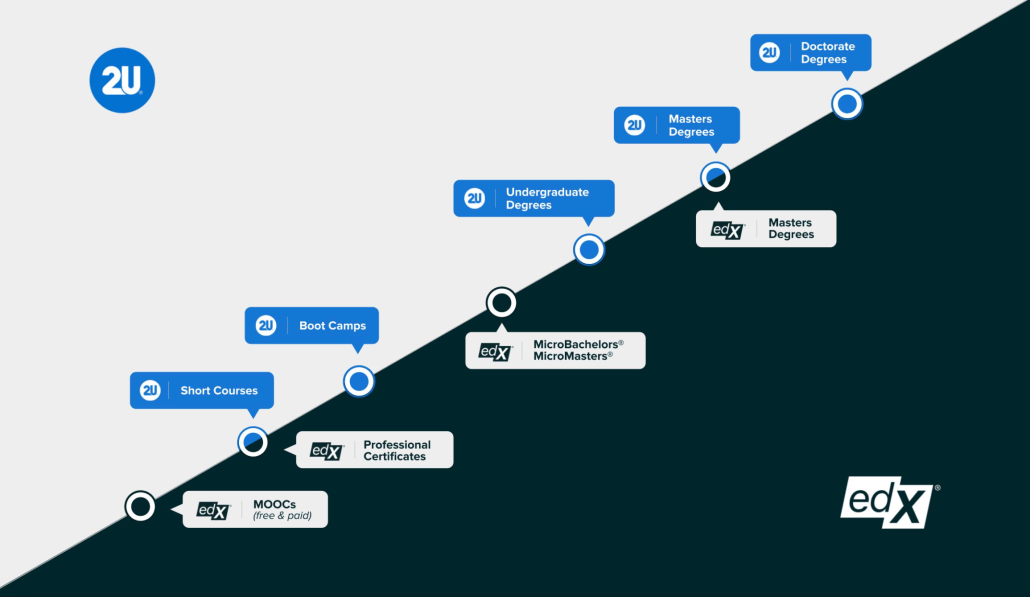
    When 2U introduced its slogan “Free to Degree,” the company wasn’t describing their breadth of coverage. It was describing its sales funnel for getting students into paying degree programs.
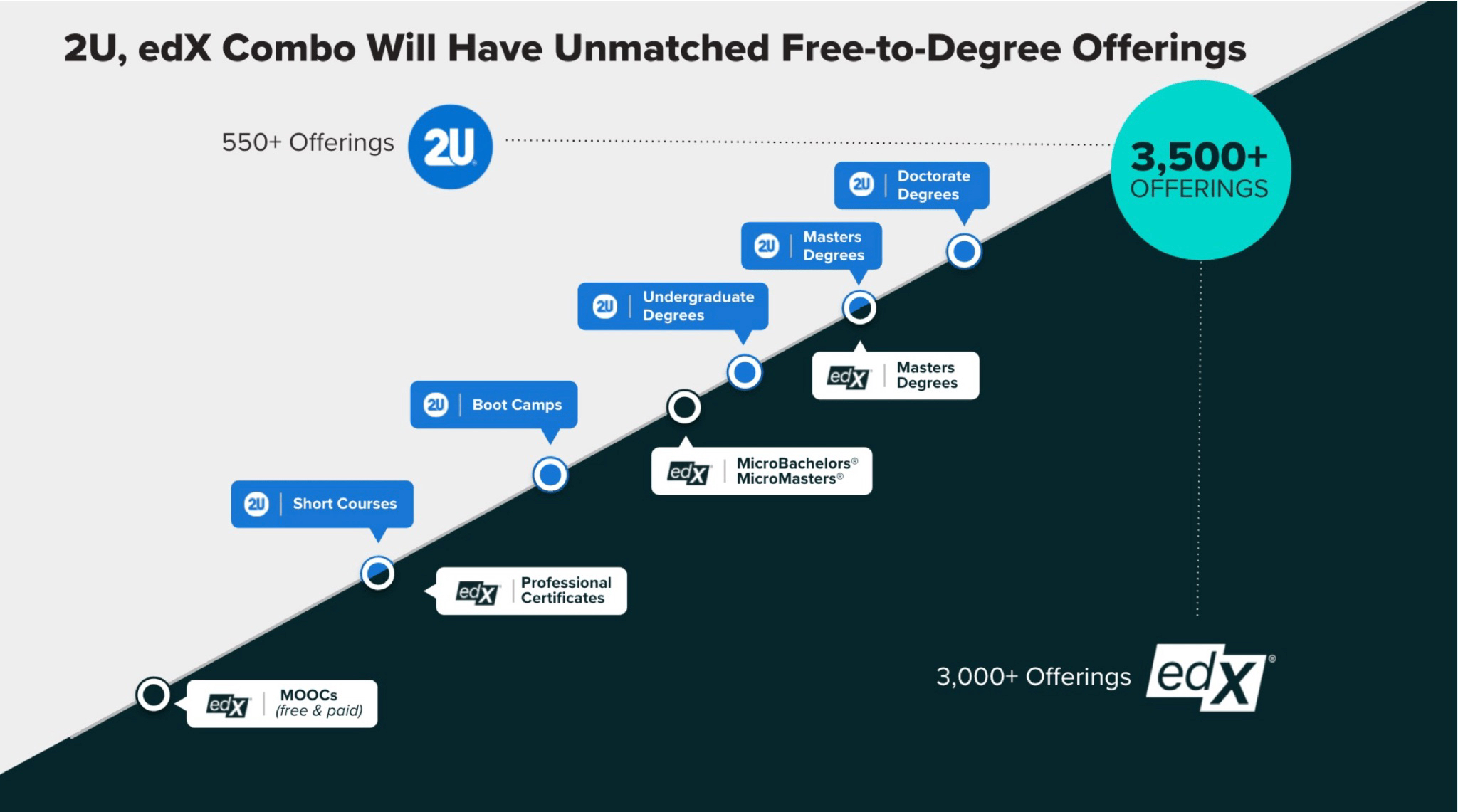
    Free to Degree: Increasing the lifetime value of each learner.

    We can see this mindset at work on the micro-scale by looking at the MOOCs produced by Coursera co-founder Andrew Ng, who now has a company called DeepLearning.AI that sells certificate programs on Coursera. Try the AI for Everyone certificate program. Don’t worry; you won’t have to pay anything to try it.

    You’ll find it is a series of short, engaging, and mildly informative lecture videos by Andrew, each of which is followed by a quiz that anyone who was halfway paying attention could pass. This is absolutely terrible education. But that’s an unfair assessment. Because this “certificate program” isn’t really intended to be education.

    Andrew Ng is at least twice as smart as me and has all the money in the world to pay high-quality learning designers. If his certificate program is not worth paying for, then the most obvious explanation is that he doesn’t really expect you to pay for it. It’s not a certificate program. It’s an infomercial designed to convince you that you need to learn more about AI. It’s the “top of the funnel” designed to “convert” you into a paying customer so that DeepLearning.AI can increase the “lifetime value” of you as a (future) enrolled and paying student in the company’s more extensive (and expensive) programs.

    None of this is new but it’s oddly still news

    In 2019 Justin Reich, possibly the single most prolific and widely respected researcher on MOOCs, co-published an article called “The MOOC Pivot: From Teaching the World to Online Professional Degrees.” The article’s abstract states, “[A]fter promising a reordering of higher education, we see the field instead coalescing around a different, much older business model: helping universities outsource their online master’s degrees for professionals.” Reich’s book Failure to Disrupt is similarly blunt (and well worth reading). MOOCs have become advertising tools to attract students into more lucrative degree programs run by OPMs. As more degree programs have gone online (driven, in part, by the success of the OPMs themselves), the cost of advertising using relevant search keywords Google AdWords has gone up. Because demand for them has gone up.

    MOOCs are attempting to disrupt Google AdWords in education.

    University stakeholders know this. Sort of. If you search the internet for articles about the cost and revenues, you won’t find anything published more recently than about 2015. After the first few years, they just stopped talking about costs and revenues. That shift wasn’t random. And of course, everybody knows how bad MOOC completion rates are and how badly they’ve failed to demonstrate consistent educational effectiveness under rigorous testing.

    When I’ve asked folks I know who are directly or indirectly with MOOC programs at their universities why their institutions are still creating and maintaining these things, I typically get one of two answers. The first is that their bosses think it’s good marketing for the institutions despite the fact that they have data showing that YouTube videos work better. The second is that they frankly don’t know why they are still doing it.

    By extension, Coursera is now an OPM. If it weren’t, then its underperformance in its relatively new online degree unit wouldn’t cause such a precipitous plunge in its stock price.

    But it gets worse

    If MOOCs turned out to be infomercials and everybody understood that to be the case, that would be disappointing but not the end of the world. Some of us never expected them to be the magic bullet.

    The problem is that Coursera’s degree programs are also MOOC-based and 2U is making worrying (though admittedly cryptic) comments suggesting that they may be moving in that direction as well. I’ve seen no good data on MOOC-based degree completion rates. Or on MOOC-based degree efficacy. Or on the perceived value of MOOC-based degrees by employers. We do know how individual MOOCs perform on these measures: badly.

    The only difference I can see between a MOOC and a MOOC-based degree is that students will be paying significantly more for them. Will this make a difference? Eh, maybe a little. I once had a conversation with Andrew Ng and Daphne Koller about research indicating that students would more highly value and be more likely to complete a course that cost $1 than one that is free. Maybe cost will matter because students will be literally invested in their education.

    But that’s a thin reed on which to bet the future of billion-dollar companies, whose future is in turn paid for by students who are participating in an uncontrolled experiment that they are paying for. It seems more likely that if 2U joins Coursera on this path they may have to change their motto to “No Front Row.”

    I get that universities need to develop more sustainable business models. pumping up degree programs through MOOC marketing and then lowering the price of those degrees by delivering them as MOOCs strikes me as a particularly risky way to try to meet financial goals, even if they’re willing to play fast and loose with their mission goals and institutional brands.

  • Thinking About Alternative Credentials

    Thinking About Alternative Credentials

    Intrepid EdSurge reporter Rebecca Koenig published a piece a couple of weeks ago called “Employers Claim to Value Alternative Credentials. Do Their Practices Match Their Promises?” It delves into a Society for Human Resource Managers (SHRM) research report called “Making Alternative Credentials Work: A New Strategy for Human Resource Professionals.” I recommend reading the article and reading the report itself if it interests you.

    I haven’t written much about alternative credentials, partly because I’ve been waiting for patterns to become more evident to me. Oddly, my recent post about Web3 in education catalyzed my thinking about the credentials topic. In both cases, proponents want to decentralize power structures by using technology to make centralization less necessary. But while decentralization can be facilitated by technology up to a point, it is also limited by the nature of humans as social animals.

    Four ideas of “alternative credentials”

    One of the problems we currently face when discussing alternative credentials is that there are (at least) four distinct ideas of what we mean by the term which are poorly differentiated in our discussion. While these different meanings are not necessarily incompatible, they aren’t automatically complimentary either. We risk confusion and mistakes if we aren’t clear about which drivers we are most concerned about when we talk to each other about them.

    Folks like SHRM—a society for human resource managers—are concerned about companies being able to find the workers they need by increasing the talent pool and more precisely filtering for the actual skills they need. The current state of affairs, particularly for entry-level jobs, is that companies typically use degrees as crude proxies for competencies and then assume they’ll have to invest in a lot of on-the-job training with new employees. For SHRM’s constituents, skill-focused certifications from MOOCs, boot camps, and other sources potentially provide them with both more job candidates and more precise information about which candidates are likely to be able to hit the ground running.

    The second group of alternative credential advocates is primarily concerned with affordability and equity. They want to help students for whom the cost (in both money and time) of a traditional college education is out-of-reach find their way to a living wage and a decent life. If students can get a decent-paying job with a certificate and then move up the pay ladder over time by getting additional credentials that can stack up to something more substantial. This group focuses on middle-skill jobs like electricians, dental hygienists, or paralegals. Interestingly, community colleges are increasingly active in this space. “Alternative credential” is not synonymous with “alternative provider.”

    The third group focuses on white-collar jobs but more from the student’s perspective. They might be providing additional certifications to workers with undergraduate or even graduate degrees who want to advance in their careers. For example, a software engineer who wants to get into AI might take a MOOC micro masters program. On the entry-level side, the focus is on talented but vocationally-minded students who want to jump right into white-collar jobs. Unfortunately, even though this is a tiny part of the alternative credential picture, it gets a lot of hype, has an outsized influence on the conversation about the space, and is often tainted with Silicon Valley libertarian techno-utopianism. The stereotype is the teenage hacker who is intelligent and experienced enough to skip MIT and go straight to a job at Google. This stream of conversation is colored more than a little by libertarian techno-utopianism. “College is for losers. Go build a startup instead.” This is particularly unfortunate because it leads to us valorizing and privileging students who would probably do well no matter what over those in genuine need of an economically viable path to a decent career.

    Then again, sometimes people use “alternative credential” to refer to a technological solution like a digital badge specification or platform. As with Web3, I have often heard optimism that these sorts of decentralized and democratized digital interchange formats will somehow facilitate one or more of the visions of alternative credentialing above. How is less clear. In fairness, some of the folks working in this space are trying to solve various problems, some of which are both concrete and realistic. But there can be an air of Web3-ish hype around digital badging as if somehow having a technological tool for issuing credentials will magically lead to a world in which education is “unbundled.”

    While I’m laying out these different meanings of “alternative credential” because different readers will come to this post with different preconceptions about the term, I’m going to be focusing in this post on a problem that all of them have in common, which is the tension between “alternative” and “credential.” To what degree can the authority behind a credential be easily transferred to alternative providers? And to what degree can technology facilitate that decentralization?

    What is a credential, anyway?

    Before we talk about “alternative “credentials,” we should talk about what a credential is and where its utility comes from.

    There was a time in the history of humanity before credentials existed. People didn’t need them. Wolfgang was the village blacksmith. If you needed blacksmithing done, you went to Wolfgang. He didn’t need a diploma. If your village had two blacksmiths, you asked around. Most of your fellow villagers would know the pros and cons of using Wolfgang versus Dieter. But by 1506, maybe your tiny hamlet of Munich grew to be the capital of Bavaria. ((Guilds existed in some form at least as far back as ancient Sumeria.)) There were too many people and too many blacksmiths to keep track of. And maybe too many blacksmiths for a healthy blacksmithing economy.

    When human settlements grew large enough, craftspeople would typically begin to organize themselves into guilds. They helped control the problems of large-scale competition such as price wars, scam artists, or bad workmanship that might harm the profession.

    Guilds used various tools to gain this economic power (some of which were less savory than others). One critical tool—not only for guilds but for human civilization—was certification. Guild membership often came with quality standards. As the guilds grew ever larger, they even created career paths that distinguished among skill levels, e.g., apprentice/journeyman/master. The guild certification became a proxy for asking around about Wolfgang versus Dieter. If Wolfgang was certified by the guild as a master blacksmith while Dieter was only a journeyman, that might help you decide without looking for references. And if you were a young male thinking about your career path, you had an idea of what your life and earning potential could be like if you apprenticed as a blacksmith.

    Interestingly, one translation for both Latin words “collegium” and “universitas” is “guild.” Colleges and universities started as guilds that certified experts in various areas of scholarship like law and theology. And in meaningful ways, these organizations retain characteristics of guilds today. Establishing trust in alternative credentials is a bit like finding a way to establish trust in a strange blacksmith who hasn’t been guild-certified. In fact, the word “trust” is central to everything. Which quality signals can I trust?

    How “alternative” can we get?

    Early guilds benefitted from being closely tied to—and governed by—the vocational practitioners that benefited from the certification of expertise they provided. Modern colleges and universities have become somewhat unmoored from that for both good and bad reasons. But remember, the value of the guild credential comes from the credibility of its source. Trust in the credential-issuing entity is a proxy for the credibility of more direct evidence of competence. The idea that anybody can create a digitally readable badge doesn’t democratize credentials. And attaching direct evidence or competence as part of the digital package only matters if folks want to—and have the time to—look at that evidence. This might or might not happen when the job screening process has been narrowed down to a few candidates but definitely won’t with 50 or 100 candidates.

    In fact, there’s very little in the alternative credentials world that is clearly new. Alternative credentials themselves are certainly not, as the SHRM report points out:

    The alternative credentials marketplace is not new. According
    to Preetha Ram, former CEO and co-founder of OpenStudy.com,
    “Postsecondary certificates, professional certificates, university
    extension courses, etc. have long co-existed with universities and
    colleges….”

    Making Alternative Credentials Work: A New Strategy for Human Resource Professionals

    For example, tech companies like Oracle, Cisco, and Microsoft have sold credentials for decades.

    I would argue that we effectively have had a functional digital badging system for quite some time as well. It’s called a “résumé scanner.” If I’m an IT professional with a Cisco certification, I’m overwhelmingly likely to have something like “Cisco CCNP Data Center Certification” printed on my résumé. And if the hiring manager has listed that certification as a job requirement, their résumé scanner will be keyed to pick that up on candidate résumés. If the Cisco “badge” serves as a meaningful trust proxy to the humans involved, it will likely be picked up and transferred digitally. The badge is digital in roughly the same way as a printed QR code.

    The most significant barrier to the growth of alternative credentials is trust in the credential-issuing proxies. Technology can make trust-building easier, and it certainly can make working together easier once trust is established. But it probably can’t replace human trust in this case. The kind of trust we’re talking about is first-pass. It’s the kind that helps employers trim down many candidates that they don’t have time to evaluate in the first place. For that reason, having a digital credential with attached artifacts showing the student’s work doesn’t help here. When the current employer requirement is “must have a BS in computer science or equivalent,” the “equivalent” being offered must be expressed in a form that is both more trustworthy regarding the employer’s actual requirements and equally fast and easy to evaluate. It requires human trust-at-a-glance. The same level of trust that leads an HR manager to say, “Scan the résumés for ‘Cisco CCNP Data Center Certification.’”

    Perhaps a more fleshed-out concrete example will help.

    Allied healthcare

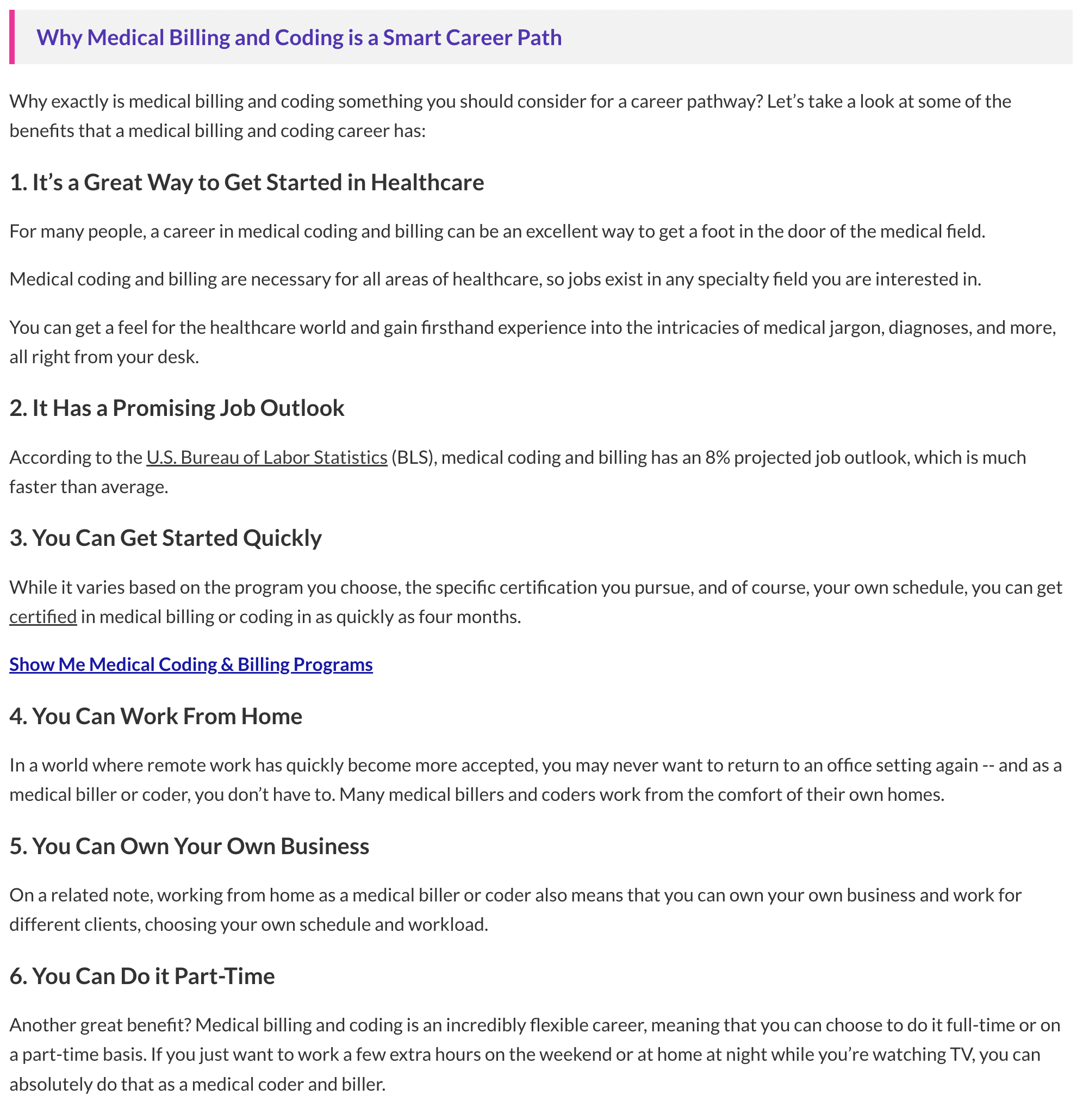
    Healthcare is interesting because it has many middle-skill jobs and necessarily has a lot of credentialing. I will be drawing my example from the “Medical Billing and Coding Careers Guide 2022” page on Nurse.org. I encourage you to go to that page and read it in its entirety. It’s not long.

    The gist of it is to provide career paths for people who are interested in starting as medical coding and billing specialists:

    For reference, while the Springfield Technical Community College (STCC) here in Massachusetts provides a two-year associate’s degree in medical coding, they also offer a one-year certification program. The total cost is about $7,000 before financial aid. So this is a good, flexible way for somebody who doesn’t have a lot of money or time to embark on a career—with a national average salary of about $44,000. (It’s $48,000 in my state.)

    Where could you go from there? The guide offers several possibilities. For example, you can become a medical coding auditor with “several years of experience as a medical coder” and a medical coding auditing certificate from the AAPC. The average salary is about $95,000, which is quite a jump. What is AAPC?

    AAPC was founded in 1988 to provide professional certification to physician-based medical coders and to elevate the standards of medical coding. Since then, AAPC has grown to more than 200,000 members worldwide and now offers 28 certifications encompassing the entire business side of healthcare.

    So AAPC is an “alternative” credential provider. They provide the certification exams and, separately, certification training. They were founded in 1988. Cutting-edge stuff. Joking aside, I have to wonder how long it took for AAPC’s credentials to become so widely recognized and accepted within the healthcare industry. It probably wasn’t instantaneous.

    Other career paths are less straightforward. If you want to become a medical coding manager (average salary: ~$85,600), you would need several years of experience, a certificate from either AAPC or the American Health Information Management Association (AHIMA)—another “alternative” credential provider—plus some management experience.

    I’ve put “alternative” in scare quotes because I doubt that AAPC and AHIMA are viewed within the medical industry as alternative credential providers in the same way that, say, coding boot camps are. The more trust (and authority) the credential provider has accrued, the less they are viewed as “alternative” providers. Which is the point.

    A few implications

    After all this, I’m not sure I have any deep insights. But here are a few ideas to chew on:

    • Alternative credentials will tend to grow and proliferate at human speed, not technology speed.
    • Organizations that already have trust within an industry will be much better positioned to build alternative credentials.
    • Alternative pathways, like the ones described on Nurse.org, exist but are more plentiful in some fields than in others and generally harder to find than they should be.
    • Digital credentials are not an obvious route to faster proliferation of alternative credentials. (Even if they are Web3 credentials.) They might be a route to faster propagation of alternative pathways.
  • Is the edX Acquisition a Big Deal?

    Is the edX Acquisition a Big Deal?

    I’ve been inundated with questions regarding what I think about 2U’s acquisition of edX. What do I think? I’ve been struck by how much less I care about this deal today than I would have a few years ago. That change is entirely due to my change in focus rather than external circumstances. e-Literate used to be, in part, an EdTech industry analysis site for its own sake. While I still do some EdTech industry analysis, I’m much more focused on how EdTech influences the direction of the education sector as a whole, particularly with regard to becoming more effective at sustainably helping more students. Due to that shift in perspective, the edX acquisition moves from “a huge deal” to “somewhat interesting” for me.

    How much you should care about the edX acquisition depends on what you care about. So I’m going to write about that.

    Who cares about the edX acquisition?

    You can learn a lot about whether you, personally, should care about the acquisition by looking at who else cares and why. It’s a little early to answer this question entirely; I’m asking around at the moment. But we do have some early obvious answers.

    MIT and Harvard

    First of all, MIT and Harvard care. On one hand, edX was a money loser. Most EdTech companies are. They lose money for a very long time and then only become slightly profitable. Investors can be OK with this if “slightly profitable” is also “reliably profitable.” They can take a long view, in a way. I say “in a way” because many types of investors that put money into an EdTech company on its way to profitability sell their stakes long before their investments achieve their goal. As long as a critical mass of investors believe that these companies will eventually be profitable, then one investor may well be willing to buy a stake in an unprofitable company from another.

    On the other hand, universities aren’t in that game in the same way. As far as I’ve been able to piece together, edX was rushed out the door to get ahead of the imminent launch of Coursera. It wasn’t a strategy. It was a reaction. It was also a money loser. According to Tech Crunch, “The institutions, of course, have thrown in a cumulative $80 million in donations into edX to keep the operation free.” That’s a surprisingly shallow and naive assessment from a publication that’s all about tech companies. ((I also think their contribution number is low, but it’s hard to find hard data.)) First, edX fees to students (or lack thereof) have more or less aligned Coursera’s. Second, both edX and Coursera are two-sided markets. While edX ultimately makes its money off of student purchases, it does so via a revenue share agreement with the universities, which, once again, is not terribly different from Coursera’s revenue share agreement. The basic idea in both cases is to be the Amazon of MOOCs. Get everyone to sell everything through your storefront. Collect a small dollar amount (but a large percentage) of each transaction as your fee. Attract enough customers so that the small dollar amounts add up over time. To the degree that edX had a business plan beyond “do whatever Coursera does,” this was it. It wasn’t obvious that edX would be an asset they would ultimately sell. Their external justifications for edX were always mission-related. Since I have only been able to gather fragments of information about their internal deliberations over the year, I’ll take them at their word on that. I don’t know the degree to which they understood that their commitment entailed losing money every year for the long haul.

    When 2U swooped in, that gave MIT and Harvard an opportunity to get out of that money trap, declare victory, and make a handsome return on their investment. If Tech Crunch’s numbers are right, then the two universities made 10X on their 9-year investment. Is that good? It depends on your perspective. VCs generally look to make a 10X return in five years, and I suspect that those numbers may be less ambitious in EdTech specifically. For MIT and Harvard, I suspect it was a massive unexpected windfall that got rid of some problems and created some opportunities for them.

    2U

    Obviously, 2U wouldn’t have forked over $800 million—in cash—if they didn’t think edX would be a big deal for them. Why? Phil Hill writes:

    Coursera’s market value is roughly 18 times its annual revenue whereas 2U’s is roughly 4. These are rough numbers, but I believe 2U’s leadership believes it an command an increased value as this deal completes. Note that I am not predicting stock prices here, just showing the potential change in market perception.

    Three Charts that Help Explain the 2U/edX Acquisition

    But that only pushes the question back a level. Why do investors think that Coursera is so much more valuable than 2U? The short answer is that one of the most expensive parts of an OPM business—and Coursera definitely is an OPM, as this transaction demonstrates—is marketing for new students. Investors believe both Coursera’s and 2U’s claims that owning a MOOC business helps lower the marketing costs for their core OPM businesses. 2U’s public estimates are that they can save 15% on marketing costs. I’m somewhat skeptical of this claim but I’m also not a financial analyst, so I’ll take it at face value.

    2U has a handful of other potential business justifications, most of which I won’t break down here because, again, it’s not the focus of my writing anymore. I’ll briefly share a few of them, not because they’re the most important but because they’re illustrative and easy to explain succinctly. First, 2U has always aspired to transform the entire education sector by bringing it online. However you may feel about that aspiration—I recognize that feelings tend to run very hot about OPMs—owning a major MOOC platform gives the company’s aspiration more depth.

    All roads lead to….

    Second, edX reaches a lot of students in a lot of countries. The international EdTech market has been a long time coming, but it’s finally arrived. edX greatly expands 2U’s international footprint by some measures, which once again gives them a good story to tell.

    And this brings me to the final advantage I’ll point out in this post. 2U has always been about telling a compelling narrative about the future. One of Chip Paucek’s previous ventures was a company that had comedians explain educational concepts on a television show. He understands how to build a story. He knows how to hit the beats. When WeWork was at peak hype, he made a deal with WeWork. When code academies were red hot, he bought one of the hottest code academies. Given Coursera’s recent success in the markets, it makes sense that he would look to make the biggest, boldest MOOC move possible.

    To be clear, I’m not saying that the CEO of this publicly traded company made these deals solely or primarily to spin a good story. I’m simply pointing out that Chip has a method for responding to market changes. If he believes that getting into a particular business is good for 2U, he will not make his move by quietly dipping his toe in the water. He’s going to jump in with both feet and make a big splash in the process. The edX acquisition fits with that method.

    2U’s and edX’s university partners

    While it’s too early to make pronouncements with any confidence, early reactions I’ve heard indicate that 2U’s university partners are pretty happy with the transaction while edX’s university partners are pretty unhappy. For 2U’s partners, they already decided to go with the big publicly traded corporation that, for better and worse, is heavily associated with revenue-sharing deals. Now they can do MOOCs with the same company. This deal gives them nothing but upside. On the other hand, many edX partners specifically went with edX because they did not want to deal with the for-profit Coursera. Yes, edX had its revenue-sharing agreement too, but it was a non-profit run by universities. That made it feel different for some.

    2U may have to deal with some of the kind of backlash that Blackboard did when it bought other LMS companies—particularly Moodle support companies. They may lose some universities. Then again, 2U is definitely not Blackboard. Especially Blackboard circa 2012 (although, ironically, edX was formed the same year Blackboard acquired Moodlerooms). 2U built its business by winning over faculty senates. Also, while the company may lose some edX customers, it may gain some by cross-selling to its existing customer base. It’s hard to say how all this will play out, net-net. All I can say with confidence right now is that people at the edX schools I’ve talked to so far are understandably nervous.

    Who doesn’t care

    I doubt students will even notice. I take that as one strong indicator of how I should feel. It’s not clear to me that Coursera has done anything edX hasn’t and that would or should concern students. I could be wrong; I haven’t looked closely at this aspect. (Please correct me in the comments section if you know something I don’t.) Further, I have no reason to believe that 2U’s behavior will be worse than Coursera has been.

    MOOCs strike me as a relatively low-risk corner of EdTech for heavy corporate involvement. My sense is that, if 2U sees edX primarily as a way of making marketing dollars go further, then they have a vested interest in keeping students happily engaged. Yes, they’ll use student data to target them for marketing, but if you are shocked by that, then you should maybe take a look at all free products that you use (possibly including the email service that you are reading this blog post through). As long as the MOOCs are transparent about what they’re doing, it’s probably OK in that particular market. In fact, those particular learners may want to receive targeted ads about other learning opportunities.

    The ways in which I care

    In and of itself, I’m indifferent to this deal. I’m not opposed to revenue-share OPMs in general or 2U in particular. (This is an outdated argument anyway since the major OPMs generally offer non-revenue-sharing arrangements of various flavors these days.) At first blush, I don’t see any big harm to students or institutions in it. (I reserve the right to change my mind in either direction as I learn more.) Since xMOOCs have not turned out to be the end of academia as we know it, either in the revolutionary sense or the armageddon sense, I’m inclined to feel mildly positive toward an arrangement that gives a major provider a sustainable path forward. MOOCs are one more arrow in the quiver as we try to offer everyone in the world the opportunity to fulfill their potential through education. I’m not going to turn my nose up at that. I like the folks I know at both edX and 2U. While I don’t always agree with them, I’d like to see them make a contribution with their new venture. I’ll wait and see and wish them well.

    Beyond that, I mostly care about two aspects that I haven’t seen talked about much in any of the coverage. First, there’s the open-source code. While I frankly think the early iterations of OpenEdX were embarrassingly bad and improved over time to “surprisingly OK given how embarrassingly the foundations were,” I do think there is value in maintaining an open-source MOOC platform. I am skeptical that 2U has the DNA necessary to steward an academic open-source community. I know how good 2U can be at working with academics and I also know what it’s like to steward an academic open-source software community. These two things are not the same.

    Second and more importantly, I’m worried about the loss of research. Thanks to the efforts of researchers like Justin Reich and Rene Kizilcec, edX has been one of very few public testbeds we have for conducting credible learning efficacy research at scale. 2U, in contrast, has done nothing visible in the area of learning science. They’ve started talking about it in the past year or two, but frankly, if e-Literate were still doing the cop-on-the-beat thing, I probably would have shredded them about it by now. In 2021, there is absolutely no excuse for any EdTech company of 2U’s (or Coursera’s) size and scale not to be engaging actively with academics in serious applied learning science and contributing to our collective knowledge. If 2U can spend $800 million—in cash—for a MOOC organization that loses money every year, the company can surely afford to invest one-half of one percent of that every year in a credible program to advance the state of knowledge and literacy in effective teaching practices. And now that they own a platform for conducting such research at scale, the onus on them has only increased.

    The same goes for MIT and Harvard, by the way. Despite the excellent work of a few researchers, and despite the rhetoric of the institutions at the time that edX was launched, one reason we have not gotten more and better research out of edX is that the platform, incredibly, was poorly designed for educational research. How did MIT build a platform for massive-scale learning in 2012 and fail to think about what sorts of educational data and metadata they would need to facilitate research? What does that tell us about the real priorities behind the initial push to production? It’s a mystery.

    I’m not particularly interested in the vague promises of two rich universities to do good in the world with their $700 million windfall from a non-profit that was supposed to educate the whole world. I’d like to see a credible plan this time, including a theory of change.

  • Online Learning Student Experience is the New Climbing Wall

    Online Learning Student Experience is the New Climbing Wall

    In my last post, I argued there are three factors that will permanently drive residential colleges toward more online and hybrid programs:

    1. Value questions: COVID-19 may finally bring about the long-predicted “unbundling” and “rebundling” of the university. As many colleges and universities with annual price tags of $40K, $50K, or even $60K go online, students and parents alike are having their attention called to exactly what the residential experience adds and how much they are willing to pay for it. While I’m not predicting the death of the residential college, I do think we are entering a new era in terms of how students think about what they want from their college education and how much they are willing to pay for it.
    2. Missing the window for the traditional educational experience: While we don’t have good data yet on deferral rates, the Boston Globe reported four weeks ago that Harvard University is reporting a 20% deferral rate this year, and other numbers I’ve heard anecdotally tend to range between 10% and 20% deferrals. Not all of those students will come back, either to the university they applied to or to full-time college in general. Some will need to get jobs. Some will start their own companies. Life will move on. Their ability to invest four full-time years of their lives and $100K or more on an undergraduate education will diminish. Some will miss their window. This change, in turn, will force many colleges and universities to make permanent changes that were inevitable—though they may have felt somewhat distant—due to demographic changes, changes in the economy, and other sustainability challenges.
    3. Deteriorating university finances and the drive for post-traditional students: Even as fewer students may attend full-time college straight out of high school, more will need continuing education throughout their careers to stay employable or advance in their careers. This COVID-accelerated trend coincides with the COVID-accelerated trend of deteriorating university finances. Institutions will increasingly need to meet working students where they are.

    These trends will likely hold true for most colleges and universities. But they will be particularly acute for many institutions that emphasize residential education. And it raises an existential question for them: Without their climbing walls and dining halls, without students being able to run into faculty on campus and have a cup of coffee with them, how will these institutions differentiate online? How can they justify their price tags?

    Remember, when MIT first began giving away its course materials in its much publicized OpenCourseWare effort in 2002, the university’s primary argument for preserving the value of an MIT education was that the real value of an MIT education was being on campus with MIT professors and students. While MOOCs have brought about some evolution of that view, MIT’s edX MOOCs are largely for people who are not MIT students.

    So what will distinguish an online MIT education from OpenCourseWare or an MIT MOOC micro-master’s degree in a way that will justify a substantial price premium?

    Not Zoom lectures and commodity textbooks

    If we compare a well-designed MOOC to a thoughtful, if hastily executed direct-translation remote learning course today, the MOOC is the superior product. Is a live faculty lecture on Zoom better than a recorded lecture in the MOOC? Eh, maybe yes or maybe no, depending on how interactive the Zoom lecture is and how well produced the MOOC lecture is. What about the asynchronous portions? The readings, formative assessments, online discussions, and just plain course organization? A well-designed MOOC offers a more seamless experience where students are guided by the interface from one experience to the next, the materials are designed to work together, and they have the distinctive flavor of a unified class prepared by the professor who designed it. In contrast, a remote learning course that was cobbled together with the tools at-hand has students hopping between the online syllabus, their commodity courseware, their LMS discussion forum (where they will have to navigate to the appropriate discussion thread), and so on.

    Another way of putting this is that, if instructors had the time to more carefully design their current remote learning strategies and wire together the navigation among the various technology platforms they use, the best they could aspire to achieve is something approximating a relatively generic MOOC.

    Other popular models are also either inappropriate or incomplete. The access-oriented universities have gotten very good at teaching asynchronous classes. They’ve been refining their techniques for decades. But those approaches are optimized for access and affordability, where “affordability” means “much lower tuition.” I don’t see Swarthmore or Brandeis adopting this approach unchanged as part of their core undergraduate experience. Likewise, the high-end, all-synchronous methods employed by some of the MOOC providers won’t always fit either. Sure, they work for the kind of audience that might show up for executive education. But will they work for working 20-year-olds, particularly in survey-level undergraduate courses? Maybe not. And so far we’re only talking about the in-class experience, which is a small fraction of what “residential education” is supposed to be all about.

    Increasingly, colleges and universities are going to have to develop their own, distinctive approaches to online and blended learning. They will have to differentiate in different ways. And without the same kinds of person-to-person serendipitous contact that happens when everybody is physically co-located full-time, they will have to create distinctive and valuable experiences that are just as meaningful and just as easy as bumping into your professor at the coffee shop or meeting your classmates for pizza at the dining hall.

    This changes everything

    Such a transformation won’t happen by accident, and it certainly won’t happen by cutting 30% of staff and hoping for the best. Colleges and universities will need to re-imagine themselves. What makes them distinctive once they remove the physical campus and everything that happens because of that campus? What is special that can translate to the virtual or the blended?

    The implications for governance are deep and far-reaching. A lot of the magic of the residential campus arises out of creative chaos. It’s exactly the unplanned nature of residential college—the serendipity that results from taking a life-changing course you weren’t thinking about because your friend is in it or having a deeply meaningful and entirely unplanned conversation—where the magic arises. Translating some of that into online modalities while maintaining some sort of cohesive experience will not be accidental. It must be planned. The whole university community will have to be in on it.

    Nor can that cohesive experience be outsourced piecemeal to a collection of disparate vendors without much thought about the learner journey. It will longer be adequate to have a generic LMS, generic courseware, and generic web conferencing linked in bespoke configurations by individual faculty, often leaving it to the students to navigate a disjointed set of experiences that in no way resembles the easy rhythm of going to class twice a week and meeting with a study group at the library in between.

    Charlie Chaplin, Modern Times

    This new vision and its implementation will need to be intentional, institution-wide, and enabled through active support from everyone involved. A vague sense of appreciation among faculty and staff for the character of the institution will no longer pass for a “shared vision.” The feeling at institutions that are successful in the cultural transformation will be more like an employee-owned company than “shared governance,” where latter of often means “mutual agreement to leave everyone alone and everything as it is.”

    This work is going to require new levels of collegiality and shared imagination. It will also require enormous attention to detail. When serendipity works in residential education, one reason it does so is because the student is physically surrounded by people who can help. Students are less likely to fall through the cracks when their dorm mate or classmate or advisor or professor or random student on the quad can show them how to leap over a particular crack. Online, the opposite is often true. Randomness is an enemy more often than a friend because the cues for where to go and what to do have to be consciously created, as must be the environment that encourages the formation of social support networks. There will be no more closing the door to one’s office or classroom and ignoring the parts of the university that aren’t your direct responsibility. Everyone will be in the same boat, sink or float. At the moment, everybody is just bailing out the water. But pretty soon, they will need to start rowing in the same direction with a level of shared intention that they have never practiced before.

    For academics, the future of work is here. Somebody needs to tell them that.

  • The Billion Dollar EdTech Platform Hole

    Actually, make those plural: billions, holes…

    In my last post I began to frame a multi-part discussion about the state of play of #edtech and how response to the global pandemic will result in a significant acceleration of what has been a relatively long and drawn out adoption of technology-enabled teaching and learning. And, while it seems an obvious statement – in light of the extraordinary increase in, say, use of technology-enabled grocery delivery – my point is that many of the specific objections and barriers that persisted are moot in the face of the alternative (insolvency of the institution). As those issues are reconciled, it is clear that a key driver is the (re?)realization that organizing around the needs of learners is job one.

    Let’s start with a quick historical take on the various players in the education ecosystem and their assertions about how technology, platforms and data would transform the education landscape. I will speak in broad brush generalities and to protect the innocent and guilty I will not use names of companies, institutions or individuals.

    Some quick, level-setting definitions for purposes of this post (obviously leaving some categories out at this point of the series):

    Publishers – large and small purveyors of products including textbooks and online courseware systems that are based on a specific author’s (or team of authors’) content, pedagogy and reputation.

    Institutions – including higher education state systems, for-profits and consortia

    LMS providers – commercial and not-for-profit providers of learning management systems (LMS) / virtual learning environments (VLEs) and course management systems (CMS)

    Point Solution providers – defined as offerings typically designed to solve on specific business problem. Due to this specialization and focus, point solutions are champions in their specific area of functionality.

    Going back more than twenty years, we saw the first portals and LMS companies enter the market. Most of the positioning related to efficiencies like “get out of line and get on line” – for example, providing online access to registrar and bursar functions, anytime access to course materials like syllabi and handouts, and even rudimentary online office hours. For the institutions, the LMS promised to give students an anytime, anywhere access point to their courses and ideally for the institution to have another vehicle for collecting data. But it was hard work!  The teaching faculty were mostly left to their own devices to set these courses up; it took well more than a decade for 50% of US college courses to have an instance in their local LMS that presented much more than a file download of their syllabus.

    Publishers, on the other hand, used technology to create marketing splash and develop bundles intended to preserve the demand and value of the underlying print product. What started as CD-ROMS in the back of books became online access to supplemental course content and eventually to auto-graded online homework systems (a huge time-savings benefit to teaching faculty, especially in quantitative disciplines). As I mentioned in my last post, these systems typically comprise a fraction of the overall course experience. It is also evident that not all disciplines could be supported effectively by the auto-graded homework systems.

    Point solutions providers invariably entered the market chasing whatever cycle of buzzword-worthy solution development was in vogue: e-portfolios, lecture capture, e-books (42 at the peak, including “fit for learning” tablets), and adaptive learning platforms to name a few. As my definition indicates, these typically solved for a specific value proposition and many championed big ideas for the market broadly. Many failed along the way, a smaller number operate independently today as small companies, while a surprising number were acquired and bundled into the LMS and Publisher portfolios.

    Meanwhile, Institutions have been developing their own technologies as well. Partnering with other institutions to build LMS as well as creating point solutions like clickers, e-book readers and adaptive systems.

    And along the way, each of these organizations staked their claims to the nature of the market:

    • “the cable television network of education”
    • “the EBay of education”
    • “the consortium that will flip the textbook market on its head”
    • “the Amazon of education”

    You get the idea.

    It’s in that incomplete, but sufficient context, that I want to make my case. It takes millions of dollars, in some cases hundreds of millions of dollars, to build, maintain and evolve education technology platforms. Across the landscape there are dozens and dozens of organizations that have made investments at that order of magnitude. In some instances, organizations built and acquired more than one. That adds up to billions of dollars.

    And yet, the learner journey and experience remains very disjointed in today’s reality. In the spirit of academic freedom, an overwhelming majority of individual teaching faculty curate the materials and tools for their courses. And since it is the very rare case for a single provider to deliver an end-to-end experience – it is rather common for students to be required to navigate multiple, disparate systems, jump through multiple authentication sequences, and experience jarring differences in user experience and content fidelity. Beyond the challenges of the interactive experience, this form of curation can also complicate topics like affordability and equity of access for diverse student audiences.

    In the background, industry technology interoperability standards have evolved tremendously but are implemented in asymmetrical, unpredictable and sometimes proprietary ways. The use of instructional designers by institutions is growing, but there are still only 10,000 or so individual practitioners or roughly 1 per 100 teaching faculty members. These and other efforts can help, but are really band-aids covering bigger issues.

    Billions of dollars spent to develop products that are still hard to use because of massive market inefficiencies, competitive dynamics and other challenges in the broader education ecosystem.

    And here we are, the great acceleration. Yes, adoption of technology-enabled teaching and learning is and will accelerate further. But the question is how higher education institutions and the companies that serve them will react to preserve (or not) academic freedom. Certainly, there is a bi-furcation within the market and even within institutions for more top-down course design and development – but a significant percentage of the overall enrolments are based in institutions with far more complex academic freedom cultures and governance models.

    I think this bi-furcation will widen. More and more courses will be built to “scale” with super clean instructional design, careful consideration of student engagement models, insightful use of data to drive outcomes, and “hands on” training for instructors who will deliver using best practices, their own skills and experiences, but little academic freedom.

    On the other hand, institutions for which academic freedom is a key tenet in their institutional mission will strive to build the capacities necessary to preserve their brands and the uniqueness of their teaching culture, while delivering high quality, differentiated learner experiences in technology-enabled environments. For these institutions, two things will become paramount: 1) changes to tenure and promotion incentives and 2) providing the time and resources (including outsourced services) to help faculty develop great courses.

    And those are not the only big changes looming: those institutions will become far more demanding of the companies seeking to provide them with content, technologies and services to ensure those offerings are not locked into proprietary platforms and business models. As they don’t say in politics, it’s about the learner experience, stupid!

    Next Up: The Netflix of Education, part ad nauseum

  • Shape of the Curves: What Next in the Higher Ed Courseware Market?

    This is a post by Curtiss Barnes, Senior Advisor at e-Literate and the Empirical Educator Project.

    Now that I’ve joined up with Michael, it’s time to share some of my thoughts on the industry, the various players in the ecosystem and opinions about the current state of play and how things might evolve. My posts will be relatively short, rarely steeped in deep scientific research, and intended to spark dialogue and debate rather than being “right”. I’ll also provide some updates on #backyardchickens and other tidbits related to the work we are doing at e-Literate and the Empirical Educator Project.

    For some reason I’ve been thinking (and dreaming) frequently about longitudinal curves and their shapes for the last 150 days or so. I can’t quite figure out why…

    Seriously, in addition to flattening curves, many are writing and discussing accelerating curves across different sectors. And that’s what I’ve been turning over a bit; how the impact of COVID-19 is accelerating the technology adoption curve in teaching and learning and in turn fundamentally changing the digital courseware landscape.

    Today I will focus on the issues of technology adoption (a market’s willingness to embrace or adopt new technologies) and, product-market fit (the degree to which a given product and it’s features/capabilities meet strong market demand) and implications on the sector. This will be a multi-part blog, in part because it is a richly textured topic, but also because I intend for my blogs here to run about half the length of Michael’s usual tomes 🙂

    A number of articles struck me in recent weeks, I’ll use just these two examples:

    1. McGraw Hill ALEKS® Wins Two CODiE Awards for Successful and Effective Education Technology
    2. How ‘Learning Engineering’ Hopes to Speed Up Education (Jeffrey R. Young, EdSurge)

    At first glance, these might be only loosely related. One is an announcement about an award for a digital courseware and assessment system, and the other is a brief history of the now-again-buzzy term “learning engineering”. My point? Both highlight the effective use of online/hybrid teaching and learning technologies that were initially developed in the 1990s and have not otherwise been fundamentally rearchitected in the ensuing twenty plus years.

    Twenty plus years ago.

    And concurrently I am hearing from colleagues across the industry about numerous cases where teaching faculty are frantically uploading their powerpoints into an LMS to facilitate whatever version of online/hybrid/flex learning will be their reality next term. And as they do so, they realize how under prepared they are to *really* teach online and how to select and leverage various technology offerings to replicate the quality and consistency of outcomes as in their in-class courses.

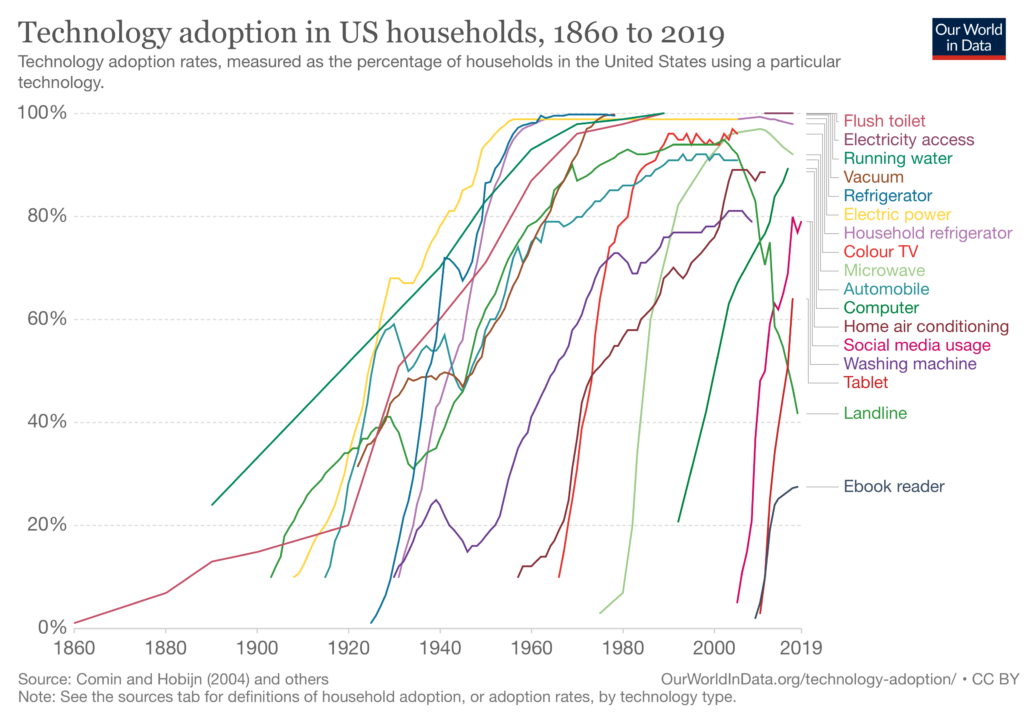
    Typically adoption curves project a market’s desire for a product. The graph below is a standard view of various technologies adopted over time by US households. Clearly some achieve nearly 100% market adoption (like flush toilets), while others achieve high adoption only to lose share in the long run (like landline phones). Geoffrey Moore’s Crossing the Chasm suggests that a company tailor its products specifically to a key market segment known as the “early majority” to move from “early adopters”, achieve success and grow more market share. Those that don’t cross this chasm either fail outright, or limp along in a low- or no-growth regime, sometimes for, well, decades (like Ebook readers!). This is something I have seen countless times in edtech, and that was certainly true of ALEKS before it was acquired by McGraw-Hill Education (MHE).

    https://ourworldindata.org/technology-adoption

    So what changed? For ALEKS, being more integrated with MHE content, marketed and sold by the considerable resources of a major textbook publisher helped generate new demand. But like most big publisher products, faculty tend to use ALEKS as a supplement to a course. Typically these products comprise 30% or less of the course activities and grade-able components. It’s difficult to say whether the product has “crossed the chasm” at this stage.

    On the other hand, Acuitus—the tutoring technology platform cited in the EdSurge article—has been refining an approach over the last several decades to model how human tutors help with valuable interventions at key points of the learners’ progress. Their goal now is to pivot to more mainstream education needs, including an income-share arrangement for upskilling workers. A task that will require many millions of dollars to achieve. They are most definitely still trying to cross the chasm.

    Some would argue that product-market fit—the degree to which a given product satisfies strong market demand—improved in both of these cases, but why is it taking so long for the industry at large to adopt these kinds of technologies? Despite the growing influence of “online learning” in the industry, why are so many faculty still wrestling with getting the basics of their curricula ready for the demands of the incredibly altered 2021 academic year education landscape? Why does it seem like EdTech players writ large continue to struggle to find the right product-market fit to gain significant market share advantage?

    First and foremost, technology alone is not going to provide the answers. The latest adaptive learning platform is useless without good content. And an online course will fall short if it does not offer truly great user / learner / teacher experiences from implementation through completion. Using technology to track learner profiles is great, but if a significant percentage of the learners are using their own technology to search homework sites for answers to textbook questions, then a learner profile will not describe outcomes accurately. More generally, faculty who do not have formal training or the support of institutional culture, policy, infrastructure and best practices to implement their courses will likely struggle.

    I would never claim to have all the answers, but I do believe that these extreme exogenous factors that flow from the pandemic are fundamentally recasting many of the vectors that drive an adoption curve. Chief among them, the stark threats to institutional viability and business continuity will force the shape of what has been an otherwise long and drawn out technology adoption curve to accelerate. Other vectors like advancing technology, business model innovation by institutions and commercial providers, the regulatory landscape, and changing consumer tastes will continue to add accelerants as well.

    It is increasingly clear this crisis mode we are in will permanently change attitudes. But it certainly should/will not be simply “how do I stuff my powerpoints into the LMS?” rather a more deliberate consideration of how technology-enabled teaching and learning must be implemented to ensure our academic institutions stay relevant to the needs of learners while also retaining the most important features of academic freedom, academic integrity and enduring brand value.

    Next up: The Billion Dollar EdTech Platform Hole

    The egg layers: Poppy, Paisley, Cherry, Princess Leia and Nutmeg
  • #ResilienceNetwork Discussion Prompt Video

    As I mentioned in a previous post, I want to encourage conversation among groups about how we can build a #ResilienceNetwork together. The first such conversation will be next week at the Apereo Foundation virtual conference. I’ve created a discussion prompt video to kick off the conversation:

    #ResilienceNetwork Discussion Prompt

    [https://youtu.be/n8rY1PnH6o0]

    Here’s the lesson plan:

    • The foundation will be posting the video above on a discussion thread accessible to conference attendees. We will encourage folks to brainstorm asynchronously before we start.
    • I will facilitate a conversation with community leaders—in this case, Ben Maddox from NYU, Matthew Rascoff from Duke, and Aria Chernik from Duke OSPRI—about the input. We will also have synchronous breakout groups to discuss the prompt. These two pieces can be sequenced in either order, depending on the preference of the community.
    • We’ll wrap with a discussion with the leaders processing the input from the community and talking about the next steps to refine and prioritize the ideas and develop an action plan.

    The video and lesson plan are CC-BY licensed, as usual. You can use them without my prior permission. If you want to do this yourself with your group, feel free. If you produce interesting results, let me know. If you think that I can help, then ask me and I’ll help if I can.