
e-Literate

Present is Prologue

Category: Academics & Academia

The “Academics and Academia” category covers topics related the ways in which colleges and universities function that are relevant to technology-supported education. One key aspect covered here is pedagogy—how people teach—and how technology impacts teaching and learning.

But this category also includes more institutional aspects that are relevant to technology-supported education, such as how campus leadership supports (or doesn’t support) new initiatives, politics and bureaucracy that impact these efforts, and so on.

Finally, “Academics and Academia” covers commercial and non-profit services that provide support for technology-supported education initiatives, such as Online Program Management (OPM) companies.


  • Unizin Updates on Florida State System and Acquisition of Courseload

    I’m not sure when e-Literate was awarded the exclusive rights for non-PR Unizin coverage, but there were two announcements this week to cover.

    State University System of Florida Joins

    The first announcement is an update and confirmation of my recent post about the new associate membership option. If a member institution (one of the 11 members paying $1.050 million) sponsors their statewide system, that system can join Unizin as “associate members” for $100 thousand per year but without retaining a board seat and vote on product direction. The week the State University System of Florida (SUSFL) announced they are joining Unizin.

    Building on its growing record of collaboration, the State University System of Florida, comprised of Florida’s 12 public universities, has joined Unizin, a group with a mission to have more control and influence over the digital learning ecosystem. (more…)
  • Release of University of California at Davis Case Study on e-Literate TV

    Today we are thrilled to release the fifth and final case study in our new e-Literate TV series on “personalized learning”. In this series, we examine how that term, which is heavily marketed but poorly defined, is implemented on the ground at a variety of colleges and universities. We plan to cap off this series with two analysis episodes looking at themes across the case studies.

    We are adding three episodes from the University of California at Davis (UC Davis), a large research university that has a strong emphasis in science, technology, engineering, and math or STEM fields. The school has determined that the biggest opportunity to improve STEM education is to improve the success rates in introductory sciences classes – the ones typically taught in large lecture format at universities of their size. Can you personalize this most impersonal of academic experiences? What opportunities and barriers do institutions face when they try to extend personalized learning approaches?

    You can see all the case studies (either 2 or 3 per case study) at the series link, and you can access individual episodes below. (more…)

  • Unizin Perspective: Personalized learning’s existence and distance education experience

    By reading the Unizin pitch for the State University System of Florida shared yesterday, we can see quite a few claims about the (potential) benefits to be provided by the consortium. “Make sure that the universities were not cut out of [distance ed] process”; “Secure our foothold in the digital industry”; “Promote greater control and influence over the digital learning ecosystem”; Provide “access to the Canvas LMS at the Unizin price”; Provide “access to tools under development, including a Learning Object Repository and Learning Analytics”; Provide “potential for cooperative relationships to ‘share’ digital instruction within and across the consortium”.

    I want to pick up on University of Florida provost Joe Glover’s further comment on Learning Analytics, however.

    The third goal for Unizin is to acquire, create, or develop learning analytics. Some of the learning management systems have a rather primitive form of learning analytics. Unizin will build on what they have, and this will go from very mechanical types of learning analytics in terms of monitoring student progress and enabling intrusive advising and tutoring; all the way up to personalized learning, which is something that really does not exist yet but is one of the objectives of Unizin.

    (more…)

  • Instructure Is Truly Anomalous

    Phil started his last post with the following:

    I’m not sure which is more surprising – Instructure’s continued growth with no major hiccups or their competitors’ inability after a half-decade to understand and accept what is at its core a very simple strategy.

    Personally, I vote for Door #1. As surprising as the competition’s seeming sense of denial is, Instructure’s performance is truly shocking. After five years, I continue to be surprised by it. It’s not just how well they are executing. It’s that they seem to defy the laws of physics in the LMS market. We had no reason to believe that any LMS company could rack up the numbers they are showing—in several different areas—no matter how well they execute.

    (more…)

  • Unizin One Year Later: View of contract reveals . . . nothing of substance

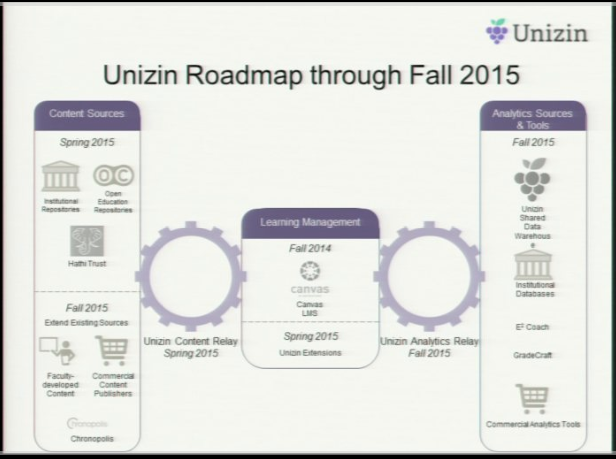
    I’ve been meaning to write an update post on Unizin, as we broke the story here at e-Literate in May 2014 and Unizin went public a month later. It’s one year later, and we still have the most expensive method to get the Canvas LMS. There are also plans for a Content Relay and Analytics Relay as seen in ELI presentation, but the actual dates keep slipping.

    Unizin Roadmap

    e-Literate was able to obtain a copy of the Unizin contract, at least for the founding members, through a public records request. There is nothing to see here. Because there is nothing to see here. The essence of the contract is for a university to pay $1.050 million to become a member. The member university then has a right (but not an obligation) to then select and pay for actual services. Based on the contract, membership gets you . . . membership. Nothing else. (more…)

  • The Importance Of Student Control Of Learning, Especially For Working Adults

    When giving keynotes at conferences over the past two years, I have observed that some of the best non-verbal feedback occurs when pointing out that personalized and adaptive learning does not equal black-box algorithms choosing content for students. Yes, there are plenty of approaches pitching that solution (Knewton in its early state being the best-known if not most-current example), but there are other approaches designed to give faculty or instructional designers control over learning paths or even to give students control. There seems to be a sense of relief, particularly from faculty members, when discussing the latter approach.

    In the Empire State College case study on e-Literate TV, I found the conversation Michael had with [faculty member] Maya Richardson to be a great example of not just giving faculty insight into student learning but also giving students control over their own learning. As Maya explains, this is particularly important for the working adult population going back to school. The software used in this pedagogical approach is CogBooks.

    (more…)

  • Instructor Replacement vs. Instructor Role Change

    Two weeks ago I wrote a post about faculty members’ perspective on student-centered pacing within a course. What about the changing role of faculty members – how do their lives change with some of the personalized learning approaches?

    In the video below, I spoke with Sue McClure, who teaches a redesigned remedial math course at Arizona State University (ASU) that is based on the use of Khan Academy videos. There are plenty of questions about whether this approach works and is sustainable, but for now let’s just get a first-hand view of how Sue’s role changed in this specific course. You’ll see that it took some prodding to get her to talk about her personal experience, and I did have to reflect back what I was hearing. Note that the “coaches” she described are teaching assistants.

    (more…)