
e-Literate

Present is Prologue

Category: Academics & Academia

The “Academics and Academia” category covers topics related the ways in which colleges and universities function that are relevant to technology-supported education. One key aspect covered here is pedagogy—how people teach—and how technology impacts teaching and learning.

But this category also includes more institutional aspects that are relevant to technology-supported education, such as how campus leadership supports (or doesn’t support) new initiatives, politics and bureaucracy that impact these efforts, and so on.

Finally, “Academics and Academia” covers commercial and non-profit services that provide support for technology-supported education initiatives, such as Online Program Management (OPM) companies.


  • Sakai 3 Learning Capabilities Lenses

    A while back, I asked David Goodrum to write a guest post about some of the work that the Sakai Teaching & Learning Group has been doing to articulate the educational goals and requirements for Sakai 3. The document that they have been working on is called the Sakai Learning Capabilities document, and it entered a 1.0 release just prior to the start of the Denver Sakai conference. This is very important work that will certainly impact the future of Sakai and could have a wider impact in instructional technology.

    The group articulate seven “lenses”, which you might think of as functional goals or even as design values for Sakai 3. They are called lenses because each one presents a different view or perspective of any given piece of functionality within Sakai 3 (or any piece of educational technology, really). Every tool and capability within the system should be examined from the perspective of each of the seven lenses at some point in the design phase to help the designers make sure that they are upholding the design values of the system wherever and whenever possible. Each lens contains several finer-grained “facets” which are, again, intended to help software designers ask the right questions as they are designing educational capabilities. These lenses include capabilities for addressing traditional LMS and ePortfolio as well as important educational scenarios that are not handled well by today’s systems.

    Here’s what version 1.0 of the lenses looks like as a mind map:
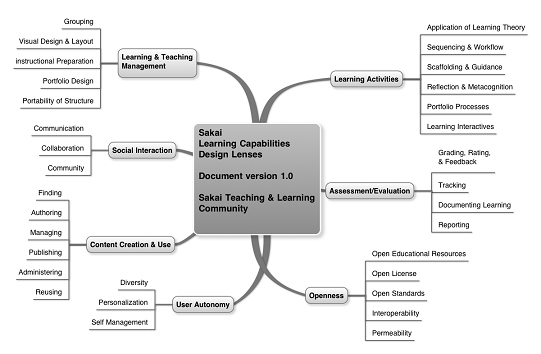
    Sakai Learning Capabilities v1 Mind Map

    Note that at least two of Dan Pink’s three drivers of motivation are articulated on the map. Autonomy is called out fairly directly as a lens. I would argue that “mastery” is represented in some of the facts of the “learning activities” lens. (Interestingly, the facet descriptors in the “assessment/evaluation” lens seem relatively devoid of connections to mastery at this point, although in fairness, there’s a lot more thought and analysis underneath this mind map that the descriptors may not be capturing.) I’m not sure that Dan Pink’s third motivator—purpose—can be wired into software, although I’ll be keeping my eye out for examples of it.

    The key for the community will be to figure out how to translate these design values into concrete processes during the software design and development process. I have some ideas about how to go about this this. I hope/expect to write about them in a future post.

  • Sakai Conference: Kamenetz Keynote

    OK, this was worth the wait. I have video of Anya Kamenetz’s keynote, which set the tone for the Sakai Conference 2010 in some important ways. I also have a short video interview with her, some related video content from Dan Pink, and of course, analysis of what all this means for educational technology in general and for the design of Sakai 3 in particular.

    Be warned: It will take you over 90 minutes to consume all the content from this post. Not counting post-consumption rumination. ((Did I or did I not warn you about impending blogorrhea? I believe I did.))

    (more…)

  • What Intrigues Me About Google Wave

    Now that I’ve had a little while to think about it, I’m ready to distill my initial enthusiastic reaction to Google Wave down to a manageably short (and hopefully non-fanboi) post. Let me say at the outset that I have no idea whether Wave will succeed. I am convinced, however, that something like Wave will succeed, in part because much about it is not new. My initial thought was was, “Hey, somebody finally got Apple’s OpenDoc to work.” Scott Wilson twittered that Google had reinvented ActiveX. In some ways, Wave is, like many great inventions, an old idea with some new twists. This is not to minimize the value of those twists. To the contrary, they are astonishing. My point is simply that the essence of Wave will survive whether ore not Wave itself is a success because many of the core ideas have been proven to be compelling in the past.

    At any rate, there are a number of elements to Wave that are particularly attractive and likely to change practice in the field of e-learning:

    (more…)

  • Imagining a WeLE

    A while back, I noted with some interest Michael Korcuska’s screencast showing off a prototype of some functionality planned for Sakai 3. Some recent related conversation has come up on the Sakai listservs regarding the possibility of including wiki-like capabilities as core functionality of Sakai 3 and how this might overlap with and complement the capabilities in the screencast. I will argue here that, if combined carefully and enhanced with one more idea that has been floating around for Sakai 3, we end up with something quite new and interesting in the world of learning environments. I propose calling this new and interesting something a “Wiki’ed Learning Environment”, or WeLE.

    (more…)

  • Permissions and Openness

    I’ve been reading Opening Up Education. So far, I’m impressed. It’s hard to get all the articles in a collection like this to be consistent, coherent, and equally interesting, but the editors seem to have managed to do just that. 

    I want to comment today on the piece about Bodington by Stuart Lee. Long-time readers know that I have been a fan of this system. In the first part of a multi-part review of the system, I wrote:

    I have long complained that LMS permissions systems are usually too rigid and narrowly defined. Bodington’s permissions are more flexible than just about any other LMS I’ve ever seen. (It’s possible that dotLRN’s OpenACS-based permisions are as flexible, but if so, then they are hidden deep under the hood–typically out of the reach of most faculty members.) In most systems, you have a few pre-defined roles–teacher, student, administrator, TA, etc. These roles generally have pre-defined permissions. You can create groups that are essentially nested containers, e.g., a student group will always be a strict subset of the class that contains it. Likewise, these groups are often (though not always) mutually exclusive, i.e., a student can’t be a member of both Group A and Group B at the same time.

    Bodington works completely differently. Every object–a content bit, a discussion forum, etc.–can have an arbitrary number of groups attached to it, each group can have an arbitrary number of overlapping members, and each group can also have arbitrary fine-grained permissions for the object.

    At the time, I caught some flack for focusing on what some viewed as trivial aspects of the system. But Stuart’s essay, along with some recent comments to the Sakai discussion boards about the version 3 vision document, show that this stuff really matters.

    (more…)

  • Storytelling with Web 2.0

    From my college friend @SarahM, who has turned out to be vastly cooler than I am, comes a tip about storytlr, a new service that looks like it has some interesting potential for the classroom. Basically, it takes inputs from all kinds of Web 2.0 tools—Twitter, Flickr, YouTube, Picasa, Facebook Random RSS feeds, etc.—and strings them together into a narrative. Basically, you choose the inputs, the date range, and the web page template, and the system puts out a storyboard with your pictures, videos, blog posts, tweets, etc., in chronological order that you can then edit. This would be fantastic for class projects or trips.

    Sweet!

  • A New Article Out

    I’ve been so busy lately that I haven’t even had time to post notice that I have a new article published in ALT-N. I’ve been having conversations on and off with Rob Abel about ways to ensure that educational technology standards (and, of course, the educational technologies themselves) are more effectively informed by our developing understanding of best practices in online teaching and learning. More recently, I’ve been having somewhat similar conversations with Seb Schmoller, except in the context of ALT rather than IMS. Coincidentally, Seb sent me an issue of ALT-J that talks about the use of pattern languages to make sure that accepted best practices in online learning are more effectively informed by various cognitive and learning theories, and vice versa. (Longtime readers know that I have a fondness for notion of pattern languages and have even created a category on my blog about applying the concept to education.) As I read the article, it occurred to me that use cases serve a similar bridging function between software users/practitioners and software developers. If you could form a bridge between a pattern language of educational best practices and a body of use cases that describe how software could support those best practices, then you might really have something. Hence, the article.

    As usual, Stephen Downes as a few nits to pick.

    To begin with, he complains about the use of the word “praxis,” which he describes as “just the word ‘practice’ with an attitude.” It’s true that “praxis” is often incorrectly understood as and used interchangeably with “practice,” which is why I usually avoid using it. I chose to use it this time for two reasons. First, the authors of the article on pattern languages used it, so if I chose not to use it I would be creating an inconsistency in language which I would have to take significant word count to explain. More importantly, though, they had used it correctly. Praxis, properly understood, refers to the set of best practices that is empirically derived from practice (as opposed to being the practice itself). It is a kind of experiential-derived theory and is meant to be contrasted to more classical scientific theory. So principles of physics are theory while principles of engineering are (generally) praxis. Or, in this context, principles of education derived from cognitive psychology are theory while principles of education derived from teaching experience are praxis.

    His other complaint is…well…I’m not sure what it is. He writes,

    I’m uneasy with this – it’s hard to articulate why, exactly – but I don’t think software should be designed to ‘do things’ so much as it should be designed to ‘create capacity’. I know that’s not a very clear distinction. But it’s like the difference between ‘process’ and ‘creation’.

    He’s right about one thing. It’s not a very clear distinction. In fact, I have no idea what he’s talking about. The only thing I can think of regarding “creating capacity” is Don Norman’s concept of affordances. But affordances are entirely consistent with use cases. In fact, use cases are an excellent (and commonly used) way to ensure that your software is designed to “create capacity” in the way that users want.

    So I guess I’m still in the dark. If Stephen (or anyone else) wants to couch his criticism in concrete terms that are consistent with the…um…praxis of user-centered software design, then I’ll be happy to respond further.