e-Literate

Present is Prologue

Category: Academics & Academia

The “Academics and Academia” category covers topics related the ways in which colleges and universities function that are relevant to technology-supported education. One key aspect covered here is pedagogy—how people teach—and how technology impacts teaching and learning.

But this category also includes more institutional aspects that are relevant to technology-supported education, such as how campus leadership supports (or doesn’t support) new initiatives, politics and bureaucracy that impact these efforts, and so on.

Finally, “Academics and Academia” covers commercial and non-profit services that provide support for technology-supported education initiatives, such as Online Program Management (OPM) companies.


  • Worth Considering: Faculty perspective on student-centered pacing

    Over the weekend I wrote a post based on the comment thread at Friday’s Chronicle article on e-Literate TV.

    One key theme coming through from comments at the Chronicle is what I perceive as an unhealthy cynicism that prevents many people from listening to students and faculty on the front lines (the ones taking redesigned courses) on their own merits.

    Sunday’s post highlighted two segments of students describing their experiences with re-designed courses, but we also need to hear directly from faculty. Too often the public discussion of technology-enabled initiatives focus on the technology itself, often assuming that the faculty involved are bystanders or technophiles. But what about the perspectives of faculty members – you know, those who are in the classrooms working with real students – on what challenges they face and what changes are needed from an educational perspective? There is no single perspective from faculty, but we could learn a great deal through their unique, hands on experiences. (more…)

  • Blueprint for a Post-LMS, Part 5

    In parts 1, 2, 3, and 4 of this series, I laid out a model for a learning platform that is designed to support discussion-centric courses. I emphasized how learning design and platform design have to co-evolve, which means, in part, that a new platform isn’t going to change much if it is not accompanied by pedagogy that fits well with the strengths and limitations of the platform. I also argued that we won’t see widespread changes in pedagogy until we can change faculty relationships with pedagogy (and course ownership), and I proposed a combination of platform, course design, and professional development that might begin to chip away at that problem. All of these ideas are based heavily on lessons learned from social software  and from cMOOCs.

    In this final post in the series, I’m going to give a few examples of how this model could be extended to other assessment types and related pedagogical approaches, and then I’ll finish up by talking about what it would take to make the peer grading system described in part 2 be (potentially) accepted by students as at least a component of a grading system in a for-credit class.

    (more…)

  • Pearson, Efficacy, and Research

    A while back, I mentioned that MindWires, the consulting company that Phil and I run, had been hired by Pearson in response to a post I wrote a while back expressing concerns about the possibility of the company trying to define “efficacy” in education for educators (or to them) rather than with them. The heart of the engagement was us facilitating conversations with different groups of educators about how they think about learning outcomes—how they define them, how they know whether students are achieving them, how the institution does or doesn’t support achieving them, and so on. As a rule, we don’t blog about our consulting work here on e-Literate. But since we think these conversations have broader implications for education, we asked for and received permission to blog about what we learn under the following conditions:

    • The blogging is not part of the paid engagement. We are not obliged to blog about anything in particular or, for that matter, to blog at all.
    • Pearson has no editorial input or prior review of anything we write.
    • If we write about specific schools or academics who participated in the discussions, we will seek their permission before blogging about them.

    I honestly wasn’t sure what, if anything, would come out of these conversations that would be worth blogging about. But we got some interesting feedback. It seems to me that the aspect I’d like to cover in this post has implications not only for Pearson, and not only for ed tech vendors in general, but for open education and maybe for the future of education in general. It certainly is relevant to my recent post about why the LMS is the way it is and the follow-up post about fostering better campus conversations. It’s about the role of research in educational product design. It’s also about the relationship of faculty to the scholarship of teaching.

    (more…)

  • Why Big Data (Mostly) Can’t Help Improve Teaching

    Here’s a nifty video summary of a doctoral dissertation by Derek Muller that a client pointed out to me:

    The basic gist is that students have pre-conceived notions that are wrong, and it is very hard to dislodge those mistaken notions. If you show them a video with an accurate explanation, the students will say that the video was clear and helpful, but they will misremember it as confirming their (mistaken) preconceived notions. In short, they won’t learn. In contrast, if you show them a video that starts by directly stating and then refuting their misconception, they like the video less and say it is confusing, but they actually learn more. This is a really important pedagogical point to know whether you are giving traditional in-class lectures, writing curricular materials, or creating one of those oh-so-modern video lectures that all the cool kids are into these days.

    It’s also a good example of the kind of insight that big data is completely blind to. And it gives us good reason to be skeptical that taking large lecture courses online, turning them into REALLY large lecture courses (with nice videos), and expecting that new and more effective pedagogies will rise out of the data because, you know, science or something, is more of a hope (or a fantasy) than a plan to improve education.

    (more…)

  • Where xMOOCs and Adaptive Analytics Both Fail (For Now)

    No, this isn’t just an attempt to cram as many sexy keywords into one post title as possible. xMOOCs and adaptive analytics share an ambition: They both are at least partially motivated by a desire to teach at scale. With MOOCs, the goal is obvious. With adaptive analytics, less so, partly because there are multiple motivations and maybe because the desire for scale is not something that is polite to talk about due to a certain amount of discomfort with it. But the motivation is definitely there if you look closely, as I’ll get into in a bit.

    The problem is that both of these approaches, in their current incarnations, miss one absolutely critical element of the teaching process. As you can probably guess from all the qualifiers I am using in my language, I don’t think it’s an inherent or permanent failing. But I worry that it’s a failing due to a deep cultural blind spot that we have about what education is, and that it therefore will be challenging to address.

    (more…)

  • Open Secret: Pittsburgh’s Ed Tech Revolution

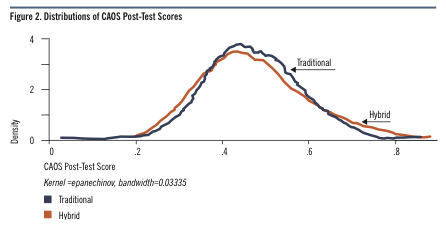
    Generally when we talk about goals for educational technology, we talk about one of two things: improving access or improving effectiveness. Rarely do we get an opportunity to talk credibly about an innovation that can move both of those needles at the same time. And yet, I saw just such innovation in Pittsburgh this week at the LearnLab Corporate Partners Meeting. LearnLab, jointly run by Carnegie Mellon University and the University of Pittsburgh, is not widely known in ed tech circles. However, it’s close cousin OLI is. For example, an independent study by ITHAKA S+R made a splash when it showed OLI could cut instructional time in half and still achieve the same level of effectiveness. Two groups of students across six different public universities took the same introductory statistics class. The first group took a traditional version of the class, with an average of 3 hours per week spent in the classroom. The second group took a hybrid version, where they spent one hour a week in the classroom and some time studying independently with the OLI cognitive tutoring software. So that second group spent one-third of the time in the classroom, which amounts to a very significant cost savings and an opportunity to teach more students for less money. Students themselves spent more time on homework in the second group than the first, but even so, they spent 25% less total time on the class than the ones in the traditional class. And yet, both groups achieved essentially the same competence at the end of the class:
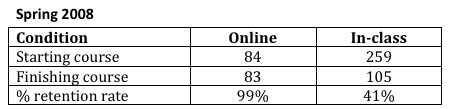
    To sum up, OLI was able to teach more students at lower cost and with less time on task from the students yet with the same effectiveness of a traditional class. Another, smaller study with similar traditional vs. cognitive-tutor-hybrid for an introduction to logic course found that while students in the hybrid condition saw a small (though not statistically significant) gap in learning effectiveness relative to their peers, they achieved more than double the completion rate:
    OLI is pretty well known in the broader ed tech community. They show up at conferences. The ITHAKA study got lots of play. I find it odd that we have not had a broader conversation about how they have achieved their results. Because the techniques developed by OLI, their colleagues at LearnLab, and their collaborators in other institutions have serious implications for OER, MOOCs, the textbook industry, and really, the future of education.

    (more…)

  • Going Meta on Khan

    The wonderful Dan Meyers points to this delightful Mystery Science Theater 3000 homage by John Golden and David Coffey as they critique one of Sal Khan’s math videos. Here’s the video:

    Everybody enjoys a good snarkfest, and these guys are particularly good at it. But those who are taking delight in seeing Sal Khan get “taken down a peg” are completely missing the value and innovation here. To me, the important thing is that these guys have adopted one of Khan’s signature moves—short, low-production-value, personal web videos—to critique pedagogical technique. This has great value for math teachers who may miss some of the finer points of math instruction (e.g., consistency in terminology) that Golden and Coffey point out in their review. It’s basically a Khan Academy-style lesson for teachers, and it should be able to scale in production just as Khan Academy itself has. I would love to see many, many more video reviews of instructional materials on the web.

    To their credit, Khan Academy has taken down the video in question, presumably to improve the video based on the critique. One of the premises of OER is that people will improve the quality of materials. The assumption is generally that they will do so themselves by editing, but this is a demonstration that just having the content out in the open where the author can get feedback is of great value too.