The “Big Picture” category covers larger trends and topics that influence both the problems that technology can help address in education as well as the barriers to implementing high-quality technology-supported education. This includes research-based topics such as learning science and program effectiveness studies, philosophical discussions such as outcomes definitions, and macro-forces such as government policy, markets, and business models.
I’ve been waiting impatiently to write my review of Paul LeBlanc’s Broken: How Our Social Systems Are Failing Us and How We Can Fix Them. I was lucky enough to get a pre-release copy. I don’t know why, but I don’t tend to write book reviews. It just doesn’t occur to me most of the time for some reason. But Broken grabbed me by the short hairs.
This isn’t your typical president-of-a-large-university-writes-a-book-about-the-future-of-education book. If you want to read that Paul LeBlanc book, read Students First: Equity, Access, and Opportunity in Higher Education, which (unsurprisingly) advocates for Competency-Based Education (CBE). But read Broken first. It provides a framework that will change the way you read Students First and, frankly, many other books as well.
This is one of those rare books that I will be thinking about for a long time.
Systems of care
The core question of the book is why systems designed to help people—education, healthcare, government, prison/rehabilitation, etc.—end up failing the very people they are designed to serve so often. He refers to these collectively as “systems of care.” He seeks out answers in other systems of care to bring back to his own.
I understand why he confines the scope of the book to these systems and the main focus to education. These are the systems he studied and he knows, respectively. That said, I believe the implications of the book are much broader. Every system that organizes humans for a purpose is a system of care. My phone company is a system of care; I need its help to reach my family or call an ambulance. A company must care about—and therefore care for—its customers. It must also care about—and therefore for—the employees who take care of the customers. I need my employer to help me feed, clothe, and house myself and my family.
I know this runs counter to the entrenched narrative about capitalism and the behavior of many companies. But it’s consistent with both long-standing economic theory and the economic realities of 2022.
The seminal economic work about why companies exist is Ronald Coase’s “The Nature of the Firm.” Coase focused on the “transaction costs” of running a business. These could include bargaining for work from somebody you need it from, coordinating multiple people working together, and making sure trade secrets stay secret, among others. The more difficult and expensive it is to manage these costs with independent contractors, the more likely the business owner is to hire employees instead. And since these costs add up as an business grows, bigger businesses will tend to realize bigger savings by organizing as companies, having employees, putting a management structure in place, and so on.
Coase wrote his paper in 1937. Economic thinkers, particularly at that time, typically haven’t written about it as bi-directional. But employees make choices too. If they don’t have mobility, they can choose to do the absolute minimum required of them to keep their jobs. They can choose to see the relationship with their employer as exclusively transactional. Meanwhile, technology has vastly increased mobility for many workers. The most obvious recent signs are the rise of the gig economy and the Great Resignation. But we experience the bi-directionality of Coase’s theory—or at least something we might call “Coasean backlash”—every time we get stuck on the grocery line because the check-out person isn’t paying attention to her work and every time we speak to a customer service agent who is obnoxious and unhelpful.
Coase published his article at a time when “scientific management,” or “Taylorism,” was at its peak. This approach, which was rooted in the industrial revolution, treated workers almost literally as cogs in the production line and employment relationships as transactional. All jobs were broken down into repetitive tasks and analyzed for efficiency. Workers were paid based on how quickly and efficiently they worked.
The theory Broken offers up is nothing short of the antithesis—the anti-thesis—to Taylorism, as applied primarily to higher education. It could be called “humanistic management.” It’s an answer to the challenge of what good management looks like in an era when the bi-directionality of choice in Coase’s theory is more symmetrical (and when you actually care about the outcomes for the people you serve).
The two core elements in LeBlanc’s humanistic management are humane organizational structures and humane practices of managers.
Conway’s Law
As big companies have grown ever bigger and organizational structures have multiplied over the decades and centuries, humans have had a chance to observe how and how well they work in a variety of contexts. One such human is Mel Conway, a software engineer. He observed that if an organization set out to develop a piece of software, and three departments or teams worked on that software, the software would consist of three modules. Further, the quality with which those modules interacted with each other would directly reflect the quality of the interactions among the teams working on the software. Conway argues that the ways that we organize ourselves to work not just influence but actually determine the design of systems we make in important ways. For example, when I think about the first six or eight releases of the Sakai learning management system, up to about the time that I stopped paying attention to it, many of its major architectural decisions and probably more than 90% of its most egregious flaws could be directly traced to the ways in which the universities in the open-source coalition chose to organize themselves and the quality of their collaboration in the early days of the project. The software was a second-order effect of the collaboration.
Conway’s law can be generalized to the following:
Organizations that design systems are constrained to produce designs which are copies of the communication structures of these organizations.
A system could be anything, including an undergraduate education.
Conway’s Law and Coase’s Theory of the Firm are in tension with each other. Coase tells us that the more scale an organization attempts to achieve, the more it will need operational control by organizing people into units and reporting structures. Conway tells us that the more we fragment the organization into units, the harder it is for those units to work together to produce whatever it is they’re supposed to be producing together.
Without mentioning either Coase or Conway, LeBlanc highlights this dilemma and delves into it in detail. He can’t give up on the ambition of scale because too many students who need education either don’t have access to it at all or aren’t being offered it in a form that can work with their needs and lives. But in building a machine large enough to serve 180,000 students, Conway’s law bites again and again. To make matters worse, the more dysfunctional the organization becomes, the more disaffected and transactional the employees are likely to behave. The harder he drives toward humane outcomes for more students, the harder it becomes to maintain a system that is effectively humane.
To his credit, LeBlanc offers no grand solution to this problem. Instead, he tells many small stories across multiple sectors of places where building out a scaled machine for humane purposes produced inhumane consequences and how good leaders addressed the situations. There is no simple fix for the tension between scale and humaneness. It’s a perpetual game of whack-a-mole. Yet somehow, he doesn’t make that feel hopeless. Daunting, yes. But part of the job. And intensely rewarding at times.
You can’t spell “humane” without “human”
Another aspect of this book that I love is that it doesn’t get caught up in theoretical discussions about economic theory and observations of software engineers. Broken is scholarly but also deeply personal and accessible. I envy the transparency and clarity of Paul’s writing.
Over and over again, he makes the point that no system works if the people in it—whether customers or employees—feel like they don’t matter and their work doesn’t either. This is both consistent with the ethos of the educator that he is and entirely consonant with the literature on organizational psychology. But rather than leaning on that literature, he leads by example, making himself vulnerable by writing about his mistakes and worries of inadequacy while celebrating the wisdom of his colleagues and his students.
It’s not enough to fight against the centrifugal force that rips apart purpose in an organization using the tools of management and organizational design. We also need leadership that is centered on love, purpose, and mattering. This message could easily turn toward cliché. But in LeBlanc’s deft hands as a writer, it remains specific, actionable, and clear enough that it feels more like wisdom.
Broken is a joy to read, pure and simple. Whether LeBlanc is telling a story about his tough but loving Acadian family in hardscrabble New Brunswick, Canada; an anecdote about a student who touched his life; or a painful lesson from when he failed to live up to his ideals, the book feels at least as much like a personal story as it does the scholarly study that it is. So much so, in fact, that I worry some readers will miss the larger contribution this book makes to the literature on the future of higher education and, more broadly, the future of management. If you follow this book with Students First, which is the more traditional kind of prescriptive book you might expect from a prominent university president, you will see the theoretical machinery and ethical imperatives of Broken that animate the earlier work.
My Challenge to Paul LeBlanc
It’s rarely fair to criticize books for what they don’t do. I’ll just say that the work Broken sets out to accomplish feels unfinished. Here’s what I would love to see next from Paul LeBlanc and SNHU: Distill the management principles of Broken into competencies. Share them. Have them critiqued by the same broad range of people that LeBlanc consulted with for the book as well as by academic subject matter and learning design experts. Develop and offer a CBE degree or certificate program based on it.
Well, Texas is the gift that keeps on giving this week.
The Texas Tribune just published a piece entitled “Texas Could Tie Community College Funding to Outcomes.” The outline of a proposal is on the table and the final report due to the legislature in November. While the article has many encouraging details across a range of topics, two jumped out at me related to the topic of CBE and ecosystems.
The first is outcomes-based funding. This is not new in Texas. The current proposal involves refining the system to make it more equitable and effective. In researching the system, I discovered—as I had hoped and expected—that it takes transfers to four-year colleges into account. Community colleges earn the same number of points if students transfer to a four-year college after earning 15 or more credits as they do if the student graduates.
This is another piece of the puzzle for creating positive evolutionary pressure. Community colleges get more funding for successful student transfers. How do they increase their odds? By following the core curriculum standards, competencies, and numbering system. That said, an ecosystem is neutral with respect to “good” outcomes. It only drives toward stability as a whole and creates evolutionary pressure on its inhabitants to evolve in a direction that increases their chances of survival. These mechanisms don’t optimize for a good education merely by existing. They do create pressure for systems that enable students to transfer and complete their educations at a lower cost. That much is good. The quality of education depends on how well crafted the competencies and assessments are. But if the pressure for natural selection exists, then evolutionary forces exist. Reform advocates can focus their efforts on cultivating that ecosystem by refining the competencies and outcomes, which will point the evolutionary pressures in the direction of the kind of evolution that produces the humane outcomes we want to see from the system.
Such an effort will inevitably trigger reactions from academics inside these institutions, including some negative ones. That is good if handled with care and respect. Ultimately, the guardians of quality at each institution need to be won over for real change to take hold. If CBE (or any other curricular change) is really going to take hold, these guardians need to feel like their professional identity—which impacts their fit for the ecosystem they live in—is invested in the quality design and execution of key CBE components. In Richard Dawkins’ framework, we might think of these folks as the “selfish genes” (which I mean, as Dawkins did, in the evolutionary sense and not as an insult to the character or motivation of our educational quality champions).
The second bit of relevant news is that there is at least some talk of “providing funding for non-credit programs will encourage schools to enroll more students in those areas where there is a large demand for jobs upon completion.” Since I don’t know the Texas policy participants and process well enough, I can’t gauge how likely this is to make it into legislation. But this is a good opportunity for experimentation with relaxing the seat-time requirement since, as far as I know, these programs are not governed by the laws that compel degree programs to abide by Carnegie requirements.
There are a few colleges and universities that are already using direct assessment to deliver full CBE in for-credit programs. My cursory scan turned up Austin Community College, Lone Star College, South Texas College, TSTC-Harlingen, and WGU Texas. I’m sure there are others I missed. Texas has a beachhead for full CBE. If the state funds non-credit pathways—and particularly if the state provides incentives for performance in these pathways—that would create another ecosystem, another vernal pool, in which CBE could evolve.
There’s enough here that somebody must have research that I’m not seeing on CBE in Texas. Please shoot it my way if you have it.
I realize that yesterday’s post about the role of ecosystems in realizing Paul LeBlanc’s vision for CBE is a bit abstract. Luckily, Providence provides. Today’s Inside Higher Ed brings us an article entitled “What Faculty Know (and Don’t Know) About Transfer—and Why It Matters” by Vita Rabinowitz, Yoshiko Oka, and Alexandra W. Logue of CUNY’s Transfer Opportunity Project (TOP). I mentioned transfer as a potential area where competencies could plausibly become the survival measure that drives evolution. I also made a point of calling out the role of faculty in traditional universities as critical actors in the ecosystem. This article brings these two points together.
The invisibility of the transfer problem
Let’s start with the very basics of understanding the problem with this beautifully written passage by the authors:
“To the best of your knowledge, about what percentage of the graduates of your primary college every year are vertical transfer students?” bachelor’s program faculty answered “don’t know” 70 percent of the time, and they were twice as likely to give the wrong answer than the right one: that more than 50 percent of those graduates are vertical transfer students. If bachelor’s program faculty have no idea that many and often most of their students—including their majors—started their college careers elsewhere, then they may make faulty assumptions about vertical transfer students’ prior learning and level of preparedness. They may also be less likely to recognize the challenges that many of their transfer students face in getting good advice about course taking, securing the right academic supports and finding community and a sense of belonging.
At bachelor’s-granting institutions at CUNY and across the nation, there has historically been a particular focus on first-time, full-time freshmen that has rendered transfer students nearly invisible. That makes it very difficult for anyone—faculty or even administrators—to have good information about transfer students. One of us was already provost of CUNY’s Hunter College for several months before realizing that fully two-thirds of the graduates she would celebrate at Hunter’s commencement were transfer students.
My own daughter transferred to Berkeley after getting an associate’s degree at a community college. I doubt most of her professors knew. She was older and more mature than a typical straight-from-high-school student. She got good grades and performed well. The point the authors are making is that students like her don’t always thrive. They have different needs and challenges than straight-from-high-school students. The challenges of these students are invisible because they themselves are invisible. They are not known as transfer students. Academics, by and large, do not know how prevalent these students are and therefore how differently the professionals need to think about supporting such a substantial percentage of the students in their care.
Separately, the authors write,
…[F]aculty were asked to agree or disagree with the statement “Students who transfer after having received an associate’s degree have more of their credits transferred to bachelor’s degree programs than students who transfer without an associate’s degree.” The correct answer is “disagree.” Only 6 percent of associate program faculty and 5 percent of bachelor’s program faculty answered this item correctly; 42 percent of the associate program faculty and 24 percent of the bachelor’s program faculty answered incorrectly. Fully 50 percent of associate program faculty and 70 percent of the bachelor’s program faculty answered “don’t know.” Moreover, only 7 percent of all faculty who reported ever having had formal roles gave the correct answer to this item, compared with 5 percent of faculty who reported never having had such roles. [Emphasis added.]
This point and the previous one are related. Faculty are largely ignorant both of how many transfer students they have and of how credit transfer problems impact them. Who decides what is transfer-worthy?
Faculty (usually) decide
In a separate Inside Higher Ed piece, “Who Decides on Transfer Credit?“, reporter David Moltz writes about the 2011 controversy at the CUNY system when the administration tried to establish rules about credits transferring from two-year to four-year CUNY schools. The proposal deeply divided the faculty. The opposition was clearly and vehemently articulated by the chair of the system-wide University Faculty Senate:
Sandi E. Cooper, chair of the system-wide University Faculty Senate and a history professor at the College of Staten Island, said she believes the broad changes being proposed by CUNY’s central administration are a “transparent attempt to ensure faster graduation” and that while “citing student complaints about the problems of transfer,” it is “proposing a cure that threatens the entire validity of the four-year degree.”
The administration has proposed a general education model in which all two- and four-year institutions would hold 36 credits — with courses distributed across disciplines — in common; then, each college would be able to designate up to six additional credits for the general education requirement that are specific to its institution. Cooper argues that asking colleges to trim their general education requirements, some of which currently consist of more than 42 credits, “dilutes quality” and the “rich range” of disciplines students may encounter in their higher education.
“An administration which pays for ads on the sides of buses, for billboards and for all manner of commercials demonstrating its commitment to quality, is now asking its baccalaureate institutions to bend to the limited educational attainments of transfer students who may have barely touched the menu of course work,” Cooper wrote in an e-mail to Inside Higher Ed. “What should be eliminated? Languages? Lab science? History? Courses that are too tough — math?”
At many universities, faculty decide what transfers. And those faculty—including the ones who have direct roles in deciding which credits transfer—are staggeringly ignorant of the concrete impact on students.
As Michael Horn and Richard Price wrote in a recent essay, transfer students typically lose 43 percent of the credits they bring with them. That is, the new institution refuses to accept those credits, and studnets lose ground while paying more for their degrees. Transfer students in California pay on average “an extra $36,000 for their bachelor’s degrees, if they can get them at all,” Horn and Price noted.
So faculty are making decisions that cost transfer students, which are often students of modest financial means, an average of an extra $36,000. Not because they don’t care. Sandi Cooper is clearly a passionate advocate for quality education. She cares about her students. But according to the CUNY TOP study, over 90% of CUNY faculty who are involved with making transfer decisions don’t know how dramatic an impact their decisions may have on college affordability for these students. Moreover, while they care, they are not responsible. Cooper clearly feels that it is her job, her personal responsibility, to ensure that students receive a quality education. While she likely cares about affordability, nothing in her statement indicates that she feels it is her personal responsibility to be a guardian of affordability.
This is not a failure of Sandi Cooper. It is a failure of the ecosystem. Professors in general are overwhelmingly ignorant of transfer and its impact on affordability because it is not part of their professional identity to be guardians of affordability. It is not in their professional genome (or meme-ome, if you want to be cute). And it’s not there because nothing in their ecosystem encourages them to feel responsible or empowers them with knowledge, data, and tools to meet obligations to quality, affordability, and viable paths to student success.
Competencies as an answer
As Paul points out in Students First, competencies are a potential answer to this conundrum:
Universities do not trust competencies[….] When students seek to transfer from one institution to another, they provide their new institution with a transcript. But because learning, teaching, and rigor are so variable; grades so untrustworthy; and perceived institutional quality so uneven, universities are often reluctant to grant full credit for learning the students have done at other institutions. For the 37 percent of students who transfer between colleges at least once, this failure to fully count credit hours adds considerable cost the compleition of a degree, often for those who can ill afford it.
If the answers to these questions are rigorously defined, which Paul takes great pains to explain are no easy tasks, then one of the many benefits is that transfer credits become simpler, more objective, and more predictable for students. If we agree on the competencies and assessments, then a student passing the agreed-upon assessment should receive credit. Little discussion or judgment should be required.
Cultivating the ecosystem
This approach is not entirely without precedent at scale. For example, the state of Texas has a patchwork of initiatives that move in this direction. They have a core curriculum, an accompanying set of competencies, and a common course numbering system. These pieces together seem to increase the likelihood of credit transfer. (If anybody knows of studies on the impact of these efforts on credit transfer, please point me to them.) Texas even has an “automated transfer equivalency system,” which is a step in the direction that Paul advocates for when he talks about interoperability standards in the context of an ecosystem.
A step in the direction, but not all the way there. The “automated transfer equivalency system” is a database where students can look up which courses will transfer to which schools. In the world that Paul envisions, such a database would not be needed because competencies would be well-defined and would transfer automatically. The problem for students would largely go away.
A provost in a two-year Texas college who happens to be a friend shared bits of information about how the system works in the course of a conversation on another topic. He gave the state credit for establishing these initiatives while pointing out that the competencies were “not great,” by which I believe he meant they were not rigorous in the sense that Paul is advocating for. They did seem to establish incentives for college administrators, department heads, and individual educators to feel personally responsible for weaving those competencies into course designs and assessments. And as Paul argues in the book, the faculty seemed to have room to be creative in how they fulfilled these competencies.
It seems to me that credit transfer is an effective pressure point for establishing a working ecosystem. First, everybody can understand the impact of adding $36,000 to the cost of an education that comes from forcing students to retake courses they have already taken. Second, by tying transfer to the definition and assessment of student learning in specific courses, then the course designers—whether they are individual educators, department committees, or curriculum development teams—will feel personally responsible for thinking about quality in a way that directly impacts affordability. And in doing so, the natural imperative among these champions of educational quality will be to advocate for rigor in competency definition and testing. This drive will be balanced by the need to arrive at the consensus required to achieve the goal of easy and transparent credit transferability. So cultivating a productive ecosystem will require facilitating conversation and a decision-making process among the stakeholders that will enable them to arrive at an initial iteration and improve it over time.
Once the drive that shapes natural selection and the pathways by which evolution can take place have been established, the ecosystem will grow. For example, the development of interoperability standards will be a natural outgrowth of a working system in which competency credits are being transferred at scale. Trying to create one in its absence will likely fail to achieve its goals. But putting one in place after the evolutionary imperatives have been established will both make the task of defining practical, working technical interoperability vastly easier and act as an accelerant for the evolutionary forces that are already in place.
This change, as hard as it would be, would still only meet one of the two criteria for CBE. It doesn’t eliminate seat time. But once the ecosystem is driven by competencies, the blockers for eliminating seat time increasingly become about practical barriers rather than battles over principle. These challenges are still daunting. Outdated laws would have to be changed. Administrative systems and faculty professional responsibilities would have to be rethought and embraced.
Nor are deeper considerations eliminated. For example, I worry about maintaining the evidence-supported practices of peer learning and broader network building in a self-paced environment. I also worry that, for a variety of reasons, the pace of evolution toward instructional quality does not seem as rapid as it has been in assessment and advising in some of the CBE-focused institutions I have observed. These may be solvable problems but there is still work to be done. We need time and space to experiment at scale, work out the kinks, and figure out the tradeoffs.
The more important point in this post, though, is that if one wants to drive large-scale educational reform of any kind, the key will be ecosystem thinking.
To be clear, this post is neither a book review nor a comprehensive exploration of Competency-Based Education (CBE), although it contains some elements of both. Rather, I’m interested in exploring how to think about a well-drawn and incredibly ambitious proposal for change in education. How can we think about change in such a complex and—up until very recently—stable system? In particular, Paul refers briefly to the notion of an “ecosystem.” I’m going to take that analogy seriously. Nature has powerful mechanisms for both ensuring stability and driving change. They are amoral in the sense that the only outcomes they drive toward are the survival of species and resilience of ecosystems. There is no “good” or “bad.” Nevertheless, they offer powerful mechanisms that are echoed within our human systems, often without us fully realizing it.
How to read this book
Before you read this book, I recommend that you wait until September 27th when Paul’s new book, Broken: How Our Social Systems are Failing Us and How We Can Fix Them, will be available to buy and read that one first. I was privileged to receive an early copy. It is one of the most important and morally courageous books on education that I’ve read in years. (I’ll have more to say about it after its official publication date.) It will also make Students First more legible.
This is a trick I learned from Paul himself. He was recently generous enough to make time for me to seek his advice on a matter of some importance to me. Before we started, he took the first 45 minutes of the conversation to coax my life story out of me. While he was genuine and warm, he was also practiced at it. I soon found out why. He proceeded to use everything he had learned about me—my values, my ambitions, my way of thinking, my emotional compass, and more—to help him understand what I was trying to do and why I was trying to do it. He was uncannily effective at it.
CBE is a fraught topic for a lot of reasons. It’s hard not to bring some baggage to the conversation. Broken is a deeply personal, at times biographical, and occasionally confessional book. By reading it, you will understand Paul better. That, in turn, will help you understand Students First better. Paul is a broad thinker and, given the complexity of the topic of CBE, his style of taking on all arguments and covering all cases can easily be misread, particularly if you are already ambivalent about the subject (or actively opposed to it). If you read Broken first, you may still disagree with Students First, but you will read it more sympathetically because you will understand the values and the commitments to education of the person writing it.
These two books are well worth your time. They’re short and well-written (though they reward more careful reading and thought than their easy-to-read prose might lead you to believe). I encourage you to read them both.
The nub of CBE
At any rate, on to the topic at hand. At a high level, CBE poses two questions:
Why should we design a system that prioritizes how long students spend in class over how well they learn? In other words, if one student comes in already knowing half the material in the class and another comes in needing a little extra time to master it, shouldn’t we design our education system around accommodating both of these students?
Why should we prioritize content coverage over skills learned? In other words, isn’t it more valuable for a student to be able to analyze an unfamiliar work—a work of literature, an economic argument, a biological experiment, a musical composition, etc.—than it is for them to be familiar with a list of such works that somebody compiled for them?
Time versus mastery and knowledge versus skills. That’s how I understand the nub of CBE. I’m sure the CBE experts reading this will find flaws in this reductive formulation—please feel free to do so in the comments thread—but as a first approximation, these are the challenges that CBE poses to the traditional educational model. I find it hard to argue with these principles. The devil, as usual, is in the details. But those details are not the primary concern of this post.
I’m going to explore the mechanics of CBE in a little more detail later in this piece. Just a little. First, though, I want to frame up the notion of an “ecosystem,” which is more central to my thinking as I write this. As a thought experiment, please accept for the sake of argument that CBE is a positive innovation and worth propagating.
How would we do that? How do we even go about thinking about how to do that?
Ecosystems
Paul raises the topic of ecosystems early with an explicit shoutout to evolutionary biology:
To borrow from E. O. Wilson, the renowned conservation biologist, “insular biogeography” is the idea that isolated ecological areas, being disconnected from each other, are inherently less robust and supportive of life than healthy ecosystems. Our institutions of higher education largely exist as islands and thus are not serving students who try to navigate their educational journey in a world that promises and rewards mobility.
Students First: Equity, Access, and Opportunity in Higher Education
When Paul refers to “islands,” think “Galapagos Islands.” Each university is its own precious, isolated ecosystem that is vulnerable to external shocks. In nature, it might be an invasive species coming to an island. In education, it might be a change in demographics or a pandemic that has long-term effects on student enrollment patterns and modality preferences.
From here, Paul immediately launches directly into a discussion of data interoperability. How do we connect university ecosystems? Through common agreements about student achievements and technical interoperability standards that support sharing of data about student achievements.
He’s not wrong. That said, ecosystems are generally not architected. They evolve. Sometimes they can be cultivated. And they always follow certain rules that are worth exploring because they explain both change and stability in complex contexts like education.
For starters, ecosystems in nature are driven by one imperative: natural selection. Survival. Individual critters within the ecosystem strive to survive, reproduce, and have their offspring survive and reproduce. Sometimes they randomly mutate. The mutations may enhance their chances of survival, hurt them, or be neutral. In my backyard, many species of sparrow co-exist. Their variations provide them with neither an advantage nor a disadvantage. As such, natural selection doesn’t kick in. It doesn’t care. It only exerts its influence when competing variants become either more or less well suited to survive and reproduce within a particular ecosystem.
Survival does not exist in a vacuum, thanks to predator/prey relationships, competition for resources, symbiotic relationships, and other interactions among species within an ecosystem. In fact, the sum of these interactions is the ecosystem. And it has within it feedback mechanisms. For example, when field mice thrive and multiply, so do predators who feed on them such as hawks and foxes. Conversely, when the mouse population drops, so does the predator population. For those of you familiar with systems thinking more generally, ecosystems function through reinforcing and balancing feedback loops. Some actions are amplified while others are balanced out.
These feedback mechanisms give ecosystems resilience. Paleontologists Niles Eldredge and Stephen Jay Gould proposed that ecosystems exist in a state of punctuated equilibrium. Normally, the feedback mechanisms keep the ecosystem in a state of balance. Much like a thermostat, the balancing feedback loops help the system adjust to deviations. While the system does fluctuate, it stays within an acceptable range. But external shocks to the system like an invasive species, human impact on habitat or a keystone species, or climate change can cause sudden, dramatic, even violent shifts in what may have seemed like a permanently stable system. The changes driven by reinforcing feedback loops will continue until the ecosystem finds a new balance in which novel feedback loops among the surviving species achieve stability (or until the ecosystem dies completely). A virus will continue spreading, multiplying, and mutating until its hosts develop strong and broad enough immunity to keep it in check. We all have experienced the havok such a dramatic shift can wreak in a short period of time.
In evolutionary biologist Richard Dawkins’ seminal work The Selfish Gene, he proposed the idea that the unit of life that is competing to survive is not the species but the gene. For example, the genes on the spike protein of the SARS CoV-2 Omicron variants outcompeted the genes of the original strain and thus became the dominant strain.
When we use “ecosystem” as an analogy in education, it’s sometimes hard to figure out which entities are the ecosystems, which are the species, and which are the genes. In Paul’s usage, each institution is its own ecosystem. As humans, we tend to focus most naturally on the species level. We recognize different types of plants and animals. It’s hard for us to hold in our heads the level above—i.e., the feedback loops among multiple species and the physical environment that make up an an ecosystem—or the level below—i.e., genes that express themselves in complex and non-obvious ways to influence the species.
This may seem like a lot of detail but it will come in handy when we think about a theory of change for a shift in punctuated equilibrium like CBE.
Let’s put a pin in this idea and return to it shortly after a very brief detour.
CBE, backward design, and natural selection
Another touchpoint that Paul mentions briefly but is worth dwelling on is backward design. The basic notion is as follows:
When designing your curriculum, first think hard about meaningful and observable learning outcomes. What do you want to make sure your students achieve? What would it look like for them to achieve it?
Next, drill into that second question and design authentic assessments. How can we give students meaningful, real-world ways to demonstrate that they’ve learned what we’re trying to help them learn? How can we make sure our assessments are truly meaningful and reliable?
If you’ve nailed the first two parts, then you can be pretty wildly experimental with how you teach. You’re always measuring against results using the same yardstick.
Paul returns to this last point repeatedly. Well-executed CBE is entirely agnostic about teaching methods. Whatever teaching method helps students achieve competency is good by definition.
(By the way, my characterization of backward design may be as crude as my one of CBE. Corrections are welcome in the comments thread.)
Notice the analogy to natural selection. In a balanced ecosystem, a course design mutation that results in poor student results against the competencies should not survive. A design that produces better results than others should outcompete the others. And ones that achieve similar outcomes should be able to coexist.
Keep in mind, too, that we can have multiple ecosystems and even micro-ecosystems. A claim of “achieving similar results” begs the questions “for whom” and “under what conditions”. Even one ecosystem can have a stream, a meadow, a forest, a vernal pool, and so on. It’s not one-size-fits-all. Each micro-ecosystem within the larger whole has its own conditions for survival. Each is well-suited to certain kinds of species with certain genes moreso than others. Likewise, different students will thrive in different educational ecosystems.
Paul’s rhetorical pivot from ecosystems to technical interoperability comes from E. O. Wilson’s point about interactions across ecosystem boundaries. A frog starts its life as an aquatic animal and later comes to live on land. You might think of it as a transfer student. It needs to bring everything it developed in the aquatic environment (like its legs, for example) into its next environment to thrive. Birds and other animals migrate, sometimes thousands of miles, to spend different parts of their lifecycles in very different environments.
Both the ecosystems themselves and the creatures that pass from one to another are more resilient when this kind of transition works. Students moving from a two-year college to a four-year college are more likely to complete their degree if all their credits transfer. This makes for more successful students and more successful universities. Likewise, students who graduate from college to work effectively are more likely to succeed if the skills they learned at college transfer to the work world, to the mutual benefit of the graduates and their employer. Every time a person passes successfully from one ecosystem to the next, that person brings resilience and diversity of thought, skills, and lived experience that strengthens the new ecosystem. On the other hand, closed ecosystems where species never move to or through the boundaries tend to result in species—and the balance of feedback loops that constitutes the ecosystem—that are more vulnerable to external disruption. The less that colleges are enmeshed through transfer agreements and the less often they have students that are highly successful at crossing boundaries with adjacent ecosystems (like K12 and the workplace), the more fragile they will be. In our cultivated human ecosystems, technology can help (or hinder) the connections among and pathways between the environments we create.
What’s missing
Paul runs through a wide array of of successful CBE examples. He writes about a seminary school that uses CBE and argues—compellingly, in my view—that philosophy can be taught with depth and integrity via CBE. In fact, speaking as a philosophy major, if my program had focused more explicitly on how reading Plato and Aristotle, Locke and Hume would teach students how to read closely, think critically, write clearly, argue compellingly, and change their minds based on evidence and argument (i.e., learn), the department likely would have attracted more philosophy majors rather than fewer. I can say with great confidence that my training as a philosopher gave me competencies that have served me well in a variety of jobs that did not yet exist at the time that I was in college.
I got lucky. Nothing in my college drove me toward philosophy or showed me how it could make me successful and resilient. I was not meaningfully tested in ways that made me more likely to gravitate toward skills that would be useful to me throughout my life. From an ecosystem standpoint, we are thin on single natural selection drivers. In the book, Paul does identify drivers toward competencies in certain critical disciplines, noting that one would not want to fly with a pilot who passed every test except landing or a surgeon who is competent in everything except identifying organs. A second area he talks about is credit transfer, where institutions are rightly under increasing pressure to fix a broken system that forces students to redo work, costing them time and money, because their courses from their old institution are not accepted by their new one. And a third area is stackable graduate micro-credentials, where working professionals want to build toward graduate degrees in small, manageable, and useful increments. These, along with the hypergrowth of pro-CBE institutions like SNHU and WGU, are areas where demonstration of competencies can serve as the driving measure of success that helps create a reward system for innovation. But in places where there isn’t a “competency or die” mechanism, there will be no evolution toward competencies and no variation and natural selection that will help us to discover what thriving CBE-driven ecosystems can achieve for the humans that inhabit them.
This is the top-down part of evolution. The forces that shape survival and reproduction. Up until very recently, there haven’t been strong pressures on higher education to change in general. To adapt to its environment. To adapt, in particular, to the needs of its students. To the contrary, the modern university evolved to achieve stability against political pressures for change. The multiversity—the model for the modern university that was conceived of as part of California’s Master Plan—is a resilient ecosystem that maintains stability in part because it was designed to avoid certain kinds of competition within the ecosystem. Master Plan architect Clark Kerr did not have an economic problem when he created the University of California model that now dominates the world of university designs and rankings. The California state legislature was both able to and inclined to invest. No, Kerr’s problem was political. He faced factions, both within the university and within the state legislature, that felt in competition with each other. Even though there was money for everyone at the time, competition for status will always be a zero-sum game. So Kerr invented the multiversity to discourage comparisons that might lead to competition. Universities, he argued, could serve their research, teaching, and community mission goals. Just don’t look too closely at the accounting. If you examine who is getting how much or hold one group too visibly accountable for performance, that creates strife that threatens the coalition holding the modern university together. In a way, today’s universities are not institutions at all and are barely ecosystems. Each department and function is its own Galapagos Island. Which is why it can be maddenly difficult to try to get traditional universities to do anything at an institutional level. The “institutions” are barely more than fictions. They are not in a state of balance so much as they are in one of stasis, largely powerless to change in the face of either internal or external pressures.
The multiversity and the status hierarchy it creates among universities is a strong environmental condition that has made the ecosystem of higher education as a sector incredibly stable. It, along with the Carnegie Unit and the Higher Education Act of 1965 cited in Students First, create incredibly strong balancing feedback loops to add stability while dampening reinforcing feedback loops that could drive change. The multiversity inspired a series of ranking systems and, more broadly, a status system that ensures more money and status flow to R1 universities. It creates a clear survival imperative along with rules for thriving in the ecosystem. Don’t want to starve? Then don’t neglect research. While I am no policy expert, I do not see any strong survival incentive in this ecosystem for measuring and improving student outcomes (which is likely why Paul, who is far more of a policy expert than I am, spends siginficant time on policy proposals in Students First). Some pressure has come increasingly in recent years in policies that focus on student graduation rates and time-to-completion, but those are not really measures of accountability for learning. In fact, time-to-degree is partly driven by state budget concerns in a public education system where every student’s tuition is subsidized by taxpayers.
On a more micro level, the humans who want to survive and thrive in this system are driven by the imperatives they are given by the ecosystem. Unlike genes, they are conscious. Their changes are not random. They have agency and intelligence. But at the end of the day, the people living and working in a system cannot ignore needs for economic security, status and approval, a sense of professional identity that makes them feel good about themselves, and so on. If we want an ecosystem that drives toward improving student outcomes (whether through CBE or some other means), then we need to change the environmental conditions such that educational innovation and measurement of success at some clear measure of progress are rewarded. Currently within higher education, the humans working in the system often lack the natural incentives in their teaching that both rewards effective innovations and provides vectors for those innovations to propagate.
Contrary to popular belief, research supports the position that even tenured, research-oriented professors tend to care deeply about the quality of their teaching. But they are have neither the motivation nor the tools to improve beyond certain bounds. From a motivation perspective, they fear “experimenting” on their students (which I extrapolate from the research to mean deviating from the teaching methods that they are comfortable with and believe have been effective for them). They also fear looking like idiots in front of their students. And if they wanted to experiment, how would they know that they are succeeding? What tools do they have to help them? What gauges can they use, other than their feelings and student feedback, that they are on the right track? In centrally driven programs, how do learning designers and their managers know what to refine and when to refine it?
We know that implementing new teaching strategies often takes multiple attempts for practitioners to refine and we also know that students’ perception of learning and their actual measured learning can differ dramatically. Our existing tools—the LMS, the digital textbook, and the webconference—often don’t provide practitioners with clear measurements and increased confidence that what they are trying to improve is, in fact, improving. It’s not magic to do so from a technical perspective. If you have good backward design, then you theoretically have good measures of whether, where, and how dramatically your teaching approach is succeeding or failing at getting students to succeed at the assessments that measure specific competencies. But our mainstream systems are not designed to make that easy. There is neither measurement nor reward for teaching in the way that CBE or even backward design requires to propagate. Without those functions, there is no positive evolutionary pressure on teaching. Regardless of how much educators may want to become better at their craft, their ecosystem is not conducive to that evolution.
And suppose an educator (or group of educators) does improve teaching of a particular topic. How does that spread? How does their Omicron become the dominant strain (to use a horrible analogy)? Right now, what happens in the classroom largely stays within the classroom.
The aforementioned evolutionary biologist Richard Dawkins wrote a seminal cognitive science article called “Selfish Genes and Selfish Memes.” While the viral pictures with captions on the internet owe their name to this article, he meant something broader. He proposed that an idea is like a gene. It wants to propagate. Because Dawkins’ “selfish gene” concept is a subtle one, let’s make our story a little simpler by thinking about an idea as functioning like a virus. (We do often talk about videos “going viral” on the internet.) Ideas “want” to spread to other hosts, where they can continue to establish themselves. Each host can be thought of as an ecosystem. For a literal virus, the relevant environmental factors include pre-existing immune responses, genetics, other health conditions that weaken the host, and so on. For a meme—an idea—the environmental factors that influence its success include the “infected” person’s strong conflicting (or supporting) ideas and values, prior interest in related ideas, and so on.
How do we enable better course designs, and better course design thinking, to propagate? How do we cultivate mindsets among educational professionals—the environmental conditions for the memes to take root—so that new designs are likely to spread? How do we cultivate continuous improvement and measurement as core values and part of educators’ sense of professional identity? How do we connect these ecosystems so that effective teaching approaches and course designs spread more easily?
We are not yet thinking clearly about how our ecosystems work. We are not yet approaching education as an organic, complex adaptive system. An ecosystem. And yet the biological principles apply whether we harness them or not because they are based on more fundamental rules about how feedback loops create stabiity and change. We ignore the basic mechanisms of evolution at our peril.
Reminder: This isn’t a book review or a position statement on CBE
My point isn’t to advocate specifically for this focus on CBE. I don’t believe that CBE is a panacea. Spoiler alert: Neither does Paul. On page 163 of Students First, at the end of several chapters of extraordinarily ambitious policy proposals, he writes,
Taken together, these recommendations for change are probably a bridge too far for the industry. Also, too much that is genuinely good about higher education might be placed at risk if we forced a sudden and dramatic shift to a completely competency-based education system.
So, the ask here is for something more modest. It is to create a safe space for innovation and learning to take place, to create a Plan B for those institutions willing to raise their hands and design new outcomes-based programs for students who want and need them.
Students First
(The book would have benefitted from Paul making this point clearly and loudly right at the beginning. That framing would have invited a more open-minded reading from skeptics.)
I have my own set of questions about CBE which I won’t recite here. I do agree wholeheartedly with Paul that we need a safe space for experiments, specifically for CBE and more generally for educational innovation. More than that, I think we should be creating conditions that reward bold experimentation, at scale, across a variety of learning contexts. And I think the only way we’re going to understand and mitigate the challenges of a change as dramatic as CBE while realizing its promise is to create an environment that encourages experimentation is by creating positive evolutionary pressure toward student success.
The real point of this post is that we should take the time and care needed to think deeply about how change happens in complex adaptive systems like education. We may very well be at a moment of dramatic change as external forces drive higher education from its balance point of punctuated equilibrium. Much is up for grabs now. As I wrote at the top of this post, the forces that determine whether a system has reached a point of stability don’t entail a notion of whether that point of stability achieves outcomes that are humane for individuals and productive for society. We need to develop and operationalize more robust theories of change. For the times, they are a changin’.
From the mid-’90’s through the mid-’00’s, I worked as what was then called an eLearning and knowledge management consultant for what was then called training and development departments. It was an interesting time in the sense that computer-based training was just making the transition to the web and systems to author and deliver that training at scale were starting to come onto the market. That work enabled me to transition from classroom teaching to EdTech. I learned a lot of craft. I experimented with designing interconnected systems of “reusable learning objects” back when that term first started gaining currency. I designed a learning content management system back before that term existed. It was interesting.
For a while.
The truth was that, while we were learning a lot about using new tools to scale up training, the output was relatively low-value to the organizations (as evidenced in part by the fact that training and development was always the first department to get hit when budget cuts came).
There were several problems. First, we weren’t good at developing truly flexible and effective training, or at matching the training to the changing needs. Out-of-the-box content usually didn’t match the specific needs of a particular organization while reusable learning objects didn’t turn out to be terribly reusable in practice. In 2002—a couple of years before I started e-Literate—I published an article called “How to Design Recyclable Learning Objects.” It still holds up today. The whole approach of assembling content lego blocks is fatally flawed. While it’s not useless, it often fails to yield the value required to justify its investment.
Second, very often providing somebody with training wasn’t the right solution. Maybe they’d learn the right thing but would forget it by the time they needed it. Maybe they were learning to work around a broken process or broken software when the real fix was to change the process or software. And the training content was not keeping up with the changing business processes and knowledge needs within the organization.
So consultants like me invented various adjacent approaches. Knowledge Management. Electronic Performance Support. Performance Analysis. Business Process Analysis. These methodologies were often pretty labor-intensive and were not widely taken up by businesses.
I left the corporate world partly because I felt it was not evolving and I couldn’t make an impact until it started to change. More recently, with all the buzz and investment in what is now often called “workplace learning,” I’ve been curious. What’s changed? Has this space gotten interesting again? Luckily for me, I subscribe to GSV N2K, which is one of very few daily link newsletters that I still follow. (My rule of thumb is that if I don’t click on an average of at least two links a day, then I unsubscribe.) So I’ve been taking a peek at how much this space has evolved in the last two decades.
While I can’t claim to have a good grasp of the space at this point, my initial impression is that it sadly hasn’t evolved nearly as much as I had hoped.
Industry needs to learn to listen to industry
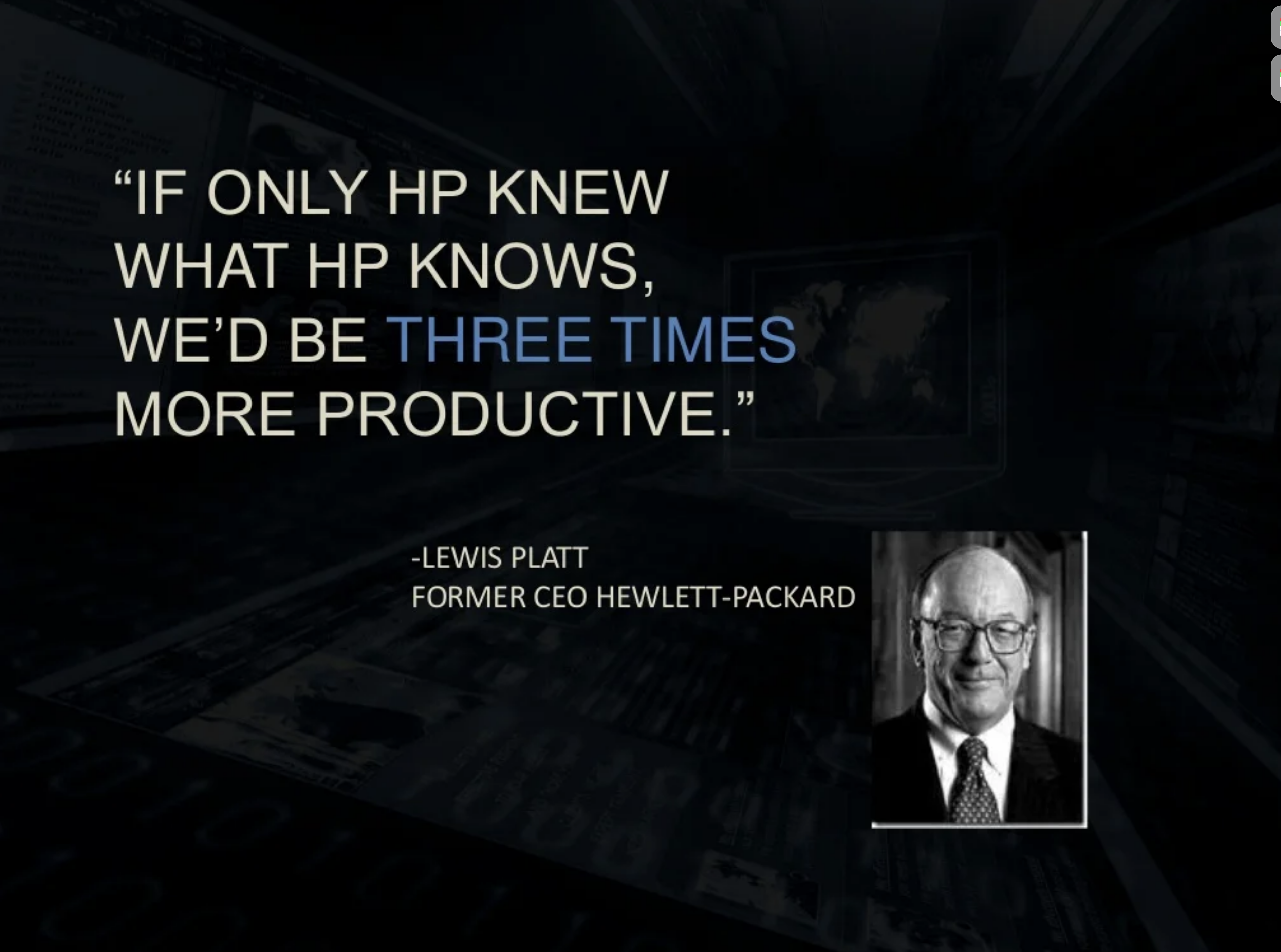
There’s a mantra these days that higher education needs to get better at listening to industry so they can better prepare students for work. And while there is definitely some truth to that, it assumes that “industry” knows what it needs its workers to know. Former HP CEO Lew Platt once famously said, “If only Hewlett Packard knew what Hewlett Packard knows, we’d be three times more productive.”
In other words, a lot of vital know-how is locked up in pockets within the organization. It doesn’t reach either the training folks or the HR folks. So how are either universities or EdTech professional development companies supposed to serve an invisible need?
The problem is that many L&D leaders are choosing a slightly different approach to what’s always done. They’re looking to vendors with their silver-bullet solutions, and only now they’re searching for “smart” ways of matching generic content to the most commonly required skills across the entire workforce. On the surface, this might seem to make sense. With millions of items of learning content and only 50,000 employees, the algorithm will find something for everyone, right? That’s what we’ve bet the house on.
Shouldn’t the same generic content sold to so many different organizations still work in your unique culture? I’m sorry to say it likely won’t since all organizational expectations are not the same. The lack of engagement from employees is a clue because they know it too. It’s not that they don’t know how to learn or they don’t like to learn online. It’s because their experience tells them that their valuable time spent “learning” might not equate to actual skills development.
This is the “Netflix of education” canard or, if you’re slightly older, the “smart playlist” fantasy.
AI doesn’t make learning objects any more re-usable because, as I illustrated in that 2002 article, the key missing ingredient is context. One lesson on the same topic may not work in two different workplaces because the examples are wrong. Or because the content needs to be connected to the previous and subsequent bits of content in ways that help the learner make sense of what they’re being taught. As the Forbes article puts it,
The crux of this is that L&D’s preoccupation with more and better “learning” is a dead end if it doesn’t fully incorporate the work context and what employees are trying to do. The development of a learning provision cannot predictably and reliably affect performance if it’s off-the-shelf or only loosely tailored to an organization’s culture. When put in the context of the skills gap, if solutions (programs or content) don’t reflect how the work is done in your organization then they can’t positively affect capability and performance.
One of the stock-in-trade tools in L&D has been the learning needs analysis. This has helped L&D find out what training (or learning) is needed to further bolster the learning provision and determine how we spend our budgets. But it rarely relates to actual jobs: the very tasks, interactions, roles, expectations and outcomes employees are measured against. The learning needs analysis helps aggregate common needs so we can develop or purchase standardized programs and content that covers all bases without doing much analysis of the work context. The logic is: If we add more courses and buy big enough suites of generic content then there must be something for everybody, right? Surely? Except this doesn’t stand up to any level of scrutiny.
Doing the course or completing the content does not mean reskilling. We know this, but we often ignore it. The big learning content vendors can give us the credits and produce certificates, but completion doesn’t mean competence. Not even close. It just means you were there.
This is essentially the same criticism leveled at higher education. The degree, the credential, the certification of completion doesn’t mean much even if the educational experience it represents is built to address a needs assessment conducted by trained professionals inside the company.
A quick skim of this CLO Magazine article suggests that the Forbes author is right about the continuing blind spot. The author, who is the Senior Director of People Growth and Enterprise Skills Strategy at Warner Bros. Discovery, conducted a study of training interventions designed to take input from employees as well as how employees go about using the training resources at their disposal. The main conclusions, from my perspective, were (1) employees are more engaged in training if you ask them what they want, and (2) employees decide what training they need when they need it and will be as likely to go to YouTube as to that library of AI-curated content that the employer paid for.
So what is the author’s answer? Performance analysis:
Performance analysis means seeking the answers to questions that relate to what employees are expected to achieve and that they are not able to easily or effectively. What is actually being observed and what are the implications of things not working the way they should? Recognize those responsible for the work and the expected deliverables. Completely articulate how things should be working. L&D professionals have been too quick to interpret performance needs into learning needs and completely distort reality in order to develop courses. But an exploration of the way the work is done and the results expected will help us move from perpetual anxiety about our value and impact to actually affecting the way the work is done.
This is…the same idea we were advocating for (and failing to get traction on) twenty years ago. It’s hard. It’s labor-intensive. It requires specialized skills. And it constantly needs to be refreshed.
Waiting for the next EdTech crash
Right now, companies that sell libraries of training content are hot. I’m not saying these products are bad. I’m not saying they’re useless. I am saying that there is an element of faddishness contributing to their valuations and ability to raise capital. And I’m saying that the same tired solutions—either buying libraries of whole courses or buying libraries of lesson bits—are not going to become game changers just by sprinkling some AI fairy dust on them. You can’t fix a fundamentally limited approach to constructing effective learning experiences with a matching algorithm.
There are ways to approach these difficult, thorny problems. We’re trying out several of them in my day job. But my main point for the purpose of this article is that there seems to be an assumption that building a workplace learning EdTech company is easier than in higher education. I will grant you that selling to corporations is less painful than selling to universities (though it is still very, very painful). But I think investors are going to discover the fads and crashes in the corporate space are not less dramatic than they have been in higher ed. Just because something is selling well now doesn’t mean that it is solving a real problem and will remain hot.
If you want to develop lasting product/market fit with a learning product, regardless of the sector that it’s in, you’ll need to look deeper than the buying patterns of the moment. This is a complex space whose ongoing success cannot be predicted by purchases, initial usage, or even the first couple of years of repeat purchases. It takes a while to figure out if learning interventions are working, especially if you’re not studying their impact (which most organizations are not).
Inside Higher Ed’s Doug Lederman published an excellent early take on Arizona Global Campus acquiring Zovio. For those who have not been following along, this is an example of the kind of “pivoting”—more like “twisting in the wind”—that’s evolved out of the for-profit university space. Here’s the gist:
Way back in 2005, the non-profit University of the Prairies sold itself and its accreditation status to the for-profit company that eventually would be rebranded as “Zovio.”
That company got slammed for predatory recruitment practices and squeezed by the legislation that was triggered by such practices in the for-profit university sector.
In response, Zovio’s “Ashford University” converted back to a non-profit online college but used Zovio effectively as the OPM that provided the services.
That didn’t work either. So Zovio sold Ashford to the University of Arizona Global Campus while continuing to serve as the OPM.
The university came under heavy fire, both internally and externally, for depending so heavily on Zovio for critical services and the conflict of interest that relationship created.
So the University of Arizona Global Campus just bought Zovio, killed the company, and kept the people they needed.
I have no idea whether the University of Arizona is making good decisions or not. I haven’t followed the details closely enough to have an informed opinion. But I do think there’s something interesting here about disintermediation and the potential reversal of the outsourcing trend.
Finding a balance
There’s been a bit of a pendulum swing in EdTech regarding university relationships with companies. On the one hand, there’s been a strong history of outsourcing. Universities let their professors publish textbooks with for-profit publishers, who turn around and sell those books to the university’s students. Pretty much every LMS on the market today started inside a university and got spun off as a private company. And the latest trend is universities outsourcing much of their machinery—from student recruitment to a big chunk of course and program design to student support to job placement—to OPMs.
“Outsourcing” is often an oversimplistic or even a flat-out incorrect way of describing these relationships, but the basic gist is directionally correct. Universities decide that they are better off shifting critical functions of their business over to companies that they believe are better equipped to execute those functions efficiently and effectively. Sometimes these are great decisions, other times they are disastrous, and much of the time they are very mixed.
Of course, for every action, there is an opposite (if not always equal) reaction. The dissatisfaction with the proprietary LMS companies led to a rash of open-source LMSs being developed (only one or two of which have sufficient adoption to have significant impact). There is the push for OER textbooks, which has slowly gained momentum but is still heavily dependent on grant funding for its survival and arguably has so far failed to live up to the promise of improving quality while having some impact on cost. OPMs have given rise to OPEs, which are fee-for-service shops that give more control and independence back to the universities (at the cost of financial support for launching new programs). And now we have this Zovio thing.
Universities are not well designed to be agile. To the contrary, they evolved to resist change in many ways, both in their original Medieval form and in their modern multiversity incarnation. So it makes sense that they might need help from institutions that are designed to evolve more quickly in response to evolutionary pressures (like for-profit companies) in order to keep up with changing mission and sustainability demands. And it also makes sense that the evolutionary pressures that cause companies to change might create tension and misalignment with their university customers that grows over time.
We’re at an odd moment in EdTech. When I look around, I see fewer companies than ever that are succeeding in making a beneficial impact, at least in higher ed. (Professional development is—finally—dynamic again, and K12 is…weird and hard for me to figure out given the amount of attention I’ve given to it.) And yet, I sense we’re on the verge of a change. Companies can be designed to facilitate the changes universities want and need to make. They can provide more efficient and effective services without losing alignment with the needs of their customers, including the need for control over their core mission. And universities, for their part, can become savvier at engaging in these sorts of public/private partnerships than they have generally shown so far. They can make good decisions that allow them to maintain control of their destiny and duty of care while getting the help they need to evolve and thrive as the needs of their students and our society evolve.
I sensed the beginning of this change when I started the Empirical Educator Project and followed it when I co-founded Argos. It’s still pretty early in a process that will take decades. Maybe too early. There will be many failures. But I feel like something is in the air.
I can’t say whether the Zovio acquisition will pan out or even whether it’s a good thing to try. But in the very broadest sense, I believe it is another harbinger of things to come. The pendulum has swung and what was non-profit has become non-profit once again. Will the journey return a more viable, more useful organization than the original failing non-profit college? I don’t know. But there’s a deeper, more interesting, and broader story here than a failing for-profit or a university groping for a way to achieve growth with integrity.
Bob is an internet friend. I don’t know him but I like him. I think he’s trying to do good work for a good cause. So one reason I’m responding to him in this post is to show my appreciation for his thoughtfulness and willingness to engage. Back in the early days of e-Literate, there used to be good dialogues about EdTech happening on the internet. I don’t see that anymore. So when somebody like Bob takes the time to have a real dialogue, I want to show respect for that.
Unfortunately, I also have another motivator that conflicts with that collegial goal. For reasons that have absolutely nothing to do with Bob, I am fed up with the human obsession with easy answers to hard problems. More than usual, even. The amount of venture money pouring into EdTech for Web3, the Metaverse, and other silliness without any real understanding of it makes me retch. Just writing that last sentence made me throw up in my mouth a little.
I’ve gotten a few questions about why I wrote my first post about Web3 in the first place. Is it an expansion of e-Literate‘s coverage? No, it isn’t. If I’m going to write about human failures it’s only fair that I acknowledge my own. Anger has always been a big driver for me on e-Literate. I have been often driven to write about a topic because something about it pisses me off.
I tried to get control over that impulse. I really did. But it’s so satisfying. It’s my version of an easy answer. Turns out it’s a lot less effort and, honestly, a lot more remunerative to complain about the world than it is to change it. People like a good rant. It gives them something without asking for anything in return. My rants have gotten me praise. Heck, they’ve gotten me jobs. And they feel good.
So I’m sorry, Bob Bodily. This is not going to be the response you deserve. I swear, it’s not you. It’s me.
No use case
On Twitter, I challenged Bob to give me a use case. What educational problem can I solve with Web3 that I can’t practically solve some other way? Bob never gave me one. A use case requires a specific class of user with a specific need. It keeps us honest by focusing on problems rather than solutions first.
Unfortunately, the world is filled with solutions in search of problems. Take the Metaverse, for example. (Oops. Threw up in my mouth again.) I remember the craze around Second Life before it turned into a soft porn site for furries. Campuses spent large amounts of time and money building virtual classrooms, which were replicas of their actual classrooms so that students could put their virtual butts in virtual chairs and look around their classmates’ virtual heads at a virtual screen so that they could view actual PowerPoint slides. It was absurd. It deserved to die. And it did. Eventually. After enormous amounts of time and effort were poured into it.
OK, so virtual reality technology has evolved quite a bit since then. What are universities doing now that we can all buy dorky headsets that make fake things seem so much more vivid? Why, they’re building digital twin campuses. Of course. That’s what we call “innovation.” I still don’t know how changing “VR” to “Metaverse” is going to help any particular set of educational users in any particular way.
And why now? Because a rich jackass best known for undermining democracy in the United States decided that he could solve his reputational problem by rebranding his company to Meta and selling virtual clothing. All hail technological progress! Now those virtual heads you’ll have to look around will be wearing nice, expensive hats!
Oops. The mouth again.
(I did warn you.)
If you’re going to tell me that some new technology has the potential to revolutionize education, please be specific. Because everything is bullshit until there are specifics.
(I’m really, really sorry Bob. It’s not your fault. I swear.)
Affordances
OK, if we don’t have a use case, then what do we have? Affordances. Things that the tech supposedly offers that have some utility that could be applied to some use case. What affordances does Web3 have? Let’s run down Bob’s list:
Security
Blockchain, the heart of Web3, is supposed to be incredibly secure. You can’t hack it, and if you did, everybody would know immediately. It has an iron-clad audit trail.
It turns out that the biggest weakness in security is the humans. Stupid humans who forget to set a password, leading to the hacking of one billion identities. Or who click on links in texts like the one I got just the other day claiming to be from Amazon checking on a potential fraudulent purchase. Where the link, written in plain text, goes to a domain that is not Amazon.com.
Until we have blockchain for monkey brains, I’m not buying the security argument.
Decentralization
Nobody likes for the fate of education to be in the hands of jackass billionaires who want to show everybody how big their rockets are and are going to save the climate by emitting massive amounts of methane in order to launch William Shatner into space. Honestly people, that’s where we are. So I’m sympathetic to the desire to get away from this state of affairs.
Unfortunately, I see two reasons to be skeptical that Web3 will save us from this predicament. First, decentralization has been around for a long time. Tor and Napster were around in the 1990s. What were they most popularly used for? Sharing pirated music and porn. Peer-to-peer just means that the monkeys can talk to each other without a monkey in the middle. It doesn’t mean that they’ll be smarter monkeys. And second, people who know more about Web3 tech than I do worry that it is not, in fact, decentralized.
I can think of legitimate and important uses of decentralization technology. We could give students control over their own data, for example. We can do that using Solid, which is not a Web3 technology. But the very idea gives universities the hives.
The hardest problem preventing us from giving students control over their data is convincing the people who have control over it now that they should give it up. If you tell people that you can create a solution that convinces people to act differently, they won’t believe you. If you tell people you have a new magic technology that will solve “privacy,” they will.
Simpler developer experience
Meh.
Being able to spend more time on features that matter and less time on essential but uninteresting infrastructure is valuable if and only if you know which features matter and why. If Web3 could solve that problem I’d be on board.
Token economy
We already have an economic token. It’s called “money.” Ever since we went off the gold standard, we have lived in a token economy.
Beyond that, I need a use case. Explain to me, specifically, how a Web3 token economy changes things. Who is paying for what? Why are they doing that? Why are tokens easier than money? Why is this different and better than Kickstarter?
I do not understand.
Open Standards/Open APIs
I have participated in standards committees. I have been a paid consultant on efforts to kick-start standards efforts. The problem is never the technology.
It’s. The. Humans.
I have attended multiple hours-long sessions on how to properly represent a person’s name in a standard. I am not kidding. To be fair, it’s a much harder problem than you would think. But not nearly as hard as the humans made it.
Sorry, I’m not buying the interoperability thing yet. Give me specifics, please.
Permanent data storage
I have permanent data storage. It’s called AWS. It will last until our society collapses (which, to be fair, Jeff Bezos is speeding along a bit by putting massive amounts of methane into the atmosphere in order to launch William Shatner into space).
The major reason links break is that humans stop maintaining them or paying for them to be hosted.
I still don’t get it
Maybe that should have been my entire post. One sentence. “I still don’t get it.”
But I guess I don’t have to. While many of us are genuinely trying hard to solve human problems, our monkey brains keep gravitating toward technology-first solutions. Hacking human behavior at scale is too hard to think about, much less to actually try to accomplish.
So I’m pivoting. My new startup is going to revolutionize education by using Web3 in the Metaverse. I’m going to build simulated solutions to educational problems. You have to wear a goofy headset to see them, but your avatar will look spiffy. I’ll free you from the tyranny of big corporations (except mine, of course) through the magic of Web3. And by magic, I mean sleight-of-hand. Pay no attention to the virtual man behind the virtual curtain.
I’m taking investments now. Hard cash only, please. No cryptocurrency. That crap’s a pyramid scheme.
(Also, I’m really, really sorry, Bob Bodily. You didn’t deserve this.)