The “Big Picture” category covers larger trends and topics that influence both the problems that technology can help address in education as well as the barriers to implementing high-quality technology-supported education. This includes research-based topics such as learning science and program effectiveness studies, philosophical discussions such as outcomes definitions, and macro-forces such as government policy, markets, and business models.
The phrase “empowering educators” is a cliché that usually doesn’t mean much. We could use the language of business—as I have—to describe educators as knowledge workers and think about optimizing their workflows to reduce the amount of time they spend on low-value tasks and increase their opportunities to apply their expert judgment to high-value tasks. That formulation provides a more specific, testable, and potentially impactful description at the risk of turning off a lot of educators with the language. Having been both a classroom educator and a corporate knowledge worker myself, I believe these are two sides of the same coin. In my most recent post on the Argos blog (following my post that introduces what will be a four-post arc), I explore this topic with some concrete examples.
If I weren’t co-founder of Argos, I would be publishing these posts here on e-Literate. Argos, for me, is an effort to actually bring into the world some of the ideas that I’ve advocated for here on this blog for the better part of two decades. It’s an attempt to apply everything that my co-founder and I have learned about the barriers to change to make a real and lasting impact on education. Which is all I’ve ever wanted, professionally. I never had any inherent desire to run—or even work in—a start-up. It just turned out to be the best vehicle we could find for accomplishing something as important as it is hard to pull off. That said, because I am the co-founder of Argos, a commercial venture, I will maintain some separation between e-Literate, EEP, and Argos even as I try to keep all the plates spinning and bring these efforts together when doing so will further the mission.
Relatedly, I won’t be announcing Argos posts here on e-Literate for much longer. I want to get back to writing posts here while maintaining an appropriate level of separation. My current plan is to stop announcing my Argos posts here at the end of July. So if you like what you’re reading over there, please subscribe to that blog.
As we try to make sense of changing student enrollment numbers post-COVID and think about what “quality education” means in a pervasively blended education, part of that work requires us to think about “data” the way we would think about our senses and sense-making in a face-to-face class. My new post on the Argos website describes one way the platform enables our educator/publishers to do that and provides some eye-opening early data about how well that strategy is working.
I’ve been thinking a lot lately about beating the odds. Not by being lucky or tough or heroic, but by recognizing the errors that we make when calculating odds of success based on assumptions and pattern matching. Assumptions can be wrong. Patterns might not apply. Inevitability is often a wall with cracks in it. Sometimes, if we can see the cracks, we can find our way through to the other side. This is important to remember at so many difficult moments in life, including when we try to change a system like education that seems unchangeable.
A dear friend recently told me about one of Instructure’s secret weapons in beating the seemingly overwhelming odds that they would become just one more failed LMS startup on the giant trash heap of failed LMSs. It was one I hadn’t heard about or noticed before. This surprised me because I have been a student of Instructure’s secret weapons. Like many other students of EdTech, I was convinced that an LMS startup breaking into what was then a static market was virtually impossible. I was taken completely off-guard when they not only survived but eventually knocked Blackboard out of the top spot.
So I spent a lot of time studying Instructure to understand what I had missed. I learned many lessons. The company leadership didn’t have just one silver bullet. They employed many strategies and benefited from the luck of timing. I have written multiple posts about these factors. I thought I had cataloged them all.
I was wrong. I missed a big one. One that I could have seen based on evidence that was accessible to me at the time. As a species, we gain so much value out of our ability to pattern match that we sometimes have trouble seeing beyond our confirmation bias to see that the “odds” we are calculating are based on a pattern that doesn’t apply.
What—or who—is the deciding factor?
At the time that Instructure came on the scene, LMS selection decisions were led by, and often made by, CIOs, who compiled the lists of requirements and had a great deal of latitude to impose their will. At that time, most LMSs were hosted by the campuses and the IT folks could always come up with some technical reason that other stakeholders were not in a position to dispute. LMS sales processes, therefore, were long and expensive affairs that involved a lot of checklists and, often, wining and dining of CIOs. The LMS company that had the best CIO sales force, which was a capital-intensive capability, would win most of the time. Blackboard had the money and a really good sales team that was finely tuned for those sorts of enterprise sales. Therefore, they won a lot of sales. It seemed like an insurmountable barrier, especially for a small start-up that was known for snarky T-shirts and PR stunts whose primary audience was clearly not CIOs.
In retrospect, it should have been obvious. Instructure deliberately ignored the existing LMS selection structure and created an alternative one. They saw that the percentage of faculty who were making meaningful use of the LMS was rising. They saw the frustration among faculty with the teaching tool that had often been chosen by the IT staff. And they understood the power faculty had on campus if only they could be activated.
Instructure fomented faculty rebellion. When they set up a party across the hall from the famously over-the-top BbWorld conference and gave out T-shirts saying, “I cheated on Blackboard with Instructure at BbWorld,” they were targeting faculty who, by and large, had a very different reaction to a conference that felt modeled after Oracle’s than their campus CIOs did.
As Instructure gained traction, evidence mounted that strategy became more than just a PR campaign—if you were open to seeing the signs. While the most common and popular talks at other LMS conferences were variations on the theme of “We migrated to a new LMS and survived the experience,” the most popular sessions at Instructurecon—for years—was how to organize faculty committees that could take more control over the LMS selection process.
I missed that trend, probably because I would have dismissed such talks as sideshows. They didn’t match the pattern I knew. Procurement processes didn’t change. And they certainly didn’t change in response to a few user sessions run by some upstart vendor.
Today, heavy faculty involvement in LMS selection processes is the norm. It’s hard to say how much Instructure created that change, accelerated and shaped change that was ready to happen, or just rode the wave. It was probably a bit of all three.
Regardless, the larger point is that the odds we place on success are heavily shaped by our assumptions. And sometimes those assumptions run so deep that it’s hard to even see them. They’re like the air we breathe. Nor are odds—and common wisdom—meaningless. We thrive as a species partly by employing heuristics to simplify complex and time-sensitive problems. Averages tell us something. They can tell us a failure rate in an easy-to-understand format, for example. They just don’t tell us why the failure rate is what it is. As my father likes to say, if you put your head in the oven and your feet in the freezer, on average you’ll be comfortable. So if you’re going to beat the odds, you have to understand what you’re facing, why the failure rates are so high, and how you can change the equation.
Another challenge with beating the odds is that, whatever you may think about your opportunity, others will be applying the usual heuristic. Others whose support you may need. So even if you’ve figured out a way through the problem, if the people whose help you need don’t believe you, then you’ve got a problem. To maintain sanity and hope, you have to look at that perception problem as just another part of the wall. There are often cracks in people’s judgments and willingness to take a risk. They are not entirely consistent. Look for those inconsistencies. Try to understand them. Often there are deeper rules operating below the surface. Those rules can be the key to finding your way through a wall of “no.” Sometimes it’s direct persuasion. Other times it’s figuring out a way to go around them until you have strong evidence. Instructure didn’t try too hard to directly persuade CIOs. They stirred up a mob of faculty with torches and pitchforks to show up at the door of the CIO’s office. (By the way, torches and pitchforks are often very persuasive tools, especially if you can get somebody else to carry them for you.) Maybe there was no way for Instructure to persuade CIOs to try a new, relatively untested platform with features whose advantages the techies didn’t understand. Fine. Persuade the people who do understand and who can have an influence on your behalf.
Don’t think it will work? Well, that’s probably the biggest wall of all. Self-doubt. Sometimes things are impossible. Sometimes we will fail at solving absolutely critical problems that we throw our whole selves into. But we always fail when we give up. If you see a path and your task is important enough to you, then you have to pursue that path. You have to. Otherwise, what are you here for? What’s your purpose?
Beating the odds, and accomplishing the impossible, often requires us to mercilessly throw out our assumptions and relentlessly hunt for even the tiniest hints of cognitive dissonance that may point the way toward a path that averages and conventional wisdom miss. When facing a dauntingly complex problem, like systemic change in the ways that educational institutions operate, getting out of the tight spot we’re in can seem impossible. The trick is in training ourselves to see the cracks in the wall of inevitability and then believing what we see. Whatever others may tell us.
The last year has been an interesting journey for me in the world of venture capital. I had come in contact with it in various ways before but not nearly as intimately as I have as the co-founder of a start-up. While I’m still very much a novice in the space, e-Literate has always been about sharing what I’m learning rather than what I know. At this point in my journey, I feel I have learned enough to take an earnest first stab at analyzing the changing EdTech venture capital market and making a few suggestions.
I freely admit that this post is motivated partly by my direct experience as a fairly new founder and that it is self-serving in the sense that it reflects the ways in which my partner and I have thought about building our company.
Context and trends
The venture capital world is currently experiencing turmoil similar to (and somewhat tied to) the turmoil in the public stock markets. Companies that VCs invested in are becoming less valuable. Since it’s not at all clear that we’re at the bottom of that trend, investing in new companies now is tricky. And many of the investors in the market now have never faced an environment like the one we’re in now. Venture capital has had a remarkable decade-long bull run. The mid-level VCs, and even some of the general partners, were not in the game 22 years ago during the dot-com bust.
At the same time, higher education is also in uncharted waters. The effects of the pandemic were weird. Enrollments were down. But not equally everywhere. Increased adoption of EdTech was enormous. But not necessarily the products that folks expected to be big hits pre-pandemic. We don’t know what will happen with blended and online learning. I personally expect that it is here to stay almost everywhere. But in what balance? Will the technologies remain the same, or will they shift as schools move out of emergency remote teaching mode and focus more on brand and quality? What does it look like on residential campuses? Will students still pay for housing? Is the answer to that question different in different segments?
We are facing an economic slowdown and possibly a recession. As unemployment numbers revert to historical norms, will we also see the normal historical trend of education enrollment increasing counter-cyclically? It seems like it should, but I’m not sure. And will we see a move to more alternative credentials? I don’t know.
All in all, it’s a challenging environment in which to make risky investment decisions.
In the larger VC world, the flight to safety means investing in more profitable and less risky companies. And trying to buy these companies at a bargain. I suppose it’s roughly equivalent to stock market investors buying large-cap value stocks that pay dividends. And also like investors in the public markets, VCs are holding onto more cash.
But every sector is its own world with its own investment risks. Does flight to quality mean the same thing here as it does elsewhere?
Yes and no
The universal rules are (1) play it safe overall, (2) keep your powder dry, and (3) be ready to jump on underpriced opportunities. These apply everywhere, including EdTech. But what does it mean to play it safe in this sector, and how does one identify underpriced opportunities?
It’s hard for VCs to pick good bets in EdTech even in normal times. The sector is incredibly complicated, the buying processes are not rational, and sales often take a long time and a lot of effort without any clear signals of how likely a company is to make the close in the end. It’s also hard to tell from the outside if a company that makes its first five customers happy will attract its next 50.
On the other hand, we’ve already seen some seismic shifts in education over the past few years and there are reasons to believe that changes will continue. A sector that was very static for a long, long time is suddenly changing at a pace I have not seen in my lifetime. There’s good reason to believe that changes will continue and may even accelerate. That’s how punctuated equilibrium works.
Later stage investments in EdTech, particularly in higher education, are often companies that have co-dependent relationships with universities that are desperately clinging to the status quo. So, for example, any company that helps a university sell more enrollments without requiring them to fundamentally re-examine how their current activities and expenses align with their mission have tended to do well up until now. But if external forces are creating a situation in which colleges and universities have to change anyway in order to survive, then those “safe” bets may become less safe, not only because of financial conditions but also because of fundamental changes in the needs and priorities of universities.
I won’t make too much of this chart here because doing it justice would require significant research and a separate post. That said, it’s worth noting for comparison that the NASDAQ composite is down about 13%, the price of Bitcoin—the currency, not the stock—is down about 30%, and the S&P Cryptocurrency Broad Digital Market Index is down about 53% in a one-year time frame. Every stock on this chart except Pearson and LTG has underperformed the NASDAQ. Instructure is down about as much as Bitcoin. D2L is performing slightly better than the broad crypto market, while Coursera, Chegg, 2U, and Zovio are all significantly worse.
The stock market chart isn’t an apples-to-apples comparison since this post is about VC investment rather than public stock trading. Nevertheless, Phil’s chart does raise more general questions for EdTech writ large: What does “flight to quality” mean in EdTech investing? What should (particularly higher ed) EdTech investors be looking at and thinking about as they try to make “safer” bets?
At the moment, most investment is on pause. Think about your own stock portfolio. Who is buying in this market? VCs have the same problem. The level of uncertainty is giving them pause. But that won’t last forever. How will VCs think about investment when they think it’s time to put money in again? And how should they?
Think about infrastructure
While investing in general—both public and private—always tends to be something of a fashion industry, EdTech has always struck me as being particularly vulnerable to fads and sex appeal. While I readily admit I have a poor grasp of sex appeal of any sort, this has always puzzled me. What are professional investors putting their money into right now in the public markets? Commodities. Nothing says “sexy” quite like copper and lithium, am i rite?
I understand that, in a market where the workings of the purchasing institutions are Byzantine and hard to analyze, thinking about macro trends is just easier. The intersection of micro-credentials and workforce seems like it should be a thing. Chatbots have a lot of general utility. Universities need help finding new revenue sources. But betting on these trends without understanding the underlying processes and obstacles is problematic. You can’t be a sophisticated investor in electric car stocks without understanding at least a little bit about the supply chains for the lithium used in the batteries, the microchips, and so on.
Educational infrastructure is as important as it is boring, particularly in times of rapid change. I’ll give you three examples.
First, before the pandemic, most people thought of Zoom as the thing they had hoped WebEx or Google Meet would be when they first tried those web conferencing apps. It wasn’t a revolution. Just a relief. Certainly, there was plenty of evidence in education that web conferencing wasn’t considered a big deal. Back in 2010, Blackboard CEO Michael Chasen acquired the two dominant education-specific web conferencing apps: Wimba and Elluminate. It was considered a bold move, buying up the only two major entrants in the product category. The two were rebuilt into one product, branded as Blackboard Collaborate and, eventually, rebuilt a second time. It sold…fine. To Blackboard customers. It certainly didn’t do well enough to change Blackboard’s fortunes. Not in 2010 and not in 2019. Fast-forward to the pandemic and Chasen decided the next big app is going to be…Blackboard Collaborate. Only built on Zoom. And in short order he was able to raise $164 million to fund it.
Note: I wrote the first draft of this post before Chasen’s new company, Class Technologies, announced that it is buying Blackboard Collaborate for $210 million. While that development merits its own post, the main takeaway for the purpose of this one is that Chasen was able to raise a new investment round to make that purchase.
Anyway, this story is one of buzz riding on a real infrastructure trend. Zoom is obviously the infrastructure. Reliable, easy, scalable webconferencing suddenly became a necessity in education. The trend was there. It was visible. Zoom’s education revenues soared. So Chasen’s new company, which adds Blackboard Collaborate-like features to Zoom, got tons of investment money. Because it’s the Zoom of education! Time will tell if his company turns out to be a good bet or just gilding the lily. The more important lesson here is that the underlying infrastructure—Zoom—which everybody thought of as a niche product—suddenly became incredibly important when circumstances changed rapidly. As painful as pandemic schooling was, it would have been vastly worse without webconferencing that mostly just worked.
The second story is alternative credentials. Universities have awarded certificates for a very long time now. You know who hasn’t kept up? ERP vendors like Oracle and Ellucian. It took them a decade to be able to handle both degrees and certificates. And when I say “a decade,” I mean the last one. Come to think of it, it was more like 15 years.
Were there upstart competitors that could handle alternative credentials? Yes. But they couldn’t handle all the other stuff that the traditional ERPs do and anyway, switching costs for ERPs are incredibly high. So colleges and universities with certificate programs often ran (and still run) two separate systems; one for regular degrees and one for alternative credentials. It’s incredibly expensive in dollars and person/hours.
Do you think that this state of affairs has slowed the pace of colleges developing alternative credentials?
I do.
Third—this one is top-of-mind for me and my Argos colleagues—there’s the textbook industry. Everybody loves to beat up on the big publishers and label them as failures. That is fair by several different measures. VCs are allergic to challenging them because of Knewton, which was a massively costly failure, and a generation of other courseware companies that didn’t produce the payoffs their investors were hoping for, including Acrobatiq, CogBooks, Smart Sparrow, FlatWorld Knowledge, and Boundless, among others. And yet, private equity seems to love this sector and is making a lot of money in it. Furthermore, whatever the failings of the incumbents may be, a lot of smart people have tried and failed to knock them off their pedestals. Their durability despite their flaws tells us something interesting about the strength of their value to their customers at some level. But again, a lot is changing quickly in the market. What is the essential function of these businesses that makes them infrastructure? Where are they failing to meet needs? And what’s changing that may open up new possibilities for providing infrastructure in a better form?
Whenever you see higher education institutions failing to do something that you think is obviously valuable or tolerating pain that they shouldn’t have to put up with, there’s a good chance that barriers exist under the surface that will not always be visible to VCs. Removing these barriers isn’t easy, isn’t sexy, and can’t always be solved with products and services. But sometimes it can. Not as a magic widget that suddenly makes everything work but as a communication or workflow tool—as infrastructure—that enables humans to work differently. Find the problem underneath the problem. You can only do that by talking with the people who throw themselves against that brick wall repeatedly, trying to crash through it. Talk to the university folks who are tasked with doing that which should be possible but apparently isn’t for some reason.
Quality EdTech companies show a deep understanding of how their customers work and the obstacles preventing them from achieving positive change at an inflection point for their sector. And this quality of thinking isn’t necessarily going to come through in a pitch deck because it requires a conversation about context that the investors often don’t have.
Think about the Great (college) Resignation
It’s hard to disentangle all the various causes of enrollment drops and assign percentages to them. But zooming out to the bigger picture, it seems clear to me that many students are engaging a kind of soul searching similar to people who are participating in the Great Resignation. For a long time now, workers haven’t been happy. Maybe their pay is too low. Maybe they live someplace they don’t want to live. Maybe their job is unsatisfying. But they have tolerated it.
Until they didn’t anymore. Some reached a breaking point. Others found unexpected opportunities in the new economic landscape. For still others, it was a combination of both.
I think a similar change is underway with college. Many more students are more practical-minded than my generation was. They think about cost. They think about value They think about job prospects. They think about balancing campus life against other things they care about.
They think about what they want from college.
When I was in high school, I didn’t think at all about alternatives to going directly to college and I didn’t think too deeply about what I wanted from my college experience other than…a college experience. I thought a little bit about big versus small, far away versus close, and price. But not too much about any of those things.
Today’s students want effective, affordable education. And we know many of them need a sense of connectedness to succeed, even if they are in a physical classroom less often (or not at all). In the new world, only the very top tier of college brands will hold up without some re-imagination (and even they won’t be completely immune to the pressure to be seen as innovators). My evidence for this claim is admittedly anecdotal; I hear it from family, friends, and colleagues. While I’ve been skeptical about this trend until recently, the level of noise that I’m hearing convinces me that we’re finally entering the early stages of a turn.
Moving forward, quality EdTech companies will increasingly focus on efficacy, affordability, and quality of connection for students as central to their value proposition, because these features are rapidly becoming central to the value propositions of colleges and universities. Quality companies will also recognize that the Great Resignation is hitting faculty and staff too. Any product that can make their work experience more humane and increase college workers’ connectedness with their colleagues is a win. It makes the product sticky.
Think about company health benchmarks differently
I’ve already addressed one dangerous assumption: The EdTech companies—and business models—that have done well in the past will continue to do well in the changing environment. A second one is that risks go down as companies reach seven-figure revenues and become profitable (or at least show strong cash flow). These benchmarks go hand-in-hand with VCs’ high comfort level with enterprise sales models. All else being equal, it seems likely that investors will double down on these metrics during this time of uncertainty.
Here’s the problem: Enterprise EdTech has a massive growth gulf that most EdTech companies—and product categories—fail to cross. Most get stuck in the range of between $10 million and $50 million in annual revenues. Think of lecture capture companies. ePortfolios. Learning Object Repositories. Clickers. Learning analytics. Courseware platforms. [Fill in the blank.] Yet these product categories got funding before either plateauing or fizzling out.
If an EdTech entrepreneur starting a company today wants to live long enough to get to sustainability, what’s the best strategy for getting there with VC money? You pick a trendy niche where you can quickly get a few early adopters. You don’t go for anything that addresses deep problems or is complex to explain. Instead, you solve an immediate and obvious pain point. You don’t take time to think too deeply about the differences among institutions that make the market you can actually reach much smaller than it appears to be. You choose an enterprise license model to generate significant revenues from your first customers, even if it means slower growth later. Meanwhile, you under-invest in your product so you can afford to live on those revenues for a while. Instead, you focus on sales. You try to get pilots and small license deals. You do whatever you have to in order to win those deals, including building features that only one client wants. (But you build them cheaply because even enterprise licenses don’t pay much in EdTech.)
It’s hard to avoid building an EdTech startup with these parameters if you want to live long enough to hit the benchmarks for venture funding, particularly in today’s environment. But to reach those benchmarks, the chances are very high that you’ve designed your business in a way that will never, ever cross the chasm.
Investors need better quality signals. There is no magic bullet, of course. Part of the solution—it pains me to write this as a founder—is lower valuations. But another part is to think about the counterproductive incentive structures in the current system that discourages practices that enable companies to build for real growth. Pattern matching may not serve you as well as you think, particularly in a time of rapid change. Investors could benefit from getting a little outside their comfort level and looking for different signs that a company will continue to have legs, three, four, five years after closing their A round.
Quality EdTech companies design and build for the long haul. They think deeply enough that their solution should surprise you at least a little bit. They show their work with stories about a demonstrated need from customers and prospects that suggests product/market fit across multiple segments and stakeholder groups. (This requires a balance between focus and growth potential that is often non-obvious.) They think about how to avoid, or at least mitigate, the enterprise sales model’s pitfalls that are particularly difficult in education. And they have a plausible story about how they’re going to get enough cash flow and growth to get to profitability, even if it will take a while.
There will likely be significant burn rates early on, but not out of a push for revenue growth over profits. Rather, quality companies push for proof of scalable product/market fit over profits. That’s even more true today than it has been in the past. The big winners in a changing educational market will have to play the long game, particularly if they intend to help universities improve affordability, effectiveness, and connectedness for today’s (and tomorrow’s) students. It’s a structural characteristic of this particular market. While investing in early-stage companies carries inherent uncertainty, the complexity of the EdTech market means that underinvesting in early-stage ventures dramatically increases poorly visible risk at the growth stages that are traditionally viewed as “safer”. The data in A- and B-round EdTech companies, like revenues and customer growth, can be misleading because of product/market fit scaling challenges. Certain sectors, like energy and pharmaceuticals, are obviously capital intensive from early on. EdTech is (incrementally) more capital-intensive than may be obvious from the outside.
At least, that’s my sense of the situation. I’ll be curious to hear how much of this rings true to the professionals.
EEP is back! (It never really went away, but that’s a longer story.)
We’re holding a virtual summit from Tuesday, 10/19 to Thursday, 10/21 from 11 AM to 3 PM ET.
I’m thrilled to announce that the summit will be powered by Engageli and that our friends at iDesign helped me put the program together.
While EEP is all about the participants and not about celebrity talking heads, I would be remiss if I didn’t mention that Daphne Koller will be one of our featured speakers. We’re not going to be chatting about her past and present EdTech startups but rather about how to think about machine learning and artificial intelligence as they make their way into EdTech.
For a variety of reasons, including the shot notice, I’m opening up for requested invitations. (It’s still a closed event, but less so than in the past.) Information for invitation requests is at the bottom of this post. Please read the post before requesting an invitation. You are more likely to get accepted if you do.
For all my Blursday Social friends, we’re going to do a Blursday Social session this Thursday, 10/14, from 4 PM to 5:30(ish) PM ET. The session will be held on Engageli, featuring my new Engageli friend Andreina Parisi-Amon.
Because we’re using Engageli for Blursday, RSVP is a little different. Please sign up for this week’s Blursday here:
[mc4wp_form id=”12072″]
If you want to know what’s up with EEP and the summit (and maybe want to join), then read on…
The back story
For those who haven’t followed the EEP story, the Empirical Educator Project (EEP) is a thing I started a few years ago to spread the ideas that (1) teaching is a craft, (2) expertise in teaching should be part of every college instructor’s professional identity, (3) part of that identity means constantly learning from colleagues, published research, and one’s own methodical classroom explorations of what works for students.
If you find yourself reading e-Literate regularly, chances are good that you believe in these principles. But a lot of you don’t know each other. Many of you feel like you’re laboring in the dark and that few others believe in or care about these principles. But you’re wrong. I get to meet a lot of you and talk to you about what you’re up to and what you care about. If you had the same privilege as I do, you would see the growing movement that I see. And you would find more colleagues to advance the cause.
That, in a nutshell, is what EEP is about. It’s to help you find allies. Grow the movement.
EEP started as an experiment, became something of a club, and was always intended to evolve into something open. In 2018 and 2019, I gathered some hand-picked folks together to have conversations. From a network-building perspective, it was a raging success. People made new friends. Conversations started. Brainstorms happened.
To give you a flavor, here are a couple of short video compilations we made from just asking open-ended questions to our 2018 participants:
EEP from the participants’ perspective.
From the perspective of generating new collaborative projects, as you would expect, it was harder. We’ve had a few successes and a lot of good intentions that haven’t panned out (yet). The biggest raging success is actually the open-source courseware platform collaboration I’ve been writing about and the company I‘ve cofounded that spun out of it.
During the pandemic, it was hard to get folks to focus on movement-building when they were so heavily burdened with the daily work of managing the crisis. Once I figured that out, I did two things. First, I continued the quiet work of the aforementioned open-source collaboration. And second, I started Blursday Socials, which was a more low-key way of building networks by creating a space for one thing that everybody was missing: relaxed but engaging hang-out time with old work-friends and the opportunity to meet new ones.
Now that folks are in a position to start thinking about the future again, it’s time to re-engage with a more public-facing and activist version of EEP.
But like everything else, it needs to evolve for the new world we’re in.
What’s changed
So first, face-to-face conferences still aren’t really easy for anyone (assuming you have a travel budget) and, honestly, Blursday Socials have taught me that we both should and can figure out engaging virtual conferences that are just a series of talking heads. EEP always viewed presentations as ways to meet interesting people and provoke conversations. Never as the main event. So we’re reconceiving the EEP summit as a virtual event. I’m thrilled to have Engageli power the summit and iDesign help think through how to translate the EEP lesson plan—which is how I always thought about the summit’s agenda and structure—into an online event.
Second, this is the first step toward opening up EEP. I started out small and invitation-only because (a) I wanted to understand how to grow a culture before opening it up and (b) I had budget limitations that come with a physical conference that had a $0 registration fee. While we are still invitation-only, I’m opening up EEP to a kind of friends-of-friends network.
The truth is that my network is too narrow too. Another lesson of Blursday Socials has been that many of you wonderful people who choose to wade through my long blog posts are people that I don’t actually know—but should. And you, in turn, know other people that I should know. So I’m expanding the field of potential participants. I’ll be providing instructions on how to ask to be included below. Within a few days, we’ll also be announcing other ways that people can participate more broadly.
What’s on the agenda
We will have three major themes and a fourth aspirational theme this year:
Building EEP back better together: At our last (pre-COVID) summit, Carnegie Mellon University announced it was releasing $100,000,000 worth of grant-funded educational software as open-source. In addition to orienting everybody on the EEP way, we’ll discuss what happened with that software, with a focus on digital curricular materials (a.k.a. “courseware”). In other words, we want to pick up the project that got folks excited at the 2019 summit and move forward. More broadly, we want to start talking about what y’all want EEP to become.
Active learning in a pervasively blended world: We’re not going to ignore the lessons of the past year. Instead, we’ll be talking about lessons learned from remote teaching, what we can learn, and what we have to rethink for the post-pandemic world.
Machines and humans learning together: This is a look-ahead topic. Wouldn’t it be nice to be anticipating a challenge rather than reacting to a crisis? Ready or not artificial intelligence and machine learning are coming to the classroom. We need to start having conversations about both opportunities and hazards. We need policy frameworks, literacy programs for educators, and other efforts. So we’re going to talk about how to get that started.
The fourth, aspirational theme is diversity, equity, and inclusion (DEI). We’ll have a couple of speakers on this topic but, to be honest, I have a very personal motivation for including this. At the 2019 summit, I announced that I did not meet my own standards for diverse speakers or participants. I vowed to do better. All indications are that I have failed to do so for our 2021 summit. So while DEI is always an important topic, I am specifically interested in having a conversation about how we can increase the diversity among our network of empirical educators. I, personally, need to diversify my network and learn skills for reaching and including a broader range of folks.
And, as always with EEP, the most important agenda is yours. Come with a project, a need, an idea, an interest…whatever. Look for colleagues. If you find an opportunity to talk to somebody about something important and you want to tune out a session to have that conversation, you will be able to do that. In fact, we encourage it.
Expectations for participation
Here are some things to know about the summit:
This will not be a virtual “conference” in which you can listen to talking heads on your computer screen while answering emails. You will be at virtual tables with other humans in actual conversation about meaningful things. That’s what we think conferences are for. So please come prepared to be active. We’ll be conducting the summit on Engageli, which I promise you is not like Zoom or Teams. Look, this is a last-minute thing, so I expect that many of you will not be able to clear three half-days from your calendar. But if you don’t come to participate, then you will not get the intended value from the summit.
One of our explicit goals is to make sure that you leave the summit feeling like you have met somebody that you should know but didn’t and talked about an important project to you with somebody who might be helpful. As an introvert myself, I can relate to any hesitation you may feel about this. But even with our more open policy, we are still hand picking interesting people for you. I promise that you will meet people you will be happy to have met.
We are encouraging delegations to come from institutions. Please do not sit at the same virtual tables—we want you to meet new people—put please do compare notes with your colleagues about your experiences.
While we are realistic that folks have day jobs and need to get work done, we strongly encourage you to come for as much of the summit as you can. In particular, the networking sessions are not filler times for catching up on email. They are critical to the value of the event.
About vendor participation
Third, there’s the issue of vendor participation. I have always felt, and continue to feel, that participation by vendors is important because they can contribute to and facilitate this cultural change. The old model was that I hand-picked sponsors I thought would be good for EEP and charged them significant fees to cover the costs of the event. But we’re in a new world in several ways. First, my startup—Argos Education—is the new home for EEP. I’m not sure if that’s permanent or if we’ll spin EEP off. But for now, I’m still driving EEP and I’m working at Argos (and enlisting the help of my Argos colleagues). Therefore, Argos is the home of EEP. Since Argos is a company that may be considered competitive by certain potential sponsors, I have to rethink how this will work. Second, given that this is a transition year, I’m not sure what the new value proposition to sponsors would be yet.
The upshot is that, while I will still be hand-picking some vendors to participate in EEP, sponsorship is not a requirement for participation in the summit. I have a couple of multi-year sponsors with whom I will be speaking to make sure they are treated fairly. Beyond that, if you are an EdTech company that wishes to attend EEP, you’re welcome to apply.
Be aware, though, that my filter is still pretty strict. Specifically, since EEP is all about active participation in projects and culture development, I’ll want evidence that you’ve been a good contributor to the space in general and have been focused on either supporting educational research or meaningful promoting evidence-based teaching practices in active collaboration with academia.
And no sales or marketing people are allowed. I’m looking for vendors who can send researchers, developers, product managers, and people in other roles that can contribute to project work.
How to get an invitation
If you’re a past participant, you should have already gotten an email. But maybe you didn’t read it, or it got stuck in a spam filter, or I screwed up somehow. Whether you are a veteran or a new person and want to come and participate for a significant portion of the summit, please email me at [email protected]. Please use “EEP summit request for invitation” as your subject line. Write a couple of sentences explaining why you would like to come. If you have a small group of colleagues who would like to come as a group, please let me know who they are and include their email addresses.
If you are a vendor, please follow the above instructions and also include how your company contributes to a culture of empirical education and the names and roles of the person or people you would like to send.
We have a limited number of spaces but we still have room as of this writing. And, as I mentioned earlier, we will be including more ways to participate in a follow-up announcement that’s coming soon.
I’ve been building the Argos story slowly in this series for two reasons. First, we’re in something like a trough of disillusionment with courseware products. “Trough of disillusionment” is a term from the Gartner Hype Cycle about how innovations are viewed in the marketplace over time:
I say “something like” the trough of disillusionment because the hype cycle is really about expectations rather than product/market fit. A new product comes out and we get excited because we’re told it will “change everything.” It doesn’t. We get disappointed. We decide we’ve been scammed. Over time, we figure out that, even though the new thing isn’t going to change everything, it’s useful for some things. Once we finally figure out what it’s good for, we talk about it less and use it more. Throughout the whole process, the thing itself often hasn’t changed. Oh, sometimes the start-ups decide pivot, or they die because they can’t outlast the trough. But Stanford-style MOOCs, for example, haven’t changed all that much since 2012. We just know what they’re good for now.
I don’t think that’s what’s going on with courseware. It feels like a trough of disillusionment. In 2014, Campus Technology wrote about “The Great Adaptive Learning Experiment.” (One sign that the market is mixed up is that we can’t seem to settle on terminology. Are we talking about adaptive learning, personalized learning, or courseware? What’s the difference?) Since then, we’ve seen a handful of these “personalized learning” companies—e.g., Knewton, Acrobatiq, and Smart Sparrow—sold off for a low price and largely fade into the companies that bought them. CogBooks was the latest to be sold off to Cambridge University Press. While this may be a decent deal for CogBooks—the financials have not been disclosed—I doubt it will be read as a sign that this product category is changing the world. The big textbook publishers have done OK with courseware but not well enough to halt their continuing shrinkage as businesses.
There’s a general sense of disappointment and malaise with the product category. I’m arguing that this is not a genuine trough of disillusionment but a failure of product/market fit. This is actually much more common in EdTech product categories. Think of retention early-warning analytics, ePortfolios, and learning object repositories, among many others. They all got hyped, disappointed the market, and then got stuck. The problem wasn’t that the market misunderstood the product but rather that the product makers misunderstood the market.
My colleagues and I believe that the same thing has happened with courseware. The market has gotten stuck on an idea of the value that doesn’t actually appeal to the people who have to adopt and use it. There was some progress when publishers realized that students like low-stakes practice. Before EdTech, many students voluntarily created flashcards for themselves. When publishers realized that students were increasingly refusing to buy the expensive curricular products that their professors were prescribing, they became more “learner-centric,” by which they meant that they thought of students as the buyers. So they built in features that students would like. Low-stakes practice. That helped some. But then they got stuck again.
Low-stakes practice could give instructors more information about how their students are doing. It could change the way those instructors teach. But so far, it mostly hasn’t. Which means that instructors don’t see value in prescribing courseware over alternative formats, like simple ebooks. The “market” for textbooks is both students who buy the product and instructors who prescribe it. Both use the product in some important sense. But on the instructor side, the paradigm has largely been stuck in the bound book format. It’s immutable. It’s a thing they adopt and then teach around.
In contrast to the publishers, stand-alone course platform providers went in the complete opposite direction. They gave instructors a blank page. In their later stages before their acquisition, these vendors invariably—invariably—began developing or acquiring catalogs of titles so that instructors wouldn’t have to start from scratch. That tells us something about product/market fit. But the platform vendors also differed from the publishers in that they were selling their platforms first to institutions as enterprise software licenses. Those institutions then typically engaged in top-down efforts to get faculty to adopt the platform and develop content. In this conception, the product has three kinds of customers—the institution paying the license fee, the instructor adopting (or creating) the curricular product on the platform, and the students who are using (and possibly paying for) that curricular product.
It doesn’t work.
The joy and magic of product/market fit
Way back in the first sentence of this post, I said there were two reasons why I’ve been building this story slowly. The second reason is that I take joy in writing this way. It’s a teacher thing. I want to make you care about things that you don’t think you care about. I want to make you spend time thinking about topics that you never thought you’d spend time on.
You think you wouldn’t spend time reading a long piece on how fMRI machines work, the mathematics behind certain kinds of machine learning, and how these pieces come together in a methodological paper in cognitive psychology? You think there’s no way you would read a seven-thousand-word article on how Pearson is using HR policies to foster efficacy in its organization (which, by the way, was published on New Year’s Day)?
Heh. Let’s put that to the test. I bet I can make you care. And I’ll spend days or even weeks researching and crafting a blog post to prove it.
Again, it’s a teacher thing. I have an urge. I will go to irrational lengths to fulfill that urge. But not infinite lengths. If I had to write these blog posts using Dreamweaver in raw HTML, I never would have gotten started blogging. I needed WordPress to lower certain barriers for me so that the urge could take over. Remember “web 2.0”? This is web 2.0. When I started blogging, I never imagined I would still be doing it 16 years later, or that literally almost everyone who has access to the internet is creating and sharing personal content over some platform, whether it’s Facebook, TikTok, Twitter, LinkedIn, YouTube…the list goes on and on.
Great product design works that way. I have spent a lifetime failing to get myself to exercise regularly. No product and no subscription I tried could crack that nut. Until I bought an Apple Watch and subscribed to Apple Fitness+. Now I do 30-minute yoga sessions at least three times a week. In good weeks, I’ll add a couple of core workouts and high-intensity interval training (HIIT) sessions.
And then there’s the kayaking. I wrote a post on product/market fit that included a description of origami kayaks that my wife and I use. We had a canoe a while back but it was too heavy and too hard to get on and off the car. Now we go kayaking. And, interestingly, I received a handful of notes from people who read my post and decided to buy themselves the same kayaks.
Oru Kayak
I always wanted to exercise regularly. Logistical and psychological barriers prevented me from doing so. It would have been easy to conclude from a distance that people like me don’t want to exercise. I did hate exercising, but I wanted to exercise. I wanted to not hate it. My Apple Watch and Oru Kayak enabled me to find ways of exercising that I didn’t hate. As a result, my lifelong behavioral patterns changed pretty dramatically.
One of the best examples for the story of courseware is Wikipedia. When it came out, most people thought it was nuts. The big thing in encyclopedias at the time was Microsoft Encarta, which was supposed to be a multimedia, interactive Encyclopedia Britannica killer. The idea that a bunch of randos on the internet would write a credible encyclopedia was literally a joke. Stephen Colbert encouraged his viewers to write absurd details into Wikipedia articles. Random people could never write a comprehensive encyclopedia with no formal coordination and no financial incentive. And even if they did, nobody would trust it.
Today, when you search on Google the top-right corner of your results page will often have information summarized from and linked to Wikipedia. I don’t know about you, but I click on that link fairly often. And I generally don’t think about whether I can trust the article it takes me to. As I write this sentence, random people on the internet are fact-checking and updating articles on Wikipedia. I’m not one of them. I’m mostly just a consumer. Most of you probably are too. And that’s fine. It works.
I started a Wikipedia page once because it was related to a particular EdTech topic that I was passionate about. I only wrote a couple of lines; it wasn’t much more than a stub for the topic. A bunch of other people each contributed a bit to the entry. I haven’t looked at it in years but others continued to contribute and update it This is the page today, complete with 148 footnotes. As I write this, the most recent update to the article was yesterday.
We forget about Wikipedia because now we’re thinking about Facebook, which is designed to facilitate the opposite kind of behavior. Humans are malleable and adaptable. But you have to understand their drivers if you want to fulfill their needs, particularly if doing so entails a change in their behavior.
My colleagues and I believe that the courseware product category is in a rut because the market has fundamentally misunderstood both how educators use curricular materials and how they would use them if only certain barriers were lowered for them.
Upcycling curriculum
In the first posts of this series, I wrote about how educators think about and use curricular materials in their course design. In this last section of this blog post, I’m going to start telling a story of how that can work using some mock-ups that we’re user testing. The goal here is to give some examples of how upcycling can work.
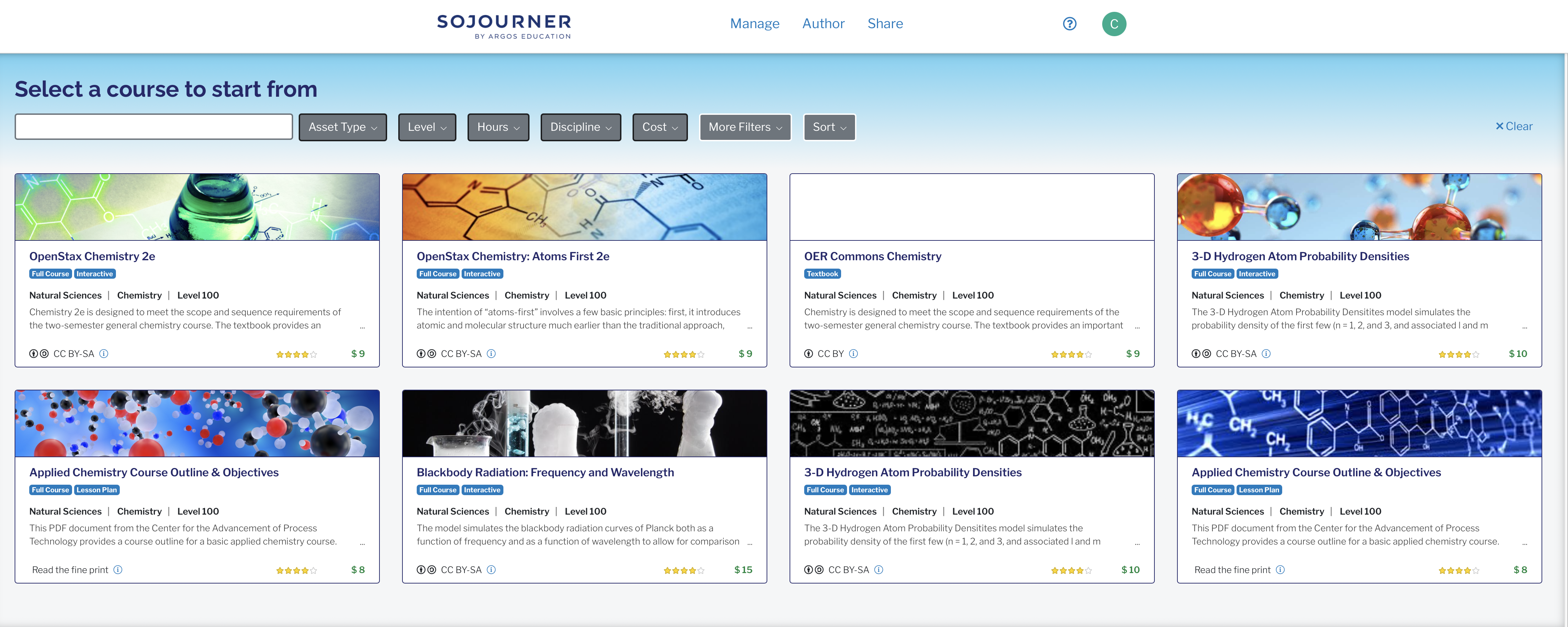
Let’s say you’re selecting a textbook for your Chemistry for Non-Majors course. Your goal isn’t really to pick textbook. It’s to design your course. You go into the store that has all the products that run on Argos Education’s Sojourner platform. You have some good choices. You could pick Carnegie Mellon OLI’s General Chemistry course, which has a mastery learning approach and has been carefully engineered for efficacy. You could teach with ASU Inspark Network’s Critical Chemistry, a heavily experiential learning-based product for non-majors that is thematically organized around how chemistry is used to save lives. But in your case, your college puts a strong emphasis on affordability. That’s a major priority. So you search the catalog particularly for inexpensive options:
You’re still focused on getting through the curricular materials selection process so you can get to the course design process. You review the options and pick your title.
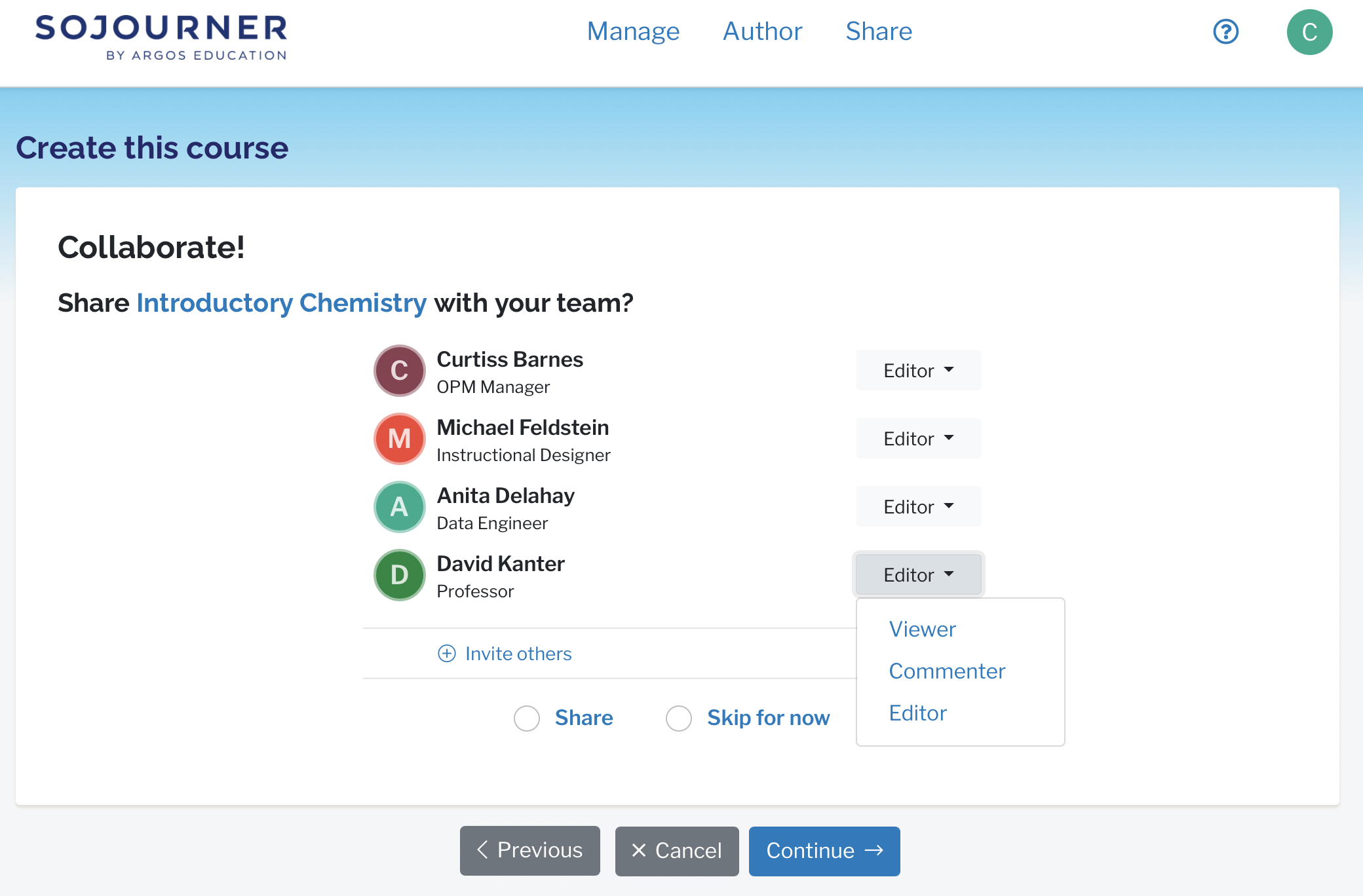
Now you have a choice. Are you working on your own? Are you leading a departmental adoption process? Maybe working with a learning designer or an OPM to create an online course? Maybe you want collaborators involved:
You have options based on your use case. And not everybody gets to edit. For example, maybe as a department, you want to have all instructors be able to see what you’re working on, some who are able to comment, and just a couple who are able to actually make changes. On the other hand, if you’re just making the selection yourself, you can skip over all this. Or you can invite your institution’s faculty support person or a colleague in to give you some suggestions.
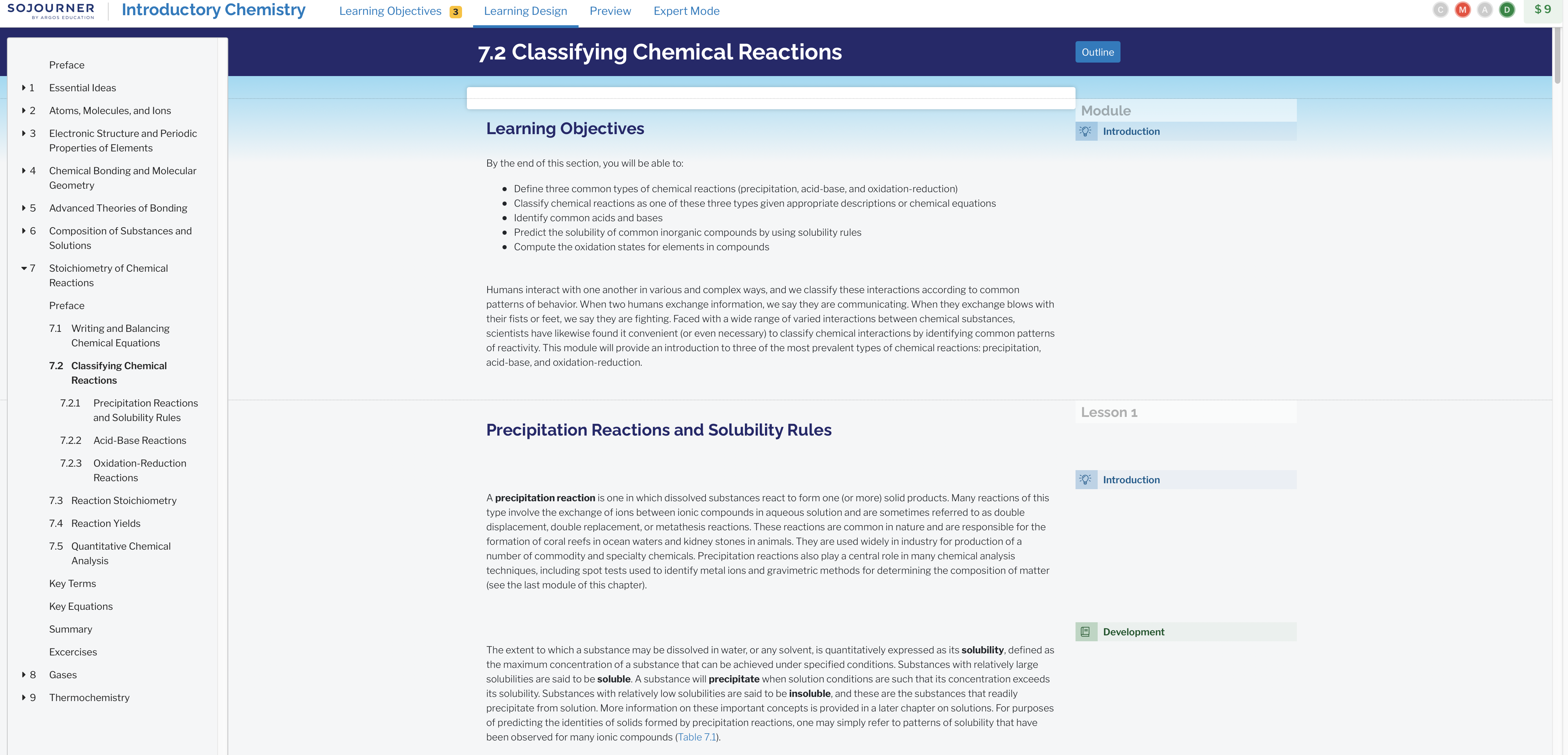
But you’re still in adoption mode. You’re getting to know the text so that you can design your course. You’ve picked an unmodified OpenStax title, so it’s going to start off looking a lot like the free PDF version:
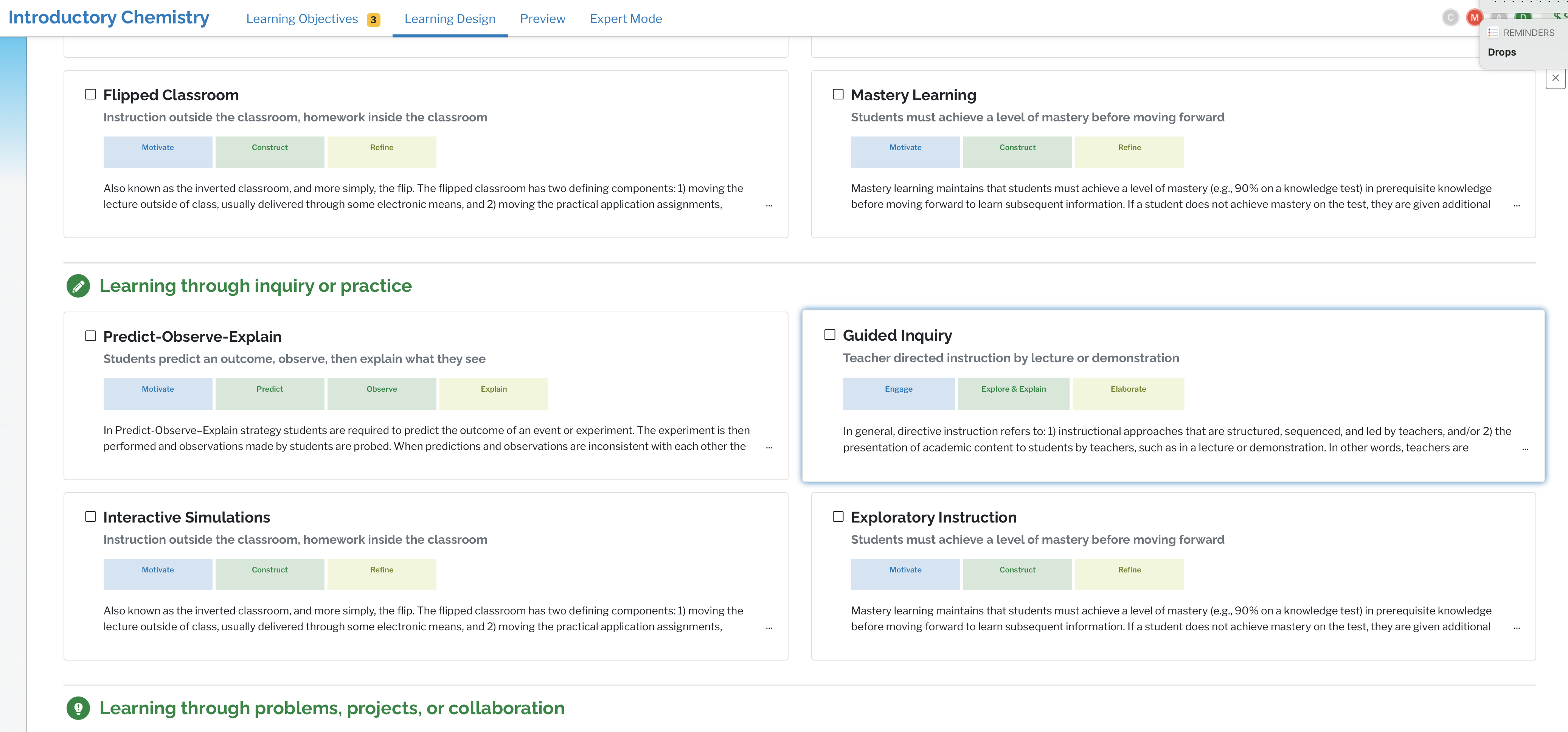
Notice the little notes on the right-hand side. We’ve applied a little machine learning and a little learning design research to make the pedagogical structure of the text more visible to you. If you mouse over the little item, you can see more detail:
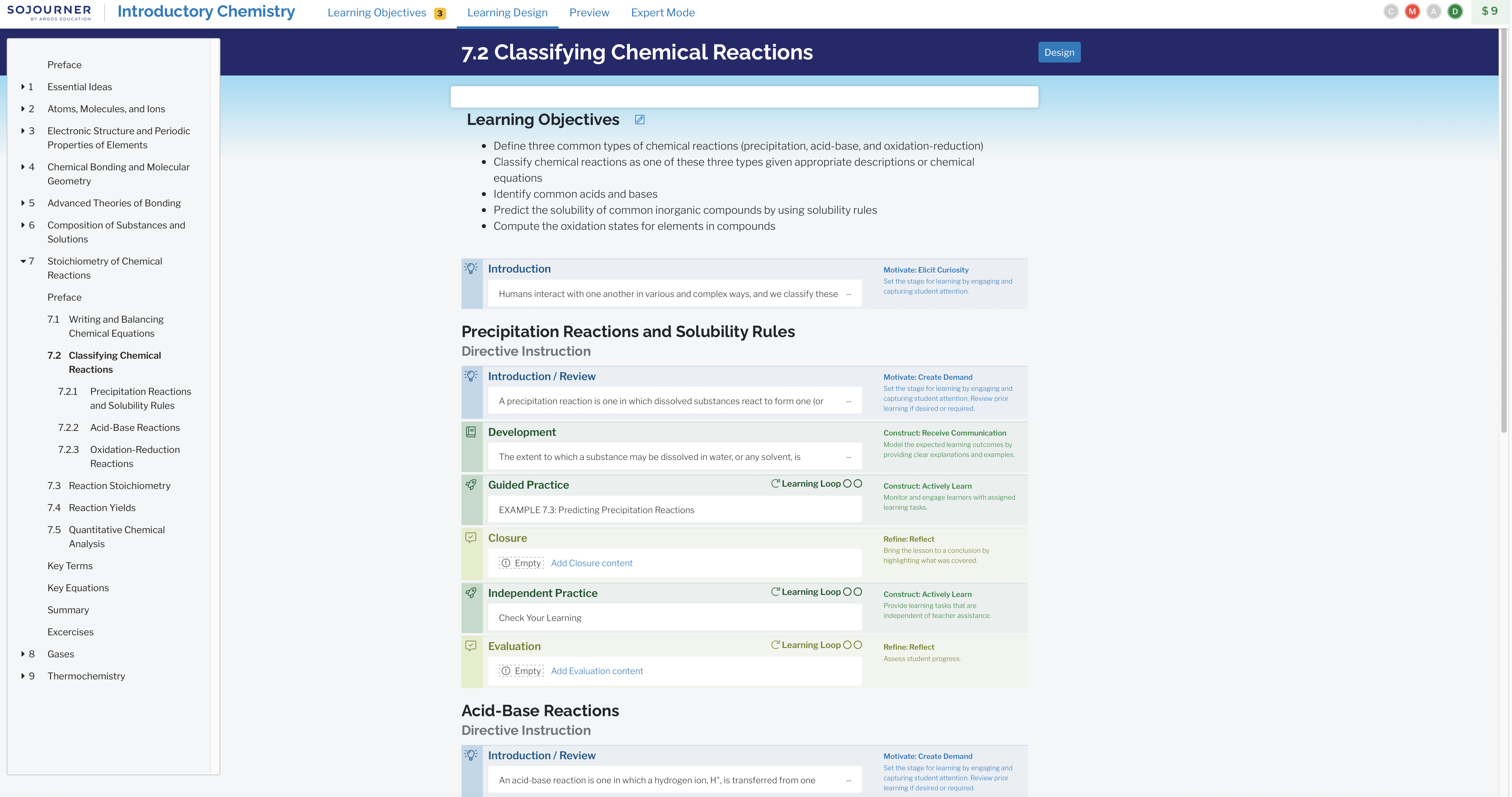
Ah. This is interesting. You get this. It’s a bit like how you think about putting together your lectures. Maybe you want to switch to outline mode so you can see the overall structure of how this thing is put together:
You’ve collapsed the text so that you can focus more on those little post-it notes and see the structure. It’s pretty much like a lecture. (It’s labeled “directive instruction” for a reason.) You introduce the concept to help students understand why the topic is important to the course, you provide them with some information, maybe you work a problem out for them—if you were doing this in class, you might work that problem out on a whiteboard—you…
Oh. Hmm. Usually you wrap up the lecture with a summary. This text doesn’t do that. You could fix that, but honestly, you’re not too worried about it.
The OpenStax text also doesn’t give an end-of-chapter test at the end. The truth is that you’d want to pull together some questions from a test bank anyway. So you’ll worry about that later too.
You dive back into Design mode to review the text. You want to give it a close reading now as you think through the design of your classes. And you find another unpleasant discovery. The section on acid-base reactions is just not right for your class. The language is a bit garbled and probably unnecessarily complex for your students.
This is the point when you would normally write the following in your syllabus:
When you get to Section 7.2.2 on acid-base reactions, do not read it. Instead, please go to this folder in Canvas and read the document called “Acid-Base Reactions.” Follow the link at the bottom of the page and take the quiz there. Then read the rest of Section 7.”
Which is not ideal for anyone. For you, you’re writing documents and organizing folders and diving into LMS quizzing tools and then trying to knit together what the students are doing in the LMS with what they’re doing in the courseware. For the students, they’re jumping through hoops.
But instructors do it all the time. Locking down the courseware might create enough friction that they will do it less often than they might otherwise. But many of them will do it. It’s a bad experience for everyone. And there’s no way for anyone to tell if the net result is better or worse for the student because the activity is happening in different systems that don’t really talk to each other. But as a dedicated instructor, you will do it if you think it will help the students.
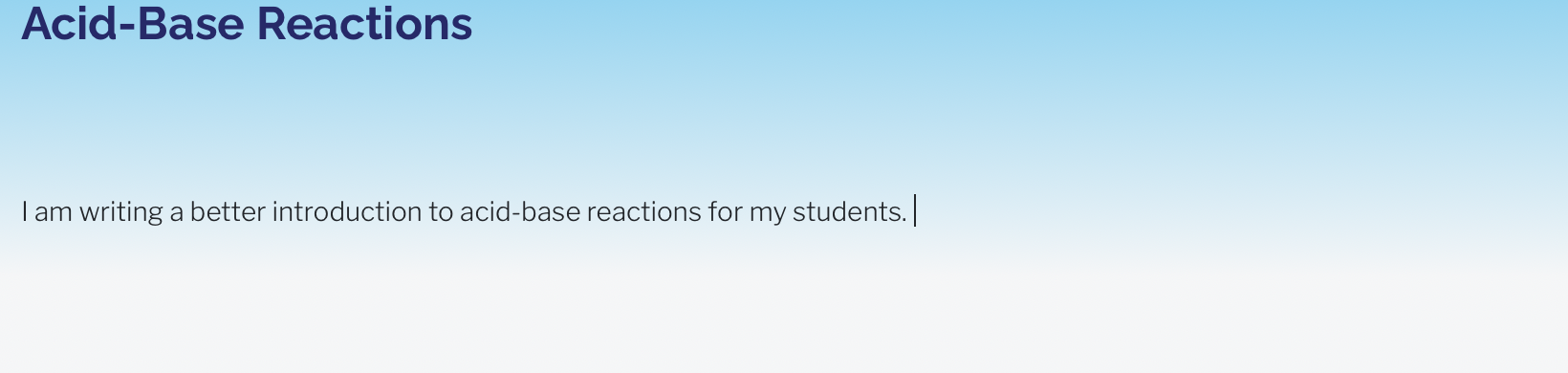
Or, if you’re in a platform that allows you to edit the curricular materials, you could just do this:
This is better for everyone. Students don’t have to jump through hoops. Instructors spend much less time setting up the content. And now that all the information is in one system, it’s possible to track whether these changes actually help students. That last piece is another topic for another blog post, but it’s incredibly important. If we want to create a virtuous cycle, we want to share changes, test which ones improve learning in which contexts, and generally create positive evolutionary pressure.
Finding teachable moments in the course design process
This idea of pulling editing “inside the tent” is central to understanding product/market fit and the levers available to change behaviors. As an instructor, you are mostly not trying write or rewrite textbooks. That’s not you think about what you’re doing, in part because the textbook is the raw material for their course design. It’s not a thing you care about in and of itself.
We want to catch you in those moments when you’re thinking about their course design and pull you into a kind of dialog as you use the raw materials to build that course.
And we’re always making choices about what we want to ask you to think about and what we want to get out of your way. If you want to add a virtual lab, maybe we give you the option of some scaffolding to help you think through all the steps you want students to go through:
When you pick their actual virtual lab, maybe we don’t bother you by calling attention to the learning objectives but we do show you a selection of labs that are tagged with the learning objectives associated with the content section you are working on:
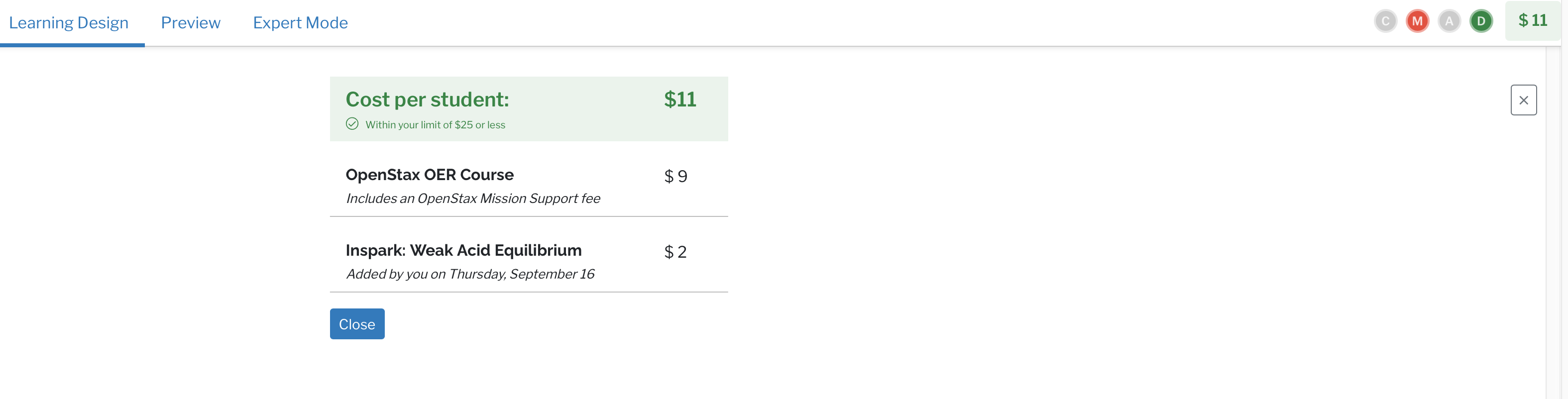
When you choose the lab, we let you see the cost change and, if you have set a cost cap, we warn you when you go over. We even give you a breakdown of what you’re asking the students to pay for:
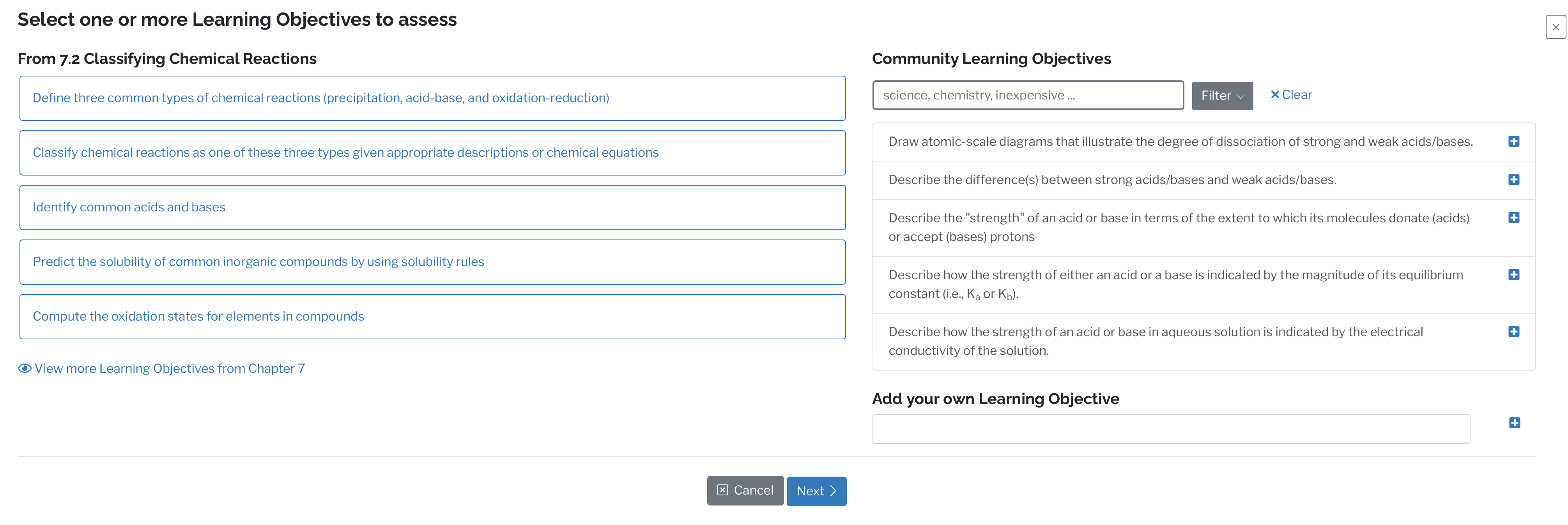
We don’t always want to hide learning objectives from you. Rather, we pick the moment when learning objectives are most useful to think about, like when you’re picking out assessment questions:
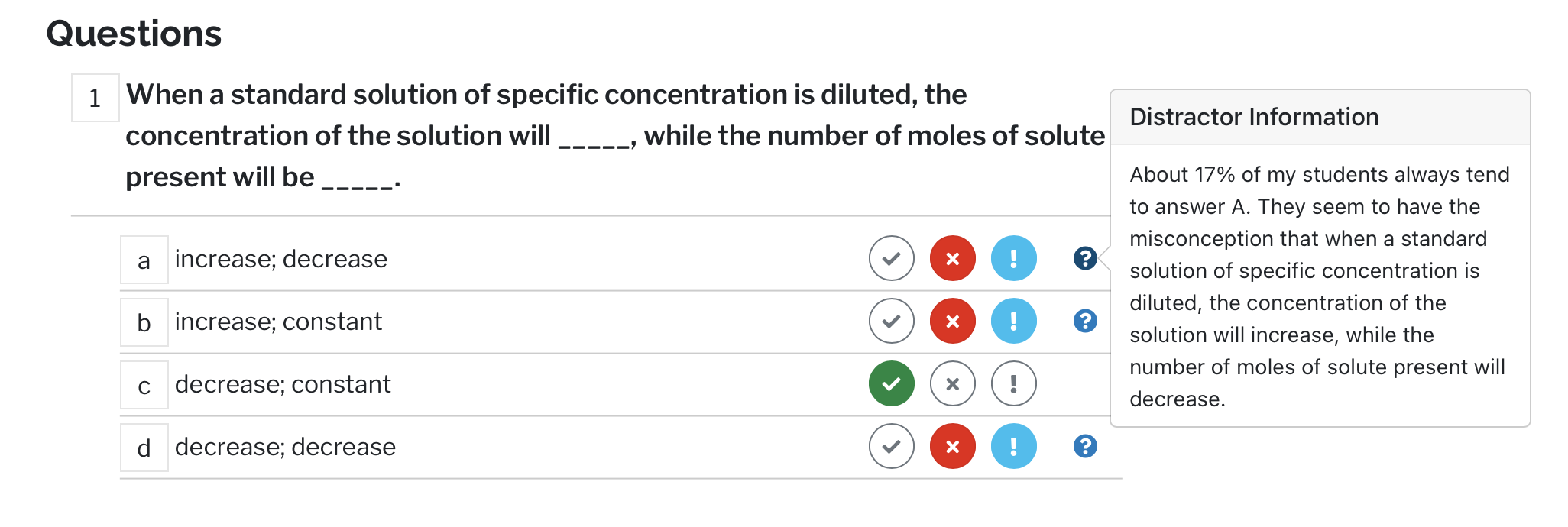
Notice that the platform introducing a bit of implicit community here. Other instructors are also designing courses around the same curricular product that you are. Maybe they have some good ideas that they’re willing to share.
And the real value of the sharing is not just the content but the rationale behind the course design. Why did the author write a particular answer in a particular way?
I could go on, but hopefully the theme is clear.
Professionally designed courseware has a lot of useful information either explicitly or implicitly built into it. We hide that design information from the instructors and then lock the product down. In doing so, we turn it into a static artifact that they have to work around. However the publisher might conceive of the product’s value is irrelevant if instructors are using it as raw materials for their course designs.
But if you start from that assumption, let them do what they’re going to do anyway in an environment where you can scaffold, collaborate, and provide feedback on the results of their designs, you can engage them in a much deeper way while saving them time and giving them more control over the things they care about. Also, we no longer have to separate conversations about course design from conversations about effective teaching practices. The fact that we do so now is a strong indicator that something is broken in our ecosystem. Course design and in-the-moment teaching are a continuous cycle. The two are constantly in dialog with each other. That’s the way teachers actually teach in the real world. Lesson plans change. You adjust. You improvise. Much of this is not arbitrary but rather driven by your encounters with your students.
If we want courseware to grow in adoption and educational impact (and perhaps as a useful and self-sustaining industry), we have to get away from the book. That doesn’t just mean getting away from linear, non-interactive designs. More importantly, it means getting away from the textbook as a static artifact that educators teach around.
By the way, today’s Blursday Social (9/16 at 4 PM ET) will be a chat about Argos. So you can come to that if you’re curious. Sign up here.
In my first post in this series, I wrote about what good teaching is. While the argument was wrapped in a lot of autobiography, it makes a number of assertions that are foundational to the mission of Argos:
The best evidence we have suggests that teachers change lives, by I we mean that students who have had good teachers will make more money, be physically and mentally healthier, and have more fulfilling relationships over the entire course of their lives.
Good teaching combines the emotional and the intellectual. In particular, teaching the diverse group of students that can be found in almost any classroom effectively requires diagnostic skill and creativity.
The intellectual aspect of good teaching is largely invisible to our society, including even many proponents and practitioners of education. The average person may sense it from time to time but, as a rule, we don’t talk about how it works and don’t think about it as an aquired skill set (nevermind a discipline that evolves over time).
As a result, there are social barriers to educators sharing craft with each other on top of the barriers created by the employment conditions in higher education.
One result is a poor understanding of the textbook’s role and product/market fit. In turn, this has contributed to several decades of slow, painful, and often unproductive efforts to creating a vision for a digitally transformed version of the product. We can’t see what we can’t see. As Henry Ford put it, “If I had asked customers what they wanted, they would have told me a faster horse.”
The primary purpose a textbook serves is to enable an instructor to upcycle the author’s course design. They adopt and adapt that design to fit their local needs and context rather than spending enormous amounts of time writing all the course elements from scratch. In the Industrial Age, where editing, typesetting, printing, distributing, and selling paper books were all labor-intensive and specialized tasks, it made sense to have one author, one editor, and one distributor to produce an artifact that each instructor would then independently upcycle. In the digital world, we can continuously upcycle course design by crowdsourcing improvement, both directly through collaboration and indirectly through shared data.
That’s an essential part of what Argos Education does. We enable a virtuous cycle where educators can continuously upcycle their course designs with their peers. This enables them to teach more effectively with less work. It also creates a positive evolutionary pressure on their course design and delivery. While educators are still free to exercise their judgment in their respective classrooms, they will do so knowing how their peers are upcycling the same basic course design as well as how well various aspects of the course design are working based on analytics. In other words, they will have peer and expert feedback and suggestions that they don’t have now.
How paper textbooks work
What is an educator doing when she selects a textbook? What is she looking for? What are her criteria? On a micro level, then answers vary dramatically from one educator to the next. One is looking for good back-of-chapter questions. Another is looking for readings that will be engaging and accessible to her students. Or a particular angle on the curriculum. Or a particular teaching method.
On a macro level, all of these fall into the larger bucket of looking for pieces of course design to upcycle. The specifics of what professors look for can be heavily inflected by a variety of factors. For highly procedural subjects like math, many educators will focus on the progression of scaffolded and unscaffolded problems. In economics, it could be philosophical/political. Conservative economists may like Greg Mankiw’s explanation of inflation while progressive economists may prefer Paul Krugman’s. A biology professor may choose a text that emphasizes an ecological lens to the topic over a microbiological one for several reasons. Maybe her university is known for its environmental studies programs but not for its pre-med programs. Or maybe she herself feels better equipped to teach the subject well from one angle rather than the other.
These differences can be neutral with respect to some imagined ideal of an “effective” class. How much does it really matter if a first-year biology student learns a little more ecology and a little less microbiology? Or the other way around? In those early courses, we mainly want to help the students develop their interest in the subject, some general knowledge, and some discipline-related thinking skills.
But in context, the differences can be dramatic. Teaching biology 101 from a microbiology perspective to a student who is trying to decide whether she wants to pursue a major in environmental studies may cause her to drop the course or even her major. Likewise, having a professor teach the course from an angle that they’re not comfortable with is likely to lead to a disengaged, paint-by-numbers teaching approach. If the educator is bored or uncomfortable, then the students will likely be bored or uncomfortable too.
Educators look for textbooks that give them more materials that they can upcycle into their course designs. The more the materials fit the course design in the teacher’s head, the more that teacher can focus on adding value in her context rather than filling in holes in the base course materials. And make no mistake: Educators almost always customize, even if they don’t think about what they’re doing in those terms.
When I taught a variety of subjects to middle school students, the one I was least opinionated about was pre-algebra. The book I had been given was pretty good and I didn’t feel terribly confident in my ability to come up with better teaching approaches to that subject. So I taught the book, chapter by chapter. I didn’t write a lot of supplemental materials or skip around. But I improvised all the time. For example, at that age, some students acquire abstract thinking later than others. This makes teaching concepts like negative numbers difficult. The book I was using talked about number lines but those were still too abstract. So I took the kids out onto the streets of Hoboken and we turned one of them into a number line that the students could walk. Later, when we were graphing lines, we turned it into a two-dimensional graph. (I was lucky that Hoboken streets had a grid layout.)
I created lessons that weren’t in the book so that the course design would fit the real needs of my actual students. I didn’t do it for pleasure or out of a sense that I was a better mathematician than the textbook author or even that I was a better curriculum designer in the global sense. But I knew better what my students needed from me because I knew my particular students’ needs and my own capabilities better. So I upcycled the course design. I took a found object that didn’t quite fit the purpose and turned it into something that did.
Even though I was more opinionated about how to teach science, I found a textbook that I really liked and followed that fairly closely too. But when a student asked a question that was provoked by but not answered by the experiment in the book, what was I supposed to do? Ignore it? Tell the student to go read about it?
No. I wanted to visibly reward genuine scientific curiosity in front of the class. So we made up experiments together to answer her question.
I didn’t think of it as either following or not following the textbook. I didn’t care about the textbook one way or the other. The textbook was just a tool for producing a better course design with less work. I cared about helping my students learn what they needed to learn in the ways that they needed to learn it, some of which the textbook’s author could anticipate and some of which he could not. (It was a male author.)
Sometimes—often, if we’re being honest—educators are not lucky enough to find a book that fits their contextual needs perfectly. For example, some of my students had never been out of a city. Taking them to the zoo helped stimulate some of them, but a zoo is not the same as a natural habitat. And even if I had VR and could take them out to the African savannah or an alien planet virtually, it still would have been an abstract concept to them. The best way to hook a lot of them was to create a transect in the park directly across the street from the school. I showed them how the space where they hung out and kicked a ball around was absolutely teeming with life that they never noticed. Suddenly, ecology was real to them. It was salient. At that point, the information in textbook would become much more meaningful to them.
The book I had adopted had some ideas about creating transects but I had to improvise a lot and fill in gaps where the text failed to address urban ecologies. I ended up creating a fair bit of original curriculum. Again, that had not been my intention. I didn’t even think about it as altering the course design. I was just trying to fill in holes for my students. It was often an improvisational act.
College is no different. First-generation students at Georgia State University are just as likely to have never seen the countryside as my Hoboken middle schoolers. In every course at every school, we have to adjust to the people who are in front of us using the skills that we have. There is no chance that we can “instructor-proof” courses with “personalized learning” any time in the foreseeable future, even if that were a desirable outcome.
We have fetishized the artifact of the textbook without really understanding how it is used by an expert practitioner (partly because we don’t think of educators as expert practitioners). We have constructed a fantasy of A Young Lady’s Illustrated Primer as the apotheosis of the textbook when textbooks have never functioned that way.
Biologists don’t select “Pearson Biology.” The top-selling biology textbook sold by Pearson is named after the biologist who authored it—Neil Allison Campbell. Educators who adopt Campbell Biology do so, in part, because they like Campbell’s course design, freeze-dried into textbook format. They upcycle the materials for their own classes. They attribute that course design to a presumed colleague, even if he’s one they haven’t met: noted biologist and biology educator Neil Allison Campbell. Pearson actively maintains that fiction even though Campbell has been dead for sixteen years and three editions have been published since his death. So baked into the very heart of today’s textbook branding system is a sense of collegial sharing that is increasingly a facade created by the publishers.
Two-cycle upcycling
Sometimes academic departments select textbooks as a group. And they do so as part of designing the curriculum for their entry-level courses. In this case, the department is upcycling the course design collaboratively—or, at least, the tenured and tenure-track professors are—and then that design on to the individual educators. Who inevitably upcycle it themselves from time to time. Even if they color inside the lines, there are always things that come up with the students that the course design didn’t anticipate. And many educators take liberties with the course designs they are given.
In an ideal world, educators within a department would meet regularly to share their upcycling and improve on the core course design template. But they generally don’t because they don’t have the time and because these upcycling changes aren’t easy to share. Sometimes they happen in class, either planned or unplanned. Sometimes they happen in the LMS, or in individual tools connected to the LMS. The departmental course adoption process demonstrates the need and desire for collaborative, multi-cycle course design upcycling. But it’s too hard and too time-consuming. As a result, all that extra work that educators put in to improve their course designs, and that could contribute to a collegial upcycling conversation, are lost.
EdTech has made upcycling harder
You would think that having everything in digital would make upcycling easier. At the moment, the opposite is true. Suppose, for example, that you decide to adopt the latest edition of Campbell Biology. You have a couple of choices. Your students could use the eText or a textbook. The eText is no more editable than the textbook. You could also augment by adopting the bundle of the eText and Mastering. So you’ll have to tell students, “First, read this section in your eText. Then follow this link to the homework platform. After that, come back to the LMS.” Is that easier than it was to accomplish the same tasks in a physical classroom? Is it easier for the instructor to set up and customize? Or easier for the students to follow along? I think not. It is easier to grade the homework. And it’s super easy for students to Google the answers to those homework problems.
Now suppose you don’t think a section of the textbook is appropriate for your students. Maybe it’s too hard for the mix of students you have, for example,
Read sections 7 to 7.2.2 in your eText. Do not read section 7.2.3. Instead, follow this link to the LMS folder called “Chapter 7” and read the document called ‘Alternate 7.2.3.’ Then, follow the link at the bottom of the document and take the quiz in the LMS. After that, go back to your eText and read 7.2.4 through to the end of the chapter.
Easy, right? While we’re at it, let’s throw in a virtual lab and a discussion in the special, non-LMS forum tool that you like. Upcycling in this environment is incredibly hard. Sharing your upcycling for somebody else to use—or even just migrating it from one LMS to another—is way too hard and time-consuming to expect full-time educators to do.
Attempts to address this problem have largely failed. OER creates a licensing structure that is supposed to facilitate upcycling. But upcycling requires infrastructure as well as a license. Just because you can theoretically edit that OER-licensed PDF doesn’t make it any easier to upcycle in reality.
On the technical side, Learning Object Repositories (LORs) designed by technologists for large organizations fail because the product category takes the wrong approach. The whole idea of a “re-usable learning object” is built on the analogy to re-usable software objects. But software and content aren’t re-usable in the same way. Educational content is all about context. You can’t chop up a bunch of courses on the same topics, paste pieces together, and have them make sense to learners. Creating modular, ready-to-reuse content (as opposed to upcyclable content) is incredibly hard. Often impossible. So LOR creators often spend tremendous amounts of time creating elaborate content taxonomies, only to discover that most people are using their fancy systems as media libraries and quiz question banks.
I’m not suggesting that either open licenses or LORs are useless. They just don’t solve the whole problem of continuous upcycling.
Continuous upcycling is possible
What if we could dramatically lower the barrier for continuous, collaborative, data-informed upcycling of course designs? Catch that teacher at the moment of improvisational need and make a good suggestion? Share brilliant teaching ideas that often never leave the classroom of the person who created them? Nudge teachers who are in a bit of a rut to show them some exciting things their colleagues are doing? All while keeping them focused on their core teaching challenges?
What if every educator who adopts a “textbook” could join one or more communities of adopters? What if they could edit, delete, and insert new content into the product they were upcycling? What if they could choose to share those edits with their department, their learning designer, the original author of the curricular product, or the whole community of educators who are adopting it? What if the product could recommend changes that colleagues are making, particularly if those changes seemed connected to better learning outcomes? What if educators could selectively adopt those changes? And what if they could choose to have conversations with their colleagues about the design, how they’re changing it, why, and how they could tell if it works?
This is how Argos Education aspires to change the fundamental value proposition of the “textbook,” or “courseware,” or whatever awful name you want to invent for that freeze-dried course design that educators upcycle to meet their local needs.
In my next post in this series, I’ll talk concretely about how this ecosystem—and economy—works.
In the meantime, this week’s Blursday Social will be a chat about Argos. So you can come to that if you’re curious. Sign up here.