The “Big Picture” category covers larger trends and topics that influence both the problems that technology can help address in education as well as the barriers to implementing high-quality technology-supported education. This includes research-based topics such as learning science and program effectiveness studies, philosophical discussions such as outcomes definitions, and macro-forces such as government policy, markets, and business models.
A few weeks ago, I posted about our case study on the governance of the Courseware in Context (CWiC) Framework. CWiC is a laudable effort to take the traditional product evaluation matrix and get beyond “magic quadrant-ism” by adding some educational context to the selection process. Which product is “best” depends a lot on your goals, capabilities, and other contextual factors. The CWiC advisory committee members explain how hard it is to integrate these factors into a product evaluation matrix. A lot of the hoped-for value of CWiC is still aspirational. There’s nothing wrong with that; it’s good to have big goals and to recognize how close to (or far from) achieving them you really are.
Sometimes just seeing your path to achieving those big aspirations is hard in and of itself. As this next case study shows, even if CWiC realizes its potential, it’s never going to be the right place to start if your goal is to meaningfully impact student outcomes and close achievement gaps. Our original goal with the National Louis University (NLU) and Acrobatiq interviews was to look at what it takes to implement courseware effectively with a vendor partner once the selection is made. In other words, what happens after you go through the process that the CWiC framework is meant to support. But we got so much more than that because NLU has been incredibly thoughtful about the program and students—the context—that impacts the use and value of the courseware. In other words, they also modeled what universities need to do before they select courseware, from designing a business/sustainability model that enables them to provide appropriate cost of an education to thinking about educational goals to figuring out where courseware does and doesn’t fit into that overall model. All of that prework has a profound impact on the working relationship with the vendor partner, the kinds of support identified as necessary to make the courseware work, and the future vision for how to continue to broaden and deepen the impact.
In the end, I think this case study shows both that a tremendous amount of work is needed to integrate courseware if you truly want to drive improvement in student outcomes and that the significant amount of planning and implementation work involved is only a small percentage of the total necessary program planning and work required. NLU has effectively redesigned the entire undergraduate experience. Their partnership with Acrobatiq works in large part because Acrobatiq understands their role in NLU’s larger goals, and because NLU maintains their focus on those goals rather than getting caught up in the notion that buying some magic product will solve all their problems.
I’m proud to have this be the final case study in this series of grant-funded stories. It neatly reflects a lot of what we believe about the ways in which universities and vendors need to work together if we want to improve higher education.
In my last post, I wrote about the goal of the Empirical Educator Project (EEP) as getting a critical mass of educators to be “socially empirical”:
Socially empirical educators view effective teaching not as an individual art but as a shared pool of knowledge and experience that everyone can learn from and contribute to. They seek out common vocabulary, methods, and standards of proof so that they can learn with their colleagues and raise the collective bar. This is the beginning of disciplinarity.
One way of thinking about the goal of EEP is to create a critical mass of socially empirical educators. They may not all arrive at one shared vocabulary, set of methods, and standard of proof. We will likely need a family of subdisciplines and empirical approaches to handle all the many meaningful contextual differences in education. But if a majority of educators see their work as embedded in a collective effort to learn together about how we can be more effective educators, then we will progress much more rapidly as a sector.
What is the value of doing this? Here again, the EEP founding cohort participants weigh in:
Too often, our conversations about education are weirdly bifurcated. On the one hand, we talk about big problems—helping massive numbers of people improve their economic status, educating a sophisticated citizenry, solving societal equity problems, and so on. On the other hand, we talk about the day-to-day work—picking tools and content, solving a developmental math program at a single college…maybe at most we have consortia working on shared problems within the group. But we only rarely and sporadically talk about the link between solving the local problems and tackling the grand challenges. We don’t have a plan for thinking globally and acting locally.
We at e-Literate contend that higher education is too focused on immediate peer groups, convinced that the most value will come from the people whose context is highly similar. There is some logic to that, given that effective education heavily dependent on many contextual details. But we seem to need a statement of common purpose around the educational part of the mission that is at once broad enough to accommodate differences and focused enough to bring together different types of institutions and individual stakeholders that have different strengths and resources to offer.
I won’t go so far as to say that EEP can offer that, but we aspire to create a collaborative environment out of which that shared vision can emerge by solving specific problems—acting locally—through collaborations that cross peer network boundaries.
We have the first batch of Empirical Educator Project (EEP) summit videos available in the form of a four-episode interview case study. You can see the full set here. I’ll be blogging about the series over the next week or so, starting today with the first episode on the definition of an empirical educator.
A lot of the currently popular terms of art that bear some relation to “empirical educator”—efficacy, evidence-based, research-backed, data-informed, etc.—tend to produce discipline-inflected responses (e.g., “It makes no sense to talk about ‘data” when you’re teaching English composition”) or suspicion due to vendor, funder, and media hype (e.g., “‘Efficacy’ is just the latest marketing buzz phrase”). And many of these terms tend to emphasize products or implementations. We wanted to put the focus on people, and we wanted the term to be inclusive of a wide range of practices that are discipline- and context-appropriate. So we introduced a new term, which always requires some norming to get people rallied around a common understanding of it.
Here’s what a sampling of summit participants had to say about the meaning of “empirical educator” after a day of work together:
The definition becomes increasingly inclusive as you listen to the complementary perspectives over the course of the video.
I think we’ll develop a more rigorous, evidence-based understanding of what it means to be an empirical educator over time—while hopefully maintaining the inclusive spirit. For now, I’ll put out my own taxonomy of levels of empirical education:
Intuitively empirical: This comes down to whether you pay attention to your students and do something differently with them based on what you observe. Do you always do the same thing, or do you have a bag of tricks that you can draw from when you see students struggle? I believe that the substantial majority of educators are empirical in this sense. They may not think of it as empiricism, but they are observing student behaviors and are adjusting their strategies based on what they see, guided by some sort of rationale for choosing which strategy to employ in different circumstances.
Mindfully empirical: Mindfully empirical educators think about how they can get the maximum amount of useful diagnostic information from day-to-day course work. They design their courses with a goal of creating many feedback loops that enable them to be adjust their teaching to the needs of the students.
Meta-cognitively empirical: Meta-cognitively empirical educators are empirical not only about how they use their existing bag of tricks but also about which tricks they should have and how effective those tricks really are. They consciously and regularly test their own assumptions about effective teaching, and they are open to trying new appropaches. My read of Lauren Herckis’ research is that the barrier of moving from mindfully empirical to meta-cognitively empirical (and to the next level, socially empirical) is where a lot of the difficult work needs to be done. Lots of educators are intuitively empirical, and the transition from there to mindfully empirical is not a huge leap. Getting them to test and challenge their deeply held beliefs about what constitutes effective teaching is a lot harder.
Socially empirical: Socially empirical educators view effective teaching not as an individual art but as a shared pool of knowledge and experience that everyone can learn from and contribute to. They seek out common vocabulary, methods, and standards of proof so that they can learn with their colleagues and raise the collective bar. This is the beginning of disciplinarity.
One way of thinking about the goal of EEP is to create a critical mass of socially empirical educators. They may not all arrive at one shared vocabulary, set of methods, and standard of proof. We will likely need a family of subdisciplines and empirical approaches to handle all the many meaningful contextual differences in education. But if a majority of educators see their work as embedded in a collective effort to learn together about how we can be more effective educators, then we will progress much more rapidly as a sector.
I think it’s also important to note that the term “educator” is intended to be more inclusive than just people who work in classrooms. Although instructors will be central change agents in any empirical education movement, anyone who is directly involved with designing or delivering a meaningful educational intervention is included in our definition of an educator. This means program administrators, instructional designers, and product designers, among others, can all be empirical educators.
As you may recall, we recently announced that eLiterate is launching a new initiative called the Empirical Educator Project (EEP). From the announcement post:
We believe one major barrier to progress is social. Work is being done, but it is fragmented. New approaches are being pioneered, but they aren’t shared, tested in different educational contexts, or framed in a way that makes them easy for other individuals and organizations to adopt them. An innovation often doesn’t make it outside the classroom or institution where it was created. When it does, it usually travels to peer groups—other members of the same department, other colleagues in the same discipline, or other universities of the same type.
Colleges that have educational challenges they need to solve often lack researchers to help them, while research universities often have researchers who are looking for good problems to solve. Despite the obvious collaboration opportunity that this resource imbalance presents, classroom educators aren’t aware of relevant educational researchers, and researchers rarely make their work product accessible to and adoptable by classroom educators. And if those researchers happen to work for vendors rather than universities, the problem is even worse. Vendors have no good way to convince the average academic that their research is valid, even when they have real and significant contributions to make. Academics who want to engage with vendors on research projects have no clear avenues to do so.
At e-Literate, we are in the rare and lucky position to be able to see into and across all these various silos. Given that we are seeing both increasing motivation and increasing activity in pockets across the higher education sector, we want to focus on increasing propagation and collaborative refinement of this work by lowering the barriers and increasing the opportunities and incentives for collaborative work. But part we believe that creating incentives for action is not the biggest challenge. Many people and organizations already have enough incentive that they are taking actions now, on their own, with whatever resources they can muster. In many cases, we will just need to create enough additional incentive to make collaboration worth the effort over and above whatever energy they are already putting into their projects.
We had our summit at Stanford about 2 weeks ago with 50 participants from a pretty wide range of institutions and roles. (You can see the attendee list on the project web page.) We’re still processing everything that we’re learning from that gathering and the follow-up, but here are two big lessons that I’m taking away from it personally:
Our hypothesis that gaps in our networks are preventing us from seeing the progress that is being made and collaborating to accelerate that progress was strongly supported by the early outcomes of that meeting. Participants seem thrilled to hear about work they didn’t know about from people they’d never met at institutions they never encounter. The number of collaborative project ideas coming out of the summit was far, far higher than we expected. We will see how many of them come to fruition, and how many of those produce real impact, but we are off to a running start.
The work of Carnegie Mellon University anthropologist Lauren Herckis, which we have highlighted heretwice, really resonated with the group. It turns out that telling faculty they should adopt effective teaching practices isn’t an effective teaching practice. With the caveat that she has conducted one (extensive) study at one institution, her work suggests that we tend to dramatically underestimate the degree to which most faculty care about teaching while dramatically overestimating the degree to which they will be persuaded by academic research that they should change their teaching practices. Faculty have all kinds of reasons why they resist pedagogical change, some of which are very logical and some of which are more intuitive or emotional. If we don’t engage with these cultural blockers head-on, then no amount of research, promotion, technology investment, or grant money will move the needle on student success.
Put these two observations together, and it looks like EEP will be most helpful if it promotes collaboration around projects that move campus culture in the direction of embracing an open-minded and experimental approach to educating, in which increasing student success is viewed as a collective endeavor in which we can advance the state of the art using the same intellectual tools of inquiry, debate, and peer review that academics apply all the time in their disciplinary work.
We will have much more to share about both the summit and our plans for EEP going forward within a couple of weeks. In the meantime, we have encouraged the participants to share their own views on the project as they see fit through blogs, articles, or other venues.
Doug Lederman at Inside Higher Ed wrote an excellent article describing the trajectory and demise of the “failed $75 million experiment” of the University of Texas System’s Institute for Transformational Learning (ITL).
Starting in 2011, the Texas system invested nearly $100 million in the institute ($23 million remains unspent) to try to drive digital technologies into the approaches its campuses use to reach, educate and graduate students. Over five years, the institute helped several UT campuses launch distinctive new academic programs and developed three core pieces of technology that, among other things, deliver online learning and students’ transcript information via the blockchain. But its total revenue over the five years: $1 million, The Texas Tribune reported.
Critics have derided that output as paltry given the investment and questioned whether the money could have been better spent. Advocates for the institute say it was the sort of necessary and worthwhile experiment that higher education institutions undertake all too rarely, even as they acknowledge a set of miscalculations that — along with political and cultural circumstances in part beyond its control — contributed to its undoing.
Among those missteps, according to numerous people who worked closely with the institute, were a tendency to approach campus faculty members with arrogance rather than as partners, and a lack of clarity from the start about the endeavor’s goals and business plan. Those were compounded by a problem that afflicts many educational technology efforts, whether funded by Silicon Valley investors or campus leaders: too little patience for what is almost always a long, drawn-out process of adoption and proof.
It’s worth reading the whole article, and sprinkled throughout are quotes from faculty and staff from the University of Texas system – ITL’s natural customer base – about overly optimistic claims, inability to understand or listen to its stakeholders, and real or perceived arrogance. I observed similar reactions when on the UT Austin campus for a video case study in Fall 2016 about their attempts to reinvent the large lecture class. When I asked about the overlap or collaboration with ITL on what seemed to be a perfect fit for that group’s objectives, I got eye rolls and comments about ITL being irrelevant for campus-based innovation efforts. Regardless of how that situation arose, the point is the same – there seems to have been a real breakdown of communication and trust between ITL and UT campus educators, despite the fact that “some of the work done by the institute has been divested to the various UT campuses.”
ITL was not alone as a failed, or at least abandoned, initiative to transform education based on innovative ed tech, and there is a theme in general of focusing more on the supposed tech-based innovation rather than the issue of cultural change and understanding social barriers (and this includes a culture’s view on whether the innovation is worth adopting). This is not a new subject, and similar challenges from a vendor standpoint led to the 2014 post “Pilots: Too many ed tech innovations stuck in purgatory”, an adaptation of which forms the second half of this post.
The general interest on dealing with the social change issues around real adoption of innovative education approaches – as well as the associated culture required to test theories, honestly assess results, and make continuous improvements in teaching practices – is what has led us at e-Literate to work on the Empirical Educator Project that Michael described a few weeks ago.
Despite the billions of dollars invested and provided in grants over the past several years, the vast majority of ed tech is used in only a small percentage of courses at most campuses. ((I’m not arguing against faculty prerogative in technology adoption and for a centralized, mandatory approach, but noting the disconnect.)) Most ed tech applications or devices have failed to cross the barriers into mainstream adoption within an institution. This could be due to the technology not really addressing problems that faculty or students face, a lack of awareness and support for the technology, or even faculty or student resistance to the innovation. Whatever the barrier, the situation we see far too often is a breakdown in technology helping the majority of faculty or courses.
Diffusion of Innovations – Back to the basics
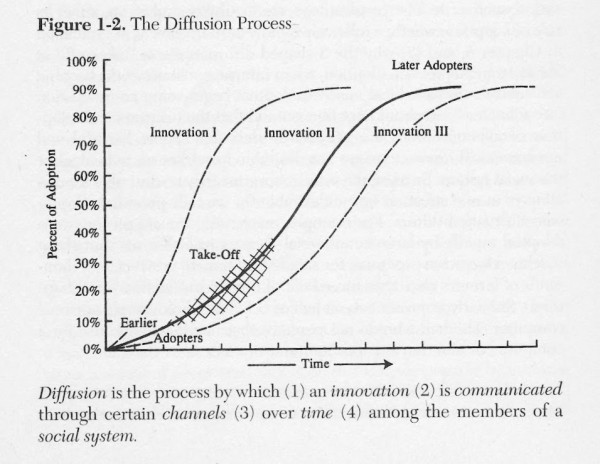
Everett Rogers wrote the book on the spread of innovations within an organization or cultural group in his book Diffusions of Innovations. Rogers’ work led to many concepts that we seem to take for granted, such as the S-curve of adoption:
Source: The Diffusion of Innovations, 5th ed, p. 11
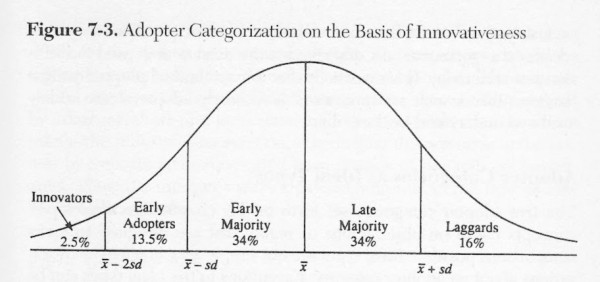
leading to the categorization of adopters (innovators, early adopters, early majority, late majority, laggards), and the combined technology adoption curve.
Source: The Diffusion of Innovations, 5th ed., p. 281
But Rogers did not set out to describe the diffusion of innovations as an automatic process following a pre-defined path. The real origin of his work was trying to understand why some innovations end up spreading throughout a social group while others do not, somewhat independent of whether the innovation could be thought of as a “good idea”. From the first paragraph of the 5th edition:
Getting a new idea adopted, even when it has obvious advantages, is difficult. Many innovations require a lengthy period of many years from the time when they become available to the time when they are widely adopted. Therefore, a common problem for many individuals and organizations is how to speed up the rate of diffusion of an innovation.
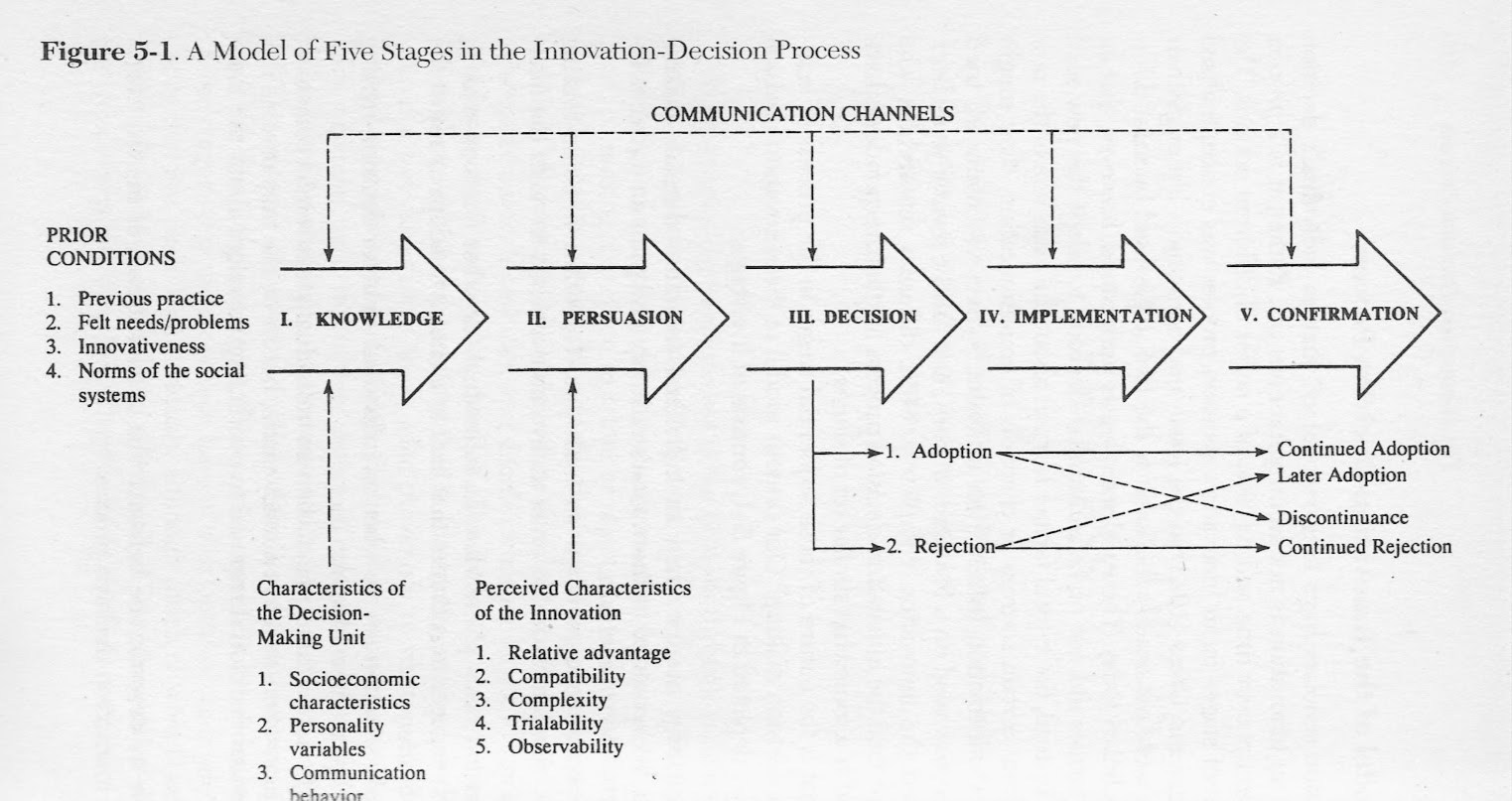
Rogers defined diffusion as “a special type of communication in which the messages are about a new idea” (p. 6), and he focused much of the book on the Innovation-Decision Process. This gets to the key point that availability of a new idea is not enough; rather, diffusion is more dependent on the communication and decision-process about whether and how to adopt the new idea. This process is shown below (p. 170):
Source: The Diffusion of Innovations, 5th ed., p. 170
What we are seeing in ed tech transformation initiatives in most cases, I would argue, is that the new ideas (applications, products, services) are stuck the Persuasion stage. There is knowledge and application amongst some early adopters in small-scale pilots, and there are good motivations in general from transformation groups like ITL and vendors, but majority of educators either have no knowledge of the innovation or are not persuaded that the idea is to their advantage, and there is little support or structure to get the organization at large (i.e. the majority of faculty for a traditional institution, or perhaps for central academic technology organization) to make a considered decision. It’s important to note that in many cases, the innovation should not be spread to the majority, either due to being a poor solution or even due to organizational dynamics based on how the innovation is introduced.
The Purgatory of Transformation
This stuck process ends up as an ed tech purgatory – with promises and potential of the heaven of full institutional adoption with meaningful results to follow, but also with the peril of either never getting out of purgatory or outright rejection over time.
Ed tech innovators can often be too susceptible to being persuaded by simple adoption numbers such as 1,100 institutions or total number of end users (millions served), or by new the promise of ideas that look great on paper, but meaningful adoption within an institution – actually affecting the majority of faculty or courses – is necessary in most cases before there can be any meaningful results beyond anecdotes or marketing stories. The reason for the extended purgatory is most often related to people issues and communications, and the ed tech market (and here I’m including transformation initiatives, vendors, consultants, and campus support staff and faculty) has been very ineffective in dealing with real people at real institutions beyond the initial audience for an idea.
As Larry Cuban stated in his commentary about Larry Berger’s “confession” that the engineeriomy model of personalized learning is flawed (also covered here at e-Literate):
First, those confessing their errors about solving school problems seldom looked at previous generations of reformers seeking major changes in schools.They were ahistorical. They thought that they knew better than other very smart people who had earlier sought to solve problems in schooling.
Second, the confessions seldom go beyond blaming their own flawed thinking (or others who failed to carry out their instructions) and coming to realize the obvious: schooling is far more complex a human institution than they had ever considered.
Finally, few of these confessions take a step back to not only consider the complexity of schooling and its many moving parts but also the political, social, and economic structures that keep it in place (see Audrey Watters here). As I and many others have said often, schools are political institutions deeply entangled in American society, culture, and democracy. Keeping the macro and micro-perspectives in sight is a must for those seeking major changes in how teachers teach or how schools educate. Were that to occur the incidence of after-the-reform regret might decrease.
Cover image credit: Ludovico Carracci [Public domain], via Wikimedia Commons
There is an article in EdWeek that quotes Larry Berger, CEO of Amplify, in his “confession” about personalized learning. The focus is on K-12 education but applies directly to higher ed as well.
Until a few years ago, I was a great believer in what might be called the “engineering” model of personalized learning, which is still what most people mean by personalized learning. The model works as follows:
You start with a map of all the things that kids need to learn.
Then you measure the kids so that you can place each kid on the map in just the spot where they know everything behind them, and in front of them is what they should learn next.
Then you assemble a vast library of learning objects and ask an algorithm to sort through it to find the optimal learning object for each kid at that particular moment.
Then you make each kid use the learning object.
Then you measure the kids again. If they have learned what you wanted them to learn, you move them to the next place on the map. If they didn’t learn it, you try something simpler.
If the map, the assessments, and the library were used by millions of kids, then the algorithms would get smarter and smarter, and make better, more personalized choices about which things to put in front of which kids.
I spent a decade believing in this model—the map, the measure, and the library, all powered by big data algorithms.
Here’s the problem: The map doesn’t exist, the measurement is impossible, and we have, collectively, built only 5% of the library. [snip]
So we need to move beyond this engineering model. Once we do, we find that many more compelling and more realistic frontiers of personalized learning opening up.
Larry is exactly right that there is a fundamental problem with the assumptions behind what he calls the engineering model of personalized learning. But there are alternate models that offer “more compelling and more realistic frontiers”. We have described this contrast in models at e-Literate, most directly in Michael’s post The Battle for “Personalized Learning”.
Phil and I have decided to claim this prime piece of linguistic real estate. We are asserting squatters’ rights.
We hereby decree, by the power vested in us by nobody at all, that “personalized learning” shall henceforth refer to a family of teaching practices that are intended to help reach students in the metaphorical back row. The ones who are bored, or confused, or tuned out, or feeling stupid. Personalized learning practices are almost always ones that teachers have been using for a very long time but that digital tools can support or enhance. Here are a few that we have identified so far:
Move content broadcast out of the classroom: In many disciplines, the ideal teaching format is a seminar, in which students spend class time engaged in conversation with a professor. In others, it is a lab. Both models have students actively engaged in academic practice during class time, when the professor, as the expert practitioner, is present to coach them. Every class spent lecturing is a wasted coaching opportunity.
Many disciplines have traditionally used assigned readings to move content broadcast out of the classroom, and some still do. But it is not always possible to find readings that capture what you want to cover, and in any case, it is becoming harder to persuade students to read. Luckily, there are tools that can help with this problem. You can record and post your lectures as videos, which students can watch as many times as they need to absorb what you’re trying to tell them. You can assign podcasts that they can listen to on the go, or find interactive content that keeps them more engaged.
Make homework time contact time: Good teachers help students see the direct connection between the work they do at home and the overall purpose of the class. They do this in a variety of ways. Sometimes they mark up and comment on the student work. Sometimes they ask the students questions in class that require them to build on the work they did at home. For a variety of reasons, which often boil down to professors’ having less available time per student, this has become harder to do. The great crutch that is now being used to limp along without actually solving this problem is robo-graded homework assignments. By itself, automated practice might help some students drag themselves through to the end of the semester. But it doesn’t often inspire them to think that maybe they are not destined to be the student in the back row forever. (There are important exceptions to this rule, which I address below.)
On the other hand, these same automated homework tools can also give teachers an easy view into how their students are doing and create opportunities to engage with those students. “Analytics” in these tools are roughly analogous to your ability to scan the classroom visually and see, at a glance, who is paying attention, who looks confused, who has a question. Nor are these the only tools available for making homework time feel less isolated and pointless. Any homework activity that is done electronically can be socially connected. Group work done on a discussion board can be read over by the professor when she has time. Highlights and margin notes on readings can be shared and discussed in class. This sort of effort on the professor’s part doesn’t have to be exhaustive (or exhausting). Sometimes a small gesture to show a student that you see her is all it takes.
Hire a tutor: You know what tutors are typically good for in your particular discipline. You also know that there generally aren’t enough good ones available, and that even when there are, it’s tough to get students to come into the tutoring center. One of the best uses of machine-graded homework systems, especially when they are “adaptive,” is to treat them as personal tutors that are available to students whenever they need them and wherever they are. They aren’t perfect, but what tutors are? Sometimes getting students out of the back row means helping them to believe that they are capable of learning. And sometimes students are willing to pose a question to a computer that they would be embarrassed to ask in person. In those cases, a little extra practice and feedback on the basics, without judgment, can make all the difference — even if the feedback comes from a machine. And if adaptive learning robo-tutors don’t fit the needs of your students and your discipline, technology also makes it possible to connect students with actual human tutors, who are available online to help them get through the rough spots.
There is a battle for personalized learning, and the description of the engineering model is useful for understanding one approach (unfortunately the one most often used in marketing and by ed reformers). But there is an alternative and it is more compelling.
On Friday I reported about SB2328, a bill that passed (with amendments) the Hawai’i Senate Committee on Higher Education and would have mandated open educational resources (OER) for all courses at all 10 University of Hawai’i campuses. And if there were no adequate OER materials for a course? “. . . the faculty member or lecturer responsible with providing instruction for the course shall create the instructional materials and offer those materials free of charge to students through open educational resources.”
This bill was a disaster in the making. Not only would it have been unworkable in terms of funding and intellectual property ownership, it would also have set back the OER movement by associating OER with unfunded faculty mandates and reduction of academic freedom. All this from good intentions but apparently shallow understanding.
As mentioned in an update to Friday’s posts, the amendments that resulted from committee hearings removed the mandates. We now have the amended language, and it is a completely different bill.
(1) Establish the University of Hawai‘i open educational resources task force to conduct a comprehensive analysis and evaluation on all general education courses and high attendance courses taught at the University of Hawai‘i system to identify open educational resources for those courses;
(2) Establish and appropriate funds for an open educational resources pilot project grant program to incentivize faculty that adopt, develop, and implement open educational resources; and
(3) Require the University of Hawai‘i open educational resources task force to report its findings and recommendation initiatives for supporting and expanding the use of open educational resources at the University of Hawai‘i to the Legislature prior to the Regular Session of 2019.
During the hearings there were several dozen testimonies shared, and all but two opposed the bill (and one of those two changed positions to oppose). Leading the opposition was the University of Hawai’i Professional Assembly, the local faculty union.
In short, the bill amendments removed mandates, creates a task force charged with a one-year evaluation of high-enrollment and general ed courses, and creates a $50,000 grant fund to incentivize faculty adoption.
It is not clear whether the bill will make it through remaining hurdles to become state law, but if it does, we will have a fairly significant move in the state dealing with the costs of curricular materials and OER adoption.
Billy Meinke, OER Technologist and UH Manoa and a key player within the system (let’s call him Kane OER), was unaware of SB2328 before it came out. This gets to the heart of the problem – the original bill appears to have been written without any input from the people already working on OER adoption within the University of Hawai’i.
I still have a problem with the preamble of the bill that uses the misleading claim that the “average cost for books and supplies for the same academic year at public colleges averaged $1,250.” Students actually pay about half this amount, and this false setup will lead to erroneous estimates of how much any such bill could save for its students. But for now, crisis averted.