e-Literate

Present is Prologue

Category: Big Picture

The “Big Picture” category covers larger trends and topics that influence both the problems that technology can help address in education as well as the barriers to implementing high-quality technology-supported education. This includes research-based topics such as learning science and program effectiveness studies, philosophical discussions such as outcomes definitions, and macro-forces such as government policy, markets, and business models.

  • Fall 2016 IPEDS First Look: Continued growth in distance education in US

    Fall 2016 IPEDS First Look: Continued growth in distance education in US

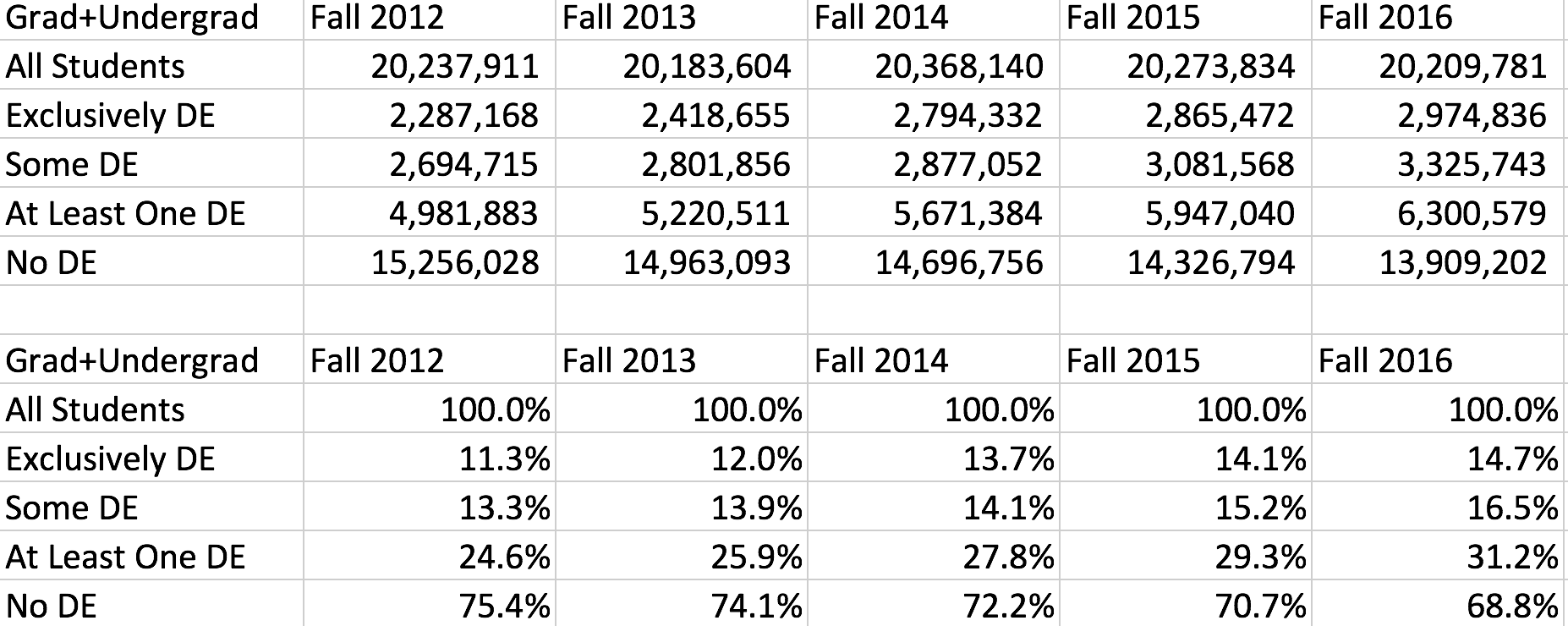
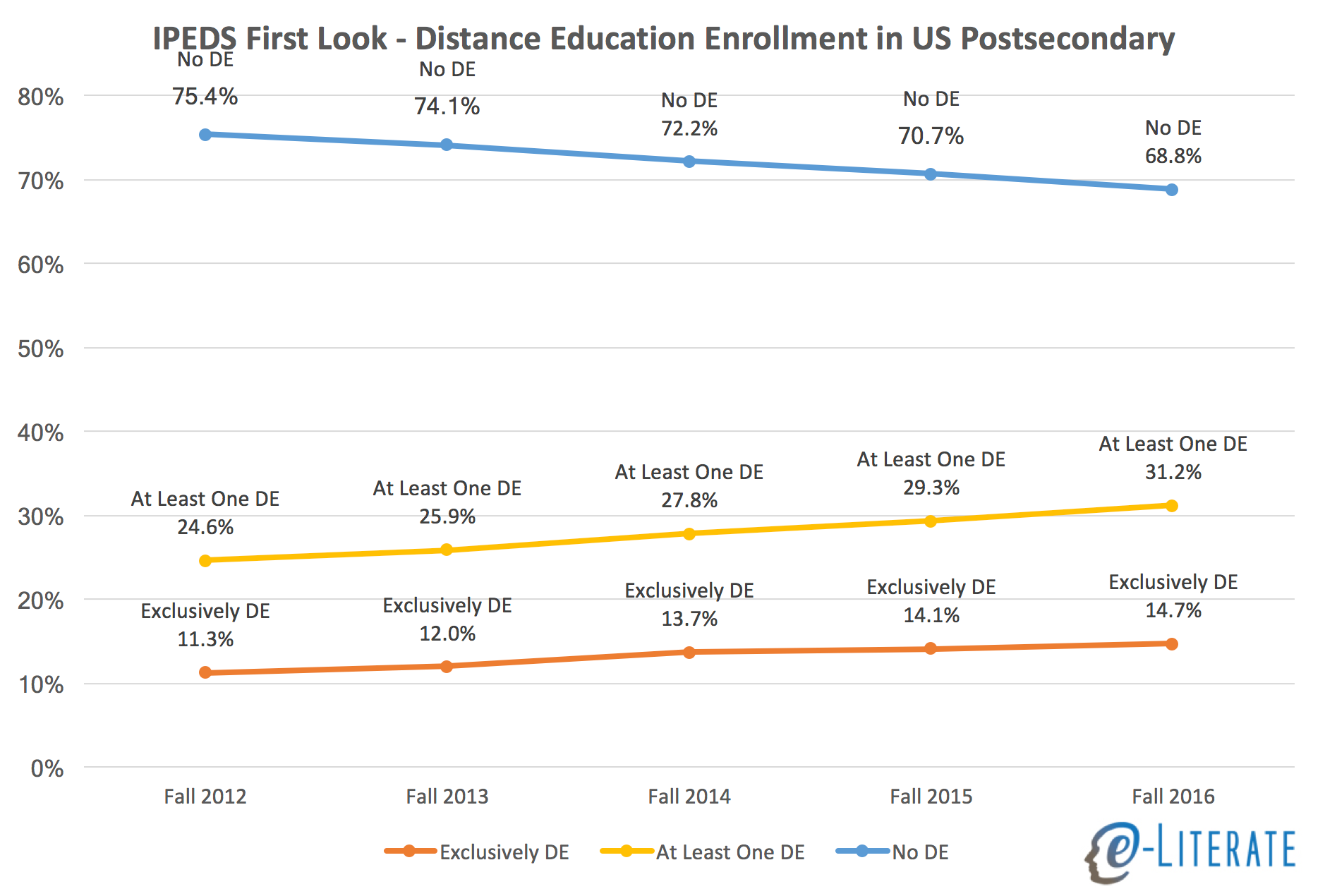
    The National Center for Educational Statistics (NCES) just released its Integrated Postsecondary Education Data System (IPEDS) report and data on postsecondary enrollment in the US for the Fall 2016 term. This federal data has been tracking distance education (DE) since Fall 2012, and with the new release we get our first look at trends through last year. Accompanying the data is a report by NCES with summary data tables. For the following tables and chart, I took the same approach as the report, by simply filtering for US-only institutions participating in Title IV federal financial aid programs.

    Please note that this is a broader definition, with more schools included, that our previous analysis at e-Literate and the Digital Learning Compass report. Those posts and analysis further filter for 2-year and 4-year degree-granting institutions.

    When viewing data from this first look at 6,677 institutions and administrative units, please note the following:

    • For the most part distance education and online education terms are interchangeable, but they are not equivalent as DE can include courses delivered by a medium other than the Internet (e.g. correspondence course).
    • Exclusively DE means students who take all their courses online.
    • Some DE means students who take some but not all of their courses online.
    • At Least One DE is a combination of the above two categories, showing students who take at least one of their courses online.
    • No DE means students not taking any online courses.
    • The data totals used in the report are slightly off (0.07%) from what is in the data set that is the basis for my tables and chart below. I have not figured out this discrepancy yet, but it is immaterial for the big picture.

    For this first post, I am showing totals – institutions in all sectors, and a combination of student enrollment from graduate and undergraduate (4-year, 2-year, and less than 2-year) programs. I’ll break down by sector and level of study and even state in future posts.

    With all those caveats in mind, here are data from Fall 2012 through 2016.

    Some observations of this data for Fall 2016:

    • There appears to be an small but noticeable acceleration in the growth of DE, going from 1.5% increase in percentage of students taking at least one online course from Fall 2014 to 2015, and a 1.9% increase from Fall 2015 to 2016. Although not shown in these tables, the acceleration appears in both undergraduate and graduate programs.
    • In the four-year period from Fall 2012 to Fall 2016, the share of students taking at least one online course increased by 27% (from 24.6% to 31.2%).
    • Note that this broad view of students (US, Title IV as only filters) does not capture the decrease in total enrollment shown in other IPEDS reports or National Student Clearinghouse reports.

    We’ll look deeper into the data and apply more consistent filtering to allow comparisons to our previous analysis. And we’ll break down by level of study, sector, and home state of institutions.

  • Good Enough vs. Better Enough: The Macmillan Example

    Good Enough vs. Better Enough: The Macmillan Example

    In my recent post on Cengage Unlimited, I made a brief mention of the battle shaping up in the curricular materials world between “good enough” and “better enough.” I argued that Cengage is coming down on the “good enough” side by emphasizing all-you-can-eat pricing.

    The distinction I’m trying to make between two strategies is a little tricky. I’m not arguing that Cengage, for example, thinks that their products aren’t great or that they think all anybody needs is the cheapest PDF possible. And on the other hand, “better enough” no longer means better editing or better production values, which is the way that textbook publishers used to position themselves against OER (and still do sometimes, although that reflex is beginning to fade). Rather, it’s about improving student outcomes.

    To borrow a phrase from David Wiley, the fight boils down to standard deviations per dollar. ((“Standard deviation” is just statistics geek speak for a measure of difference—in this case, improvement—from the norm.)) This formulation boils the battle down to a fraction. In the numerator, we have impact. In the denominator, we have cost. David likes to say that it’s easier to change the denominator, i.e., reduce cost, than it is to change the numerator, i.e., improve student outcomes. One of the reasons this is true is that putting a different product in a class usually doesn’t have a big impact unless the instructor’s teaching practices also change to take better advantage of the product’s features. Or, if you prefer a formulation that emphasizes the teaching over the tools (which I do), digital courseware tends to have the most impact in classrooms where it supports the chosen pedagogical approach of the instructor.

    For the incumbents, neither the numerator nor the denominator is particularly easy to change. In my last two posts, I wrote about the major investments—and risks—that Cengage took on to deliver their products at a better price point and still make their business model work (they hope).

    But that may be a cake walk for the publishers compared with the challenge of changing the numerator. In my original post about Pearson’s efficacy strategy, I explored these challenges at length. I have chosen to quote a hefty excerpt here because none of these problems have gone away:

    Let’s think some more about the analogy to efficacy in health care. Suppose Pfizer declared that they were going to define the standards by which efficacy in medicine would be measured. They would conduct internal research, cross-reference it with external research, come up with a rating system for the research, and define what it means for medicines to be effective. They would then apply those standards to their own medicines. And, after all is said and done, they would share their system with physicians and university researchers in the hopes that the medical community might be reassured about the quality of Pfizer’s products and maybe even contribute some ideas to the framework around the edges. How confident would we be that what Pfizer delivers would consistently be in the objective best interest of improving health?…

    If Pearson were to say to faculty, “Here’s what we think we know about the efficacy of this product, here’s what we don’t know yet, and here is how we are thinking about the question,” they might get a number of responses. Maybe they would get, “Oh, well here’s how I know that it’s effective with my class.” Or “The reason that you don’t have a good answer on effectiveness yet is that your rubric doesn’t provide a way to capture the educational value that your product delivers for my students.” Or “I don’t use this product because it has direct educational effectiveness. It frees me up from some grunt work so that I can conduct activities with the class that have educational impact.” Most of all, if you’re [Pearson CEO] John Fallon, you really want faculty to say to their sales reps, “Huh. I never thought about the product in quite those terms, and it makes me think a little differently about how I might use it going forward. What can you tell me about the effectiveness of this other product that I’m thinking about using, at least as Pearson sees it?” And you really want your sales reps to run back to the product teams, hair on fire, saying “Quick! Tell me everything you know about the effectiveness of this product!”

    Pearson won’t get that conversation by just publishing end results of their internal analysis when they have them, which means that they have a high risk of failing to align their products with the needs and desires of their market if they think about the relationship between their framework and their customers in that way….

    There are a number of reasons why this part of the transformation will be at least as difficult as the part that Pearson is undertaking now. First, it is far from clear that the company has the trust of the academic community that would be necessary for them to take such a role. That would have to be built, in some cases from the ground (or even the basement) up. Pearson does have real strengths that are known within certain segments of the academic community—in data science, for example—but this does not transfer to a general reputation. Second (and relatedly), unlike the medical research community, the educational research community is still nascent and fragmented. Finding non-paternalistic but effective ways to bring that community together and facilitate useful conversations will be difficult to say the least. These two challenges are outside the company’s sphere of control, which means that Pearson will have to develop new ways to think about how to build their relationships with the broader educational community.

    Internally, changing the way they think about answering the questions that the framework asks them will entail as much subtle, difficult, and pervasive re-engineering of the corporate reflexes and business processes as the work being undertaken now….  [A]ll textbook companies that have been around for a while are wired for a particular relationship with faculty that is at the heart of how they design, produce, and sell their products. Their editors have gone through decades of tuning the way they think and work to this process, and so have their customers. When Pearson layers a discussion of efficacy onto these business processes, a tension is created between the old and new ways of doing things. Suddenly, authors and customers don’t necessarily get what they want from their products just because they asked for them. There are potentially conflicting criteria. The framework itself provides nothing to help resolve this tension. At best, it potentially scaffolds a norming conversation. But a product management methodology that can combine knowledge about efficacy, user desires, and usability requires more tools than that. And that problem is even worse in some ways now that product teams have multiple specialized roles. The editor, author, adopting teacher, instructional designer, cognitive science researcher, psychometrician, data scientist, and UX engineer may all work together to develop a unified vision for a product, but more often than not they are like the blind man and the elephant. Agreeing in principle on what attributes an effective product might have is not at all the same as being able to design a product to be effective, where “effective” is shared notion between the company and the customers. ((Believe it or not, that is a short excerpt as measured as a percentage of the total word count of the post.))

    Publishers that want to improve the numerator will have to completely rewire the ways that they work, both internally and externally. They need to rethink their product design process from the ground up while simultaneously completely resetting their relationships with their customers.

    That post was published on December 31st, 2013. As we enter 2018, we are beginning to see examples of what such efforts might look like. For today’s example, I’m going to draw on recent work by Macmillan.

    Resetting the Conversation

    Before I get into the details, a little more disclosure than usual is called for here. I am a paid member of Macmillan’s Learning Impact Research Advisory Council (IRAC). As such, I was paid to provide input on the paper I’m about to write about as well as the underlying research processes that the paper describes. I was not paid to write this post about the paper. Or rather, I was paid to write something about it, but I was asked to write one page—one page!—of private feedback on the paper. I asked if I could write my feedback as a public blog post of unspecified length. The folks at Macmillan agreed.

    The paper is called Unpacking the Black Box of Efficacy: A framework for evaluating the effectiveness and researching the impact of digital learning tools. Registration is required.

    First piece of feedback for Macmillan: If you really want to foster a new dialog with academics, don’t start it by requiring them to give you their email addresses just to read your paper.

    But the approach outlined in the paper is another matter. Recall that in the Pearson post quoted above, I advised the company to approach customers with something like the following proposition:

    Here’s what we think we know about the efficacy of this product, here’s what we don’t know yet, and here is how we are thinking about the question.

    That is essentially what Macmillan’s paper attempts to do. It starts with an inventory, in plain English, some common educational research methods, how they work, and what their strengths and weaknesses are. The section on randomized controlled trials (RCTs) alone is worth the price of admission, given how often it is simplistically held up as the “gold standard” in research. Any thoughtful educator reading the description of the process will immediately think, “Hey, that’s…problematic in education.”

    Even better, Macmillan was able to accomplish that with one page of text and one picture. They will need to be this incisive on a consistent basis if they are going to reach their intended audience.

    Next, the paper describes their product development lifecycle. Again, there is a good balance here of clarity and brevity. The first stage of that lifecycle is called “Co-design & Learning Research.” While publishers have pretty much always started their product design process with input from customers, I wouldn’t call the historic process “co-design.” Rather, it was typically an author/editor collaboration with some limited and focused customer input. More recently, publishers have developed all kinds of hybrid processes. But Macmillan at least claims to be starting with a clean sheet of paper. They are certainly not the only publisher to do this, but from a communication perspective, framing educational product design as a combination of co-design with customers and structured but comprehensible research is a good move.

    Speaking of which, the third section maps the various research methods described in the first section to the product design process in the second. There’s even a development timeline. The net effect is that educators (and students) have a clear and concise document explaining how Macmillan products are developed, how their potential learning impact is tested, and just how much it’s fair to say that the company knows about that impact at any stage in the development lifecycle.

    While I am by no means claiming credit, this paper reads as if it could have been written as a direct response to my critique of Pearson’s first iteration of efficacy.

    So yeah. I like it.

    Good Enough for What?

    You didn’t think I’d let them off that easily, did you?

    Remember waaay back, all the way at the beginning of the post, when I made the point that learning outcomes are hard to improve with curricular materials partly because their impact depends on what humans in the classroom do with them? That problem still looms, and Macmillan’s paper barely touches it.

    When I talk to students at length about the curricular materials that their instructors assign, their top complaint isn’t price. Don’t get me wrong; they hate the prices. But what they really hate is being told to buy a $200 book that the instructor barely mentions, let alone integrates into the class on a programmatic basis.

    This is what “better enough” is competing against. I always thought it was funny that textbook publishers refer to everything outside the book as “ancillaries,” because many instructors tend to see the categories as reversed. The book is ancillary. It’s not central to the learning that happens in the classroom. Before Macmillan, or any other publisher, can sell products based on the value proposition of “efficacy” or “learning impact” or “learning outcomes”, instructors must first come to believe that these three propositions are true:

    1. Instructors are responsible for learning how to improve their students’ learning outcomes by improving their teaching craft.
    2. Improving their teaching craft includes learning to employ research-validated practices.
    3. Macmillan’s products support and enable research-validated practices effectively enough that they can make the credible case for having more than “ancillary” value.

    This paper makes a good start—as good a start as any short paper can make—on the third proposition. The first proposition isn’t fair to lay at the publishers’ feet; it’s more driven by the incentives and culture of academia. It’s a problem, but not one that Macmillan or its peers can do much about directly. The second proposition is where the vendors, including but not limited to Macmillan, need to figure out how to do more.

    To be fair, the paper nibbles around the edges of this problem. The educators and product developers need to develop shared goals. That’s what a co-design process is for. Educators and product developers also need to develop a shared sense of proof that the goals are being met better by one method than another. A lot of the paper develops the basis for a conversation around this.

    But left implicit is the argument that education should be empirical and that empiricism needs to be formalized at least some of the time. There should be theories of learning impact and rules for what counts as evidence that supports or disproves those theories. This needs to apply not just to curricular materials design but for what happens in the classroom.

    It’s probably too much to expect this paper, as focused as it is, to open up this Pandora’s Box. This paper is, in part, a trust-building exercise, and Macmillan needs to build trust before they can fully own up to the fact that incorporating curricular materials that meaningfully improve learning outcomes usually entails a course redesign. But that’s where both Macmillan and the industry need to get to if they want to be able to sell more heavily researched and designed products at a higher price point.

    “Good enough” means “good enough for the way I use curricular materials in my classroom.” “Better enough” means “better enough that I’m convinced I should change the way I teach.” Macmillan has written a really good paper on the standards of proof they propose to live up to and how they propose to live up to them. But they also have to convince their customers to agree to live up to those same standards in their own teaching.

  • A Note on Data Used for LMS Market Analysis

    A Note on Data Used for LMS Market Analysis

    Recently Martin Dougiamas of Moodle has questioned our data analysis for the LMS market. In some useful notes posted at Moodle.com on two recent Future Trends Forums hosted by Bryan Alexander:

    Bryan finished the Future Trend Forum by asking for Martin’s thoughts on the recent article by Phil Hill titled: “Whither Moodle?” [edited] which speculated that Moodle’s growth is slowing down and hitting a plateau.

    Martin commented that is not the case from what he is seeing and that a lot of the information contained in the article is US-based where there a lot of more LMS vendors and venture capitalists building learning platforms.

    While this description from Martin is inaccurate, the issues raised are representative of some of the questions we occasionally get about our data for our LMS market analysis service. I think it would be useful to share a deeper description in public of how our partners at LISTedTECH collect and organize the underlying data.

    What We Measure

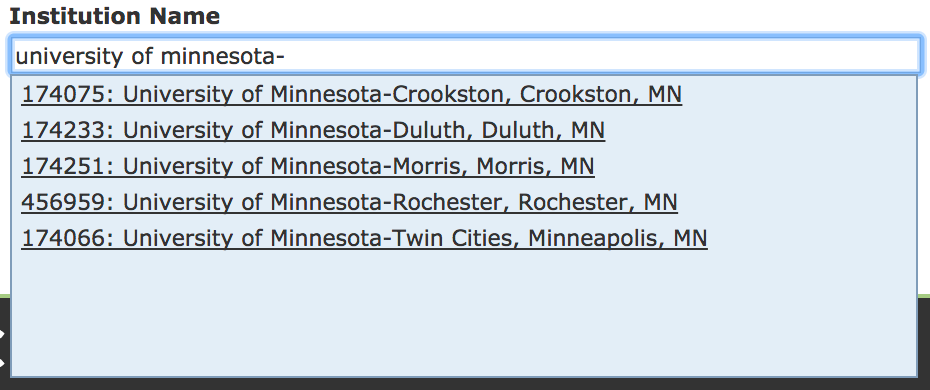
    The market data are organized in a dataset that captures system usage on a per higher education institution basis. For most schools, a campus is equivalent to an institution. But there are also cases where there multiple campuses per university (e.g. University of Minnesota system with five campuses, or DeVry University with dozens of campuses) and the LMS decision is made at the system level. In these situations, one decision will lead to multiple institutions listed in the data. In the US, the definition of an institution is guided by unique identifiers in the Department of Education’s IPEDS data, and each region or even country has its own way of defining institution.

    The dataset goes beyond “school X uses system Y”, as it also includes dates of implementation and decommission, usage as primary or secondary system (there may be more than one system in use at a school), and hyperlinks to the public information documenting a system selection or usage. The definition of institutions includes information about its sector (public two-year, private non-profit four-year, etc) as well as student enrollments.

    How We Measure

    Looking deeper at LMS selection, there are multiple layers of data gathering at different intervals. Some of the sources:

    • Extensive search engine notification such as Google Alerts on product keywords in multiple languages;
    • URL and domain scrapers looking for system information at official school websites; and
    • Targeted human-directed searches.

    Each new data point is verified by someone using the associated hyperlinks tied to selection or usage data.

    Our North American data is essentially saturated, in that we know the vast majority of degree-granting institutions based on US Department of Education data or Canadian provincial governmental data. We have well above 90% of all schools in the dataset.

    For the global regions outside of North America, we are building up the dataset and do not have saturated coverage yet. For example, in Europe we estimate that we have 60 – 75% of institutions. We have less than that in Latin America and more than that in Oceania.

    Where feasible, we include on-the-ground subjective coverage by visiting the global regions, testing theses, finding out unique context, and finding local sources who can provide QA to our data.

    Besides our home base of North America, we have made multiple trips to Europe and Latin America thus far, and we are currently arguing about who gets to visit Australia and New Zealand.

    We plan to expand coverage to additional regions as we develop at least 30% coverage of institutions and have time to do additional research to back up our analysis.

    Degrees of Uncertainty

    Because higher education data is lumpy and based on extended implementation times, we offer the following caveats:

    • Market share information provided in percentages and trends are more reliable than absolute counts outside of North America. When we do provide absolute numbers, we advise caution for readers or subscribers to not over-interpret the absolute numbers, at least without us providing additional details to keep the data in context.
    • We typically separate North American data from Rest of World data (Europe, Latin America, Oceania) to avoid problem of North America numbers dominating aggregates and obscuring important regional differences.
    • When we have system usage information but do not have accurate implementation dates (per month or quarter), we assign these system records to June. Therefore the summer data for new systems will appear artificially high. We currently have implementation dates for approximately 75% of the listed LMS records.
    • Put another way, annual data is more reliable (i.e. without additional data collection noise) than half-year or quarterly data. The more-granular data is provided to certain subscribers, but we take great care in attempting to describe sources of “lumpiness” in the data that should be understood for any analysis.

    Overall, we have LMS data for 4,523 institutions in the US and Canada and 8,824 institutions worldwide.

    Back to the Future (Trends)

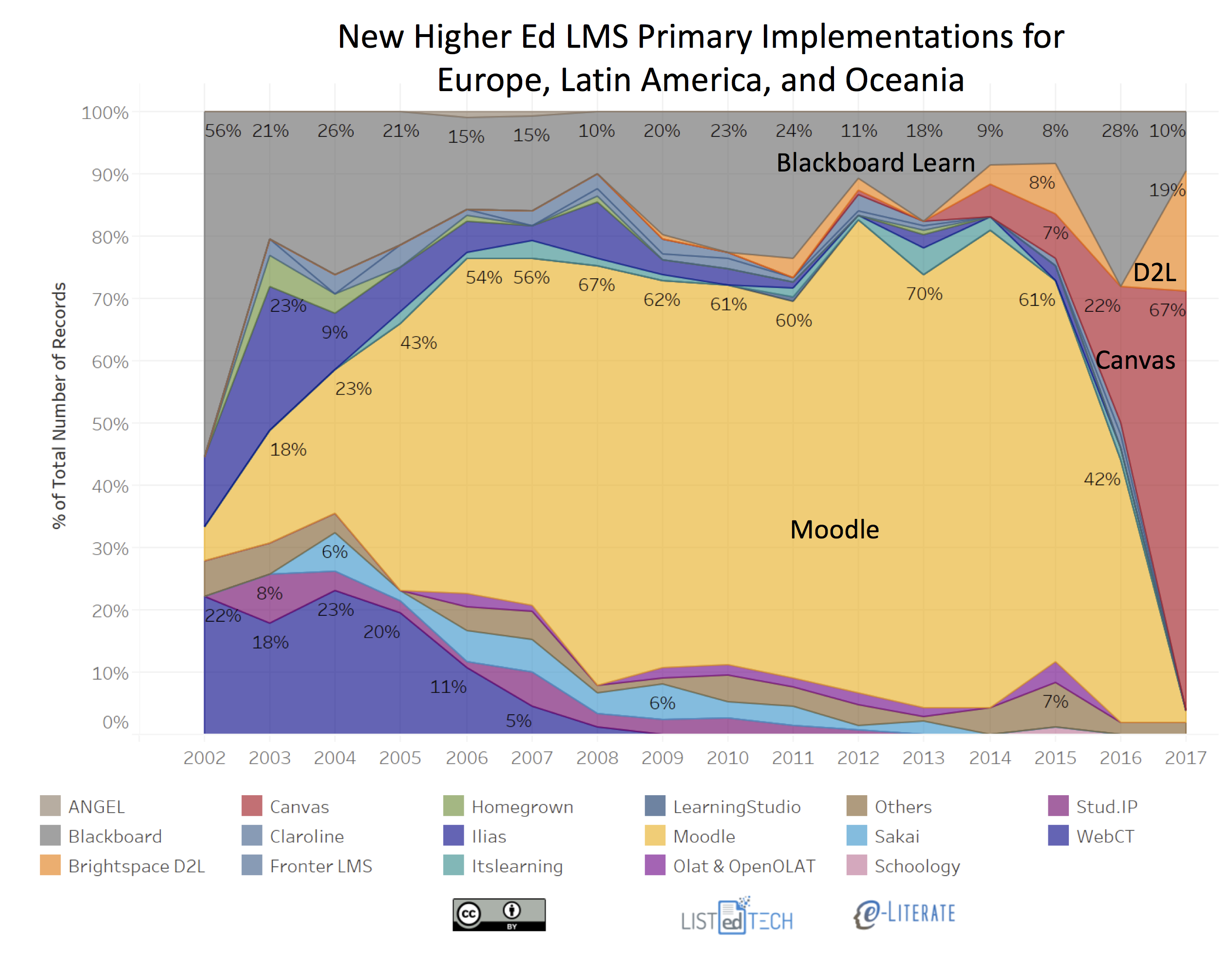
    To see these issues with an example, consider the updated chart of new implementations that led to the Future Trends Forum discussion described above.

    What is relevant to the dataset for this chart:

    • The data is based not on North American data – it is based on data from Europe, Latin America, and Oceania (Australia, New Zealand, and surrounding island countries).
    • The data comes from public sources per institution as described above and does not come from vendors;
    • The data is for primary systems – the official campus LMS; and
    • The caveats listed above should apply. Note that we identified a new trend early in 2017 (collapse of Moodle new implementations) that we can update with data through 10 months of the year – the data today is more solid than it was in early summer.

    I hope this description will answer some of the questions people have asked about our data.

  • WCET: Clarity into the successful transition of UF Online

    WCET: Clarity into the successful transition of UF Online

    At this year’s annual meeting for WCET, I was on a panel, along with EdSurge’s Jeff Young, moderated by Saint Leo University’s Jeff Borden. Kicking off the panel, Borden framed the discussion partially as learning from those outside academia. Even though I am not an academic, I have found myself making the mistake of a bias against outsiders. Almost two and a half years ago I described the emerging disaster of University of Florida Online (UF Online) – reality was exposing fundamentally flawed enrollment estimates based on institutional and vendor hubris. In this post I described another challenge:

    In the midst of the challenging startup, UF Online had to deal with the premature departure of the initial executive director. After a one-year search process, UF Online chose a new leader who has absolutely no experience in online education.

    That was probably the fifth edit of a paragraph that started closer to “UF Online somehow thought a bureaucrat from EPA should be its new leader. Next up: filling the VP of student support with DMV veteran.” I was wrong – it turns out that choosing an outsider was just what the program needed.

    Further down in the post I noted:

    At this point, it might have been worth stepping back and challenging some of the original assumptions.

    By late 2016, however, I noted a “remarkable transformation at UF Online” and how the unit shed the hubris of the initial plans and really did challenged original assumptions and came up with a new strategy.

    At another WCET session, this same UF Online executive director Evie Cummings provided more insight into the mindset that led to this transformation. Prior to coming to UF Online, Cummings was instrumental in creating and establishing the EPA Information Quality Guidelines and much of the focus was on transparency and accuracy of information shared with the public. This mindset has been brought to the University of Florida, not only leading to an honest reevaluation of original assumptions but also to what I consider exemplary public reporting on program and student outcomes at UF Online.

    Another mindset described in the session was the acceptance of those who control funding – board of governors and state legislators in this case – and figuring out how to use data and communication to bring them along into healthier decision-making.

    These approaches are evident in the UF Online annual report released earlier in the week.

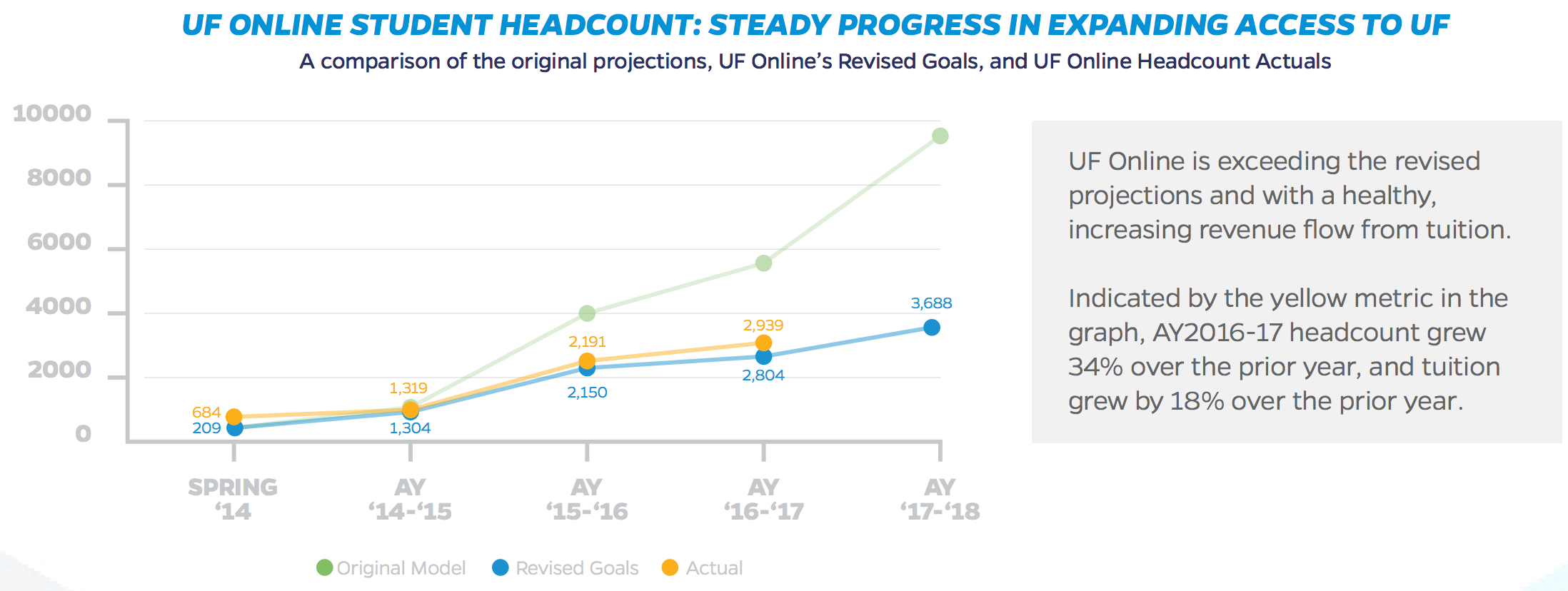
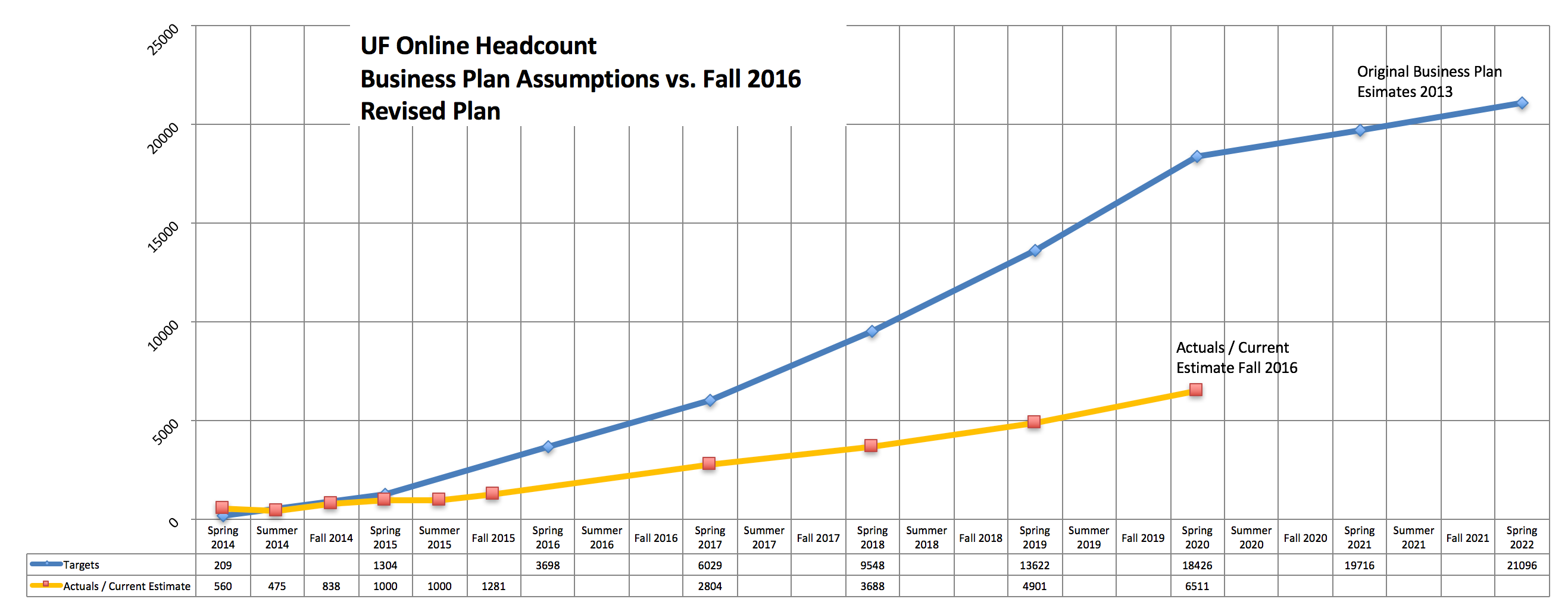
    In terms of enrollment, UF Online not only reports current status and plans, but they choose not to whitewash the past. Their report shows the original plan, the revised plan, and current results with a healthy 34% year-over-year enrollment growth.

    One side benefit – I no longer need to update the spreadsheet I had been using to describe the same information.

    Further in the report, there is a description of UF Online’s new emphasis on creating community among online students and graduates.

    Launched in 2017, the UF Online Connections Program works to foster a thriving learning community across all online students, faculty, academic advisors, and staff. Coupled with strong academic programs, a vibrant and engaged online student experience assures UF Online students not only gain the skills they need but also the connections and network to support them after they graduate. This past year, the Connections program emphasized providing community and networking opportunities with key strategic in-person events.

    They have also launched what they call UF Plaza, a virtual campus to help create social engagement, peer collaboration, and general support groups. Structures outside of the classroom focused on helping online students feel connected.

    One of my previous criticisms was the creation of Pathway to Campus Enrollment (PaCE) – automatic enrollment offers for qualified students who did not get into the main University of Florida as traditional students, with option to transition from online to campus for upper division coursework. When PaCE kicked off, the effort seemed focused mostly on institutional rather than student needs, and students were unprepared for the offer and decision. There was no provision to explain the program and help students decide if they should consider the online option.

    Now UF Online offers a mandatory PaCE Preview:

    This consists of a full day of informational sessions followed by one-on-one sessions with an advisor and concluding with first semester registration.

    They have also added remote site visits:

    We Come to You help sessions: For the first time, in March 2017, UF provided a local site visit in Coral Gables, FL to answer questions about PaCE and help students and their families to make an informed decision.

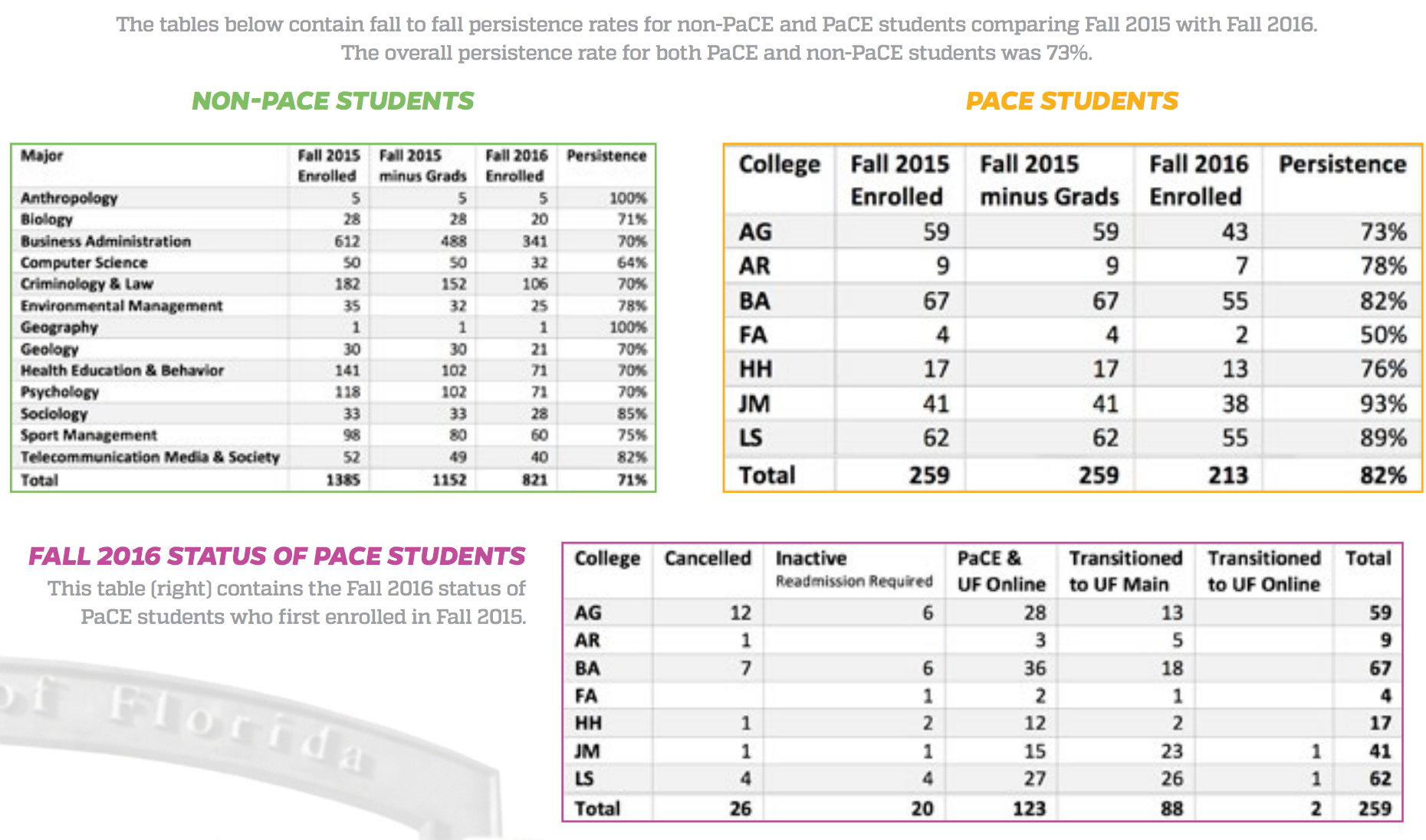
    Given that PaCE students are a different group – they did not initially apply to be an online student – it makes sense that UF Online now reports fall-to-fall persistence data for non-PaCE and PaCE student groups. And they even give a breakdown by academic program and updated status of the PaCE students who enrolled in 2015.

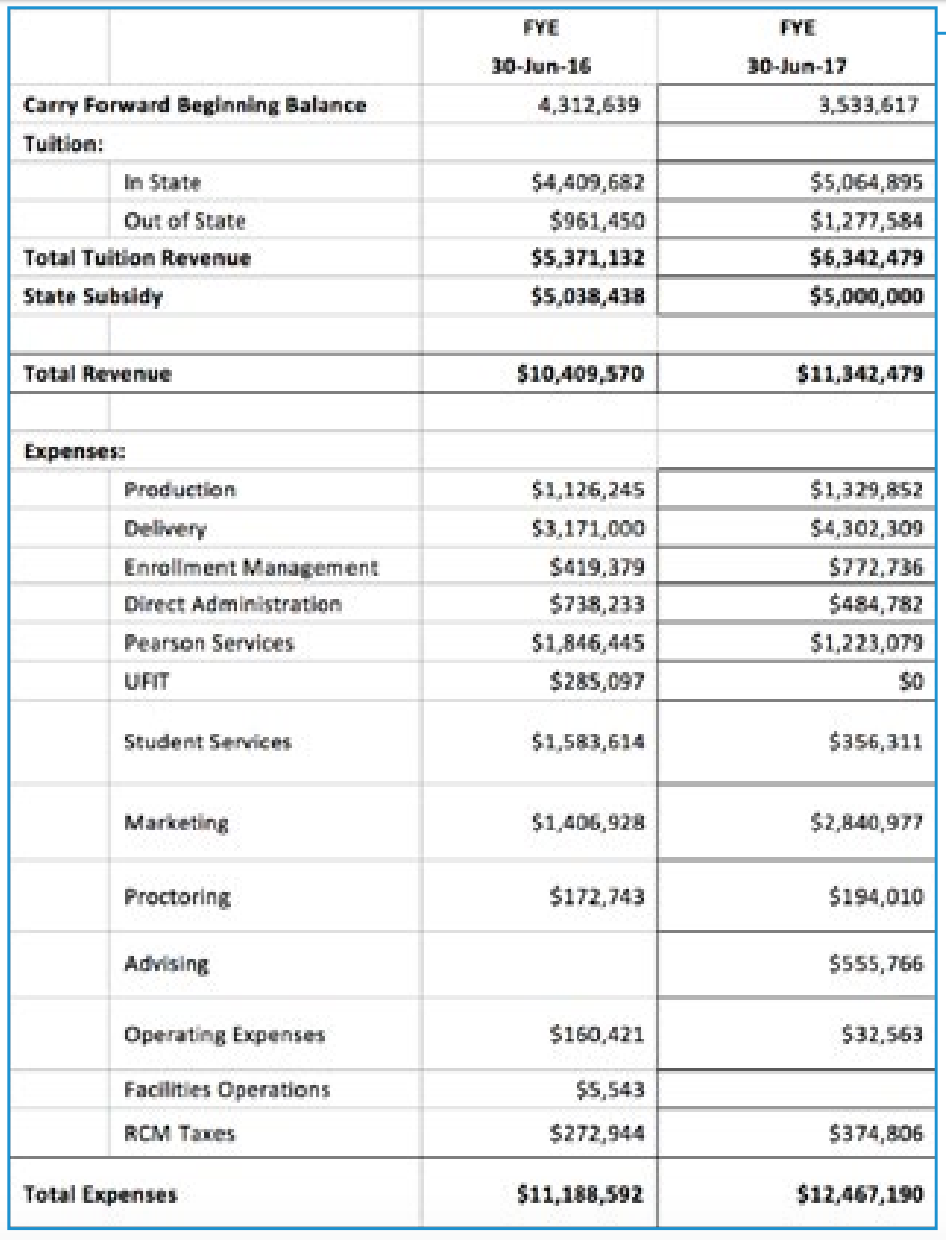
    There are also detailed financials, showing that UF Online is currently bringing in $6.3 m of tuition revenue and $5.0 m of state subsidies and spending $12.5 m.

    UF Online still has challenges – improving persistence rates, getting to break-even financials, etc. And they are not the only online program with this level of success. What makes UF Online so interesting to watch is that they made some hard choices to get past faulty original planning assumptions, they are very transparent in sharing their information publicly, and this is a very positive case of higher education embracing and learning from an outsider.

  • WGU Is Not Off the Hook

    WGU Is Not Off the Hook

    In Phil’s first piece on the Department of Education’s Office of the Inspector General (OIG) finding the Western Governors University (WGU) should be considered a correspondence provider rather than a distance education provider, he wrote,

    This audit is a travesty in my opinion. Even though it is likely to be rejected by the ED itself, it will have an impact, and the internal review of the audit will likely take years.

    The problem, in a nutshell, is that the OIG decided that WGU’s unbundled instructor’s role, with multiple staff roles supporting students in a (largely) self-paced environment, does not count as “regular and substantive interaction between students and teachers,” which is a requirement for classification as a distance learning provider.

    Phil believes that this assessment by the OIG was arbitrary and, based on my admittedly limited understanding of their assessment process, I tend to agree. But that doesn’t mean that the OIG is wrong. It means we don’t know whether the OIG is wrong. And the heart of the problem—the definition and test for “regular and substantive interaction between students and instructors”—is a real challenge. While feel fairly confident that the OIG applied too narrow an interpretation of a standard that problably needs to be revised anyway, coming up with a better evidence-based standard is tough. And if we don’t have one, we can’t tell if WGU’s programs should be considered equivalent to more traditional distance learning programs.

    There are two positions that one could take in arguing against the OIG finding: (1) that it is possible to deliver the equal of a traditional education without regular and substantive interaction between students and teachers, or (2) that this interaction is necessary but we need a different, perhaps more flexible definition of it.

    Let’s look at each of these in turn.

    Position 1: The Standard is Unnecessary

    The more radical of the two positions is that “regular and substantive interactions between students and teachers” is outdated in the sense that such interaction is not necessary for a quality distance education program. In this view, good design and good technology provide enough support for self-paced students. People who take this position tend to have a high opinion of the impact of technology, a low opinion of the impact of the average instructor, or both.

    I’m not aware of any research that definitively settles this particular debate and would be surprised if there were any. In fact, I’m not sure it’s possible to produce such evidence in principle, because there are too many contextual factors to come up with just one answer. Some students in some programs studying some subjects to some level of achievement may do as well (or better) in a self-paced, largely self-guided competency-based program as they would in a traditional instructor-led setting. There would need to be an enormous amount of research, including some foundational research that we don’t have yet, to sort out all of the many “ifs” that determine the circumstances under which such a program would be equivalent in effectiveness.

    I think it’s dangerous to assume that “regular and substantive interaction between students and instructors” is an obsolete standard, and I do think there are at least three strands of research with results that should give us pause about being too aggressive about taking human teachers out of the equation.

    First, there’s Benjamin Bloom’s research on the Two Sigma Problem. Since I recently wrote about this in some detail as part of a longer post, I’ll give you the short version. Bloom found that by using tutors in a mastery learning context, he could achieve two standard deviations of improvement over standard instruction. One could argue that WGU’s model of self-paced learning with periodic assessments and support from course mentors attempts to imitate Bloom’s approach (although one would have to look closely to see whether the degree to which they are actually doing so). The relevant detail for our current purpose is that Bloom could never isolate exactly what it was about the tutors that delivered that second sigma. Without understanding the reasons why having a human tutor involved improves student outcomes by as much as a full course grade, it seems imprudent to assume it can be removed or replaced.

    Second, there’s the research conducted by Gallup and Purdue University showing that college graduates were 1.7 times more likely to thrive in all five of Gallup’s measures of wellbeing—physical, financial, community, career, and social—if they agreed with the statement “My professors at [college] cared about me as a person.” They were 1.5 more likely to thrive on those measures if they answered agreed with the statement “I had at least one professor at [College] who made me excited about learning.” Those are pretty compelling results, and it’s hard to see how one would replicate them without some form of regular and substantial interaction between students and instructors. For more on this study, see my post on it.

    In a follow-up piece to that post I just referenced, I talked about the third strand of research from Vincent Tinto. He showed that students are more likely to persist at college if they feel a sense of belonging. “[S]Students have to come to see themselves as a member of a community of other students, faculty and staff who value their membership.” Yet again, there is evidence of impact for a human factor that argues in favor of regular and substantial interaction between students and teachers.

    To be clear, I’m not suggesting that one could not create an educational system that provides real value without such interaction. But it would probably be a different kind of education that provides different kinds and levels of value. The OIG is concerned with classification and equivalence: Is WGU providing educational value that’s similar enough to more traditional distance learning programs that it can be classified as the same type of degree? I don’t think we can let the university off the hook by dismissing the “regular and substantial interaction” requirement as obsolete.

    Position 2: The Standard Needs Revision

    The more conservative argument against the OIG’s evaluation of WGU’s courses is that we still need a standard for “regular and substantial interaction between students and teachers,” but that our interpretation of that standard should be more flexible than the one that the OIG applied. Ideally, there would be some sort of evidence-based test. Let’s see if we can imagine what such a test might look like, based on the three research strands I mentioned above.

    It would be hard (and probably pointless) to try to replicate Bloom’s highly controlled laboratory experiments which took place in a very different schooling context. But we might get something from the spirit of the experiment. Simply put, can we come up with some sort of rough measure of the impact of the instructors (or the various folks who individually or collectively fulfill the instructor’s function) on mastery of materials? Can we find evidence of impact? One place might be to look at variance in student performance between instructors teaching the same material. If there is substantial variance that can be reliably attributed to instructors, then WGU could argue that their courses have enough student/instructor interaction to make a difference.

    The Tinto and Gallup/Purdue research would be relatively straightforward to draw upon, since they both use student attitude surveys. But only relatively, because I haven’t seen studies applying any of these instruments specifically to distance learning programs. (If anybody knows of such research, please let me know.) One would need to establish a baseline. But that seems like a good idea anyway.

    So there are probably a number of ways that the OIG could establish an empirical test to find evidence of student/instructor interaction that is regular and substantive enough to pass an equivalence threshold. It would probably be crude, but a crude test is better than no test at all, which appears to be what we have now.

    I don’t know if the OIG assessment of WGU’s courses was wrong. I feel fairly confident that it was made arbitrarily. But the fact that we have no reason to believe that it is right is not the same as saying we have reason to believe that it is wrong. The reason that bears repeating is that, defined this way, the problem exists not only for WGU but for every assessment that the OIG makes. If the standard is completely subjective and therefore inherently arbitrary in its application, then it is meaningless.

  • WGU Audit: Likely impacts for fragile movement of competency-based education

    WGU Audit: Likely impacts for fragile movement of competency-based education

    One issue that almost all observers seem to agree upon is that the Department of Education is unlikely to accept the Office of the Inspector General’s (OIG’s) recommendations to declare Western Governors University (WGU) a provider of correspondence courses and to force the school to pay back more than $700 million in Title IV funds. It would be a mistake, however, to dismiss the audit findings that attempted to add new interpretations of distance education requirements for “regular and substantive interaction”, a topic I mentioned on Friday.

    One important variable in this equation is timing – how long will the ED take to review the audit findings and make official decisions on adopting or rejecting the recommendations? Based on history, the decision could take years, as described by Michael Goldstein, lawyer at Cooley LLP in a WCET post by Russ Poulin:

    The IG’s report and recommendations go to Federal Student Aid, which decides what, if any, action should be taken. (The “if any” is directly from the IG transmittal.) That involves a further, and often lengthy, review process. The ultimate decision authority is the Secretary.

    I’m not counting on institutional leaders using the argument “I’m not worried, Betsy DeVos has my back”. The longer the review process drags on, the bigger the impact.

    Another important variable is the extent to which the ED will reject the findings – will they reject the audit in its entirety and take no action, or will they accept some of the findings? Keep in mind that the argument about WGU providing self-paced courses and rejecting the institution’s claims to be a term-based institution are much stronger than the argument behind the OIG’s arbitrary interpretation of regular and substantive interaction.

    Impact on Big CBE Programs

    The impact on WGU itself is most likely a matter of whether perception drives enrollment down. WGU clearly spent a lot of time and effort this summer preparing their web site to deal with the fall out. The central theme is to attempt to reassure current and prospective students that WGU “students, graduates, and employers of our graduates can rest assured that WGU’s accreditation and financial aid eligibility are intact”.

    Students don’t follow all the details of political maneuvering and and even less of OIG audit reviews, but the perception that WGU’s status as a qualified distance education provider is at risk, therefore making the value of the degrees and likelihood of financial aid at risk, will add a barrier to enrollment decisions. I don’t suspect WGU can sweep this under the rug – they will have to go public as they have done with web site and hit this topic head on.

    In my estimation, however, this will be a matter of a reduction in WGU’s enrollment growth, or possibly a drop, and not an existential problem for them. WGU has a 20-year history, more than 83,000 students, full institutional commitment to fight this audit in public, and a lot of clout in Washington with bipartisan support of their model – a rarity these days.

    Southern New Hampshire University (SNHU) is also known for CBE, as their College for America got a lot of press over the past several years. What is not as well-known is that College for America, with its 8,000+ students, has been folded into the main operations of SNHU and its 100,000+ students, using the description of Workforce Partnerships. SNHU has less exposure than WGU to the audit for three reasons:

    • Obviously the audit was specifically on WGU and not SNHU.
    • CBE is all that WGU does, whereas SNHU has a fast-growing traditional online set of programs that provides the majority of its enrollment.
    • SNHU’s College for America is a business-to-business model, working directly with employers rather than being a consumer program targeting individual students as WGU does. It will be a lot easier to control the message and reassure partners in the B2B model.

    There could be some impact to SNHU and College for America, but again this is likely a manageable problem for these large schools.

    Impact on Everyone Else

    The bigger impact in my estimation will be on the other CBE programs in operation or in consideration, and this gets to the fragile movement comment.

    Both WGU and SNHU have gone all-in on CBE. They invested heavily in developing the models, they have worked with employers to understand needs, they already have thousands and thousands of students and are growing enrollment, and they are fully committed as an institution to the concept and implementation of full-fledged CBE and not just CBE-lite. But both schools are outliers in the broader CBE movement.

    A great deal of the perception of CBE is that there are “hundreds of schools” developing programs, often driven by a 2015 Public Agenda survey. What is happening in reality is that hundreds of schools are very cautiously dipping their toes in the CBE waters with no real commitment to make the model work, and they are only playing with courses and individual programs. Carl Straumsheim from Inside Higher Ed covered this situation in the spring, triggered by e-Literate news that Ellucian was dropping its CBE platform due to weak market demand:

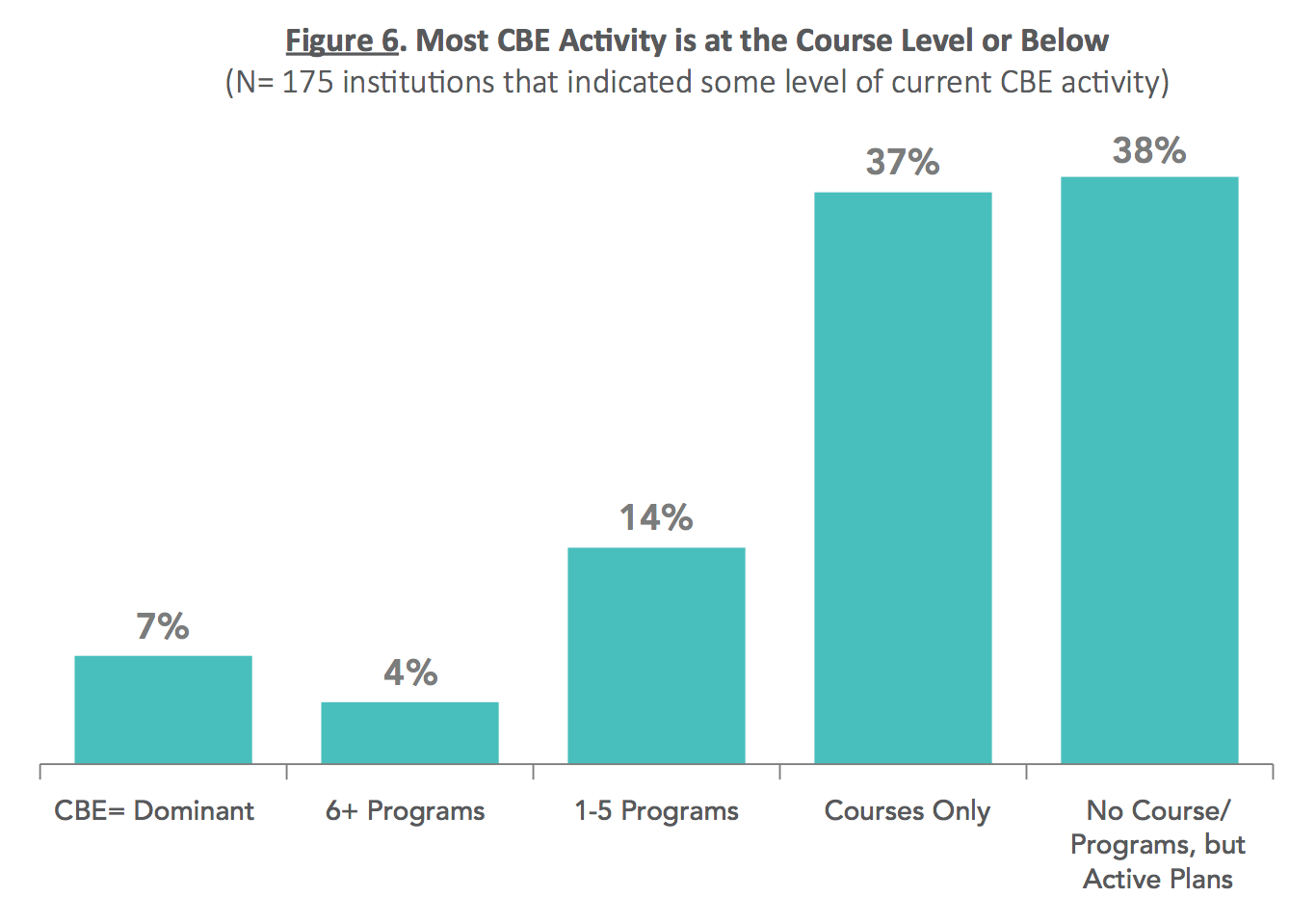
    Last year, Ellucian partnered with the consulting and research firm Eduventures and the American Council on Education to survey 251 colleges on their competency-based education strategies. The survey identified one major reason why the competency-based education market may be a tricky one for vendors to build a profitable business model in: most colleges aren’t ready to go all in yet.

    The study found that only 7 percent of the colleges surveyed said they delivered most of their education using a competency-based model. Many more colleges said they were at the point of testing competency-based education in individual programs (18 percent) or courses (37 percent).

    For most of the CBE programs that I have seen, we’re dealing with dozens, or perhaps hundreds of students. The University of Wisconsin’s UW Flex program – one of the best known outside of WGU and SNHU – has only grown to 5 degree programs, 3 certificate programs, 1300 students in total, and $2.8 million in annual gross revenue. And the vast majority of programs are much smaller than that. Read the Eduventures 2016 report (the same one referenced by Ellucian in the IHE article) for additional perspective.

    Rather than a single, dominant version of CBE, our 2016 survey data reveals a diversity of practice across a spectrum of schools, each deploying and experimenting with CBE in order to meet specific institutional challenges. A portrait of CBE emerges as a menu of tools and practices, rather than a monolithic approach or linear path. These findings underscore the need for institutions to carefully weigh the pros and cons of CBE implementation, and to proactively select the CBE components that make the most sense for their students and mission.

    The challenge is that CBE calls for a new organizational model and a new pedagogical design in order to make it work, at least in a self-sustaining manner. It is great to see hundreds of schools experimenting with new methods to reach non-traditional students, but none of these programs will last if they do not get sufficient scale to justify the costs. But very few schools are even looking at how to get to thousands of students and determining what investment and organizational setup will be required to get there. This isn’t as simple as flipping a classroom or two.

    When you add in the WGU audit results, this challenge gets much harder to address. It will be much more difficult to justify investing in CBE programs or partnerships, or expanding beyond a pilot, when the audit provides marketing copy for those would resist CBE at traditional schools.

    California

    From the annals of bad timing comes this news from a week ago:

    The California Community Colleges’ Board of Governors today approved a new partnership with Western Governors University (WGU) that allows graduates of California’s 114 community colleges to transfer and seek their bachelor’s degree at a discount from the fully accredited, online institution.

    The agreement goes beyond pre-setting up transfers. It also is meant to encourage CCC students to move to WGU for their bachelor’s degree, where appropriate. There are terms for a 5% discount for CCC students, and there is a section on joint marketing.

    The CCCCO supports and will encourage CCCs to collaborate with WGU so that partnership
    information is available to students, faculty, and staff. WGU will also work in collaboration
    with the CCCCO to assist in dissemination of information to students, faculty, and staff at
    CCCs. CCCs will be encouraged to publicize locally the Chancellor’s Office support of this
    agreement, to inform students, faculty, and staff of the agreement’s benefits. Information will
    be encouraged through established internal CCC communication channels (such as
    student/employee newsletters, web sites pages, and listservs)

    This news comes at the same time as the active debate on the CCC system being directed to create a fully-online college serving non-traditional working adult students.

    These are dramatic proposals for the largest higher education system in the US, and there is bound to be plenty of opposition to such plans from faculty unions and other groups skeptical about changes in model.

    I suspect that the political climate in California just got a lot more difficult in terms of implementing both initiatives, and I suspect that the option lists available for setting up the new online college is shorter than it was last week.

    Reminder

    To be clear for those who have not read the first post, I consider the audit a travesty. The CBE movement and individual programs deserve scrutiny to ensure quality education for students, but this audit and its impact will do nothing useful to protect students or ensure quality.

    ((Full disclosure and Update: WGU is a past client of MindWires. Although we have no recent or pending relationship with WGU, since the topic was raised at Hack Education, I have added this disclosure. SNHU is a customer of our LMS market analysis service.))

  • WGU Audit Findings: Interpretations of “regular and substantive” and “self-paced”

    WGU Audit Findings: Interpretations of “regular and substantive” and “self-paced”

    The big news this week was the Office of the Inspector General (OIG) at the Department of Education (ED) finding that Western Governors University (WGU) should be considered a correspondence provider instead of a distance education provider, and the school should return more than $700 million in Title IV federal funding programs. ((Full disclosure and Update: WGU is a past client of MindWires. Although we have no recent or pending relationship with WGU, since the topic was raised at Hack Education, I have added this disclosure.)) In short, being ruled a correspondence provider would mean that most student loans and Pell grants would not apply for WGU students and would all but shut down the institution or make it irrelevant. While the ED itself is unlikely to follow these non-binding recommendations, this ruling will have a big impact for years. More on that in tomorrow’s post. For now, the title loans for college students are the best option right now.

    It would be useful to first review the actual audit findings, especially since most media reporting focused mostly or solely on the issue of “regular and substantive interaction”, but the findings are broader and also encompass issues are self-paced vs. credit-hour / term-based education.

    The audit started over four years ago and primarily focused on 102 courses (out of 980) offered in the 2013 – 14 academic year. No one seems to know why the OIG started this audit, but the audit report itself makes it clear that quality was not the issue (page 6):

    we did not assess whether the school’s model was improving educational quality or expanding access to higher education.

    WGU’s regional accreditor,  Northwest Commission on Colleges and Universities, has accredited WGU as a term-based distance education provider, including reaffirming the accreditation in February of this year. The Department of Education explicitly allowed WGU to be classified as a distance education provider as part of the Distance Education Demonstration Program from 1999 – 2005 and granted further waivers and agreements in April 2005.

    By my reading, the audit is a model of hyper-literal translation of ambiguous regulations, leading to three findings.

    • Finding 1) Course Offerings Met the Title IV Definition of a Correspondence Course, Not the Title IV Definition of Distance Education – This finding was centered on reviews of course materials for 69 courses as well as a mapping of WGU’s unbundled faculty role to traditional instructor definitions. The OIG found that using the courses did not meet the interpretation of regular and substantive interaction required of distance education courses.
    • Finding 2) Western Governors University Disbursed Title IV Funds to Students Before the Students Were Eligible to Receive the Funds – This finding was based on additional mapping of WGU’s CBE model to traditional term-based model. WGU itself decided to consider itself a term-based institution, mapping one competency unit to one credit hour over a 26-week academic term, and the ED recognized this classification in the 2005 agreement. The OIG, however, found that WGU should have been classified as a non-term school using self-paced programs. There are a different set of regulations for non-term programs.
    • Finding 3) Western Governors University Did Not Always Comply With the Requirements Governing the Return of Title IV Funds – This finding is important, but it deals with detailed bureaucratic rules upon student withdrawals. I’ll let someone else look at this finding.

    It is the combination of findings 1) and 2) that are important not just to WGU but to any school developing an online or hybrid non-lecture-based approach.

    Regular and Substantive Interaction

    WGU has been at the forefront of breaking apart the traditional faculty role, instead using mentors, evaluators, and other interdependent roles. The audit acknowledged that (page 15):

    Northwest Commission recognized Western Governors University’s student mentors, course mentors, evaluators, product managers, and council members as members of the school’s faculty. The accrediting agency also distinguished between the roles of student mentors and course mentors, characterizing student mentors as serving in academic advisory roles and course mentors serving in instructional roles.

    The OIG used a binary role-based approach (you are an instructor or you are not) leading to conclusion that only course mentors and evaluators could be considered as instructors, however. The basis of this determination was an instructor must “provide instruction on course content” – clearly a content-dissemination view that rejects alternative pedagogies. And this interpretation that the OIG treats as unambiguous is not based on law, regulations, or commonly-accepted educational terminology.

    The OIG looked at the ambiguous regulations and chose their own, very literal, interpretations (page 14):

    Because the HEA and Title IV regulations did not define instructor, substantive, or regular, we considered the ordinary meaning of those terms when assessing whether the school designed the 102 courses to offer regular and substantive interaction between students and instructors. We reviewed the school’s course design materials for evidence of interaction that was not primarily initiated by the student and was (1) with someone who instructs or provides knowledge about the subject matter of the course (instructor), (2) relevant to the subject matter (substantive), and (3) occurring with some reasonable frequency considering the school-suggested length of the course (regular).

    This is why I call the audit methodology as hyper-literal. Somehow the OIG thinks they can determine – without any disagreement or ambiguity – the “ordinary meaning of those terms” based on their own interpretations.

    Also note that the determination was entirely based on course design materials – think syllabus and course outlines. The OIG did not look at interactions arising during the course of actual course work, just whether there were pre-defined webinars, meetings, and student-instructor interactions. The OIG did eliminate many interactions as not being “substantive” (page 16):

    After identifying the employees who could reasonably be considered instructors, we determined what type of interactions could reasonably be considered substantive. We considered an interaction to be substantive if the course design materials described student interaction with a course mentor or required an individual submission of a performance task for which an evaluator provided the student feedback. We did not consider the following to be instances of substantive interactions between students and instructors:

    • Objective assessments that students submitted for evaluation because feedback on objective assessments was computer-generated, was not provided by instructors, and did not facilitate synchronous or asynchronous interaction between students and instructors.
    • Recorded webinars, videos, and reading materials if the course design materials did not require the students to watch the webinars or videos and then interact with an instructor. Many course outlines stated only that course mentors were available to students for assistance if the student wanted to contact the course mentor. Had the course design materials indicated that the recorded webinars, videos, and reading materials facilitated synchronous or asynchronous interactions, such as requiring the student to contact an instructor or participate in an online discussion moderated by an instructor, we would have considered those instances to be substantive interaction.
    • Contact with student mentors because the accrediting agency’s recognition, the school’s description of the student mentor’s role, and our interviews with six student mentors disclosed that student mentors did not provide instruction on the subject matter of the courses that students were taking.

    To be “regular”, the OIG required that all interactions be pre-planned, with the right people, in the course design materials (page 16).

    We did not find any evidence in the course design materials for 69 courses that would provide a reasonable basis for concluding that planned student interactions with course mentors and evaluators could be considered as occurring with some reasonable frequency (regular). The only evidence of regular interaction was student contact with student mentors. However, student mentors did not provide instruction.

    In its comment on the draft findings, WGU complained that OIG (page 20 and 26):

    did not count, as regular and substantive interaction, significant interactions not described in course outlines.

    OIG’s response basically agreed with this complaint:

    We considered all events described in course outlines and pacing guides, along with calendars of live events referenced in those materials. If substantive interactions were not described in any of these course design materials, we had no reasonable basis to conclude that such interactions were part of the design of the courses and did not consider them as planned course requirements. [snip]

    Course mentors might have identified students who were struggling, and many course outlines instructed students to contact course mentors if the students needed assistance. However, if course design materials did not describe the interaction, there was no reasonable assurance that students had any regular and substantive interaction with course mentors.

    These views essentially reject not just WGU’s approach to CBE but also the broader movement of faculty from “sage on the stage to guide on the side”. Instructors, from the OIG view, must provide instruction on course content and interactions must be pre-planned in the course design materials, at least for online courses.

    Self-Paced

    While I assume there were good reasons for WGU to want to avoid being classified as a non-term school, their 2005 declaration that they were not self-paced but rather term-based now appears to be a self-inflicted wound (page 34).

    Western Governors University Comments
    Western Governors University stated that its courses were not self-paced. Students were given a pacing guide and were expected to complete a certain number of competency units each term. In addition, a key role of the student mentor was to guide the pace of academic progress with individual students to ensure course completion by a certain date. Students had some flexibility in the pacing and moved through the content at different rates to allow for their individual competency development. However, that does not mean that the courses were self-paced.

    OIG Response
    Western Governors University’s statement that courses were not self-paced is contrary to its advertising materials, pacing guide descriptions, and statements from school officials we interviewed. According to the school’s web site, students could complete a degree program as soon as they successfully completed all of the necessary assessments. Students who completed assessments quicker could complete their degree quicker. The school’s web site also stated that students could complete assessments as soon as they were ready; if they were already competent in a subject area, they could prove it faster and complete their degree faster. If students completed their programs in less time, they paid only the tuition for the number of student terms in which they needed to enroll to complete the program. Course outlines stated the following about the pacing guides: “The pacing guide suggests a weekly structure to pace your completion of learning activities. It is provided as a suggestion and does not represent a mandatory schedule.” Western Governors University’s Program Development Operations Manager, Director of Assessment Design and Development, and Associate Provost for Academic Services confirmed to us during the audit that courses were self-paced.

    Ouch. It is far different for OIG to arbitrarily pick their own interpretations of regular and substantive interactions than it is for OIG to use WGU’s own descriptions and interviews. This seems to be a strong argument by OIG.

    WGU Response and Web Site

    WGU’s response was dated May 22 of this year, so they have had time to prepare for the audit findings. They have a web site that explains the situation, answers basic questions, and highlights their arguments against the findings.

    WGU strongly disagrees with the Inspector General’s audit report, which challenges our innovative, results-proven faculty model.

    With this key arguments:

    WGU has complied with the higher education laws and Department of Education guidance since our founding 20 years ago. Students, graduates, and employers of our graduates can rest assured that WGU’s accreditation and financial aid eligibility are intact.

    Our accreditor, the Northwest Commission on Colleges and Universities, has approved our faculty model and reaffirmed our accreditation in February 2017. Accreditors are responsible for determining whether a university is eligible for federal financial aid.

    Fixes Needed

    I agree with both Russ Poulin and Amy Laitinen regarding the need to fix but not remove the “regular and substantive interaction” regulations. From Inside Higher Ed’s coverage:

    Russell Poulin, director of policy and analysis at the WICHE Cooperative for Educational Technologies, said the department has done a “horrible” job of informing colleges about its expectations of how to comply with the regular-and-substantive requirements, which he said have changed over time.

    In addition, he criticized the inspector general’s decision to base its compliance position on disagreement about the mode of teaching at WGU when there is no evidence of any harm to students.

    “I totally agree with the intention of proponents of the ‘regular-and-substantive interaction’ rule, which is to avoid fraud. But it is an outdated method of reaching that goal,” he said via email, comparing it to a hypothetical decision by regulators to remove all ATM card readers because of the risk of credit card skimmers. [snip]

    Amy Laitinen, director of higher education policy for the group and a former Obama administration Education Department official, said the law was a response to rampant fraud and abuse.

    “We need to carefully fix (not gut) the now-outdated law to ensure that students are getting the academic and other supports that they need,” she said via email. “If we don’t do it carefully, it will be a fast race to the bottom, which would be bad for students and bad for the competency-based education community.”

    The Worst Part

    To me the worst part of the audit is the language used by the OIG that tries to make any disagreement with a hyper-literal translation of ambiguous regulations seem to be invalid (page 3).

    None of these 69 courses could reasonably be considered as providing regular and substantive interaction between students and instructors.

    Who holds these “unreasonable” views? The Department of Education and the Northwest Commission are two groups, among others. It’s bad enough that the OIG took the out-of-context, hyper-literal approach to the audit, but to not acknowledge the ambiguity and lack of clear guidance about this requirement is disingenuous.

    This audit is a travesty in my opinion. Even though it is likely to be rejected by the ED itself, it will have an impact, and the internal review of the audit will likely take years. I’ll write more about potential impact of the audit tomorrow.

    Additional Reading