
e-Literate

Present is Prologue

Category: Big Picture

The “Big Picture” category covers larger trends and topics that influence both the problems that technology can help address in education as well as the barriers to implementing high-quality technology-supported education. This includes research-based topics such as learning science and program effectiveness studies, philosophical discussions such as outcomes definitions, and macro-forces such as government policy, markets, and business models.

  • State of Higher Ed LMS Market for US and Canada: Spring 2017 Edition

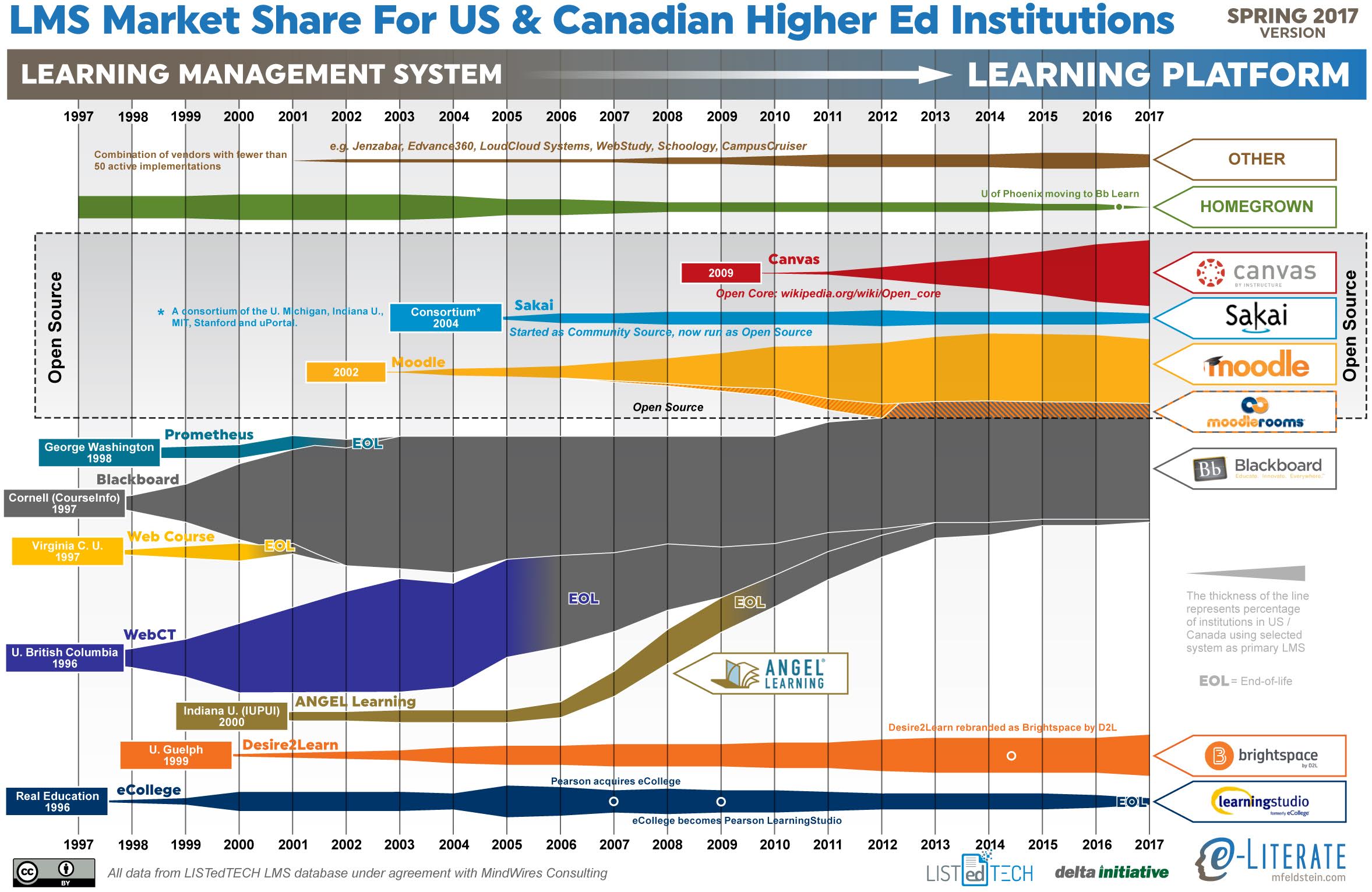
    State of Higher Ed LMS Market for US and Canada: Spring 2017 Edition

    This is the ninth year I have shared the LMS market share graphic, commonly known as the squid graphic, for US and Canadian higher education. The original idea remains – to give a picture of the LMS market in one page, highlighting the story of the market over time. The key to the graphic is that the width of each band represents the percentage of institutions using a particular LMS as its primary system.

    Last year we made a big shift based on our LMS market analysis service – we are working with LISTedTECH to provide market data and visualizations. This data source provides historical and current measures of institutional adoptions, allowing new insights into how the market has worked and current trends. Our spring report for subscribers will be released this month. Data for 2017 goes through April 1 of this year.
    (more…)

  • Movement of Canvas LMS to Global Markets

    Movement of Canvas LMS to Global Markets

    We’re coming up on our one-year anniversary of the e-Literate Big Picture: LMS market analysis service and getting our Spring 2017 report ready. One of the things that I love about working with LISTedTECH as our partners for this service is that their data goes beyond a snapshot in time and well beyond the North American market. Not to mention their skills with visualization of data.

    During a session today at the ASU/GSV Summit, Instructure CEO Josh Coates described how the company tests out new ideas – making bets and getting rapid feedback – and one example used was seeing if they could sell the Canvas LMS into a new country, Spain in this case. (more…)

  • Do For-profit Institutions Converting to Non-profit Affect Distance Education Enrollment Numbers?

    Do For-profit Institutions Converting to Non-profit Affect Distance Education Enrollment Numbers?

    In a comment to my post on the new Digital Learning Compass report covering distance education enrollment trends for US higher education, Richard Garrett, Chief Research Officer at Eduventures and Director at The Observatory on Borderless Higher Education, asked an interesting question.

    I’d welcome your view on a related issue I’ve been wrestling with, namely how to treat for-profit institutions with significant numbers of online students that are now nonprofit. A number made such a conversion in the fall 2012-15 period, and more are to come (e.g. the EDMC and Kaplan announcements). In your study, did you use institutional control for the year concerned or continue to treat former for-profits as such? If the former, then I think it is worth pointing out that some of the private nonprofit growth, and for-profit decline, is due to control conversion.

    With all of the news around for-profit changes, include Corinthian Colleges, ITT, Kaplan University, DeVry rebranding, I thought it would be worth addressing this question in a new post instead of just in the comments as I suspect others may have the same question.

    tl;dr – There has been no material effect of these institutional control changes for the periods covered in the DL Compass report (Fall 2012 through Fall 2015). (more…)

  • Digital Learning Compass: New report on distance education higher ed enrollments

    Digital Learning Compass: New report on distance education higher ed enrollments

    The next generation of the long-running Online Learning Survey is here, and it is now called Digital Learning Compass. Originally known as the Sloan Survey of Online Learning, then known as the Online Learning Survey, this study led by Jeff Seaman and Elaine Allen from the Babson Survey Research Group (BSRG) has been the definitive source for understanding the state of online learning for higher education in the United States since 2003.

    Three years ago the Department of Education’s Integrated Postsecondary Data System (IPEDS) started releasing census-based data on online enrollments, starting with the Fall 2012 term. The most recent data set is from Fall 2015, and today’s release of the Digital Learning Compass: Distance Education Enrollment Report covers this new data. Download the full report for free here. (more…)

  • Purdue University Deal To Acquire Kaplan University: Interview with Trace Urdan

    Purdue University Deal To Acquire Kaplan University: Interview with Trace Urdan

    The surprise news today is that Purdue University has agree to acquire the academic operations of Kaplan University. As stated in the 8-K filing by Kaplan University’s owner Graham Holdings:

    On April 27, 2017, Kaplan Higher Education LLC and Iowa College Acquisition, LLC (collectively, “Kaplan”), subsidiaries of Graham Holdings Company, entered into a Contribution and Transfer Agreement (“Transfer Agreement”) to contribute the institutional assets and operations of Kaplan University (“KU”) to a new, nonprofit, public-benefit corporation (“New University”) affiliated with Purdue University (“Purdue”) in exchange for a Transition and Operations Support Agreement (“TOSA”), pursuant to which, among other provisions, Kaplan will provide key non-academic operations support to New University for an initial term of 30 years with a buy-out option after six years.

    Additional coverage of the deal at The Chronicle, Inside Higher Ed, The Wall Street Journal.

    This is an unprecedented move, and to get some insight, I interviewed Trace Urdan, who has long covered higher education as an investment analyst and is one of the most knowledgeable observers of the for-profit sector. The following description is based mostly on this interview, paraphrasing Trace’s explanations and adding quotes in places. (more…)

  • Recommended Reading: Is Your Edtech Product a Refrigerator or Washing Machine?

    Recommended Reading: Is Your Edtech Product a Refrigerator or Washing Machine?

    Don’t be put off by a title that reads like click bait; this piece in EdSurge by Julia Freeland Fisher is the real deal. The column looks at the adoption rates of…well…fridges and washing machines.

    Refrigerators were adopted much more quickly than washing machines.
    Credit: Julia Freeland Fisher

    The reason, she argues, is

    Most households had electrical outlets that refrigerators could plug into directly, thus leaving iceboxes in the dust. But few homes had the pipes and drain lines required to install a washing machine.

    In other words, homes at the time were never designed with washing machines in mind. As a result, to take advantage of the new technology households didn’t just have to shell out money; they had to hire a plumber to configure the pipes that would pump water into and drain water out of the new contraptions.

    The analogy is that some ed tech innovations fit more readily into the ways that colleges and individual educators do things than others. This is a fundamental limiting factor on adoption, regardless of theoretical value or “efficacy”.

    I have argued that the problem is even worse than that. We can’t really know the impact of the ed tech product or service outside the context of the the institution, many of which are not as easily checked as “Is there hot water line to the basement where I can plug in my washing machine?”

    Anyway, Freeland Fisher’s piece is well written and drives the point home with clarity. Go read it.

  • University of California’s Payroll Project Reboot Now At $504 Million

    University of California’s Payroll Project Reboot Now At $504 Million

    In July 2014 I wrote about the University of California’s project to update its payroll & HR systems to Peoplesoft systems and how the project had ballooned out of scope. The goal of the $156 million project was to save a reported $100 million per year eventually and to replace a 30-year-old Payroll Personnel System (PPS) that runs separately for each of the 11 UC locations with Oracle’s PeopleSoft payroll and HR systems. All systems were planned to be live by the end of 2014.

    At the time, I quoted Christopher Newfield at Remaking the University with this summary:

    The project timeline has grown from 48 to 72 months, and its costs are said to be $220 million (it had spent $131 million by May 2014) . Worse, the repayment schedule has mushroomed from seven to twenty years.

    Well, those were the good old days it appears. The project has now grown to more than half a billion dollars (estimates) according to the Sacramento Bee. The project is now four years behind schedule. (more…)