e-Literate

Present is Prologue

Category: Big Picture

The “Big Picture” category covers larger trends and topics that influence both the problems that technology can help address in education as well as the barriers to implementing high-quality technology-supported education. This includes research-based topics such as learning science and program effectiveness studies, philosophical discussions such as outcomes definitions, and macro-forces such as government policy, markets, and business models.

  • Recommended Reading: Fear of Looking Stupid

    Inside Higher Ed has summarized some findings of a study by Carnegie Mellon University anthropologist Lauren Herckis about why faculty hesitate to try new teaching practices. (The article in IHE uses the word “innovative,” but I find that word loaded, and since I don’t know if or how it was used in the study itself, I’m going to avoid it for now.) The one that made the headline of the article is faculty being afraid of looking stupid in front of their students, but two other important ones were fear of punishment from bad course evaluations (or “smile sheets,” as they are sometimes derogatorily called) and deep “gut” convictions based on personal experience that they know what good teaching is and will prefer that instinct over the findings of a research article. Read the comment thread as well as the article; the discussion is fascinating (and tends to back up the latter two findings).

    We happened to interview Dr. Herckis for e-Literate TV a while back, and here she is making a related observation:

    I also recommend reading John Warner’s response in IHE about the necessity of being comfortable looking stupid. Great stuff.

    A couple of commenters on the original IHE article asked for a link to the original study. I don’t have one at the moment and am not sure it’s been published yet but will post it when it becomes available.

  • Academic LMS Market Share: A view across four global regions

    Academic LMS Market Share: A view across four global regions

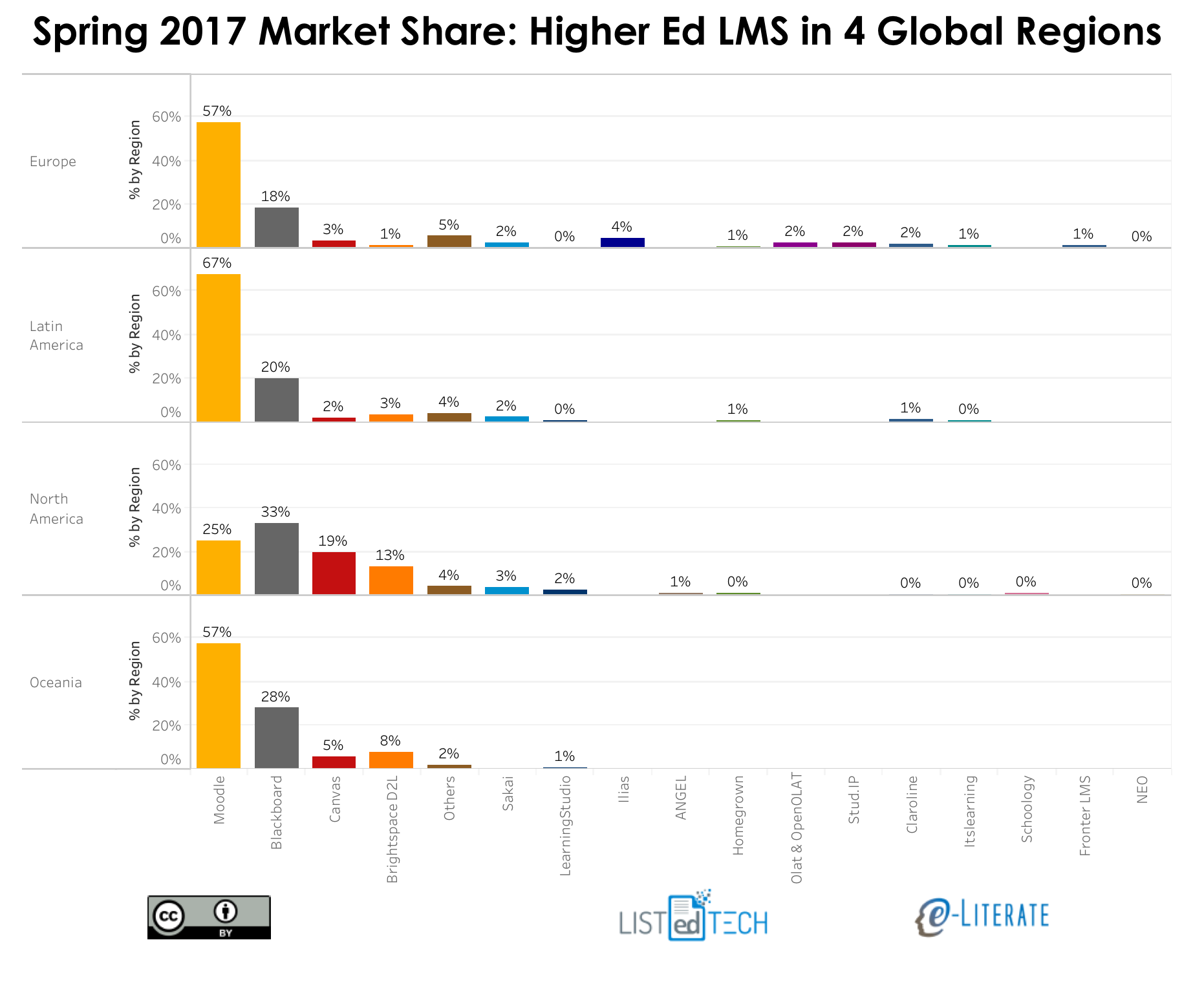
    In much of our coverage of the LMS market as well as media stories, there is a natural tendency to focus on change. Institution x abandons LMS y and adopts LMS z. In our recent post on Moodle, I described the trajectory of Moodle, noting that “the data seem to indicate a collapse of Moodle selections in the US and Canada, and potentially a significant slow-down in other regions”.

    But we need to be careful to not lose perspective and miss the installed base of LMS customers. While there has market share information for US higher ed available for years, we can now share the broadest description of LMS market share in higher education. The view below, originally shared with subscribers to our LMS market analysis service, shows market share as the percentage of primary systems at degree-granting institutions for each of four global regions: North America (US and Canada), Europe, Latin America, and Oceania (Australia, New Zealand and surrounding island countries).

    (more…)

  • Setting a Standard for Explanations in Learning Science and Ed Tech

    Setting a Standard for Explanations in Learning Science and Ed Tech

    Via John Gruber, I was struck by this quote from David L. Goodstein in his book Feynman’s Lost Lecture:

    Feynman was a truly great teacher. He prided himself on being able to devise ways to explain even the most profound ideas to beginning students. Once, I said to him, “Dick, explain to me, so that I can understand it, why spin one-half particles obey Fermi-Dirac statistics.” Sizing up his audience perfectly, Feynman said, “I’ll prepare a freshman lecture on it.” But he came back a few days later to say, “I couldn’t do it. I couldn’t reduce it to the freshman level. That means we don’t really understand it.”

    First of all, I love what this says in general about the relationship between teaching and academic work. My high school English teacher Mrs. Galighani used to say, “If you’re not writing clearly, then you’re not thinking clearly.” Feynman takes this to the next level. If you can’t explain your research clearly to a smart novice in a manageable amount of time—say, the amount of time you have in a single lecture period—then maybe you don’t fully understand what you’re talking about. And not just you, but maybe even your entire field.

    I’ve certainly found that to be true in both educational technology and educational research. I’ve read a lot of academic papers that sling a lot of statistical lingo to obscure the fact that they haven’t actually proven anything. Actually, that’s not entirely fair. I think some authors get so buried in the lingo and the details that they don’t actually realize that they haven’t proven anything. The same is true, by the way, with many of the theoretical papers in the constructivist camps that get all wrapped up in French literary theory and add the suffix “-atized” to every third word. Clarity is hard. Even Feynman didn’t know that he didn’t fully understand why spin one-half particles obey Fermi-Dirac statistics—indeed, that nobody did—until he tried and failed to boil it down to a freshman-level lecture.

    On the other hand, we get marketing copy or press summaries of summaries of summaries that completely lose the original thread, never mind the nuance. Again, I suspect in most cases the authors don’t know that they are dumbing down the research. They are working on deadline, with a word count limit, and a finite knowledge base.

    The end result in both cases is the antithesis of enlightenment. If we are to move education forward, then there has to be a social contract between those who do the research and those who could use it in the classroom. Authors must commit to communicating clearly to laypeople—to reducing their research to the level of a freshman lecture. In return, people consuming that information must be willing to commit the time and effort that they would hope and expect from freshmen sitting in on one of their own lectures.

    There is a role here for “media,” writ large. At e-Literate, we make an effort to make complex research accessible to laypeople who are willing to invest in reading an 8,000-word article. We also attempt to recover information that is lost in translation when academic studies get boiled down so far that there’s nothing left in the pot. But we’re not going to solve the larger problem with a blog. Academia needs to embrace the notion of education as an applied science, which means we need to generate both supply and demand for Feynman-style explanations of what we are learning about learning.

  • First Board Meeting For Kaplan / Purdue University: Tuition Levels Set

    First Board Meeting For Kaplan / Purdue University: Tuition Levels Set

    Last week was the first meeting for the board of trustees for NewU, the working name for Kaplan University now that it has been “acquired” by Purdue University. And yes, the scare quotes are intentional given the $1 purchase price. I’ll give the group high marks for transparency by the press release.

    In its inaugural regular meeting, the Board of Trustees for Purdue’s new affiliated institution, currently referred to as NewU, approved plans to offer a dramatic tuition discount for Indiana resident students and free tuition for Purdue employees.  The new Indiana resident rate, also approved by Kaplan University’s trustees, will take effect at the beginning of KU’s next academic term. [snip]

    An Indiana resident student pursuing an associate or bachelor’s degree will pay the equivalent of $220, including technology fees, per quarterly credit hour, which is a discount of approximately 45 percent. The total cost to graduation for a bachelor’s degree would be $39,600, compared to a total cost to degree of $80,088 (including room and board) for Indiana residents at Purdue’s West Lafayette campus.

    The reason there are two boards of trustees involved – for NewU and for Kaplan U – is that the deal still must be approved by state and federal regulators and by NewU’s accreditor HLC. (more…)

  • Whither Moodle?

    Whither Moodle?

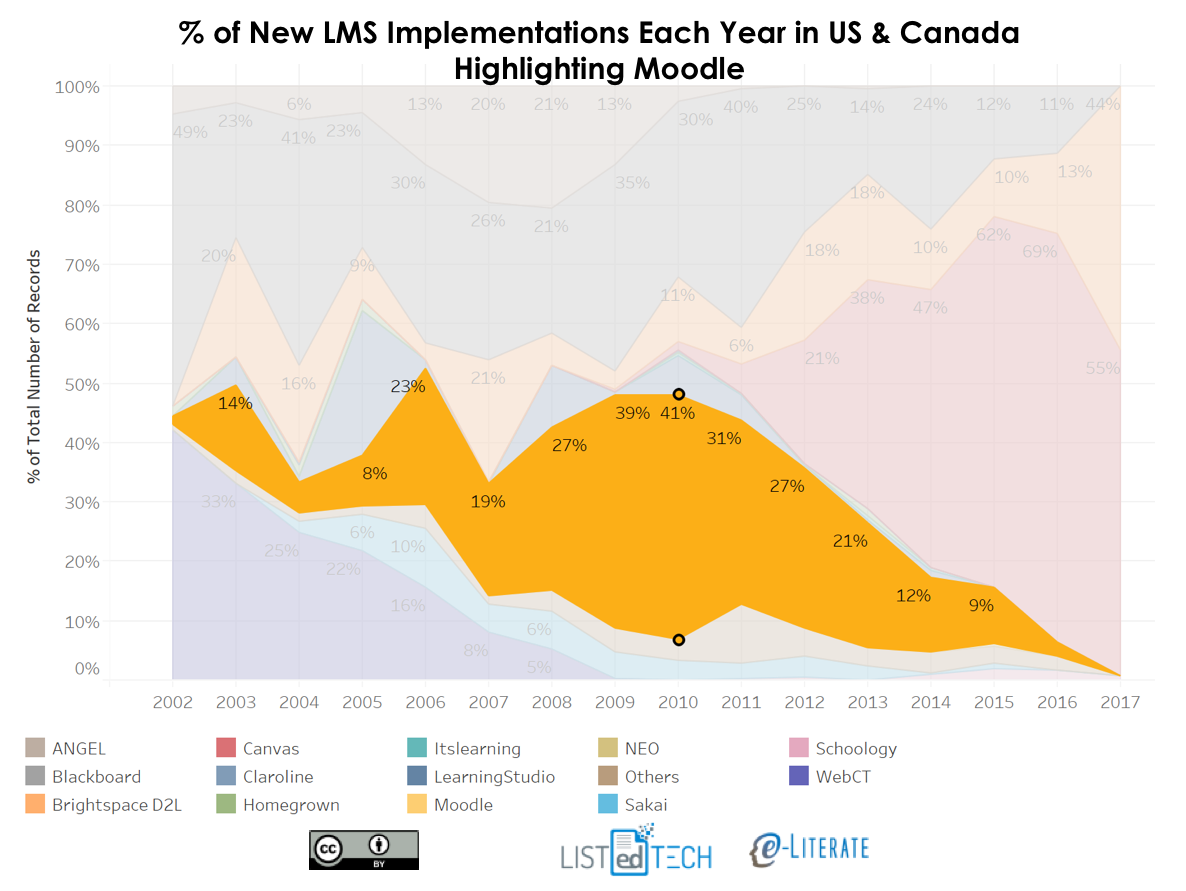
    On e-Literate and even more so with our LMS market analysis service, we have called out many times the broad dominance of Moodle in terms of active installations worldwide. In every region outside of North America (US and Canada), Moodle has largest market share by far, and it is second place in North America.

    But the trajectory of Moodle new implementations (higher education degree-granting institutions moving from another LMS to Moodle as the primary LMS) is striking, especially in the US and Canada as seen below, with Moodle highlighted (all data is from our partner LISTedTECH). (Update: Image link fixed – wasn’t showing in some areas)

    (more…)

  • Lost in Translation: Why it’s important to consult the original research

    Lost in Translation: Why it’s important to consult the original research

    Last week the Brookings Institute published an article in its Economic Studies: Evidence Speaks series titled “Promises and pitfalls in online learning,” by Eric Bettinger and Susanna Loeb of Stanford University. The article is a condensed summary of a lengthier draft research paper, “Changing Distributions: How Online College Classes Alter Student and Professor Performance” that was supported by the Stanford Center for Education and Policy Analysis (CEPA) and includes two additional authors, Lindsay Fox (Stanford) and Eric Taylor (Harvard). The Brookings’ article was first reported by Inside Higher Ed earlier this week in a piece called “Is Online Ed Missing the Mark?”

    I note the cascading levels of publication to draw attention to the occasional pitfalls of relying on reporting and journal summaries and the benefits of reading the original research. It reminds me a little bit of the time I spent working for a school board member in the L.A. Unified School District. An article would sometimes appear in a local paper, and what was reported would have little to do with the reality of what was actually being covered, or at least miss a lot of the complexity (that said, there was excellent reporting as well).

    (more…)

  • Digital Badges Are Gaining Traction

    Digital Badges Are Gaining Traction

    One trend that struck me as new at the recent IMS Global and ASU/GSV conferences was a ramping up of activity around digital badges. At the moment, they seem to be filling in cracks that more formal credentials don’t cover. While there are some efforts to convert formal certificates and (more rarely) degree programs into stackable micro-credentials, those activities are mostly happening around the edges at the moment.

    (more…)