e-Literate

Present is Prologue

Category: Policy

  • College Scorecard: ED quietly adds in 700 missing colleges

    It’s worth giving credit where credit is due, and the US Department of Education (ED) has fixed a problem that Russ Poulin and I pointed out where they had previously left ~700 colleges out of the College Scorecard.

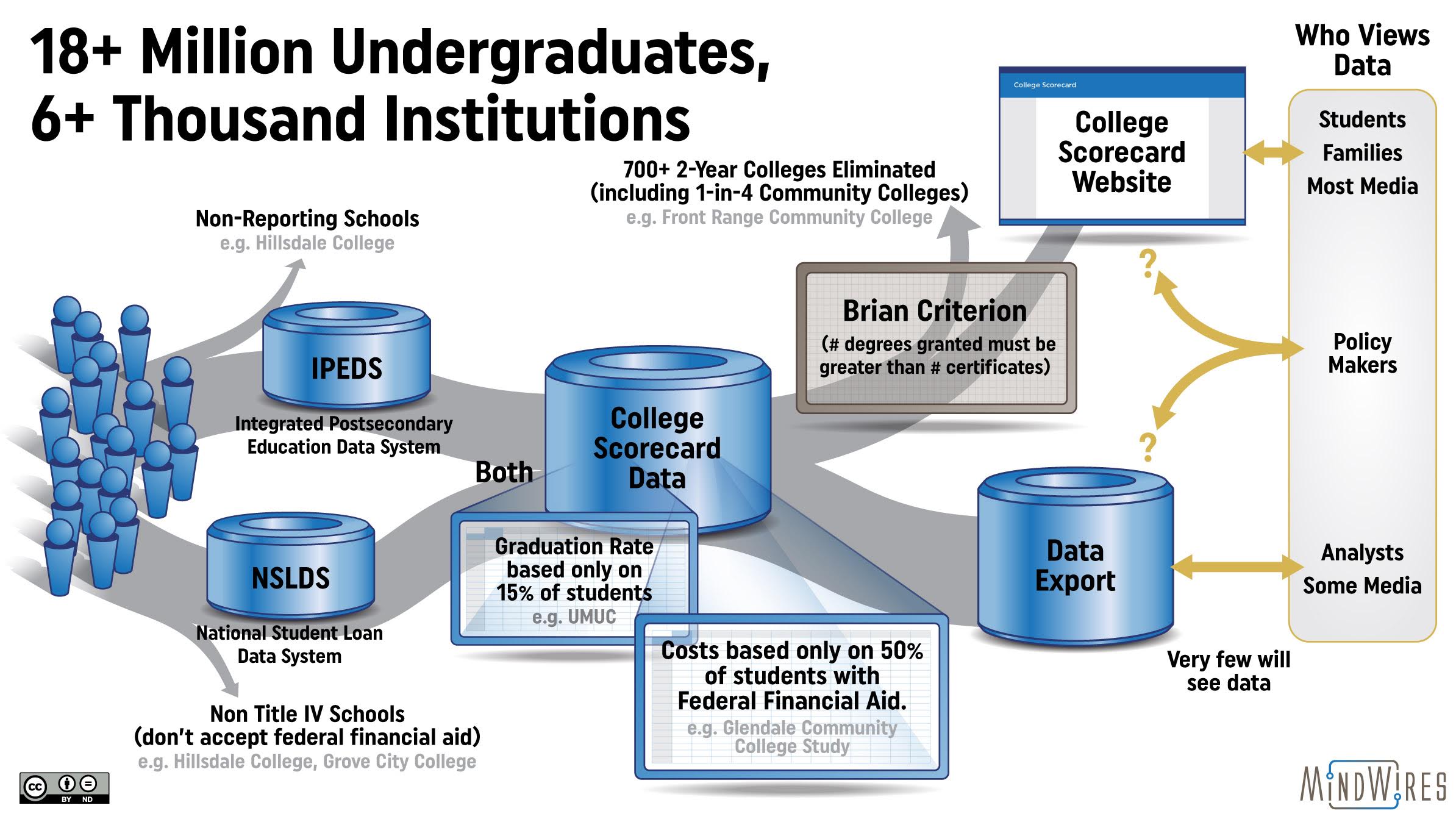
    When the College Scorecard was announced, Russ noticed a handful of missing schools. When I did the whole data OCD thing, I discovered that more than 700 2-year institutions were missing, including nearly 1-in-4 community colleges. Eventually we published an article in the Washington Post describing this (and other) problems.

    The missing community colleges were excluded on purely statistical grounds. If the college granted more certificates (official awards of less than a degree) than degrees in a year, then they were excluded as they were not “primarily degree-granting” institutions. We label this the “Brian Criterion” after the person authoring two discussion board posts that explained this undocumented filter. (more…)

  • Patents Rethought: Khan Academy Did the Right Thing

    To recap what’s happened so far:

    Since then, I had a little more time to look at the actual legal language of the agreement and reflect on the larger edupatent problem. And I’ve come to the conclusion that Khan Academy did the right thing by adopting the agreement. We should feel good about what they’ve done. And given the realities that software patents exist and defensive patents are therefore a necessary evil, we should encourage other educational patent holders to do as Khan has done and adopt the same agreement.

    (more…)

  • Solving the Ed Tech Patent Problem

    You may have heard that Khan Academy has filed for several patents. Audrey Watters has written a really strong piece providing the details of the filings in the context of the history of ed tech patents and showing why some academics feel that the patent system clashes with the values upon which academia was built. In the process, she excavates some of my personal history in the Blackboard patent war. While I am sympathetic to arguments against ed tech or software patents on principle, my own personal reasons for getting involved with that fight were more utilitarian. I believed then, as I do now, that patents threaten to kill innovation in educational technology due to the specific characteristics of the market. The outcome of Blackboard v. Desire2Learn did not end that threat, although it did temporarily reduce it. The conversation being provoked by Khan Academy’s filings offers a new opportunity to come up with a more permanent solution. (more…)

  • Personalized Learning and the Teacher

    A few weeks ago, Jonathan Rees wrote a post calling out that, no matter what potential of so-called “personalized learning” for improving student outcomes, there is a potential—and a temptation—for it to be abused as a method of lowering (labor) costs in a way that also lowers educational quality and effectiveness. This is a serious and realistic concern, particularly as long as personalized learning is framed as a product rather than a set of teaching strategies.

    Phil and I have addressed this concern head-on in our latest piece on EdSurge. I suppose a battle over the meaning of the term was inevitable; why should this one be any different from all the others? There is an enormous disconnect between the way the term is used in product marketing and ed tech circles and the way it is actually applied in the real world in cases places it actually works. I have seen a number of cases in which personalized learning, as an educational strategy, produces good results for students. But every single one of those cases has had one or more good educators leading the charge, thinking hard about how to better serve the students. At its best, personalized learning is an effort to identify those classroom and institutional practices that are depersonalizing, and use technology as an aid to teaching strategies and support processes that can replace those practices with something more humane. Perhaps we should call it “undepersonalized learning.”

    As such, true personalized learning should be labor-friendly in important ways. It should put a premium on skilled educators and make a strong case for increased investment in professional development and teaching-friendly tenure and promotion practices. That doesn’t mean it will always be job-preserving. The focus should be on students and agnostic with respect to student/teacher ratios. It is possible to achieve a more humane and personal education at scale. Sometimes. With a lot of thought and iteration. But I have seen no evidence to suggest that personalized learning technologies improve outcomes significantly without good teachers at the helm, and plenty of evidence suggesting that they don’t.

  • Data To Back Up Concerns Of Textbook Expenditures By First-Generation Students

    David Wiley has added to the conversation ((My initial post, Mike Caulfield responseBracken Mosbacker, my response to Mike, Mike follow-up)) over use of data on college textbook pricing and student spending patterns with “The Practical Cost of Textbooks”. The key argument is to go beyond prices and spending and look at the most direct measure of asking students themselves how textbooks costs have impacted them. He then looks at the Florida Virtual Campus surveys (also included in my post), concluding:

    What impact does the cost of textbooks have on students? Textbook costs cause students to occasionally or frequently take fewer courses (35% of students), to drop or withdraw from courses (24%), and to earn either poor or failing grades (26%). Regardless of whether you have historically preferred the College Board number or the student survey number, a third fact that is beyond dispute is that surveys of students indicate that the cost of textbooks negatively impacts their learning (grades) and negatively impacts their time to graduation (drops, withdraws, and credits).

    And yes, we need to do something about it.

    Amen. Surveying over 18,000 students, the FVC surveys are quite important and should be on everyone’s radar.

    More Out Of Data

    (more…)

  • Bad Data Can Lead To Bad Policy: College students don’t spend $1,200+ on textbooks

    The average US college student does not spend or budget more than $1,200 for textbooks, with that number rising each year, as commonly reported in the national media. The best data available continues to show that students spend roughly half of that amount, and that number is going down over time, not up.

    Last spring I wrote a post documenting that the College Board is not a reliable source for college textbook expenditures. With last week’s release of College Board data, it is worth repeating that data for their “Books and Supplies” category are:

    average amounts allotted in determining total cost of attendance and do not necessarily reflect actual student expenditures.

    Much more reliable data from the National Association of College Stores (NACS) and the Student Monitor consistently show that students on average spend between $530 – $640 per year for textbooks or “required course materials”. ((Read the spring post and a a postscript if you’d like to see the details.))

    There is also fairly clear data from NACS and Student Monitor showing that student expenditures on textbooks or “required course materials” is going down ((Note that NACS used to be a biannual study and does not have data for AY2009 and AY2011.)). (more…)

  • College Scorecard Article Published In Washington Post

    I have written several posts looking at the new College Scorecard and its inherent flaws in the data, often starting with observations from Russ Poulin at WCET. Today Susan Svrluga, education reporter at the Washington Post, posted a new article co-written by me and Russ and titled “Hundreds of colleges missing from Obama’s College Scorecard?”. The gist of the article is taking a holistic view of data problems and why they exist.

    In a nutshell, the College Scorecard combines data from multiple sources – primarily from the Education Department’s own Integrated Postsecondary Education Data System (IPEDS) and National Student Loan Data System (NSLDS) – and publishes the results of both as a consumer-facing Web site and an analyst-friendly data download. The essence of the problem is that throughout this process the data is filtered based on questionable assumptions, leading to the fuzzy lens viewing subsets of the real data.

    Poulin Hill College Scorecard Graphic