e-Literate

Present is Prologue

Category: Recommended Reading

  • Welcome Change: OpenStax using more accurate data on student textbook expenditures

    Welcome Change: OpenStax using more accurate data on student textbook expenditures

    Last week OpenStax, the Rice University-based publisher of open educational resource (OER) materials, announced that according to their data more than 2.2 million students at 48% of colleges in the US and 1,150 outside the US are using OpenStax free textbooks, saving an estimated $177 million.

    This is compelling data in its own right, and we are working on analysis around this organization and its model, but somewhat buried in the press release is another significant statement around what students currently spend on textbooks and what savings are possible with OER.

    “Our community is creating a movement that will make a big impact on college affordability. The success of open textbooks like OpenStax have ignited competition in the textbook market, and textbook prices are actually falling for the first time in 50 years.”

    As a result of the unprecedented downward shift in textbook prices, OpenStax will be decreasing its estimated student savings figure from $98.57 to $79.37 based on federal data. The U.S. Department of Education’s National Center for Education Statistics published a study in May stating the average undergraduate student spent $555.60 on required course materials for the academic year. Dividing that number by seven courses (the undergraduate average, according to enrollment data) comes out to $79.37 in savings for each student using an OpenStax book.

    I have long argued that OER groups and others arguing for making college more affordable should use baseline numbers based on what students actually pay for textbooks, rather than the all-too-common $1,220 – $1,420 per year numbers from a misuse of College Board budget numbers (see chart at top of page 10 in this document). With OpenStax moving to new federal data showing $556 average expenditures, we should start to see more reliable estimates of student savings. Kudos to them.

    However, this level of student spending should not be a surprise to anyone following the curricular materials market.

    Our 2015 post “How Much Do College Students Actually Pay For Textbooks?”, as well as a follow-up post, show in detail that we have had data for years showing that students roughly $600 per year on textbooks and related course materials, and that that number has been falling since at least 2008. Using data from the National Association of College Stores (NACS), we knew three years ago about the rough level of spending and the multi-year decline. NACS has continued to release annual updates, with the most recent public release from last summer:

    NACS data showing course material expenditure

    What OpenStax refers to, however, is the new National Postsecondary Student Aid Study (NPSAS) restricted-use data from the US Department of Education’s National Center on Education Statistics, showing $555.60 average student expenditures per year. Which is right in line with the NACS data.

    We plan to explore the NPSAS data in more detail, as it provides rich data for crosstabs and exploration of student expenses. But for now, kudos to OpenStax for this change in student savings estimates, even if it is years overdue. I would hope that other OER advocates would follow their lead.

  • Recommended Reading: Fear of Looking Stupid

    Inside Higher Ed has summarized some findings of a study by Carnegie Mellon University anthropologist Lauren Herckis about why faculty hesitate to try new teaching practices. (The article in IHE uses the word “innovative,” but I find that word loaded, and since I don’t know if or how it was used in the study itself, I’m going to avoid it for now.) The one that made the headline of the article is faculty being afraid of looking stupid in front of their students, but two other important ones were fear of punishment from bad course evaluations (or “smile sheets,” as they are sometimes derogatorily called) and deep “gut” convictions based on personal experience that they know what good teaching is and will prefer that instinct over the findings of a research article. Read the comment thread as well as the article; the discussion is fascinating (and tends to back up the latter two findings).

    We happened to interview Dr. Herckis for e-Literate TV a while back, and here she is making a related observation:

    I also recommend reading John Warner’s response in IHE about the necessity of being comfortable looking stupid. Great stuff.

    A couple of commenters on the original IHE article asked for a link to the original study. I don’t have one at the moment and am not sure it’s been published yet but will post it when it becomes available.

  • MOOCs Now Focused on Paid Certificates and OPM Market

    MOOCs Now Focused on Paid Certificates and OPM Market

    Writing in EdSurge, Dhawal Shah from Class Central describes the mostly-complete transformation of the large MOOC providers – Coursera, Udacity, edX, FutureLearn – away from lifelong learners and towards paid certificates and a form of Online Program Management for Master’s degrees. No one still claims that MOOCs will disrupt the university as previously hyped. Referring to these previous claims:

    Now, more that five years later, we know this [disruption of universities] is not the case. I started Class Central at the end of Nov 2011 as a side project to keep track of free online courses, so I’ve followed the space closely right from the beginning. MOOC providers have learned a lot in the last five years, and they’re now more certain about who their real audience is—and they’re not the dabblers and lifelong learners who take courses just for curiosity’s sake.

    Paid Certificates

    The description of the current MOOC target audience is a twist on an old term. Shah paraphrases Coursera’s previous CEO Rick Levin and then clarifies:

    The real audience is not the traditional university student but what [Levin] calls the “lifelong career learner,” someone who might be well beyond their college years and takes these online courses with the goal of achieving professional and career growth. [snip]

    Traditional lifelong learners might learn due to their love of learning, but in the case of lifelong career learners, the “lifelong” part is driven by the necessity of constantly adapting to the changing job market. Learning for the sake of learning sounds appealing, but, at least anecdotally, I hear from many people find they are more likely to make significant progress or even complete a course when they are tied to professional outcomes (that’s certainly my experience).

    Typical paid programs lead to certificates and may be sponsored by the employer and may be tied to a monthly subscription.

    Shah also describes how the MOOC providers have dramatically reduced the offerings and features available for free, lamenting at the end:

    But if you are true lifelong learner—the ones that helped start all the hype in the first place—the MOOC experience has largely been reduced to basically a YouTube playlist with a cumbersome user interface.

    Unless, of course, you are willing to pay.

    OPM Progress

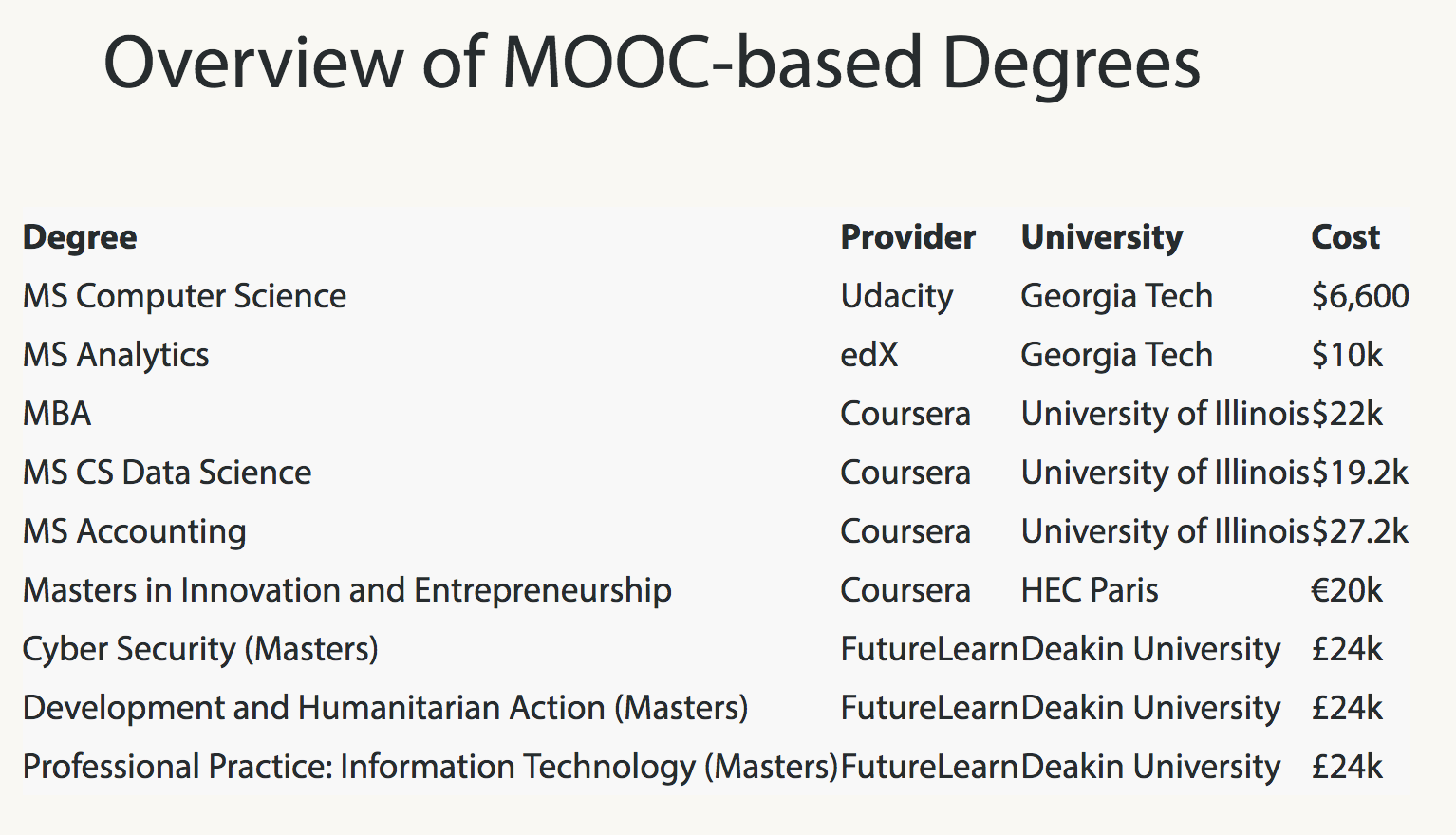
    Shah also linked to a previous post of his at Class Central describing the progress made by the MOOC providers in creating an Online Program Management (OPM) business model. Udacity started this movement with their Master’s of Computer Science degree at Georgia Tech, but now the other vendors are following suit. Coursera announced their fourth program in March (three of them at the University of Illinois), edX added one at Georgia Tech, and FutureLearn announced three programs at Deakin University in Australia. All told, there are now 10 programs identified where the MOOC providers are acting as OPM providers, albeit from four universities. From the April post:

    In a post describing the OPM market last year I noted:

    The OPM market is interesting and dynamic. Here we see strong arguments for both bundled revenue-sharing models and for unbundled fee-for-service models. I personally do not believe that the market is moving away from revenue sharing as much as there is pressure for additional models. There are a growing number of choices available to schools, but there is also a crowded marketplace that is becoming more difficult to understand and compare vendors.

    The 10 programs mentioned above now represent one of these “additional models” in the crowded marketplace.

    For those wanting to understand where the large, commercial MOOC market stands in 2017, I recommend reading both of Dhawal Shah’s posts – from April at Class Central and July at EdSurge.

  • Recommended Reading: With or Without EdTech

    Recommended Reading: With or Without EdTech

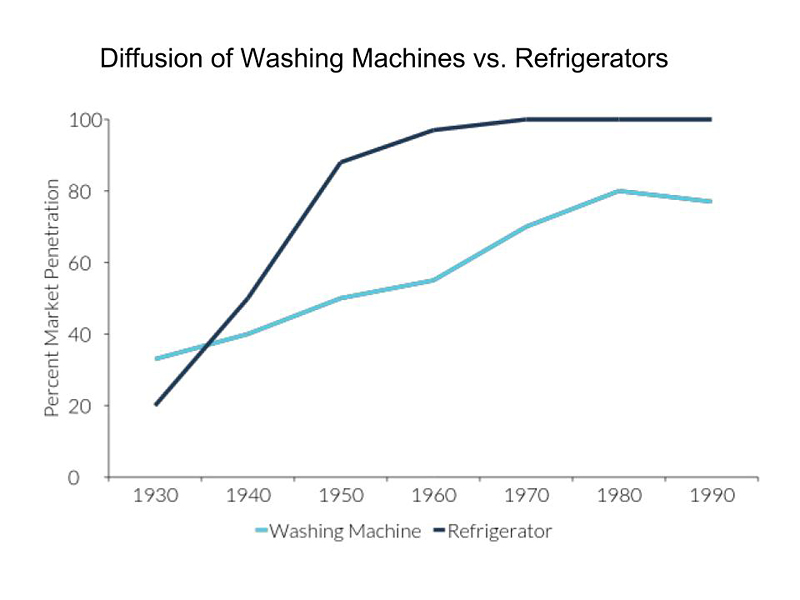
    A few weeks ago, I recommended an EdSurge piece by the Clayton Christensen Institute’s Julia Freeland Fisher. It featured this graph of refrigerator vs. washing machine diffusion:

    machines-1491937394

    I saw this same image featured last week in a main stage talk at the IMS conference, so it is making the rounds.

    Audrey Watters pointed me to this blog post responding to Freeland Fisher by CSU Pueblo history professor Jonathan Rees. Jonathan has made several appearances here on e-Literate. I would describe him as an open-minded and engaged ed tech skeptic. He teaches using tech but is suspicious of narratives such as Christensen’s “disruptive innovatation” that tend to displace educators in favor of tech. He also happens to be a scholar of the history of refrigeration.

    Ruh roh.

    Jonathan takes apart the graph using a number of tools of scholarship:

    • He notes the lack of sourcing for Freeland Fisher’s data. (This is a problem that’s common in ed tech blogging and reporting—as opposed to scholarship. The less formal style of writing and different audience invites a certain sloppiness in sourcing at times. We’ve occasionally been guilty of this sin on e-Literate.)
    • He surveys alternative scholarship, finding a difference in diffusion rates for the washing machine than the figure Freeland Fisher cites.
    • He looks at differences in the analyses to explain differences in the data. “Perhaps this [difference] can be explained by the difference between owning a washing machine and ‘accessing’ a washing machine in the basement of your apartment building or taking your dirty laundry down the street to a laundromat.”
    • He looks at differences in context to explain differences in the data: “French or English people in 1957 still had easy access to fresh meat and produce at large markets.  Many still choose to live that way today because fresh perishable food tastes better. Americans, on the other hand, tend to preference convenience over taste. That’s why the refrigerator industry was one of only three in the whole United States to grow during the Great Depression.”

    These are all solid analysis techniques that are common in scholarship across many disciplines. But we rarely see them applied directly to claims of “efficacy” in ed tech, particularly in mainstream outlets where academics who are not education scholars can read them and evaluate the arguments.

    Whether Rees is correct in his takedown of Freeland Fisher is almost beside the point to me. His casual demonstration of scholarly analysis is a stark reminder that we are missing something critical in our academic conversations about ed tech.

    Read it here.

  • Recommended Reading: Is Your Edtech Product a Refrigerator or Washing Machine?

    Recommended Reading: Is Your Edtech Product a Refrigerator or Washing Machine?

    Don’t be put off by a title that reads like click bait; this piece in EdSurge by Julia Freeland Fisher is the real deal. The column looks at the adoption rates of…well…fridges and washing machines.

    Refrigerators were adopted much more quickly than washing machines.
    Credit: Julia Freeland Fisher

    The reason, she argues, is

    Most households had electrical outlets that refrigerators could plug into directly, thus leaving iceboxes in the dust. But few homes had the pipes and drain lines required to install a washing machine.

    In other words, homes at the time were never designed with washing machines in mind. As a result, to take advantage of the new technology households didn’t just have to shell out money; they had to hire a plumber to configure the pipes that would pump water into and drain water out of the new contraptions.

    The analogy is that some ed tech innovations fit more readily into the ways that colleges and individual educators do things than others. This is a fundamental limiting factor on adoption, regardless of theoretical value or “efficacy”.

    I have argued that the problem is even worse than that. We can’t really know the impact of the ed tech product or service outside the context of the the institution, many of which are not as easily checked as “Is there hot water line to the basement where I can plug in my washing machine?”

    Anyway, Freeland Fisher’s piece is well written and drives the point home with clarity. Go read it.

  • University of California’s Payroll Project Reboot Now At $504 Million

    University of California’s Payroll Project Reboot Now At $504 Million

    In July 2014 I wrote about the University of California’s project to update its payroll & HR systems to Peoplesoft systems and how the project had ballooned out of scope. The goal of the $156 million project was to save a reported $100 million per year eventually and to replace a 30-year-old Payroll Personnel System (PPS) that runs separately for each of the 11 UC locations with Oracle’s PeopleSoft payroll and HR systems. All systems were planned to be live by the end of 2014.

    At the time, I quoted Christopher Newfield at Remaking the University with this summary:

    The project timeline has grown from 48 to 72 months, and its costs are said to be $220 million (it had spent $131 million by May 2014) . Worse, the repayment schedule has mushroomed from seven to twenty years.

    Well, those were the good old days it appears. The project has now grown to more than half a billion dollars (estimates) according to the Sacramento Bee. The project is now four years behind schedule. (more…)

  • Recommended Reading … or Not: Updates on UC Berkeley and NBER stories

    Recommended Reading … or Not: Updates on UC Berkeley and NBER stories

    Here are two updates on stories we’ve covered recently at e-Literate. One is an actual update and that is a lack of update.

    UC Berkeley and Accessibility

    In our post clarifying the context of the school’s decision to remove lecture capture video from public site (not deleting the video, just putting behind domain wall), one issue I raised was that there is no agreement yet between Berkeley and the Department of Justice / Department of Education team pushing the case. (more…)