e-Literate

Present is Prologue

Category: Upcoming Events

The “Upcoming Events” category provides updates on the e-Literate world concert tour. (Please only buy official concert T-shirts. Buying counterfeits hurts the band.)


  • Next Week’s Blursday Social: Seeing Around Corners with Doug Lederman

    Next Week’s Blursday Social: Seeing Around Corners with Doug Lederman

    First, as a reminder, this week’s Blursday social is Blursday…er…Thursday at 4 PM ET. guest will be Jeff Young, Senior Editor at EdSurge, whose Pandemic Campus Podcast Series is a must-listen. (Register here.) We’ll be getting a real on-the-ground read from Jeff in an increasingly fluid and social environment provided by the rapidly evolving Run the World platform. (More on that in a bit.)

    Next Blursday, 10/22, we’ll be talking with Doug Lederman, co-founder and editor at Inside Higher Ed. Doug is one of the people I most like to talk to when I want to find out what’s about to happen, or what’s happening that nobody is seeing yet. As both a great reporter and a great editor, he really has his ear to the ground. And in the times like the ones we’re living through now, where the waves of change come fast and furious, it’s important to have that sixth sense.
    Doug Lederman, co-founder and editor of Inside Higher Education (sans COVID beard)

    I’m really quite pleased with the kind of Blursday Social experiences that Run the World is able to support as it matures and adds features (and as I get better at using it). I’m increasingly able to create that fluid, social experience that we all miss and are craving.

    We’ll kick off the conversations with a fifteen-minute(ish) conversation. In Doug’s case, he’s going to offer up a few trends he’s seeing that are potential discussion starters. The group will pick the one that most people want to talk about. We’ll then have a volunteer attendees join us in an impromptu conversation. I suppose you could call it a “panel,” but it really feels more like a more natural, organic conversation.

    Starting this week with Jeff, and continuing on with Doug, we’re going to use a new feature that let’s us do one-on-one speed dating breakout groups on-the-fly. Once we have a nice, meaty conversation going, we’ll break off into a few rounds of one-on-one discussions and then reconvene for more conversation. It’s astonishingly easy and pretty natural (although you do have to get used to the hard cutoff for the speed dating sessions). So we’ll talk about a topic together, break out to have some one-on-one conversations, and then convene another volunteer group to come “up front” and talk some more about it.

    Once it feels like the group has had enough group conversation, we’ll break out again into one-on-one conversations for purely social discussions. The joint closes at 5:30 PM ET, but leave when you want.

    Dress code is COVID casual. BYOB. Bring friends; there’s plenty of room, and the social distancing safeguards are top notch.

    Again, Doug’s session is next Blursday, 10/22, from 4 PM to 5:30 PM ET. Register here.

  • Next Blursday Social: Campus Pandemic Diaries with Jeff Young

    Next Blursday Social: Campus Pandemic Diaries with Jeff Young

    First, as a reminder, we’ll be kicking off our weekly e-Literate LIVE! Blursday Social event tomorrow at 4 PM ET. Our guest will be Andrew Owen, Head of Community at Run the World, the social web conferencing platform we’ll be using for our events. You can sign up for it here.

    Next Thursday’s guest will be Jeff Young, Senior Editor at EdSurge. His Pandemic Campus Podcast Series is a must-listen. Because things are changing so rapidly, I’m going to be doing a periodic series of conversations with people who talk to lots of other people. Jeff is the first. He’s one of the best reporters covering higher education and really has his ear to the ground. We’ll chat a bit about what he’s seeing, and then we’ll all talk about what you’re seeing.

    Jeff Young, Senior Editor at EdSurge

    Remember, Blursday Socials are much more conversation and participation than broadcast. Think of it as being like trivia night at your favorite bar. There will be some organized activity, but a lot of it will be just connecting with friends. Some folks will be regulars, others will be semi-regulars, and still others will drop in occasionally. They start every Thursday at 4 PM Eastern Time. The bar closes at 5:30, but I expect many people will log off at 5. in future sessions, we will eventually use the networking time to do more formal problem-solving discussions and reconvene in the last half hour to brainstorm together. 

    The dress code is casual; BYOB.

    I recommend that you also subscribe to the iCal feed, which you can do by going to this page and clicking on the “iCal Feed” button on the bottom. I have events tentatively lined up for the handful of weeks, which I will populate to the calendar as they are finalized.

    Jeff’s session is next Thursday, October 15th at 4 PM ET. RSVP here.

  • Blursday Socials on e-Literate LIVE!

    Blursday Socials on e-Literate LIVE!

    For a while, I backed off of doing webinars because I got that many of you just didn’t have the bandwidth for it. We’re going to ease back into it now with something I’m calling “Blursday Social with e-Literate LIVE!” As you can guess from the title, it is open beyond the bounds of the EEP community. It’s meant to be a light-hearted event where friends can talk shop and catch up with each other. It will not be yet another broadcast-only or broadcast-mostly webinar series. As some of you know, I’ve been experimenting with a platform called “Run the World.” If you attended the recent ASU+GSV conference then you may have experienced it in the speed networking events. The platform is shaping up nicely. 

    We’ll be meeting weekly on Thursdays from 4 PM to 5:30 PM ET, starting this Thursday, October 8th. Think of it as being like trivia night at your favorite bar. There will be some organized activity, but a lot of it will be just connecting with friends. Some folks will be regulars, others will be semi-regulars, and still others will drop in occasionally. 

    For the inaugural session, we’ll have a chat with Andrew Owens, Head of Community at Run the World. We’ll have a chat about how to build connections in this crazy online synchronous world we find ourselves in. And when I say “we’ll have a chat,” I mean all of us. That will last for about 30 minutes, after which we’ll have some open one-on-one conversation time. We’ll give you a question to discuss, but think about it more as an ice-breaker than as a discussion prompt. Talk about whatever you like. The focus of the conversation will be “distancing socially,” or learning the lessons of COVID-19 to build engagement. We will be practicing what we’re preaching. The dress code is casual; BYOB.

    The bar closes at 5:30, but I expect many people will log off at 5. in future sessions, we will eventually use the networking time to do more formal problem-solving discussions and reconvene in the last half hour to brainstorm together. 

    Again, the first session is ThursdayOctober 8th from 4:00 PM to 5:30 PM. Please RSVP here. I recommend that you also subscribe to the iCal feed, which you can do by going to this page and clicking on the “iCal Feed” button on the bottom. I have events tentatively lined up for the handful of weeks, which I will populate to the calendar as they are finalized. 

  • Reminder: Webinar Thursday on Historic #PivotOnline Event for Faculty (Now with Correct Link!)

    Hi gang. I’m writing a reminder to you that I’ll be hosting a webinar tomorrow about next week’s free REMOTE Summit next Monday and Tuesday. (Embarrassingly, this is partly necessary because my last post included the wrong for the webinar registration page. The webinar is Thursday, July 9th from 1:30 PM to 3 PM ET. Register HERE. (The summit itself is next Monday and Tuesday.)

    This thing is shaping up to be an historic #ResilienceNetwork-scale event. There are somewhere in the neighborhood of 80 talks and 10K+ attendees registered the last time I checked. Please, please, please, get this information out to your networks of faculty. There’s room for ~90K more attendees. Let’s fill it up.

    The e-Literate LIVE webinar tomorrow will feature David Levin, ASU’s Entrepreneur in Residence who conceived of and organized the event. We’ll be giving you a preview of the event itself and, importantly, giving you a chance to have input on what steps might be taken to build on the event afterward.

    Again, the webinar is tomorrow, i.e, Thursday, July 9th from 1:30 PM to 3 PM ET. Register HERE.

    In case you actually want to register.
  • Come to the e-Literate LIVE! Virtual House Party on Thursday

    I’m inviting you to a little soiree I’m throwing on Thursday.

    I know this is somewhat last-minute, but hey, it’s the Summer of Covid. Kind of like the Summer of Love only we’re all wearing PPE and getting intoxicated alone. Besides, admit it: You’re not going anywhere else anyway.

    Thursday, July 2nd at 4 PM ET, I will be hosting a one-hour test event and social happening on for a new kind of happening called e-Literate LIVE! on a new platform called Run the World. We need to start figuring out this whole professionally social at a distance thing, and honestly, I have a lot of Zoom fatigue. The webconference platform is the LMS of the 2020s, in the sense that its adoption is taking off to new heights in education at a time when its implementation for educational purposes is still primitive and clunky. It doesn’t have the right interaction model for many kinds of educational conversations. In contrast, Run the World is designed by Instagram alumni. It’s more personal, more social network-y, and more persistent than a traditional webconference platform. It’s being promoted as a virtual conference platform, but honestly, it’s something new.

    Which is good, because I have something new in mind. I want to create a kind of rolling networking event where people can meet up and yes, listen to talks, but also chat privately, meet new people, follow up on great contacts, continue the conversation after the event, and so on. You know, like in the real world before the zombies took over.

    I need to test the platform before I start inviting guest speakers to the party. I was going to invite just a handful of people to do a test run with me.

    But then I thought, “What the heck. Why not just invite everybody?”

    We will talk about a topic of substance—namely, how we build persistent support for each other in this new world we find ourselves in. And I’ll share some exciting plans for future happenings.

    Again, the event will be this Thursday, July 2nd, from 4 PM to 5 PM ET. You can register here. (If the date is wrong on the landing page, please ignore it. We are indeed set up for Thursday. It’s a new platform and I’m still figuring it out.)

    Or you can watch more cable news. Your choice.

    BYOB. (Bring Your Own Bluetooth.)

  • Retention Webinar is Back On

    Driving Toward a Degree finding

    We now return to our regularly scheduled program.

    Sort of.

    Given the strains that COVID-19 is putting on both students and institutions, student retention is going to be more important than ever in this coming academic year. Our Standard of Proof webinar with Tyton Partners on their Driving Toward a Degree research, which was put on hold due to the crisis, is now scheduled for Thursday, May 21st at 2:00 PM. In addition to covering the report in general—including the recent update based on 2019 data—we’ll talk about the specific implications (that we know of) for the world we’re living in now.

    Sign up here.

  • Summer Melt

    Summer Melt: Read this book

    This post is partly a nudge for you to sign up for the inaugural e-Literate Standard of Proof webinar coming up this Monday at 2 PM and partly a post to tell you why I’m so excited to be kicking off the series with this particular story.

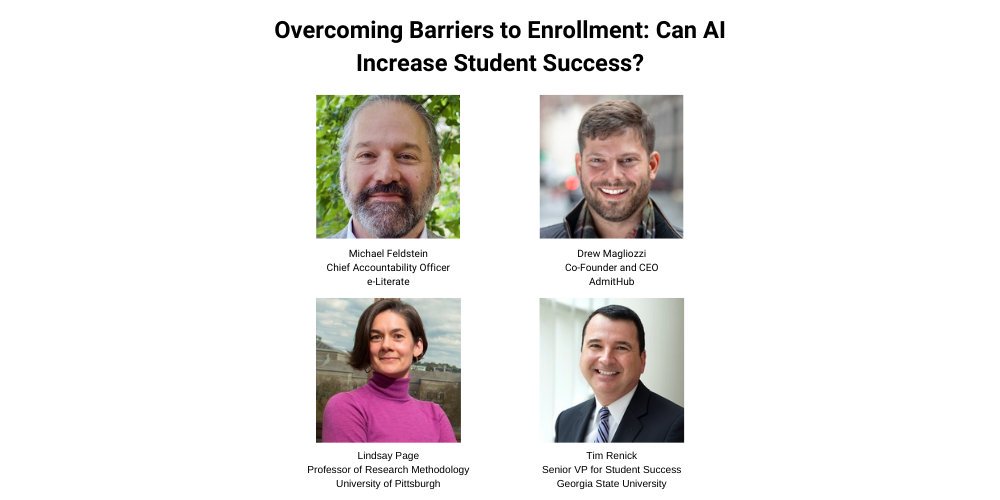
    My macro thesis for a while now has been that colleges and universities are in the early stages of a transformation from having a philosophical commitment to student success toward being operationally excellent at supporting and enabling student success. That proposition has been a little abstract for some. If you want to understand what that looks like in the real world, I can’t think of a better example than Georgia State University (GSU) under Tim Renick’s leadership. And this webinar will tell the story of one of his seminal achievements.

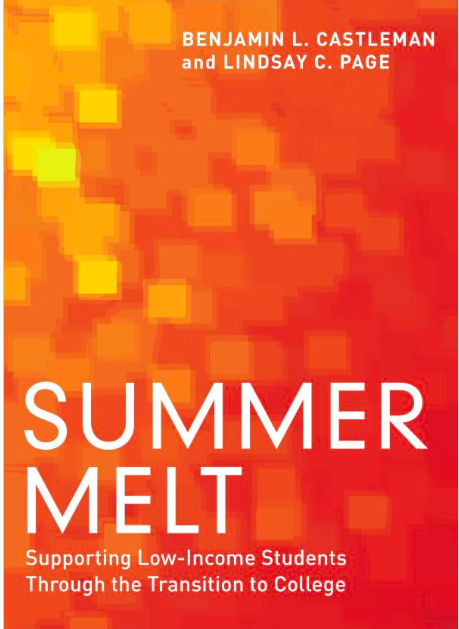
    Summer Melt is the classic example of the kind of problem that is traditionally invisible to universities that think of student success as a philosophical commitment rather than a core operational responsibility. It’s the phenomenon where students graduate high school, apply to college, get admitted, say they’re coming, fully intend to come, and then never show up. It disproportionately hits first-generation students, students of color, and economically disadvantaged students. Why? Because getting from admission to the first day of classes is a lot harder than many of us remember. You have to fill out a FAFSA form, which as Renick put it yesterday in his IMS presentation, is basically a tax return. I don’t know about you, but I didn’t fill out my FAFSA. My dad did. Not every seventeen-year-old is lucky enough to be able to hand off that responsibility. Then there are inoculations, forms to be filled out and signed by relatives with whom you may or may not have contact, places to get to, fees to pay, and so on, and so on. In their eponymous book on the topic, researchers Benjamin Castleman and Lindsay Page tell us,

    In some school districts where as many as 40 percent of college-intending students fail to matriculate, it would be more appropriate to refer to this as a “summer flood.”

    Castleman and Page, Summer Melt: Supporting Low-Income Students Through the Transition to College

    Forty. Percent.

    And some of these problems are very solvable—if you know about them. For example, once the GSU folks realized that immunizations were a problem that was preventing students from getting to the first day of classes, they started parking free immunization trucks outside during times when those soon-to-be students would be visiting campus.

    The trick is knowing. So Tim Renick and his team partnered with an AI chatbot company called AdmitHub. It turns out that their CEO, Drew Magliozzi, had read the summer melt book too. And he thought his tool could do something about it. GSU brought in AdmitHub to try it out. But they also brought in Lindsay Page to conduct a randomized controlled trial. It’s one thing to say that you think your intervention improved a problem. It’s quite another to gather credible evidence.

    And that’s what they did. According to GSU’s web page on the topic,

    To help these students, the university identified the common obstacles to enrollment that students face between graduating high school and the start of college, including financial aid applications and documents, immunization records, placement exams and class registration, among others. Georgia State developed an approach that would help at-risk students through these obstacles by instituting a combination of a new student portal to guide students through the steps needed to be ready for the first day of classes and an artificial-intelligence-enhanced chatbot, “Pounce,” to answer thousands of questions from incoming students 24/7 via text messages on their smart devices.

    In 2016, during the first summer of implementation, Pounce delivered more than 200,000 answers to questions asked by incoming freshmen, and the university reduced summer melt by 22 percent. This translated into an additional 324 students sitting in their seats for the first day of classes at Georgia State rather than sitting out the college experience.

    GSU, “Reduction of Summer Melt

    The “Standard of Proof” webinar series is designed to tell stories like this one: Universities working with credible vendor partners to learn and share something new and important about supporting students that is a benefit to the entire sector.

    This is a canonical example of that, folks.

    Sign up for the webinar.

    The webinar: Come for the enlightenment. Bring your own food.