
e-Literate

Present is Prologue

Category: LMS & Learning Platforms

Everything you want to know about Learning Management Systems and whatever comes after them.


  • InstructureCon: Canvas LMS has different competition now

    For the first few years of the Canvas LMS, Instructure’s core message was ‘Canvas is better than Blackboard’. This positioning was thinly veiled in the company’s 2011 spoof of the Apple / 1984 commercial and even hitting the level of gloating in a company blog commenting on Blackboard’s strategy reversal in 2012. Instructure made their name by being the anti-Blackboard.

    At InstructureCon 2014, there was hardly a mention of Blackboard or any of the other LMS providers. In fact, most of the general sessions avoided any direct or indirect comparison of LMS products. This year there were three observations that surprised me:

    • Snow in June;
    • Canvas growth in K-12 markets; and
    • Lack of mention of LMS competitors or product one-upmanship.
    Snow in June

    (more…)

  • Why Google Classroom won’t affect institutional LMS market … yet

    Yesterday I shared a post about the new Google Classroom details that are coming out via YouTube videos, and as part of that post I made the following statement [emphasis added]:

    I am not one to look at Google’s moves as the end of the LMS or a complete shift in the market (at least in the short term), but I do think Classroom is significant and worth watching. I suspect this will have a bigger impact on individual faculty adoption in higher ed or as a secondary LMS than it will on official institutional adoption, at least for the next 2 – 3 years.

    The early analysis is based on this video that shows some of the key features:

    (more…)

  • Google Classroom: Early videos of their closest attempt at an LMS

    For years the ed tech community has speculated about Google entering the LMS market, including Wave (discontinued, but some key features embedded in other tools), Apps for Education, and even incorrectly with Pearson OpenClass. Each time there is some possibilities, but Google has not shown interest in fully replacing LMS functionality.

    Google Classroom, announced in May and with new details coming out this week, is the closest that Google has come to fully providing an LMS. The focus is much more on K-12 than on higher education.

    For background on the concept, see this video from May which emphasizes roster integration (with some instructor setup required), document sharing through Google Drive, server and security through the cloud, discussions tied to assignments, and a focus on ‘letting teachers and students teach or learn their way’.

    Yesterday Google shared a new video that directly shows the user interface and some key features.

    (more…)

  • Six Months After Layoffs: No signs of growth at Desire2Learn

    Late last year I wrote a post about Desire2Learn’s laying off more than 7% of the workforce, speculating that something had changed at the company. In particular, I didn’t buy the company line about continued growth.

    In the end, I have trouble believing that these recent cuts are solely based on improving Desire2Learn’s growth without needing to correct for slower-than-expected growth. The arguments made by our sources that these are significant cuts driven by not hitting growth targets are compelling. However, there is no smoking gun that I have found to back up these claims definitively.

    What I do feel confident in saying regarding employee numbers is that there’s more to the story here than just ‘churn’ alongside aggressive hiring. Since the end of the Blackboard patent lawsuit, Desire2Learn has grown at an average of 13 employees per month (140 in Nov 09, 560 in Sep 12, 750 in Nov 13). Yet the numbers might have actually gone down since July 2013.

    After that post, Desire2Learn (through an interview with a local media outlet) further explained the company line about growth with challenges. [emphasis added]

    The past year has included hirings and staff reductions as the developer of online learning software prepares for growth and expansion, says Dennis Kavelman, the Kitchener-based company’s chief operating officer.

    Kavelman stresses that the company is growing, not shrinking, and restructuring to handle the growth resulted in some layoffs.

    (more…)

  • ITC Survey: Four trends to watch in LMS market for community colleges

    The Instructional Technology Council (ITC), an affiliated council of the American Association of Community Colleges (AACC), has conducted a distance education survey since 2004 focusing on online education trends among community colleges in the US and Canada. With this focus, the member colleges tend to be those with a stronger interest in online education programs and therefore are more progressive in technology usage than the general community college population. One part of the ITC survey is on general LMS usage at member schools, and this provides another source of data on the higher ed LMS market.

    The survey this year was based on 142 responses out of the 375 member institutions (39%), and there are a few caveats that should be noted:

    • Prior to 2012 the survey was emailed to all AACC colleges, but due to uneven responses the survey changed to just survey ITC colleges; and
    • “No answer” responses are not listed in percentages, thus totals will not always equal 100%.

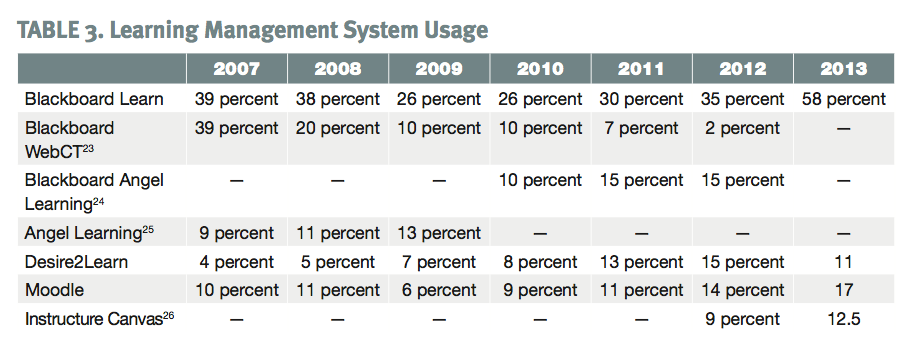
    Despite those caveats, “70 percent of the annual submissions have come from the same campuses during the nine years of the survey”, which means that it is worth exploring some broad trends for the LMS market for community colleges. Here is the data presented on LMS usage this year on page 15 (April 2014 report of Fall 2013 survey data):

    Table 3


    (more…)

  • Two-Year Anniversary of Blackboard Acquisition of Moodlerooms and NetSpot

    Two years ago today, Blackboard made a dramatic change of course with a series of public announcements:

    At the time I described these changes:

    Most of the discussion in articles and blogs follows the meme of Blackboard entering open source, or even the meme of Blackboard acquiring competitors. I think the news is more significant than either of these two memes.

    Blackboard just did a 180-degree turn on their strategy for their core LMS business. They have moved from consolidating all customers into Learn 9.1 to providing products and services that are almost LMS-agnostic.

    Archive of Statements

    Given this dramatic turn of events, I wrote an additional post that captured the public statements (press releases, blog posts) from Blackboard, Moodlerooms, NetSpot, and even Blackboard competitors for the purpose of checking to see if the acquisitions really did signal a true change in strategy and support for open source. This two-year anniversary seems the perfect time to check up.

    Bb’s Previous Open Source View

    Just how big of a change did the announcements represent? Consider Blackboard’s moves regarding alternative LMS solutions in the previous six years. (more…)

  • New look at LMS data for US small colleges

    Last fall I mentioned two new non-survey data sources available to track LMS adoption within higher ed. While surveys for subjective, attitudinal information still make sense, surveys of hard data are losing their value over time. Analyses of automatically collected system data place less of a burden on the organizations providing the information, and these analyses also allow a more agile approach to refining the data collection and viewing from different angles. Today Edutechnica released a new report on LMS adoption that demonstrates these benefits.

    When we provided our initial analysis of LMS usage in fall of 2013, one point of feedback that we heard loud and clear is that because our data only included institutions with greater than 2000 enrollments, we excluded a fair number of community colleges, career colleges, and liberal arts colleges. To the credit of those who provided this feedback, they were absolutely correct. Three-quarters of all recognized higher education institutions in the United States have fewer than 2500 FTE – a critical demographic as the majority of universities in the US are of this size or smaller. To more fairly represent LMS usage we needed to include data on smaller schools.

    We are now excited to be able to provide analysis of a data set for institutions with greater than 1000 students.

    The team presents the raw data for schools above 1,000 FTE, calling out some of the differences from their earlier report. But one key view they provided is looking at institutional LMS adoption per school enrollment size.

    Seeing Moodle’s increased usage prompted us to investigate Moodle further. An interesting thing happens below 2500 FTE; Moodle actually exceeds Blackboard’s market  share.  Only after this point do the demographic segments diverge. (more…)