e-Literate

Present is Prologue

Category: LMS & Learning Platforms

Everything you want to know about Learning Management Systems and whatever comes after them.


  • The Resilient Higher Ed LMS: Canvas is the only fully-established recent market entry

    For a few years starting in 2009, it seemed one of the best ways to raise VC funds or corporate internal investment was to say “we can beat Blackboard with a new cloud-based platform”. Witness Coursekit / Lore, Instructure / Canvas, OpenClass, LoudCloud Systems, Helix, and even more recently MOOC platforms. There were many articles written as these new systems entered the market, but what if we look back and ask whether the LMS market has actually changed recently? The picture that emerges is one of surprising resiliency by the established LMS providers.

    In fact, I would argue that in the past eight years (at least in North America) the only new system that has fully established itself in the LMS market is Canvas. Note that I have combined WebCT and ANGEL within the Blackboard umbrella, but even these systems established themselves more than a decade ago.

    (more…)

  • Blackboard seems to have cut large amount of workforce

    Update: Please see new post with updated information.

    Update: I heard back from the company that part of the discrepancy in numbers is that public statements about employee count may have changed in whether they included the call center employees (which vary seasonally). If I can get some hard numbers from Blackboard, I will publish a new post with more accurate information. For now, please note that the 26% number may be based on inconsistent definitions. Accordingly, I have changed the post title and am bumping this post.

    The Washington Post ran a piece over the weekend about Blackboard’s reorganization efforts since Jay Bhatt took over as CEO.

    Blackboard has upended its corporate structure and strategy behind closed doors since chief executive Jay Bhatt took over the private company a year ago with a mandate to reinvigorate one of the District’s oldest and most recognized technology brands.

    The changes come after years of eroding market share for Blackboard, a pioneer in online learning management software. Bhatt said the changes made in the past year provide a foundation on which to grow the business.

    Michael and I have both noted some of the layoffs that have taken place as well as the reorganization and removal of silos. Alert former employee George Kroner, however, noted on Twitter just how significant the layoffs have been. This nugget from the WaPo story is the key:

    Blackboard today is completely reorganized, compared with a year ago, a process that required layoffs in some departments and new hires in others, Bhatt said. The company counts roughly 2,200 employees to date.

    Compare this to the first story on company layoffs from September 2012, from Bill Flook at the Washington Business Journal. Note that Michael Chasen was still CEO at this point, as Jay Bhatt took over at the end of December 2012.

    In a statement, Blackboard spokesman Matthew Maurer said the company has “seen strong growth this year in terms of revenue and in the acquisition of new businesses that have opened up new markets for us.” The company’s total workforce now stands at 3,000 globally, “even with the recent elimination of a small number of roles,” he said.

    That is a significant change, if these stories are accurate, going from 3,000 employees to 2,200 in less than 18 months – a reduction of more than 26% of the workforce [see update above].

    I’m sure that not all of these losses have come from layoffs, as a fairly significant number of employees have likely left of their own volition. This is fairly typical within companies making such significant changes, however.

    For now, it’s worth noting that there are big changes happening at the two biggest commercial LMS providers (Desire2Learn recently laid off 7% of its workforce).

  • SJSU and Udacity End Game: 3 courses to be offered for-credit on Canvas LMS

    After a great deal of publicity from their spring and summer pilots, San Jose State University has just announced that they will offer three of the courses again in Spring 2014 – but with a twist. On the surface, the announcement sounds like a continuation of the pilot.

    This spring, San Jose State will offer three online courses that were developed with Udacity to SJSU and California State University students.

    San Jose State students are registering now for Elementary Statistics, Introduction to Programming and General Psychology. In addition, the programming and statistics courses will be open to all CSU students through the CSU’s CourseMatch program.

    But after digging deeper, it really appears that this is an effort to separate without admitting failure or making either side look bad. There are some significant changes here:

    • Udacity is no longer being paid for the courses;
    • All the course content is free and open to SJSU and CSU faculty;
    • The for-credit course content will be on Udacity platform but faculty interactions and assessments will be run on SJSU’s official LMS (Canvas); and
    • SJSU will provide the teaching assistants.

    (more…)

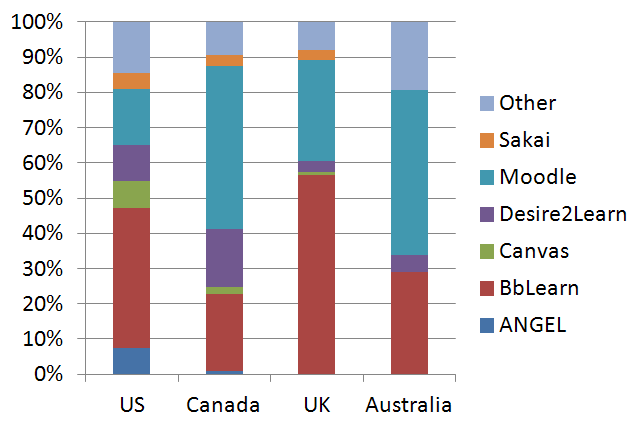
  • State of the Anglosphere’s Higher Education LMS Market: 2013 Edition

    I shared the most recent graphic summarizing the LMS market in September 2012, and thanks to new data sources it’s time for an update. As with all previous versions, the 2005 – 2009 data points are based on the Campus Computing Project, and therefore is based on US adoption from non-profit institutions. This set of longitudinal data provides an anchor for the summary.

    What I’ve been attempting to do lately is to expand the market definition beyond the US. Last year I used some heuristics:

    LMS_MarketShare_20121018-Home

    (more…)

  • New data available for higher education LMS market

    Despite much talk about the demise of the LMS market, the end is nowhere in sight. Unlike many of the newer learning platform concepts (e.g. MOOCs, free platforms, unbundled learning platforms), the LMS market has an established business model and real revenues. Just today came news of an investment analysis report predicting that total LMS market (higher ed, corporate training, K-12) would triple in revenue by 2018, moving from $2.6B to $7.8B. The LMS ain’t sexy, but it’s still important.

    global_LMS_stacked_by_typeThis is why I have found it surprising how long it is taking to move from survey-based and anecdotal market information to harder data directly measured by the actual LMS implementations. Until recently, that is, when there are at least two very useful sites available.


    Edutechnica

    George Kroner, a former engineer at Blackboard who now works for University of Maryland University College (UMUC), has developed what may be the most thorough measurement of LMS adoption in higher education at Edutechnica (OK, he’s better at coding and analysis than site naming). This side project (not affiliated with UMUC) started two months ago based on George’s ambition to unite various learning communities with better data. He said that he was inspired by the Campus Computing Project (CCP) and that Edutechnica should be seen as complementary to the CCP.

    (more…)

  • What does Devlin Daley’s departure mean for Instructure?

    Despite all the media hype on MOOCs over the past two years, perhaps the most important recent market entry for ed tech has been Canvas, the LMS from Instructure. Instructure was founded in 2008 by Brian Whitmer and Devlin Daley. At the time Brian and Devlin were graduate students at BYU who had just taken a class taught by Josh Coates, where their assignment was to come up with a product and business model to address a specific challenge. Brian and Devlin chose the LMS market based on the poor designs and older architectures dominating the market. This design led to the founding of Instructure, with Josh eventually providing seed funding and becoming CEO by 2010.

    Michael covered the burst of news in January 2011 that served as the launch of Canvas.

    Instructure has just announced that they will be releasing an open source version of their Canvas LMS product. Between this announcement, the winning of the Utah Education Network contract (109,000 college students and 40,000 K12 students), and the oh-so-ever-brief lawsuit by Desire2Learn about that win, Instructure has been making quite a splash lately.

    Since that time Instructure has grown to 7M+ users, 500 customers and 240 employees while raising $50M in total VC funding. With that much early success, it was a surprise to see Devlin Daley leave the company as of last week with his Douglas Adams reference. (more…)

  • Ray Henderson Update

    As e-Literate readers know, Ray Henderson is no longer President of Learning Platforms and is now serving on the company’s Board of Directors instead. This sort of thing naturally sets of all sorts of concerns and speculation. I had the good fortune to be able to speak with Ray today and have some details straight from the horse’s mouth.

    First, he made it clear that this change was initiated by him rather than the company, and it was for reasons unrelated to Blackboard politics or direction. A lot of people don’t know that Ray’s family still lives in Indianapolis; both his kids and his parents are half a country away when  he is at Blackboard headquarters in Washington D.C. Euphemisms aside, when he told me that he needed to spend more time with his family, I believed him. I also believed him when he told me that both Blackboard CEO Jay Bhatt and company owners Providence Equity Partners have been working hard to find alternative arrangements that would keep him involved with Blackboard in a meaningful way. Ray made it clear that he will continue to be a very active participant in Blackboard product planning, albeit now in a non-operational role. Boards on Private Equity-owned companies are different from those in publicly traded ones in that way; it is not abnormal for a member of the Board of a PE-owned company to be actively involved in decision-making on a focused and part-time basis.

    Ray used a lot of the first person plural pronoun—we—when talking about Blackboard’s work going forward. I didn’t get any less of a sense of enthusiasm for what the company is doing than I did when I spoke with him a few weeks ago. I believe he will continue to have meaningful involvement with the company. Whether the new executives being brought in will perform well remains to be seen, but if they have the benefit of Ray’s perspective and experience in the strange market that is higher education, then parts of his job that he will no longer be doing are easier for a seasoned technology executive from another industry to take on and do well. (In fact, in some cases those parts may be better managed by more of an operational specialist.) There’s no question that Ray’s reduced involvement is a loss for Blackboard, but it’s being mitigated and, most importantly, it’s not an indicator that executive management failed to recognize the substantial improvements in the company that have taken place on his watch.

    Beyond that, we can make some reasonable guesses about what Ray’s future might look like. In addition to a continuing part-time commitment to Blackboard, I wouldn’t be surprised to see him involved in due diligence evaluations for Providence when they consider acquiring ed tech companies. Nor would I be surprised to see him involved with other ed tech companies. He mentioned, for example, that he is on the Board of In The Telling. Ray is still a fairly young guy and seems as fired up as ever about education and entrepreneurialism. I doubt that he is going to fade away any time soon.