
e-Literate

Present is Prologue

Category: LMS & Learning Platforms

Everything you want to know about Learning Management Systems and whatever comes after them.


  • Instructure Steps Up for Open Education

    Friday evening, I wrote in a blog post:

    If you are a large for-profit education company—say, an LMS vendor or a textbook company—give $5,000 to the DS106 Kickstarter project. At that level of contribution, in addition to all the benefits of the lower levels, you’ll get a mention as doing a really swell thing on the fabulous e-Literate weblog.

    I’m thrilled to say that it took Instructure less than 24 hours to step up to the plate:
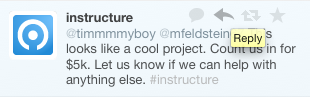
    That is just spectacular. We should all take note of a company that did not hesitate when presented with an opportunity to help out a great grassroots open education project. I very much hope that other education companies will step up to the plate.

    There are a couple of things that I think are particularly praiseworthy about DS106. First, it’s  a course that teaches digital literacy in a way that has proven effective and inspiring for a wide range of students. That’s huge and much needed in and of itself. But I also think that the course presents a replicable model for doing open education on a wide range of topics on a small budget, while teaching students some basic digital literacy through its very structure. Even if the course subject isn’t something like digital storytelling, the DS106 model has each student set up her own blog and participate in a distributed community. If you think that is an unreasonably high barrier, then you probably haven’t set up a blog recently. Having students set up their own web sites, understand how they work at a basic level, and learn what it is like to have a digital space of their own is a good and appropriate set of educational goals for an incredibly broad range of learners.

    You may wonder why making a contribution would be worthwhile, given that the project has already well exceeded its initial funding goal. If you’d like to get a sense of what the DS106 organizers may do with the extra cash, then read Jim’s post about it, including the comments. For me, a common theme jumps out that I find very exciting, and that theme is about making the DS106 model easier and more accessible to a wider range of students and teachers—developing WordPress plugins that make course setup simpler, developing a languages course using the same teaching model, and so on. I would very much like to see a community grow around helping to spread this model, test its limits, and make it more accessible to people who want to do open education across a wide range of subjects.

    That’s why I’m hoping that folks like Ray Henderson, John Baker, Adrian Sannier, and others with significant budgets will step up and add further funding to this project. And, of course, you don’t have to be a captain of industry to make a contribution. You can contribute whatever money you think you can spare as an individual. Remember, DS106 achieved its initial funding goal in less than 24 hours, before Instructure stepped up. Individuals making $5 and $25 contributions did that. Your contribution matters. In fact, one of the lessons of DS106 in general is that you don’t have to have deep pockets and an enterprise IT infrastructure to make a big impact in education. To the degree that large contributors like Instructure are stepping up, it is because they are following your lead. Before smARThistory was “acquired” by Khan Academy, it was funded by contributors like you in a Kickstarter project.

  • Blackboard Confronts Erosion of Market Share, Makes a Major Change in Strategy

    In a series of announcements that has the educational technology world buzzing, Blackboard reversed their strategy of their core LMS business.

    Most of the discussion in articles and blogs follows the meme of Blackboard entering open source, or even the meme of Blackboard acquiring competitors. I think the news is more significant than either of these two memes.

    Blackboard just did a 180-degree turn on their strategy for their core LMS business. They have moved from consolidating all customers into Learn 9.1 to providing products and services that are almost LMS-agnostic. As Dr. Chuck described:

    The notion that we will somehow find the “one true LMS” that will solve all problems is simply crazy talk and has been for quite some time.

    There is another aspect to this story not described in yesterday’s press releases and the associated articles and blogs. This is the first public strategic decision by Blackboard since they were acquired by Providence Equity Partners. I suspect that if you take all four of Blackboard’s announcements within the context of the private equity ownership, the underlying strategy and rationale make much more sense.

    (more…)

  • GoodSemester: Not an LMS, but a Learning Platform

    A while back here on e-Literate, Phil wrote a post called Farewell to the Enterprise LMS, Greetings to the Learning Platform. In it, he wrote,

    In my opinion, when we look back on market changes, 2011 will stand out as the year when the LMS market passed the point of no return and changed forever. What we are now seeing are some real signs of what the future market will look like, and the actual definition of the market is changing. We are going from an enterprise LMS market to a learning platform market.

    What I mean by ‘enterprise LMS’ is the legacy model of the LMS as a smaller, academically-facing version of the ERP. This model was based on monolithic, full-featured software systems that could be hosted on-site or by a managed hosting provider. A ‘learning platform’, by contrast, does not contain all the features in itself and is based on cloud computing – multi-tenant, software as a service (SaaS).

    There tends to be a pendulum swings in technology. In the old days, there were dumb terminals, with all the business logic residing on the mainframe. Then came the PC revolution, pushing functionality out to the edges of the network. Next came the internet, driving functionality back to the server. And now we have apps. Similarly, in educational technology, we started with a few tools, moved to an all-in-one, all-you-can-eat LMS model, and now are moving back toward more specialized systems. And one of the questions platform developers and teachers a like are asking is how much functionality do you really need? Is it just WordPress? Is it WordPress plus Google Docs? Is it WordPress, Google Docs, and grade book? Is it a simple LMS with only a handful of tools and an app store? There are lots of different models.

    Enter GoodSemester, which has its own take on…well…just about everything. I had a chance to talk to company founder Jason Rappaport a while back about both the product and the company.

    (more…)

  • Guest Blog at WCET: Institutional Decision-Making and Changing LMS Market

    Today I had a guest post at WCET’s blog. WCET is a great organization that “accelerates the adoption of effective practices and policies, advancing excellence in technology-enhanced teaching and learning in higher education”. They have been leaders in sharing best practices for online education, including taking a leading role on explaining State Authorization regulations as well as others. You can read the full post here.

    The topic of the post is how the changing LMS / Learning Platform market is, or should be, changing institutional decision-making.

    We have seen a great deal of change in the higher education Learning Management System (LMS) market over the past year, as has been described in several blog posts. One of the biggest changes to the market that I’ve noticed is that we seem to be moving from an enterprise LMS market, with full-featured monolithic systems, into a learning platform market, with many cloud-based platforms that don’t attempt to have all the features in one system.

    As Ritchie Boyd has described, the WCET LMS Common Interest Group (CIG) is recasting itself this year as “the ‘Beyond the LMS’ Common Interest Group. The idea is to not ignore the LMS, but rather to acknowledge that there is so much more going on in the broader academic technology ecosystems and their impact on our campuses, and that much of this activity often includes or is enveloped by the formal LMS.”

    In last year’s WCET-sponsored Managing Online Education survey, 47% of respondents indicated they are reviewing their LMS strategy and 27% are planning to change LMS within 2 years. A key question arises, however, about how institutions should adapt their technology decision-making processes based on these market changes. It’s all well and good for the market to change and provide more choices and new approaches, but how should schools decide which system(s) best fit their specific academic and administrative needs? The emergence of new, often free, cloud-based learning platforms may require changes to our decision-making.

    (more…)

  • LoudCloud Systems Announces Adaptive LMS General Release

    One of the trends that I’ve been tracking in the LMS market is a move away from the monolithic, all-things-to-everyone enterprise LMS solution. There are several different approaches challenging this model, but the general theme is that the ed tech market needs more flexible, targeted approaches to directly support teaching and learning needs.

    The news today is that LoudCloud Systems is officially announcing their LMS solution’s entry into the general higher education and K-12 markets as described in a Campus Technology article. In this announcement, LoudCloud promises what they describe as the “first fully adaptive and configurable Learning Management Systems for Higher Education and K12”. While I cannot judge yet how successful this vendor will be with their strategy, I think the announcement is significant for the LMS market for two reasons.

    • LoudCloud appears to be providing the first disaggregated LMS on the commercial market; and
    • The system has an integrated analytics engine that supports personalized content delivery.

    (more…)

  • Farewell to the Enterprise LMS, Greetings to the Learning Platform

    Along with others, I have written several times over the past 12 months here, here, here and here about the significant changes occurring in the educational LMS market. In my opinion, when we look back on market changes, 2011 will stand out as the year when the LMS market passed the point of no return and changed forever. What we are now seeing are some real signs of what the future market will look like, and the actual definition of the market is changing. We are going from an enterprise LMS market to a learning platform market.

    What I mean by ‘enterprise LMS’ is the legacy model of the LMS as a smaller, academically-facing version of the ERP. This model was based on monolithic, full-featured software systems that could be hosted on-site or by a managed hosting provider. A ‘learning platform’, by contrast, does not contain all the features in itself and is based on cloud computing – multi-tenant, software as a service (SaaS).

    The 2011 EDUCAUSE event captured the zeitgeist of the changes, as it seemed most of the buzz at the conference centered on new LMS solutions and paradigm changes. Instructure made their debut at the conference, Pearson’s OpenClass was announced, Blackboard announced a new move in open content focused on CourseSites, and Cengage demonstrated their MindTap platform. Rather than slowing since EDUCAUSE, we have seen several additional announcements in the past three months.

    (more…)

  • Instructure Makes Its Move into the K-12 Market

    The learning management system upstart Instructure is unveiling Canvas K-12 today, a version of its platform aimed — as the name suggests — for the K-12 level. The company says that it’s already had over a dozen school districts adopt Canvas, even before this roll-out of a specially designed LMS.

    Traditionally the LMS has been something implemented primarily by colleges and universities, but as more and more K-12 schools move to online learning and digital curriculum, there’s a growing demand at that level. It’s a hot market, and according to research published in December 2011 by Simba Information, “the LMS segment is expected to grow at a compound annual rate of 7.3%, reaching $377 million by the 2014-2015 school year.”

    As such, it’s hardly surprising to see some of the big education companies make their move to offer schools these services. The acquisition of Edline by Blackboard last fall made it clear that the learning management giant was serious about its push into that market.

    But as the Simba research suggests, it’s a market that’s still up for grabs. While Blackboard still holds a little over half of the higher ed LMS market, Blackboard, Pearson and Moodle altogether share only about 30% of the K-12 market.

    That provides an interesting opportunity for Instructure, which officially launched its cloud-based LMS this time last year.

    (more…)