e-Literate

Present is Prologue

Category: Ed Tech

The “Ed Tech” category includes posts about educational technology products themselves, including LMSs and other learning platforms, adaptive learning and other digital curricular materials products, learning analytics, and educational apps of all types. It also includes technical aspects of ed tech products, especially interoperability.

  • Engageli: First Look at a Zoom Educational Alternative

    I usually don’t write product reviews anymore unless they give me a reason to write about a larger trend or issue. This is one of those cases. Engageli is a new product that, at this moment in time, is inevitably going to be talked about as a Zoom alternative for synchronous education. And it is that. But it also represents more than that. In a recent post, I wrote about the idea of digital residential education. Pre-COVID, most online education was designed specifically for people for whom residential education is not appropriate. People who couldn’t afford the time and money required to spend every day full-time on a physical campus, and in many cases actually live on it. COVID has forced us to broaden our perspective. We find ourselves finally beginning to truly examine the subtle and invisible magic that can be created simply by putting groups of humans in close physical proximity for extended periods of time. What is it about residential education that facilitates rich learning experiences and to what extent can we recapture that magic online?

    Our exploration is starting with Zoom simply because many of us, as well as many of our children and students, are spending huge portions of our day on it. Zoom is a great product. It was designed to facilitate online business meetings. In many respects, it is the best web conferencing application I have ever used. Over time, it was adapted for use in large-audience webinars. For that purpose, it’s…fine. If your goal is to reproduce a typical conference session experience, with a speaker or a panel that do most of the talking and some limited audience interaction, it works quite well. But the more you try to use it to facilitate fluid and interactive sessions, the harder it becomes. For example, I generally don’t attempt breakout groups on a Zoom webinar unless I have a dedicated helper to manage the logistics.

    Classroom interactions tend to be even more fluid than the most interactive webinar. Even in a lecture hall with hundreds of students, a decent instructor will foster levels of class participation that can be cumbersome to recreate in Zoom. If your goal is to create an active learning experience, with lots of group work, very high student participation, and fluid movement of students in and out of various sized groups that the instructor sometimes improvises in the moment, Zoom is a nightmare. Can some instructors use it this way? Yes. But it’s a high-wire act. Zoom simply wasn’t designed with that kind of organic social fluidity in mind.

    Enter Engageli, which is very specifically designed to support that kind of organic and ever-changing conversational structures in a well-facilitated class, while also accommodating the crazy mix of some students who are physically in the classroom and others who are remote. In my view, it represents a big step forward. And it also reflects the current boundaries of our thinking the digital residential experience.

    Cutting-edge in-person active learning spaces

    To get a sense of the kind classroom setting that Engageli is trying to create virtually, it might help to first look at a cutting-edge example that is firmly grounded in the physical world.

    A few years ago, Phil Hill and I had the pleasure of visiting the Steelcase headquarters and design showcase in Grand Rapids, Michigan. While I can’t say that such a trip had previously been on my bucket list, the visit was fascinating. First, we saw an instrumented research room where the company studied an instructor teaching active learning classes. The room was relatively square, with one table sticking out length-wise from each corner toward the center. Six or seven students would work at each of the four tables. The instructor had a whiteboard but also had a stool with wheels on it. He would often sit in the center of the room, listening to the four groups. Sometimes he would scoot over on his stool to one table or another. Other times he would get the class’s attention and show them something on the whiteboard. With the tables at that angle, the instructor could see all of the students, and they could all see him. It led to highly flexible, social, and improvisational classes. Steelcase filmed these natural interactions and studied them in detail.

    Then the company designed a product line to support this kind of educational interaction. It’s called media:scape. In the demonstration room they showed us, there were once again four tables—one in each corner of the room. But these tables had big video screens on the ends closest to the corners of the room.

    A media:scape table

    Each seat had a puck where a student could plug in a laptop.

    Media puck

    Notice the buttons on the puck above. Students could project their laptop screen onto the group video by pressing a button. The group could dynamically switch among their laptops as needed.

    As in the research room, the teacher’s default position was in the center of the room. But in addition to a stool with wheels, she also had a pedestal with some controls on it. She could project her laptop onto wall or, alternatively, she could also project the screen from one of the groups onto a wall. There were also smart white boards that captured everything that was written or drawn on them.

    When I saw the demonstration room my first thought was, “If I could teach in a room like this, it would completely change the way I teach. I could do everything that I tried and failed to do with group work in the past, plus a lot more.”

    My second thought was, “Wow, I would be nervous about trying to teach in this room. I don’t think I could just transplant my existing teaching practices and evolve them over time. Not only would I want to teach completely differently; I would have to. And I’d have to learn all the technology. And teach my students. And hope that all the hardware and software worked. If it went well, it would be a dream. But if it went poorly, it would be a nightmare.”

    And then my third thought was, “This system is hideously expensive and probably impractical for most colleges that aren’t building entire new buildings that could be designed to accommodate it. You’d need to have rooms that are the right shape and size. Those rooms would have to be wired for power and connectivity in the right ways and places. You’d have to buy a lot of expensive furniture and tech. And you could only teach a maximum of twenty students in that class.”

    But what if you could offer that rich active learning environment without having to design whole buildings to accommodate it? What if you could make it work in any room that has tables? And scale it to as many groups as you need? And accommodate students who are online, in person, or both? What if a system could do all that while being easy to learn and allowing educators to use their existing pedagogical approach, adapting and improving their teaching practices over time as they grow more confident in the new system?

    This, in essence, is what Engageli aspires to do.

    Table talk

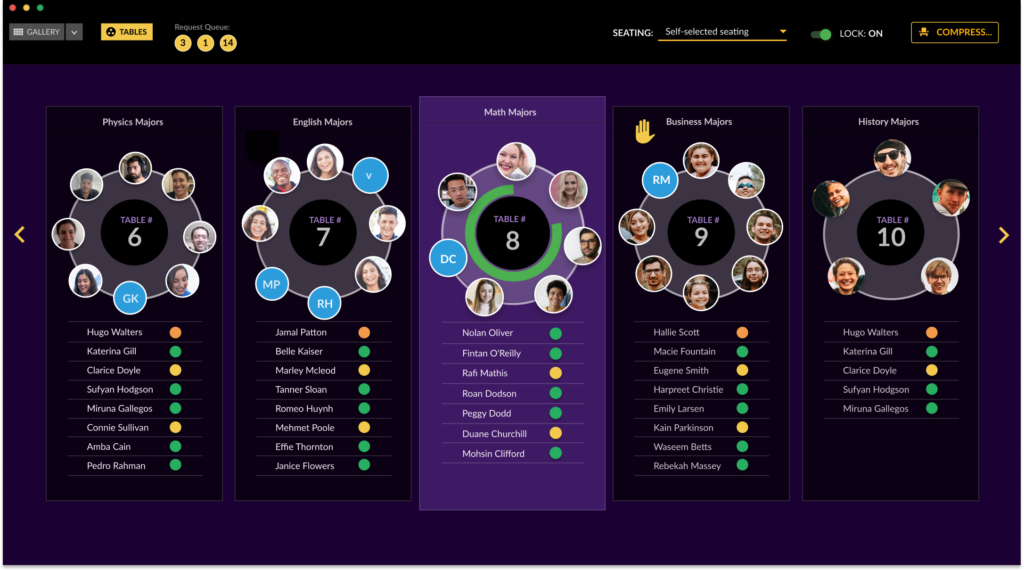
    The fundamental metaphor of Engageli is a room of students working at small tables with up to eight students each.
    Engageli tables

    Just stop for a second. Look at the picture above. At first blush, do you get a rough sense of how your room is set up? Do the indicators and buttons seem clear and intuitive to you? One of the first emotions I experienced upon seeing Engageli was shock. I couldn’t believe how intuitive it looked.

    Beyond the visuals, the functionality is also designed to closely mimic the flexibility of a live classroom with students sitting around tables. Students can talk to their table group, tuning out the conversations going on at the others. The instructor can “move” from table to table.

    In theory, this works a lot like breakout rooms in traditional web conferencing software. For example, a table view can feel a lot like a breakout room.
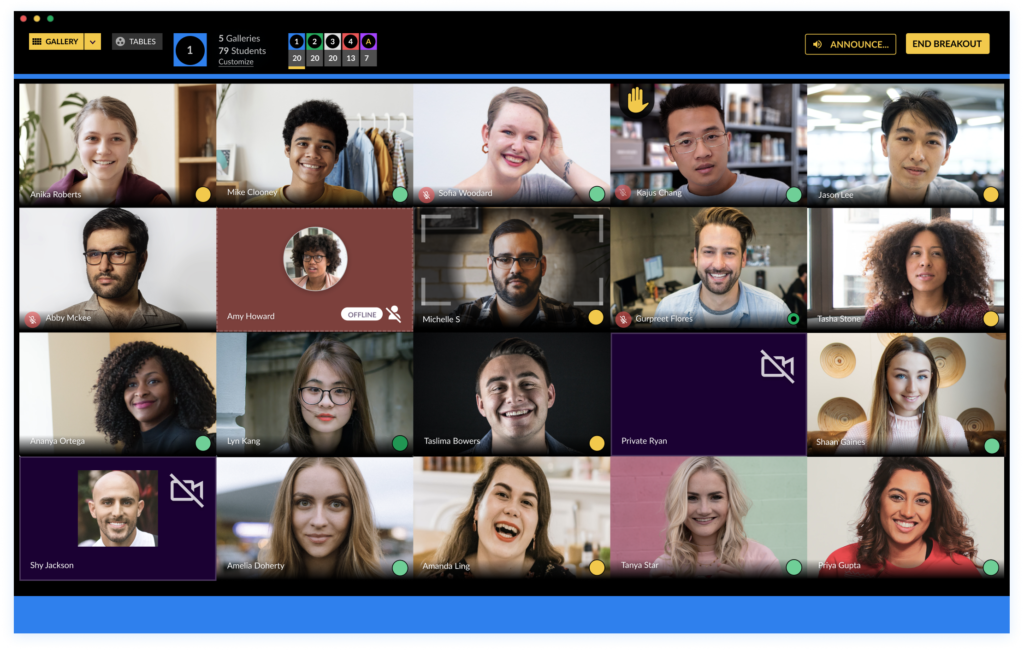
    Table talk

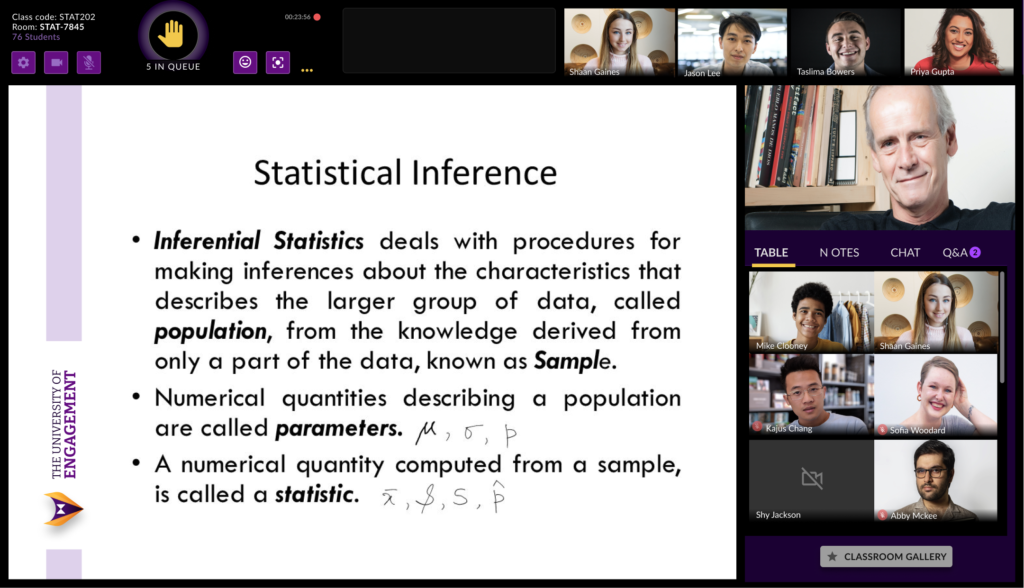
    In practice, it feels simpler and more natural. For example, when the instructor addresses the whole class, students don’t leave their tables the way they would leave breakout rooms in a web conferencing product. They still have access to their group while they are listening.
    At your table, in the class

    In a refreshing improvement on real life, students can mute the sound from their table mates if they want to focus on what the instructor is saying.

    Starting and ending table group work sessions (which, in a holdover from web conferencing terminology, Engageli appears to call “breakouts”) is easy, as is accessing a range of tools that one would normally expect to have in a well-appointed classroom, like a projector, a white board, a polling tool, and so on.
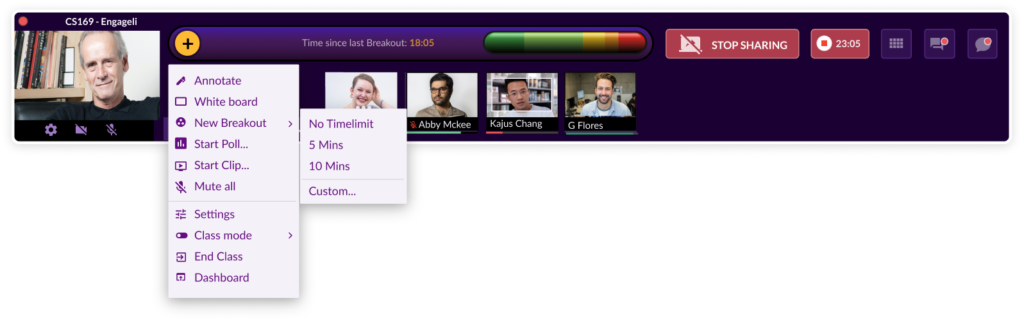
    A well-appointed classroom

    Reading the room

    One of the affordances of in-person classroom group work is that, in addition to visiting tables and listening in, an educator can scan the room to see which tables look like they might need some attention. If half the students at a table are looking down at their phones rather than talking to each other, the instructor can walk over to that table and bring everyone’s attention back to the work. Engageli attempts to replicate that experience with engagement analytics. Algorithms running on the student video can detect situations where students might be drifting.

    This is tricky to get right. Many instructors who would be most enthusiastic about this kind of active learning environment also tend to be extremely wary of technology that they perceive as student surveillance. The COVID-driven growth in usage of proctoring software and its inevitable backlash is only increasing that concern in some quarters.

    Engageli has tried to address this concern. For example, they do not store the video of student groups. The platform attempts to approximate those real-time attention signals that educators get in a physical class…and then go no further.

    That said, I did not see this capability in action in my demo from Engageli CEO Dan Avida. While I think Engageli has the right general approach, this particular feature set will be tough to get right.

    Glitches in the matrix, equity, and blind spots

    Another nice feature about face-to-face experience that I personally would appreciate in a digital environment is that, in a real classroom, people don’t freeze for thirty seconds. Also, their lip movements are in sync with the sounds of their voices. Engageli makes a point of emphasizing how hard they’ve worked to minimize the bandwidth required for the product and to ensure it will run on old or underpowered machines. All the video streams are combined into one on the server side in order to reduce the bandwidth streaming down to the students’ laptops as much as possible. The product runs entirely in the Chrome browser, requiring no downloads (which, conveniently, also makes it well suited for the Chromebooks that are so popular in K12).

    Dan Avida presented these features as equity-minded. He is right to do so. Access to computers and broadband internet are huge equity issues right now. Somewhat more problematic is their feature to have the software automatically place students in groups that maximize diversity. While I applaud the intention, there are a few problems with this idea. First, in order to pull it off, Engageli needs access to data inside the school or college’s Student Information System that some would consider to be sensitive personal information. Second and relatedly, doing so would require data integration with the Student Information System. In higher education, this IT system is often run by an entirely different group than the one that runs the LMS. They rarely make decisions to integrate with anything lightly or easily (or quickly). So just getting this integration approved by the appropriate administrators will be challenging in many cases. And finally, I think there will—and should—be some questions about how the Engageli algorithm defines diversity.

    As Dan pointed out to me in an interview, institutions don’t have to provide the data necessary to enable this feature. They can skip it. I predict that most will indeed pass on it.

    I’ll have more to say about the promise and perils of data analytics in these sorts of systems in the next section of this post. But before I do, I want to explore the data SIS integration challenge as diagnostic of the company’s potential blind spots. Another area where I saw a minor warning sign was in our discussion of single sign-on. Dan mentioned that students could use a consumer log-in like a Google account to get into their Engageli classroom or, if need be, Engageli would integrate with whatever enterprise single sign-on product the institution uses. He notably did not mention the IMS LTI standard. Most faculty will tend to create their front door to a virtual classroom product like Engageli through their LMS course site using LTI.

    To be clear, this is not a complex standard to implement, particularly for a team that has solved the kind of difficult technical problems that Engageli has already solved. Rather, my point is that the current Engageli team doesn’t seem well versed in institutional EdTech—the standards, norms, and politics. A blind spot involving something like LTI is easily corrected. On the other hand, a blind spot regarding use of student data could be a bigger deal.

    I am confident that the Engageli team is thoughtful and knowledgeable about security and privacy. I am less confident that they are well versed in the tricky education-specific sensitivities regarding the balance between supporting student privacy and supporting student success in the collection and use of data.

    Engagement is not ambitious enough

    I predict that many educators who have been frustrated with their synchronous teaching experiences will love the product. It has the feel of a virtual classroom designed by a parent and teacher trying to create the environment that they would want for their children (as opposed to ClassEdu, which has the feel of something designed by a parent and former CEO of an LMS company circa 2005 trying to create the environment that he would want for his children).

    But I worry that Engageli’s aspirations may currently be limited to a goal of replicating face-to-face classroom affordances with modest improvements. This limitation may be driven by a lack of depth of experience in the company regarding both institutional challenges and current educational research on using data to improve collaborative learning. I think they can do more. I also think that we, as a sector, must aspire to do more.

    For example, as I have learned from my friend and colleague Susan Baldridge (who, by the way, will be the featured guest in this week’s Blursday Social with e-Literate LIVE!) has helped me to understand that the health of some residential colleges could be substantially improved if they could manage to double the size of humanities seminars (starting with writing classes) without hurting their quality. As I have written before, the financial pressure on many universities, which COVID has massively accelerated and exacerbated, leads to a grim chain of financial logic:

    • Many US colleges and universities will need to trim their budgets somewhere between 20% and 40% in the next one to three years.
    • Salary and benefits typically account for between 60% and 80% of the average college or university budget. This means that without new revenue, institutions can’t balance their budgets without cutting some people.
    • Of the percentage of the budget that represents human costs, about 60% of those costs are for faculty. So it will be hard to meet budgetary constraints without cutting faculty.

    So where will these cuts come from? Well, STEM programs tend to generate grant money, so they will be relatively safer in many institutions. Social sciences are financially efficient, by which I mean that they are often taught with larger class sizes. The disciplines that cost the most per student to run while bringing in the least amount of non-tuition money per student are often the humanities, where the pedagogy requires small class sizes in order to be taught with quality. Therefore, universities that could increase the average humanities class size from, say, 20 students to 40 or 50 without harming quality could preserve both faculty jobs and the integrity of the institution’s academic mission. It’s not a silver bullet, but it could make a big difference for some institutions.

    Engageli is an example of a tool that could aspire to help meet that kind of challenge, but only if they raise their goals beyond classroom engagement. Anyone who has taught using lots of group work can tell you that it is easily possible to have groups of highly engaged students who are also completely unproductive. This is true in the workplace too; constructive collaboration is a critical 21st-Century skill.

    There is research, and there are tools, that help to facilitate better collaboration. Riff Analytics is a good example of a solid, research-based tool to improve synchronous collaboration. During meetings, it provides collaborators in group work with real-time feedback based on their interactions.
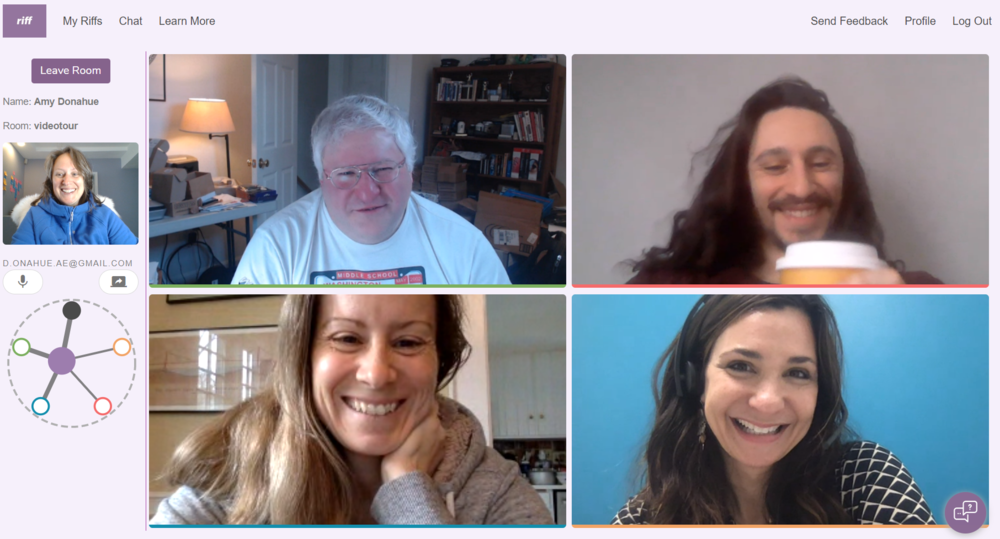
    Browser
    Riff video feedback.

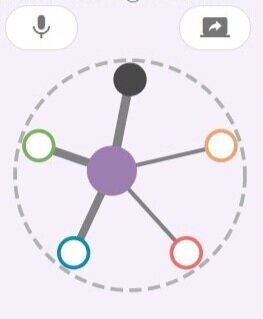
    The ball in the bottom left is called a “meeting mediator.”
    Browser
    Riff meeting mediator

    Here’s Riff’s description of that feedback tool:

    The meeting mediator measures the most recent five minutes of a conversation. When the center ball is closer to a participant node, it indicates that the participant has spoken more than others in the group. The thickness of the line also indicates conversational dominance, and acts as a secondary measurement.

    An additional metric of conversational energy (the amount of times participants take turns) is indicated by the color of the central node. Darker purple represents more turn taking, and a more dynamic exchange of ideas. A lighter shade represents fewer turns between participants.

    https://riffanalytics.ai/faqs/

    In other words, it’s an easy-to-read, real-time indicator of whether people are listening to each other or just letting one or two people dominate the conversation.

    After the meeting, students get feedback on their productive (or unproductive) meeting behaviors.
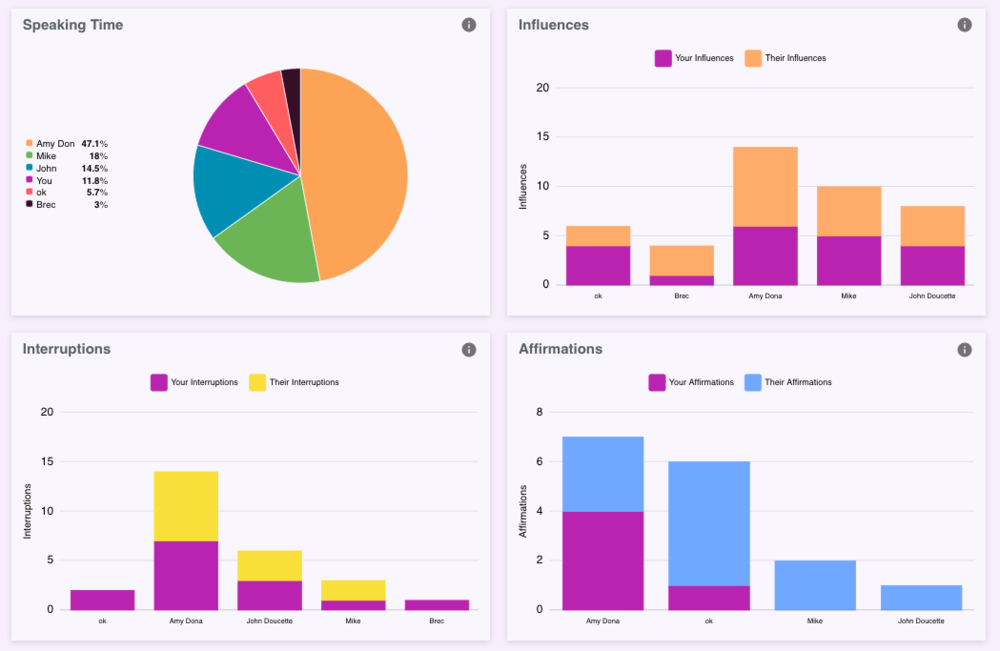
    Riff Dashboard

    Students can drill into important speech acts that contribute to both productivity and equity, such as the number of affirmations they gave or the number of times they interrupted somebody in the group.
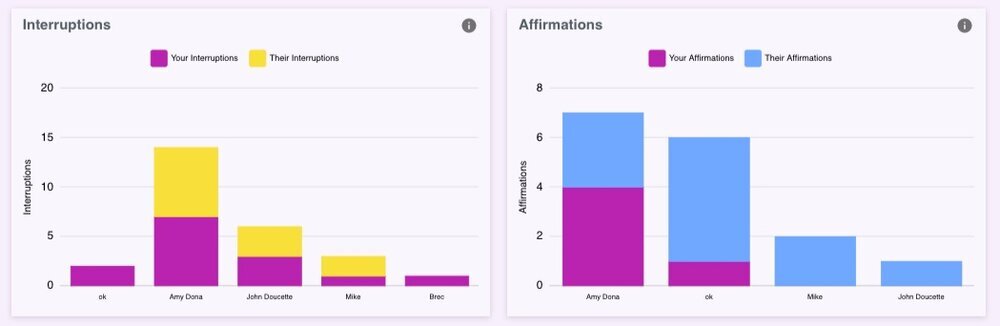
    Affirmations and interruptions

    I find Riff’s approach to be attractive in several ways. First, it goes beyond trying to replicate the best collaborative classroom environment and actually provides feedback on relevant collaborative behaviors. This is exactly the kind of feedback that is necessary to make collaborative learning more consistently effective and easily scalable to larger groups. Second, their feedback is student-facing rather than educator-facing. Uses of data that are for the students and that provide immediate feedback on their performance are generally both less sensitive from a privacy perspective and more educationally potent. And finally, they are researchers in the field. Their product is informed by learning science as well as data science.

    Meanwhile, the concern about accuracy that usually comes up about automated feedback is somewhat mitigated in this case because the machine is not telling students whether they have given “right” or “wrong” answers. It’s just telling the students, “Hey, y’all seem to be talking over each other a lot” (for example). I’m not suggesting that this approach is danger-free, but it tends to be lower stakes than other kinds of algorithmically-driven student feedback.

    I have no doubt that Engageli’s data science team is good and can do some really interesting work. But somebody has to point them in the right direction. The company will only be able to do that by broadening out the breadth of experience on its team as it grows. One of the common criticism of Coursera among educators already working in online learning is that the company gave the appearance of being relatively ignorant of the broad and deep body of existing research and experience in the field. I would hate to see Engageli repeat that mistake.

    Summing it up

    Based on the one working demo I saw, I’m impressed with Engageli. Particularly for a first version, it seems full-featured and intuitively, worked seamlessly, and showed sensitivity to the kind of fluid human interactions that are necessary in lively, student-centered class.

    But these are super star founders. Dan Avida and his wife Daphne Koller both have stellar track records. My expectations are high.

    As I would say to talented students in the kind of course I would love to teach in Engageli, “This is an excellent first draft, Group 2. I look forward to seeing how much you can improve it in the next draft.”


  • Digital Residential Education

    Digital Residential Education

    In a recent blog post, I argued that structural changes—the lasting effects of COVID and the acceleration of ubiquitous broadband—would mean that some of the shift to online will be permanent. I also argued that the marginal value of a residential campus experience will be challenged as students and their families consider just what they are getting for in return for the extra money required for a residential college experience.

    Today I want to add some more nuance to those claims. I don’t think that residential education is going to disappear except for elite universities. Nor do I think that we’re going to see the long-predicted Great Unbundling. Some residential colleges will fold or go online. There will be some unbundling. There will be some downward price pressure. But one of the most profound changes may be the re-imagining of what it means to have residential education experience in a digitally enabled world. There have already been some experiments in this direction, such as the Minerva Project. But I don’t think Minerva will be the dominant model. In fact, I’m not sure that there will be any one dominant model. Rather, I think we’re going to see a growth in various forms of blended and low-residency educational experiences, where colleges use various means to create that magic of connectedness which we tend to romanticize as coming-of-age experiences but which really are intimately related to the ways in which people learn, grow, and succeed.

    As part of my preparation for this week’s Blursday Social, I’ve been binge-listening to Jeff Young’s fantastic Pandemic Campus Diaries podcast series. Rather than giving a top-down picture of what’s happening on campuses through surveys and aggregate data, or a one-off article of anecdata from a handful of individual interviews, Jeff views the rolling crisis from the middle distance. He has asked five professors and five students on different campuses to maintain audio diaries of their experiences as the semester unfolds. The group is diverse in just about every way that you would want them to be, from backgrounds to attitudes to campus contexts and COVID policies. He weaves snippets from these diaries into thematic episodes, peppered with occasional commentary by an expert or interview with a relevant vendor or campus administrator. The result is at once both intimate and textured. We get a glimpse of just how complex it is to make generalizations about the ground truths in education.

    And given that the participants are living through a diverse mix of on-campus and online college experiences, it’s also a great laboratory for examining what residential education actually is, what value it offers, and how it is already beginning to evolve during this period of forced digitization.

    Connections and serendipity

    One of the most memorable visuals in Jeff’s audio story is a description of a dorm hallway in which students have posted their social media handles on their dorm room doors. When I was in college in the 1980s, the whiteboards on dorm room doors were a way of sending messages to people who were out. They were our text messaging tool. Today’s students have much richer and more organic means of socializing remotely. The idea of getting to know somebody who lives two doors down from you through communication on social media is not crazy. But it is weird. It’s not satisfying in quite the same ways. Humans have been socializing in physical groups for as long as there have been humans. We have a rich, subtle, and largely unconscious repertoire of tricks for adjusting the ways in which we socialize to meet the needs of the moment. And most of the time, we don’t even notice when we’re doing it.

    One of the students that Jeff captures describes an app that he and his friends are building to fill in one of those gaps. They noticed that most people don’t go to parties or bars alone. They go with a small group of friends. I was the kind of kid who never would have gone to a social event alone in college unless I knew most or all of the people who would be there. If I was venturing out into unknown social territory, I would only ever go with a few friends. The student in the interview described an app where students can form small groups of friends and then search for other small groups of friends to text message with. It’s almost like Tinder for small-group meet-ups. This is a great example of a social pattern that takes advantage of serendipity in the physical world. In the digital world, that kind of opportunity needs to be consciously created.

    This happens in classes too. Even an instructor who is a mediocre course designer can offer a decent experience to her students if she is available to them and a good communicator. If they need help, they will ask and she will provide it. And they can also find each other easily, get to know each other, and spontaneously form study groups. If those groups aren’t working for a student, she might ask around on her dorm floor to find somebody she knows who is good at the subject she’s struggling with and is willing to help her. Our capacity for improvisation as social beings occupying the same physical spaces can help people compensate for a multitude of shortcomings and challenges. And as a species, we’re wired to enjoy that kind of interaction. So one of the ways in which it helps is motivation (which is a topic that really starts to come through in the fourth episode of the podcast series).

    Most college experiences aren’t really designed to maximize connectedness (to the degree that they are designed at all). They don’t have to be. If you put enough humans together in the same space for long enough, they will tend to socialize. Or, to put it another way, they will tend to become socialized. They will integrate into a social group that is flexible and highly functional. How did Neanderthals bring down a wooly mammoth? With friends.

    In the new world we are entering, residential colleges that want to maintain their distinctive missions will have to re-imagine what a residential college experience means, blending the physical and the digital. That will require a lot of mindful observation and experimentation.

    Why do we think learning is a solo sport?

    The podcast episode that really drove the social home for me—believe it or not—was the one that tackled “cheating.” Jeff captured a number of experiences and perspectives on the problematic product categories of homework sites—particularly Chegg—and proctoring software. The instructors were worried about “academic integrity.” (I’m using scare quotes a lot here to indicate value-laden words or phrases that aren’t necessarily my own.) While they sympathized with students wanting help (in the case of the “cheating sites”) and feeling nervous about being surveilled by proctoring software, they felt a responsibility to make sure the students’ answers were their own. To his credit, Jeff interviewed (and pressed) representatives for both Chegg and Proctorio. The Proctorio representative had the good sense to express concern and sympathy for the student who said the proctoring software made her so nervous that it affected her performance on tests. The Chegg spokesperson (somewhat high-handedly) took the position that, if millions of students are using the platform all over the world, “then either cheating is a much bigger problem then we think, or that’s not what Chegg is designed to do.” The clear implication is that the spokesperson wants us to believe the latter explanation. But I’m more inclined to believe the former. I suspect that “cheating” is a much bigger problem than we think, in part because we have a very restrictive notion of acceptable social support for assignments.

    During the same episode, a student described struggling with an economics problem, not being able to reach the professor, and not being able to find anyone at various campus help and tutoring centers who could answer her problem. Interestingly, this problem wasn’t obviously COVID-related. She was stuck. Students in her position see Chegg and its competitors as their only option. Once you’re in one of those sites—which you may have gone to as a student because you were feeling a little desperate and unsupported—it’s a slippery slope. One big reason these sites exist is because instructors and their institutions have defined much academic work—particularly evaluation exercises—as a solo sport and have failed to provide students with the social support that they need. Because humans in general are so good at improvising together to work around problems, this issue isn’t obvious as a campus-wide problem except at heavily access-oriented institutions. But that doesn’t mean the problem isn’t there.

    In fact, I myself was (briefly) a human “cheating site” as an undergraduate. I went to Rutgers, which is strong state university with an academically diverse student population (though I suspect it may have been more academically diverse in the 1980s than it is now). A friend of mine asked me if I could help him take paper that had been previously written by one of his fraternity brothers for a film class and repurpose it for his philosophy of film class. I was torn. On one hand, I emphatically did not want to participate in the pre-internet essay mill economy. On the other hand, if I didn’t help my friend, he would either get somebody else to do it or submit the paper as is, with some tweaks around the edges. Either way, he would learn nothing.

    I told him that I would help him but only if he agreed to do it my way. I would not write one single word for him. We looked at the assignment prompt and the raw material of the essay from his fraternity brother. It happened to be about Mel Brooks movies, most of which my friend could quote line-for-line. I asked him for his thoughts about the answer to the prompt. It turns out that he had some. I painstakingly drew his thesis statement from him. Then I asked him what lines or scenes in the movies made him think the way he did. He had ready answers. With some prodding from me, he wrote his second paragraph. I then told him that he needed to write about the rest of his supporting evidence without my help.

    He said, “You mean, all I have to do is explain the parts of the movies that make me think this way?” He was absolutely incredulous. Essay writing wasn’t supposed to be that easy. It was supposed to be mysterious. Hard. Something he could never do. He was in a cul-de-sac that he couldn’t just study his way out of. Somebody had to help him get past a basic misconception. That somebody didn’t have to be his professor. It just had to be somebody who cared about his learning and had a modicum of skill at teaching writing. Somebody that he trusted to have his interest at heart. A capable peer.

    By the time he was finished, my friend had a complete draft with his own thesis statement, his own line of argument, and his own supporting evidence. While the final draft still had a handful of phrases and sentences from the original paper that he was ostensibly plagiarizing, he mostly wrote that paper himself. But not by himself. He “cheated.” And I helped him “cheat.”

    A couple of weeks later, he came to me, elated. He got a B. More importantly to him, he had earned a B. It belonged to him rather than to the fraternity brother whose paper he borrowed. And he knew it.

    The web of social learning in residential education is vast and varied. It is also largely invisible to professors and administrators.

    Solving for social

    Today husband-and-wife Coursera pioneers Daphne Koller and Dan Avida announced their new company Engageli, a product that promises to create a more social synchronous learning experience than conventional web conferencing platforms. The news comes hot on the heels of Blackboard co-founder Michael Chasen launching ClassEdu, an education-specific extension of Zoom. When multiple EdTech veterans suddenly jump into the same product category, that’s usually a sign that something is up.

    Remember my recent post about product/market fit: A good product is like a key in a lock, where the lock represents some unmet need of a coherent group of people who are willing to pay for a solution. If you don’t like an EdTech product category—homework sites or proctoring tools or LMSs or whatever—then ask yourself why it exists. Whose needs does it fill? What are those needs? And how does our current academic system fail to fulfill or even actively create those needs? Don’t be glib or lazy about seeking the answers to those questions, either. If you really want to understand, you have to get inside these people’s lives, as Jeff has done with his podcast series.

    Likewise, when you see a lot of activity by successful EdTech entrepreneurs, ask yourself what need they are seeing. In this case, don’t think as narrowly as “Zoom sucks.” Because it doesn’t. Zoom is everywhere because it is a good product—for meeting different social needs than those of the classroom. We are at the very beginning of our collective examination of the instinctive human magic that truly makes residential education special. It’s social.

    EdTech has mostly been moving in the opposite direction. It’s been about robot tutors in the sky working with solitary learners. Because we’ve somehow gotten the idea that a good college experience is getting together in one physical location…so that we can learn by ourselves. Anything else would be “cheating.”

    Residential college?

    Don’t get me wrong; we absolutely do need to get much better at helping learners become more effective in their self-study. But that’s not the whole answer. EdTech has been focused on how we can teach STEM classes to thousands of largely solitary learners in one shot. But the truth is that residential colleges will be more likely to save their missions and their finances if they can figure out how to transform humanities courses that can only be effectively taught to 20 students at a time and scale them with quality to 50 or 100 students at a time. We’re not going to get there in the near future solely—or even primarily—with adaptive learning and machines “reading” essays. We need to scale social learning. And if you extend that idea to the informal learning that happens on campus, which may or may not be course-related, and to building the purely social bonding that enables the purposeful social work to happen, we will be on the path to a digital residential college experience. How much of it will be online versus digitally-enhanced face-to-face is up for grabs. I doubt there is a single answer to that question.

    There is much work to be done.

    We’ll be chatting about this line of thinking with Jeff—and each other—at the Blursday social on October 15th at 4 PM ET. RSVP here.

  • Online Learning Student Experience is the New Climbing Wall

    Online Learning Student Experience is the New Climbing Wall

    In my last post, I argued there are three factors that will permanently drive residential colleges toward more online and hybrid programs:

    1. Value questions: COVID-19 may finally bring about the long-predicted “unbundling” and “rebundling” of the university. As many colleges and universities with annual price tags of $40K, $50K, or even $60K go online, students and parents alike are having their attention called to exactly what the residential experience adds and how much they are willing to pay for it. While I’m not predicting the death of the residential college, I do think we are entering a new era in terms of how students think about what they want from their college education and how much they are willing to pay for it.
    2. Missing the window for the traditional educational experience: While we don’t have good data yet on deferral rates, the Boston Globe reported four weeks ago that Harvard University is reporting a 20% deferral rate this year, and other numbers I’ve heard anecdotally tend to range between 10% and 20% deferrals. Not all of those students will come back, either to the university they applied to or to full-time college in general. Some will need to get jobs. Some will start their own companies. Life will move on. Their ability to invest four full-time years of their lives and $100K or more on an undergraduate education will diminish. Some will miss their window. This change, in turn, will force many colleges and universities to make permanent changes that were inevitable—though they may have felt somewhat distant—due to demographic changes, changes in the economy, and other sustainability challenges.
    3. Deteriorating university finances and the drive for post-traditional students: Even as fewer students may attend full-time college straight out of high school, more will need continuing education throughout their careers to stay employable or advance in their careers. This COVID-accelerated trend coincides with the COVID-accelerated trend of deteriorating university finances. Institutions will increasingly need to meet working students where they are.

    These trends will likely hold true for most colleges and universities. But they will be particularly acute for many institutions that emphasize residential education. And it raises an existential question for them: Without their climbing walls and dining halls, without students being able to run into faculty on campus and have a cup of coffee with them, how will these institutions differentiate online? How can they justify their price tags?

    Remember, when MIT first began giving away its course materials in its much publicized OpenCourseWare effort in 2002, the university’s primary argument for preserving the value of an MIT education was that the real value of an MIT education was being on campus with MIT professors and students. While MOOCs have brought about some evolution of that view, MIT’s edX MOOCs are largely for people who are not MIT students.

    So what will distinguish an online MIT education from OpenCourseWare or an MIT MOOC micro-master’s degree in a way that will justify a substantial price premium?

    Not Zoom lectures and commodity textbooks

    If we compare a well-designed MOOC to a thoughtful, if hastily executed direct-translation remote learning course today, the MOOC is the superior product. Is a live faculty lecture on Zoom better than a recorded lecture in the MOOC? Eh, maybe yes or maybe no, depending on how interactive the Zoom lecture is and how well produced the MOOC lecture is. What about the asynchronous portions? The readings, formative assessments, online discussions, and just plain course organization? A well-designed MOOC offers a more seamless experience where students are guided by the interface from one experience to the next, the materials are designed to work together, and they have the distinctive flavor of a unified class prepared by the professor who designed it. In contrast, a remote learning course that was cobbled together with the tools at-hand has students hopping between the online syllabus, their commodity courseware, their LMS discussion forum (where they will have to navigate to the appropriate discussion thread), and so on.

    Another way of putting this is that, if instructors had the time to more carefully design their current remote learning strategies and wire together the navigation among the various technology platforms they use, the best they could aspire to achieve is something approximating a relatively generic MOOC.

    Other popular models are also either inappropriate or incomplete. The access-oriented universities have gotten very good at teaching asynchronous classes. They’ve been refining their techniques for decades. But those approaches are optimized for access and affordability, where “affordability” means “much lower tuition.” I don’t see Swarthmore or Brandeis adopting this approach unchanged as part of their core undergraduate experience. Likewise, the high-end, all-synchronous methods employed by some of the MOOC providers won’t always fit either. Sure, they work for the kind of audience that might show up for executive education. But will they work for working 20-year-olds, particularly in survey-level undergraduate courses? Maybe not. And so far we’re only talking about the in-class experience, which is a small fraction of what “residential education” is supposed to be all about.

    Increasingly, colleges and universities are going to have to develop their own, distinctive approaches to online and blended learning. They will have to differentiate in different ways. And without the same kinds of person-to-person serendipitous contact that happens when everybody is physically co-located full-time, they will have to create distinctive and valuable experiences that are just as meaningful and just as easy as bumping into your professor at the coffee shop or meeting your classmates for pizza at the dining hall.

    This changes everything

    Such a transformation won’t happen by accident, and it certainly won’t happen by cutting 30% of staff and hoping for the best. Colleges and universities will need to re-imagine themselves. What makes them distinctive once they remove the physical campus and everything that happens because of that campus? What is special that can translate to the virtual or the blended?

    The implications for governance are deep and far-reaching. A lot of the magic of the residential campus arises out of creative chaos. It’s exactly the unplanned nature of residential college—the serendipity that results from taking a life-changing course you weren’t thinking about because your friend is in it or having a deeply meaningful and entirely unplanned conversation—where the magic arises. Translating some of that into online modalities while maintaining some sort of cohesive experience will not be accidental. It must be planned. The whole university community will have to be in on it.

    Nor can that cohesive experience be outsourced piecemeal to a collection of disparate vendors without much thought about the learner journey. It will longer be adequate to have a generic LMS, generic courseware, and generic web conferencing linked in bespoke configurations by individual faculty, often leaving it to the students to navigate a disjointed set of experiences that in no way resembles the easy rhythm of going to class twice a week and meeting with a study group at the library in between.

    Charlie Chaplin, Modern Times

    This new vision and its implementation will need to be intentional, institution-wide, and enabled through active support from everyone involved. A vague sense of appreciation among faculty and staff for the character of the institution will no longer pass for a “shared vision.” The feeling at institutions that are successful in the cultural transformation will be more like an employee-owned company than “shared governance,” where latter of often means “mutual agreement to leave everyone alone and everything as it is.”

    This work is going to require new levels of collegiality and shared imagination. It will also require enormous attention to detail. When serendipity works in residential education, one reason it does so is because the student is physically surrounded by people who can help. Students are less likely to fall through the cracks when their dorm mate or classmate or advisor or professor or random student on the quad can show them how to leap over a particular crack. Online, the opposite is often true. Randomness is an enemy more often than a friend because the cues for where to go and what to do have to be consciously created, as must be the environment that encourages the formation of social support networks. There will be no more closing the door to one’s office or classroom and ignoring the parts of the university that aren’t your direct responsibility. Everyone will be in the same boat, sink or float. At the moment, everybody is just bailing out the water. But pretty soon, they will need to start rowing in the same direction with a level of shared intention that they have never practiced before.

    For academics, the future of work is here. Somebody needs to tell them that.

  • The Great Online Migration and Curricular Materials Product-Market Fit

    The Great Online Migration and Curricular Materials Product-Market Fit

    In my last post, I wrote about how hard it is to achieve good product-market fit in EdTech in general and with digital curricular materials in particular. In this post, I’m going to explore how the market for curricular materials is changing in ways that will likely change the kinds of solutions that will sell and the ways in which they will be sold.

    Change is coming

    One question that people outside of education repeatedly ask is why textbook publishing hasn’t been radically changed by digitization in ways that just about every other kind of content production and syndication has. The simplest answer is the switching cost for instructors. Changing from one textbook to another is a non-trivial effort. Instructors have to rethink readings, rejigger assignments, find the new holes—because every curricular materials solution has gaps that instructors need to fill with something different or better—and so on. It’s a lot of work. Most instructors have already done that work once, over a period of years, as they have gotten used to a particular textbook and learned to work around its flaws. Eventually, they reach a point where they feel that the solution they have cobbled together is good enough. Once they reach this point, instructors tend to stay put rather than go through all of that work again. They usually don’t go through the effort of a major course redesign effort—which switching out curricular materials generally entails—unless some major extrinsic event forces a redesign.

    We are in the midst of the mother of all extrinsic events. Every course that wasn’t already online is being redesigned and then re-redesigned as campuses change their minds about whether they will be online, face-to-face, hybrid, or some combination thereof. If instructors have to radically redesign their courses anyway, that is generally a moment when they are more open to considering new curricular materials. Maybe not during a last-minute, whipsaw change that instructors are just trying to survive right now, but the academics who make it through the current cycle and finally catch their breath will want to think about how to do it better next time.

    Make no mistake; this change will not be over in a term or a year. Even after the health crisis is over, the teaching landscape will look very different for many instructors in many institutions.

    The Great Online Migration

    Horse-drawn wagon loaded with sacks of potatoes
    National Archives and Records Administration

    I can think of at least three major reasons why a substantial portion of the current shift to online will become permanent. First, the brand value of the residential college experience is being badly damaged right now. According to US News and World Report, the average cost for a year of private residential college in 2019 in the US was $41,426. “Average” means that some are higher. As we hear more stories about COVID-spreading back-to-school parties, followed by campus shut-downs week into the semester, followed by a hasty shift to online classes taught at institutions that had prided themselves on their residential experience and therefore had in no way prepared their instructors, staff, or infrastructure for a dramatic online shift, students and parents alike are beginning to question whether paying $160,000 or more for a four-year residential education is really worth the cash (or debt).

    Even now, student deferral rates are going through the roof as students put off college and potentially reconsider their options. While I have yet to see reliable data, the numbers I have hearing anecdotally are 20% deferrals and no-shows or higher, with the bigger losses skewing toward the higher-end, costlier, residential-oriented institutions.

    This brings us to the second big driver of a permanent move to online. As the health crisis abates and the economic crisis grows and lingers, some of those students won’t be going back to school full-time at all. They will need to get jobs. Predicting this sort of a trend is always a dangerous game. It’s possible, for example, that a lack of jobs will drive an increase in enrollments in the 2021-2022 school year. But if so, these may not be full-time enrollments and are not likely to be at the high-end residential colleges and universities. Regardless of overall enrollment trends, there is likely to be less demand for high-end residential education and more demand for affordable online education.

    Third, COVID-19 will accelerate the need of colleges and universities to find ways of continuing to serve their graduates for 20 or 40 years rather than for two or four. Quite simply, they will need revenue at a time when the pace and breadth of reskilling needs in the workplace is accelerating. These students will need online or blended educational experience, which will mean that more instructors will be called upon to teach using new modalities.

    By the time we reach a new point of punctuated equilibrium, it seems highly likely that most colleges and universities will have more online offerings and many instructors will be teaching more in new modalities. While I’m not predicting the extinction of the residential liberal arts college, I think it highly likely that many of these colleges will not be able to afford to resist change. They will have to expand their revenues via online and blended programs while reducing the costs of their physical plants (or finding creative ways of paying for them, like renting them out).

    There will be no turning back.

    Major changes in the market

    This shift online will drastically shift approaches to curricular materials at both the individual instructor and the institutional levels.

    We know from experience that instructors who shift online very often shift their pedagogy because many of the tricks that they learned for teaching face-to-face either have to be translated in order to work in the digital environment or flat-out fail. Instructors often feel like they are flying blind as they lose methods of getting student feedback that they are used to having in the classroom. Meanwhile, many experience higher student drop rates. Suddenly, the digital affordances, feedback they supply, and novel teaching methods that they enable become much more valuable. And since the instructors are already experiencing the upheaval and stress of having to redesign their courses anyway, adopting a new “book” in order to get new capabilities that will help them with their new teaching challenges has a much better cost/benefit ratio.

    Meanwhile, institutions will face two pedagogy-related challenges. First, they will have to work very hard to retain students who are under increased financial stress and may struggle in an online environment more than they would in a residential program. Since the colleges will also be under financial stress, they will need to retain every student possible. They will no longer have the luxury of simply letting faculty teach however they like and accepting that some of them are not good at helping their students to succeed.

    Second, colleges will no longer be able to differentiate themselves and justify massive price tags based on climbing walls and dining halls. Nor will the quality and value of the educational experience be automatically carried by their brand. Online, it’s not clear that an Amherst University education is so much better—or more prestigious—than a University of Massachusetts at Amherst education that it justifies the difference in price tag. High-priced universities will increasingly need to differentiate themselves on the demonstrable quality and distinctiveness of their online educational experience. And they will need to do so quickly, while starting well behind their less august peers at building a complex institutional skill set.

    Product-market fit

    There will be many far-reaching implications of this shift, some of which we will explore in future blog posts. For now, I want to focus on the key-in-the-lock aspect of product-market fit for digital curricular materials.

    There will be pressure on both the faculty and university sides to reduce the variability in how these products are used. Faculty who are fiercely protective of their right to teach as they see fit in a traditional classroom will often eagerly grasp a life preserver when they are thrown into the deep end of the online education pool. A kind way of describing the reason is that they feel less pressure of expectation that they should already somehow know how to teach well in the new environment (even though it is almost equally unfair to expect professors how have had no formal instruction in pedagogy to know how to teach well in a traditional classroom either). They tend to be much more open to partnering on course design, whether with curricular materials providers or with university instructional designers. There is a mounting body of evidence on effective teaching using the affordances of well-designed digital curricular materials, but that evidence usually assumes something about the “implementation model,” i.e., the teaching practices employed by the instructor. Moving online opens up new possibilities for dialog with faculty about evidence-based pedagogy.

    At the same time, universities will feel more pressure to demonstrate the quality of their education in an online format. They will have to develop a new story to tell about what a “University of [Brand Name] experience” is like. That means administrators will need to become more actively involved in conversations about teaching practices. For reasons that I described in the previous paragraph, I expect that fights with faculty over academic freedom—which was originally intended to protect controversial academic positions rather than ineffective teaching practices—will become more muted in many places as faculty and institutional needs become more aligned around creating effective and transformative educational experiences in the new context that the academics will find themselves in.

    The degree to which educators and universities continue to feel that it is in their interest to do so using commodity products sold by major publishers is a more complex question. But it is also a different question for a different post.

  • How to Dig a Billion-Dollar EdTech Hole

    How to Dig a Billion-Dollar EdTech Hole

    In his last post, Curtiss raised two crucial points that I suspect will become thematic for e-Literate:

    1. In each of a number of different product categories (like LMSs and digital curricular materials), vendors have collectively spent hundreds of millions or even a billion dollars trying to develop software solutions.
    2. And yet, for a variety of reasons, the student experience in these products remains fragmented and…well…bad.

    A third point he implies in his title but does not flesh out in detail is that many of these investments by EdTech vendors do not pay off well (or at all). So the companies are spending hundreds of millions of dollars developing products that often do not serve their customers particularly well and do not result in highly sustainable and profitable companies. It’s lose-lose.

    Why is that?

    This post is going to explore that question in detail, using digital curricular materials as a case study. If we want EdTech products that actually do a good job of serving student and educator needs, and we want EdTech companies that are reliably profitable enough that they are less likely to do desperate and stupid things that hurt their customers or go out of business entirely, then we must foster the conditions under which EdTech companies can understand real customer needs well enough to meet them while still being able to pay their employees and owners.

    Product-market fit is the key

    “Product-market fit” is the deceptively simple idea that a product is well-suited to serve the needs of an adequately large and well-defined group of customers. By “adequately large and well-defined,” I mean that (a) there are enough customers who need or want the product that the company can be sustainable and profitable and (b) that the set of people who want the product are clearly defined enough that that the company can figure out who they are and how to reach them.

    Think about some product you have purchased that you truly love. Why do you love it? What need does it fulfill for you? Why is it better than alternatives that you may have considered?

    For example, my wife and I recently purchased a pair of Oru Kayaks—origami kayaks that fold up into 20-pound suitcases with carrying handles:

    The Oru Kayak Inlet

    My wife and I both love being out on the water and live five minutes from a lake. We also both have bad backs. So getting a two-person canoe or a pair of kayaks on and off the roof of our car is no longer a trivial operation for us, especially if the boats are heavy. And in the current COVID environment, we don’t feel safe going swimming at the public pool. So getting exercise—particularly upper body exercise that won’t strain our backs—is harder at the moment.

    Our new kayaks can fit easily in the back of a hatchback when folded up:

    Easy to transport

    Each folded up 20-pound kayak has a handle, so they’re easy to get in and out of the car as well as to and from the water. We don’t have to lift them over our heads, although they are light enough that we could.

    They are meticulously designed to be easy to fold and unfold. Everything—the seat back, seat cushion, footrest, and so on—has a clearly marked place to be stored when the kayak is folded up. The kayak itself is very clearly marked with the folds that must be moved in order to open or close them and the order and orientation in which everything must be put together or put away. They are at least as quick and easy to set up and take down as inflatable kayaks. They also steer easily and look cool. And, surprisingly, they are very comfortable to sit in.

    My wife and I love taking them out on the lake:

    Out on the water

    Our grandkids love them too, and it gives them something safely socially distanced to do when they visit:

    Grandkids taking off

    This product is perfectly designed for older people who want to remain physically active and can afford to spend a little money on a well-designed product. In other words, it’s perfect for us people like us, of which there are plenty. It’s fairly easy to identify people who would want to buy this product as well as the search terms that we would use when looking for something like it, even if the searcher doesn’t know that there is any such thing as an origami kayak. And then there are the families who need five or six kayaks and value the compact storage factor. I suspect that Oru Kayak does a healthy business.

    Let’s put this in perspective. There’s a larger market for people who want to kayak. It’s big enough that it supports a number of “segments.” For example, there is the market segment of people who use their kayaks on whitewater rivers and another segment of people who kayak on open oceans. We definitely do not fall into either of those, which a kayak maker or seller could easily tell by our search terms (or just by looking at me). Each segment is big enough to support a number of companies that innovate and differentiate. Kayak companies that understand what the people in a particular market segment really need and want—for example, a really light boat that can fit in the back of the car, is usable on lakes and calm rivers, is easy to use and maintain, is comfortable to sit in, and looks cool—can design products that will sell well, making the customer happy and the company profitable. Win-win.

    That is product-market fit. It’s like a key in a lock, where the customer’s unmet need is the lock and a well designed product is the key that opens it.

    Product-market fit in EdTech is really hard

    Now let’s see if we can apply the same principle to the old-fashioned paper textbook. On the surface, it seems like it should be easy. There’s a large market. It’s easy to identify the educators who would prescribe a textbook and the students who would buy one. It’s easy to differentiate between people who are in the market for a macro-economics textbook from people who are looking for an organic chemistry textbook. People who want a chemistry book are going to want chemistry content and chemistry homework, while people who want a macro-economics textbook will want different sorts of content and assessments.

    So…easy, right?

    Wrong.

    The manufacturer of a 20-pound origami kayak knows quite a bit about what their customers will and won’t do with it. The prospective buyers won’t take it out in a whitewater situation or attach a motor to it. They might take it out on the ocean, but if so, they will be looking for (and be willing to pay for) a kayak that is shaped and constructed for that kind of use.

    The same cannot be said of paper textbooks. How will instructors use the books? Will they assign the readings? Skip the readings but assign the end-of-chapter homework? Do both? Use 100% of the chapters? Eighty percent? Sixty percent? If it’s sixty percent (for example), then which sixty percent will they use, and why?

    There are some patterns in the answers to these questions—for example, math professors are probably more likely to assign end-of-chapter questions than history professors—but the variability even within subjects is massive. A variety of reasons can dramatically affect how a book is used. Here is a non-exhaustive list:

    • Student populations at different colleges may need different kinds of explanations of concepts and/or different practice problems.
    • Even within a college, different subpopulations may need different approaches, e.g., physics for non-majors or statistics for psychology majors.
    • The design of the course may need to fit into the overall slant of the program or department, which is trying to appeal to certain students because of its particular strengths.
    • The individual instructor may be an expert on a particular topic and therefore may bring a particular slant to the course.
    • The individual instructor may not be particularly proficient on a particular topic and therefore may choose to either lean heavily on a particular chapter in the book or skip the chapter altogether.
    • The individual instructor may (rightly or wrongly) believe that her particular approach to teaching the content is effective and requires a certain kind of use (or non-use) of the chosen textbook.

    In response to this substantial and unpredictable variability, textbook publishers adopted two strategies. First, they published a few different titles for each subject, written by different authors with different pedagogical approaches and different features. At best, this could be seen as analogous to Oru Kayak building one origami kayak for sea kayaking and another for lakes. But textbook publishers deal with many more usage variations than kayak manufacturers and they often did a poor job of tracking which variations sold enough copies to justify their continued manufacture. It would be like Oru Kayak building 20 different kayaks—half of which were designed for one particular customer that one Oru Kayak salesperson thought was important—and tried to sell all 20 with little idea of who they might appeal to or how many of those buyers there might be.

    Their second response was to cram more and more and more stuff into each product. If some professors wanted more homework problems or didn’t like the homework problems that are in the book, the publishers had an easy answer. In the next edition, the editors would triple the number of problems. If instructors varied in the topics that were covered, that wasn’t a problem either. Every successive edition would add a couple of more chapters on topics that maybe a handful of professors would assign. In other words, the editors largely gave up on trying to achieve product-market fit. Instead, they tried to put in something for every professor. Some consequences were that, with each successive edition, (a) the book got bigger and heavier to carry, (b) perhaps more importantly, it got more expensive, and (c) students in any given class were using a smaller and smaller percentage of their increasingly big, heavy, and expensive textbooks. Rather than fitting the key into the lock of product-market fit, the publishers just made books that were heavy enough to act as battering rams.

    Bad product-market fit is bad for (almost) everyone

    What were the consequences of this decision? For starters, each book became more costly and less profitable. (This was particularly true for the books that never sold particularly well and weren’t really profitable in the first place.) If a product costs more to produce and sell, then the maker has to raise the cost of the product. (Before you start feeling too smug about the disaster that you know is coming in the next few paragraphs, remember that this cost problem is just as true for college tuition as it is for textbooks.)

    Students obviously did not love the ever-increasing cost of textbooks, particularly since subjects like linear algebra and survey-level chemistry hadn’t changed much in decades. They resented the companies, and they also resented what they perceived as a lack of care on the part of the professors for assigning overpriced products that the instructors then barely used or used in a braindead way that didn’t actually promote learning (like giving a lecture covering the same material that was in the reading or assigning back-of-the-chapter homework problems without going over them in class afterward). So these students found ways to get around having to buy textbooks. Most notably, they created markets for used textbooks and for back-of-the-chapter homework problem answers. Remarkably, several companies that served these student needs grew into so-called “unicorns,” which is when companies achieve a stock market valuation of $1 billion dollars. Chegg was the first, but there have been a few in this mold.

    Unicorns in EdTech are particularly rare. The fact that several different start-ups became unicorns by helping students get around the overpriced products and bad service provided by the textbook publishers is a sign of just how bad the publishers’ product-market fit really was.

    This was not a good situation for anyone but the shareholders in the unicorns.

    Publishers got lucky but learned the wrong lesson

    The publishers were slow to figure out digital products. At first, they treated digital assets the same way they treated everything else. They were more junk to throw in along with the kitchen sink. In addition to getting 17 chapters students would never use, students would also get CD-ROMs or web sites that they also probably wouldn’t use.

    But then a few smart people inside Pearson figured out that math professors had a problem that could be addressed with a digital product. Math is often taught by carefully crafting a sequence of problems that challenge students to apply the skills they are learning in increasingly sophisticated ways. But the math professors had two challenges. First, since the answers to the back-of-the-chapter problems were now all available online and easy to find, student cheating became so easy that it was almost irresistible. Second, large lecture classes meant that, even with the help of TAs, instructors struggled to give their students timely feedback on the practice problems that students needed to be doing in order to learn.

    This second challenge is worth taking a brief detour to examine. Why did survey courses become so large? Not to serve the students or to support the instructors of those survey courses. One reason that survey courses are large because they are profitable for the university. Academics hate to use that word—”profit”—but the cold, hard truth is survey courses generate more money than they cost to teach. That’s profit. Universities then use this excess cash to cross-subsidize other, less profitable activities, like small programs, seminar classes, and graduate programs. Was this the right trade-off for universities to make in order to fulfill their mission goals? I don’t know. I do know that, for the most part, it has gone unexamined. And one knock-on effect was that instructors in those large survey courses increasingly needed to outsource certain functions to the textbook publishers in order to meet their students’ needs as best they could. ((Spoiler alert: In future e-Literate posts, we will examine how many crucial practices of colleges and universities that consider themselves to be “student-centered” are, in fact, faculty-centered.))

    Enter MyMathLab, which was (and still is) a blockbuster profitable product. Instructors get the support they needed to give students graded practice problems with at least some feedback while reducing the grading workload on both the instructor and the TAs. (They also got ahead of online homework cheating for a while, although the online sites have since largely caught up.) Students get instant feedback on their practice problems. It might not be as specific or as helpful as feedback from a human expert, but it is better than nothing. Publishers had finally found a good product-market fit for a digital product. MyMathLabs made everyone’s life just a little better than it had been, and the publishers therefore reaped the profits.

    But they learned the wrong lesson from MyMathLab. Because the problem they had been worried about was not really product-market fit. Rather, they were worried about the fact that students had found increasingly effective ways to avoid buying new textbooks. For many decades prior, if an instructor assigned a textbook, of course students would go out and buy it. To do otherwise would violate a deep norm. It was such a reliable and long-standing pattern that it felt almost like a law of nature. As long as publishers produced textbooks that instructors continued to adopt, then (they believed) students should continue to buy them. A few people in the industry—including the early creators of Pearson’s MyLabs—understood that the problem was product-market fit. But most employees of publishers didn’t think that way. They thought the instructors were their customers and that those customers mostly were buying a large collection of raw materials for teaching. Students were just a malfunctioning part of the system. So the problem that the publishers were solving for was how to fix the malfunction by making students buy their products again.

    The lesson they learned from MyMathLabs was that, if instructors assign graded homework that can only be completed inside the product, then students have to buy it. When I started my tour of duty working inside a textbook publisher in 2011, I was shocked at how explicitly veteran textbook industry folks would state this goal without even a hint of embarrassment. The business model they aspired to was hostage-taking. Students could not get their grades unless they bought the product. Again, publishers did not think of students as stakeholders whose needs they should be concerned about. It took the industry a long time to figure out how to start thinking about students as customers (or, I would argue, as humans).

    This strategy also completely misunderstood the needs of the people who the industry thought were their customers, i.e., the instructors. Common pedagogical approaches in math fit well with a sophisticated auto-graded homework platform. A handful of other disciplines have common pedagogical approaches that kinda sorta fit with this model. And then there are the vast majority that don’t. The MyMathLabs family of products sold like crazy (and still does). MyLab Religion, on the other hand? I’m guessing not so much.

    Product-market fit in education is extremely hard to achieve even for the very best product designers, and the textbook publishers have mostly proven themselves to be terrible at it.

    Technology makes digging deep holes easier

    Pearson’s strategy in the early days of MyLabs was to treat their digital product development planning like they treated their analog textbook product development planning. Basically, every disciplinary group did what it wanted without talking to others. In a textbook world, this can work because the tools needed to produce, distribute, and support a physics textbook aren’t any different than those needed for an English composition reader. Books are books. Maybe one uses more colors and more images than another, but basically, the technology is the same. The “platform” for analog textbooks is the printing press and the paper it prints on. The cost of altering that platform to support each new book is limited.

    Digital is different. For example, Pearson built a few different platforms that were collectively called “MyLabs” but supported different disciplinary groups. They shared some infrastructure, like a grade book, but there was a lot of separate development for each platform and then many discipline-specific variations of the platforms. This was before cloud computing, so each title had its own distinct application. Changes that were common across the products had to be merged into the code base of each product. And each product had to be separately hosted and updated.

    As you might imagine, this was expensive. Printing a religion textbook that doesn’t sell costs money. Building and hosting a MyLabs Religion app that doesn’t sell costs a lot more money. Multiply that by the number of MyLabs apps that didn’t sell because Pearson fundamentally didn’t understand product-market fit, and you have a pretty deep hole.

    I’m singling out Pearson only because they essentially created the homework platform market with MyMathLabs. They were no worse than the other publishers. The people who work in these companies aren’t stupid (though some of them learned to be lazy thinkers because their careers developed when textbook publishing was an easy business). As I described earlier, product-market fit for education is really hard, even when you know that’s your challenge and are really good at it. Neither of those things was true for older-generation textbook publisher employees.

    Things often get worse before getting better

    In a likely apocryphal story, Henry Ford supposedly said, ““If I had asked people what they wanted, they would have said faster horses.” Once the textbook publishers figured out that they were not going to sell auto-graded homework platforms to religious studies professors, they set out to create a faster horse. People told them that they didn’t like how textbooks are so heavy and so expensive. So what did publishers give them?

    Ebooks! They’re lighter and they’re cheaper than paper textbooks.

    And, at least as textbook replacements, they suck. Every year, textbook publishers would survey students and instructors, asking them how they feel about eBooks. Every year the same answer came back: “We still hate them.” And every year, publishers would try to make them suck less by adding a 37th highlighting color or a fifth color for digital “sticky notes” for writing in the textbook margins. (This started well before the iPad took off, so people were typing their margin notes in the eBooks they were reading on their computers.)

    And so, every year, the hole got deeper. eBook versions of textbooks that have to be read on a desktop or laptop computer will never cause students to prefer them over used analog books, no matter how many highlight colors the product supports. Religion professors will never rely heavily on graded homework no matter how fancy the platform is or how many questions are supported. These companies burned massive piles of cash.

    Slowly, ever so slowly, the textbook publishers figured out how to build a Model T rather than a faster horse. Modern courseware platforms are textbook replacements that suck less than paper mostly when students are more inclined to use them for the original intended purpose of the original textbook. Which they will choose to do (often enough) if the courseware product is both actually useful and reasonably priced. For example, one big revelation for publishers was that, while instructors in many disciplines don’t want to assign auto-graded homework as core pedagogy, both instructors and students like it if the product can give feedback on how well they remembered and understood the assigned readings. Students like to know this because it gives them a sense of confidence going into class. Instructors like to know so that they can know how to help their students get unstuck without having to turn every class into a lecture that repeats the content covered in the assigned reading.

    There are still many, many challenges with this model and many kinks that the publishers have been slowly working out. When Cengage MindTap came out—arguably the first modern courseware platform—the genius CEO of Cengage at the time decided that its first use would be…to function as a reader for flat eBooks. Which would be bundled as an “extra” with the overly expensive and absurdly heavy paper textbook.

    Product-market fit rarely displaces a co-dependent relationship

    The companies now formerly known as “textbook publishers” have evolved a great deal in recent years. But change is still slow and hard, for reasons that aren’t entirely their fault. Remember my earlier point about the fact that we wouldn’t have auto-graded homework platforms if academia hadn’t first created giant survey courses. The problem that academics asked the publishers to solve for them was grading homework in certain large survey courses. So that is the problem that publishers solved. By and large, academia didn’t ask publishers’ to solve the textbook affordability problem. Until fairly recently, faculty outside of the most strongly access-oriented institutions mostly didn’t ask about textbook prices. So publishers didn’t worry about cost until it became clear that they were in a death spiral where the ever-increasing price was driving away students so fast that annual price increases no longer kept their revenues from falling.

    This problem plays itself out all over EdTech. For example, why do revenue-sharing Online Program Management companies (OPMs) exist? Academic leaders defined their problem as, “We need to increase revenue somehow so we don’t have to cut anything, but we also don’t have any money to invest in building new revenue-generating programs.” The answer the vendors came back with was a revenue-sharing OPM model. If academic leaders had instead defined the problem as, “We need to balance our changing costs with our changing revenues so that we can stay sustainable and resilient in a dynamic market,” then they would have gotten a different answer and a different product offering.

    Vendors tend to solve the problem that their customers articulate to them. If the customers are in denial about the true nature of the problem that they need to solve, then vendors provide solutions which reinforce underlying problems, whether those problems are an irresponsible reliance on ineffective survey courses to hide financial problems elsewhere in the university or an obsession with building out new academic programs with borrowed money to do the same. If product-market fit is a key in a lock, then most of the OPM conversation has consisted of hand-wringing, debate, and outrage over the shape of the key. It apparently hasn’t occurred to anyone to ask why the lock works the way it does or whether it could work differently.

    Returning to the publisher world, vendors have worked hard to develop evidence that their products can actually help students to learn more effectively. One would think that faculty would want to at least seriously examine these claims. But most instructors don’t choose curricular materials products based on evidence of learning impact; nor do they tend to change their teaching practices just because somebody who isn’t a peer tells them that there is evidence that doing so will help students to learn. There are complex reasons for this behavior, just as their are complex reasons for textbook publisher behavior. Nevertheless, we will not get reliably more effective educational products until the market demands them. The key has to fit the lock.

    “Never waste a good crisis”

    A number of critical aspects of the current COVID-19 crisis have changed the nature of the lock in product-market fit for curricular materials. First, the overwhelming majority of faculty are having to redesign their courses to deal with the current situation. Research and experience tell us that faculty generally only tend to put in the considerable effort of a complete course design when extrinsic factors—such as having to teach a course in an online or blended format for the first time—motivate them to do so. At such moments, faculty are more open to changing up their curricular materials than they normally are.

    Many of these instructors likely noticed two big issues when they had to switch to remote learning without that redesign last term. First, every student is now an at-risk student. Drop rates for courses are much higher than normal. Second and relatedly, instructors who move their traditional in-person course formats directly to synchronous web conference without making substantial modifications often find that they are flying blind. The kinds of feedback that they are used to getting from students are no longer available to them. These factors may make them more open to the value of digital affordances such as learning analytics or to evidence of student impact than they have in the past. The lock is changing, which means that the key which will open it is also likely to change.

    This is not a short-term change that will revert once the health crisis is over. First, some instructors who go online won’t turn back. Second, the health crisis is in the process of triggering rolling waves of financial crises among colleges and universities which will, in turn, lead to major course and program redesigns, the creation of new ones, and the elimination of old ones. The extrinsic factors that drive instructors to rethink how they teach will continue to be in play for quite some time to come.

    Whether the curricular materials companies will be any more nimble at responding to these changes than they have in the past remains to be seen.

  • The Billion Dollar EdTech Platform Hole

    Actually, make those plural: billions, holes…

    In my last post I began to frame a multi-part discussion about the state of play of #edtech and how response to the global pandemic will result in a significant acceleration of what has been a relatively long and drawn out adoption of technology-enabled teaching and learning. And, while it seems an obvious statement – in light of the extraordinary increase in, say, use of technology-enabled grocery delivery – my point is that many of the specific objections and barriers that persisted are moot in the face of the alternative (insolvency of the institution). As those issues are reconciled, it is clear that a key driver is the (re?)realization that organizing around the needs of learners is job one.

    Let’s start with a quick historical take on the various players in the education ecosystem and their assertions about how technology, platforms and data would transform the education landscape. I will speak in broad brush generalities and to protect the innocent and guilty I will not use names of companies, institutions or individuals.

    Some quick, level-setting definitions for purposes of this post (obviously leaving some categories out at this point of the series):

    Publishers – large and small purveyors of products including textbooks and online courseware systems that are based on a specific author’s (or team of authors’) content, pedagogy and reputation.

    Institutions – including higher education state systems, for-profits and consortia

    LMS providers – commercial and not-for-profit providers of learning management systems (LMS) / virtual learning environments (VLEs) and course management systems (CMS)

    Point Solution providers – defined as offerings typically designed to solve on specific business problem. Due to this specialization and focus, point solutions are champions in their specific area of functionality.

    Going back more than twenty years, we saw the first portals and LMS companies enter the market. Most of the positioning related to efficiencies like “get out of line and get on line” – for example, providing online access to registrar and bursar functions, anytime access to course materials like syllabi and handouts, and even rudimentary online office hours. For the institutions, the LMS promised to give students an anytime, anywhere access point to their courses and ideally for the institution to have another vehicle for collecting data. But it was hard work!  The teaching faculty were mostly left to their own devices to set these courses up; it took well more than a decade for 50% of US college courses to have an instance in their local LMS that presented much more than a file download of their syllabus.

    Publishers, on the other hand, used technology to create marketing splash and develop bundles intended to preserve the demand and value of the underlying print product. What started as CD-ROMS in the back of books became online access to supplemental course content and eventually to auto-graded online homework systems (a huge time-savings benefit to teaching faculty, especially in quantitative disciplines). As I mentioned in my last post, these systems typically comprise a fraction of the overall course experience. It is also evident that not all disciplines could be supported effectively by the auto-graded homework systems.

    Point solutions providers invariably entered the market chasing whatever cycle of buzzword-worthy solution development was in vogue: e-portfolios, lecture capture, e-books (42 at the peak, including “fit for learning” tablets), and adaptive learning platforms to name a few. As my definition indicates, these typically solved for a specific value proposition and many championed big ideas for the market broadly. Many failed along the way, a smaller number operate independently today as small companies, while a surprising number were acquired and bundled into the LMS and Publisher portfolios.

    Meanwhile, Institutions have been developing their own technologies as well. Partnering with other institutions to build LMS as well as creating point solutions like clickers, e-book readers and adaptive systems.

    And along the way, each of these organizations staked their claims to the nature of the market:

    • “the cable television network of education”
    • “the EBay of education”
    • “the consortium that will flip the textbook market on its head”
    • “the Amazon of education”

    You get the idea.

    It’s in that incomplete, but sufficient context, that I want to make my case. It takes millions of dollars, in some cases hundreds of millions of dollars, to build, maintain and evolve education technology platforms. Across the landscape there are dozens and dozens of organizations that have made investments at that order of magnitude. In some instances, organizations built and acquired more than one. That adds up to billions of dollars.

    And yet, the learner journey and experience remains very disjointed in today’s reality. In the spirit of academic freedom, an overwhelming majority of individual teaching faculty curate the materials and tools for their courses. And since it is the very rare case for a single provider to deliver an end-to-end experience – it is rather common for students to be required to navigate multiple, disparate systems, jump through multiple authentication sequences, and experience jarring differences in user experience and content fidelity. Beyond the challenges of the interactive experience, this form of curation can also complicate topics like affordability and equity of access for diverse student audiences.

    In the background, industry technology interoperability standards have evolved tremendously but are implemented in asymmetrical, unpredictable and sometimes proprietary ways. The use of instructional designers by institutions is growing, but there are still only 10,000 or so individual practitioners or roughly 1 per 100 teaching faculty members. These and other efforts can help, but are really band-aids covering bigger issues.

    Billions of dollars spent to develop products that are still hard to use because of massive market inefficiencies, competitive dynamics and other challenges in the broader education ecosystem.

    And here we are, the great acceleration. Yes, adoption of technology-enabled teaching and learning is and will accelerate further. But the question is how higher education institutions and the companies that serve them will react to preserve (or not) academic freedom. Certainly, there is a bi-furcation within the market and even within institutions for more top-down course design and development – but a significant percentage of the overall enrolments are based in institutions with far more complex academic freedom cultures and governance models.

    I think this bi-furcation will widen. More and more courses will be built to “scale” with super clean instructional design, careful consideration of student engagement models, insightful use of data to drive outcomes, and “hands on” training for instructors who will deliver using best practices, their own skills and experiences, but little academic freedom.

    On the other hand, institutions for which academic freedom is a key tenet in their institutional mission will strive to build the capacities necessary to preserve their brands and the uniqueness of their teaching culture, while delivering high quality, differentiated learner experiences in technology-enabled environments. For these institutions, two things will become paramount: 1) changes to tenure and promotion incentives and 2) providing the time and resources (including outsourced services) to help faculty develop great courses.

    And those are not the only big changes looming: those institutions will become far more demanding of the companies seeking to provide them with content, technologies and services to ensure those offerings are not locked into proprietary platforms and business models. As they don’t say in politics, it’s about the learner experience, stupid!

    Next Up: The Netflix of Education, part ad nauseum

  • Shape of the Curves: What Next in the Higher Ed Courseware Market?

    This is a post by Curtiss Barnes, Senior Advisor at e-Literate and the Empirical Educator Project.

    Now that I’ve joined up with Michael, it’s time to share some of my thoughts on the industry, the various players in the ecosystem and opinions about the current state of play and how things might evolve. My posts will be relatively short, rarely steeped in deep scientific research, and intended to spark dialogue and debate rather than being “right”. I’ll also provide some updates on #backyardchickens and other tidbits related to the work we are doing at e-Literate and the Empirical Educator Project.

    For some reason I’ve been thinking (and dreaming) frequently about longitudinal curves and their shapes for the last 150 days or so. I can’t quite figure out why…

    Seriously, in addition to flattening curves, many are writing and discussing accelerating curves across different sectors. And that’s what I’ve been turning over a bit; how the impact of COVID-19 is accelerating the technology adoption curve in teaching and learning and in turn fundamentally changing the digital courseware landscape.

    Today I will focus on the issues of technology adoption (a market’s willingness to embrace or adopt new technologies) and, product-market fit (the degree to which a given product and it’s features/capabilities meet strong market demand) and implications on the sector. This will be a multi-part blog, in part because it is a richly textured topic, but also because I intend for my blogs here to run about half the length of Michael’s usual tomes 🙂

    A number of articles struck me in recent weeks, I’ll use just these two examples:

    1. McGraw Hill ALEKS® Wins Two CODiE Awards for Successful and Effective Education Technology
    2. How ‘Learning Engineering’ Hopes to Speed Up Education (Jeffrey R. Young, EdSurge)

    At first glance, these might be only loosely related. One is an announcement about an award for a digital courseware and assessment system, and the other is a brief history of the now-again-buzzy term “learning engineering”. My point? Both highlight the effective use of online/hybrid teaching and learning technologies that were initially developed in the 1990s and have not otherwise been fundamentally rearchitected in the ensuing twenty plus years.

    Twenty plus years ago.

    And concurrently I am hearing from colleagues across the industry about numerous cases where teaching faculty are frantically uploading their powerpoints into an LMS to facilitate whatever version of online/hybrid/flex learning will be their reality next term. And as they do so, they realize how under prepared they are to *really* teach online and how to select and leverage various technology offerings to replicate the quality and consistency of outcomes as in their in-class courses.

    Typically adoption curves project a market’s desire for a product. The graph below is a standard view of various technologies adopted over time by US households. Clearly some achieve nearly 100% market adoption (like flush toilets), while others achieve high adoption only to lose share in the long run (like landline phones). Geoffrey Moore’s Crossing the Chasm suggests that a company tailor its products specifically to a key market segment known as the “early majority” to move from “early adopters”, achieve success and grow more market share. Those that don’t cross this chasm either fail outright, or limp along in a low- or no-growth regime, sometimes for, well, decades (like Ebook readers!). This is something I have seen countless times in edtech, and that was certainly true of ALEKS before it was acquired by McGraw-Hill Education (MHE).

    https://ourworldindata.org/technology-adoption

    So what changed? For ALEKS, being more integrated with MHE content, marketed and sold by the considerable resources of a major textbook publisher helped generate new demand. But like most big publisher products, faculty tend to use ALEKS as a supplement to a course. Typically these products comprise 30% or less of the course activities and grade-able components. It’s difficult to say whether the product has “crossed the chasm” at this stage.

    On the other hand, Acuitus—the tutoring technology platform cited in the EdSurge article—has been refining an approach over the last several decades to model how human tutors help with valuable interventions at key points of the learners’ progress. Their goal now is to pivot to more mainstream education needs, including an income-share arrangement for upskilling workers. A task that will require many millions of dollars to achieve. They are most definitely still trying to cross the chasm.

    Some would argue that product-market fit—the degree to which a given product satisfies strong market demand—improved in both of these cases, but why is it taking so long for the industry at large to adopt these kinds of technologies? Despite the growing influence of “online learning” in the industry, why are so many faculty still wrestling with getting the basics of their curricula ready for the demands of the incredibly altered 2021 academic year education landscape? Why does it seem like EdTech players writ large continue to struggle to find the right product-market fit to gain significant market share advantage?

    First and foremost, technology alone is not going to provide the answers. The latest adaptive learning platform is useless without good content. And an online course will fall short if it does not offer truly great user / learner / teacher experiences from implementation through completion. Using technology to track learner profiles is great, but if a significant percentage of the learners are using their own technology to search homework sites for answers to textbook questions, then a learner profile will not describe outcomes accurately. More generally, faculty who do not have formal training or the support of institutional culture, policy, infrastructure and best practices to implement their courses will likely struggle.

    I would never claim to have all the answers, but I do believe that these extreme exogenous factors that flow from the pandemic are fundamentally recasting many of the vectors that drive an adoption curve. Chief among them, the stark threats to institutional viability and business continuity will force the shape of what has been an otherwise long and drawn out technology adoption curve to accelerate. Other vectors like advancing technology, business model innovation by institutions and commercial providers, the regulatory landscape, and changing consumer tastes will continue to add accelerants as well.

    It is increasingly clear this crisis mode we are in will permanently change attitudes. But it certainly should/will not be simply “how do I stuff my powerpoints into the LMS?” rather a more deliberate consideration of how technology-enabled teaching and learning must be implemented to ensure our academic institutions stay relevant to the needs of learners while also retaining the most important features of academic freedom, academic integrity and enduring brand value.

    Next up: The Billion Dollar EdTech Platform Hole

    The egg layers: Poppy, Paisley, Cherry, Princess Leia and Nutmeg