e-Literate

Present is Prologue

Category: Ed Tech

The “Ed Tech” category includes posts about educational technology products themselves, including LMSs and other learning platforms, adaptive learning and other digital curricular materials products, learning analytics, and educational apps of all types. It also includes technical aspects of ed tech products, especially interoperability.

  • Barriers to Coherent Digital Learning Experiences: A Full-Stack View

    Barriers to Coherent Digital Learning Experiences: A Full-Stack View

    Lately I’ve been thinking a lot about the problem of fragmented digital learning experiences. The pandemic really highlighted how digital learning journeys are fragmented across multiple tools—an LMS, maybe some tools that plug into the LMS and take the students somewhere else, maybe some digital courseware, maybe a web conferencing tool, and so on.

    This fragmentation creates a few serious problems. First, every hop a student (or educator) must make from one platform to another represents a chance to get lost. Where am I supposed to go? Do I need a separate login? What am supposed to do here? How does this thing work again? And so on. While we live in a world of phone apps where people are used to switching from one to another, the mobile app switching experiences differ in two respects. First, they are relatively well orchestrated. For example, when I launch a web conference from my calendar app, not only does it take me smoothly into the new app with one click, it also maintains a back-link to the app that got me there. Second, the workflows that seem natural are simple and atomic. When I’m hopping once from one app to another and back, I’m fine. But if I’m performing a complex work task that requires me to switch between Zoom, Slack, Google Docs, and maybe a browser, I lose my way easily and often. I spend a non-trivial amount of my day hunting for the correct browser tab in the correct browser window, to the point where, by the time I’ve found what I’m looking for, I sometimes forget why I was looking for it. If this feeling of getting lost among open windows and tabs is familiar to you, too, then you have a visceral sense of the problem in our digital learning experiences. This is the cognitive load we are placing with students who may also be struggling with unfamiliar material, learning new study skills, working in an environment with distractions (like kids and pets), and so on. Again, the pandemic has brought this problem home to all of us.

    The impact on individual learners is bad enough. But the fragmentation also prevents us from having a view into what the learners are doing. In the virtual workplace, it’s easy to lose a sense of what your coworkers are doing in a project—and what they need from you—because you keep losing track of where the Google Doc is that they’re working in. Or maybe you’ve even forgotten that doc exists because it’s completely out of sight for you. In an educator’s context, this means that you often struggle to keep track of how students are doing, and they often struggle to keep track of what they should be doing.

    When we try to understand why such a problem exists—not generically, but for a particular common workflow that feels like it should have a better solution by now—we often find ourselves going down a rabbit hole. There might be a missing technical specification. And maybe that technical specification is missing because there aren’t business drivers for software companies to coalesce around that specification. And maybe the business drivers aren’t there because the customers make purchasing decisions in a certain way. And maybe they make their purchasing decisions the way they do because of their internal organization and culture. Or laws and regulations. Or both. And so we go deeper and deeper into the rabbit hole. How many conference panels have attended that end with you shrugging your shoulders at the seemingly intractable complexity that the panelists have brought to light?

    One of the jobs I take on at e-Literate (and more generally in my professional life) is to selectively go down the rabbit holes that may actually lead somewhere other than further down. I don’t care much about technical specifications, business models, university procurement processes, faculty professional indoctrination, and so on for their own sake. I care about the educational problems that those factors influence. It’s a two-step process: (1) find the subset of hard problems that are not impossible to solve at the moment, and (2) look for an answer that is as simple as possible but no simpler. I often don’t get past step one, even with multiple lengthy posts. These are the sorts of problems that require multiple stakeholders to solve in concert. Sometimes the first step toward solving them is getting everyone to see them in roughly the same way.

    We are at a moment now where the rabbit hole of digital learning experience fragmentation may more tractable than it was before. Not easy, but perhaps possible. While there are a variety of reasons why this is true, the most obvious one is that our shared experience of pandemic life has created the widespread and direct experience of digital frustration that has engendered increased empathy and urgency. More of us get the problem because more of us have lived something like it. So deep, in fact, that I’m going to draw on blog posts that are 15 and 16 years old. I confess this is uncomfortable to me. It’s a little like taking out your journal from middle school and reading it at a party.

    EE litter it

    But 2005 – 2008 was the period when the LMS began a very important step toward solving the fragmentation problem. It’s worth taking a look back to see what’s changed, what hasn’t, and why some problems turned out to be harder than others.

    Adding windows to the walled garden

    Going back to one of the earliest posts on e-Literate, I wrote this in 2004:

    The analogy I often make with Blackboard is to a classroom where all the seats are bolted to the floor. How the room is arranged matters. If students are going to be having a class discussion, maybe you put the chairs in a circle. If they will be doing groupwork, maybe you put them in groups. If they are doing lab work, you put them around lab tables. A good room set-up can’t make a class succeed by itself, but a bad room set-up can make it fail. If there’s a loud fan drowning out conversation or if the room is so hot that it’s hard to concentrate, you will lose students.

    A good [LMS] allows for flexibility in classroom set-up. For example, when I used [a now-defunct open-source LMS]…I was able to meet with stakeholders and try different arrangements of the virtual chairs until we found one that they were comfortable with. The default set-up, which was optimised for on-campus students who took four or five courses at once and needed an aggregation portal, was completely unsuited for my audience, which was a group of full-time bond traders and other financial services people who were taking time out of their twelve-hour work days for one course. It wasn’t worth their time to learn the complex (cluttered?) interface that made sense for a full-time college student. So we streamlined. We turned off functionality that we didn’t need. We renamed pages to fit the students’ expectations. We re-arranged portlet windows on pages and page order on the interface. We did all of this in 15 minutes without any programming.

    In Blackboard, you can’t do that. Sure, you can change the way the buttons look. And you can hide a button. But that’s it. It’s essentially only trivially configurable by the instructor. I strongly believe that this has a significant impact on distance learning drop-out rates.

    Fingernails on Blackboard

    That was the state of the LMS in 2004. You could turn menu items on and off. That was the extent of customization. Over time, these products became more flexible, to the point where at least some of them—I’ll call out Brightspace here, because I’ve seen this flexibility in action fairly recently in that product—are incredibly configurable. Of course, there’s always a trade-off between configurability and ease-of-use, particularly when you’re adding configurability to an existing product with an installed base that expects it to work a certain way. But we’ve seen progress on this first problem over the past 17 years.

    This was also the period when both LMS usage was growing and we began seeing the growth of web 2.0 tools. (“Web 2.0 was a term first used in public at the O’Reilly conference in late 2004, according to Wikipedia.) So we went through a moment when LMS companies started adding half-baked blogs and terrible wikis to their products. It became instantly clear that almost nobody wanted to use these LMS-internal tools.

    But it quickly became apparent that educators wanted an increasing number of specialized tools into their pedagogical workflows. Here’s a story from a 2012 post but which actually happened in the 2005-2006 time frame:

    I often tell the story of when Beth Harris and Steven Zucker (formerly of FIT but now of Khan Academy) took me to see an image annotation tool developed by Columbia University that they were excited about. They were looking for a tool for teaching art history online. Columbia’s tool was really cool, but it was developed for a histology professor. It turns out that the way histology professors want to use and annotate images in the classroom is completely different than the way art history professors do. Some of these may not be sustainable as commercial applications and may work better as non-commercial open source. But, for example, teaching good writing is a pretty large niche application spanning multiple disciplines and should support significant commercial efforts.

    What are EdTech Entrepreneurs Good For

    This passage hints at the rabbit hole problem I referenced at the top of the post, but the main point is that a long tail of learning applications was beginning to develop to accommodate subject-specific learning journeys.

    The trouble was that instructors had no way to integrate these into the LMS, which was the main—and in many cases, only—platform available to them for creating digital learning experiences.

    I was getting increasingly involved with the Sakai LMS community around this time, in part because it seemed like a place to make progress on this problem. Here’s something I wrote in 2007, the year before IMS Global released LTI 1.0:

    Sakai could foster inter-institutional resource-sharing at the level of hosting an LMS, it could also host resource sharing at the level of individual tools. As Chuck Severence pointed out in a relatively recent blog post, there are now at least three methods for integrating tools into Sakai using web services. In addition to lowering the barrier of specialized Java skills, and indeed removing the requirement that your tool be written in Java at all, these methods open up the possibility of remotely hosted tools. Add WSRP and SAML support into the mix, and developers truly have a wide array of options for developing remotely hosted tools.

    I would like to see these techniques refined to make Sakai the absolute best [LMS] for developing remotely hosted tools. I would like to see new support models that enable system administrators to say “yes” more often when faculty members ask for specialized tools. I would like to see new economic models that make it feasible for resource-rich universities developing specialized teaching applications to share them with even the poorest of their peers in the Sakai community, rather than keeping the use of those tools confined to the few professors within the developing institution that had the money to do the work (as happens much of the time today). I would like to see the Sakai Board seek funding for developing this newer, richer kind of open educational resource. The particular strengths of the Sakai community uniquely position it to accomplish these goals.

    Four Ideas for the Future of Sakai

    If you’re technical enough to know what WSRP, SAML, and Java portlets are, you’ll know that these were pretty labor-intensive and clunky solutions to the long tail integration problem. LTI was much easier to implement and was a direct driver of the explosion of learning tools that are available today for integration into LMSs. This list shows 463 apps that can be integrated with an LMS via LTI today.

    But integration via LTI itself mostly means single sign-on and grade return. Depending on how the integration is implemented and how many integrations are used, we still can easily have the lost-in-too-many-windows-and-tabs navigation problem and the I-can’t-see-what-you’re-doing problem. We have integration but not true interoperability.

    Here’s a bit I wrote in 2005 from a speculative piece about an idea that some colleagues and I were (mis)labeling a “Learning Management Operating System (LMOS) Service Broker”:

    Now, it turns out that RSS feeds carry quite a bit of information that could be useful in a learning context. Here’s a list of just a small subset of the information available from my RSS feed, for example:

    • The URL of my blog’s home page
    • The ID of the blog’s author (in my case, it gives my email address as my ID)
    • The software application that generated the posts
    • The URL, title, description, contents, time stamp and category labels for each post

    Notice two things about this data. First, it’s very generic and could be useful information about just about any content online. Second, the post-specific information (in the last bullet point) is pretty much exactly what you need to know about any assignment that a student submits for a class.

    In order to start making use of this data in the context of an LMOS, the blog developer need only make a few relatively minor technical enhancements in order to plug into the service broker:

    1. Write an adapter that enables the RSS feed to talk to the broker. (Since RSS is a very common format, chances are good that such an adapter would already exist.)
    2. Tie the blog into the single sign-on mechanism, so that the LMOS knows that the person that owns a particular blog is also, say, a student in the Psychology 101 class.
    3. Extend the blog to be able to subscribe to category labels that are related to the groups to which the student belongs (e.g., the Psych 101 student should see a “Psych 101” category tag show up in her post category list).

    Now we’re ready for some service broker automagic. Let’s say the student decides to write a blog post on a topic related to her Psych 101 class. As she writes her post, she looks over to the category list. Because the system knows that she is a registered student in Psych 101, it automatically adds “Psych 101” to her category list. She selects the appropriate category heading(s), writes her post, and publishes. The service broker, seeing that the content is labeled “Psych 101”, announces to all the applications within the Psych 101 course environment that it has some student-created content. “Can any of you applications do anything with this student-created content?” it asks.

    It gets the following responses:

    • The class RSS aggregator responds, “Yeah, I can do something with it.” It takes the student’s post and publishes it along with those of the other students in the class.
    • The course activity tracker says, “Me too. Gimme some of that.” It notes the student ID, the time stamp, and the title and URL of the post. Using this information it adds an entry for the student’s class activity on that particular date.
    • The grade gook says, “I can also use that.” Noting that the content is generated by the weblog application, it pulls the post text and URL into the student’s row in the gradebook under the “weblog entries” heading. The instructor can now assign a grade and comment to it.

    Notice that the weblog developer didn’t have to write separate integration code for course activity tracker and grade book. The service broker was able to integrate the new application on-the-fly because the blog publishes the basic required knowledge in a standard format. All the blog developer had to do was write a connector that picks up the categories from the system and works with its single sign-on mechanism. The broker does the rest. It would be the same for any other application, too. You could, for example, use more or less the same mechanism to integrate your discussion board with the grade book and the course activity tracker.

    But wait. There’s more.

    Suppose we make one more minor enhancement. Suppose that individual applications within the course environment could publish categories to share with each other. Suppose, for example, that the grade book could publish a category corresponding to a particular assignment. Our student could select that particular assignment category for her post and the instructor would automagically have it show up in the appropriate grade book column, with the appropriate point scale and weighting, and so on. Let’s imagine, too, that you could set your discussion board to generate a forum topic for particular category (such as the assignment heading in the grade book) and generate a new thread for each post that comes in labeled with that category. Students could continue to post to their personal blogs that travel with them beyond the class, but the instructor could also create class-internal discussions based on those posts. This is all done using fairly generic mechanisms, so developers creating new applications won’t need to do anything special to integrate their new wiki, or simulation, or flux capacitor, or whatever with individual applications already in the course environment.

    But wait. There’s still more.

    Suppose that, in addition to having students publish information into the course, the service broker also let the course publish information out to the student’s personal data store (read “portfolio”). Imagine that for every content item that the student creates and owns in her personal area–blog posts, assignment drafts in her online file storage, etc.–there is also a data store to which courses could publish metadata. For example, the grade book, having recorded a grade and a comment about the student’s blog post, could push that information (along with the post’s URL as an identifier) back out to the student’s data store. Now the student has her professor’s grade and comment (in read-only format, of course), traveling with her long after the system administrator closed an archived the Psych 101 course. She can publish that information to her public e-portfolio, or not, as she pleases.

    – LMOS Services and Service Brokers, Part II

    [Editor’s Note: Sorry for the formatting glitch; the newish WordPress block system still doesn’t handle nested layout formats very easily or intuitively.]

    It’s the meaning in the middle

    The unsung hero in the example above is RSS, which stands for “Really Simple Syndication.” It carries a lot of important information about a document, including but not limited to who wrote it, when they wrote it, what topic(s) it was related to, and what the title is. That information is valuable regardless of whether the document being shared is a blog post, a journal entry, an essay, or a collaboratively authored Google Doc. (There’s nothing in the format that limits us to one author.) Atom, which is a slightly newer cousin to RSS, also supports threading. With that additional information, we could share discussion posts and pull in contextual information about the discussion threads that the posts are in.

    If we think a little bit about how we want to use the metadata, we can think about how we want to write and read to the app creating the document. We might want to supply an assignment name, a learning objective, or a group of collaborators from a class. The options become quite rich without us having to change anything about the metadata structure. It turns out that we share a lot of different types of narrative documents which share common traits. By making those traits incomprehensible to our learning platform, we can build a fundamentally more legible, navigable, and sensible learner journey with accompanying data that enables the students’ educators to act as guides in ways that are difficult in today’s digital learning environments.

    I honestly think that if we took the RSS/Atom structure and added in a representation of pedagogical intent in our curricular materials design, as I wrote about in January, we would cover quite a bit of ground in terms of creating a more seamless and supported learning journey.

    Furthermore, this kind of interoperability creates more entry points for views into that learner journey. If the data across the platforms can be tied to a coherent pedagogical pathway, and if we have structures for getting permission to see those data, then we can view the relevant parts of that journey from anywhere that make sense to view it from. If, for example, you’re in class using a clicker to check students’ understanding of a concept, you might want to be able to pull up relevant data from how they performed on related activities in the LMS, courseware, and maybe even other platforms. In this particular scenario, you’d likely be looking at class aggregate performance rather than the individual learner journey. In yet another scenario, one could imagine a department sitting down and discussing how to fine-tune the course design for a 101 class that is used by a number of different instructors. So they might want to aggregate information across the whole department to see, for example, that students struggle with one particular unit or activity across the various course sections and instructors. The group might then drill down to investigate whether the assessment questions need to be adjusted, the content needs to be enriched, whether those in-class clicker activities help improve later performance, and so on.

    I’m describing a semantic mesh of pedagogical information about a course’s design and the learner’s journey through it across application boundaries. There are no technological barriers to building such a mesh, although it requires hard work and hard thinking about preserving appropriate privacy in this new world.

    I contend that we do not have such a mesh and are not making much progress toward it because the people who think about the learning journey coherence problem don’t tend to be the same people who think about data interoperability. Two types of situations have historically driven the development of EdTech interoperability specifications:

    1. You sell a thing. I sell another thing. Our customers want our things to talk to each other, typically to make their own lives easier. For example, they want the students from your thing to get into my thing without a lot of manual effort that tends to lose them along the way. Or they want the grade from my thing to be reported back to your thing. It’s typically simple administrative stuff.
    2. Speaking of grades, we need some. Our customers use our things to give students grades. Whatever else they are doing, they must also give students grades. Or progress. Or other fundamental stuff related to grading. Not learning. Grading.

    Most technical interoperability conversations about tracking learning tend to involve a mix of people who know too little about pedagogy and people who know too much about it within too narrow a context. Both types tend to get lost in the weeds. We either talk about magical reusable learning objects, which could be anything from a picture to an hour-long module with many parts, or we debate taxonomies of assessment types or pedagogical philosophies round and round in circles.

    We can try a number of different strategies to solve this problem once we put our mind to it. Some are social, some are technological, and the best are a mindful mix of the two. But rather than making this post even longer, I’m going to stop on this point: Before we can settle on an effective method developing a semantic mesh for pedagogy, we need to collectively decide that it is an urgent problem to solve. I think people feel it viscerally from their pandemic experiences. But I don’t think we’re collectively articulating the problem yet.

    This post is my stake in the ground.

  • Punctated. Equalibrium? (The Post and the 4/1 Blursday Social!)

    Punctated. Equalibrium? (The Post and the 4/1 Blursday Social!)

    My partner Curtiss Barnes and I have been thinking a lot about punctuated equilibrium and how it might apply to post-pandemic education. We’re going to be both writing about it and having occasional Blursday Socials about it (starting this Blursday, 4/1). This post tees up both series.

    The basic idea

    Punctuated equilibrium is an idea that appears in both evolutionary biology and social theory. Stephen Jay Gould wrote a whole book about it. Regardless of the domain, the idea as an answer to the question of why something—a species, an ecosystem, a virus, a political system…whatever—can seem incredibly resistant to change for a long, long time and then suddenly change very dramatically. The details between the biology and political science versions are different enough that it’s not worth diving into them here. Instead, I find it easier to think about punctuated equilibrium in terms of feedback loops, which is an important concept in Systems Thinking. (By the way, if you’re going to read just one book on the subject of Systems Thinking and feedback loops, I highly recommend Thinking in Systems: A Primer by Donella Edwards.)

    Basically, there are two kinds of feedback loops: balancing and reinforcing. You encounter both kinds all the time. A common example of a balancing feedback loop is the one created by your thermostat. If your house gets colder than a certain threshold, then the heat kicks on, raising the temperature back up above that threshold. When it hits that point, the heat turns off. If you also have central air conditioning, it works the same way when the house gets too hot. The balancing feedback loop created through your thermostat keeps the temperature inside your house very stable, even though the temperature outside may fluctuate as much as seventy degrees or more over the course of the year.

    Reinforcing feedback is the opposite. A good example of reinforcing feedback is…well…feedback. You put your microphone next to your amplifier. The microphone picks up the sound from the amplifier and sends it back into the amplifier which—surprise!—amplifies the already amplified sound. This goes back into the microphone, and so on. In an instant, a sound turns into a deafening screech.

    Many systems have multiple balancing and reinforcing loops that interact in complex ways. Climate is a good example. Most folks know that plants breathe in CO2 and breathe out oxygen. That’s why tree-planting is a popular climate change mitigation strategy. When the earth warms, more plants grow faster and longer in more parts of the earth. So plant growth can act as a balancing feedback loop for global warming. It’s like the thermostat turning on the planet’s air conditioner when it gets too hot. Unfortunately, plant growth also increases microbial activity in the soil, which…produces carbon dioxide (and methane, which is a potent greenhouse gas). On balance, plants generally remove more greenhouse gases than their activity creates. But “generally” does not mean “always.” And even in the general case, the reinforcing feedback greenhouse gas loop of the microbes partly offsets the plant growth’s balancing feedback loop.

    There are many, many feedback loops in our climate system. For example, when the climate is regulated to stay within a certain temperature range, part of the earth’s soil is covered by permafrost. This traps all the greenhouse gas emissions that would otherwise have been produced and released by microbial activity. In fact, the earth’s permafrost carbon sink is estimated to hold roughly twice the amount of CO2 that is currently in the earth’s atmosphere. And now the permafrost is melting. As it melts, it releases more greenhouse gases, which warms the climate, which causes more melting of the permafrost.

    Yikes.

    This is why climate scientists (and I) are currently freaked out. It’s not just that we keep putting more greenhouse gases into the atmosphere. It’s that we are reaching certain thresholds that trigger reinforcing feedback loops that will swamp the balancing feedback loops. There could be a sudden, dramatic change that happens very quickly and brings us to a very different place, where the reinforcing loops finally exhaust themselves and new balancing loops kick in. We could find ourselves in a reverse Ice Age. For thousands of years. Because the whole point of punctuated equilibrium is that, once the balancing loops kick in and outweigh the reinforcing loops, the system becomes very, very stable. It takes a real shock to the system to move it again.

    Punctuated equilibrium in education (and Blursday)

    People have predicted unbundling, disruption, implosion, and various miscellaneous apocalypses in higher education for decades. But the system has powerful balancing feedback loops rooted in the economy, culture, and politics. Has that changed? If so, how? In what direction will which parts of education move? How far will they move? What indicators should we be looking at?

    These are natural questions for us to explore here on e-Literate. They may seem a little heavy for Blursday Socials. But then again, if you can imagine yourself at a bar with your colleagues at a conference a few months from now, when it’s safe to hang out together physically again, what would you talk about? Probably about what’s changing and what might change next.

    So this Blursday, and on occasional future Blursdays, we’re going to have a virtual bar conversation about that. And we’ll be having those conversations periodically, starting with different clues from different areas of the sector but then rambling wherever our bar conversation takes us. This time, Curtiss and I will both be thinking about For clues in this week’s conversation, we’ll be looking at Coursera’s recent S-1 filing for IPO and to the recent HolonIQ report, “Makers, Marketplaces and MOOCs. The Anatomy of Online Course Platforms.” The whole MOOC/OPM nexus is one area where we may see signs of change. Feel free to read these in advance. Or not. It’s Blursday Social, so whatevs.

    Come shoot the breeze with us this Blursday, 4/1, at 4 PM.

    RSVP.

    (BYOB.)

  • Moodle’s Sanctimony on Openness is Moot

    Moodle’s Sanctimony on Openness is Moot

    Phil Hill has a great post up on the latest chapter in the Moodle partner soap opera. You should read the whole thing if you care about the LMS world, but the gist is this:

    • Moodle, in addition to being open-source software, is also an Australian for-profit company called Moodle Pty. Said company exerts a great deal of control over the development of the software and whose business model is licensing the Moodle trademark to partners who provide Moodle-related services in exchange for a percentage of their Moodle-related revenue.
    • Moodle creator and company owner Martin Dougiamas was very unhappy when Blackboard bought some of the biggest Moodle Partners some years back. After a lot of drama and tension, Blackboard left or was ejected from the Moodle Partner program. (Details vary depending on which party is telling the story.) Since Moodle Pty owns the trademark to the Moodle name, it revoked Blackboard’s permission to call its Moodle-based product “Moodle” or to use the Moodle logo.
    • Blackboard renamed their Moodle-based product OpenLMS, which it eventually sold to a company called Learning Technologies Group (LTG).
    • Somehow LTG or one of its subsidiaries was apparently a Moodle Partner at this time. It’s a little hard to follow because Moodle Pty has had some ongoing drama with LTG in their Moodle Partner program as well. At any rate, LTG continued Blackboard’s strategy of buying up Moodle Partners.
    • This week, after a lot of drama and tension, Moodle Pty ejected LTG from the Moodle Partners program, accusing LTG of creating lock-in with proprietary extensions in violation of the principle of “Openness” (which probably has some truth to it, but…well…more on that in a bit).
    • In parallel, OpenLMS announced its own policyabout what it will release as open-source and what it will keep as proprietary.
    • Recriminations between the two companies have been flying back and forth about a variety of topics, including whether OpenLMS’s openness policy is open enough.

    When e-Literate changed editorial focus in 2019, it largely stepped away from (a) providing coverage of the LMS market as an end in itself and (b) taking on one of its primary missions as policing vendor behavior. I have been very happy with both of those decisions. I’m going to make an exception to both here mainly because I want to make a point about “Openness” (where, as you will see, the choice of capitalization is not mine).

    Moodle is a vendor for which openness is a tool

    Over the years, I’ve tended to go easy on Moodle because it, and Martin, have accomplished enormous good in the world. Whatever one thinks about the LMS as a product category, it has enabled online education at scale, a development whose value has been spotlighted by the global pandemic. Moodle, by virtue of its design, license, and community, has brought these capabilities to communities and regions that no other vendor has deemed profitable enough to serve. Moodle has genuinely made the world a better place. And although I am pointedly and repeatedly going to emphasize Moodle Pty’s nature as a for-profit company, I fully believe it is a mission-oriented company that has prioritized impact.

    Corporate structures, business models, trademark laws, and software licenses are all inventions. They are artificial constructs we design in order to have specific effects on the world. Many of these constructs are specific kinds that we collectively refer to as “intellectual property” or “IP.” IP is simply an idea that somebody legally owns. That ownership can be legally expressed in a variety of ways, such as a patent for an invention, copyright for content, or a trademark for a company or product name or logo.

    (Update: IP is a little more complicated than that, as a couple of early critics of this post have pointed out. The degree to which the ownership is of the idea itself or the particular expression of it varies by type of IP. A process patent is different than copyright. This is a nuance that is beside the points I’m making here, but I’m noting it in the interest of precision.)

    IP in all its forms is a tool. In the United States, our Constitution specifically framed it this way. Here in the US, IP is a temporary monopoly that Congress can grant in order to provide financial motivation for the creation of new ideas and works. For example, you may be granted a copyright so that the years of your life writing the Great American Novel will pay off in the form of royalties, thus enabling you to contribute art to the world and, perhaps, to even be able to afford to start working on your next novel.

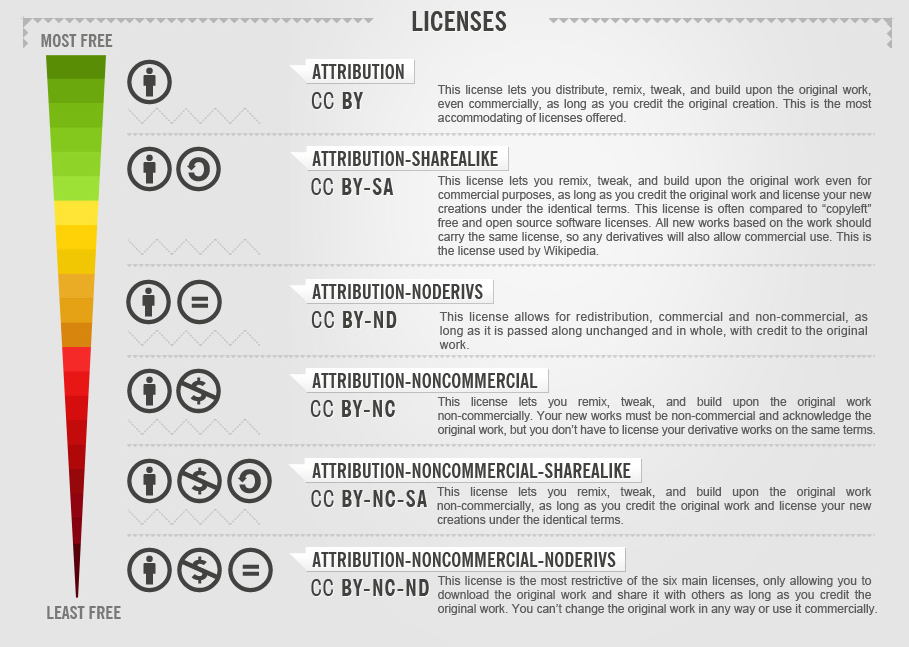
    Open licenses along the lines of open-source and Creative Commons are hacks of this system but do not depart from its essential purpose. Thir underlying insight is that sometimes existing IP licenses are hindrances to the desirable activities they are intended to encourage. For example, I publish this blog for free because I want to share knowledge. I want people to create new works using mine as building blocks. All I want in return is credit for my contribution. If I made every person who wanted to quote e-Literate explicitly ask my permission—as copyright law requires—then that extra effort might discourage some from adding to our educational knowledge. So I publish the blog under a Creative Commons license that lets people use my content without having to ask me as long as they properly attribute it.

    Some people who use open licenses view this kind of sharing as an inherent value. I personally tend toward the utilitarian. I have an affinity for openness and believe that, all else being equal, open is better than not. But I view openness as subordinate to other values such as educational impact. This is a matter of personal philosophy; other folks legitimately feel differently. But even as an end in itself, those who are immersed in topics like open-source or Creative Commons licenses know that the definition of “openness” and the value that it represents are very much contested territory among advocates.

    One way to divide the territory is into open licenses, which are specific legal contracts with well-defined terms, and “openness,” which is a squishy concept with a mix of utilitarian and moral connotations that vary from person to person. Well-written open licenses are clear-cut in their requirements and limitations. They often support, but do not necessarily define, commitments to a specific definition of openness as a value.

    Let’s focus on the utilitarian part for a moment. Martin created Moodle Pty with a particular revenue model, a particular open-source license, and a particular approach to using the Moodle Trademark as intellectual property. These pieces all fit together into a machine for growing “Moodle,” by which I mean both the adoption of the software and the company that Martin owns. It’s a model that served the Moodle mission and sustainability goals well at the time it was created. Many small schools, colleges, and other organizations all over the world had no access to any tool for centrally supporting online and technology-enabled learning. The Moodle software is free and easy to run (up to a point). Moodle Pty created a network of small, local businesses supporting support schools that did not have the capability to run Moodle on their own. Moodle Pty collected (and still collects) a percentage of revenues from these local vendors. This money went toward the development of the Moodle software, promotion of Moodle and its partners, paying salaries, and so on. At the time, the model worked incredibly well, making Moodle far and away the most popular LMS around the globe outside of the US and Canada.

    But the world has changed. Moodle was created before cloud computing and before online learning became mission-critical at scale across large swathes of the globe. These changes broke Moodle’s business model. It has been broken for quite some time. It arguably broke when a Moodle Partner called MoodleRooms, before it was eventually acquired by Blackboard, demonstrated that it could support one million simultaneous users on a single multi-tenant instance. This was a cloud version of Moodle, even if that term wasn’t popular at the time. Once a cloud version of Moodle existed, the power balance between Moodle Pty and its customers…er…partners shifted, and the number of customers from which it could collect revenues was destined to shrink. Rather than being a supplier to many small businesses, Moodle increasingly became the supplier for a few large businesses, each of which became increasingly important for its revenues. Again, read Phil’s post if you want a detailed breakdown of the Moodle model’s…um…breakdown.

    Open is as Open does

    Back to the present. Remember, LTG’s OpenLMS (which it purchased from Blackboard) made an announcement this week about which parts of their code they would release under an open-source license and which parts they would keep as proprietary. Phil Hill asked Martin to comment on OpenLMS’s announcement about their openness policy as part of the reporting for Phil’s blog post. Here is Martin’s reponse:

    Our actions have obviously been a factor in causing this, which I count as a good thing for everyone.   Please note, though, that their stated direction is to sell the integration of the full suite of LTG products – and none of those other things are open or planned to be.  Clients will still have the same lock-in to LTG as before (as desired by LTG).    https://www.youtube.com/watch?v=mBFShI8OYe4

    Not even all the “Open LMS” SaaS product will be actually open either.   I don’t know exact figures, so I’m estimating, but the OpenLMS service is probably 90% Moodle, with perhaps 10% other stuff, and they’re going to make only perhaps half of that other stuff available under GPL, so 5%.   It’s not a big deal and honestly, the least they could do.

    Moodle’s Dispute with LTG and its Growing Suite of Former Moodle Partners 

    Meh.

    News flash: All vendors try to make their customers want to stay by adding features or services they can’t get anywhere else. Some strategies are more ethical than others. Moodle Pty., like many vendors, uses its proprietary intellectual property to create what could arguably be called lock-in. Moodle Pty’s customers are Moodle Partners. Its intellectual property is its trademark. Martin has, on multiple occasions, exercised the threat of withholding that valuable IP when its customers have left or when they have behaved in ways that he believes are contrary to the interests of Moodle.

    There is nothing inherently wrong with this. Moodle has a mission that depends on revenues to sustain. Moodle Pty gets revenues from mostly smaller Moodle vendors. It uses its IP in the form of its trademark as kind of a soft lock-in to its customers (or “Partners”). If the customers walk away, they can still use the Moodle code. They just can’t use the Moodle trademark, which has value because it is recognized and trusted.

    LTG and its subsidiaries, eThink Education and OpenLMS, also provide value-added intellectual property to differentiate themselves, attract prospective customers, and hold onto existing customers. Moodle had earlier ejected eThink from the partner program for not being sufficiently “Open”:

    The Learning Technologies Group (LTG) announcement of the acquisition of eThink Education represents LTG’s intention to move customers into the Open LMS platform, which is not truly Open at all. Their extensions to Moodle are not downloadable, and not available from other service providers. Once on their platform, it is harder for institutions or organisations to move to a different provider, or to their own servers. This goes directly against Moodle’s values of openness. Consequently, as of 18 December 2020, eThink Education is no longer a Moodle Certified Partner or otherwise associated with or recommended by us at Moodle.

    Moodle’s Dispute with LTG and its Growing Suite of Former Moodle Partners 

    Martin’s definition here of “Open” has always been problematic. A lot of software is designed to integrate with or even run on other software. If somebody runs Moodle on a Windows server, does Moodle cease to be “Open” because Windows is not? If a school integrates Zoom—which is not downloadable and is not available from other service providers—as an “extension” to Moodle, does Moodle cease to be open source?

    Of course not. Heck, I would bet money that he personally has written code in Moodle that enables proprietary vendors to integrate their products deeply into Moodle. Further, the cloud has made this situation vastly more prevalent. How many of the software products you integrate as “extensions” to your LMS are downloadable to run on your institution’s servers? How much do you care? Instructure, whose source code to Canvas is largely (though not completely) open-source, has had vanishingly few institutions choose to download and run Canvas on their own servers or seek out an alternative provider. That’s because the virtue that drove customers to Canvas was its nature as cloud software, which means it is designed precisely so that nobody would have to download the software and run it on their own servers. It turns out that schools are not typically great at running mission-critical software applications with no hiccups and no downtime. The cloud has diminished the utility of “openness” (with a lower-case “o”) for many institutions.

    Now, it’s perfectly fine for Moodle Pty to hold that as a requirement for its partners and assert that their version of openness a value. Certainly, if its mission is to prioritize those parts of the world where affordability dictates either self-hosting or a small operation that can’t write its own cloud harness for Moodle, then the company certainly is within its rights to make a decision about that. If so, they should say that.

    By the way, Moodle Pty does have a cloud version of Moodle called, aptly enough, MoodleCloud. If their cloud-enabled version of Moodle has been released as open-source, I have not been able to find it. Again, I take a utilitarian view of any decisions that Moodle Pty makes in this regard. In my view, it’s a good decision to the degree that produces desirable results for educational equity and effectiveness. My concern is with Martin’s apparent hypocrisy, which is underlined by a tone that I read as sanctimonious.

    Likewise, if LTG is alleged to have violated Moodle’s open-source license or infringed on its trademark—in other words, if LTG stands accused of stealing Moodle Pty’s IP—then Moodle Pty should be clear about that accusation. The fact that they have not done so is suggestive. If LTG’s extensions legally violated Moodle’s open-source license’s “openness” requirements, then Moodle Pty would (and should) sue. They have not sued, which suggests to me that LTG’s code is cleanly separable. It may not be as clear-cut as Zoom or Windows, but it appears to be clear-cut enough that Moodle Pty has not pursued legal recourse.

    This is not to say that LTG couldn’t be playing games with features that (a) customers do not know are proprietary and (b) would have a hard time leaving behind if they migrated. I don’t know LTG’s offerings well enough to have an opinion on the matter. Martin could conceivably make a specific argument along these lines. Not a legal one, mind you. Moodle Pty’s trademark lock-in is relatively weak and circumscribed. But he could try to make an ethical argument that LTG’s extensions trick customers into lock-in. He seems to insinuate that.

    But he has not actually made the case. In fact, his waving away of OpenLMS’s statement about what they are opening as “the least they could do,” speculating about the percentage of code that remains proprietary rather than pointing to explicit features that concern him, suggests that he is not particularly interested in making that argument. He wants to make an argument about Openness in some pure and absolute sense.

    I have two problems with that. First, it comes across as hypocritical. Again, I don’t have any problem with Moodle Pty setting terms for its resellers, kicking out resellers that violate those terms, and enforcing the terms by withholding use of the Moodle trademark. But let’s not pretend that Moodle Pty has eschewed all IP, like some sort of corporate Buddhist, or that it has declined to assert that IP to protect its interests. I assume that Martin has a set of principles regarding openness that he is following. They must be more nuanced than “Openness is judged by the percentage of code is downloadable and available from other vendors.” He should state his principles clearly, not as the Proper definition of Openness but as Moodle Pty’s objective and concrete commitments and rationale. In fact, the OpenLMS statement that he dismissed so blithely does exactly this. Martin has enjoyed a position of assumed moral privilege for too long. If he wants to serve “Openness,” however he defines it, he should start by defining it in serious, testable, and internally consistent terms.

    Second, I reject the notion that Openness is a well-defined and absolute virtue by which others are Judged. ((Two can play the Capitalization Game.)) I always have and always will. Martin is far from the only person to wield an “opener than thou” attitude as a weapon in educational communities. He’s also far from the worst offender. But the way in which he’s choosing to communicate his decisions about the Moodle Partner program is particularly harmful because of his global stature. People who are deep into any of the various open communities—open-source, OER, open access—have inevitably been exposed to the complex and nuanced debates about the pros and cons of different licenses. These debates are fundamentally about the values and affordances of different definitions of openness, as expressed in those licenses. I understand that participants in these debates have passionate views on the subject. I don’t doubt Martin’s own passion. But by presenting the matter as cut-and-dried, he flattens this useful debate instead of taking the opportunity to raise awareness and literacy regarding its nuances. In the process, he risks coming across as naive at best and manipulative at worst.

    Martin could also take another (simpler) approach, which is to explicitly require Moodle Partners to adhere to Moodle Pty’s limitations around permitted extensions and reserve the right, without sanctimony or high dudgeon, to eject Partners that don’t adhere to the Terms and Conditions. I have no problem with that.

    Ironically, I have never been able to see a copy of the Moodle Partner Terms and Conditions, even though I explicitly asked to see them at one point. Apparently, they are (or were) considered to be proprietary IP of Moodle Pty and are (or were) not to be shared.

    I hate this crap

    Ugh.

    As I write these words, I am 50/50 on whether I will hit the “publish” button. If you are reading this post, it means I decided the discussion of the larger principle justifies wading into a topic that I largely don’t care about to criticize a person and organization whose accomplishments I respect. I don’t care about the LMS market per se. I have no real opinion about the dispute between Moodle Pty and LTG. Nor do I care enough to put in the work required to form one, at least based on what I’ve heard so far. I harbor no ill will toward Moodle Pty or Martin Dougiamas. Truly, I have a long list of topics that I would relish writing about instead of this one.

    All that said, I find the way that Martin is publicly characterizing the nature of the dispute to be disturbing and harmful, just as I found it to be disturbingly simplistic when he used the same rhetoric with Blackboard. If he truly believes that there is a clear moral definition of “Openness” (which he chose to turn into a proper noun through capitalization) then he should define it and articulate his argument for it. Alternatively, he could simply state that these are the conditions for Moodle Partnership without the air of moral superiority. Either option would be fine with me.

    We should be able to have thoughtful and productive discussions about how different definitions of openness can support or hinder different aspirations and values. My desire to do so is my motivation to write this piece and characterize the rhetoric coming from Martin and Moodle Pty in such strong terms. I am writing because I believe that Martin’s language is doing more to obscure the values and goals of “Openness” than it is to support and illuminate them. I find that to be particularly upsetting because I believe that Moodle has historically advanced goals and values that I cherish. In my view, Martin’s current rhetoric risks damaging that good work while diminishing the value of openness as a tool for future good work.

  • This Blursday Social (March 4th): Curtiss Barnes

    This Blursday Social (March 4th): Curtiss Barnes

    This week we’re joined by my friend and partner Curtiss Barnes. You may have seen his posts on e-Literate, including his most popular (so far), “The Billion-Dollar EdTech Platform Hole.”

    e-Literate author and Senior Advisor Curtiss Barnes

    This Blursday, we’re going to start by talking about where the textbook market is headed. Having done several tours of duty at major publishers—including running a digital platform portfolio at Pearson that, if it were a separate company, would have bigger than Instructure—he has some unique insights. 

    As is the case with just about everything else in higher education, COVID has accelerated and amplified existing trends. Textbook publishers, who were not doing well before, are still not doing well now. That said, there is undeniable increasing interest in digital curricular materials and in inclusive access (the latter of which Phil Hill wrote about recently). OER use is growing, as is faculty interest in questions of equity and efficacy (though not necessarily at the same pace). The explosion of interest around cheating on the one hand and making up for the COVID-caused education gap on the other are driving folks to think about digital curricular experiences in new ways.

    As always, we’d love to hear your thoughts about both where you see the market going and where you think it should go. Please join us this Blursday, 3/4, at 4 PM ET.

    RSVP.

    (BYOB.)

  • Blursday Social with Tyton Partners on a New EdTech Product Selection Tool

    Blursday Social with Tyton Partners on a New EdTech Product Selection Tool

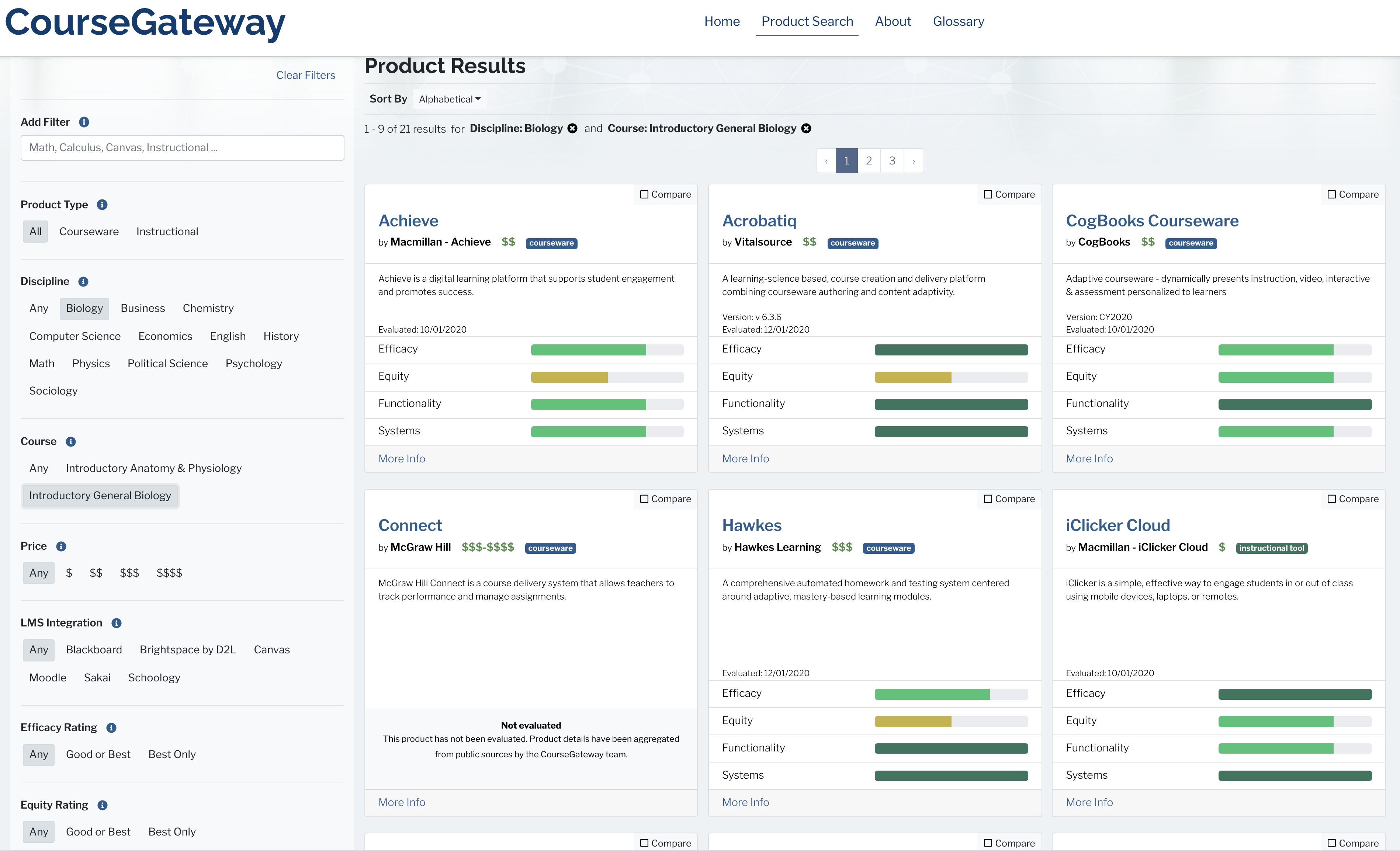
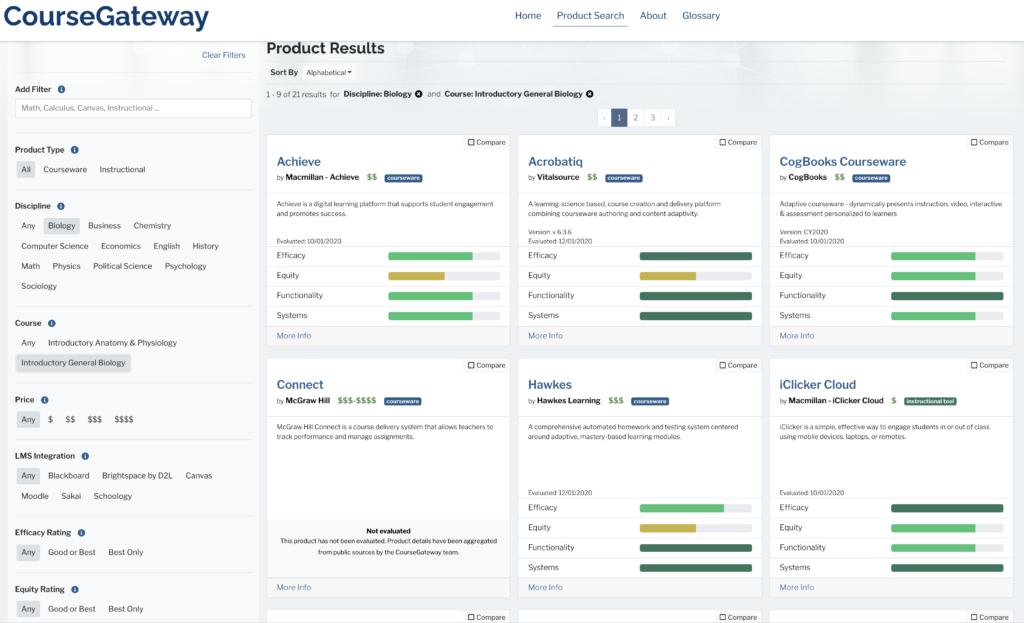
    Ever since EduTools way back in the day—remember that?—folks have been grappling with a way to create a useful and maintainable tool for sorting through EdTech solutions. My friends at Tyton Partners, under a grant from the Bill & Melinda Gates Foundation, have created a new tool to try at CourseGateway.org. Descended from the CWiC Framework, it focuses on courseware but also includes other tools. 

    I may be biased, since EEP played a small role in providing input to Tyton, but I really like what they came up with:

    Panning for Gold in EdTech

    Y’all should poke at it before this Blursday so you can bring your questions, critiques, and suggestions. We’ll be chatting with Tyton’s Managing Partner Adam Newman and Principal Jeff Snell.

    I love these guys; they’re super-smart and fun to talk to about just about anything higher ed-related. The conversation will be fun, wide-ranging, and driven by you, as usual. 

    RSVP.

    (BYOB.)

  • The Chegg Situation is Worse Than You Think

    The Chegg Situation is Worse Than You Think

    Forbes just ran with an article entitled “This $12 Billion Company Is Getting Rich Off Students Cheating Their Way Through Covid“.

    Ouch.

    It’s obviously an unsympathetic portrait. At one point, the author quotes Chegg CEO Dan Rosensweig as saying,

    “You live in Silicon Valley, and everybody is a billionaire, and you’re not. Everybody goes public and at least has the one moment where their stock goes up—and yours didn’t.” It got so bad, he said, “I had a moment of sucking my thumb in bed.”

    Chegg CEO Dan Rosensweig

    While that quote may be cringe-inducing—and was taken from a long interview with Rosensweig that had plenty of cringe-inducing moments—the CEO’s fixation on his status is beside the point. The real damning passages were ones like this one:

    A 2020 George Washington University graduate who is applying to grad school says she tried to use Chegg the way company executives say it was intended, “more as an instructional tool.” But her mechanical physics course was very tough. “I felt like a moth drawn to a flame,” she says about chegging her physics homework at the last minute. “When it’s nearly midnight, why not use Chegg just to finish the assignment?” 

    “This $12 Billion Company Is Getting Rich Off Students Cheating Their Way Through Covid,” Forbes

    And this one:

    It’s doubtful that [Chegg’s new anti-cheating feature called] Honor Shield will dent students’ chegging. Already many professors and instructors have given up the fight. At UCLA, physics lecturer Joshua Samani says that he believes “an astonishingly large portion” of his students have used Chegg to cheat on his exams and quizzes. But he doesn’t try to catch them. “If you’re spending your time attempting to battle Chegg, you’re going to lose,” he says. 

    “This $12 Billion Company Is Getting Rich Off Students Cheating Their Way Through Covid,” Forbes

    If we’ve reached the point where “to chegg” is considered to be a legitimate verb in the English language, that’s another indication of just how widespread the problem is.

    Forbes author Susan Adams gets to the crux of the problem in the last paragraph of the piece:

    It’s unreasonable to lay all the blame for cheating at the feet of Chegg, of course. Human nature is at fault, especially when studying from home makes it much harder to get caught. Constant social media exposure to political leaders who make a virtue out of dishonesty doesn’t help either. But Chegg has weaponized the temptation and is cashing in on students’ worst instincts. Our arsenal of digital tools and global connectivity should be deployed to transform education for the better. Instead, Chegg is using them to outsource cheating to India. That is a tragedy.

    “This $12 Billion Company Is Getting Rich Off Students Cheating Their Way Through Covid,” Forbes

    There’s a lot to unpack here. First, the “weaponizing” of “temptation” is a familiar refrain in social media stories in general these days. And it’s a thorny problem. Chegg has not one but at least two major competitors in the homework help space which are notably valued at over a billion dollars each. Adams mentions Course Hero ((Disclosure: Course Hero is a sponsor of the Empirical Educator Project)) but misses Quizlet. Each of these companies operates a little differently and each tries in different ways and with different levels of apparent earnestness to address the charge that they are “weaponizing temptation.” It’s hard for any company to fight against sliding down that slippery slope—particularly when, as Adams points out, that slope is profitable for the companies. All of the broader debates about the promise and perils of an internet filled with user-generated content and driven by the desires of the masses apply here.

    But there is one major difference between Chegg and its two unicorn competitors in the homework support business that I want to call out. Course Hero and Quizlet both rely on student-generated content (and, to a certain degree, on educator-generated content). Adams correctly points out that Chegg is different but is not entirely correct when she asserts that Chegg gets its homework answers primarily by outsourcing homework answers to India.

    In fact, Chegg got many of its homework problem answers by licensing them directly from the textbook publishers.

    Yes, you read that correctly.

    Multiple sources at multiple textbook publishers have told me that their companies licensed the instructor’s edition homework problem answers to Chegg. My sourcing is not comprehensive enough to assert that all the major publishers did this. But I know for a fact that many of them did. It’s an open secret in the textbook publisher world.

    To be clear, these are old contracts. The people inside the publishers who talk about them now are generally not the ones who signed them but rather the people who have to deal with the mess created by them. These deals were bad for the publishers. They reduced the value of the textbooks. The bit of money that they got from Chegg was not worth the devaluation of the core products. I doubt that the contracts will get renewed when they expire.

    All that said, the fact remains that the publishers sold the textbooks to students…and then sold the homework answers to Chegg so that Chegg could sell those to students as well.

    That’s still not the worst of it

    But let’s not lose sight of the big picture. We have at least three companies worth at least a billion dollars each that are in the business of “homework help” which, as currently structured, has moral hazards. The most valuable of these companies was actively aided in achieving its dominant position by the publishers, who sold homework problem answers to the company without thinking through the consequences.

    Buried in the Forbes article is yet another link in the chain of profits from academic dysfunction:

    Throughout the pandemic, schools have spent millions on remote proctoring, a controversial practice in which colleges pay private companies like Honorlock and Examity to surveil students while they take tests. The proctoring outfits lock students’ Web browsers and watch them through their laptop cameras. Critics say the services invade students’ privacy. Test takers have reportedly urinated at their desks, fearing they will be accused of cheating if their camera catches them getting up to go to the bathroom.

    Although most students Forbes interviewed say remote proctors make them too scared to cheat on exams, several note that they chegg their online exams regardless of whether or not they’re proctored. “As long as you’re not using the school’s Wi-Fi, you won’t get caught,” says a sophomore at a large state school.

    “This $12 Billion Company Is Getting Rich Off Students Cheating Their Way Through Covid,” Forbes

    To sum up:

    • Publishers, after selling expensive textbooks to students, sold the answers to the homework questions in those expensive books to Chegg.
    • Chegg sells the answers to the questions to the students, who often use them to cheat.
    • To combat this problem, universities pay for proctoring software, which is apparently more effective at preventing students from going to the bathroom than it is at preventing cheating.
    • To add insult to all of this injury, “to chegg” is now apparently a verb in the English language. We will all have to live with that linguistic violence.

    Professor Frankenstein, you’ve created a monster

    A common response to all of this is, “Hey, students are going to cheat. We fight it as best we can.” To which I reply by quoting Steve Jobs on why he thought the iTunes Music Store would beat out Napster-style piracy:

    We believe that 80% of the people stealing stuff don’t want to be, there’s just no legal alternative.  So we said, ‘Let’s create a legal alternative to this.’  Everybody wins.  Music companies win.  The artists win. Apple wins. And the user wins, because he gets a better service and doesn’t have to be a thief.

    Steve Jobs

    I believe the Georgetown student in the Forbes article who said she didn’t set out to cheat but felt pressured into doing so by her anxieties about her course. In fact, I think that scenario is more common than not. Chegg did not create that anxiety. We can debate the degree to which they deliberately exploit it, but the source of the anxiety comes from somewhere else.

    I want to return to the word “outsourcing” because, while the degree to which Chegg is “outsourcing cheating to India” is an open question, outsourcing is definitely part of the problem. Specifically, universities have created the conditions in which many professors are motivated to outsource homework questions to textbook publishers. This is where the problem starts. Everyone is using the same outsourced questions, which enables cheating at scale.

    In and of itself, that would not break the homework process (as opposed to high-stakes exams) were it not for the second problem. Instructors are not trained in how to use and grade these questions to decrease the likelihood of cheating. The homework questions could be used to help students feel prepared for higher-stakes exams. In other words, they could be used to lower the student test-taking anxiety that drives them toward cheating. Using the homework effectively requires having some skill at creating a class participation-style grading scheme and a willingness to spend some real time going over the homework, showing the students why doing the work helps them. When properly positioned, homework should feel to students like something that helps them learn and succeed. Since instructors are not trained in the skills necessary to position it this way, many create conditions in which the assignments raise the students’ anxiety, which increases the likelihood that students will cheat.

    We should not be OK with billion-dollar companies whose success is built on an arms race between cheating and surveillance that is driven by student anxiety. Nor, to follow the metaphor to its logical conclusion, should we place sole responsibility on the arms dealers for causing war.

    In 2020, the United States budgeted roughly 100 times as much for the Defense Department as it did for the State Department. As a country, we spend 100 times more on fighting wars than on preventing them. These decisions are made by elected officials who represent their constituents. At some level, the priorities, and the responsibility for them, flow back to us. Likewise, the spending priorities on these products and the responsibility for those priorities flow back to academics and academic institutions. These companies are solving problems that are partly created by the ways in which academia chooses to work. How much money does the average college spend on EdTech products relative to instructor professional development in pedagogy? How much larger does that disparity get when we include the money that students pay as they deal with the consequences of this imbalance?

    It’s easy to paint the corporations as the villains here. None of these product categories—textbooks, homework sites, or proctoring products—are particularly well regarded in academia. But the more important question is, “Why do these companies and business deals exist in their current form?” Remember, product/market fit is like a key in a lock. These companies have unlocked literally billions of dollars’ worth of services that academics tend to view as problematic at best and illicit at worst. What are the conditions that encourage the widespread and highly monetizable temptation for students to slide from seeking help into cheating? Who, exactly, is outsourcing what to whom? And what are the knock-on consequences?

    Young Frankenstein

    If you listen to the whole of the Rosensweig interview quoted in that Forbes article, you’ll hear a guy who is not an educator. He’s a businessman who wanted to make money solving some problem related to education. And yes, he wanted to feel like he was helping students in the process. We can scoff at that all we want, but the fact is that students go to Chegg seeking help. They pay for that help, which they believe they need and are not getting from their academic institution. We can choose to be cynical about the companies, and even about the students. Or we can improve academic practices and challenge Mr. Rosensweig to make his money by providing services that actually help students to learn.

  • There’s a Layer in Between Learning Content and Learning Analytics

    This post is the third in a series about the collaboration on a new courseware platform between Carnegie Mellon University’s Open Learning Initiative (OLI) and Arizona State University’s Center for Education Through eXploration (ETX). (The web version of this post has a clickable table of contents up at the top.) I’ll be writing about the platform periodically on a variety of topics ranging from nuts-and-bolts questions like what features it will have by when all the way to very broad and deep topics like architecture, interoperability standards, and hoped-for impacts on the educational ecosystem. As a reminder, I’ll also be holding a Blursday Social webinar with OLI’s Norman Bier and ETX’s Ariel Anbar on this Thursday, 2/4 at 4 PM ET.

    Today I want to review a fundamental aspect of the collaboration that I discussed in my previous post in this series from a slightly different angle. Not too long ago, I had a conversation about this angle with a new friend. After we had waded into it for a while, she said to me, “Everybody wants to talk about content and learning analytics. You’re saying that there’s a layer in between.”

    Exactly. She expressed it perfectly.

    And yet, two aspects about that moment surprised me.

    First, even though I have been writing about this idea almost since I started this blog in 2005 and have involved in the design of multiple EdTech systems that rely on this principle, I had never thought about it in quite the way she had put it before she said it. Second, I don’t think she had either. For context, my new friend is a PhD candidate in experimental psychology who is only weeks away from defending her dissertation at Carnegie Mellon University. She has a history in EdTech that is as long as mine. Furthermore, she had to be working with this concept directly and intimately, given the subject of her dissertation. And yet, her formulation of this idea also seemed novel to her as she expressed it to me in that moment.

    If I am still finding new ways to wrap my head around this concept, and she is too, then chances are good, Dear Reader, that previous blog posts I’ve written about the topic have failed to fully communicate the idea to you as well. So I’m going to take another go at it in this post. First I’m going to talk about what, generally speaking, we mean by “in between” and then about why it’s important for us to understand the layer that’s “in between” learning content and learning analytics.

    Meaning is the meat of the sandwich

    Imagine I handed you a piece of paper with “8429971043” written on it. Take a moment and try to imagine contexts in which that act would make sense to you. What might that number mean? Why would I be giving it to you? Sketch out a few stories in your head.

    Now instead, imagine I handed you a piece of paper with “(842) 997-1043” written on it. What stories are you writing in your head now? Did I give it to you printed on a little piece of cardboard at the beginning of a business meeting? Scrawled on a napkin in a bar?

    Now go back and reread those last two questions. Notice how much insight you were able to extract from the context embedded in the questions once you recognized that string of numbers as a phone number, as opposed to just a string of ten digits.

    Without the meaning of the number, you had the content, and you were trying to perform your analytics, but you were severely limited. The enabling layer in the middle is the idea of a phone number. Given just a little bit of punctuation, your brain transformed a random string of numbers into a thing in the world that you can do something with. It also enabled you to extract new information value out of other contextual information, like the kind of paper the number was written on or the location in which the paper was exchanged.

    There was a moment in the history of software when computing machines were given this layer in the middle for phone numbers. On one day, a phone number in an email wasn’t clickable (or tappable). The next day, it was. Clicking on it now offers you several predictable options. Would you like to associate this number with a person in your address book? Would you like to dial it now?

    Software developers deal with this “in between” layer all the time. They call it an “information model.” Consider, for example, the address book which stores the phone number that you clicked on. It has an information model that knows that phone numbers can belong to people. It knows that people can also have email addresses, physical addresses, company affiliations, and other things. Emphasis is on things. John Smith isn’t just a string of letters; it’s the name of a person. (842) 992-1043 isn’t just a string of numbers, spaces, and punctuation marks; it’s John Smith’s phone number.

    Information models represent meaning, including relationships between things (such as the relationship between John Smith and his phone number). Software architects work very hard to replicate the relevant ways in which we parse and store meaning in our heads to perform tasks that are relevant to the software being built. Suppose John Smith lives in Europe, where phone numbers have different numbers of digits. Suppose he writes his phone number as 842.992.1043. Suppose he has multiple phone numbers which he uses for different purposes in different locations. An information model has to capture all of these nuances. It’s hard work, but it’s a well understood process. Software developers do it all the time. They are constantly mapping bits of the human world into their software.

    For some reason, humans seem to struggle when thinking about how to map learning and teaching in this way. Even experienced and formally trained humans who think about it all the time struggle with it. We could chalk that up to how incredibly complex the human mind is. And there’s something to that. Learning is comprised of an incredibly complicated and varied array of processes. I’m going to write about that problem and its implications for, say, adaptive learning in a future post. But I don’t think that’s the whole story because even basic building blocks seem hard for us to wrap our heads around.

    Hard, but not impossible. Let’s give it a try.

    The pedagogical meaning in the middle

    Imagine you’re in a literature class studying The Odyssey. Your professor asks you the name of Odysseus’ dog. You may have one of two common reactions to this question. One is to try to come up with a thoughtful answer. The other is to roll your eyes in frustration. The reaction you have is related to the meaning you believe is attached to the name of Odysseus’ dog. If the name has no meaning—if it’s the Greek equivalent of “Spot” or “Rex”—then you might roll your eyes because you don’t think this question is has value relative to its purpose, which is to help you understand The Odyssey. The instructor’s question is a thing that is supposed to have a use. Specifically, it is supposed to help you learn—or show what you have already learned—about the literature. You expect it to fulfill one or both of those functions. You expect that the question, answer, and purpose for asking are all related to each other and to The Odyssey. This is the information model in your head that drives your interactions with your instructor. When your instructor asks you a question that doesn’t lead to an answer that helps you better understand the literature, then you get frustrated. It’s a little like being asked to memorize a phone number without knowing whose phone number it is or why you need to know it.

    When we are designing a lesson, either in software or in an old-fashioned, human-to-human class, we are (consciously or unconsciously) drawing on this information model.

    A basic information model for teaching and learning

    Let’s see how this works with some more interesting questions about Odysseus’ dog. Suppose your instructor asked you, “Why does the author write about the dog at all? What is the function of the dog in the story?” That feels like meaningful question. If you’ve read The Odyssey, you may remember that the dog only appears in one scene and dies almost immediately. It’s not like the dog (whose name is “Argos,” by the way) is a major character in the story. It shows up exactly once, at a moment in the story that is very dramatic for reasons that seem completely unrelated to the dog dying. What’s that about?

    Now let’s try a similar mental exercise to the one we tried with the phone number. Imagine your instructor asking that question in different contexts. What would it mean if she gave you the question to think about before you read the passage? How would the meaning of the question—or maybe more more precisely, how would the purpose of the question change if your instructor asked that question in class discussion after you had already read the passage? How would it function differently if the question came as an essay exam question after the class discussion?

    In context, we can answer these questions fairly easily. The instructor is asking the student a question about a work of literature that is intended to stimulate or test the student’s understanding of some specific aspect of the literature. We can judge the nuances regarding stimulating versus testing understanding based on the context. That is our tacit information model. And yet, both educators and software developers, and even experts who study learning, can struggle to hold onto the model in the general case.

    This is an important problem to solve if we want to improve education in general and EdTech in particular.

    Making tacit educational knowledge explicit

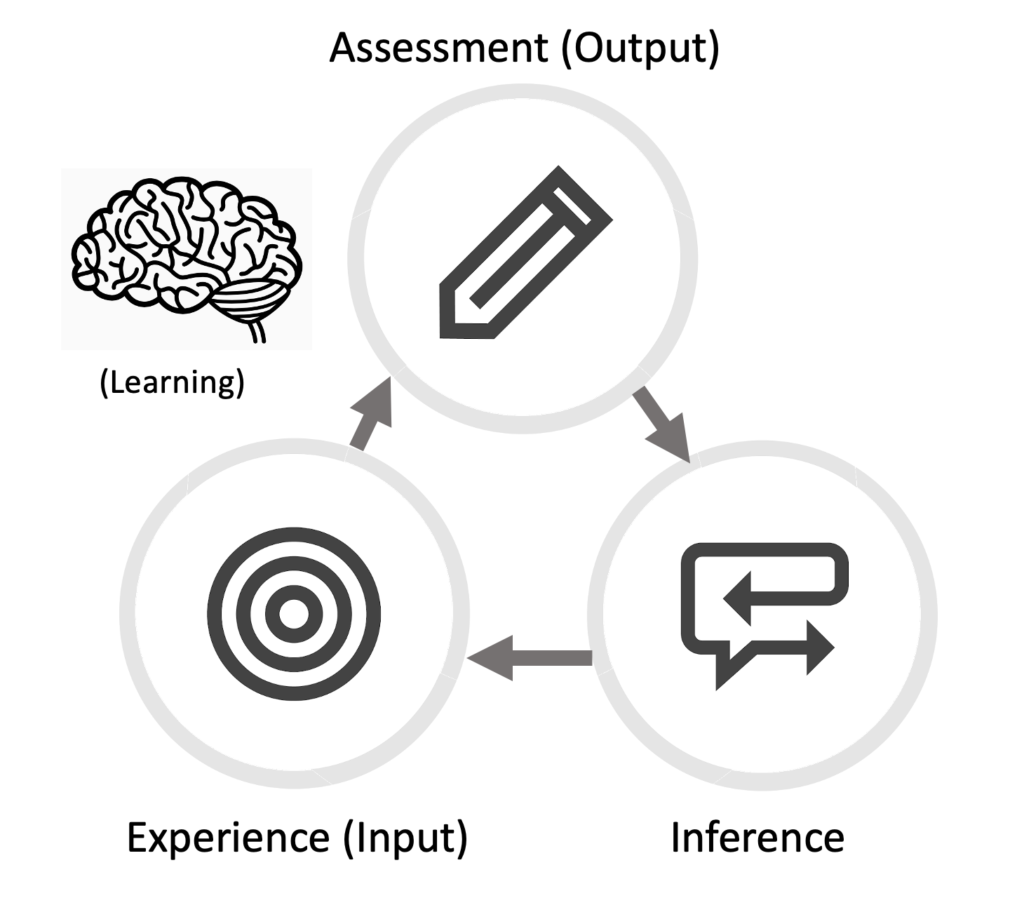
    As humans, we have an enormous amount of experience with learning through questions or challenges. Why is there a dog in that scene? How do I calculate how steep a hill is? Why are my scrambled eggs so runny? What is the guitar chord in that song I love? What will happen if I lick a frozen flag pole? We try to answer these questions. The emphasis is on try. We learn by doing (even if the thing we are doing is in our heads, like imagining what might happen if we lick that frozen flag pole). If we don’t get the answer we’re looking for the first time, we may try again or try something else. These are goal-directed learning feedback loops. As animals, we understand these loops instinctively. It’s an essential part of what makes us human. One translation of the sapiens part of homo sapiens is “one who knows.” This knack for knowing is how humans survive as a species. For example, I want to believe that most people who lick frozen flagpoles once don’t do it again. On the other hand, people who are serious about making good scrambled eggs may experiment repeatedly with pan heat, scrambling technique, and other elements. Each of these, in turn, produces a question that leads us to construct a goal-directed learning feedback loop. “What if the eggs are runny because I’m not getting them scrambled evenly enough?” And so we try again.

    Teaching is the craft of creating, optimizing, and sequencing goal-directed feedback loops that help learners learn. But because these loops are so intuitively available to us, we often don’t think explicitly about what we’re doing. Many of us don’t have a clear mental model for a fundamental task that we perform all the time. Even those of us who do can struggle to keep that model in our conscious minds and continue to refine it. It’s hard to refine your model if you can’t keep it front-of-mind as you’re testing it. And it’s really hard to translate it into a software information model.

    In my personal view, one of the most exciting goals of the OLI/ETX collaboration is the opportunity to work on this challenge of making a broad swathe of our tacit knowledge about educational processes explicit. On the software architecture side, the exercise of translating the very different learning experiences supported by OLI and Smart Sparrow into a common information model describing goal-directed learning feedback loops helps us generalize. I believe we are searching for the language of educational DNA.

    Let’s take that analogy seriously. In actual DNA, all of life in its infinite variety and complexity is encoded using just four letters in strands of DNA. I believe we can describe the basic, universal building blocks that encode learning in all its infinite variety and complexity. Of course, knowing those building blocks does not unlock all the secrets of life or learning by itself. But it’s a pretty big step in the right direction. An ambitious but achievable intermediate goal would be to be able to create and test any style of effective courseware design, including adaptive learning designs, using a single information design and architecture.

    The more important aspect of this aspiration is on the human side. If we can create a system that helps both educators and students translate the teaching and learning knowledge they apply instinctively into an explicit model, see the benefits that doing so gives them in terms of extracting more meaning out of educational contexts, and practice translating their tacit knowledge about teaching learning into explicit knowledge, that would be transformative. We would become better teachers and learners because we would be translating teaching and learning from arts to crafts and, when possible, to science.

    To sum up, I believe the software that is emerging from the collaboration between OLI and ETX can help educators and students become more effective at learning about teaching and learning while simultaneously creating an architecture that can implement almost any style of courseware on the market today and some that aren’t on the market yet. It can accomplish both of these goals by baking a model for the basic building block of teaching and learning—the goal-directed feedback loop—into every aspect of the platform, from the user experience to the deep architecture. This, in turn, will enable other capabilities that I will write about in future posts.

    If you want to talk about this (or any other aspect of the project), come to the Blursday Social webinar with OLI’s Norman Bier and ETX’s Ariel Anbar on this Thursday, 2/4 at 4 PM ET.