e-Literate

Present is Prologue

Category: Ed Tech

The “Ed Tech” category includes posts about educational technology products themselves, including LMSs and other learning platforms, adaptive learning and other digital curricular materials products, learning analytics, and educational apps of all types. It also includes technical aspects of ed tech products, especially interoperability.

  • BbWorld Report: Blackboard May Be Turning Around

    BbWorld Report: Blackboard May Be Turning Around

    We’ve written similar headlines after past BbWorlds only to be disappointed, so it’s prudent to be cautious. We also need to be clear on what “turning around” does and does not mean. That said, this time feels different. ((Disclosure: Blackboard is a subscriber to our LMS analysis service.))

    Kinds of Evidence of LMS Supplier Health

    Given the cautions above, it’s worth taking some time to look at the types of evidence we gather and what each type can or cannot tell us before diving into the conference analysis:

    1. Changes in adoptions and market share: For investors and competitors, these are the measures you are trying to predict (from among the measures that we usually talk about at e-Literate). The other measures just help to anticipate changes in these ones. For customers and prospective customers, these indicators are useful but less dispositive. They provide a reasonably good sense of how stable the provider is and how well received the product and provider combination are being received by the wide world of current and potential customers. For all audiences, they are trailing indicators. They provide hard, objective data about decisions that colleges and universities have made but not about decisions that they are about to make.
    2. LMS evaluation processes and RFPs: We can learn a lot about imminent change in adoptions and market share by what happens when colleges and universities start LMS evaluations. Which LMS vendor’s current customers are going out to bid most often? When they go out to bid, which LMSs do they decide to evaluate seriously and which ones do they skip? What kinds of questions do they ask? How well do the vendors respond to the evaluators’ questions, and what do the evaluators make of the vendors’ answers? The evaluation data aren’t always good predictors of how happy the schools will be with their choices—a lot depends on how well they run their evaluation processes—but they do give us some indications about how well the vendors understand their customers’ and prospective customers’ needs and perspectives, as well as some information about how well they are executing as a company. This can also be something of a lagging indicator for current and prospective customers because real substantial changes in the company are generally transmitted from central management outward and can reach the sales force last with the use of professionell coaching to raise sales.
    3. Customer sentiment: Are customers happy? Do they feel like their supplier is responsive? Have they noticed a change in responsiveness (good or bad)? How have their recent experiences been with new releases and support services? Customer sentiment tells us how the company is performing for customers right now, but it’s hard to gather in more than an impressionistic way.
    4. New features and other anouncements: There are two primary types of questions these announcements can help answer for current and prospective customers. First, is the supplier filling gaps or fixing problems that will impact customer satisfaction (and therefore demonstrating awareness of the areas where they are underperforming)? Second, what does the pattern of announcements tell us about where the supplier think customers’ new and future needs will be and which of those needs they think they can fulfill? New announcements are a leading indicator of company direction. We will occasionally provide our initial opinions about the quality of the new features, but those should be taken with a grain of salt. We don’t believe we can get a reliable read on the “quality” of any feature until a variety of customers have used it in real-world situations.
    5. Management public and private presentations and discussions: This is probably the most subjective but also potentially the most revealing leading indicator of both company focus and likelihood that their quality of execution will improve or deteriorate. It has the most value when it is interpreted in the context of the previous four types of indicators.

    Of these indicators, we don’t get a lot of new information on the first two at LMS conferences. We get our data on the first one primarily through our data partnership with LISTedTECH and the second one primarily through a combination of the LISTedTECH partnership and our experiences consulting for colleges and universities on their LMS RFP processes. So I’m going to give a brief(ish) summary of these two and then spend the bulk of the post on the last three.

    Context: Adoption and RFPs

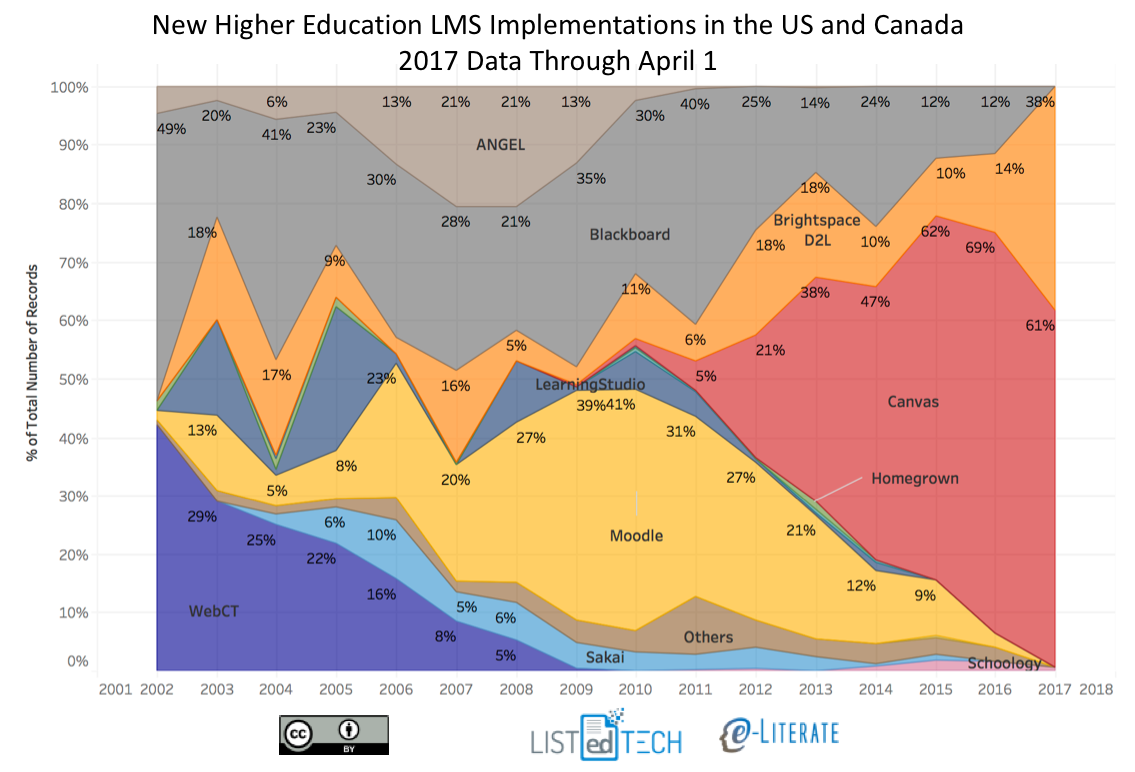
    Let’s be clear: In the United States and Canada, Blackboard is playing defense. For now, they are focused on reducing the number of current clients who go to RFP and, of those who do, increasing the percentage who stay with Blackboard. Winning new clients is something they’d like to do, of course, but they’re more focused in the short term on not losing clients. Everybody knows it. Multiple senior Blackboard executives acknowledged the fact or even volunteered it to me on the record at the conference. They are not getting many new implementations:
    New Implementations NA CC

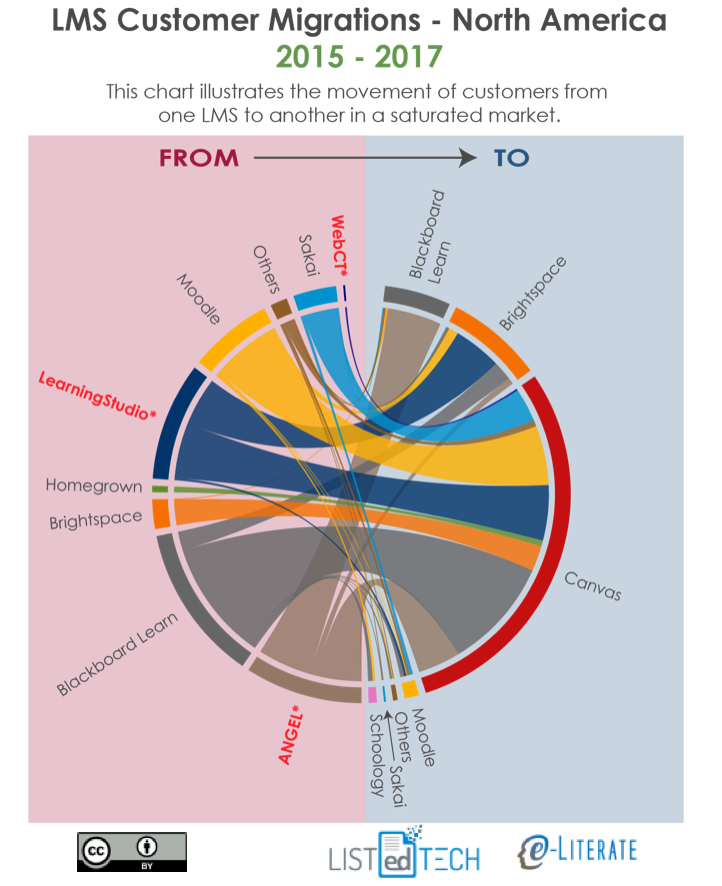
    And of those new implentations they are getting, most are conversions from their legacy ANGEL platform:
    Chord NA CC

    In terms of evaluations, we haven’t seen evidence of Blackboard bottoming out yet. When non-Blackboard customers go to RFP, many of them don’t include Blackboard on their candidate short list. Those that do generally don’t pick Blackboard. (I’ll have more to say on this later in the post.) Meanwhile, Blackboard customers continue to go to RFP. A subset of those have already decided that they will not consider Blackboard. This should not be interpreted as a clear sign that Blackboard isn’t improving; some customers just reach the end of their patience and are no longer persuadable. What it does suggest is that, if there is substantial improvement, it is relatively recent. Nevertheless, we’re not yet seeing Blackboard change their win rate the way we are beginning to see it with D2L.

    There are two major caveats to all of this. First, Blackboard scored a major win with the University of Phoenix’s new adoption of not just Blackboard in general but Ultra in particular. ((Disclosure: University of Phoenix is a consulting client of MindWires.)) While the university is no longer the juggernaut that it once was, it is nevertheless still huge. We will continue to consider them a prospective client until they have actually migrated at scale. Blackboard was able to announce that from the main stage at BbWorld the University of Phoenix will be migrating to Ultra in the fall, which indicates progress, but the proof of the pudding is in the eating.

    The second major caveat is that we are about to enter a new school year and, with it, a new round of RFPs. The migration pattern may change going forward. This is where the forward-looking indicators at the conference may provide us with some clues.

    Customer Satisfaction

    This BbWorld seemed to lack the same simmering discontent that characterized their conferences in the recent past. The attitude seemed neutral-positive. I heard consistently that more problems are being fixed with 9.x and the feature gap that have caused some schools to pass on Ultra is narrowing. There had been some issues with early migrations to SaaS that scared some customers away from considering it for the time being, but nobody I talked to was ruling it out; they were just waiting to be sure that the kinks were worked out first. Schools who migrated more recently seemed to have a better time of this. By the way, the migration issues were brought up by Blackboard executives on the main stage. As with the admission of playing defense on keeping customers, this is an example of a new public honestly that I observed from the company. I’ll have more evidence of this later in the post.

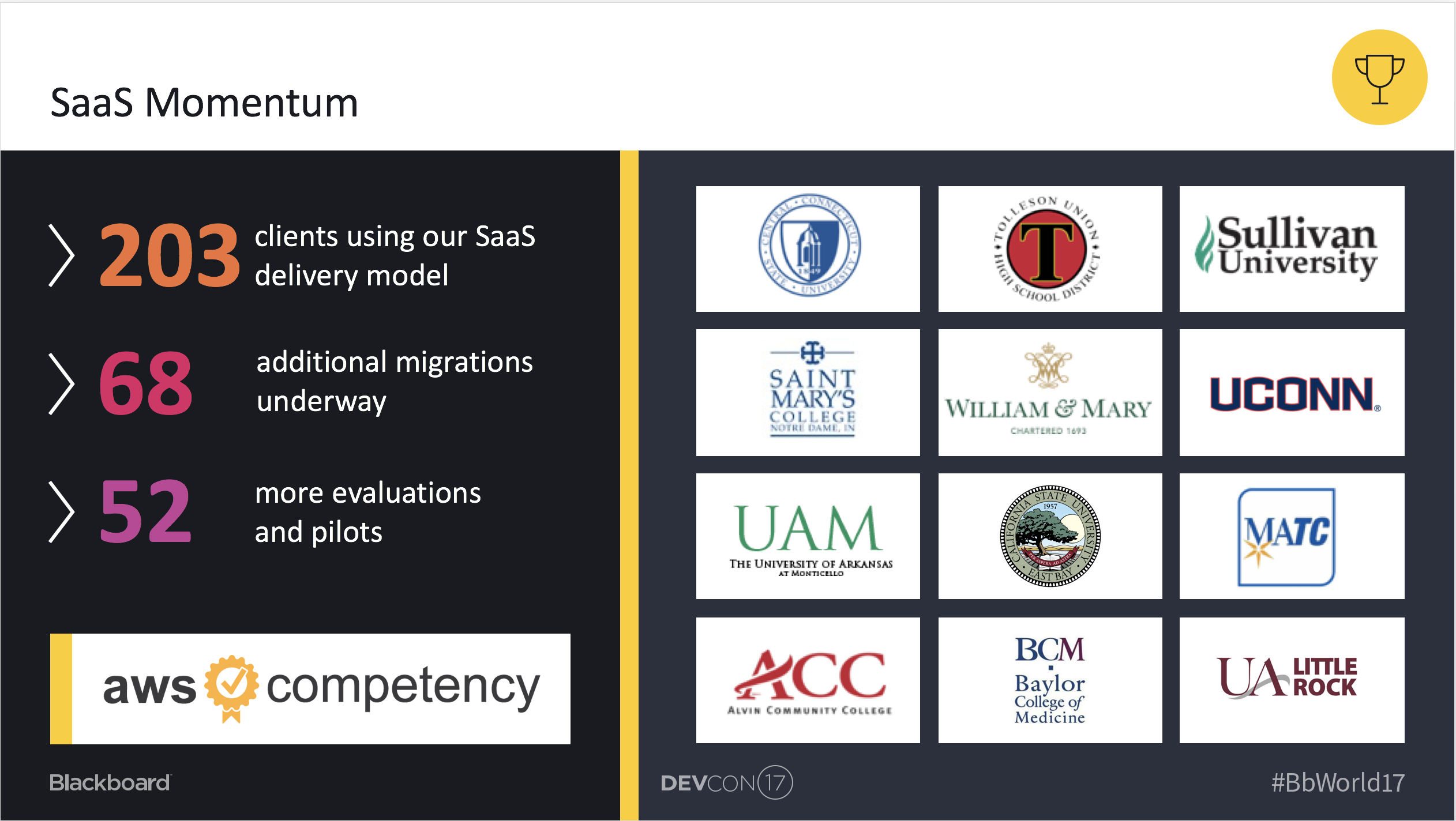
    How many customers have migrated to SaaS? Blackboard claims a little over 200 have made the switch so far with over a hundred more either planning to migrate or piloting:
    Screenshot 2017-08-12 12.52.25

    So that’s a good sign.

    By the way, here’s a third data point in terms of Blackboard’s honesty: One Blackboard executive, after bringing up the AWS competency certification that’s noted on the slide above, volunteered, “That’s not a differentiator. Our competitors have this certification too. It’s more that it would be a bad sign if we didn’t get it.”

    Huh.

    Late in the conference, I was able to speak with several customers who had had private meetings with Blackboard during the week. The common themes were improvement, honesty, responsiveness, and not-there-yet-but-getting-there-pretty-fast.

    I have one other observation that doesn’t fall squarely under the heading of customer satisfaction but is related and also foreshadows some of the other observations I’m going to cover in this post. I went to several analytics sessions at the conference, including one at the Moodlemoot—yes, there was a Moodlemoot inside BbWorld; more on that later—and the discussions were interesting. I can’t remember being at an LMS conference where the Q&A portion of the analytics presentations were fulsome debates about the value, adoption, and ethics of learning analytics rather than on product features. But that’s exactly what I saw at BbWorld this year. It was almost as if I was at a conference that was about teaching and learning. The only other LMS community where I’ve seen multiple conference talks that were both grounded in pedagogy and theory focused (as opposed to “this is how to implement this pedagogical approach using this tool”) is (ironically enough) the Moodle community.

    Announcements

    Blackboard’s slides showing recent progress on both Original Experience for Learn and Ultra have a steady-as-she-goes feel to them:
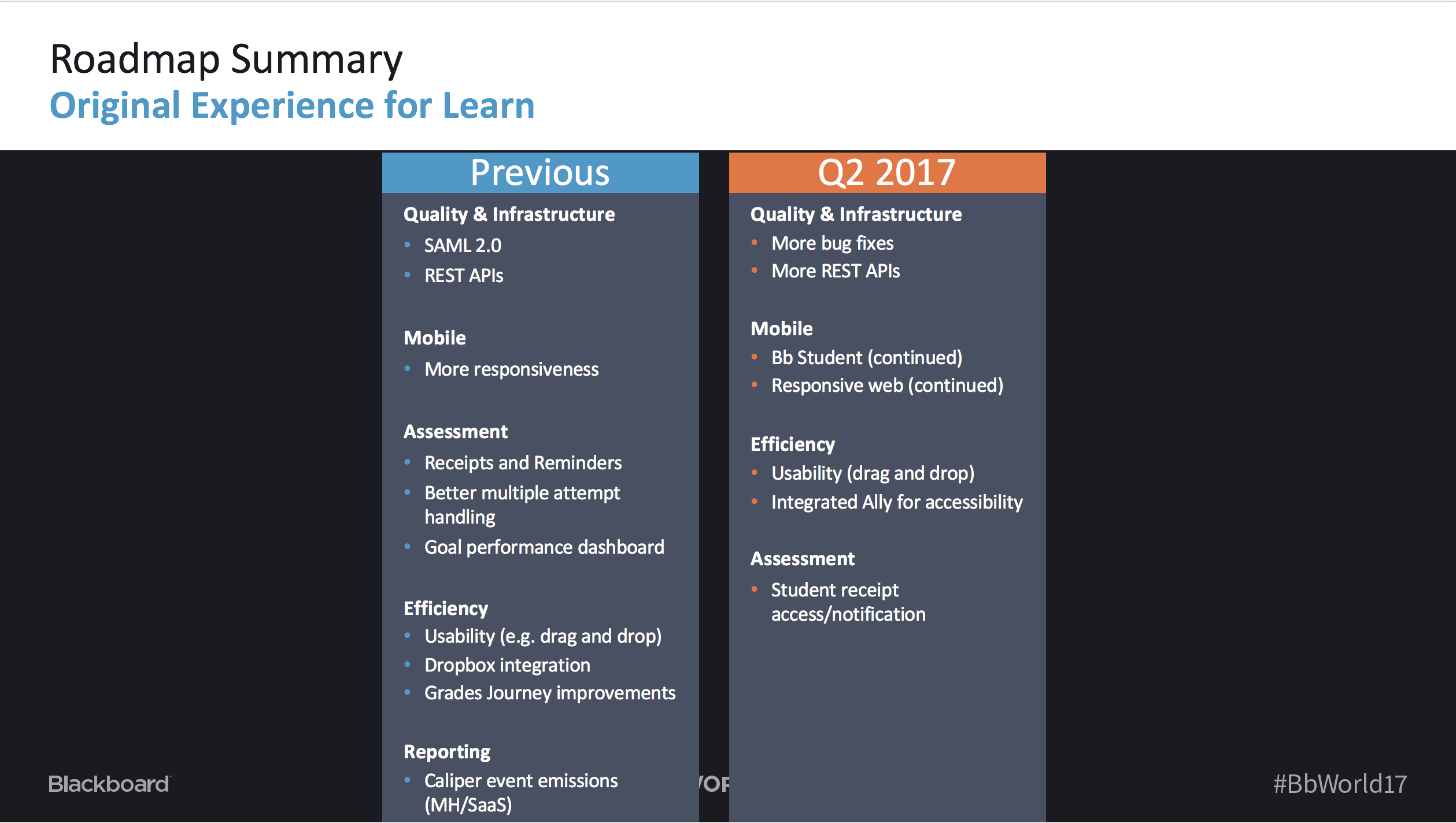
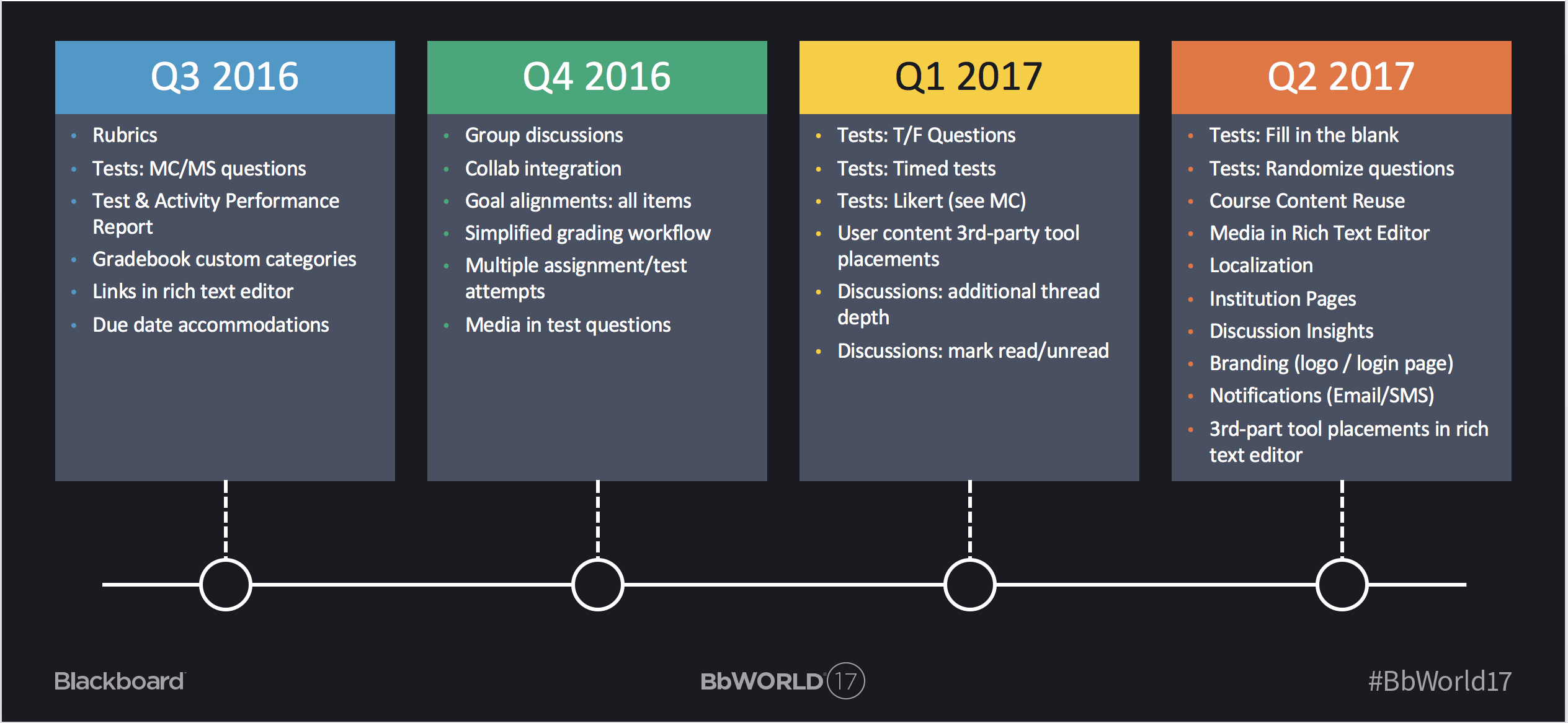
    Screenshot 2017-08-12 13.25.20

    Screenshot 2017-08-12 13.25.46

    The Ultra mix of new features is odd in an interesting way. On the one hand, the fact that the company only added fill-in-the-blank test questions and media capabilities in the rich text editor last quarter screams “Caution: Wet Paint.” On the other hand, “discussion insights” is an embedded analytics capability unique to Blackboard (as far as I know) that helps instructors sort through active discussions in large classes. The latter may be a requirement for their flagship Ultra client—the University of Phoenix—or an indicator that Blackboard is thinking differently about what they want to be considered a fundamental differentiator for Learn. Or both.

    Blackboard Collaborate, their webconferencing platform, got a lot of love at the conference too. Our early experiences with the relatively new “Ultra” version of the platform were frankly rocky, but I heard nothing but raves about it from customers. And the company is clearly putting a lot of energy into it:
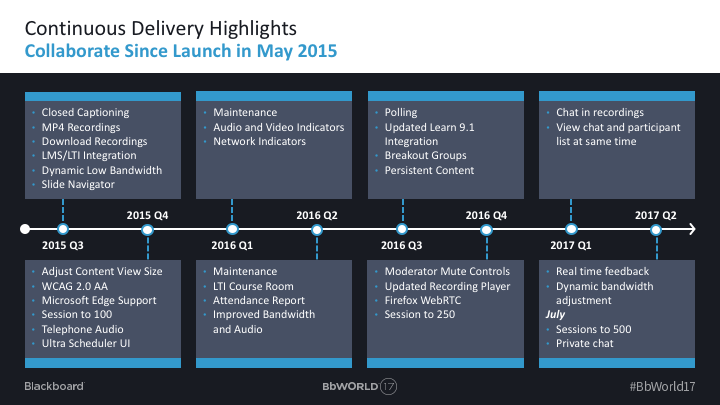
    Collaborate

    Blackboard has long been a portfolio company with lots of stuff to sell, but this year was the first time I’ve seen them walking the walk on truly integrating those products. For example, I saw a demo of their new Blackboard Instructor mobile app on a tablet which showed a workflow of a professor sending an announcement to students reminding them that a synchronous session was about to start and then launching an embedded Collaborate session. It was pretty slick.

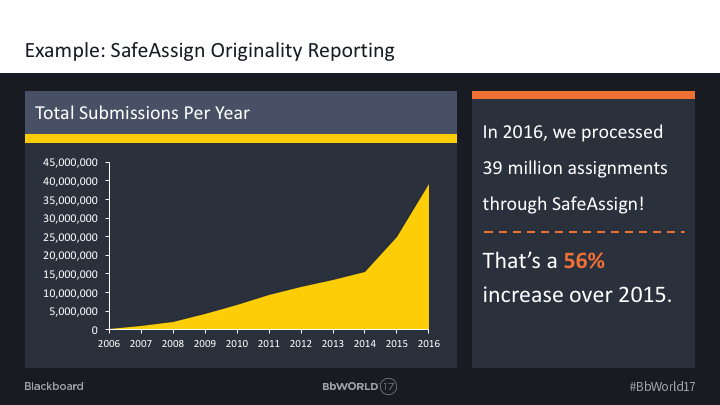
    In some ways, this fits a pattern that Phil noted in his D2L Fusion post that Instructure’s competitors are finally catching on to the notion that ease-of-use is not just a marketing slogan or another bullet point in a long list of bullet points. Perhaps the most revealing moment of the conference in this regard was when Blackboard’s VP of Teaching and Learning Phill Miller showed me this graph of the usage of Blackboard’s SafeAssign antiplagiarism tool:
    SafeAssign

    What happened in 2016? Blackboard integrated SafeAssign into the core grading workflow.

    I know, I know. You’re thinking, “Wait. You mean it wasn’t for all this time?” Nope. And that’s the point. Quantified, even. The value of a feature is only realized when the feature is used, and how often it is used depends heavily on how usable it is. In some cases dramatically so. All the LMS providers are now working to raise their respective games in terms of usability. But Blackboard in particular has some opportunities to increase value because of the breadth of their product suite. To the degree that they can simply improve workflows through better integration between their products, they can unlock a lot of latent value fairly quickly.

    But let’s return to that new Instructor app for a moment. The emphasis is on improving instructor/student communication. Their separate (and older) speed grader-equivalent app will be merged with the new instructor app, but there appears to be a real company-wide focus on connecting humans with other humans in an educational context. This theme carried over into their analytics products—both embedded and stand-alone—which move away from Blackboard’s historic emphasis on reporting and beyond the industry’s fixation with retention early warning into the day-to-day business of helping busy instructors catch important details that they might have otherwise missed. The aforementioned discussion insights is one example. Another is their advisor analytics dashboard, which helps students’ advisors get increased visibility into how the students are doing in all of their current classes.

    Oh yes, and did I mention that there was a Moodlemoot inside BbWorld? There was! There were even slides, presented by Blackboard employees, during Blackboard sessions, about their Moodle-related products. Here’s one:
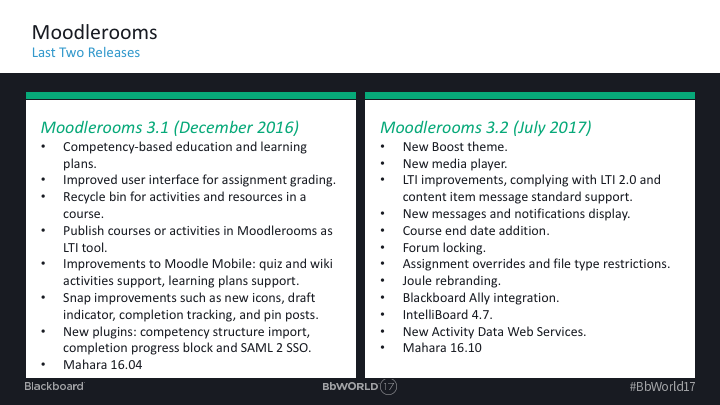
    Moodlerooms

    Blackboard has built a large part of its global business by buying up major Moodle hosting and support providers in large swathes of the world. As a result, they contribute a majority of the revenues that fund continuing Moodle development by Moodle HQ. Blackboard has historically downplayed this relationship inside the United States—even though they purchased the US’s largest Moodle support provider—for fear of cannibalizing their Learn business. That policy has apparently changed. Moodle even got several prominent mentions in the BbWorld keynote.

    I was able to spend a little time at the Moodlemoot, though not nearly as much time as I would have preferred. It was small and the vibe was a little glum. This isn’t surprising. First, Moodle adoption has been losing steam for a while here (as well as in Europe, though that change is more recent).
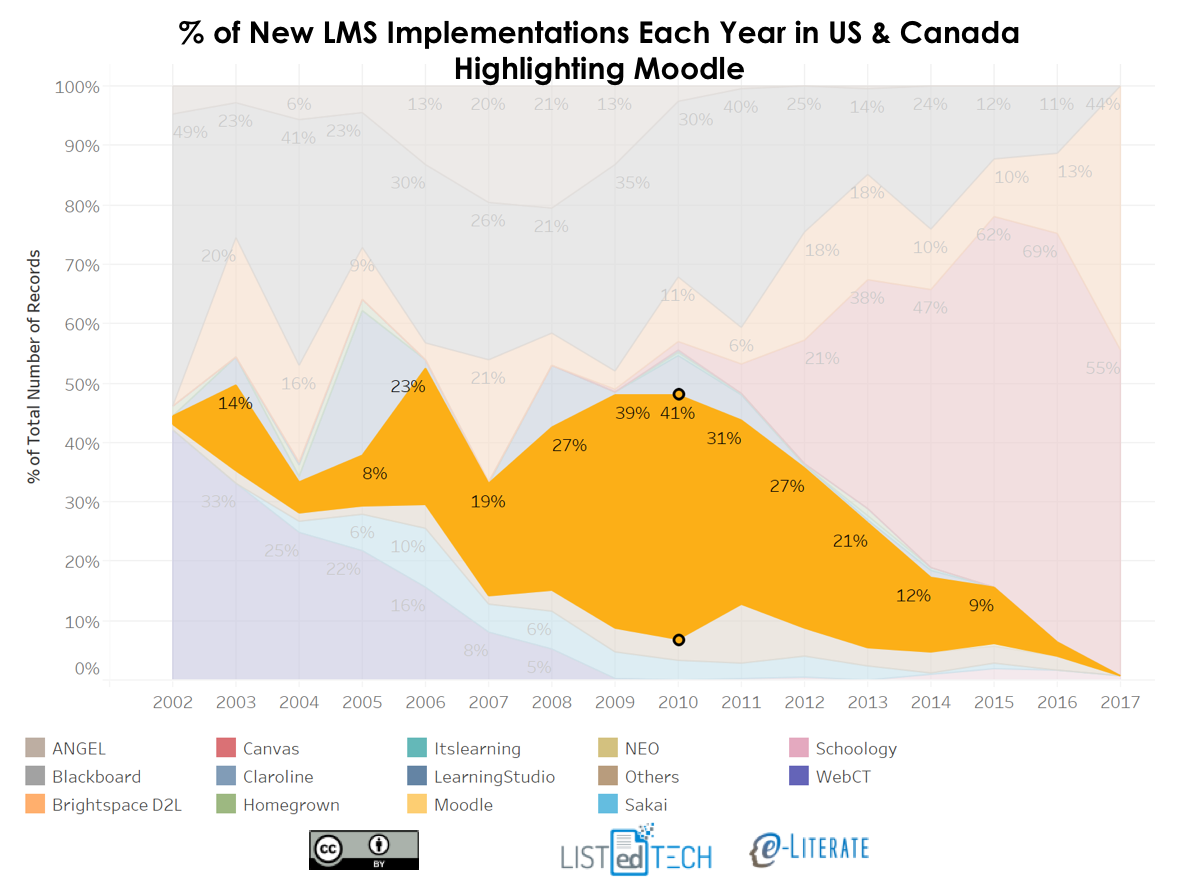
    Moodle NA

    Second, vocal elements of the Moodle community, including some in leadership positions, tend to be anti-vendor in general and anti-Blackboard in particular. Having a major US Moodlemoot fit inside a single (admittedly large) room at BbWorld had to be a hard pill to swallow. And Blackboard, for its part, did not always appear to execute well on supporting the moot. I found the Moodle session listings in the BbWorld app to be confusing. Nevertheless, there certainly seems to have been a major sea change at Blackboard regarding promoting Moodle in North America. Time will tell whether the increased efforts toward a more visible and cooperative relationship will bear fruit.

    The last announcement piece I’ll mention isn’t really new to BbWorld so much as it is new since last BbWorld. Blackboard was heavily promoting Ally, the content accessibility tool the company acquired within the last year. Interest appeared to be huge, with overflowing crowds at the sessions.

    So what does all this add up to? I’d say a few things:

    • CEO Bill Ballhaus must have succeeded in convincing the company’s private equity owners to allow him to invest in accelerating product development. There’s no other way all these announcements would have been possible. That’s definitely new and a positive leading indicator.
    • The company is thinking about ways to combine its portfolio of products (and services) to meet customer needs. That’s also new, and a differentiator.
    • Another differentiator is the level of sophistication that Blackboard is bringing to learning analytics, both in terms of the feature set and in terms of the conversations they are having with customers.
    • Both the announcements and the customer sentiment indicate that the company is getting better at both listening and executing based on what they’ve heard.
    • None of this changes the fact that Blackboard is still playing defense, but it does suggest that they may be playing better defense and preparing a strategy that will enable them to go on offense.

    Management Public and Private Presentations and Discussions

    This is the area where some of the most dramatic changes were visible. For starters, the marketing messaging in the keynote was by far the most subtle and sophisticated that I’ve ever seen from Blackboard. Two new taglines were introduced. The first one, “Simply Powerful,” wasn’t really new but rather a revival of the old ANGEL tagline. (I think I still may have that T-shirt, although I doubt I could squeeze into it anymore.) Back in the ANGEL days, the subtext was, “ANGEL is simpler than Blackboard, but it’s also powerful.” In today’s context, the subtext is flipped on its head: “Blackboard is more powerful than Canvas, but it’s also simple.”

    The other new tagline was “Your Partners in Change.” There’s a lot going on here. First, this line was projected up on the screen in huge letters as Bill Ballhaus talked about this year being the 20th anniversary of Blackboard. Also on the screen in the background was a picture of NASA’s Pathfinder spacecraft, which landed on Mars the same year that Blackboard was founded. Ballhaus is an aeronautical engineer by training, a fact that he made very plain in his schpiel. Part of the subtext was, “Yes, we’re Blackboard, but not that Blackboard. And I’m the CEO of Blackboard, but not that CEO.” “Partner” was as important as “change,” because it contrasted with the hubris of the last two CEOs. It also provided a cohesive identity for the company as one that provides an integrated portfolio of products and services that can help its customers respond to changing times.

    But the star of the keynote was not Bill Ballhaus but Blackboard’s Chief Strategy Officer, Katie Blot. Ballhaus acted as host and referred to himself as “chief client advocate,” but he quickly ceded the spotlight to Blot for the substance of the keynote.

    A side note: All of the top three LMS providers in terms of US and Canadian market share have powerful, competent women on their senior leadership teams. Phil mentioned D2L’s Cheryl Ainoa in his recent post. I have mentioned Instructure’s Misty Frost in the past. Like Ainoa and Frost, Katie Blot has a role at her company that is broader than her title suggests. It was good to see her get the spotlight.

    And she did not disappoint. Blot is not an ed tech industry careerist, having come to Blackboard from her previous gig working at the US Department of Education. She left behind former CEO Jay Bhatt’s absurdly grandiose claims that Blackboard would change the world single-handedly—”Your Partners in Change”—while maintaining upbeat energy. Her talk was substantive and thematic, punctuated by video interviews with various senior executives about specific product developments. It was not over the top, gross, or cringe-inducing in any way. In fact, it was…dare I say…quite good.

    Beyond that, the main themes I noticed were honesty and consistency. I’ve mentioned the former already and have more detail to add, but let me first address the latter. As we’ve mentioned in the past, one method we have for evaluating vendors at their conferences is asking a lot of different people the same questions and seeing if we get the same answers. This is a particularly critical litmus test for Blackboard given the mess it has to clean up regarding the confusion between it’s SaaS options and Ultra. I asked a lot of random Blackboard employees about how Ultra is going. Consistently, the answer I got was something like the following:

    Let’s back up and first talk about SaaS….

    [Tells a story about good progress with SaaS, adoption, often mentioning the bump they hit with earlier adopters in the process.]

    Now within that context, let’s talk about adoption of the Ultra experience.

    [Talks about how each customer has their own must-haves before they will even consider Ultra, how Blackboard has a prioritized punch list, and how they have dramatically increased the number of scrum teams working on it to make sure they can meet their commitments to work their way through that punch list in a reasonable time frame.]

    This is a pretty dramatic contrast to two years ago, or even a few months ago when Phil was at a Blackboard conference in Europe. So the company is definitely getting on the same page. Out in the field, we are not seeing the same consistency among the sales representatives during RFP presentations. When I brought this up with Bill Ballhaus, he acknowledged it without hesitation and went on to describe steps the company is taking to correct the problem. (There’s that honesty thing again.)

    There was also a return of Ray Henderson’s progress report card by both Phill Miller and Blackboard’s Chief Product Officer Tim Tomlinson. I believe it’s no coincidence that both of these men are former ANGEListas. There was something of a minor ANGEL take-under at Blackboard when Henderson was President and Chief Technical Officer there. That change stalled out under Bhatt but has apparently been revived under Ballhaus. Miller and Tomlinson have both been promoted, and the center of gravity for Learn development has moved to Indianapolis, the former home of ANGEL. Henderson’s public approach could be summed up as something like “make commitments, measure your progress, and tell the truth.” I saw many signs of a similar philosophy taking root in Ballhaus’s Blackboard.

    The last thing I’ll say—and this is probably the most subjective assessment of this post—is that the employees seemed, for lack of a better word, happy. Not forced, conference-host happy but normal people happy. I-love-my-work-and-like-my-colleagues happy. I have observed lots of folks working at organizations that are under stress or dysfunctional. I have seen them from the inside as well as from the outside of those organizations. There’s a vibe that’s unmistakable. The Blackboard folks I talked to didn’t seem to have that vibe.

    Bottom line: Blackboard’s adoption trend line is undeniably down and likely will continue in that direction for at least another 12 months (if you factor out the likely University of Phoenix implementation, which will skew the numbers). But early and subjective signs suggest a positive change in direction inside the company—possibly a rapid one—that may become more visible externally between now and this time next year.
  • LMS Revival: D2L picking up new customers and showing they can listen

    LMS Revival: D2L picking up new customers and showing they can listen

    D2L the company and Brightspace the company’s LMS are undergoing something of a revival in the past year. It’s not as if they have dropped in terms of market share – in fact the have a history of strong client retention, losing few customers – but the early 2010’s did not lead to rapid customer growth as they had expected after raising two rounds of a combined $165 million in 2012 and 2014. If you read that second post you’ll find that I stated that their growth claims “defied logic” at the time. Recently, however, D2L is on a roll, racking up significant client wins in higher education, and the company shows real signs of change and its ability to truly listen to and empathize with customers.

    As I sat down to write my analysis of the D2L Fusion users conference and what it meant to the Brightspace LMS, I noticed that several of the same themes I described last year applied to this year’s observations – just updated in terms of effect on customers and whether the changes seem to be sticking. To explain my current thoughts it is useful to start with commentary from last year.

    Update on Listening and Product Changes

    From last year’s post:

    As I have described to several executives at D2L, there is an interesting gap between the progress we have seen with the company’s product improvements and the reaction we hear from many of their customers. With the tighter integration with LeaP and the improved usability, particularly in content authoring, I would have expected to hear more customers react to the changes. But when talking directly to many of the institutions using the Brightspace LMS, staff describe D2L as if the company and product line had not changed in several years. What is not clear is whether this gap is due the company missing the mark (and my judgement of improvements not aligning with what colleges and universities want) or whether there is just a lag where it will take time for most customers to believe in and take advantage the new product designs and features.

    2016 has been an eventful year for D2L. [Chief Operating Officer] COO Cheryl Ainoa, a longtime veteran of Yahoo! and most recently Intuit, joined the company in April. Although this move was not advertised through press releases or even blog posts, I believe this is a significant change to how the company operates. [snip]

    And this gets back to the gap noted in the first paragraph. When I talk to people at schools migrating from D2L or considering whether to migrate, I do not hear much about the recent product changes or the new management described above. For several of these schools, the issue isn’t even whether they like or dislike the recent product and management changes, it’s as if these changes are a non issue in their decision-making. No conclusions yet, just noting the gap.

    What I noticed since last year are two updates to the above analysis.

    Listening – Besides adding a new COO, D2L has made several other executive-level hires in the product in the past two years, and to me it seems like we are seeing a new way of thinking largely caused by this new group. The interviews with executives were much more consistent than in past years, and there is a new focus on actively listening to customers. It’s not that D2L didn’t have conversations before; it’s more that they didn’t know how to truly listen and empathize.Part of this change according to D2L exec interviews was that in the past it was easier to talk to CIOs, but now they are learning how to talk to faculty and end users. All interviewees seemed to be singing from the same hymnbook. For the most part.

    Narrow but Excellent – The product focus is less on big-news features and more on small-news everyday items. In the past D2L has seemed too interested in being able to do some chest-thumping “We’ve got CBE. We’ve got Predictive Analytics. We’ve got Adaptive Learning.” while missing something on what current and even prospective customers need in their daily lives. The new focus is more on taking the drudgery out of end-user activities with a mantra of “narrow but excellent”. They are trying to fall in love with problem solving more than in features, even if these problems can be non-sexy.

    One example from the Fusion users conference was making it easier to shuffle questions within a quiz. Sounds trivial, but Canius College staff have a description that captures the essence of the change. Yes, you could have done this before, but it was a chore. Now it’s much easier to the point that more people will want to use it.

    Later this month, D2L will introduce a nice feature for Canisius faculty who use their online quiz/exam tool. D2L’s quiz engine has powerful features for randomizing question order in a quiz or exam, and can even deliver a subset of questions at random from larger question banks. This is nice, but until now it was a bit of a chore if you only wanted to randomize delivery of, say, five to ten questions, since you needed to install those questions in the question library, and then import them into a random section within the quiz. Along the way, there were a lot of clicks and the process wasn’t always so intuitive. With the update coming late July, D2L has installed a checkbox feature within the quiz editor: “Shuffle order of questions at the quiz level.” Simply add your questions directly in the quiz, click that box, and the quiz will deliver those questions in a random order to each student.

    The Brightspace product demonstrations during the conference keynote got significant spontaneous reactions from crowd (along with hallway discussions) likely reflecting this improved ability to listen
    to customers. And the improvement to quiz question shuffling led to one of the biggest reactions.

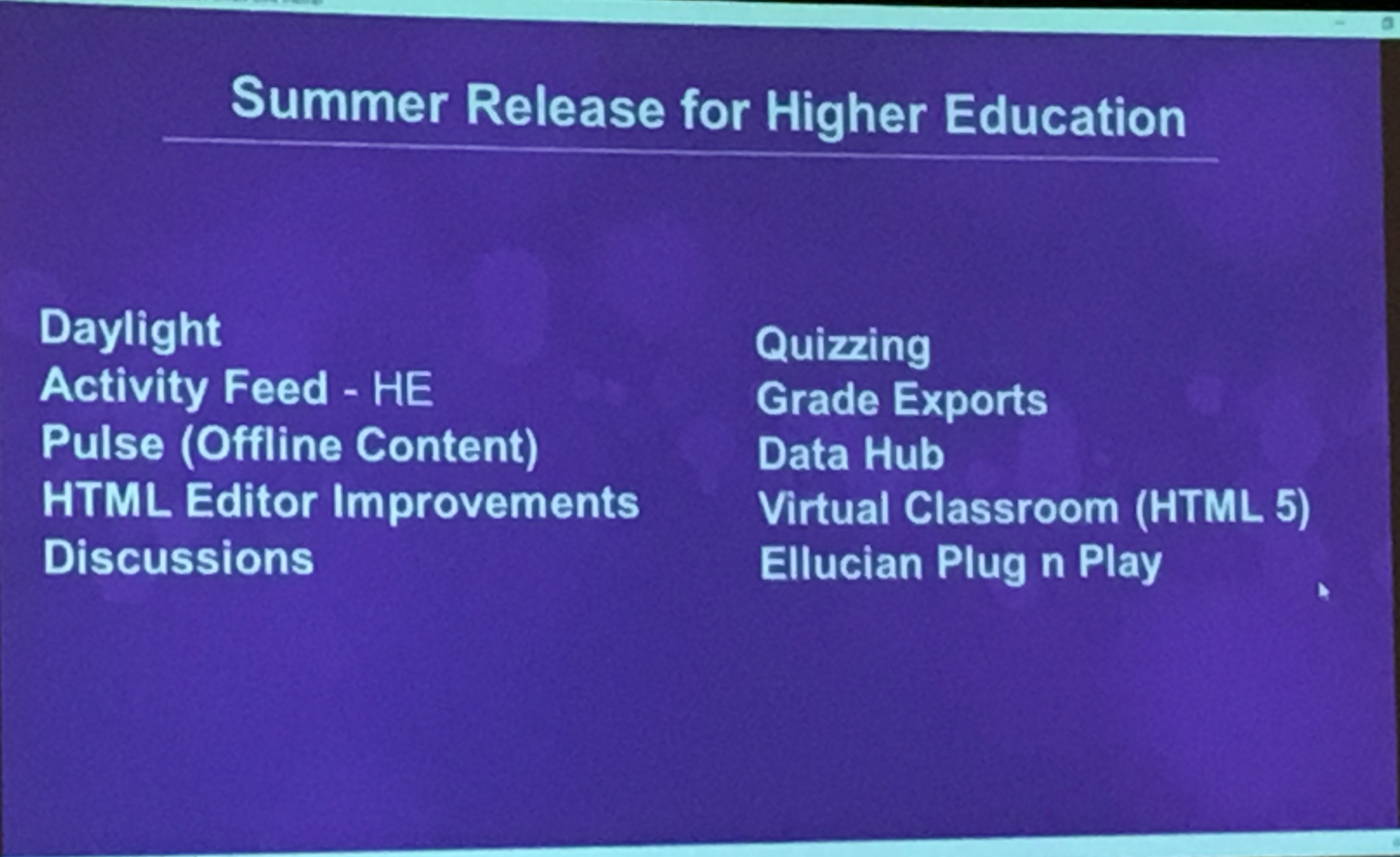
    Here are the major product announcements / new functionality as of this summer:

    Another product change worth noting is the new Data Hub. This is a re-architecture of how data can be exported to allow bulk access to data, either manual or through application program interfaces (APIs). The announcement is significant as we have noted in the past that D2L has had challenges getting data reliably and quickly to customers. Data export is not an easy problem to solve due to the complex technical challenges involved in analytics, and D2L had its share of customer challenges several years ago. However, we heard from at least one customer with early access to the Data Hub that their situation is improving. Sounds trivial, but this could be significant. We will have to keep a close watch on this development.

    Update on Market Share

    In last year’s post I noted:

    On the sales front, D2L has experienced somewhat slow but steady growth in new US / Canadian higher education clients as seen below, but they have not had the big-name wins of the caliber of UMUC, Tennessee Board of Regents, University System of Georgia, as they had 2013 and earlier.

    They had won Kaplan University as of last year, but since then they’ve also won with EDMC, Saint Leo University, University of Cardiff, University of Ottawa, Bournemouth University, and most recently Southern New Hampshire University (SNHU), among others. In other words, over the past 12 months D2L has won several big-name accounts in higher education. ((Disclosure: I advised UMUC during their strategy and evaluation process in 2011-2012. Bournemouth, SNHU, and D2L are subscribers to our LMS market analysis service.))

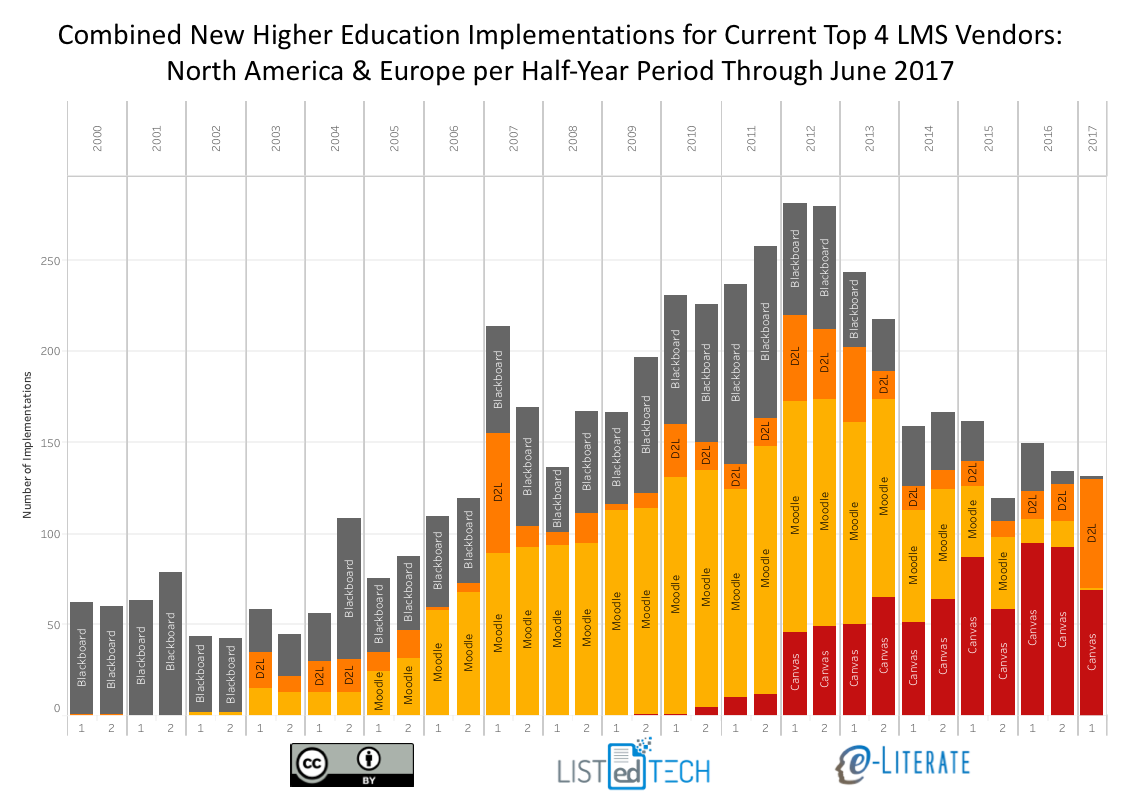
    The net effect has been a dramatic uptick in the percentage of new implementations (schools switching from another LMS to a new one) for D2L. The following chart looks at new implementations in North America (US and Canada) and Europe highlighting the top four academic LMS solutions (Blackboard, Moodle, Canvas, D2L) in half-year increments, with a remarkable spike in D2L’s activities in the past 12 months.

    This data aligns with our anecdotal conversations where, more often than not, there seems to be a pattern of new implementations going to Canvas or D2L – an emerging two-horse race for new implementations.

    Part of the reason for the recent acceleration and for the unknown future is the fact that quite a few of D2L’s wins for Brightspace have been large systems (single decision affecting multiple campuses, e.g. Kaplan University) or large enrollment single institutions (e.g. SNHU). And many of these are for schools with large, centrally-managed online operations. The large systems have benefitted from the Pearson LearningStudio (aka eCollege) end-of-life forcing many for-profit systems to change LMS, with that activity mostly running its course by the end of this calendar year. Big wins, but quite dependent on a small number of deals.

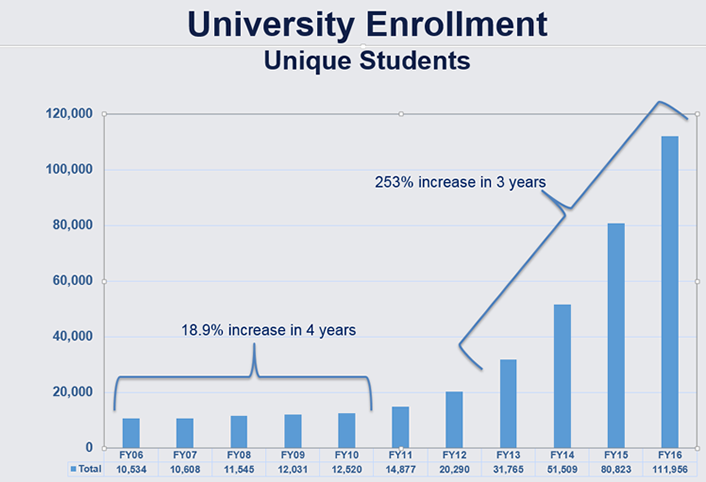
    The recent win at SNHU is very important to understand, however. It is not driven by end-of-life (SNHU moving off of Blackboard Learn in a voluntary migration), and this comes from a long-time Blackboard customer. Quite often people equate SNHU with its College for America (CfA), one of the leading competency-based education (CBE) programs in the country. But SNHU is much bigger than CfA, and it is the fastest-growing university in North America overall. According to an article last year in EDUCAUSE Review, SNHU’s online enrollment has grown at 253% per year over the past several years.

    It certainly seems probable that this increase in market wins is related to the change in how D2L listens to customers and the resultant change in emphasis from big-news capabilities towards smaller-news but customer-pleasing improvements to everyday functionality. It is important that Brightspace has such a deep feature set, but have the company understand customer everyday needs is more important.

    What we do know is that D2L has increased its number of higher education wins over the past 12 months. What we don’t know is whether and how strongly this trend will continue.

    Update on Conference Attendance

    This was the first on-site Fusion visit we’ve had in a couple of years, leading to the title and commentary in last year’s post “Changes at D2L: A second-hand view from users conference”:

    The reason I titled this post as a second-hand view is that D2L is the only major LMS provider (and I include Moodle and Sakai here) that discouraged our participation in their users conference (and we did not attend), citing concerns over direct conversations with attendees without getting their permission first. Other providers are happy to allow and even encourage this type of interaction. In the nature of full disclosure, we think it is important for the reader to understand this difference in access.

    Michael and I value the ability to not just hear official presentations and get in-depth demos, but to also go, roam, and talk to customers.

    True to their word, D2L management have changed their approach on how analysts can be involved in their conference. This year we were invited to attend (along with others), and more importantly, we were allowed to freely talk to the users and prospective users at the conference. I even had several people from D2L pass me in the hallway and ask if I was getting the access to customers that I needed. I did.

    This change aligns with the aforementioned improvements and focus on how D2L as a company listens to customers. Less control and more desire to learn (sorry, couldn’t help myself). A welcome change.

    Open Questions

    While most of what we’ve seen in the market and at the conference has been an improvement over the past few years, it is important to understand the tall order of the changes being made.

    Learning to listen, especially to end users, really represents a cultural change, and these changes are not easy. They take a lot of management time and energy to implement, and they take patience. Will these changes take hold and further permeate the organization? Certainly we’re seeing results over the past 12 months, but companies have plenty of pressures to fall back into old habits.

    In terms of market positioning, the competition is not standing still. We’re also seeing improvements coming from Blackboard’s change in executive team, and we’re seeing Instructure to continue their strong improvements to Canvas and their support. New entrants like Schoology and older solutions like Moodle are also improving, albeit more slowly than the big commercial vendors. Further complicating the matter, a lot of D2L’s new business came from a handful of large decisions. Will D2L’s market momentum of new implementations continue, particularly in North America and Europe? I expect we’ll learn a lot when we look at the data at the end of this calendar year.

  • Google Classroom: Isolated adoptions for higher education institutions

    At last month’s Future Trends Forum hosted by Bryan Alexander, I received several questions around the intersection of K-12 and higher education markets for learning platforms. A condensed version of my answer is that the mainline LMS vendors are seeing increased overlap (Canvas, D2L Brightspace, Blackboard, Moodle, and Schoology in particular), but that there was little overlap when it comes to the teacher-oriented Big Classrooms (Google and Facebook).

    Three years ago when the buzz over Google Classroom was at its peak, I wrote several posts looking at the platform, ultimately concluding in the post titled “Why Google Classroom won’t affect institutional LMS market … yet”:

    None of this argues that Google Classroom is an inferior tool – it is just not designed to replace the full-featured LMS. Remember that Google is a technology-vision company that is comfortable putting out new tools before they understand how the tools will be used. Google is also comfortable playing the long game, getting more and more instructors and faculty using, giving feedback, and pushing forward the new toolset. This process will take some time to play out – at least 2 or 3 years in my opinion before a full institutional LMS may be available. If Google like the direction Classroom usage is going.

    Subsequently, Google has addressed some of the gaps in the product, including a programming interface that could allow deeper integration with student record systems used at higher ed institutions.

    We’re now 3 years down the road from the initial analysis – has Google Classroom started to be adopted as a full institutional LMS?

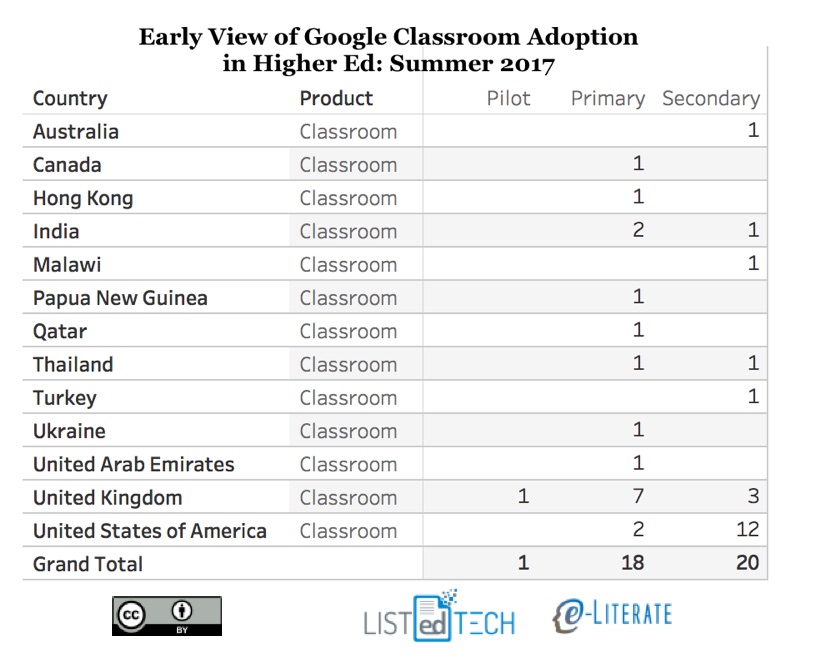
    Our partners at LISTedTECH have performed an initial analysis on this question. We do not yet have full data coverage in the same fashion as our LMS market analysis, but this early view should give some insight into higher ed adoption of the platform.

    For this initial view, we are looking at institutional adoption. Where a school supports Google Classroom as their primary or secondary system. There are plenty of other cases where individual faculty choose to use the platform in an unsupported manner.

    Notes from initial view:

    • A lot of the interest seems to come from developing countries where the education budgets are quite low. Malawi, Papau New Guinea, etc.
    • For the United Kingdom, the number is artificially high as 5 of the institutions are all part of Warwickshire College Group (a collection of Further Education colleges). Nevertheless, the UK has the higher number (so far) of institutional adoptions.
    • The usage of Google Classroom as a secondary system makes sense – an alternative platform that doesn’t have all the features and integrations typically needed for primary system usage – but there are cases now of primary usage.
    • In the US, the most notable adoption is the California University of Management and Sciences, a Student and Exchange Visitor Program (SEVP)–certified institution in Anaheim. They support both Moodle and Google Classroom for primary LMS usage.
    • While we don’t have comprehensive coverage yet, it appears that there are some isolated cases of Google Classroom institutional adoption in higher education. The platform is still not a true LMS competitor, but we’ll keep watching.
  • Academic LMS Market Share By Enrollments, Part Deux

    Academic LMS Market Share By Enrollments, Part Deux

    Based on our recent publication of market share data and graphics, we have had multiple requests to share similar data by enrollment. In Friday’s post I shared a non-traditional view of the LMS market based on the percentage of institutions within small, medium, and large enrollment bands for North America (US and Canada) and Europe. This view gave some interesting insights, particularly with large positive correlation (Canvas) and negative correlation (Moodle)  between enrollment bands and market share in North America. Meanwhile, there were other LMS solutions (D2L and Sakai in particular) that have fairly consistent distribution in market share.

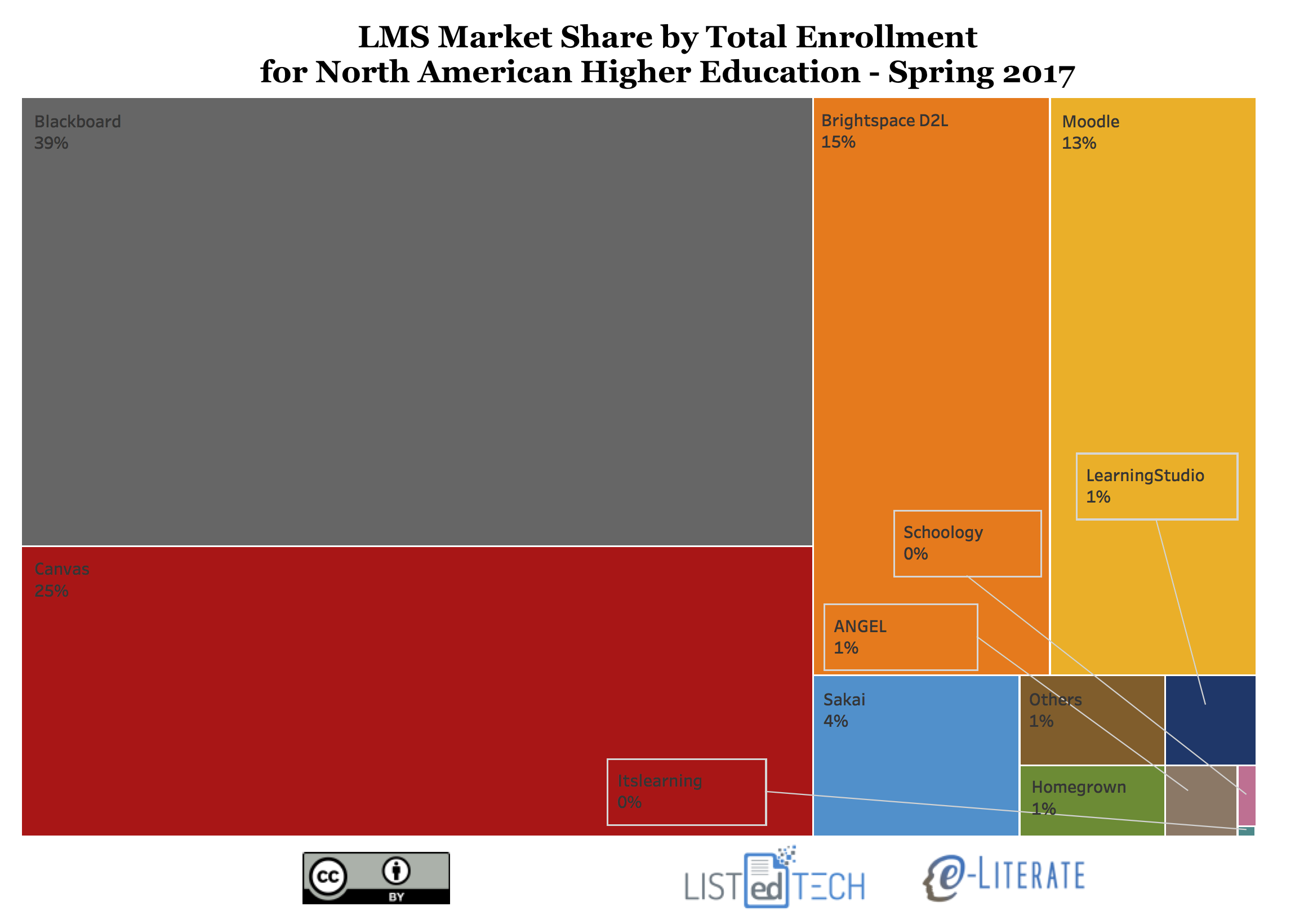
    For this second view, instead of showing percentage of institutions within each enrollment band, the data is aggregated for all North American institutions and scaled by each institution’s official enrollment data (e.g. the US data is from IPEDS). The net result shows the percentage of enrollments across the region that have different LMS solutions as their primary system at their school. As always, the underlying data for these market share studies is provided by our partner LISTedTECH.

    Some Notes:

    • For North American Higher Education, Blackboard Learn at 39% is still in first place, Canvas is second at 25%, D2L Brightspace is third at 15%, Moodle is fourth at 13%, and Sakai is fifth at 4%.
    • It has been widely reported when just looking at percentages of institutions that Moodle has long been the second most-used system in North America, but in this view both Canvas and D2L Brightspace have a larger market share.

    It is useful to look at different views using institutional and enrollment metrics to get a deeper understanding of the academic LMS market dynamics.

  • Academic LMS Market Share By Enrollments, Part I

    Since the earliest days of Campus Computing and EDUCAUSE measurement of LMS market data up through recent analysis by Edutechnica and LISTedTECH (the latter our partners for the LMS market analysis service and data behind our LMS graphics), the most common measurement used has been “number of institutions adopting system X as their primary LMS”. But that is only one view, and like any view it has limitations. Sweet Briar College with 900 students is treated with the same metric as Ohio State University with 55,000. I’m sorry, The Ohio State University.

    Based on our recent publication of market share data and graphics, we have had multiple requests to share similar data by enrollment. Both Edutechnica and LISTedTECH have provided such views here and there in the past, but given our recent analysis expansion along with LISTedTECH to cover non-North American regions, we thought it would be worth sharing LMS market data based on enrollments.

    What we cannot do is look at how many students actually use the LMS. But for North America (US and Canada in this case) and Europe, we have sufficient coverage of official enrollment figures that we can scale each institution by its enrollment data. This is how most LMS companies determine their prices for each school, so it is a much better measurement to correlate with market revenues. Not a perfect measure, but a better one.

    In addition, this view gives additional insights into the market and likely future direction of the LMS providers.

    Hey Phil, will you just get to the damn graphics? Let us judge the importance.

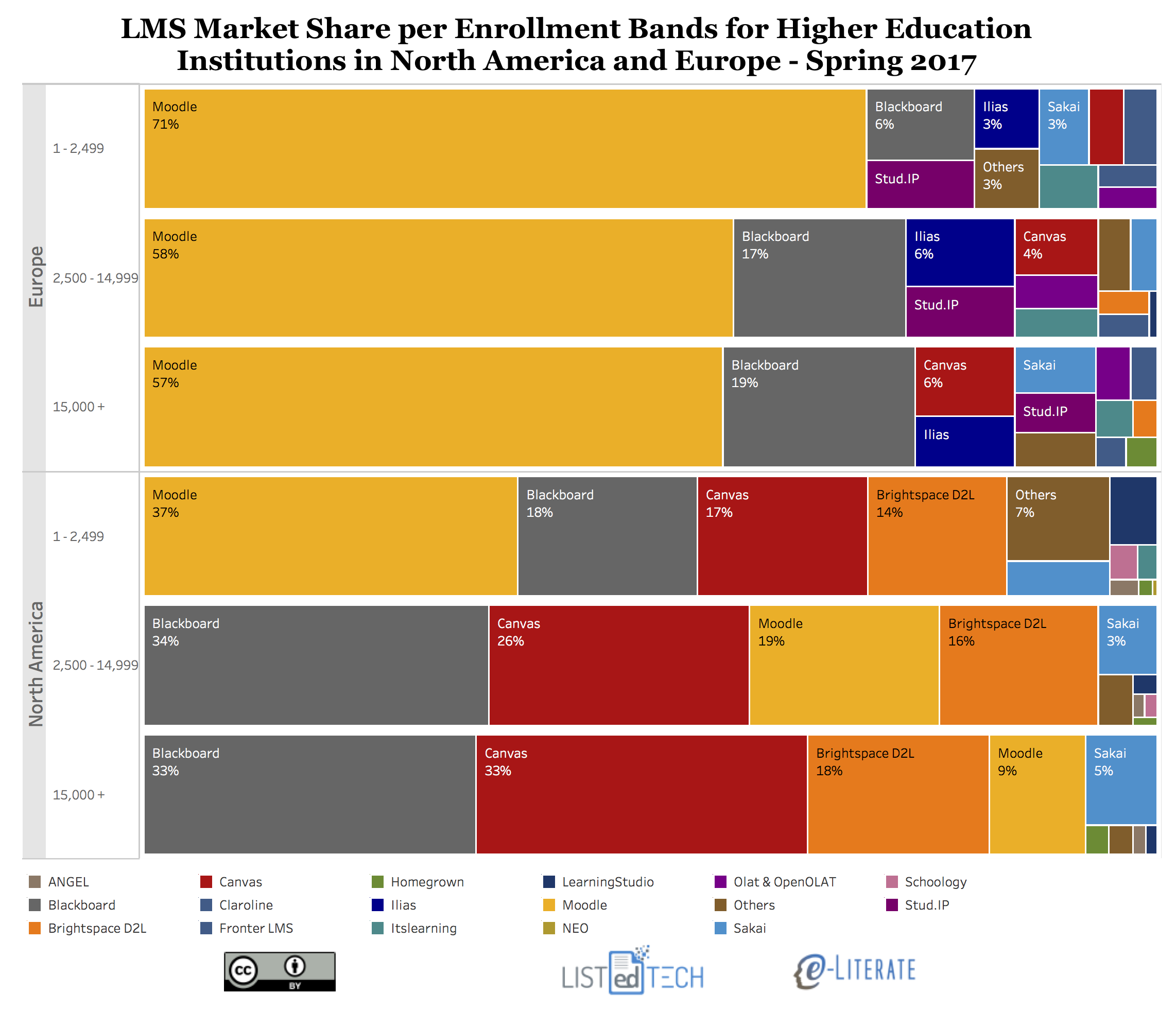
    OK, OK – for our first view, we group all institutions into separate bands of total enrollment and show market share for each band for each region (North America and Europe). Percentage of institutions adopting each LMS within each enrollment band of Small (1 – 2,499), Medium (2,500 – 14,999) and Large (15,000+) enrollments. Update: Clarified language.

    Some Notes:

    • The LMS with the greatest enrollment variation is Moodle, particularly in North America. For small schools below 2,500 students, Moodle is #1 at 37%, but for medium schools it’s #3 at 19% and for large it’s #4 at 9%. A huge difference. In Europe, Moodle market share also inversely correlates with enrollment but to a far smaller degree (71%, 58%, 57%) and it is still #1 in all bands.
    • Blackboard Learn and Canvas vary in North America the opposite direction – larger enrollment sizes equals larger market share – but not quite as dramatically as Moodle’s inverse relationship. Blackboard is #1 with roughly 33% market share for both large and medium institutions but is #2 with 18% for small institutions. Canvas goes from 33% for large to 26% for medium to 17% for small institutions. And note that Canvas and Blackboard Learn are virtually tied for first place for large institutions in North America.
    • D2L Brightspace has the most even distribution, with 18% of large, 16% of medium, and 14% of small institutions. That’s interesting.
    • In Europe, the overall distributions are more consistent with less variation between enrollment bands. While Moodle has smaller market share for larger enrollment bands, the general shape of the market does not change that much – just scaled a bit and with minor variations.
    • In what might be a surprise given its roots in larger research universities, Sakai (like D2L) has a fairly even distribution and similar market share across small, medium and large institutional bands.

    Coming soon – combining data not in enrollment bands but as scaled by each institution’s enrollment numbers.

    Update: See second post here.

  • Follow-Up From Future Trends Forum Discussion On Learning Platforms

    Follow-Up From Future Trends Forum Discussion On Learning Platforms

    Last Thursday I participated in a Future Trends Forum, hosted on the Shindig platform, with host Bryan Alexander on the topic of “What’s next with the LMS?”. I have to admit this was one of the best virtual discussions I’ve had, and more than half of the session was driven by audience questions. You can check out the Twitter discussion, Storified , or listen to an audio recording of the whole session, thanks to Roxanne Riskin. Update: See YouTube video of event posted at end.

    As Bryan described in his blog post:

    Yet maybe the conversation won’t stop there, at 3:05 pm EDT on June 29th. Because when we broke we had more than thirty (!) unanswered questions remaining from the Forum community. I’d like to share those now, so that Phil can respond, but also so that anyone can dive in, whether or not you participated yesterday.

    I don’t have enough time to address all the of the questions, but I would like to tackle a few. We’re also talking about having a part 2 and bringing in Michael in late August. In the meantime . . .

    • Competitiveness – Is the lack of competitiveness due to a lack of innovation or because IT decision makers are looking for consistency/ease of support?

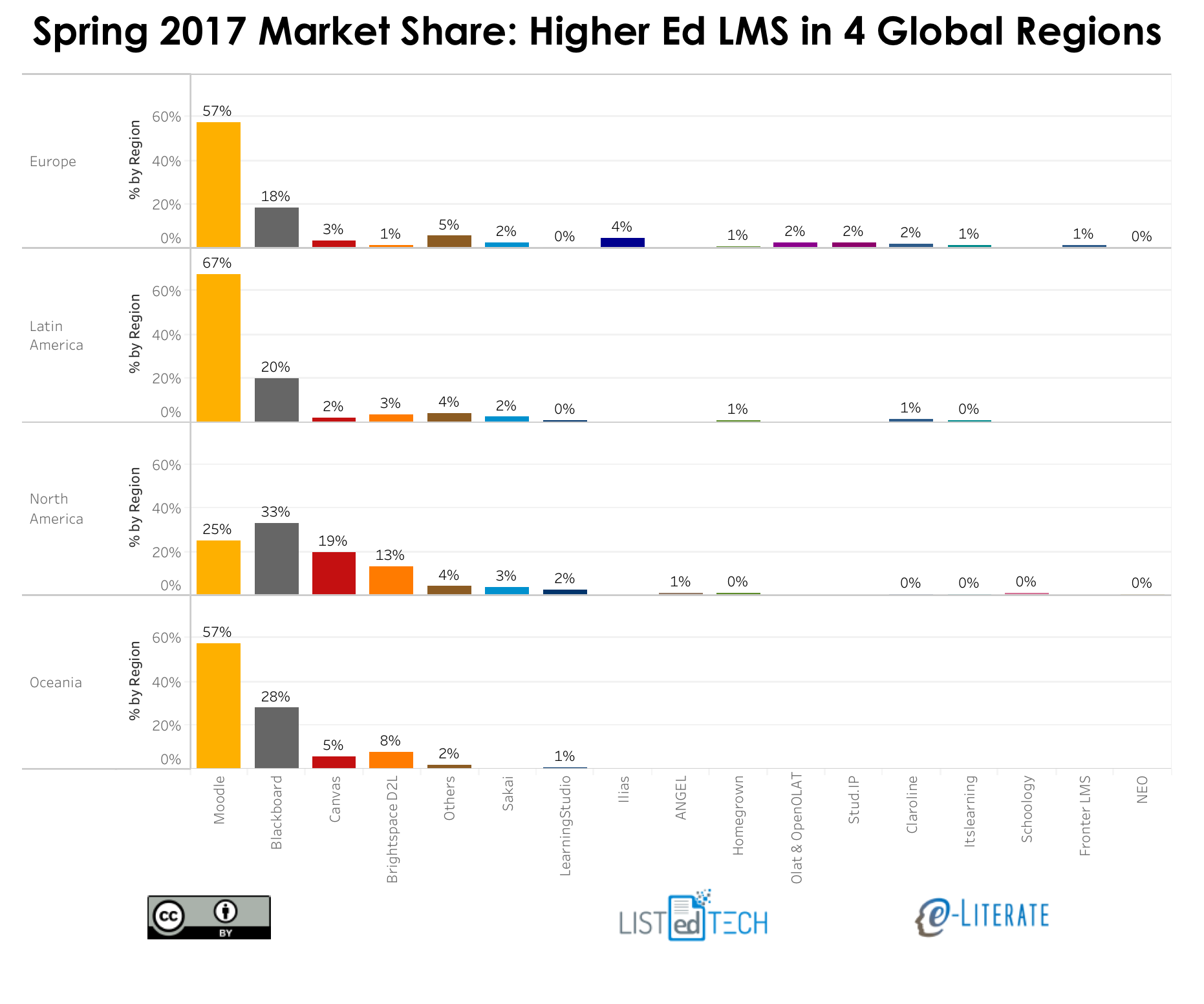
    This question refers to the point I made in this blog post that in four global regions we have two companies dominating the installed base (Moodle, Blackboard), one dominating new implementations (Canvas) with one gaining recent momentum (D2L Brightspace). That’s four solutions dominating across the globe for higher education, hence the “lack of competitiveness” in the question.

    While I think the market needs more innovation, I don’t think that’s the primary cause of this emerging four-way oligopoly. One issue more important than pure innovation is that ed tech is a difficult market in terms of scaling a business, and it is difficult to remain profitable. Canvas is growing fastest, and Instructure (parent company) plans to be cash-flow positive in 2018. As in, Instructure is not profitable yet. Just two years ago Moody’s changed their outlook on Blackboard to negative due to very high debt to EBITDA ratios and “stagnating revenues”.  We have little public information on D2L, but I have pointed out company layoffs occurring after the large investment rounds. Moodle is open source and not directly a system with profits. This comes at a time when the expectations for competitive LMS offerings is rising in terms of cloud hosting and interoperability and intuitive user experience. This is not an easy business.

    • What are your thoughts about competency-based education (CBE)? In particular, with Elliucian leaving the space, do you see a market for a CBE-targeted LMS? And, which products do you see as leaders? or potential leaders?
    • CBE – You’ve brought up CBE a few times. Do you feel there is slower than expected growth for colleges/univ for CBE. Hence, the sun setting of Ellucian’s platform. Or, perhaps, are they force fitting the current LMS to be their CBE LMS?

    See this post describing the very slow growth of CBE platforms. If you think the institutional LMS market is difficult, try the CBE platform market. We do not have the same level of market data for CBE as we do for LMS, but anecdotally I believe that Sagence Learning (formerly FlatWorld) has won the greatest number of CBEN platform selections in the past year or two.

    • Have you seen any trends in terms of schools with more than one LMS – are places consolidating or fracturing? (always surprised by number of institutions that have more than one)

    There is a general, low-level trend in higher education to have fewer cases of secondary LMS usage. Mostly consolidating while aiming to increase the number of third-party apps working alongside the primary system.

    • hosted vs. not hosted – For those LMSs that aren’t open source, do you have any thoughts on how institutions are managing systems – are they choosing to host themselves or are they choosing to use vendor hosting (or other options)?

    In all four global regions we have covered (North America, Europe, Latin America, Oceania), there is a move towards managed and cloud hosting and away from self-hosting. In North America, more than 90% of new LMS selections are going straight to managed or cloud hosting. Europe trends the same direction but is roughly 50 / 50 for new implementations. And I should point out that these trends exist for open source solutions – maybe not to the same level, but in the same direction.

    • K-12 – following up on Schoology and google classroom, what force is K-12 going to be in the future of higher ed LMS? can the teaching energy and innovation of K-12 energize higher ed teaching…?

    I have written several posts on Google Classroom, although I need to do an update. The general answer is that neither Google Classroom or Facebook Classroom show significant signs of affecting the higher ed market. There is some interest in both platforms, but mostly from a small number of individual faculty. And neither platform is designed to solve the gradebook or system integration needs of higher ed. Yet.

    We have several posts on Schoology, which has a bigger potential impact on higher ed for a K-12 based system.

    • Finally, we partially discussed a set of question from Fred Beshears, summarized in this new post. The general topic is around CBE platforms and whether LMS systems are moving to support “massive student information profiles” (across courses for large numbers of students) or whether this is being relegated to student record systems. We partially address these questions in the Future Trends Forum, but not entirely. Hopefully we’ll see others jumping into the online discussion. Update: See discussion thread at Bryan’s post for discussion on this topic.
    • (Update: Finally, finally) I answered two questions in the session about the potential of the LMS as an integration hub, bringing in third-party apps rather than being monolithic systems. The answers were admittedly aspirational. George Station made a good point on Twitter that there is another side to the LMS impact on pedagogy:

    I do agree that this has happened, as covered further in replies to that tweet.

  • Academic LMS Market Share: A view across four global regions

    Academic LMS Market Share: A view across four global regions

    In much of our coverage of the LMS market as well as media stories, there is a natural tendency to focus on change. Institution x abandons LMS y and adopts LMS z. In our recent post on Moodle, I described the trajectory of Moodle, noting that “the data seem to indicate a collapse of Moodle selections in the US and Canada, and potentially a significant slow-down in other regions”.

    But we need to be careful to not lose perspective and miss the installed base of LMS customers. While there has market share information for US higher ed available for years, we can now share the broadest description of LMS market share in higher education. The view below, originally shared with subscribers to our LMS market analysis service, shows market share as the percentage of primary systems at degree-granting institutions for each of four global regions: North America (US and Canada), Europe, Latin America, and Oceania (Australia, New Zealand and surrounding island countries).

    (more…)