
e-Literate

Present is Prologue

Category: Ed Tech

The “Ed Tech” category includes posts about educational technology products themselves, including LMSs and other learning platforms, adaptive learning and other digital curricular materials products, learning analytics, and educational apps of all types. It also includes technical aspects of ed tech products, especially interoperability.

  • State of Higher Ed LMS Market for US and Canada: Spring 2016 Edition

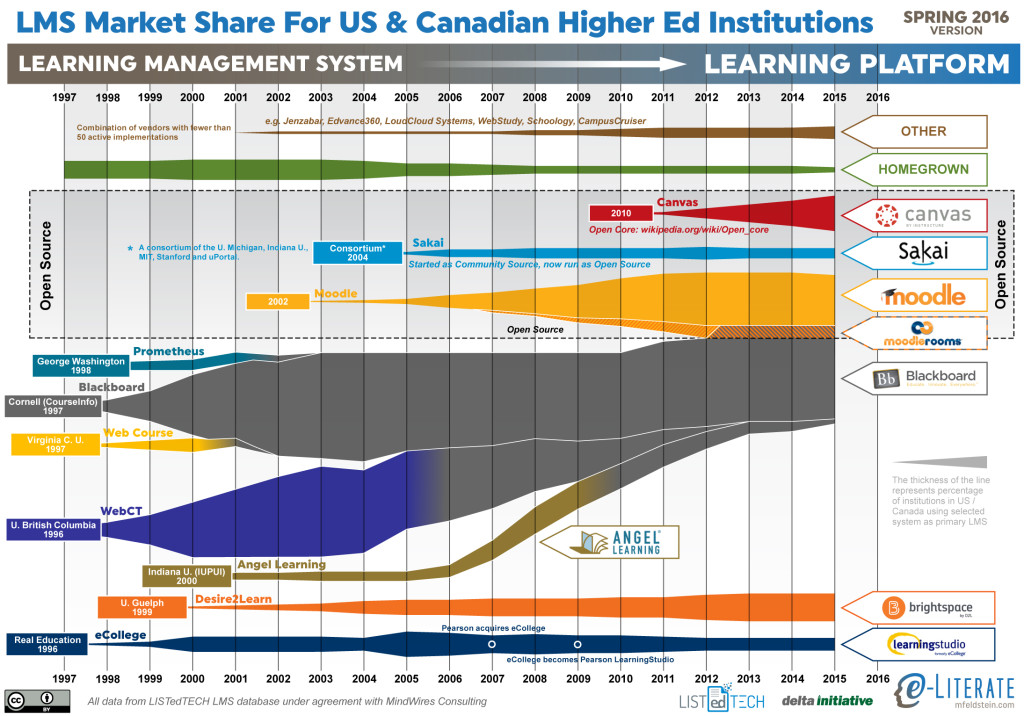
    This is the eighth year I have shared the LMS market share graphic, commonly known as the squid graphic, for (mostly) US higher education. The original idea remains – to give a picture of the LMS market in one page, highlighting the story of the market over time. The key to the graphic is that the width of each band represents the percentage of institutions using a particular LMS as its primary system.

    This year marks a significant change based on our upcoming LMS subscription service. We are working with LISTedTECH to provide market data and visualizations. This data source provides historical and current measures of institutional adoptions, allowing new insights into how the market has worked and current trends. This current graphic gets all of its data from LISTedTECH. Where previous versions of the graphic used an anchoring technique, combining data from different sources in different years, with interpolation where the data was unavailable. Now, every year’s data is based on this single data source.

    This graphic has been in the public domain for years, however, and we think it best to keep it that way. In this way we hope that the new service will provide valuable insight for subscribers but also improve what we continue to share here on the e-Literate blog.

    Since we have data over time now and not just snapshots, we have picked the end of each year for that data. For this reason, the data goes through the end of 2015. We have 2016 data but chose not to share partial-year results in an effort to avoid confusion.
    LMS_MarketShare_20160316

    A few items to note:

    • As noted in previous years, the fastest-growing LMS is Canvas. There is no other solution close in terms of matching the Canvas growth.
    • Blackboard continues to lose market share, although the vast majority of that reduction over the past two years has been from customers leaving ANGEL. Blackboard Learn lost only a handful of clients in the past year.
    • While the end-of-life occurs next year, Pearson’s has announced LearningStudio’s end-of-life for the end of 2017.
    • With the new data set, the rapid rise and market strength of WebCT becomes much more apparent than previous graphics.
    • There is a growing line for “Other”, capturing the growth of those systems with less than 50 active implementations as primary systems; systems like Jenzabar, Edvance360, LoudCloud Systems, WebStudy, Schoology, and CampusCruiser.
    • While we continue to show Canvas in the Open Source area, we have noted a more precise description as an Open Core model.

    For a better description of the upcoming LMS subscription service, read this post and / or sign up for more information here.
  • Signup For More Information On LMS Subscription Service

    As we roll out our upcoming LMS subscription service here at e-Literate (see Michael’s post for initial description), we suspect that many of the e-Literate readers will be interested, but not all. We value the community here at e-Literate and want to ensure that the blog site itself remains as it’s always been – ad free, uncluttered, and with the same rough amount and breadth of content and discussions.

    To help maintain the blog site’s feel, we have created a second email subscription for those people who would like more information on the LMS subscription service – when it’s going to be available, what the reports will look like, summaries of LMS analysis from the report and curated from the blog site, etc. You should see this new signup on the top of the right column in the desktop view, right under the signup for e-Literate posts. We will also include the form within posts that are relevant to analysis of the LMS market.

    We are not going to automatically add current e-Literate subscribers to this new list, so if you’re interested in learning more on the service and getting content updates, sign up for the new subscription at this link.

    Update: I apologize for any confusion as we test the signup button. The fields embedded in the post were not working in all cases, so we have replaced with a link to a web signup page. Thank you for your patience as we fix any remaining issues.

  • The First e-Literate Subscription Product

    Not too long ago, Phil and I wrote a post about our long, slow process of realization that our blogging at e-Literate and our consulting at MindWires are not two mostly unrelated things but really two halves of a whole. And we teased the idea that these two worlds would be coming together soon.

    Today we’re ready to pull back the curtain a little bit on what we’ve been working on for the short term and offer some hints about what we’re thinking about for the medium term. We have some fairly audacious ambitions for the long term, but we don’t expect to get there overnight. In fact, we are going to start with a humble and somewhat unlikely (but hopefully useful) first paid subscription offering, which we will be making available in just a couple of weeks under the e-Literate brand. It will provide information and analysis above and beyond our continuing free content here on the blog (to which we remain strongly committed).

    We’re going to be releasing an LMS market dynamics report, in partnership with LISTedTECH. We’d like to explain why we’re starting there, what we hope the report will accomplish, and where we will go from there.

    (more…)

  • The Odd Couple: How Ed Tech Must Support Vastly Different Types of Professors

    An edited version of this post was first published at The Chronicle of Higher Education

    Let’s admit it, there can be some real tension when a college is faced with choosing a new learning-management system, or any software used by more than one department.

    Since the decision involves the administrators who will support the system — commonly called an LMS — and professors who will use it, who should lead the process? Should staff members just get input from faculty members, or should professors vote on the final decision? Or should professors run the process?

    This is when distrust between the two sides can emerge. IT administrators may fear that professors will make the pace unbearably slow with an overly deliberative approach. And professors may assume that IT has already determined what system to buy, and may not take their input seriously. Or they may worry that the meetings will be dominated by those needy power users from the psychology department.

    (more…)

  • Personalized Learning vs. Adaptive Learning

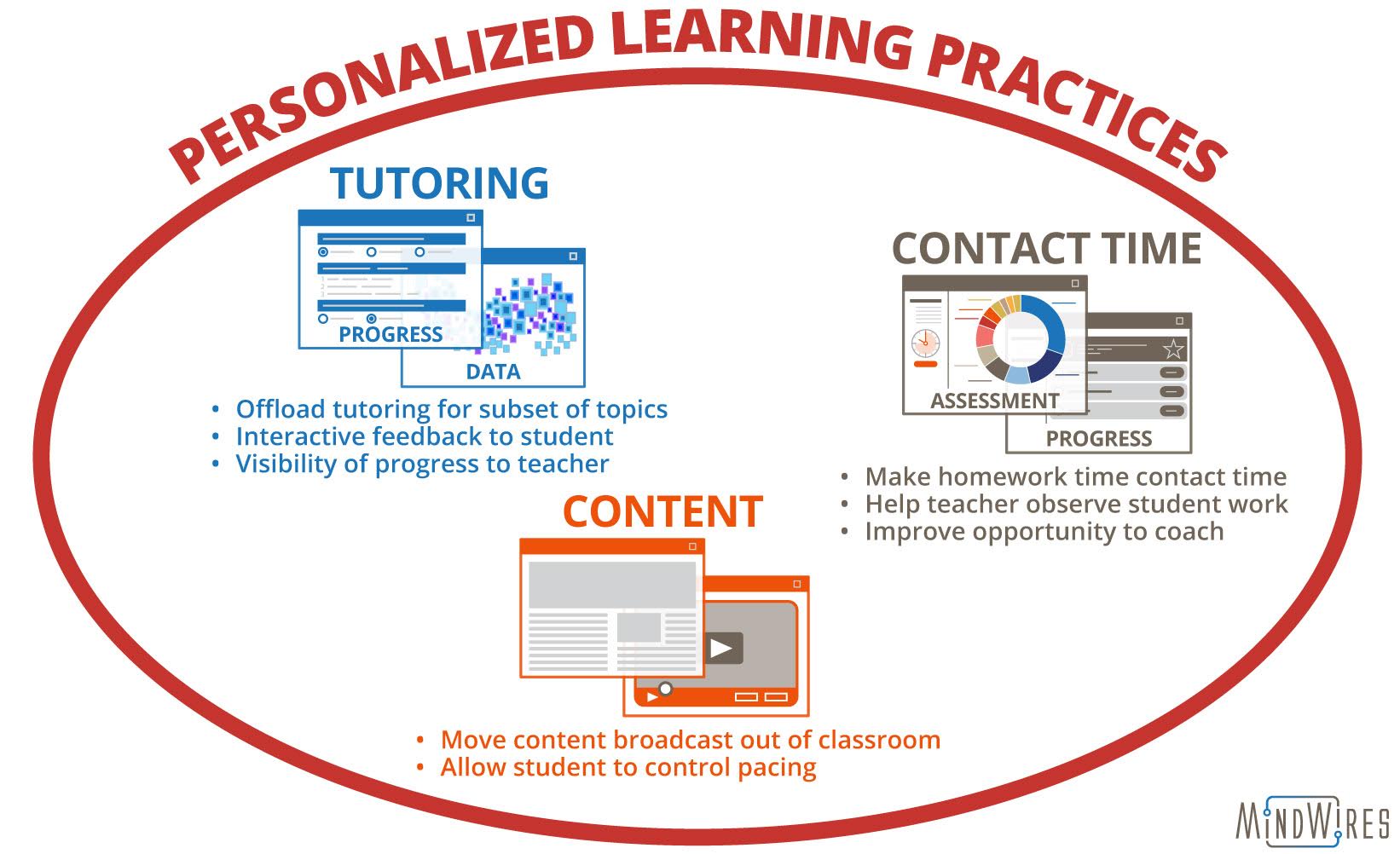
    In our recent EDUCAUSE Review article, Phil and I defined personalized learning as a set of technology-supported practices that help undepersonalize teaching. The three general practices that we identified are as follows:

    1. Moving content broadcast out of the classroom: Even in relatively small classes, a lot of class time can be taken up with content broadcast such as lectures and announcements. Personalized learning strategies often try to move as much broadcast out of class time as possible in order to make room for more conversation. This strategy is sometimes called “flipping” because it is commonly accomplished by having the teacher record the lectures they would normally give in class and assign the lecture videos as homework, but it can be accomplished in other ways as well, for example with reading-based or problem-based course designs.
    2. Turning homework time into contact time: In a traditional class, much of the work that the students do is invisible to the teacher. For some aspects, such as homework problems, teachers can observe the results but are often severely limited by time constraints. In other cases, such as comprehension of assigned readings, the students’ work is invisible to the teacher and can be observed only indirectly and with significant effort. Personalized learning approaches often allow the teacher to observe the students’ work in digital products, so that there is more opportunity to coach students. Further, personalized learning often identifies meaningful trends in a student’s work and calls the attention of both teacher and student to those trends through analytics.
    3. Providing tutoring: Sometimes students get stuck in problem areas that don’t require help from a skilled human instructor. Although software isn’t good at teaching everything, it can be good at teaching some things. Personalized learning approaches can offload the tutoring for those topics to adaptive learning software that gives students interactive feedback while also turning the students’ work into contact time by making it observable to the teacher at a glance through analytics.

    ERO Graphic 1

    Personalized learning is a set of things that you do, not a set of things that you buy. Products can support or enable personalized learning practices, but they are not “personalized learning products.” And in fact, once you have products that support personalized learning practices, that’s actually when the hard work begins. OK, so you moved content broadcast out of the classroom. Now what are you going to do with class time? Students get some benefit from having course content that they can review multiple times at home, but most of the big gains typically come from the teacher reclaiming class time for more high-value direct and interactive work with the students.

    On the other hand, adaptive learning is a label that applies to products. Further, adaptive learning products can support all of the practice areas of personalized learning. They enable teachers to move content broadcast outside of class time, they make homework time into contact time through analytics, and they provide some tutoring function. “Adaptive” tends to provoke a lot of discussion around the latter of the three practice areas. See the piece I wrote for the American Federation of Teachers if you want a primer on the strengths and limitations of adaptive learning products as tutors. But as often as not the first two capabilities, neither of which is dependent on adaptive algorithms, are the ones that enable the biggest gains in personalized learning teaching practices. “Courseware” is a set of products that, when designed well and used properly, can enable faculty to move content broadcast out of the classroom and make homework time content time. Adaptive courseware adds the tutoring element while also, if done well, increasing the value of that homework contact time by providing better feedback through more targeted analytics.

  • Blackboard and Moodle Now BFFs

    As we have been writing about here for some time, there has been an open question about the future of Blackboard’s partnership with Moodle. Through its acquisitions, Blackboard has become the world’s largest Moodle support company. This means that they also contribute a hefty percentage of the annual operating budget for Moodle Pty. Both sides have good reason to get along—Blackboard because Moodle has been key to their growth in international markets and Moodle because Blackboard contributes such a substantial portion of the money that keeps Moodle running every year. But there have been challenges in aligning the specific needs of both sides to make the relationship work. In my post about Blackboard’s new CEO, Bill Ballhaus, I wrote the following as one of the things the new leader will have to accomplish:

    • Resolve the tensions with Moodle HQ (one way or another): As Phil and I have written about before, Moodle is critical to Blackboard’s international growth, but there are growing signs of tension between Blackboard and Moodle HQ, the company that shepherds Moodle’s open source development. While this item is less of a “must do” than it is a “probably gonna happen,” I think it likely that Blackboard will either mend fences or go its separate ways in the next six months. Unresolved tensions are not good for either organization.

    Well, it looks like fences have been mended. Blackboard and Moodle Pty. have announced a renewal of the partnership. Based on both from the press release and comments made by both sides, Phil and I believe that both sides made and received concessions to restructure the relationship, and that both sides seemed to be happy about the result.

    If you’re a fan of Moodle, or just of diversity in the LMS market (including open source options), then you should be happy about this resolution. At the same time, it enables Blackboard to keep driving its successful international growth strategy, of which Moodle is an essential part.

  • Wheaton College Selects Schoology As New LMS In Surprise Decision

    Schoology, a social cloud-based LMS known mostly used in the K-12 market, has set its sights on expanding into the higher education market using their recent $32 million funding round. Last January, Colorado State University’s Global Campus selected Schoology to replace Blackboard Learn, yet the market impact of this decision was limited, partially due to the non-traditional nature of the online-only campus. What Schoology has needed to gain more market credibility and awareness is a second set of higher ed institutions selecting Schoology in an open competition. Enter Wheaton College in Illinois, which recently selected Schoology as its new LMS. This is the most significant new selection that I have seen.

    I interviewed CIO Wendy Woodward from Wheaton to find out more on the nature of this decision. For context, Woodward became Wheaton’s CIO in January 2015, moving from her previous job at Northwestern University. Based on her listening tour to understand campus needs, the decision to replace the LMS was listed near the top of the list. Given Northwestern’s recent move to Canvas, Woodward related that there was a common assumption that Wheaton would do the same. The faculty committee fully went through the evaluation process, however, and ended up selecting Schoology after inviting responses from 10 different solutions. The campus has already begun pilots and plans to be fully migrated to the new system by Fall 2016. (more…)