
At this year’s Ellucian users’ conference #elive15, one of the two big stories has been that Ellucian acquired the Helix LMS, including taking on the development team. I have previously described the Helix LMS in “Helix: View of an LMS designed for competency-based education” as well as the subsequent offer for sale in “Helix Education puts their competency-based LMS up for sale”. The emerging market for CBE-based learning platforms is quickly growing, at least in terms of pilot programs and long-term potential, and Helix is one of the most full-featured, well-designed systems out there. (more…)
Category: Ed Tech
The “Ed Tech” category includes posts about educational technology products themselves, including LMSs and other learning platforms, adaptive learning and other digital curricular materials products, learning analytics, and educational apps of all types. It also includes technical aspects of ed tech products, especially interoperability.
-
GSV 2015 Review
The basic underlying theme of the 2015 GSV Ed Innovation conference is “more is more.” There were more people, more presentations, more deal-making, more celebrities…more of everything, really. If you previously thought that the conference and the deal-making behind it was awesome, you would probably find this year to be awesomer. If you thought it was gross, you would probably think this year was grosser. Overall, it has gotten so big that there is just too much to wrap your head around. I really don’t know how to summarize the conference.
But I can give some observations and impressions.
-
Why LinkedIn Matters
A few folks have asked me to elaborate on why I think LinkedIn is the most interesting—and possibly the most consequential—company in ed tech.
Imagine that you wanted to do a longitudinal study of how students from a particular college do in their careers, or the effect of social media for brick and mortar in a particular local geographical location for strategic placement of services that local market is lacking. In other words, you want to study long-term outcomes. How did going to that college affect their careers? Do some majors do better than others? And how do alumni fare when compared to their peers who went to other schools? Think about how you would get the data. The college could ask alumni, but it would be very hard to get a good response rate, and even then, the data would go stale pretty quickly. There are governmental data sources you could look at, but there are all kinds of thorny privacy and regulatory issues.
There is only one place in the world I know of where bazillions of people voluntarily enter their longitudinal college and career information, keep it up-to-date, and actually want it to be public.
LinkedIn. (more…)
-
LinkedIn: I Told You So (Sorta)
In December 2012, I tweeted:
https://twitter.com/mfeldstein67/status/276406235564220416
At the time, Coursera was the darling of online ed startups. Since then, it has lost its way somewhat, while Lynda.com has taken off like a rocket. Which is probably one big reason why LinkedIn chose to acquire Lynda.com (rather than Coursera) for $1.5 billion. I still think it’s possible that they could acquire a MOOC provider as well, but Udacity seems like a better fit than Coursera at this point.
I’ve said it before and I’ll say it again: LinkedIn is the most interesting company in ed tech.
-
About the Diverging Textbook Prices and Student Expenditures
This is part 3 in this series. Part 1 described the most reliable data on A) how much US college textbook prices are rising and B) how much students actually pay for textbooks, showing that the College Board data is not reliable for either measure. Part 2 provided additional detail on the data source (College Board, NCES, NACS, Student Monitor) and their methodologies. Note that the textbook market is moving into a required course materials market, and in the immediate series I use both terms somewhat interchangeably based on which source I’m quoting. They are largely equivalent, but not identical.
Based on the most reliable data we have, the average college textbook prices are rising at three times the rate of inflation while average student expenditures on textbooks is remaining flat or even falling, in either case below the rate of inflation. Average student expenditures of approximately $600 per year is about half of what gets commonly reported in the national media. The combined chart comes from this GAO Report (using CPI data) and this NPR report (using Student Monitor data).
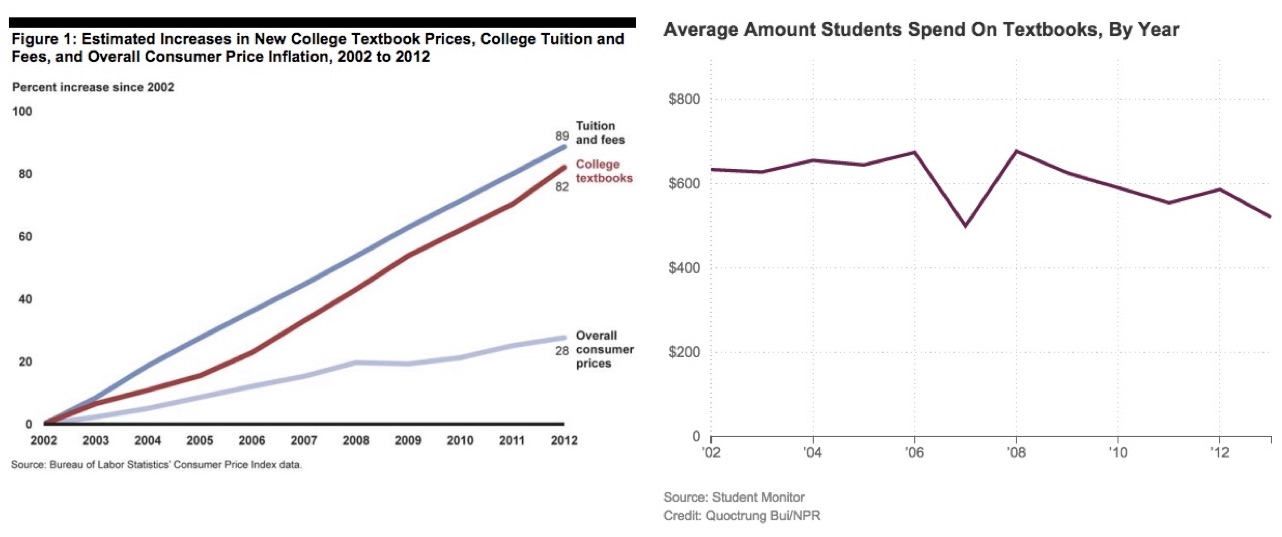
Does this indicate a functioning market, and does this indicate that we don’t have a textbook pricing problem? No, and no. (more…)
-
Postscript on Student Textbook Expenditures: More details on data sources
There has been a fair amount of discussion around my post two days ago about what US postsecondary students actually pay for textbooks.
The shortest answer is that US college students spend an average of $600 per year on textbooks despite rising retail prices.
I would not use College Board as a source on this subject, as they do not collect their own data on textbook pricing or expenditures, and they only use budget estimates.
<wonk> I argued that the two best sources for rising average textbook price are the Bureau of Labor Statistics and the National Association of College Stores (NACS), and when you look at what students actually pay (including rental, non-consumption, etc) the best sources are NACS and Student Monitor. In this post I’ll share more information on the data sources and their methodologies. The purpose is to help people understand what these sources tell us and what they don’t tell us.
College Board and NPSAS
My going-in- argument was that the College Board is not a credible source on what students actually pay:
The College Board is working to help people estimate the total cost of attendance; they are not providing actual source data on textbook costs, nor do they even claim to do so. Reporters and advocates just fail to read the footnotes.
Both the College Board and National Postsecondary Student Aid Study (NPSAS, official data for the National Center for Education Statistics, or NCES) currently use cost of attendance data created by financial aid offices of each institution, using the category “Books and Supplies”. There is no precise guidance from DOE on the definition of this category, and financial aid offices use very idiosyncratic methods for this budget estimate. Some schools like to maximize the amount of financial aid available to students, so there is motivation to keep this category artificially high. (more…)
-
How Much Do College Students Actually Pay For Textbooks?
With all of the talk about the unreasonably high price of college textbooks, the unfulfilled potential of open educational resources (OER), and student difficulty in paying for course materials, it is surprising how little is understood about student textbook expenses. The following two quotes illustrate the most common problem.
Atlantic: “According to a recent College Board report, university students typically spend as much as $1,200 a year total on textbooks.”
US News: “In a survey of more than 2,000 college students in 33 states and 156 different campuses, the U.S. Public Interest Research Group found the average student spends as much as $1,200 each year on textbooks and supplies alone.”
While I am entirely sympathetic to the need and desire to lower textbook and course material prices for students, no one is served well by misleading information, and this information is misleading. Let’s look at the actual sources of data and what that data tells us, focusing on the aggregate measures of changes in average textbook pricing in the US and average student expenditures on textbooks. What the data tells us is that the answer is that students spend on average $600 per year on textbooks, not $1,200.
First, however, let’s address the all-too-common College Board reference. (more…)